Uninsured motorist coverage is your own insurance stepping in to pay medical bills, lost wages, and pain and suffering when the at-fault driver has no insurance, too little insurance, or flees the scene. In 2023, 15.4% of U.S. motorists were uninsured, and the combined uninsured or underinsured share reached 33.4%, so this protection addresses a real risk rather than a remote possibility. Insurance Research Council data summarized by the Insurance Information Institute
You may be reading this after a crash, staring at a damaged vehicle while medical bills arrive and the other driver can't be found. Or you may be reviewing your policy before anything happens and wondering whether the words UM, UIM, and stacking matter. They do. Uninsured motorist coverage isn't a simple yes-or-no checkbox. It's a state-specific, policy-specific tool that can determine whether an injured person recovers meaningful compensation or absorbs the shortfall alone.
The Moment an Uninsured Driver Changes Everything
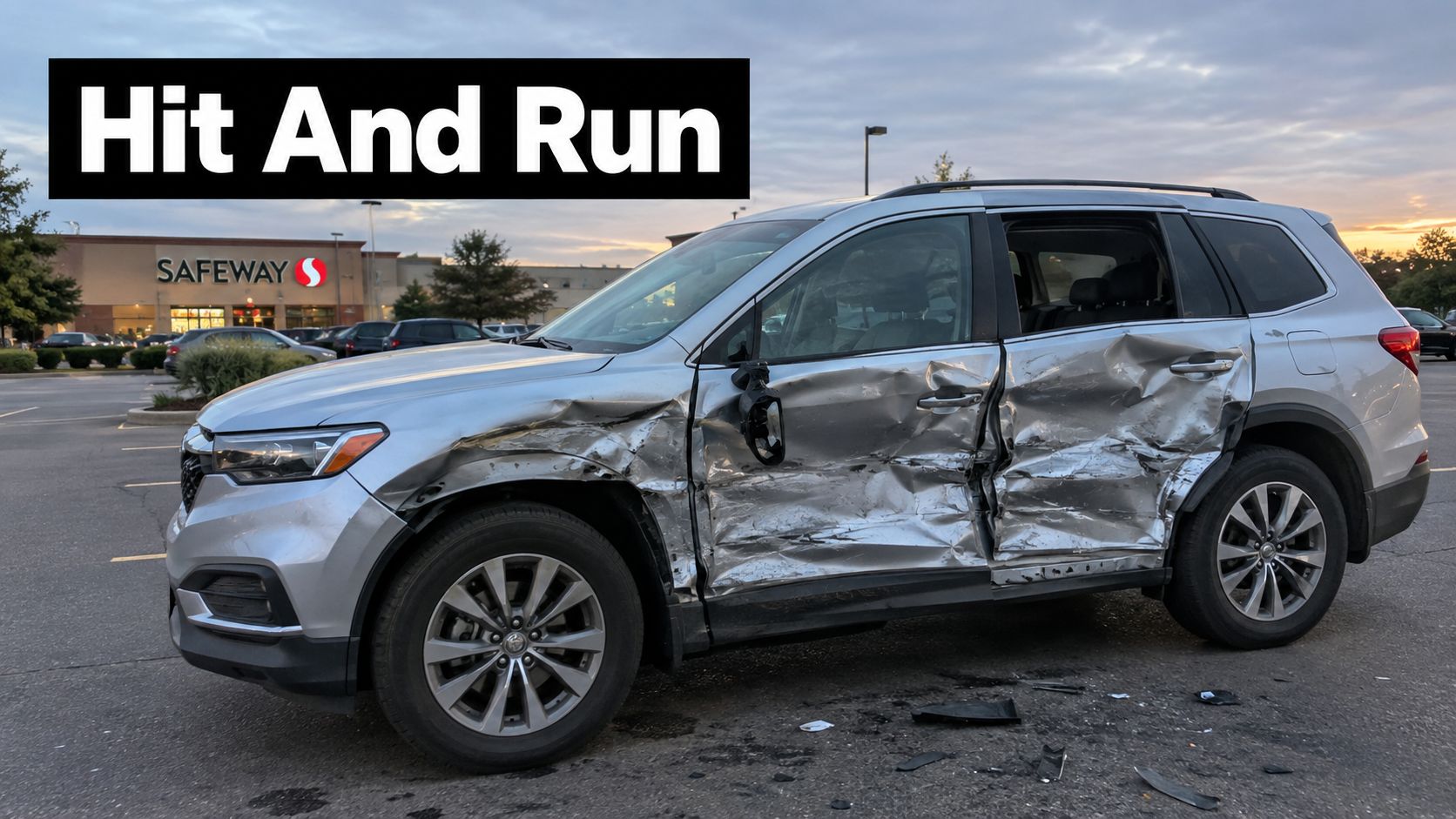
At dusk, a Colorado driver turns out of a Safeway parking lot. A pickup crosses the lane and T-bones the SUV. The impact breaks the driver's wrist, crushes the passenger-side doors and fender, and leaves the SUV looking beyond repair. Before the driver can get the pickup's plate number, it accelerates away.
The responding officer can document the collision, but the report remains limited because no other driver is present. The injured driver is left with a damaged vehicle, treatment decisions, missed work, and one urgent question: what pays now?
The policy you already own may matter first
Uninsured motorist coverage, often shortened to UM, is designed for this kind of problem. It can respond when the at-fault driver has no collectible liability insurance. A qualifying hit-and-run may also trigger bodily injury UM coverage, depending on the policy language and the evidence establishing that an uninsured motor vehicle caused the crash.
The claim goes through the injured person's own auto insurer. That doesn't mean the insurer automatically pays every bill or accepts every description of the injury. The policy still controls the limits, definitions, exclusions, proof requirements, and dispute process.
For the driver in this example, bodily injury coverage may address medical treatment, lost wages, and pain and suffering. Property damage coverage is a separate question. Some policies or state frameworks provide uninsured motorist property damage protection only under specific conditions, such as physical contact and identification requirements.
Why the first hours matter
The driver should seek medical care, report the hit-and-run, preserve photographs, identify witnesses, and notify the insurer promptly. A vague report, delayed treatment, or missing vehicle photographs can give an adjuster room to dispute what happened.
The practical purpose of UM coverage is straightforward: it creates a potential source of recovery when the person who caused the harm can't provide one. The details become clearer once UM and underinsured motorist coverage are separated.
What Uninsured and Underinsured Coverage Actually Mean
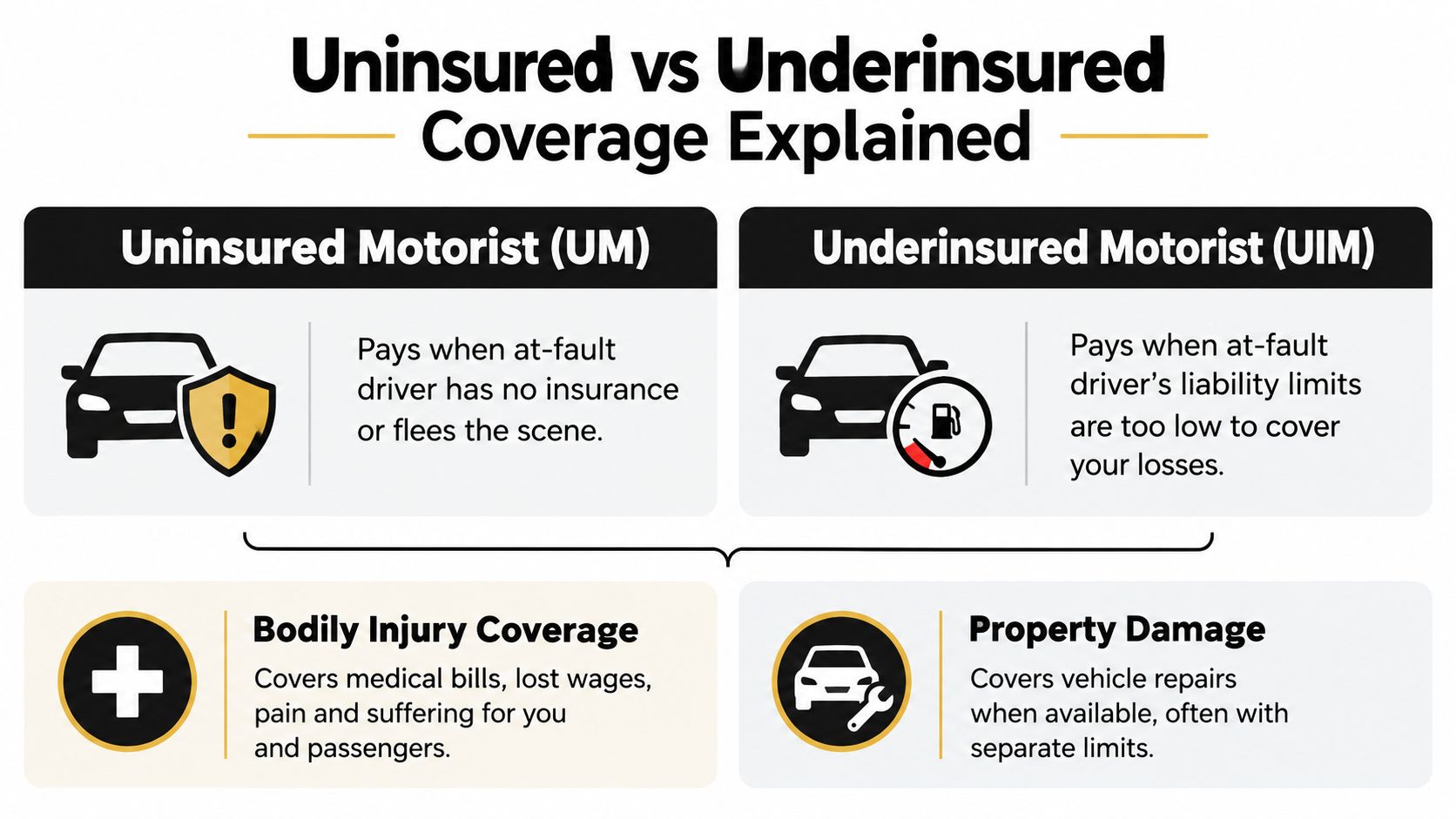
The answer to what is uninsured motorist coverage starts with the word “uninsured.” UM is a first-party auto benefit, meaning you make the claim against your own insurer after another driver causes a covered collision and has no collectible liability coverage. In some jurisdictions and policies, the same protection can apply to a hit-and-run or an insurer that can't pay, but the legal trigger is the absence of collectible liability limits, not the fact that the other driver is unidentified.
Underinsured motorist coverage, or UIM, addresses a different gap. The at-fault driver has liability insurance, but those limits are insufficient to cover the injured person's damages. UIM generally becomes relevant after the available liability limits have been exhausted. A serious injury by itself doesn't activate UIM if the other driver's collectible limits haven't been handled under the policy's requirements.
Think of UM and UIM as a second spare tire. You hope you'll never need it, but the fact that another driver carries insurance doesn't guarantee that the insurance can carry the full weight of a serious injury.
Bodily injury and property damage are different tools
UMBI or UIMBI generally concerns bodily injury losses, including:
- Medical expenses: Treatment, rehabilitation, and related care connected to the collision.
- Lost income: Wages or earning capacity affected by the injury, when supported by evidence.
- Noneconomic harm: Pain, suffering, and the effect of the injury on ordinary life.
Uninsured motorist property damage, often called UMPD, is not automatically interchangeable with bodily injury UM. California illustrates the distinction. Its uninsured motorist property damage coverage is separate, limited to $3,500, and applies only when the uninsured driver is identified, while UM/UIM bodily injury coverage is tied to injury claims. California Department of Insurance guidance
Limits and stacking change the calculation
A declarations page may show limits in a per-person and per-accident format. The per-person amount is the maximum available for one injured person, while the per-accident amount caps the total for covered injured people in one crash. The policy's wording determines how those limits apply.
Stacking can combine available UM or UIM limits from multiple vehicles or policies when the law and policy permit it. Nonstacked coverage treats the available protection differently. Whether coverage follows the person, the vehicle, or both depends on the jurisdiction and policy language. Read the policy, not just the agent's shorthand.
For a general explanation of the distinction, this comparison of underinsured and uninsured motorist coverage can help you identify which gap your policy addresses.
Why This Coverage Exists in the First Place
Compulsory insurance laws create a legal duty to carry liability coverage, but they don't guarantee that every driver complies. The risk also varies sharply from state to state. The Insurance Research Council estimated that uninsured motorist rates in 2023 ranged from 5.7% in Maine to 28.2% in Mississippi, demonstrating why a driver's location and travel patterns matter. The Insurance Information Institute's uninsured motorist overview
The national rate was 15.4% in 2023, the highest point in the IRC's 2017–2023 series, up from 12.4% in 2017. The combined uninsured and underinsured share reached 33.4%, meaning about one in three drivers could create a coverage problem after a collision. Those figures explain why UM/UIM is a market-level safeguard, not merely an optional convenience.
Uninsured drivers by the numbers
| Metric | U.S. Rate | Colorado Rate | Why It Matters |
|---|---|---|---|
| Uninsured motorists in 2023 | 15.4% | A Colorado-specific rate isn't provided in the verified data | A meaningful share of crashes may involve a driver without liability coverage |
| Uninsured or underinsured motorists in 2023 | 33.4% combined | A Colorado-specific rate isn't provided in the verified data | The at-fault driver may have insurance that still can't cover the loss |
| Range among states in 2023 | 5.7% to 28.2% | Colorado falls somewhere within the national state range, but no verified Colorado percentage is provided | Coverage needs can vary with location and travel routes |
Insured drivers collectively bear part of this problem through the insurance system. The IRC reported that insured drivers paid more than $13 billion nationwide in 2016 for uninsured and underinsured motorist coverage, averaging about $78 per insured vehicle. IRC's historical UM/UIM report
That history matters because the uninsured-driver problem has cycled rather than disappeared. Archival rates were 16.3% in 1989, 13.0% in 1998, and 12.3% in 2010, before rising again to 13.0% in 2015 and 15.4% in 2023. UM coverage closes the practical gap between the legal requirement imposed on drivers and the money available after a crash.
How Colorado Handles UM and UIM Coverage
Colorado generally makes the insurer's offer important. Insurers must offer UM/UIM coverage at limits equal to the policyholder's bodily injury liability limits unless the policyholder rejects that coverage in writing. Colorado's legislative explanation of optional automobile coverage describes this equal-limit offer structure. Colorado General Assembly explanation of optional automobile insurance coverage
That rule doesn't mean every Colorado policy has UM/UIM. A written rejection can change the result. It also doesn't answer whether the coverage is stacked, whether it applies to a particular vehicle, or whether a hit-and-run satisfies the policy's proof conditions.
Coverage choices that look similar but aren't
| Rule Area | What Colorado Requires | What It Means for You |
|---|---|---|
| UM/UIM offer | Equal to bodily injury liability limits unless rejected in writing | Your liability limits often provide the starting point for the offer |
| Bodily injury coverage | Offered as UM/UIM bodily injury protection | It can address covered injury losses caused by an uninsured or underinsured driver |
| Property damage coverage | Not mandatory in the same way as bodily injury protection and may be excluded | Damage to your vehicle may require collision coverage or a separate UMPD provision |
| Stacking | Depends on the policy, election, and applicable Colorado rules | Multiple vehicles don't automatically create one larger pool |
| Hit-and-run | Policy terms commonly require physical contact for a qualifying event | Preserve vehicle damage, scene evidence, and the police report |
Stacking requires a policy-level review
Stacking asks whether you can combine UM/UIM limits from more than one insured vehicle or policy. The answer may turn on whether the coverage is stacked or nonstacked, who qualifies as an insured, where the person was occupying a vehicle, and how household policies interact.
Coverage can also follow the person in some circumstances, but that doesn't mean every household vehicle automatically contributes limits. The declarations page, endorsements, rejection forms, and complete policy wording deserve review together. Colorado UM/UIM stacking information from Nares Law Group
Hit-and-run proof is not optional
A hit-and-run claim usually needs more than a statement that another vehicle left. Physical contact may be required, and the claimant must connect that contact to the injury or property damage. Prompt police reporting, photographs, witness accounts, nearby video, vehicle debris, and medical records can help establish the event.
Colorado policies also separate bodily injury UM from property damage protection. A damaged vehicle may have a different deductible, limit, or exclusion than a broken wrist or spinal injury. Ask the insurer to identify the exact coverage part being opened before assuming one benefit covers everything.
How a UM or UIM Claim Works Step by Step
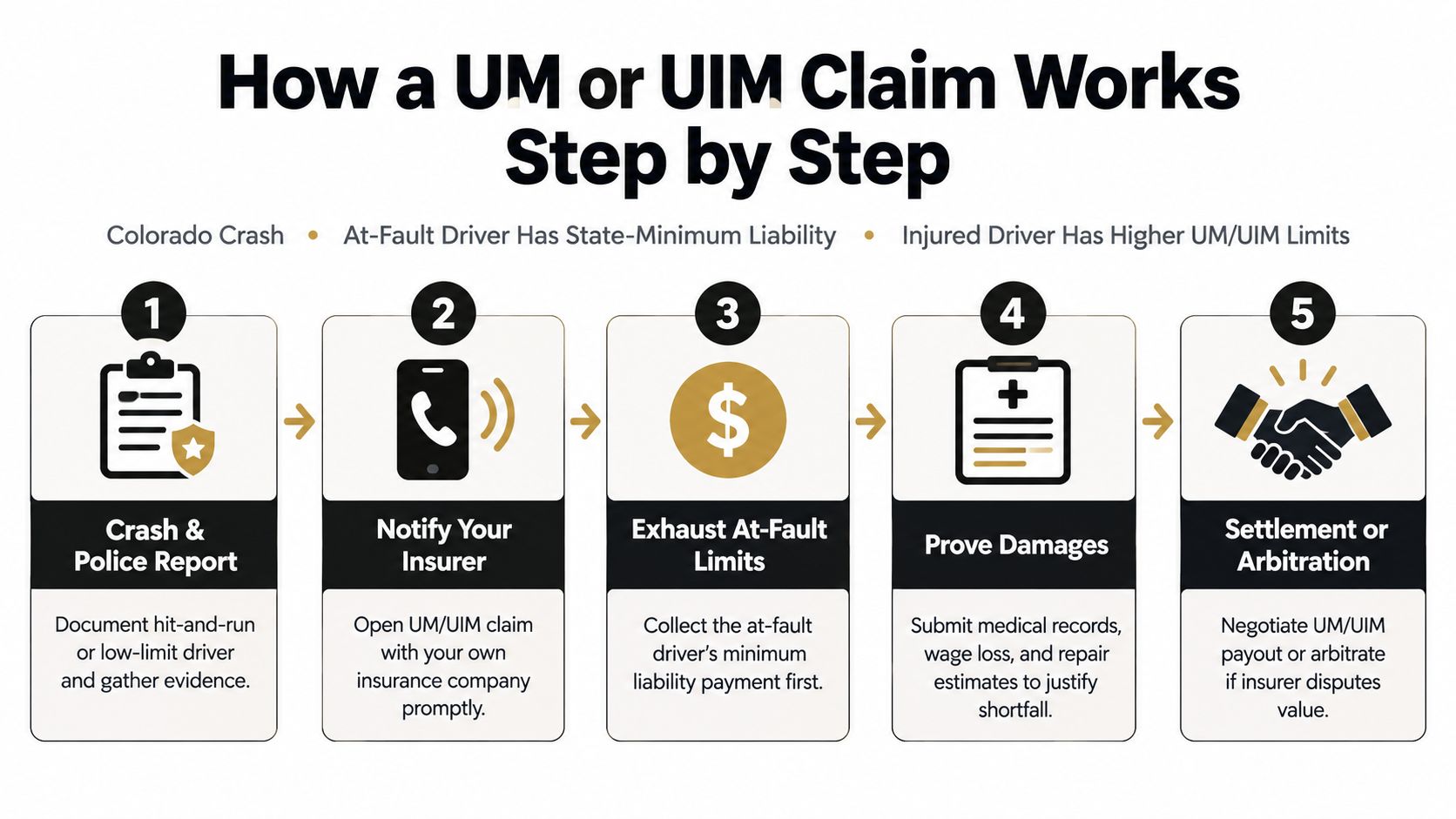
Consider a Colorado crash in which the at-fault driver has only the state-minimum liability coverage and the injured driver has higher UM/UIM limits. The injured driver shouldn't treat the other driver's policy as the whole claim. That policy may be the first payment source, while UIM addresses a covered shortfall after the required steps are completed.
Start with evidence, not settlement
The claim process usually develops in this order:
Get medical care and document the crash. Follow medical instructions, report symptoms accurately, and preserve photographs of the vehicles, roadway, injuries, and visible damage. Call law enforcement for a hit-and-run or suspected uninsured-driver collision.
Notify your insurer promptly. Tell your own carrier that you may have a UM or UIM claim. Provide basic facts, but don't guess about fault, future treatment, or the final value of your injuries.
Identify the other driver's coverage. For a UIM claim, the at-fault driver's liability insurance generally must be addressed first. Many policies also include a consent-to-settle requirement, so obtain the UM/UIM insurer's approval before accepting a liability settlement.
Build the damages file. A useful evidence packet can include the police report, medical records, itemized bills, wage-loss documentation, photographs, witness statements, repair estimates, and the other driver's insurance information.
Negotiate or arbitrate. The insurer may evaluate a demand and negotiate a payment. If the policy includes arbitration and the parties cannot agree, arbitration may determine the disputed amount.
The timeline depends on the injury and the dispute
A minor injury with clear records may resolve without prolonged negotiation. A serious injury can take longer because doctors may need time to determine whether symptoms will resolve, require continuing care, or affect work permanently. No universal timeline applies to every UM/UIM claim.
The insurer may ask for authorizations, recorded statements, examinations, or additional records. Each request should be evaluated against the policy and the claim's needs. Your own insurer still has a financial incentive to value the claim conservatively, even though you purchased the coverage.
Practical rule: Don't sign a release or accept the other driver's limits until you understand how that decision affects your UIM rights.
Missing wage records, inconsistent treatment histories, unsupported future-care claims, and incomplete vehicle documentation routinely create disputes. A demand should connect each loss to evidence and explain why the available liability payment doesn't fully compensate the injury. Colorado UM/UIM settlement guidance from Nares Law Group
Common Myths That Leave Families Underprotected
Myth one, health insurance covers everything
Health insurance can help pay covered medical treatment, but it doesn't replace lost wages, pain and suffering, or other parts of a bodily injury claim. The health insurer may also assert reimbursement or subrogation rights, which can affect the net amount left after a settlement.
Reality: Health coverage addresses medical care. UM/UIM may provide a separate source for covered losses that medical insurance doesn't pay.
Myth two, full coverage means UM/UIM is included
“Full coverage” is informal shorthand, usually referring to liability, and collision coverage and collision coverage. It doesn't tell you the amount of UM/UIM protection, whether you rejected it, or whether your insurer offers stacked limits.
Reality: Open the declarations page and find the actual UM and UIM entries. A policy can protect your vehicle from theft or collision damage while leaving bodily injury protection unclear.
Myth three, stacking happens automatically
Stacking isn't a default assumption. It depends on the coverage election, policy language, vehicle ownership, household relationships, and applicable law. A household with several cars may have several policies but no right to combine their limits in a particular claim.
Myth four, every hit-and-run receives identical treatment
Bodily injury UM and property damage UM can have different triggers. Physical contact may be required for a hit-and-run claim, and the evidence must connect the unidentified vehicle to the collision.
Myth five, higher premiums prove broader protection
Premium cost doesn't reveal whether limits are high, whether coverage is stacked, or whether exclusions apply. The declarations page and endorsements provide more reliable answers than the price of the policy.
Checking Your Own Policy and Knowing When to Call a Lawyer
Start with the declarations page, not the phrase “full coverage.” Locate the UM and UIM bodily injury limits, identify whether the coverage is stacked or nonstacked, and check for separate property damage protection, deductibles, and exclusions. Then look for a written rejection form if the policy shows no UM/UIM coverage.
A practical policy audit
- Compare limits: See whether UM/UIM matches the bodily injury liability limits you purchased.
- Confirm the election: Look for stacking or nonstacking language and any signed selection.
- Review every vehicle: Check whether household cars are insured under one policy or several.
- Check occupants: Determine who qualifies as an insured person under the policy.
- Read hit-and-run terms: Look for physical-contact, reporting, and proof requirements.
- Save the full documents: Keep the declarations page, policy booklet, endorsements, and renewal materials together.
The choice between lower and higher limits should reflect the financial consequences of a serious injury, not just the monthly premium. A person with substantial income, dependents, or assets may have more exposure if the UM/UIM limit is low or absent. The verified Colorado rule establishes the offer framework, but your signed selections and policy terms determine what protection you bought.
You may be able to handle a clear, minor-injury claim when the insurer cooperates and the records are straightforward. Consider legal help when fault is disputed, injuries are severe, several vehicles are involved, a commercial defendant appears, the insurer denies or undervalues the claim, or a deadline is approaching.
A Colorado personal injury lawyer can review the policy, organize medical and wage evidence, negotiate with your own carrier, and pursue litigation or available remedies if the insurer improperly refuses coverage. Nares Law Group LLC is one Colorado firm that reviews UM/UIM policies and helps injured people document and pursue coverage disputes.
Frequently Asked Questions About Uninsured Motorist Coverage
How quickly should I report a hit-and-run?
Report it to police as soon as possible and notify your insurer promptly under the policy's notice provision. Some policies and claims practices expect a police report within 24 hours, but the controlling requirement is the specific policy language and circumstances. Preserve photographs, witness information, video, and vehicle evidence immediately.
Can UM/UIM stack across household vehicles?
It may, but stacking isn't automatic. The answer depends on the policy election, applicable law, who qualifies as an insured, and whether the vehicles or policies can be combined. Ask for a written explanation based on the declarations page and endorsements.
Can UM pay while health insurance or other benefits pay medical bills?
Potentially. Health insurance, medical-payments coverage, and UM/UIM can coordinate, but reimbursement and subrogation rights may affect the final recovery. Keep every bill, explanation of benefits, lien notice, and payment record.
What happens if my insurer denies the claim?
Request the denial and policy basis in writing. You may pursue the insurer's internal review process, contact the Colorado Division of Insurance, or consult counsel about contract and bad-faith remedies. Don't let an appeal or negotiation delay attention to the applicable claim deadline.
Nares Law Group LLC helps Colorado crash victims review UM/UIM policies, document medical and income losses, and address denied or undervalued claims. Visit Nares Law Group LLC to request a consultation and discuss what your policy may cover before accepting an insurance settlement.