You slipped near a grocery store's entrance, reported the fall, and started dealing with medical appointments. Then the store's insurer contacts you, and a lawyer begins asking about your shoes, your reason for entering, and exactly where the water came from. Those questions can feel unrelated to your injury. They're usually aimed at identifying who controlled the hazard and who knew, or should have known, about it.
A premises liability defense attorney represents the property-side defendant, not the injured person. Understanding that lawyer's work helps claimants recognize what they'll need to prove, where a defense may succeed, and when the evidence contradicts it.
What a Premises Liability Defense Attorney Does
Say a shopper slips on a wet grocery entryway and files a claim. The store's insurer assigns defense counsel, who must reconstruct the scene after customers have moved on and employees have cleaned the floor. Think of it as rebuilding a room from photographs, records, and separate recollections, rather than accepting anyone's finished picture.
The attorney starts with the complaint: What condition allegedly caused the fall? Who's been sued? What injuries and losses does the shopper connect to the incident? Counsel then identifies the facts needed to answer those allegations.
From allegations to evidence
The early work usually includes:
- Preservation demands: Protect surveillance footage, inspection records, maintenance communications, and relevant electronic messages from routine deletion.
- Employee interviews: Identify who inspected the entrance, received complaints, placed mats, or responded after the fall.
- Expert review: Consider whether engineering, medical, or accident reconstruction analysis would resolve a disputed issue.
- Claim valuation: Compare liability evidence with medical causation, documented losses, and the uncertainty of litigation.
This is an established area of civil practice. In its historical study of state tort cases disposed of in the nation's largest counties during the period ending in 1992, the Bureau of Justice Statistics reported that premises liability represented 17% of tort cases, compared with 60% for automobile cases, and that most tort cases settled before trial.
Those historical findings aren't a current forecast, but they help explain why defense practice involves much more than courtroom argument. Counsel needs a reliable factual account before recommending negotiation, further investigation, or a contested hearing.
Practical rule: A defense attorney's first useful task is to learn what happened, not to produce the strongest-sounding denial.
For the injured shopper, that distinction matters. A claim supported by preserved footage and contemporaneous records requires a different response from one supported only by conflicting memories.
Common Defenses and When They Work
Most premises defenses challenge duty, breach, notice, or causation. The following comparison is a map of possible arguments, not a promise that every jurisdiction recognizes each defense in the same way.
Common premises liability defenses
| Defense | What It Argues | Evidence It Needs | Where It Weakens |
|---|---|---|---|
| No notice | The defendant didn't know, and reasonable inspection wouldn't have found the hazard | Inspection logs, cleaning schedules, prior complaints | Gaps in inspections or earlier complaints about the same spot |
| Visitor status | The claimant occupied a category owed a narrower duty | Entry records, signage, stated purpose | Evidence of a business invitation |
| Lack of control | Another party controlled the relevant area or condition | Leases, service contracts, work orders | Actual possession or legal responsibility contradicts contract labels |
| Open and obvious | The condition was visible and avoidable | Scene photographs, lighting evidence, video | Poor visibility, transparent moisture, or foreseeable distractions |
| Comparative fault | The claimant's conduct contributed to the incident | Witness accounts, footwear, video | Conduct wasn't causally connected or allocation rules restrict the argument |
| Alternative causation | Something else caused the claimed injury | Relevant medical records, imaging, treatment history | No supporting alternative explanation or clear evidence of new harm |
| Unforeseeable condition | The hazard arose too suddenly for reasonable detection | Inspection timing, weather information, incident history | Recurring problems or advance warnings |
What turns an argument into a defense
No notice requires a credible timeline. Counsel should examine whether inspection entries describe an actual inspection of the location, rather than a signature on a general checklist.
Visitor status requires evidence about permission and purpose. A restricted-area sign helps only if its placement and the claimant's route support the asserted restriction.
Lack of control requires more than naming a contractor. Counsel needs to determine who could inspect, repair, close, or warn about the affected area.
Open and obvious arguments require an honest reconstruction of visibility. A close-up photograph taken under bright lighting doesn't necessarily show what an approaching visitor could see.
Comparative fault requires a connection between conduct and injury. Phone possession alone proves little; footage showing where the claimant was looking may matter more. Our explanation of Colorado comparative negligence addresses why the applicable allocation rules also matter.
Alternative causation requires medical reasoning, not an assumption that an older diagnosis explains every new symptom. Counsel must distinguish a preexisting condition from a new injury or aggravation.
Unforeseeability requires examining patterns. A sudden spill differs from a recurring leak that staff repeatedly cleaned without addressing its source.
These arguments can combine, but they shouldn't contradict the evidence. A defense supported by specific records is stronger than one that relies on employees remembering an ordinary shift long afterward.
How Visitor Status and Notice Decide the Case
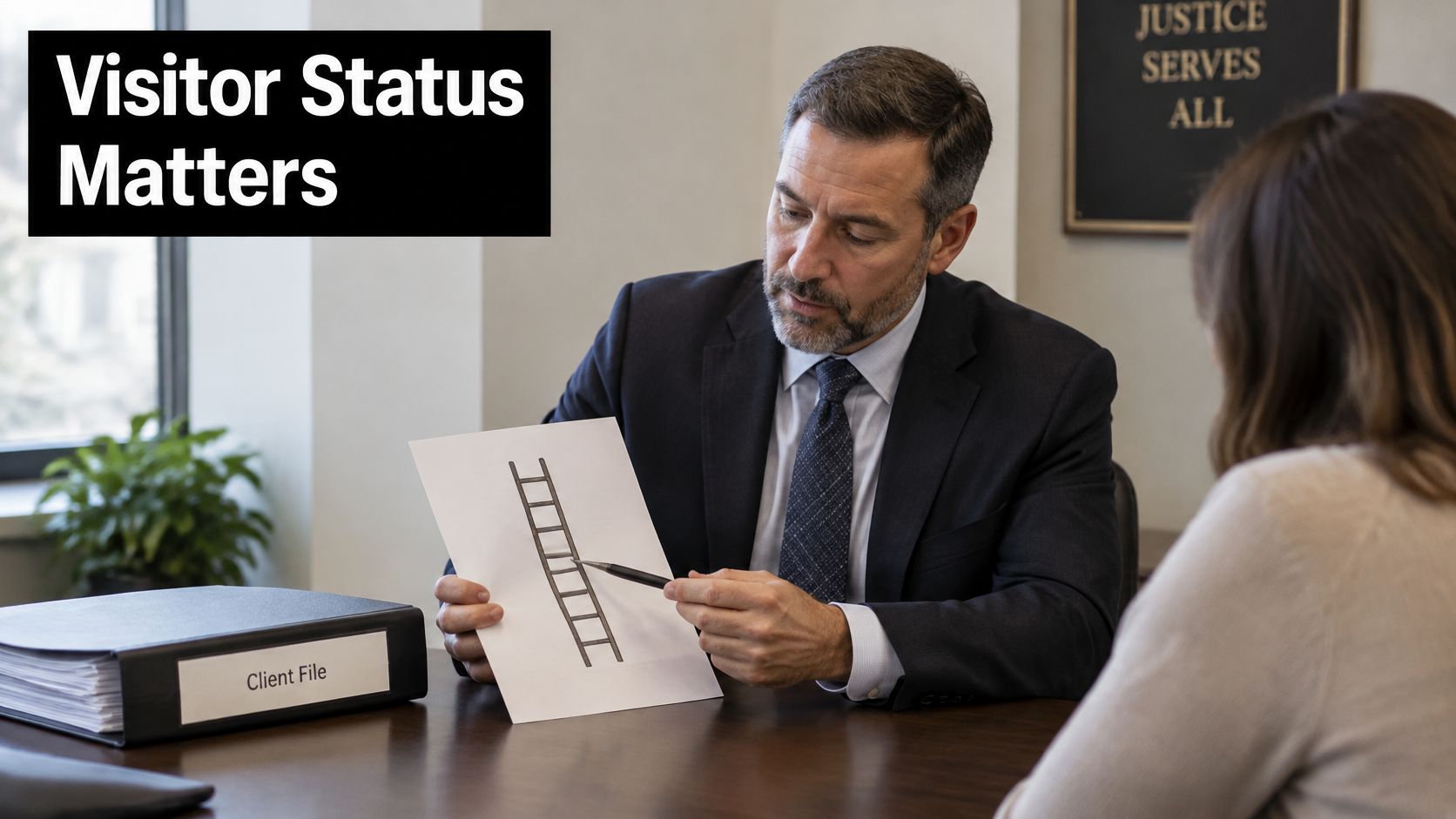
Colorado's visitor categories work like a ladder of protection. The injured person's relationship to the property determines which duties apply, so counsel must establish the correct rung before evaluating whether the defendant met its obligations.
Under the Colorado Judicial Branch's premises liability instructions, a trespasser generally may recover for harm willfully or deliberately caused by the landowner; a licensee's protection focuses on known dangers and specified warning obligations; an invitee receives reasonable care against dangers the landowner knew or should have known about.
Duty owed by visitor status
| Visitor status | Duty owed | What the plaintiff must show | Defense test |
|---|---|---|---|
| Trespasser | Recovery generally limited to willful or deliberate harm | Willful or deliberate conduct by the landowner | Examine authorization and any implied invitation |
| Licensee | Reasonable care concerning actually known dangers, with specified warnings for non-ordinary dangers | Actual knowledge and the applicable unreasonable failure to exercise care or warn | Test knowledge, creation of the condition, and warnings |
| Invitee | Reasonable care against dangers known or reasonably discoverable | Knowledge or constructive knowledge and failure to exercise reasonable care | Examine duration, inspection quality, and the condition's source |
Actual knowledge versus an opportunity to discover
Actual notice can come from a customer complaint, an employee's observation, or a maintenance message. Counsel should identify who received the information and what it described. A complaint about a loose entrance mat isn't automatically notice of an unrelated spill elsewhere.
Constructive notice concerns what the defendant should have discovered through reasonable care. In a hypothetical cooler-leak case, a puddle appearing shortly before the fall presents a different inspection question from one visible throughout a substantial portion of a shift. Neither situation creates an automatic result; the leak's history, location, and detectability still matter.
A clean inspection log is useful only if the inspection could reasonably have detected the condition being disputed.
For a claimant, proof that an employee passed the area may help establish opportunity, but it doesn't necessarily establish observation. For the defense, uncertainty about when a spill formed isn't permission to ignore evidence that the equipment had repeatedly leaked.
The workable sequence is classify the visitor, identify who created the condition, and test notice. Skipping any part can produce a confident argument built on the wrong legal duty.
How Defense Teams Test the Hazard Itself
Witnesses may agree that someone fell while disagreeing about why. Physical examination helps separate a plausible mechanism from a guess. NIST's discussion of walkway friction explains the coefficient of friction as the horizontal force needed to slide surfaces against one another divided by the force pressing them together.
That relationship is useful, but a measurement isn't a verdict. The examiner must explain how the tested conditions relate to the incident.
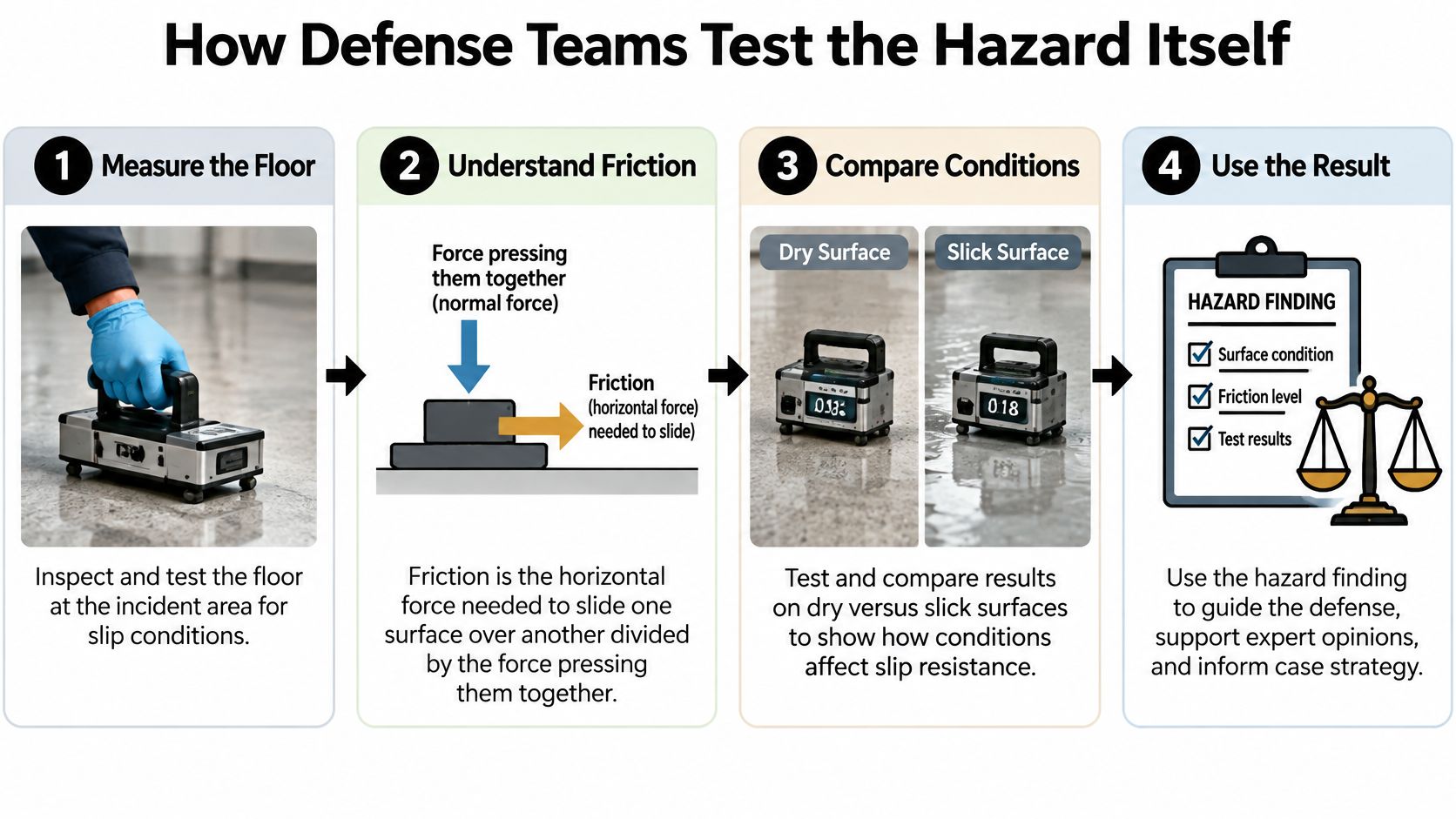
A defensible examination process
Secure and document the scene. Photograph the flooring, contaminants, footwear, and surrounding area before conditions change, where safely possible. Protect people from the hazard promptly rather than leaving it exposed merely to preserve evidence.
Collect the incident records. Obtain surveillance in its usable original format, incident reports, and cleaning logs. Preserve the surrounding footage too, because it may show the condition developing or an employee inspecting the area.
Record environmental conditions. Document lighting, moisture, weather, slope, and mat placement. These details help explain both the fall mechanism and whether an inspection could have revealed the problem.
Choose a qualified examiner. Have the examiner select and explain a validated testing protocol suited to the surface and question. An improvised demonstration doesn't become reliable because someone records it.
Match the incident conditions. Account for footwear, contaminants, cleaning products, and surface changes. Testing a clean, dry replacement tile may not answer a question about the original wet floor.
Explain uncertainty and limits. The report should identify assumptions, measurement uncertainty, and what the testing cannot establish. Counsel shouldn't present a friction reading as proof of when the defendant learned about a hazard.
Our guide to investigating a premises liability case provides context for coordinating scene evidence with witness and documentary evidence. We also have access to medical and accident reconstruction experts who can testify about an injury's cause and impact.
For shared residential spaces, Towne and Country Property Management's HOA common area maintenance strategies provide useful operational context when reviewing maintenance responsibilities. Such resources don't establish the legal standard by themselves.
Claimant-side counsel can use the same technical tools to challenge mismatched testing conditions. A scientifically careful defense must acknowledge unfavorable results as well as favorable ones.
Who Is Responsible When Several Parties Share Control
A shopper falls in a shopping-center corridor outside a restaurant. The center owner maintains common areas, a cleaning company services the corridor, and restaurant employees move containers through it. Naming the building's owner doesn't resolve who was responsible for the particular condition.
Zurich North America's discussion of premises risks emphasizes why duties, control, and jurisdiction need separate attention. Counsel should trace responsibility through both agreements and actual conduct.
Follow the records, then the conduct
- Leases may assign corridor maintenance to the owner while requiring tenants to address spills from their operations.
- Service contracts identify cleaning duties, reporting procedures, and the areas covered.
- Work orders and inspection logs show whether anyone acted on those assignments.
- Incident reports and employee training records help establish who was expected to respond when a hazard appeared.
- Surveillance and communications can reveal a different working arrangement from the one described on paper.
Suppose footage shows a restaurant employee dropping liquid, while messages show the property manager received a warning and postponed cleanup. That evidence can support investigating responsibility beyond the person who caused the spill. Conversely, a contractor's presence somewhere in the center doesn't establish control over every corridor.
Preservation demands should reach the parties that hold the relevant records, not just the owner. Counsel also needs to examine whether a third party's conduct should become part of the fault analysis rather than treating every additional business as an automatic defendant.
Control question: Who had the authority and practical ability to prevent, discover, repair, or warn about this condition?
Colorado's broad landowner framework can encompass agents, people in possession, and those legally responsible for property conditions or activities. A contract calling someone an independent contractor doesn't, by itself, settle the injured person's claim.
Responsibility and collection are separate questions, too. Our explanation of joint and several liability addresses an issue that can arise when multiple parties bear responsibility.
The same shopping-center incident can produce different results in Colorado, Texas, or New York. Statutes, case law, notice requirements, and comparative-fault doctrines must be evaluated locally rather than imported from another state.
How Defense Strategy Affects the Injured Claimant
A defense strategy changes which facts an injured person must develop and which losses remain disputed. An early challenge to visitor classification can narrow the legal obligation at issue, making evidence about permission and purpose important before settlement discussions become productive.
A fault argument shifts attention toward the claimant's behavior. Counsel may examine the walking route, whether a warning was visible, and whether footwear or distraction contributed. An allegation of carelessness isn't the same as proof, and any effect on recovery must follow the governing jurisdiction's rules.
Where recovery becomes contested
Medical causation disputes can change the claim's value even when responsibility for the fall is clear. The defense may accept that an incident occurred while disputing whether it caused a later procedure, lasting limitation, or inability to work.
The claimant's response should be an accurate medical timeline, not concealment of earlier symptoms. Relevant records can help distinguish baseline health, new symptoms, and aggravation.
- Status challenges make invitations, appointments, receipts, and access permissions relevant.
- Notice disputes make the hazard's history and witness observations important.
- Damages disputes make treatment records, employment documentation, and functional limitations central.
Insurers may develop an early settlement estimate before the claimant's long-term condition is clear. That estimate can change when additional records reveal stronger liability evidence, a different diagnosis, or a more reliable account of future needs.
Expect questions, requests for medical authorizations, and possibly a request for a recorded statement. Understand the scope of what you're being asked to provide before agreeing, and get advice about requests that seem broader than the disputed injuries.
A disagreement about missing video also deserves attention. The practical question isn't whether footage exists, but who held it, what it showed, and what preservation steps were taken.
What Property Owners and Insurers Should Expect
Fewer claims don't necessarily mean less financial exposure. The Verisk year-end claims analysis reports commercial property claims declining from approximately 0.91 million in 2023 to 0.71 million in 2025, while describing continued casualty-market pressure, including Q2 2025 general-liability pricing increases of 5.3% and umbrella and excess increases of 9.3%.
Commercial property claim counts and liability pricing measure different things. They shouldn't be treated as a premises injury frequency study or proof that fewer visitors are getting hurt.
The practical concern is severity concentration. A catastrophic brain injury, spinal injury, fatality, or serious negligent-security allegation can create substantial exposure despite an otherwise favorable incident history. Claims involving children or vulnerable visitors may also require careful assessment of long-term needs.
Coordinate defense and coverage early
Owners and insurers should address distinct tasks rather than assuming the assigned defense lawyer will resolve every insurance question.
- Assess liability promptly. Identify the strongest unfavorable evidence alongside the available defenses.
- Tender to potentially applicable insurers. Review the policies and contracts connected to each involved party.
- Check additional-insured status. Obtain the relevant policy language rather than relying only on a certificate.
- Review reservation-of-rights letters. Identify which coverage issues remain unresolved and whether separate advice is needed.
- Track limits and aggregates. Determine how other claims, defense costs, and policy wording could affect available protection.
- Preserve evidence across organizations. Coordinate with managers, vendors, and tenants before routine systems overwrite records.
For residential operations, Overton Security's residential property risk management frameworks offer context for organizing prevention and security responsibilities. Operational planning is valuable, but it doesn't replace analysis of the actual policy or the duty owed in a particular case.
A business's insurance tower is the sequence of potentially applicable primary and excess coverage. A severe claim can raise questions across those layers, including notice, attachment, and settlement coordination.
Documentation quality and venue can matter more than a low incident count. Owners should expect counsel to explain both the defensible facts and the unresolved risks, not just reassure them that serious claims are unusual.
What Injured Claimants Should Do to Protect Their Case
Protecting a claim starts with protecting your health. Get appropriate medical attention, then preserve what you safely can without entering a dangerous area or delaying treatment. The most useful records describe what happened before anyone knew which details would become disputed.
Immediately after the incident
- Photograph the actual condition. Capture the hazard, the surrounding approach, warnings, mats, and lighting before cleanup if you can do so safely.
- Record the circumstances. Write down the time, your destination, what you were doing, and the shoes you wore. Separate what you observed from what someone later told you.
- Identify witnesses. Get names and contact details, including anyone who saw the condition before the fall.
- Report the event. Tell the manager and request an incident report in writing. If a copy isn't provided, retain your request.
- Keep physical evidence. Store your shoes and clothing without altering or discarding them.
- Request preservation. Ask in writing that relevant surveillance and incident-related records be retained, identifying the location and approximate time.
You don't need to diagnose the defect or decide who's legally responsible at the scene. An accurate description of visible water, a shifted mat, or a broken step is more useful than a confident technical conclusion you can't support.
During treatment and recovery
- Attend follow-ups. Keep appointment records and explain any barriers to treatment rather than leaving unexplained gaps.
- Document earnings losses. Save pay stubs, missed-work information, and employer correspondence.
- Keep a concise symptom diary. Note specific limits, such as difficulty climbing stairs or concentrating, without exaggeration.
- Get advice before recorded statements. Understand the purpose and scope of the property insurer's request before participating.
- Preserve original files. Retain photographs, messages, and documents in their original form, not only edited screenshots.
Your records should remain truthful even when a fact seems unfavorable. A consistent account that acknowledges uncertainty is more useful than an account adjusted to defeat an anticipated defense.
During our investigation, we collect medical records, accident reports, witness statements, and expert opinions to establish liability and damages. That work connects the incident evidence to the injury evidence so the claim doesn't depend on either in isolation.
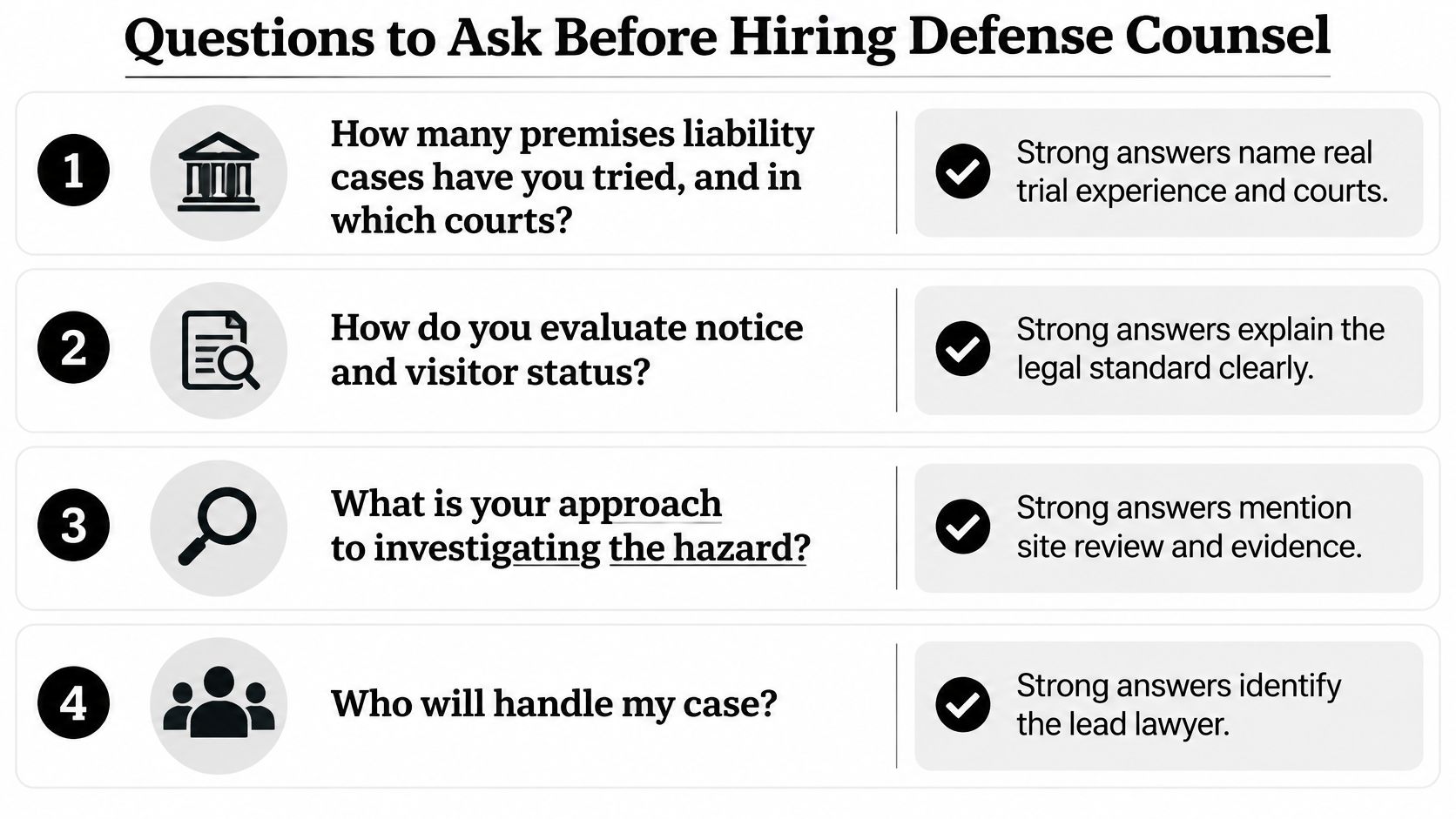
Questions to Ask Before Hiring Defense Counsel
Property owners need defense counsel who can explain an evidence plan, not just recite defenses. Injured people need claimant-side representation and should confirm that distinction before discussing confidential details.
Evaluate the proposed working relationship
How many premises liability cases have you tried, and in which courts? A strong answer identifies actual trial experience, relevant counties, and outcomes without suggesting that past results guarantee yours.
Who will handle the file day to day? Look for a named lawyer, clear responsibilities, and an explanation of supervision.
What will you preserve at the outset? The answer should identify video, maintenance logs, communications, and contractor agreements specific to the incident.
Which experts would you consider? Counsel should explain the roles of friction testing, medical causation, reconstruction, and damages specialists, including when an expert isn't necessary.
How will you value the claim, and what would change that estimate? Expect reasoning tied to disputed facts, injury evidence, and litigation uncertainty.
How will you coordinate with insurers? A useful answer distinguishes defense work from coverage advice and explains how reservation-of-rights issues will be addressed.
How will reporting and fees work? Request the reporting schedule, billing terms, staffing expectations, and expense responsibilities in writing.
Search visibility isn't a substitute for evaluating those answers. CitationOS's discussion of law firm SEO and AI citations provides context for how law firms appear online, not evidence of courtroom skill.
For injured people evaluating our firm, our free consultation gives you an opportunity to ask a personal injury attorney questions about putting together a case and pursuing the compensation you deserve. We represent claimants in this context, not the property owner's insurer.
Nares Law Group LLC helps injured people investigate Colorado premises liability claims, establish responsibility, and pursue compensation for their losses. Visit Nares Law Group LLC to request a free consultation, and bring your incident report, photographs, and insurer correspondence so we can discuss the evidence and your next steps.