You're standing at an intersection after a crash, exchanging insurance information while trying to remember whether the light was changing, how fast the other driver was moving, and what you said in the few minutes afterward. Later, the adjuster suggests you may share responsibility. That suggestion can affect far more than the tone of the claim. Under Colorado comparative negligence, a small change in the assigned fault percentage can reduce your payment substantially, or eliminate recovery altogether.
Understanding How Fault Affects Your Recovery
Consider a collision involving two drivers. One driver turns left across traffic, while the other approaches too quickly and reacts late. Both may have contributed. The injured driver might expect the other motorist's conduct to control the claim, but Colorado asks a more precise question: how much negligence belongs to each person?
Colorado adopted its comparative-negligence system in 1971, replacing the harsher common-law contributory-negligence rule for covered tort claims. The rule appears in Colorado Revised Statutes § 13-21-111. A claimant's own negligence doesn't automatically destroy the claim. Recovery remains possible when the claimant's negligence is less than the negligence of the opposing party.
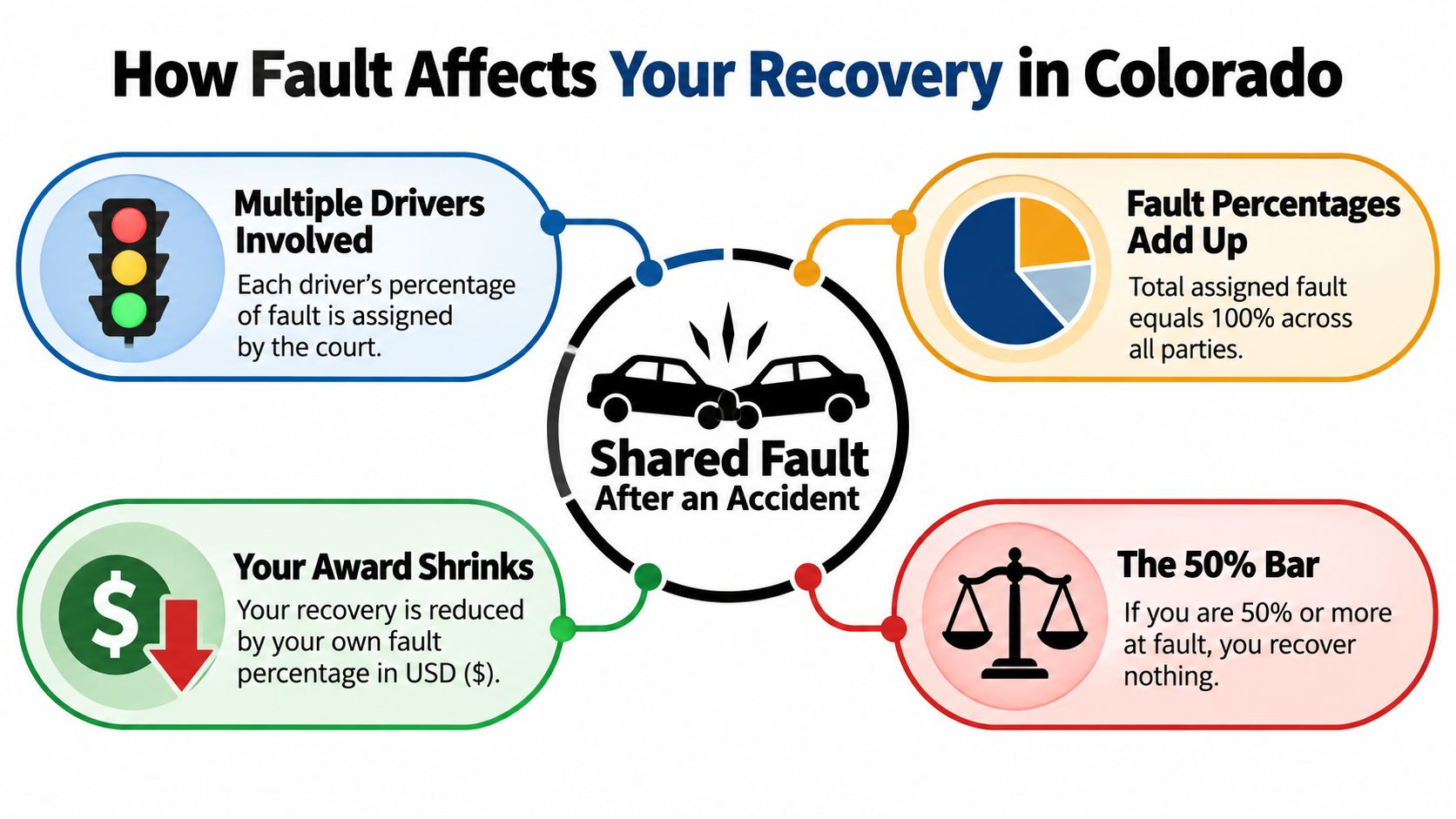
The percentage matters twice
The first effect is eligibility. A claimant assigned 49% fault may still recover, while a claimant assigned 50% fault cannot recover under the statutory threshold because the claimant's negligence is no longer less than the opposing party's negligence. The second effect is the amount. If recovery remains available, the court reduces damages in direct proportion to the claimant's fault.
For example, a claimant with $100,000 in total damages and 20% assigned negligence would have a mathematically reduced award of $80,000, assuming no other legal limitation applies. That's why Colorado comparative negligence is not a technical footnote. Evidence about speed, lookout, warnings, driving behavior, medical proof, and causation can change both whether a claimant recovers and how much remains after the reduction.
Practical rule: Don't treat an adjuster's fault estimate as a final finding. It's an argument about the evidence, and it can be challenged.
The same framework affects motor-vehicle, trucking, premises-liability, and wrongful-death claims. If you're evaluating the larger picture, the Colorado personal injury laws provide useful context, but the fault analysis must still be built around the facts of your particular incident.
The Math Behind Damage Reduction
Colorado's statutory calculation has two distinct stages. The court or jury first determines the full damages amount that would apply if the injured person had no contributory negligence. It then assigns negligence percentages to the parties and reduces the claimant's award according to the claimant's percentage.
Stage one determines the full loss
Suppose a jury finds that the claimant's total damages equal $250,000. That figure represents the amount the fact finder believes would be recoverable without claimant negligence. It can reflect the legally supported value of the injury and its consequences, not merely the amount an insurer initially offers.
Stage two applies the fault percentage
The jury then assigns 30% fault to the claimant and 70% to the defendant. The claimant's recovery is reduced by the claimant's share, leaving $175,000 before other applicable adjustments. The arithmetic is direct:
- Full damages: $250,000
- Claimant's assigned fault: 30%
- Reduction: $75,000
- Recoverable amount: $175,000
Those figures come from the statutory example described in Colorado's comparative-negligence statute. The important procedural point is that the fact finder states the full damages figure and the fault percentages separately before applying the reduction.
A different allocation creates a different result even though the injury evidence stays the same. At 49% claimant fault, the same $250,000 damages finding becomes $127,500. At 50% fault, the claimant no longer satisfies the statutory requirement that their negligence be less than the opposing party's negligence, so judgment goes to the defendant.
The cleanest way to evaluate an offer is to test both numbers independently: what are the damages, and what evidence supports the proposed fault allocation?
This is why a settlement review should show the underlying assumptions rather than present one unexplained figure. A resource on how to calculate a personal injury settlement can help organize that review, but an attorney still needs to test causation, liability evidence, insurance coverage, and any other legal limitations.
Why the 50 Percent Line Changes Everything
Colorado's threshold creates a financial cliff. A claimant assigned 49% fault can recover, subject to the proportional reduction. A claimant assigned 50% fault cannot recover under C.R.S. § 13-21-111. The difference between those findings is only one percentage point, but the legal result changes from a reduced award to no recovery.
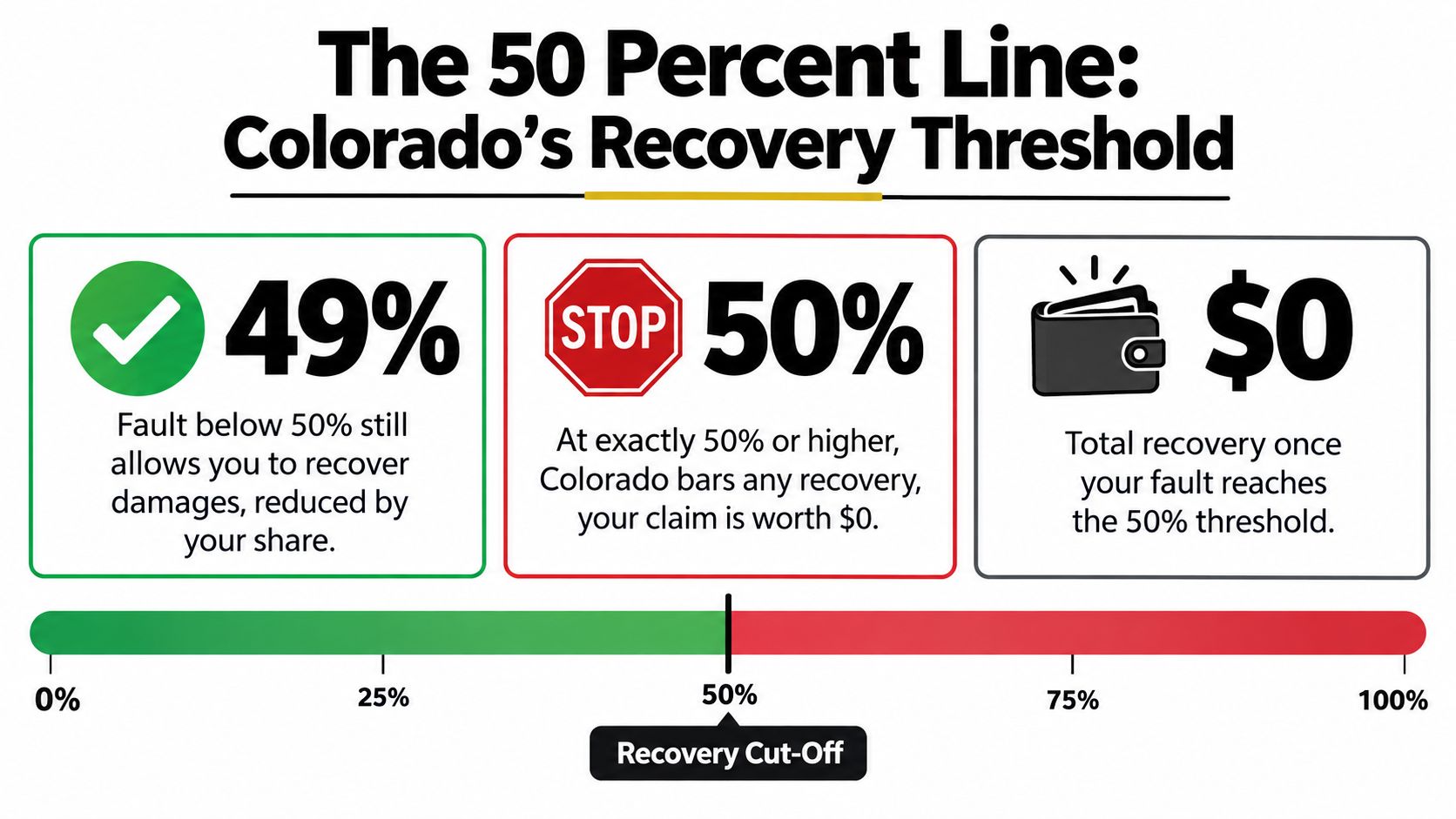
The threshold also matters well before trial. On a $200,000 damages finding, 20% claimant negligence produces a $160,000 judgment, before other applicable adjustments. If the claimant's assigned fault shifts to 35%, the same damages finding produces $130,000, a $30,000 difference. The underlying injury hasn't changed. The allocation has.
Why insurers focus on claimant conduct
Insurance adjusters understand this arithmetic. They may focus on evidence suggesting excessive speed, poor visibility, delayed reaction, inadequate following distance, seat-belt use, or another specific act by the claimant. That doesn't mean the allegation is correct. It means the allegation has financial significance.
A claimant's statement that they “may have been going a little fast” can be interpreted differently from verified vehicle data, witness testimony, or scene evidence. The same is true of a disputed traffic signal or a disagreement about whether a driver had enough time to react.
The Colorado comparative-negligence rule requires the fact finder to determine full damages and each party's negligence percentage. Liability evidence therefore affects the claim at two levels, first by influencing whether the threshold is met, and then by determining how much the award is reduced.
Near the cutoff, careful reconstruction matters. Visibility, reaction time, vehicle positions, and medical causation can separate a recoverable claim from a barred one. That's why preserving evidence early is not paperwork for its own sake. It protects the percentage that may determine the entire outcome.
How Different Claim Types Are Affected
Comparative negligence uses the same basic framework across injury cases, but the evidence changes sharply by claim type. A straightforward collision may turn on traffic controls and vehicle movement. A trucking case can involve a carrier, employer, maintenance provider, or another driver, each with a different role in the allocation.
Motor-vehicle claims
In a car crash, the dispute often centers on driving conduct. Investigators may examine speed, lane position, right of way, visibility, reaction time, and whether either driver had a reasonable opportunity to avoid the impact. A claimant's conduct matters, but so does the opposing driver's failure to take reasonable care.
Commercial trucking collisions
Trucking cases require a wider evidence net. The potentially responsible parties may include the driver, commercial carrier, employer, maintenance provider, or another actor connected to the vehicle or route. Missing one responsible participant can affect the percentage allocation and the amount that can be collected.
Traumatic brain injuries
A traumatic brain injury often creates a separate causation dispute. The defense may challenge whether the collision caused the symptoms, whether an earlier condition contributed, or whether later events explain the claimant's limitations. Medical records, treating-provider opinions, diagnostic evidence, and the timing of symptoms can influence both injury valuation and fault arguments.
Wrongful-death claims
Wrongful-death cases carry the same comparative-fault structure even though the human stakes are different. The parties may dispute the decedent's conduct, the conduct of one or more defendants, and the damages claimed by surviving family members. Emotional weight doesn't replace proof. The verdict still requires a damages determination and fault allocation.
Colorado's allocation statute generally limits each defendant's ordinary liability to that defendant's percentage of fault, subject to statutory exceptions. Under the example in C.R.S. § 13-21-111.5, a $500,000 verdict with the claimant 10% at fault, Defendant A 60%, and Defendant B 30% produces an adjusted recovery of $450,000, with ordinary allocations of $270,000 to A and $135,000 to B, subject to exceptions and enforceability rules.
Building Evidence to Protect Your Claim
Fault percentages follow the quality of the evidence. A persuasive claim doesn't merely say the other driver caused the crash. It connects conduct to physical facts, witness accounts, vehicle damage, and medical proof.

Start with the scene. Preserve photographs of vehicle damage, traffic signals, lane markings, road conditions, debris, skid marks, and surrounding visibility. Save dashcam footage and identify surveillance cameras near the intersection. A recording can answer questions that a later reconstruction cannot.
Evidence that moves the percentage
- Witness information: Get names and contact details for people who saw the collision or the moments immediately before it.
- Crash reconstruction: In a disputed case, a qualified reconstruction professional may analyze vehicle positions, impact evidence, visibility, reaction time, and movement.
- Medical causation records: Tell providers how the injury happened and describe symptoms accurately. Consistent documentation helps connect the event to the claimed harm.
- Vehicle and electronic evidence: Preserve available vehicle data before repairs or disposal alter the evidence.
- Written communications: Keep insurer messages, claim explanations, photographs, receipts, and settlement offers in one organized file.
A police report can help establish an early account, but it isn't the final word on civil fault. Insurers may emphasize a sentence that supports their position while ignoring physical evidence that points the other way. A complete presentation forces the allocation discussion back toward the facts.
Evidence principle: Preserve the facts before arguing about the percentage. Once a vehicle is repaired, footage is overwritten, or a witness forgets key details, the negotiation becomes harder.
Don't guess about speed, pain, or medical causation in conversations with an adjuster. Answer accurately, avoid speculation, and obtain advice before giving a recorded statement when fault is disputed. The objective isn't to hide unfavorable facts. It's to prevent an incomplete statement from becoming the foundation for an inflated fault assignment.
When to Seek Legal Representation
Early legal advice becomes especially important when the insurer disputes fault, the injuries are severe, several parties may be responsible, or the settlement offer appears disconnected from the medical and financial consequences. Comparative negligence turns liability evidence into money, so an unsupported shift in fault can materially reduce a claim.
An attorney can test the adjuster's allocation against the available record. That may involve reviewing photographs, statements, medical records, vehicle evidence, scene conditions, and the identity of other potentially responsible actors. In a trucking case, it may also require preserving records held by a carrier or maintenance provider before the evidence becomes difficult to obtain.
Signs the dispute needs focused analysis
- The insurer says you caused or contributed to the crash: Ask what specific evidence supports that conclusion.
- The proposed fault percentage is close to the statutory cutoff: A small shift can change eligibility for recovery.
- Multiple parties are involved: Allocation and collectability may depend on identifying every responsible participant.
- The injury has lasting consequences: Medical causation and future impact need more than a quick claims estimate.
- You're asked for a recorded statement: Get advice before making statements that may be taken out of context.
Legal representation isn't useful because every claim must go to trial. It's useful because the threat of litigation, a documented liability analysis, and a realistic damages presentation can improve the quality of settlement discussions. If you're researching how law firms present and develop their services, personal injury lawyer marketing offers broader professional context, but an injured claimant needs case-specific legal analysis rather than generic messaging.
Nares Law Group LLC handles investigation, medical treatment coordination, negotiation, trial preparation, and settlement work for Colorado injury clients. The right time to consult counsel is before an insurer's percentage estimate becomes the accepted version of what happened.
Common Misconceptions About Fault Allocation
“Any fault means I lose.” That's wrong under Colorado comparative negligence. Partial fault can reduce recovery, but it doesn't automatically bar the claim. The critical issue is whether the claimant's negligence is less than the negligence of the opposing party under the statutory standard.
“The adjuster's percentage is official.” It isn't. An insurer's assessment is a claims position, not a judge or jury's final allocation. The carrier may be testing whether you'll accept a reduced payment without demanding support for the proposed percentage.
“Only the other driver matters.” Multiple defendants and properly identified nonparties may affect allocation. A commercial carrier, employer, maintenance provider, governmental entity, or nonparty driver may have facts relevant to responsibility. Failing to investigate those actors can leave part of the liability picture unexplored.
“A serious injury proves the value of the claim.” Injury severity matters, but it doesn't resolve causation or fault. The defense may argue that the collision didn't cause all claimed symptoms or that the claimant's conduct contributed to the event. Medical records and credible causation evidence remain essential.
The distinction between comparative and contributory negligence is explained further in comparative fault versus contributory negligence. The practical lesson is simple: don't concede a percentage because it sounds modest. A percentage can reduce the award directly, and near the statutory line it can determine whether any recovery remains.
Nares Law Group LLC evaluates disputed fault, preserves evidence, coordinates medical documentation, and handles negotiation or trial for people injured in Colorado crashes, truck wrecks, traumatic brain injury cases, and wrongful-death claims. Visit Nares Law Group LLC to request a consultation and discuss how the evidence in your case may affect the fault percentage and your potential recovery.