You report the crash, send the medical records, answer the adjuster's questions, and then the claim goes quiet. Weeks pass. The insurer asks for information it already has, offers far less than your injuries require, or sends a denial built on a reason nobody mentioned earlier. Meanwhile, medical bills arrive and your ability to work may be shrinking.
That frustration alone doesn't prove a bad faith insurance claim. Colorado law focuses on the insurer's conduct, investigation, explanation, and basis for acting. Your job is to preserve the record that shows what the carrier knew, what it failed to do, and why its decision was unreasonable.
What a Bad Faith Insurance Claim Really Means
In ordinary language, an insurer acts in bad faith when it handles a covered claim unfairly instead of giving the policyholder's interests the honest consideration the insurance relationship requires. The core issue is not that the company said no. It is whether the insurer investigated fairly, communicated meaningfully, evaluated the available evidence, and reached a position it could reasonably support.
That duty comes from the implied covenant of good faith and fair dealing. You paid for protection, and the insurer accepted the obligation to assess the claim according to the policy rather than according to a private goal of minimizing payment. A difficult coverage question can be legitimate. A claims process designed to delay, discourage, or conceal the true reason for denial can cross the line.
Two settings matter:
- First-party bad faith: Your own insurer refuses, delays, or mishandles benefits owed directly to you. Examples include uninsured or underinsured motorist benefits, medical payments, disability benefits, or property coverage.
- Third-party bad faith: Your insurer handles a claim brought against you by someone else. The focus may include the defense provided, settlement opportunities, and whether the carrier protected you from personal exposure within the policy's limits.
The distinction changes the evidence and the available remedies. In a first-party claim, you'll usually examine the insurer's investigation of your loss and its decision about benefits owed to you. In a third-party claim, the file may center on demands from the injured person, liability evidence, settlement opportunities, defense communications, and the risk the insurer allowed you to face.
The law also varies by state. By 2012, at least 46 states recognized third-party bad faith as an independent tort, while at least 31 recognized first-party bad faith as an independent tort, as summarized in this overview of insurance bad faith doctrine. Colorado-specific analysis is essential.
The practical question is not “Did the insurer deny me?” It is “What did the insurer do with the information it had?”
The Legal Test for Bad Faith in Colorado
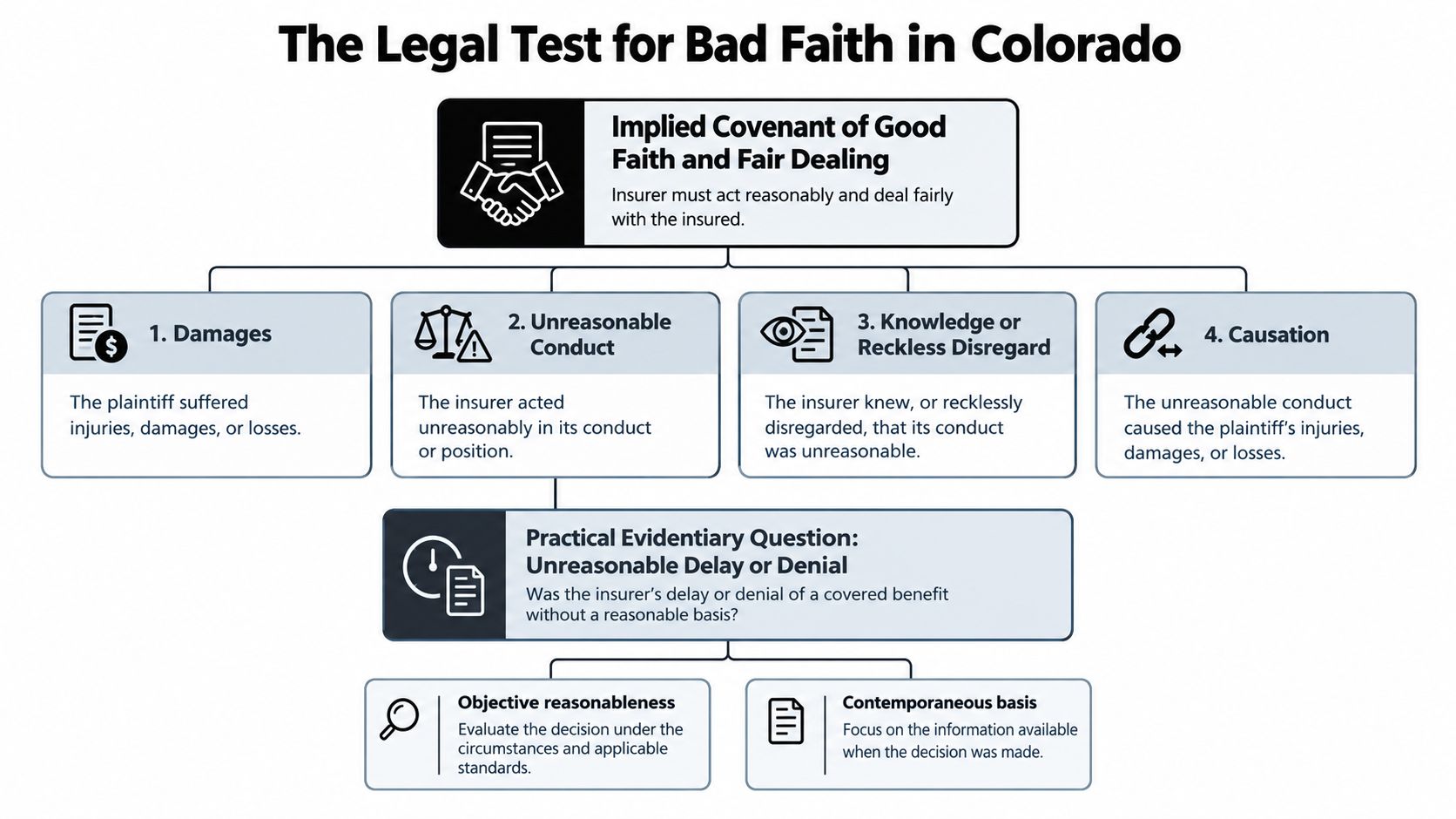
Colorado's legal test starts with the insurance contract and the duty to handle covered claims fairly. A jury then looks at whether you suffered a covered injury or loss and whether the insurer intentionally denied, failed to process, or failed to pay the claim without a reasonable basis. The Colorado jury instructions provide the framework for evaluating those questions.
That means a denial letter isn't the end of the analysis. It's one piece of evidence. The stronger question is whether the insurer's position was objectively supportable when the company made the decision, based on the information available at that time.
First-party and third-party claims require different proof
For a first-party claim, collect the policy, notice of loss, proof of injury, medical records, bills, wage information, adjuster communications, requests for additional documents, claim notes you receive, and every explanation for delay or denial. If your insurer refuses underinsured motorist benefits after a serious crash, the central dispute may involve the value of your injury, policy interpretation, causation, or the carrier's failure to evaluate decisive medical evidence.
A third-party claim follows a different path. The insurer may owe you a defense and may need to evaluate settlement demands against the risk of a judgment exceeding your limits. Evidence can include demand letters, accident reports, witness statements, expert opinions, defense counsel communications, settlement authority, and the carrier's evaluation of liability and damages.
Reasonable disagreement is not automatically bad faith
Insurance companies can make coverage arguments. They can request additional proof. They can dispute causation or the extent of an injury. A court may ultimately reject the carrier's interpretation without finding that the insurer acted in bad faith.
Your claim becomes stronger when the process itself looks unreasonable. Warning signs include an investigation that ignores available information, a denial that changes explanations, a failure to communicate applicable benefits, or an unreasonable delay in authorizing a covered benefit. The National Association of Insurance Commissioners model standards identify similar concerns, including failure to investigate with available information and failure to attempt a prompt, fair, and equitable settlement when liability is reasonably clear.
Common Insurer Tactics and Red Flags
Claims handling creates the evidence. In its 2024 complaint-index report, the Kansas Insurance Department recorded 3,661 total complaints, and 67 percent concerned claims handling, including delays, denials, communication failures, and related processing problems, as shown in the Kansas complaint report. Complaints don't automatically prove bad faith, but they show where policyholder disputes commonly develop.
Watch for these patterns:
- Unexplained inactivity: The adjuster says the claim is under review but doesn't identify what remains outstanding, who requested it, or when a decision will be made.
- Shifting explanations: The denial letter relies on one reason, then the insurer adds a different reason after you challenge it.
- Selective medical review: The carrier highlights an old symptom while ignoring new imaging, a treating physician's opinion, or a specialist's explanation of how the crash caused the condition.
- Unreasoned valuation: The adjuster presents a low offer without explaining the medical, wage, liability, or policy analysis behind it.
- Hidden or overlooked coverage: The insurer doesn't clearly identify applicable medical-payment, uninsured-motorist, underinsured-motorist, or other benefits.
- Refusal to reconsider: The company receives decisive new evidence but treats the original decision as final without addressing the evidence.
- Pressure through delay: The carrier uses mounting bills and financial stress to push you toward an inadequate settlement.
Build the timeline instead of arguing from memory
A claim file should show what happened at each decision point. Use this working table:
| Stage | Expected Action | Evidence to Preserve |
|---|---|---|
| Notice | The insurer acknowledges the claim and records the reported facts. | Notice date, claim number, acknowledgment, initial description of loss |
| Liability assessment | The carrier evaluates fault and identifies disputed facts. | Crash report, photographs, witness information, recorded statements, investigator notes |
| Coverage review | The insurer applies the policy terms to the reported loss. | Policy, declarations, endorsements, reservation of rights, coverage correspondence |
| Medical review | The carrier obtains and evaluates relevant medical evidence. | Records, bills, imaging, physician opinions, independent reviews, authorization requests |
| Missing information | The insurer identifies specific documents needed to decide the claim. | Requests, your responses, delivery confirmations, follow-up messages |
| Valuation | The carrier evaluates damages and explains its position. | Offers, calculations, comparable evidence, wage records, life-care or vocational materials |
| Decision | The insurer pays, denies, or explains why more review is necessary. | Denial letter, payment record, decision notes, appeal or reconsideration request |
For property losses, an independent estimate can help test an insurer's valuation. A resource such as Audit Genius estimate auditing may help you understand how an outside estimate can be compared with the carrier's scope of work. In an injury case, the equivalent is a careful medical and damages record, not a higher number.
If the insurer's conduct involves a complex investigation, review the carrier's process and your rights before responding. Nares Law Group's insurance company investigation guidance addresses issues that can arise when an insurer examines an injury claim.
When the Adjuster Is an Algorithm
The adjuster may not be the only decision-maker. Insurers increasingly use automated systems to triage claims, score risk, identify suspicious patterns, recommend reserves, and route files for denial or escalation. A computer-generated result isn't automatically bad faith, but the carrier remains responsible for handling your individual claim fairly.
A 2025 legislative analysis reported increasing consumer complaints about unfair discrimination connected to insurers' use of AI, algorithms, and other data models, while regulators emphasize that AI-supported decisions remain subject to unfair-claims and discrimination rules, as discussed in this analysis of AI in insurance claims.

Ask targeted questions in writing:
- Was the claim automatically triaged, scored, or denied?
- What reason code or rule produced the result?
- What policy criteria did the system apply?
- Did a human review the output?
- What evidence did the system consider?
- Was the result escalated or overridden?
- Did the insurer identify and correct known errors in the tool?
You may not receive every internal record voluntarily. Privacy, privilege, trade-secret, and discovery rules can affect what the insurer must disclose. Still, asking creates a record and may reveal whether the company meaningfully investigated your claim or merely accepted an automated recommendation.
The strongest AI-related argument is usually ordinary and concrete: the system ignored individualized evidence, the insurer failed to supervise it, or a human approved a result without investigating the facts. Preserve claim letters, portal messages, medical records, adjuster notes, and every request for an explanation.
Statutory Remedies and Colorado Deadlines
Colorado provides a statutory remedy for certain first-party claims when an insurer unreasonably delays or denies covered benefits. Under section 10-3-1116, an insured may seek attorney fees, costs, and two times the covered benefit, subject to the statute's requirements and defenses. The applicable statutory framework provides background for evaluating the remedy.
A legitimate coverage dispute does not automatically establish bad faith. Separate the questions: does the policy cover the loss, and did the insurer handle the claim unreasonably? Identify whether you seek benefits under your own policy or challenge conduct involving a claim against you. Then document the disputed benefit, the date of delay or denial, the insurer's stated reason, and the evidence showing why that reason lacked a reasonable basis.
Notice and timing require early attention
A statutory claim may require written notice before filing suit. Make that notice specific. Identify the benefit owed, the policy provision, the documents you supplied, unanswered questions, the delay or denial, and the action requested. A general accusation of unfair treatment gives the insurer less useful information and creates a weaker record.
Do not rely on the insurer to identify your deadline. Contract terms, statutory notice requirements, common-law claims, and personal-injury claims can follow different timing rules. The Colorado statute of limitations guidance explains why an injured person should have the relevant dates evaluated instead of relying on a general internet deadline.
Colorado's remedies also differ from those in other states. A state-law comparison reports that Texas's prompt-payment remedy can provide 18 percent annual interest and attorney fees for a statutory deadline violation without a separate bad-faith finding. Colorado is primarily common-law and requires clearer proof for punitive damages, according to this comparison of bad-faith insurance remedies. Do not import a Texas remedy or deadline into a Colorado claim.
Preserve the dates that control the case
Build a claim timeline. Record when you gave notice, each information request, every response, promised decision dates, payments, denials, and later explanations. Keep the letters, portal messages, policy, medical records, and proof of delivery together. A lawyer can assess the legal clock and the reasonableness of the investigation only if the file shows what the insurer knew and what it did afterward.
Damages and Remedies You Can Pursue
A bad-faith case can involve several categories of recovery, but each depends on the facts and the evidence. Start with the underlying insurance benefit. If the policy covered the loss, the contract claim generally seeks the benefit the insurer should have paid.
The statutory path may add attorney fees, costs, and the statutory multiplier described above when the requirements are met. That remedy is separate from the question of whether the insurer's conduct caused additional harm outside the unpaid benefit.
Separate the recovery categories
Contract damages address the policy benefit itself. For an injured person, that may involve benefits payable under applicable coverage. For a third-party claim, the analysis may concern consequences of the carrier's failure to defend or settle appropriately.
Extra-contractual compensatory damages address losses caused by the insurer's conduct beyond the benefit dispute, where Colorado law permits recovery. Preserve evidence of financial harm, additional expenses, disrupted treatment, credit consequences, and other injuries. Don't assume the court will infer them from frustration.
Statutory remedies can provide attorney fees, costs, and the applicable multiplier for an unreasonable delay or denial of covered first-party benefits. The statute's requirements control, and the insurer may raise defenses based on coverage, reasonableness, notice, or proof.
Punitive damages are different. They punish especially serious misconduct rather than compensate you for ordinary loss, so the proof burden is higher. A simple mistake, disputed interpretation, or unsuccessful defense usually won't be enough. Evidence of conscious disregard, deliberate concealment, or a knowingly abusive process matters more.
If the dispute follows a fire, flood, or other property loss, post-fire legal assistance can help explain how coverage disputes and damage documentation may intersect. For injury claims, your medical timeline and treatment coordination usually carry the same evidentiary importance.
Damages follow the file. If the file only shows that you were unhappy, the insurer has room to characterize the dispute as ordinary. If it shows ignored evidence, unexplained delay, and changing reasons, the analysis changes.
What to Do Right Now if You Suspect Bad Faith
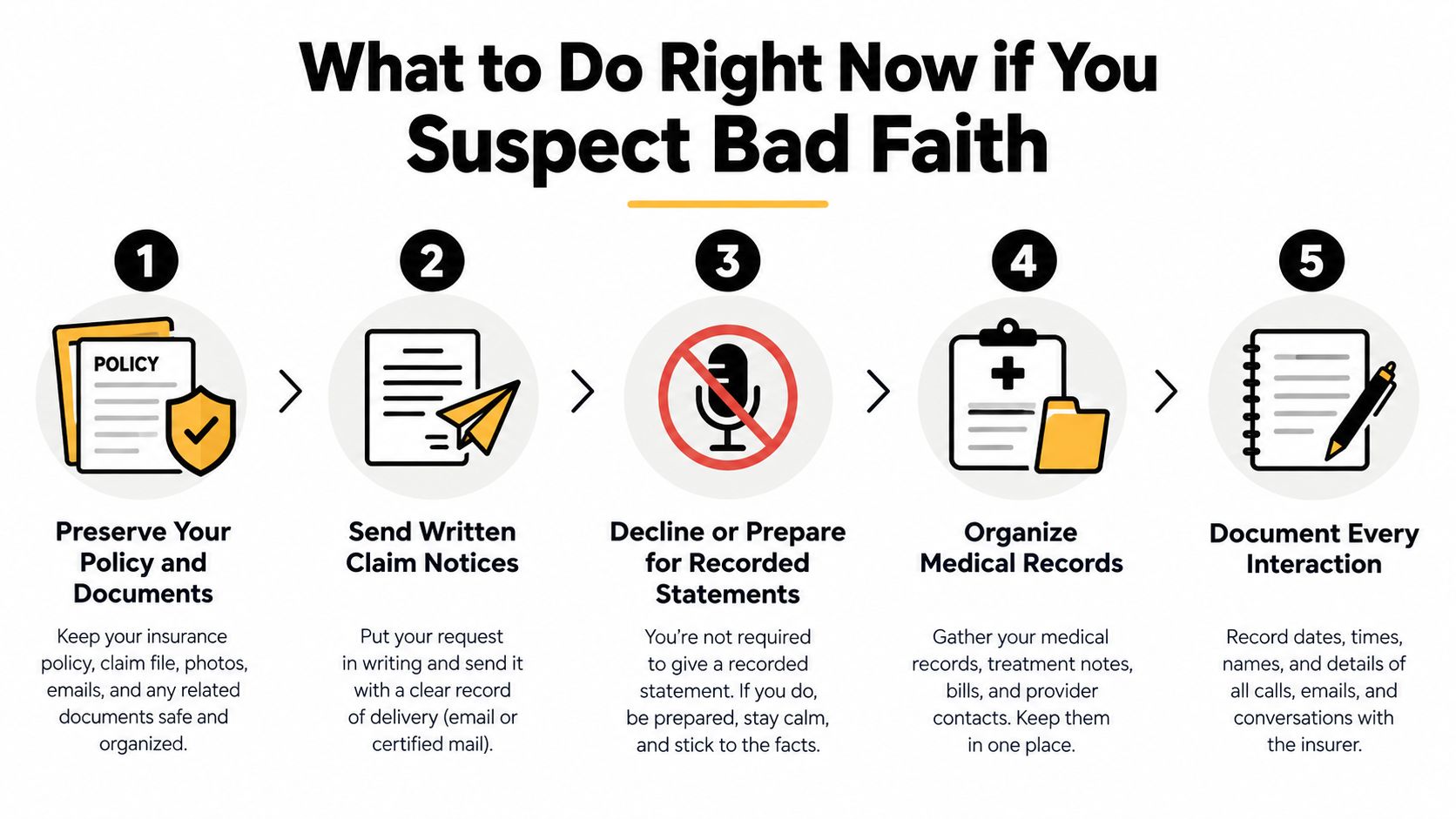
Don't start by accusing the adjuster of criminal conduct or threatening public exposure. Start by building a clean record that another person can understand without asking you to reconstruct months of events from memory.
Preserve the source documents
Save the complete policy, declarations, endorsements, claim notices, denial letters, payment records, emails, text messages, portal messages, recorded statements, photographs, medical records, bills, wage documentation, and accident materials. Keep original files when possible, including attachments and metadata. Make a separate copy outside the insurer's portal because access can change.
Put communications in writing
After a phone call, send a short confirmation email: identify the date, the person you spoke with, what the adjuster requested, and what the adjuster said would happen next. Ask the insurer to identify any missing information specifically and explain how that information affects the decision.
You don't need to write an argument in every message. A calm chronology is more useful than an angry paragraph. Don't guess about medical facts, minimize symptoms, or speculate about liability.
Prepare before giving a recorded statement
A recorded statement can affect how the carrier characterizes your injury and the accident. Review the facts, policy, treatment history, and prior statements before answering. You may provide a truthful statement, but you don't have to treat an adjuster's schedule as a substitute for legal advice.
Organize the medical proof
Create a treatment timeline with provider names, dates, diagnoses, symptoms, restrictions, referrals, imaging, procedures, bills, and missed work. Ask providers to correct factual errors in records. Tell your lawyer about prior injuries truthfully, because concealment damages credibility while accurate context helps distinguish old conditions from crash-related aggravation.
Send a focused demand
A useful demand identifies the coverage, liability evidence, medical evidence, benefits requested, documents already supplied, unresolved issues, and a reasonable response request. It should also preserve your position if the insurer continues delaying. Avoid exaggeration. Credibility is part of your negotiating power.
If the carrier continues ignoring the file, consider a complaint to the Colorado Division of Insurance. A regulatory complaint may create another record and prompt a response, but it isn't automatically a judicial finding of bad faith and doesn't replace a lawsuit or legal evaluation.
Use the insurance claim dispute guidance from Nares Law Group when you need to organize the dispute before seeking counsel. Once the claim involves substantial injuries, a policy-limit issue, a recorded statement, a denial with shifting explanations, or an approaching deadline, stop treating it as a routine customer-service problem.
A Local Example and Common Questions
Consider a Colorado motor-vehicle collision involving a traumatic brain injury. You report the crash to your own underinsured-motorist carrier, provide treatment records, and explain that your neurologist expects ongoing care. The adjuster sends a small offer based on an early record, ignores later testing, and then says the claim is delayed because the insurer still needs records you already delivered.
That fact pattern doesn't guarantee a bad-faith case. It does identify the questions that matter: Did the policy cover the benefit? When did the insurer receive the decisive medical evidence? What did the carrier investigate? Did it explain the valuation? Did it identify the missing records specifically? Did it reconsider after receiving proof that challenged the original position?
A strong file connects each answer to a document. A weak file relies on the policyholder's understandable but difficult-to-prove belief that the company wanted to pay less.
Does a low settlement offer prove bad faith?
No. A low offer can reflect a legitimate dispute over causation, liability, policy limits, or damages. It becomes more significant when the insurer cannot explain its valuation, ignores reliable evidence, relies on incorrect facts, or changes its rationale after you challenge the offer.
How long can an insurer keep an injury claim pending?
There isn't one universal period that makes every delay unreasonable. The relevant facts include the complexity of the injury, the evidence available, the information the insurer requested, whether you supplied it, and whether the carrier identified a genuine unresolved issue. Document every unexplained gap instead of relying on a general deadline.
Can I seek statutory interest without proving bad faith?
The answer depends on the statute and the type of claim. Texas, for example, may provide 18 percent annual interest and attorney fees for a statutory prompt-payment violation without a separate bad-faith finding, as described in the state-law comparison linked above. Don't assume Colorado provides the same remedy. Have counsel identify the applicable Colorado cause of action and requirements.
How long do I have to file?
That depends on the claim, policy language, statutory path, notice requirements, and the date the relevant conduct occurred. A demand letter or regulatory complaint may not preserve every lawsuit deadline. Bring the complete file to a Colorado attorney as soon as the insurer denies, delays, or undervalues a significant claim.
Nares Law Group handles suspected insurance misconduct alongside serious motor-vehicle, trucking, brain-injury, and wrongful-death matters. The firm's work can include investigating the claim, coordinating medical records, drafting a supported demand, negotiating with the carrier, and preparing the case for trial when negotiation fails. Its attorneys are licensed in Colorado, Texas, and New York, which matters when a crash, policy, insurer, or family connection crosses state lines.
Bring your policy, claim correspondence, medical records, payment history, and communication log to the consultation. The right first step is a direct assessment of coverage, evidence, timing, and whether the insurer's process supports a bad-faith theory.
Nares Law Group LLC offers free consultations for injured people facing denied, delayed, or undervalued insurance claims, including motor-vehicle, trucking, brain-injury, and wrongful-death matters. Visit Nares Law Group LLC to request a case review and discuss the evidence, deadlines, and remedies available for your claim.