You're standing beside a damaged car, trying to remember a license plate that flashed past you seconds after the impact. You may have only caught a few characters. Your dashcam image may be blurred. A witness may remember the vehicle's color but not its make. That doesn't mean the investigation is over.
A hit and run license plate lead is valuable, but it rarely works alone. Police and insurers build stronger cases by combining plate fragments with the crash location, exact time, vehicle description, witness accounts, and nearby camera footage. Your job is to preserve every fragment quickly and describe it accurately, without guessing.
What to Do When You Have a Partial License Plate
A hit-and-run leaves you with seconds of observation and a fast-moving vehicle. Check for injuries first. Then record every plate fragment before conversation, stress, or other people's guesses change your memory. A few characters can help, especially when combined with the vehicle's color, body style, damage, location, and direction of travel.
Do not try to reconstruct a complete plate from uncertain details. Tell police exactly what you remember and label anything unclear. A partial plate, blurry dashcam frame, and witness description can form a usable investigative path when they point to the same vehicle.
License-plate recognition systems may search partial plate information and return full vehicle images for witness review. The Motorola Solutions license-plate recognition brochure documents that function in hit-and-run investigations. Ask investigators whether nearby cameras, traffic systems, or business footage can be checked using your time and location details.
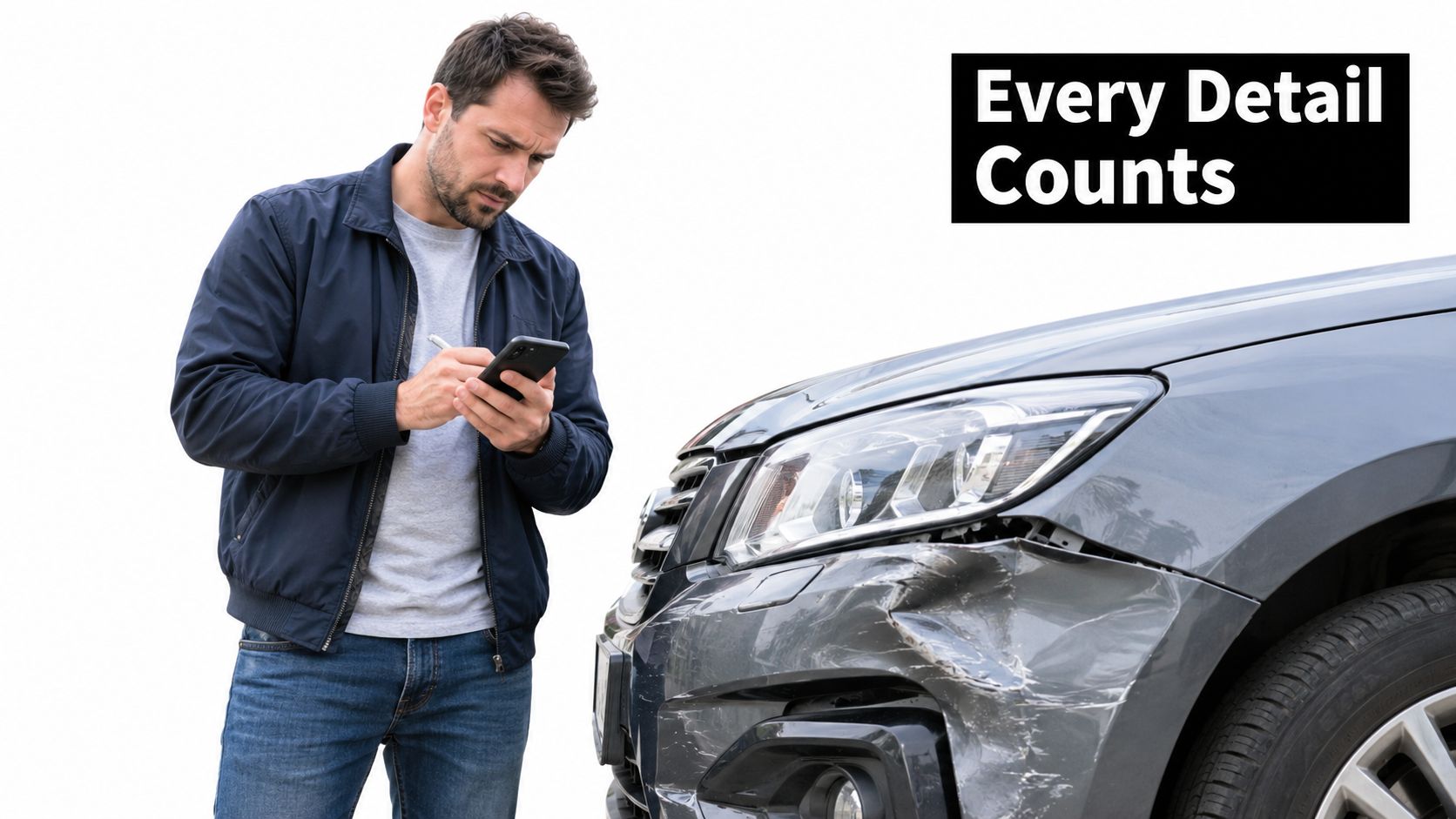
Record fragments without filling gaps
Use your phone's notes app or make a voice recording. Separate certainty from uncertainty:
- Certain: “I saw the final three characters as 4K7.”
- Uncertain: “The first character may have been an A or an H.”
- Vehicle details: Record the color, body style, visible damage, decals, headlights, and direction of travel.
- Scene details: Note the street, cross street, lane, traffic signal, and approximate time.
Give police and your insurer the original wording. A guessed full plate can direct the investigation toward the wrong vehicle, while a precise fragment can be compared with camera records and independent witness memories. For practical steps on identifying a fleeing motorist, review this guide on how to find a hit-and-run driver.
Preserving Your Evidence Before It Disappears
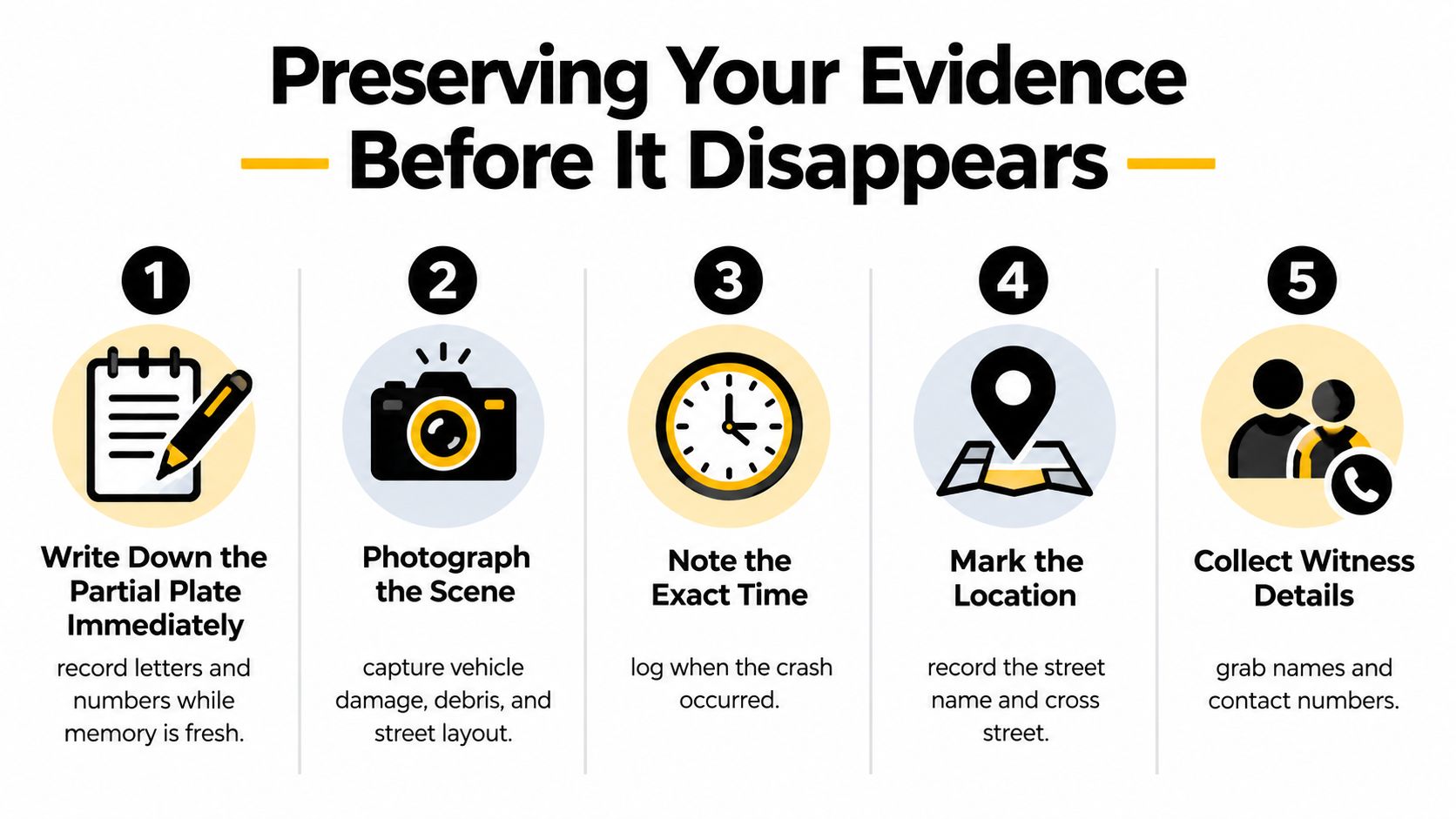
A blurry dashcam frame, a partial plate, and two witnesses who remember different characters can still identify a fleeing vehicle. They become useful only when you preserve each fragment before it is overwritten, altered, or forgotten. Save the original material first, then prepare copies for police, your insurer, and your lawyer.
Write your account before repeated conversations reshape your memory. Record the sequence, the other vehicle's movement, the impact point, the plate characters you recall, and what happened immediately afterward. Leave the first note unchanged. If another detail comes back, add a dated supplement so investigators can separate your initial recollection from later memories.
Use a simple preservation checklist
- Save original video files. Remove the dashcam memory card if that stops new footage from replacing the recording. Copy the complete file, not just a screen recording or shortened clip. Keep the original untouched and work from copies.
- Photograph the whole scene. Capture damage, paint transfer, broken parts, debris, skid marks, lane markings, traffic controls, and the vehicle from several angles.
- Write down the exact time and place. Check your phone, vehicle clock, navigation history, receipt, or call log. Record the street and cross street, not only the neighborhood.
- Collect witness information. Get each person's name and phone number. Write their accounts separately, and do not steer anyone toward a particular plate character.
- Identify nearby cameras. Check storefronts, gas stations, banks, apartment buildings, traffic cameras, doorbell cameras, and parked vehicles that may have dashcams.
Contact property owners promptly. Ask them to preserve footage from the likely time window, even if they will not release it directly to you. They may retain it for law enforcement or an attorney. These GoAccess LPR security insights explain how license-plate cameras can support community investigations.
Preservation rule: Do not wait for a complete plate. Request footage while you still know the likely time, road, and direction of travel.
Automated license-plate systems can search large collections of vehicle observations using fragments alongside location and time. That makes a blurry image, an uncertain character, and a witness memory more useful as a combined lead than as separate evidence. A discussion of license-plate recognition in hit-and-run cases describes this investigative role. Give investigators the fragments exactly as observed, with uncertainty clearly marked.
Filing a Police Report With Plate Information
File the report even when the plate is incomplete. Give the officer each fragment exactly as you remember it, and mark uncertainty clearly. “Possibly 4K7, dark SUV, traveling east” gives investigators a usable lead. A confidently reported plate that later proves wrong can send the search in the wrong direction.
Bring an organized evidence packet. Include your written account, photographs, dashcam file details, witness contact information, the vehicle's make, color, body type, and damage, plus nearby camera locations. Explain the likely time window, road, intersection, and direction of travel. Ask the officer to attach the materials to the case file or identify them in the report. Before leaving, get the incident or report number and ask how to provide additional evidence later.
The report should give investigators a search path, not just a description of the crash.
Ask whether available automated license-plate reader systems can be checked using the partial characters, crash location, time window, travel direction, and vehicle details. Those details work together. A blurry dashcam image, an uncertain character, and a witness's incomplete memory may identify the same vehicle when investigators compare them across locations.
A documented police case used a partial plate and crash location to query an ALPR system within a 10-mile radius. Image matches helped reveal the full plate and led to a felony arrest, as reported in Police1's documented ALPR case examples. That result does not promise the same outcome here. It does show why incomplete plate evidence belongs in the report.
Ask whether the partial plate, vehicle description, and travel corridor can be circulated or searched through systems available to law enforcement. For a broader explanation of hit-and-run investigations, review how investigators connect separate leads. Do not follow the vehicle, confront a suspected driver, or post an accusation online. Preserve your safety and give investigators evidence they can verify.
Understanding DMV Records and Subpoena Limits
A license plate identifies a vehicle, not automatically the person who drove it. Law enforcement can use the plate to investigate registration information, but a private individual generally can't obtain confidential DMV records just by asking for the registered owner's name. Privacy restrictions exist precisely because a plate can be observed by anyone on the road.
That creates an important distinction:
| What the plate may establish | What it usually does not establish by itself |
|---|---|
| A vehicle connected to the crash | Who was driving at the time |
| A possible registered owner | That the owner caused the collision |
| A direction or route when supported by images | Liability for your injuries or property damage |
The guidance on making an injury claim after a hit and run makes the central point clearly. A plate may help identify the registered owner, but it doesn't by itself prove who was driving or establish liability.
How the legal process fills the gap
When registration information matters to a claim, an attorney may seek it through formal legal procedures, such as a subpoena or court order, depending on the jurisdiction and posture of the case. A subpoena is a legally authorized demand for records. It isn't a shortcut around privacy law, and it doesn't replace the need for proof connecting the driver to the crash.
That connection may come from a witness who saw the driver, footage showing the person entering or leaving the vehicle, vehicle damage that matches the collision, or a documented route from the crash scene. Investigators may also compare the vehicle's appearance with images captured before and after the incident.
Don't promise an insurer that a registration match solves the claim. Give the plate information to police and your lawyer, then preserve the independent evidence that answers the harder question, who had control of the vehicle when it struck you.
Submitting an Insurance Claim With Limited Plate Evidence
A partial plate can support an insurance claim, but it will rarely carry the claim by itself. Notify your insurer that the collision was a hit and run, and provide the police report number when available. Submit the plate exactly as you reported it, including any uncertainty. Add photographs, medical records, repair information, dashcam footage, witness contacts, and a written timeline.

Ask the adjuster to confirm in writing which coverage is under review. Depending on your policy and state law, uninsured motorist coverage or collision coverage may help when the driver remains unidentified. Notice rules, deductibles, coverage limits, and proof requirements vary. Read the policy before assuming that a partial plate guarantees payment.
Build the claim file around a clear timeline. State where the collision occurred, what you saw, what witnesses reported, when the vehicle left, and when each piece of evidence was obtained. Send documents through a traceable method, then keep copies of emails, claim numbers, adjuster names, recorded statements, and requests for more information.
Describe uncertain evidence with equal precision. You might write, “The witness remembered a silver pickup,” or, “The dashcam shows the last three characters, possibly 4K7.” You can report that the vehicle traveled north from the intersection and that a storefront camera may cover the roadway. Do not write, “I know that's the plate,” when the image is blurry or your memory is incomplete. Accurate wording protects your credibility.
Insurers and investigators can compare the partial plate with the vehicle's make, model, color, direction of travel, nearby cameras, and dashcam footage. That method is explained in this evidence guide for proving a hit-and-run case. The goal is a consistent chain of clues, not a confident guess presented as fact.
Before giving a recorded statement or signing a release, consider legal advice, especially if you have injuries or the insurer disputes coverage. Your insurer may handle the claim, but its adjuster still evaluates causation, damages, coverage, and the strength of the identification evidence.
This video may help explain practical insurance issues after a hit and run:
If police later identify the driver, update the claim immediately and provide the new information. Guidance concerning hit-and-run drivers can also help when the insurer needs a clear account of how separate clues developed into an identification.
How an Attorney Can Help Pursue Charges and Compensation
A hit-and-run creates two separate legal concerns. Police and prosecutors decide whether the driver can be identified and charged for leaving the scene. Your attorney handles the compensation side, building proof of your injuries, vehicle damage, lost income, and other losses. The two processes may share evidence, but they do not require the same proof or produce the same result.
Your lawyer should act quickly to protect evidence before it disappears. That can include asking businesses to preserve recordings, locating cameras along the vehicle's route, organizing witness accounts, reviewing original dashcam files, and comparing the damage on your vehicle with photographs of a suspected car. Counsel can also communicate with investigators and present your account accurately, without turning an incomplete memory or blurry plate into an unsupported identification.
A partial plate is a starting point, not a complete answer. Your attorney should separate four questions: What vehicle was involved? Who owned or registered it? Who had access to it? What evidence shows who drove it during the collision?
A camera image or partial plate may help identify the vehicle. Lawful access to registration records may identify its registered owner. Establishing who drove requires additional proof, such as witness testimony, video, an admission, the vehicle's location, or physical evidence. A registration match alone does not establish the driver.
The civil claim requires a separate record of harm. Counsel can organize medical records, treatment information, repair estimates, wage-loss documentation, and evidence of lasting limitations. The attorney can also review whether your own insurance coverage applies and respond when an insurer dismisses a fragmented plate lead without assessing the surrounding evidence.
Nares Law Group LLC handles motor vehicle injury matters, including investigation, medical treatment coordination, insurance negotiations, and litigation. If investigators identify the driver, your attorney can communicate with the criminal process while keeping the civil claim focused on the evidence and damages required for compensation.
Choose counsel according to the work your case demands. Ask who will preserve recordings, communicate with the insurer, assess partial plate evidence, and handle disputed liability or serious injuries. A prompt consultation can matter before footage is overwritten and witnesses' memories fade. The first legal task may be protecting evidence, not filing in court.
Moving Forward When the Plate Is Only Part of the Story
A partial license plate isn't a dead end. It's a lead that becomes stronger when you pair it with a precise time, location, vehicle description, witness account, and preserved video.
Write down the fragments now. Save the original files. Report the crash accurately. Notify your insurer and keep a complete paper trail. Don't try to identify the owner through improper means, and don't assume a registration match proves who was driving.
If the collision involved a parked vehicle, practical guidance on someone hitting my parked car and leaving can help you organize the immediate steps. If you were injured, don't wait for the investigation to stall before seeking advice. A lawyer can pursue evidence while memories and recordings are still available.
If you were injured in a hit and run, Nares Law Group LLC can help investigate partial plate evidence, preserve relevant records, and evaluate insurance and compensation options. Contact the firm for a consultation and bring your police report, photographs, videos, witness information, and insurance documents.