The other driver caused the crash. So why is the hospital billing you?
That gap catches a lot of injured people. Fault answers who should carry the loss. It does not answer who pays the emergency room this week. Care starts the day of the wreck. The at-fault driver's liability insurer usually waits until coverage, fault, and the extent of injury are sorted out, which can take weeks or months.
Who pays medical bills after a car accident is almost never one company writing checks as you treat. Your own auto medical coverage, or personal injury protection in a no-fault state, and then your health plan, usually fund treatment first. Bodily injury liability on the other driver's policy can reimburse those medical expenses later, inside a settlement or a judgment, and only if the claim is proved. State law and the wording of each policy change the order, so learn the sequence before a collector does.
Who Pays First After a Car Accident and Why
When treatment starts, the bill usually goes first to medical payments coverage (MedPay) on your own auto policy, or to personal injury protection (PIP) in no-fault states, and then to your health plan for what those benefits leave unpaid. The at-fault driver's liability insurer generally pays later, once fault and the size of the injury are resolved, because the hospital will not wait on that investigation.
MedPay pays reasonable accident-related care whether or not you caused the crash. Health insurance then covers remaining treatment, subject to deductibles, copayments, and network rules. The other driver's bodily injury liability coverage is the piece that can repay medical expenses, but through a settlement or judgment, not as each visit is billed.
The scale of crashes is why an interim plan matters. The National Highway Traffic Safety Administration reported an estimated 5,930,496 police-reported traffic crashes in 2022, including approximately 2,382,771 injured people. NHTSA also estimated that U.S. motor-vehicle crashes generated $340 billion in economic costs in 2019, the latest year for which its cost estimate was available. That total included medical costs, emergency medical services, lost productivity, and property damage, among other items. Bills arrive while liability files are still open.
Practical rule: Route the bill to a first-party benefit before you spend energy arguing about fault. Fault still matters. It just does not unlock the first check.
How the payment sources line up
Use the table as the lookup. Each row names the coverage, whose policy it comes from, whether you must prove fault, and when money typically moves.
| Coverage source | Comes from | Needs proof of fault? | When it typically pays |
|---|---|---|---|
| Medical payments (MedPay) | Your own auto policy | No | First, once accident-related care begins; Colorado default limit $5,000 |
| Personal injury protection (PIP) | Your own auto policy | No | First in no-fault states; policy limits and any wage benefits follow the policy and state law |
| Health insurance | Your health plan | No | After MedPay in Colorado; subject to deductibles, copayments and network rules |
| At-fault driver's bodily injury liability | The other driver's auto policy | Yes | Later, after the claim is resolved through settlement or judgment |
| Uninsured or underinsured motorist coverage | Your own auto policy | No, but the other driver must be uninsured or underinsured | Later, after the at-fault driver's limits are exhausted or if no insurance exists |
Before you assume a row applies, pull the declarations page of your auto policy, check your state's fault rules, and read your health plan summary of benefits. Those three documents show which rows you have, and at what limits. A missing rejection form, a household policy, or a passenger's own auto coverage can add a payer you did not expect.
Which Payer Comes First in No-Fault and At-Fault States
The first payer follows the state's system, not the police report's fault box.
The National Association of Insurance Commissioners defines MedPay as first-party coverage for injuries incurred in a motor-vehicle accident, and PIP as a first-party benefit used in no-fault states to pay basic expenses for the insured and family. First-party means the policy you bought pays you. Third-party means the other driver's liability policy pays you only after that driver is shown to be responsible.
No-fault states
In a no-fault system, your own insurer generally pays regardless of who caused the crash. PIP commonly covers medical expenses and may also cover lost wages and funeral costs up to the policy limits. You still report the crash, but you do not wait for the other carrier to accept fault before basic bills are submitted.
A plain explanation of personal injury protection coverage is worth reading if your declarations page lists PIP and you are unsure whether wage loss belongs in that claim or in a later liability claim. Mixing those two files is a common way wage benefits get delayed.
At-fault states such as Colorado
Colorado is an at-fault state. You typically use available MedPay and health insurance for immediate care, then seek damages from the at-fault party's liability insurer. MedPay eligibility turns on a covered automobile accident and accident-related care, not on proving negligence. In Colorado, MedPay is also positioned ahead of the health plan and can be applied toward health-plan deductibles.
Health coverage can fill the gap after auto medical benefits run out. It can still impose network rules, copayments, utilization review, and a later right to be paid back. An early payment is not the same thing as final economic responsibility.
Confirm three items before the first large bill goes out:
- State system: Ask whether your claim sits in a no-fault state or an at-fault state like Colorado.
- Policy form: Check whether your auto policy includes MedPay, PIP, or both.
- Dollar limits: Write down each limit so you know when the next payer has to take the balance.
How to Route Bills Through Each Coverage Step by Step
A clean file assigns every charge to a named payer. In Colorado, that payer is often your own MedPay, not the at-fault driver's liability insurer. No-fault states can reverse or replace this order with PIP, which the callout on the flowchart flags.
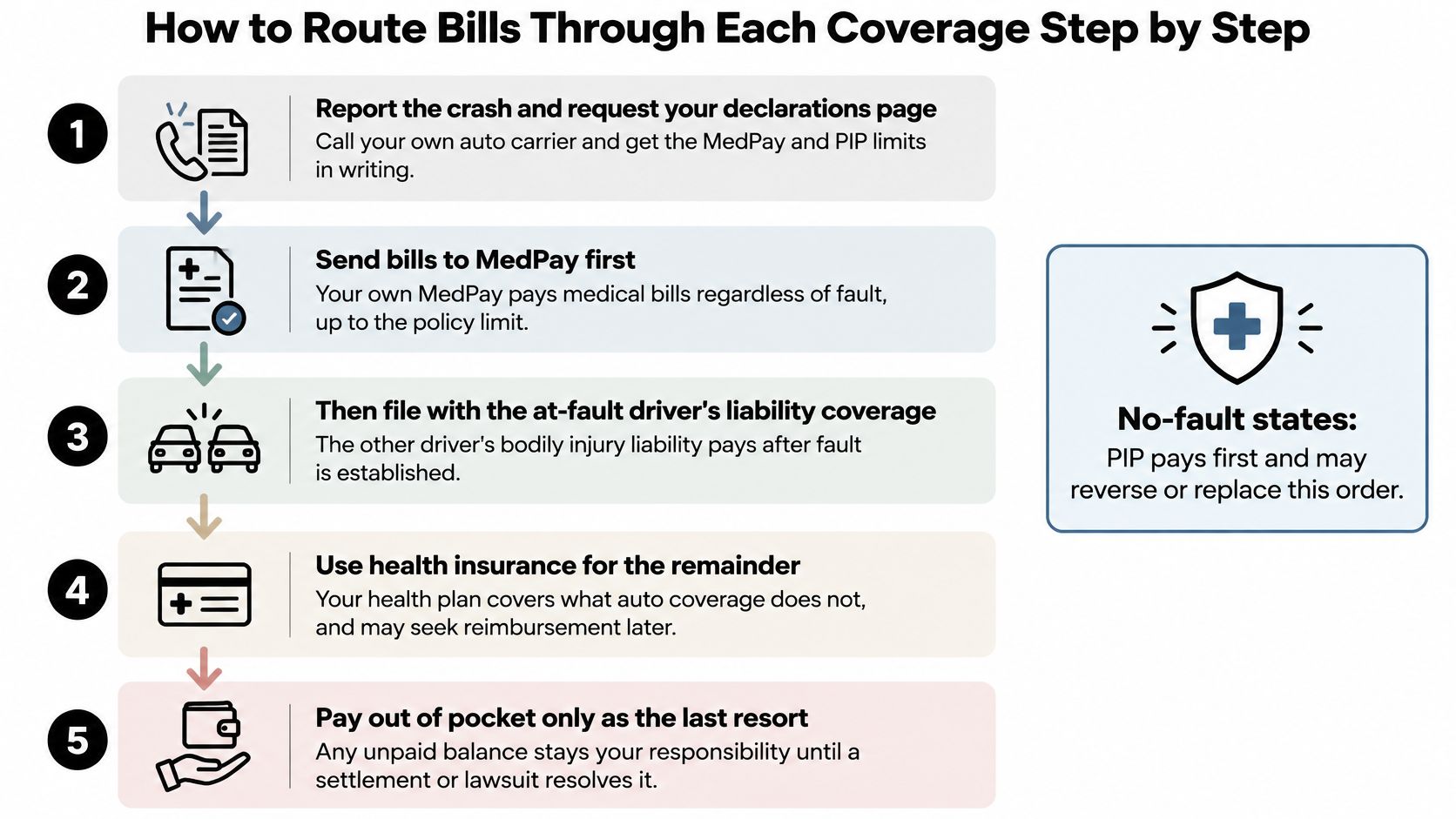
The Colorado Division of Insurance states that MedPay covers the insured and passengers' reasonable bodily-injury healthcare expenses regardless of fault, and that a $5,000 limit is included unless the insured rejects it in writing or through the same application method. The Division also specifies that MedPay pays before health insurance and may be applied to health-plan deductibles and coinsurance.
The routing sequence
- Report the crash to your own auto carrier and request the declarations page, the MedPay limit, the current balance, the payment ledger, and the list of pending bills. You need those figures before any provider sends a charge, or the office may bill you while unused coverage sits on the policy.
- Submit accident-related bills to MedPay first, including the ambulance, emergency room, imaging, and specialist visits. It is a first-party benefit, so eligibility does not wait on a negligence finding.
- Keep a running ledger of what MedPay has paid and what remains. Early emergency, imaging, and ambulance charges can consume a $5,000 ceiling quickly, and a specialist visit after that point needs a different payer.
- Send the remaining balance to your health insurer. The plan may apply its deductible and coinsurance, and it may limit payment to in-network care.
- Save every explanation of benefits, itemized bill, and insurer payment record. Those papers decide later reimbursement fights, and a missing EOB is hard to recreate months later.
- Ask each provider to hold collection on the accident-related balance while claims are pending, and get in writing which payer is covering that bill. A phone promise from a billing clerk disappears. An email does not.
- When the liability claim opens, send unpaid balances, deductibles, and lost-income figures to the at-fault insurer. That claim is a separate path. It addresses unpaid medical expenses, amounts already reimbursed, deductibles, lost income, and other legally recoverable damages after fault and causation are established. It does not fund treatment the week of the crash.
A correctly routed file has every bill assigned. Nothing sits in a "we'll figure it out" pile. MedPay can fund care now. Third-party liability payment generally depends on claim resolution.
What Pays When the At-Fault Driver Has No Insurance
A clear fault finding does not create a check if the other driver has no policy, or a policy too small for the care you need. Your own coverage can become the main source of payment.
A 2025 Insurance Research Council analysis estimated that 15.4% of U.S. motorists were uninsured in 2023, more than one in seven drivers, and that 18.0% were underinsured. Combined, 33.4% of drivers were either uninsured or underinsured, a 10-percentage-point increase from 2017. Those are national figures, not a prediction for your claim, and coverage rules still differ by state.
When the at-fault driver has no insurance, that driver's liability policy cannot pay medical bills. Recovery may instead depend on your uninsured motorist coverage, your health plan, MedPay or PIP, and sometimes the driver's personal assets. Personal assets are slow and uncertain. Do not build a treatment plan around them.
When the driver is underinsured, the liability limit may be too low for hospitalization, surgery, rehabilitation, or longer neurological care. Underinsured motorist coverage may help after those liability limits are exhausted, subject to the policy and state requirements. You still have to show that the other driver was at fault and that the injuries came from the crash. You do not have to show that your own driving was perfect in the way a liability claim against you would require.
An apparent liability claim is not a promise of full payment. A clearly negligent driver can still carry limits that stop well short of the bill.
A short guide to uninsured motorist coverage helps if you are sorting UM from UIM, or if a passenger in your car may also have a household policy. Identifying every applicable auto policy can matter as much as proving fault.
Before you close this question, confirm three things on paper:
- Your limits: Find uninsured and underinsured motorist limits on the declarations page, including any stacked household policy.
- Health benefits: Confirm the health plan will still process accident-related care when the other driver is uninsured.
- MedPay or PIP: Confirm those benefits remain available even though no liability carrier is in the picture.
How Health Plan Reimbursement and Liens Shrink a Settlement
A settlement that looks adequate on the offer letter can shrink once everyone who already paid a bill asks to be repaid. Payment timing and final economic responsibility are separate questions. Having health insurance does not make the medical cost disappear.
A health plan may assert a right to recover amounts it paid from a later settlement when another party is responsible. Guidance on the real cost of a car crash identifies the plan's subrogation language as the mechanism for that recovery. Net recovery can also drop because of outstanding deductibles, copayments, medical liens, and provider balances. In Colorado, MedPay generally should be addressed before health benefits, and the health plan may still claim what it paid on the remaining charges.
A subrogation claim is not a suggestion. It is a demand against the recovery, and it has to be answered before you treat the offer as spendable money. If you want a sense of how gross figures get discussed in negotiation before those demands are subtracted, realistic personal injury settlement numbers from Mediation & Negotiation Services (M&N) are a useful contrast to the net figure you keep.
A settlement that looked like $40,000
Say the at-fault carrier offers $40,000. The health plan's reimbursement claim is $12,000. You still owe $1,500 in deductibles and copayments. A provider lien claims $3,000. Subtract those three items and about $23,500 remains, before attorney fees and case costs. The offer did not change. The claims against it did.
Walk every deduction the same way. Write the gross offer on the top line. List each claimant, the dollar demand, and whether that demand is final or still negotiable. Then compare the bottom line with unpaid care you still expect, not with the number in the insurer's email subject line.
| Deduction | Claimed by | What it covers | Effect on net recovery |
|---|---|---|---|
| Health plan reimbursement claim | Health plan | Amounts the plan paid, under its subrogation language | Reduces the net amount you keep |
| Outstanding deductibles and copayments | Health plan and providers | Cost-sharing you still owe | Reduces the net amount |
| Medical liens | Providers or lienholders | Balances claimed against the recovery | Must be resolved before payout |
| Provider balances | Treating providers | Unpaid accident-related charges | Remain owed if not paid or assigned |
Do not accept a gross offer as your result. Net every reimbursement, lien, and balance against that figure before you decide it is enough.
What to Confirm Before Accepting a Settlement
The offer is a starting number. The release is the document that can end the claim. Match them against the file before you sign.
- Get an itemized list of every accident-related bill and the payer recorded for each one. If a charge has no payer, it is still yours.
- Request each payer's reimbursement or lien amount in writing, including MedPay, PIP, and health plan claims. A verbal "we're not asserting anything" is not a waiver.
- Confirm that MedPay or PIP payments were credited, and that no bill is sitting unassigned between the auto carrier and the health plan.
- Confirm that provider balances will be paid from the proceeds and that liens are satisfied before money is released to you. A lien that survives the payout can follow you after the insurer has closed its file.
- Compare the net amount after reimbursements, liens, and balances with the gross offer. If future surgery or therapy is likely, put that cost on the same page.
- Read whether the release covers future medical care. Some releases end all claims once signed, including treatment you have not had yet.
At Nares Law Group, Karla Prado monitors medical bills, liens, subrogation interests, and other obligations that can affect a client's final recovery. During the investigation, we collect medical records, accident reports, witness statements, and expert opinions so liability and damages rest on the file, not on a guess about who should have paid. We fight for compensation that can cover medical costs, lost income, and future care.
When reimbursement claims are large, the health plan will not reduce its number, or the release language reaches future treatment, get independent advice from a qualified attorney before you sign. A signature is much harder to undo than a delayed counteroffer.
Nares Law Group LLC helps people injured in Colorado crashes sort MedPay, health-plan reimbursement, liens, and the at-fault driver's coverage before an offer gets accepted. We coordinate the medical and insurance pieces of the claim and pursue compensation for medical expenses, lost wages, and longer-term harm. If mounting bills and a settlement that may not be what it looks like are sitting on your kitchen table, visit Nares Law Group LLC to talk through your file.