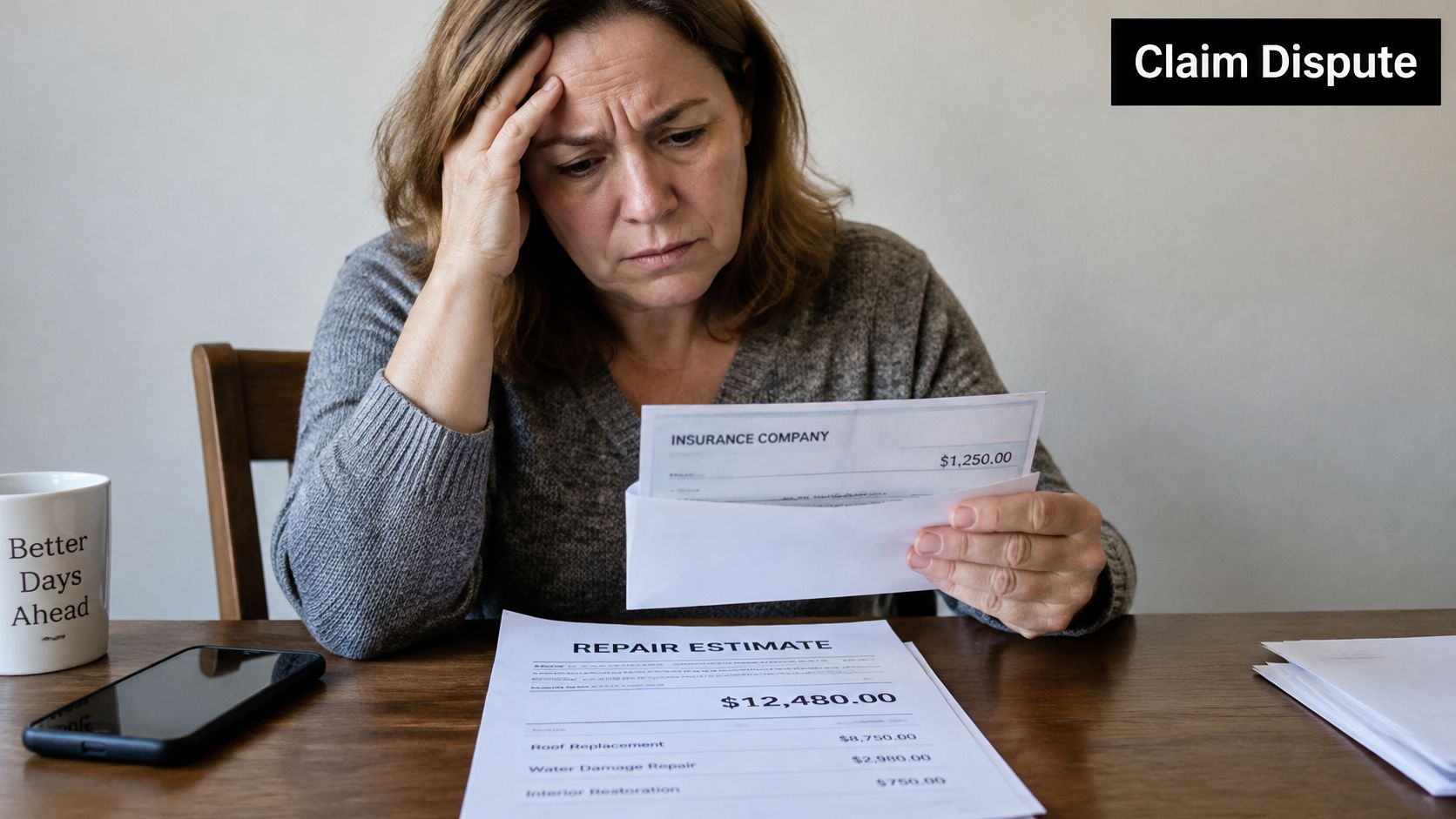
The insurance check arrives, but it won't cover the repair estimate. Your medical bills are piling up, you're missing work, and the adjuster's last message says the investigation is still pending. You need more than reassurance. You need to know what the insurer disputes, what evidence will answer it, and how to keep the disagreement from disrupting your care or costing you a legal deadline.
What an Insurance Dispute Claim Really Is
An insurance dispute claim is a disagreement between a policyholder or injured claimant and an insurer about whether payment is owed, how much is owed, or how the insurer handled the request. It isn't necessarily a separate claim form. It's the contested part of an insurance claim, whether you're dealing with your own carrier or pursuing compensation from someone else's.
A small check can make a complicated dispute feel like a simple refusal to help.
Identify the kind of disagreement
These categories overlap, but each asks a different question:
- Coverage dispute: Does the policy cover this loss or driver? Think of a ticket checker deciding whether your ticket admits you at all.
- Valuation dispute: What is the covered loss worth? This resembles agreeing that an item is for sale but disagreeing about its price.
- Liability dispute: Who caused the accident? It's the argument about who knocked over the glass, not what replacing it costs.
- Handling dispute: Did the insurer investigate, explain its decision, and communicate appropriately? Think of a clerk keeping you waiting without explaining what's missing.
The insurer's process deserves scrutiny alongside its policy wording. The Kansas Department of Insurance reported that 69% of complaints across six major lines in 2025 concerned claims handling. That finding doesn't establish wrongdoing in your case, but it shows why looking only for a policy exclusion can miss the actual problem.
Turn frustration into a defined issue
The National Association of Insurance Commissioners identifies delays, denials, and unsatisfactory settlements as common complaint reasons and recommends supporting emails and a chronological call log when submitting a state insurance complaint.
A useful starting note answers these questions:
- Who disputes what? Identify the insurer and its exact position.
- How much is at stake? Separate documented unpaid losses from amounts still being evaluated.
- What written record exists? Locate the denial, offer, correspondence, and supporting documents.
Replace “the insurer is being unfair” with a statement you can test: “The adjuster says the repair estimate includes unrelated damage, but hasn't identified which repairs.” That gives you a specific explanation to request and a factual position to challenge.
Why Insurers Dispute Accident Claims and What Proves Each Point
Match the insurer's stated reason to the evidence that answers it. A larger stack of records won't necessarily strengthen your response. The useful document is the one that addresses the disputed fact.
In a 2024 analysis of closed complaints reported through the NAIC, claims-handling complaints accounted for 65.2% of 60,861 complaints analyzed, according to Claims Journal. Those figures describe complaint categories, not the likelihood that your particular claim was mishandled.
Insurer dispute reasons and the evidence that answers them
| Dispute reason | What the insurer typically argues | Evidence that answers it |
|---|---|---|
| Fault or liability | The other driver or the claimant caused the crash | Police report, photos, witness statements, vehicle or dashcam data |
| Injury severity | Treatment was not needed or the injury is minor | Medical records, imaging results, treating physician notes, treatment timeline |
| Medical necessity | Care after a set date is unrelated to the crash | Physician referrals, treatment plan, prior records showing baseline health |
| Lost wages | Income loss is exaggerated or undocumented | Pay stubs, employer letter, tax returns, time-off records |
| Settlement value | The offer reflects a lower value for pain and future loss | Repair or medical estimates, itemized bills, expert opinion, comparable settlements |
| Coverage | The loss or driver falls outside the policy | Declarations page, policy wording, endorsements, written denial letter |
| Policy limits | The claim exceeds the amount the policy pays | Declarations page, written limits disclosure, records of other available coverage |
Answer the argument the insurer actually made
Suppose an adjuster accepts that the crash happened but questions whether ongoing physical therapy relates to it. More photographs of the intersection probably won't resolve that concern. A treating clinician's explanation of the diagnosis, symptoms, functional limitations, and treatment plan is more directly useful.
For a fault dispute, collision evidence matters more than the size of the hospital bill. A police report can help identify witnesses and document observations, but it isn't automatically conclusive. Video, vehicle damage, road conditions, and witness accounts may support or contradict its description.
A coverage denial requires a different approach. Read the cited exclusion together with the policy's definitions and endorsements. The declarations page summarizes coverage, but it doesn't contain every condition or exception.
Practical rule: Ask the adjuster to identify the disputed fact, the evidence relied on, and the evidence that could change the decision.
Be careful with comparable settlements. Another person's result isn't a price tag for your injury. Fault, available coverage, prognosis, jurisdiction, and the strength of the evidence can make apparently similar cases materially different.
Policy limits also need careful treatment. Proof that your damages exceed the stated limit doesn't, by itself, increase that policy's coverage. It may instead prompt an investigation into other insurance, other responsible parties, or a separate legal basis for recovery.
For every applicable table row, write a sentence stating what your file proves and what remains unsupported. For example: “My employer confirms missed shifts, but I haven't obtained documentation of lost overtime.” Identifying that gap before sending a demand lets you request the missing evidence instead of defending an unsupported total.
Build a Claim File That Holds Up
Build the file so someone unfamiliar with your accident can understand it without calling you for explanations. Use a master index, clearly named folders, and filenames that identify the document date and subject. Keep original files separate from anything you annotate.
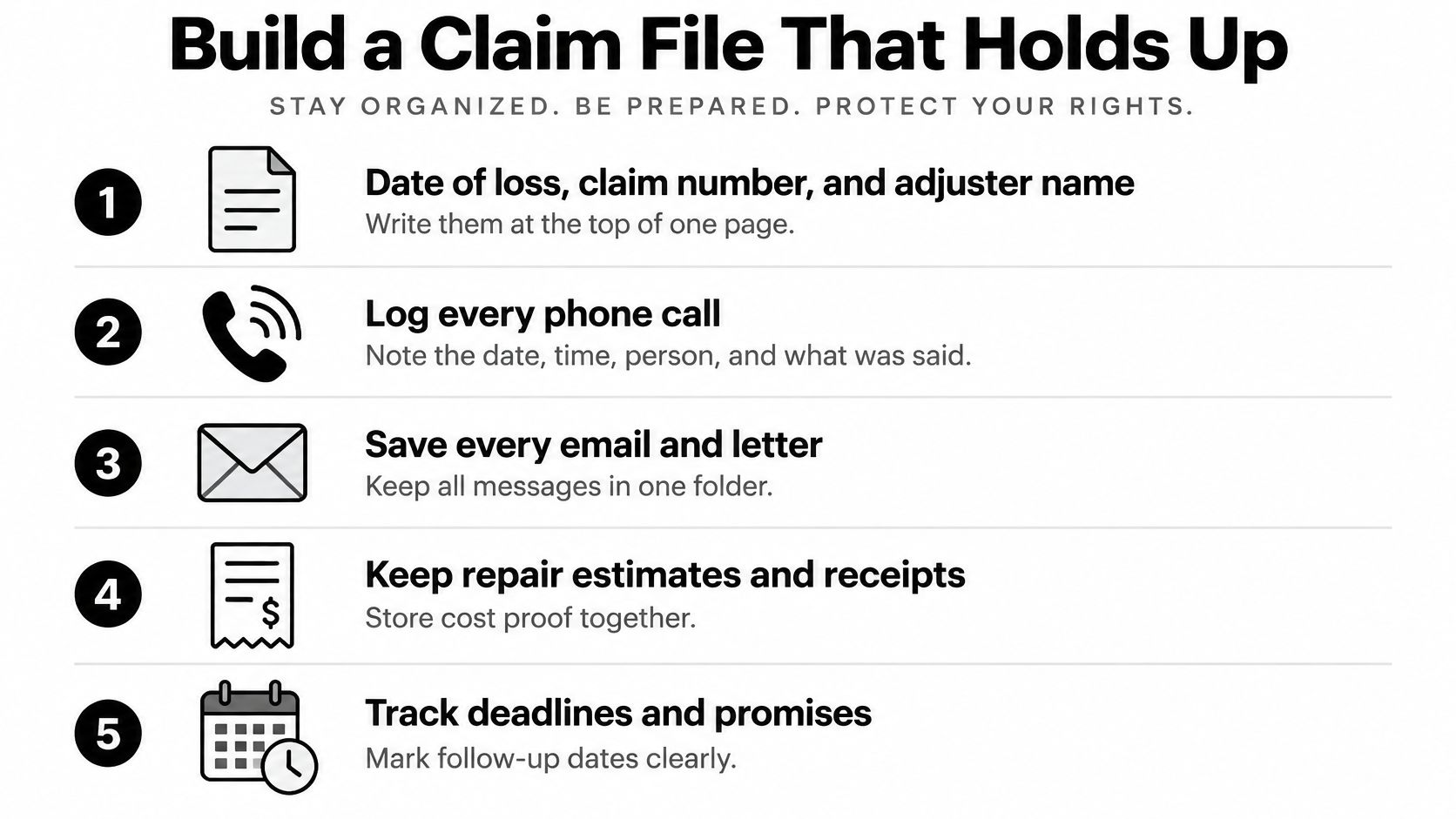
Use this visual checklist as a starting point.
Collect the record in a usable order
- Create a claim cover sheet. Write the date of loss, claim number, insurer, adjuster's name, and contact information at the top so documents don't get mixed between insurers or coverage types.
- Log every phone call. Record the date, time, participants, and a short summary, distinguishing what someone promised from what you understood or requested.
- Preserve messages in their original form. Save emails, letters, and texts with full headers and original attachments because forwarded excerpts can omit context.
- Track document requests and responses. Record when each request arrived, what it asked for, when you answered, and how you delivered the response.
- Keep submission evidence. Store medical-record authorizations, submitted bills, wage records, inspection dates, and delivery confirmations so you can establish what the insurer had.
- Pair offers with explanations. Keep photographs, estimates, receipts, and settlement offers together with the insurer's stated reasoning so you can compare the decision with its supporting information.
- Flag statement requests and repetition. Note recorded-statement requests and repeated questions, including where you already supplied the requested answer.
Make the file readable without changing the evidence
Use a spreadsheet with columns for date, event, document, insurer response, and next action. If an adjuster changes, the chronology helps you identify unfinished requests without reconstructing every conversation.
For medical materials, organize by provider and treatment date rather than mixing appointment notes with invoices. Our guide to medical-record organization can help you separate clinical evidence from billing records.
When an appeal portal or attorney needs a combined packet, PDFWix's step-by-step PDF merging methods explain ways to assemble documents. Preserve the originals, add an index, and check that every page remains legible and in order before sending the combined copy.
Don't upload sensitive medical or identity information to an unfamiliar tool without reviewing its privacy and security terms. A convenient document workflow shouldn't expose your claim materials unnecessarily.
A useful claim file shows not just what you sent, but what happened after you sent it.
Keep a secure backup separate from your working copy. Review outstanding requests and promises weekly, updating each item as received, answered, disputed, or still pending.
Deadlines Insurers Must Meet and How to Track Them
Colorado insurer deadlines for prompt payment
The following benchmarks come from Colorado's prompt-payment statute and apply subject to its coverage, definitions, exceptions, and conditions; they aren't a universal timetable for every accident-related demand.
| Situation | Insurer deadline | What to keep |
|---|---|---|
| Clean claim submitted electronically | Paid, denied or settled within 30 calendar days | Submission receipt with date |
| Clean claim submitted by other means | Paid, denied or settled within 45 calendar days | Proof of mailing or delivery |
| Insurer needs more information | Written explanation of what is missing within 30 days | Copy of the request and what you already sent |
| Claim that is not clean | Resolved within 90 days, with limited extensions | Written reason for any extension |
| Late payment on a clean claim | Interest on the amount allowed: 10% a year for the first 180 days, 15% after | Due date, payment date and interest calculation |
First confirm that the rule applies to your coverage and submission. Don't assume a statute governing covered claims gives an at-fault driver's liability insurer the same payment deadline for your injury demand. Different claim types can follow different rules.
A clean claim generally contains the information needed for a decision under the applicable requirements. If the insurer calls your submission incomplete, request a specific list of missing items and compare it with your delivery records.
Convert the rule into a dated task
Create a separate calendar entry for each legally significant submission. Attach the delivery confirmation, identify the rule you're using, and note the event that starts the clock. A sent email and proof that a complete submission reached the proper recipient aren't necessarily the same thing.
Use separate labels for:
- Insurer response dates: When an explanation, decision, or payment may be due.
- Your filing obligations: Notice requirements, appeal windows, and lawsuit deadlines.
- Follow-up promises: Dates an adjuster voluntarily gives you, which aren't automatically statutory deadlines.
A color-coded calendar can make those categories easier to distinguish. Pretty Progress's guide to visual deadline tracking for students offers organizational techniques you can adapt, but it isn't authority for calculating a legal deadline.
A missed payment deadline doesn't prove who caused the accident. It may support a delay complaint or an interest request if the governing law's conditions are met.
Court filing deadlines, policy notice provisions, contractual suit limitations, and health-plan appeal periods require separate attention. Their triggering events can differ, and an ongoing investigation doesn't necessarily extend them. Confirm the controlling state, policy, plan, and claim rules rather than assuming the clock starts with the denial.
Treat the earliest plausible deadline as your working date until qualified counsel confirms otherwise. Don't delete an entry because the insurer asks for another document or says negotiations are continuing.
How to Escalate a Dispute Step by Step
Escalation should give the insurer a clear opportunity to correct a specific problem, not create an endless exchange of increasingly angry letters. Move through the available options deliberately, and stop when you've reached an acceptable resolution. If a legal deadline is close, seek counsel rather than completing every informal step first.
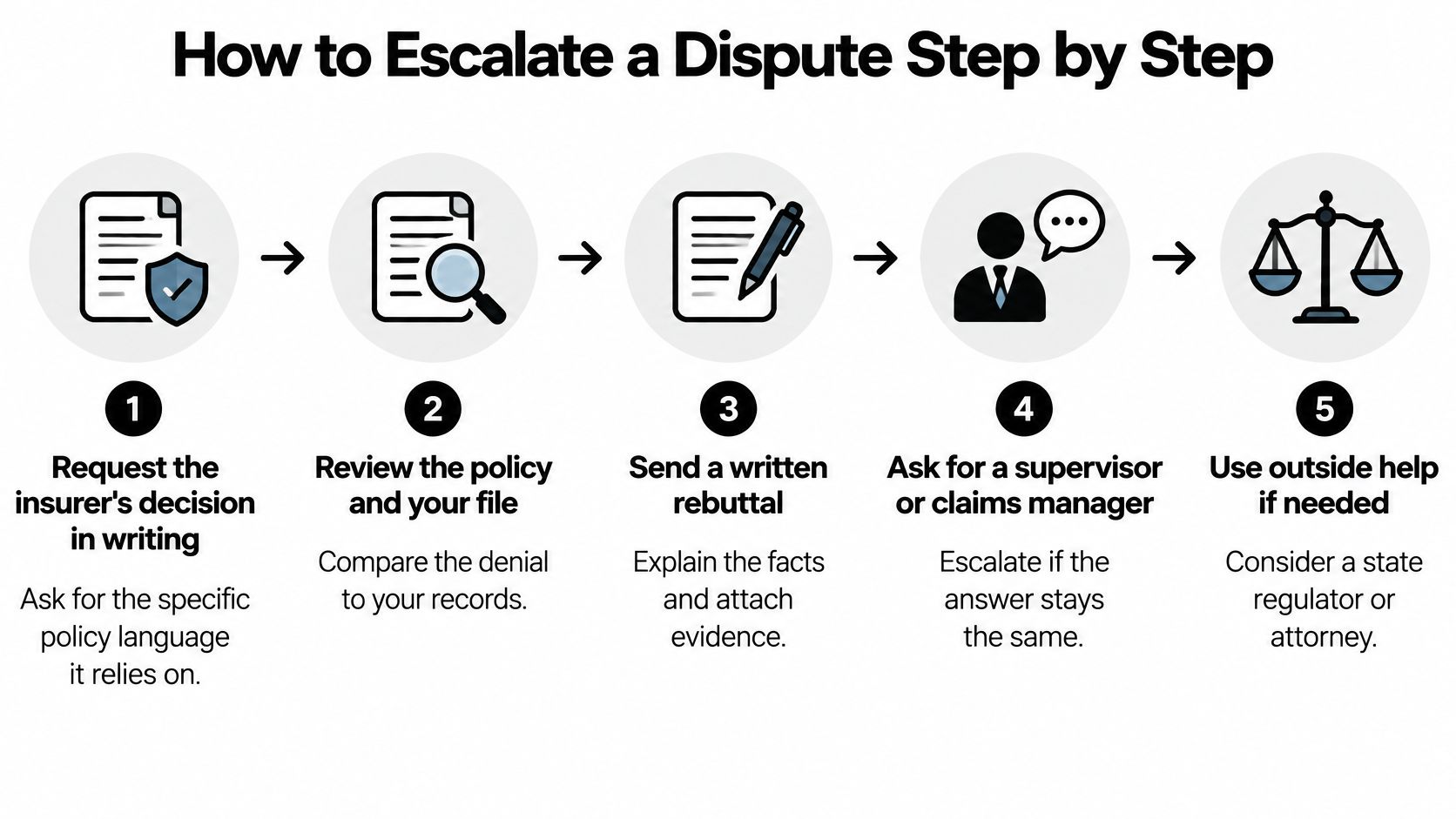
This process graphic captures the basic progression from a written decision to outside help.
Move from explanation to a supported challenge
- Request the decision in writing. Ask for the factual grounds, specific policy provisions, and any appeal instructions; move on when you can identify exactly what you're challenging.
- Send a focused demand or rebuttal. State the relevant facts, amount requested, supporting documents, and requested response date. Our guide to an insurance dispute letter can help you organize the response without burying the central issue.
- Seek internal reconsideration. Use the insurer's available appeal process and request supervisor review where appropriate; preserve the appeal deadline even if an adjuster offers to discuss the matter informally.
- Evaluate independent resolution. Appraisal, mediation, or arbitration may be available under the policy or by agreement. Check what each process can decide, whether participation is mandatory, and whether the outcome is binding.
- Submit a regulatory complaint. Explain the handling problem, attach the relevant correspondence, and request review. A regulator can examine insurer conduct, but a complaint isn't a damages lawsuit and shouldn't be assumed to suspend filing deadlines.
- Negotiate defined settlement terms. Address payment, releases, unresolved bills, and any remaining claims, not just the headline amount. Move on if the insurer won't meaningfully address documented losses.
- Prepare for litigation when necessary. Counsel can evaluate the proper parties, legal claims, evidence-preservation needs, and filing requirements before time runs out.
Know what escalation can't promise
Appraisal commonly addresses valuation questions within the applicable policy's scope, not every coverage or injury dispute. Mediation creates an opportunity to negotiate; it doesn't guarantee agreement. Arbitration can affect review rights, so understand the governing terms before consenting.
The Administrative Office of the U.S. Courts describes a historical pattern of insurance-case filings increasing after major natural disasters. That finding concerns a broader litigation context, not a prediction about your accident claim or how quickly a court will resolve it.
Record the date, recipient, requested outcome, and result of every escalation. A useful next step should either produce a decision, supply missing information, or preserve an enforceable right. Repeating the same unanswered request indefinitely doesn't accomplish those goals.
Paying Bills and Getting Care While the Claim Is Pending
The assumption that an insurance denial means treatment must stop can put your health at risk. An adjuster's payment decision isn't a medical instruction. Discuss necessary care and affordable alternatives with your treating clinician rather than stopping treatment solely because an insurer objects.
The financial pressure is real: a Commonwealth Fund survey found that 32% of working-age adults with private insurance were paying medical bills or medical debt over time. Keeping treatment available requires attention to billing as well as the liability dispute.
Unpaid bills can become an immediate household problem while the claim remains unresolved.

Keep the payment tracks separate
A health-insurer dispute concerns benefits under your health plan and follows that plan's appeal procedures. An at-fault auto-liability claim seeks compensation from the responsible party and their insurer. Don't assume the liability carrier will pay each medical bill as it arrives.
Your own policy's medical-payments coverage, if available and applicable, may provide a bridge. Health insurance may also pay eligible expenses while the accident claim proceeds, subject to its terms.
Those payments can create reimbursement questions later. A health plan or provider may assert a reimbursement claim or lien against settlement proceeds under applicable law or agreement. Ask for the asserted basis and an itemized balance before treating a settlement's gross amount as money available to spend.
For additional context on the financial side of an injury claim, consider the accompanying video.
Protect care and document the account
Contact provider billing offices before an overdue balance becomes harder to manage. Ask about billing holds, financial assistance, payment plans, and corrections to insurance submissions, and obtain any agreement in writing. A pending accident claim doesn't automatically prevent collections.
Keep a separate billing folder containing:
- Itemized bills and benefit explanations: Identify the service, insurer adjustment, payment, and remaining balance.
- Payment receipts: Preserve proof of what you paid.
- Collection notices: Record the sender, account, amount, and response instructions.
- Hardship notes: Document affordability barriers and the billing arrangements requested.
- Current treatment plan: Keep referrals, recommendations, and changes in care together.
Tell your clinician when cost prevents you from following the plan. A documented access problem is different from an unexplained treatment gap.
Never obtain unnecessary care to increase a claim. Conversely, explain legitimate interruptions, such as transportation problems or inability to afford appointments, so the clinical record reflects what happened.
Review any medical authorization, settlement release, or recorded-statement request before agreeing. These serve different purposes: permission to obtain records isn't the same as permission to resolve your entire injury claim.
Decide Whether to Bring in an Attorney
Bring in an attorney when the injury is serious or still changing, fault is contested, coverage is denied, the offer falls far below documented losses, or a deadline is approaching. Brain injury and wrongful-death claims also warrant early legal review because the evidence and long-term consequences can extend well beyond the initial bills.
You don't need to prove insurer misconduct before seeking advice. Sometimes the central problem is an incomplete damages presentation. Sometimes it's disputed policy language, missing crash evidence, or a handling pattern that requires a separate legal analysis.
What counsel should do with the dispute
An attorney should connect the legal issue to an investigation plan. That means identifying which witnesses, records, medical opinions, or accident-reconstruction evidence could change the insurer's position, rather than merely sending a more forceful version of your last letter.
At Nares Law Group LLC, we collect medical records, accident reports, witness statements, and expert opinions to establish liability and damages. We also have access to medical and accident-reconstruction experts who can testify about an injury's cause and impact.
Our attorneys negotiate with insurance carriers, and we don't accept lowball offers. If negotiation fails, we're prepared to take a case to court. Those are commitments about how we handle cases, not guarantees of a particular recovery.
When comparing representation, our guide to how to choose a personal injury attorney can help you evaluate communication, relevant experience, and litigation readiness.
Arrive with questions and an organized packet
Bring materials that let counsel assess both the claim and its urgency:
- Decision documents: The denial letter, policy materials, and every settlement offer.
- Evidence file: Crash information, treatment records, bills, and income-loss proof.
- Timing record: Your deadline calendar, submission receipts, and appeal instructions.
- Open questions: Missing evidence, disputed charges, care concerns, and reimbursement demands.
Ask which deadlines require immediate action, what additional evidence would be useful, and whether you should continue communicating directly with the adjuster. Discuss fees and the proposed scope of representation before committing.
Gather the file, identify the earliest potential deadline, and arrange a consultation within the week. If a filing date may arrive sooner, make that urgency clear when you first contact counsel.
Nares Law Group LLC offers a free consultation to answer questions about denied, delayed, or undervalued accident claims and assess the path toward compensation. Visit Nares Law Group LLC to request a consultation, and bring your denial letter, latest offer, and deadline calendar so we can focus on the decisions that need attention first.