The medical bills are arriving, you're missing work, and the adjuster has sent an offer that doesn't explain what was left out. Or your claim is still pending, with another request for records you thought you'd already submitted. You need payment, but you also need to avoid accepting an amount that leaves future treatment unpaid.
The insurance dispute resolution process starts with a deadline and a paper record, not a stronger argument on the phone. Identify what the insurer disputes, preserve the earliest filing deadline, and build a file that lets someone outside the claim understand exactly what should be paid and why. Then choose the route that can grant that relief.
Dispute Routes at a Glance
Dispute routes compared
| Route | Best for | What it can decide | Binding? | Typical cost to you |
|---|---|---|---|---|
| Insurer internal appeal | Missing records or misread policy terms | Reconsiders the insurer's decision | A rejection generally doesn't end external rights | Usually free |
| State insurance department complaint (US) | Delay, unfair handling, unresponsive insurer | Reviews conduct and may prompt correction or payment | Regulatory authority applies, but it isn't a damages judgment | Usually free |
| Appraisal | Disagreement over loss valuation | Usually the amount of loss, not coverage | Usually binding on amount under the policy | Your appraiser's fee and allocated umpire costs |
| Mediation or ombudsman | Stalled negotiations or an eligible consumer complaint | Settlement, or an ombudsman determination within its authority | Mediation requires agreement; ombudsman rules control acceptance and effect | Mediation fees; eligible ombudsman services are often free |
| Arbitration | A policy clause requires it or both sides agree | Issues submitted under the arbitration agreement | Usually binding, with limited review | Filing, arbitrator, and possible attorney fees |
| Litigation | Serious damages, disputed fault, coverage, or bad faith | Claims and remedies permitted by applicable law | Judgment binds, subject to appeal | Attorney fees, court costs, and litigation expenses |
Most readers enter this process during claim adjustment, not when buying insurance. An analysis of closed complaints based on National Association of Insurance Commissioners data identified 39,680 claims-handling complaints in 2024, representing 65.2% of the complaints analyzed, including delays and unsatisfactory settlement offers.
Match the route to the disputed issue
Appraisal usually decides how much a covered loss costs, not whether the policy covers it. Paying for appraisal when the actual obstacle is an exclusion may leave that obstacle untouched.
A missing medical report calls for correction of the claim record. An unexplained delay may justify a regulator complaint, while a serious injury or potentially unreasonable denial deserves attorney review. These are different problems, even when they appear in the same letter.
Property disputes also require different support from injury claims. For a homeowner comparing repair scopes, PostDamage's resource on public adjuster help for homeowners provides context for obtaining claim-preparation assistance, rather than confusing that role with legal representation.
Choose a first route based on the remedy you need. Write its deadline on your calendar before spending money on escalation, and verify eligibility, fees, and binding effect under your policy and local rules.
Gather Evidence Before You Push Back
Build a file that another person can evaluate without your narration. Save original documents, preserve email attachments, and use filenames that identify the date, sender, and subject.
Assemble the evidence record
- Policy documents. Collect the policy, declarations page, and every endorsement. A declarations page summarizes coverage but doesn't replace the provisions that govern payment.
- Complete claim file. Request the insurer's file, including adjuster notes and correspondence. Preserve your own copies because access to internal materials may be restricted or contested.
- Estimates and invoices. Include repair estimates, receipts, independent valuations, and the insurer's calculation. Highlight differences in scope, labor, replacement assumptions, or deductions.
- Medical support. Obtain treatment notes, itemized bills, relevant records, and explanations addressing disputed necessity or causation. A bill establishes a charge, but it may not explain why treatment was needed.
- Wage documentation. Gather pay statements, an employer letter, missed-work dates, and evidence supporting reduced earning capacity when applicable.
- Incident evidence. Preserve photographs, accident reports, witness statements, and original digital files. Keep evidence of the event separate from evidence of its financial consequences.
- Expert opinions. Use appropriate medical, reconstruction, repair, or valuation expertise when the insurer disputes a technical issue.
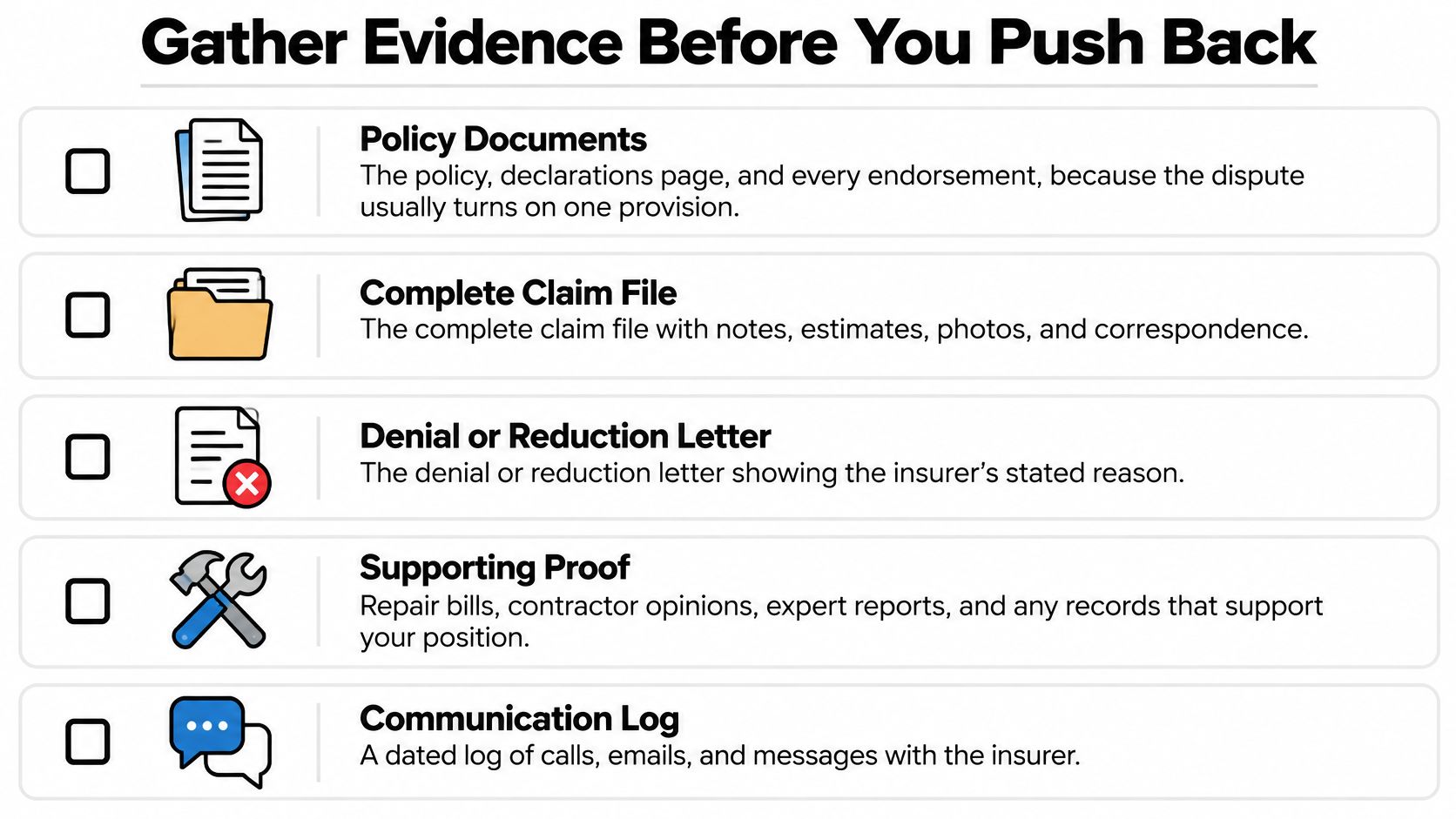
Keep the core documents together using this checklist.
Make the requested payment reproducible
Create a coverage-and-damages matrix with a row for each payment requested and columns for the supporting policy provision, factual proof, and amount. For a claim against another driver, identify the liability and damages evidence instead of forcing every loss into your own policy's coverage terms. Separate amounts already paid from outstanding charges so a reviewer can reproduce your calculation without double counting.
The Financial Ombudsman Service's annual complaints review reported 47,010 new insurance complaints in 2023/24 and a 38% uphold rate for resolved insurance complaints. That's a UK dispute-resolution measure, not a prediction for your claim.
Recordkeeping rule: Confirm an adjuster's verbal explanation in writing the same day. Ask the adjuster to correct anything you misunderstood.
At our firm, investigation includes collecting medical records, accident reports, witness statements, and expert opinions to establish liability and damages. Our pre-litigation files are reviewed for completeness, organization, and preparation. Apply that standard yourself by creating a dated document index before submitting the package.
Decide Whether an Appeal Is Worth the Time
Only about half of privately insured working-age adults who experienced a denial appealed in the nationally representative 2025 Commonwealth Fund survey; 33% of those who challenged a denial said the insurer reduced or eliminated the amount owed, while more than 60% of respondents who received an appeal decision said it took at least a month. Respondents also described uncertainty about their rights, whether appealing would matter, and whom to contact.
Those findings concern private health insurance, not an auto-injury success rate. The practical lesson is narrower: a correctable denial deserves attention, but you shouldn't budget on an immediate reversal.
Whether to appeal, wait, or get advice
| Your situation | Next move | Why |
|---|---|---|
| Missing records, a coding error, or an authorization mistake | Appeal quickly | A specific correction may resolve the stated denial |
| Treatment cannot safely wait | Request urgent review | Ordinary processing may not meet your medical needs |
| Serious injury, an exclusion, limits near damages, disputed liability, or possible bad faith | Get legal advice | Rights beyond internal reconsideration may need protection |
| You can't explain the insurer's error in a sentence | Gather evidence first while preserving the deadline | A focused appeal needs an identifiable error and supporting proof |
Weigh the cost of waiting
An appeal is worthwhile when you can identify what changes the decision. That might be a missing physician's explanation, proof that authorization was obtained, or policy language the insurer overlooked. Repeating that the outcome is unfair without addressing the stated reason usually adds little.
For urgent treatment, ask the treating clinician to document why ordinary review would be medically unsafe and follow the plan's expedited-review instructions. Don't assume that describing financial pressure alone establishes medical urgency.
Unpaid bills, lost income, and interrupted care also need a parallel plan. Ask billing offices about account status and available arrangements while the dispute continues, without promising payment from an unresolved claim.
Place your denial into a next-action category today. If the deadline is close, preserve the filing right rather than waiting for a perfect package.
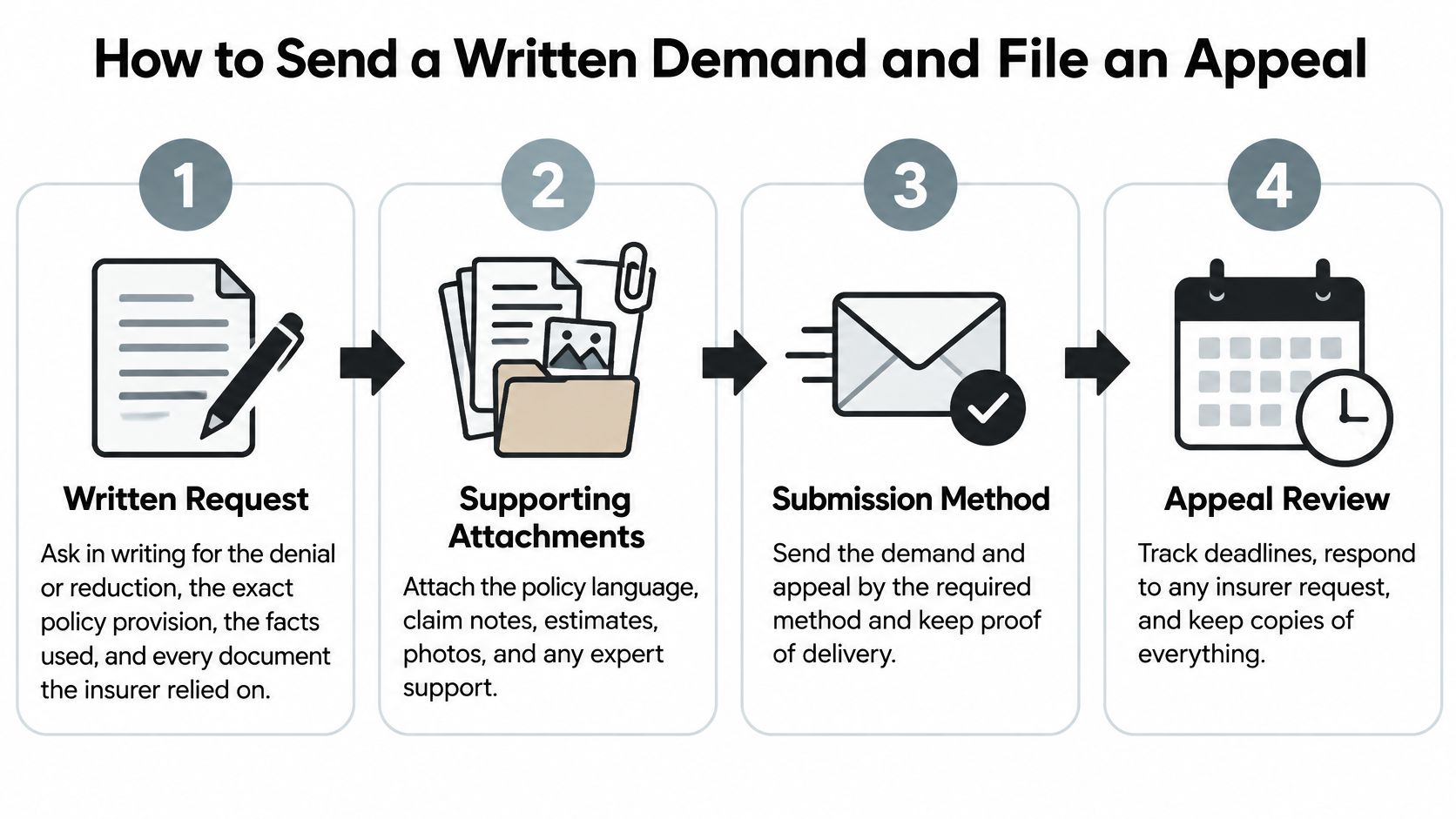
How to Send a Written Demand and File an Appeal
A demand explains what should change. An appeal must also satisfy the insurer's filing rules. A well-written letter sent to the wrong destination or after the controlling deadline may not preserve your rights.
Follow the filing sequence
Request the decision and its basis. Ask for the written denial or reduction, the exact policy provisions relied on, the factual findings, and the documents used. If the insurer describes the matter as still under investigation, ask what remains outstanding and who must supply it.
Attach the matrix and indexed exhibits. Use the coverage-and-damages matrix as the package's roadmap. Label attachments consistently so the reviewer can find the proof supporting each disputed amount without searching an unorganized medical-record download.
Write an issue-specific demand. Identify the claim and policy, state the requested correction, address each reason given, and explain what the attachments establish. Request a written explanation for every amount the insurer continues to deny or reduce. Our guide to an insurance dispute letter can help you organize that written presentation.
Verify every deadline independently. Record the decision date, receipt date, and the appeal instructions' triggering event. Check for notice, proof-of-loss, contractual suit-limitation, and statutory filing requirements. Don't assume the denial letter lists every deadline or that all periods start on its date.
Submit by the required method. Use the designated portal, address, fax, or other permitted channel, and retain the exact package plus delivery confirmation. Set a follow-up reminder that fits the applicable response period. Answer further document requests in writing and identify anything you cannot obtain.
Use the regulator complaint route after a failed appeal when appropriate. If the insurer rejects the appeal or remains unresponsive, submit the relevant state insurance department's complaint form. Attach the denial, demand, matrix, and delivery record; describe the handling problem precisely and save the complaint number. Confirm jurisdiction, especially with health coverage administered under a different regulatory framework.
Move to a forum with the necessary authority. If the regulator cannot award the disputed damages or decide the controlling issue, obtain advice about the appropriate next proceeding. Carry forward the organized record rather than rewriting the dispute from memory.
Use the following sequence as a submission check.
Audit before sending
At our firm, Case Resolution Manager Karla Prado manages demand packages, identifies missing evidence, tracks coverage and policy-limit opportunities, and audits files for potential issues. The practical equivalent for your submission is a final attachment check: does every factual statement point to proof, and does every requested amount have support?
Don't assume an appeal, negotiation, or regulator complaint pauses the deadline to sue. Confirm any extension and its legal effect before relying on it.
Send the demand before the earliest applicable deadline. Keep proof of what you sent, not just proof that an envelope arrived.
How Appraisal, Mediation and Arbitration Work
Neutral proceedings work best when you know what authority the neutral has before paying a fee or submitting evidence. Preparation also includes deciding what you can accept and what remains unresolved.
A meeting may look similar across these routes, but the consequences differ.

Prepare for the particular proceeding
Appraisal commonly begins with each side selecting a qualified appraiser under the policy. The appraisers choose an umpire, inspect or review the loss, and try to resolve their differences; many clauses make an agreement by the required members of that panel effective. Read the actual clause for qualifications, selection procedures, award requirements, and expense allocation rather than assuming every policy uses identical terms.
Mediation starts with selecting a facilitator and agreeing on the session's procedures. Bring a concise damages summary, supporting exhibits, and a settlement position that accounts for unresolved treatment needs. Confirm that the insurer's participant has meaningful settlement authority, and request written terms for any offer you're considering.
For practical preparation, Miles Hansford Law Firm's mediation guide provides background on the facilitated negotiation process. Our explanation of what the mediation process involves can also help you prepare questions about attendance, confidentiality, and settlement documentation.
Arbitration requires closer attention to the governing agreement before filing. Determine which disputes are covered, how the arbitrator is selected, what evidence exchange is allowed, how fees are allocated, and whether an award is binding. A less formal hearing doesn't necessarily mean low expense or broad appeal rights.
The accompanying video provides another format for reviewing the dispute-resolution discussion.
Review the settlement before committing
Choose appraisal for a qualifying amount-of-loss dispute, mediation for negotiable differences, and arbitration when an enforceable agreement requires it or informed agreement makes it appropriate. Check your policy's appraisal and arbitration provisions before selecting a route.
A release deserves separate review. Settlement paperwork, and sometimes language accompanying a payment, can affect rights beyond the amount currently disputed. Don't sign or accept settlement terms before understanding whether future medical costs, unknown injuries, or other claims are included.
When to Escalate to Bad Faith or Litigation
Use these warning signs to identify when routine claim correspondence is no longer enough.
Escalation triggers and next moves
| Warning sign | Why it matters | Next move |
|---|---|---|
| Insurer misses an applicable state claim-handling deadline | A violation may support regulatory action or a legal claim | Log the dates, verify the rule, and file an appropriate complaint |
| Offer is below documented losses without a written basis | You can't evaluate an unexplained reduction | Demand the written valuation and submit your matrix |
| Insurer refuses to pay an undisputed amount | Withholding may conflict with applicable payment duties | Request payment in writing and identify any asserted conditions |
| Denial turns on a liability investigation | Responsibility for the accident requires separate attention | Preserve the claim against the responsible party |
| Policy limits are close to the injury's value | Settlement choices may affect access to other recovery | Obtain attorney review before accepting |
| You're asked to sign a release | The wording may surrender unresolved rights | Pause for legal review |
Escalation should buy something useful
A lawsuit isn't automatically the best next step. Mediation may deliver practical relief without the expense and disruption of discovery, while litigation may be necessary to resolve contested fault, compel evidence, or pursue remedies unavailable through a complaint process.
The review of Ireland's Financial Services and Pensions Ombudsman complaints published by Kennedys reported that 41% of all complaints closed in 2025 were resolved through mediation. That finding concerns that ombudsman's caseload, not a promised outcome for a Colorado injury dispute.
Bad faith is more than disagreement over value. The applicable standard and available claim depend on the jurisdiction and your relationship to the insurer. Unreasonable delay, an unsupported denial, or an offer without a reasonable basis may warrant investigation; our bad-faith insurance claim guide explains the distinction further.
Maintain a dated log showing requests, responses, missing explanations, and resulting consequences. Preserve a personal-injury claim against a liable driver separately from any complaint about insurer conduct.
Account for the burden of litigation
Discovery may provide access to relevant claim-handling notes, communications, and valuation materials, subject to privilege and other limits. It also requires document production, testimony, scheduling, and expense, without guaranteeing recovery. At our firm, we're prepared to take a case to court if negotiation fails.
List the warning signs present in your file. Mark the issue that requires action this week, especially if evidence or a filing deadline is at risk.
What to Bring When You Hire an Attorney
Attorney review is most useful before you commit to a decision that's difficult to reverse. That includes responding to a proposed release, navigating disputed fault, evaluating damages near available limits, or deciding how to address an unexplained delay.
The first conversation should clarify which route fits, which deadline controls, and how representation would be paid for. Ask whether fees are hourly, contingent, or structured another way, how costs are advanced, and what obligations remain if the matter doesn't produce a recovery. Get the engagement terms in writing.
Bring a file that supports decisions
- The decision and responses. Include the denial or low offer, your replies, and any correspondence explaining the insurer's position.
- The complete policy. Bring the declarations and endorsements as well as the main policy form.
- Your organized proof. Supply the dated document index and coverage-and-damages matrix, with attachments available electronically.
- A working timeline. Identify treatment, missed work, insurer requests, delivery dates, and periods without a response.
Tell the attorney about other insurance, prior payments, outstanding medical balances, and any documents you've signed. Explain what remains uncertain rather than guessing at a fact to make the file look complete.
Focus on the recovery you can retain
Ask counsel to distinguish your own-insurer claim from any claim against an at-fault driver. Each may involve different duties, procedures, and deadlines, and a strategy for one shouldn't accidentally compromise the other.
The gross settlement also isn't the same as the amount available to you. At our firm, Karla Prado monitors medical bills, liens, subrogation interests, and other obligations that can affect final recovery.
Before the appointment: Flag any pending recorded statement, notice request, settlement payment, or document requiring your signature.
You don't have to wait for a formal denial to seek advice. Schedule review before the earliest date on your calendar, and send the attorney the deadline information when requesting the appointment.
Nares Law Group LLC offers free consultations for Colorado auto accident cases and helps injured people investigate claims, organize supporting evidence, negotiate with insurers, and pursue litigation when appropriate. Visit Nares Law Group LLC to request a consultation, and bring your insurer's decision, policy, and deadline calendar so the discussion can focus on your next move.