Your phone rings while you're sorting discharge papers at the kitchen table. The adjuster has an offer, but you still have headaches, your next appointment isn't scheduled, and your paycheck is smaller than it should be.
The number sounds helpful. What you need to know is whether it will cover what's already owed and what's still ahead. A car accident injury settlement should be judged by the money you can keep and use, not just the amount printed on the release.
What a Settlement Check Actually Buys
The adjuster asks whether you're ready to resolve the claim. You're wondering whether resolving it means the clinic gets paid, your missed shifts get covered, or you can finally stop answering insurance calls.
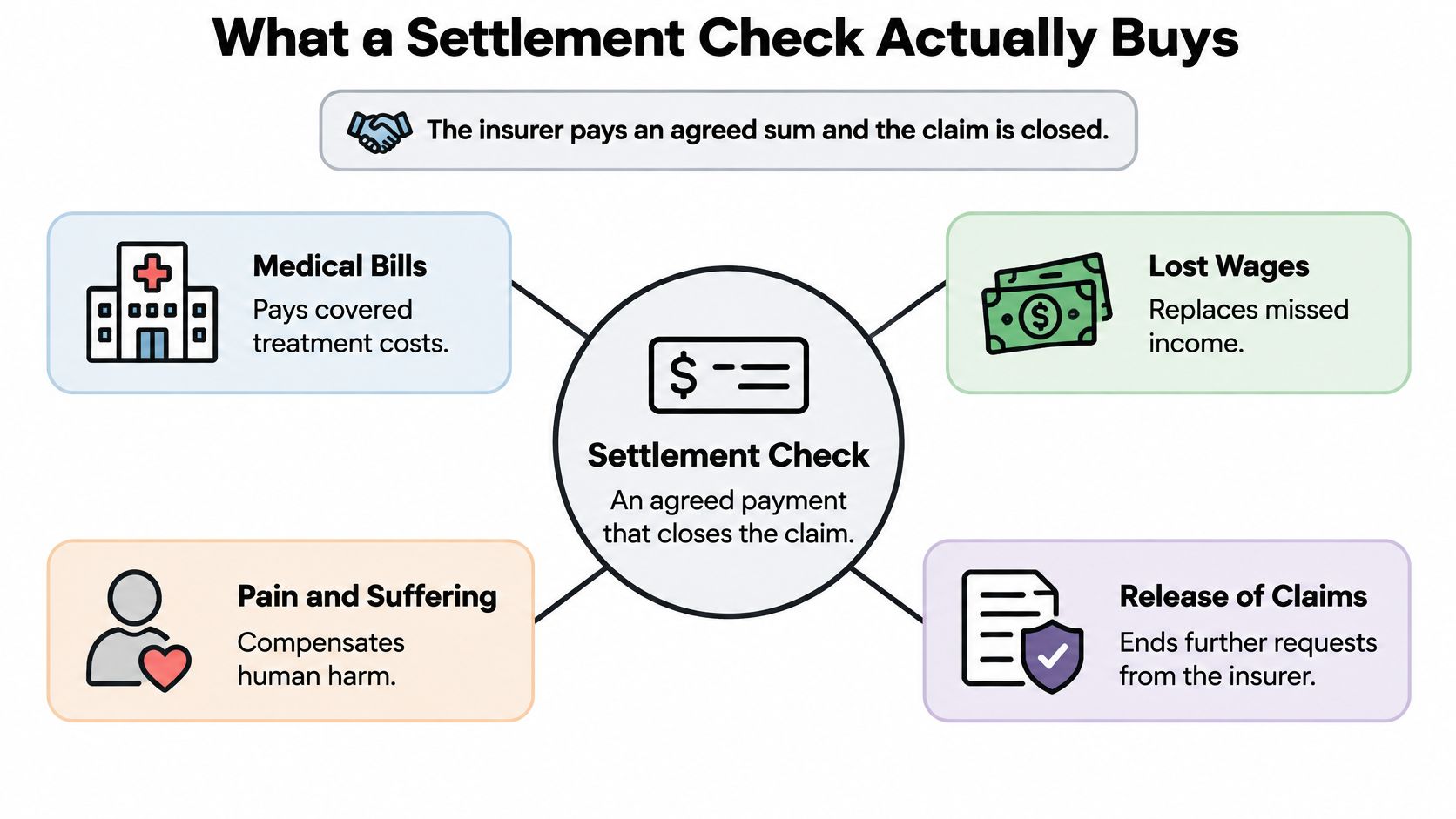
A settlement is a contract. The insurer agrees to pay an amount, and you sign a release that usually ends your injury claims against the people and insurance interests named in it. It isn't a traffic fine, a deductible refund, or a jury verdict.
Settling buys certainty, much like locking a price ends haggling. The difference is that this price may need to cover care you haven't received yet.
The basic exchange looks like this.
More than the emergency room bill
The payment may address treatment, missed income, household help, physical pain, and limits on everyday life. Being unable to lift your child or concentrate through a workday matters even when there's no separate invoice for it.
NHTSA's crash-cost report estimated $340 billion in economic costs from U.S. motor-vehicle crashes in 2019, rising to approximately $1.4 trillion when quality-of-life valuations were included. Those national totals aren't a settlement formula, but they show why bills alone don't describe an injury's consequences.
Practical rule: Describe what changed in your life, not just what diagnosis appears in your chart.
Health insurance may pay the clinic first and later seek reimbursement from the settlement. That means the deposit and the amount you keep can be very different.
Available liability coverage also matters. The at-fault driver's policy limit generally caps that policy's payment, not necessarily every possible source of recovery, and shared fault may reduce what you recover under applicable law. Before agreeing to a figure, identify both the losses it addresses and the claims you're giving up.
Settlement Benchmarks and What They Measure
Say a cyclist gets an offer while the neck still locks up before dawn. The adjuster calls the number “in line with the data.” The useful question is narrower: which data, counted how, and after which deductions?
What common settlement figures actually measure
Older paid-claim studies can show that averages moved as medical costs and attorney involvement changed, but they describe closed claim populations. They do not price an open file, and they do not predict what one injured person should accept.
| Benchmark | Figure | What it counts | Common confusion |
|---|---|---|---|
| Average third-party bodily-injury payment | About $29,900 | Payment per injured person in recent claims data | A quote for ongoing care |
| Medical expenses submitted with third-party claims | About $32,300 | Submitted medical cost per injured person in Q1 2026 | The amount providers must accept |
| NSC disabling motor-vehicle injury | $174,000 | 2024 average economic cost of a disabling injury | An insurer settlement |
| NSC evident injury | $45,000 | 2024 average economic cost of an evident injury | A settlement including pain and suffering |
| NSC possible injury | $28,000 | 2024 average economic cost of a possible injury | A minor-claim offer |
The newer payment and submitted-expense figures come from CCC's Crash Course report, which reports approximately $29,900 in average third-party bodily-injury payments per injured person and $32,300 in submitted medical expenses per injured person in Q1 2026. Those are separate averages across many claims, so subtracting one from the other does not reveal a personal shortfall.
The economic-cost rows measure another thing. The National Safety Council's cost guide lists 2024 average economic costs of $174,000 for a disabling motor-vehicle injury, $45,000 for an evident injury, and $28,000 for a possible injury. That is a model of financial harm, not a promise that an insurer will write a check for that amount.
Match the number to the question
Put the offer beside the benchmark only after naming what the benchmark leaves out. A paid-claim average may blend minor sprains with surgery cases. A submitted-expense figure may reflect charges before reductions. An economic-cost estimate may count losses a release still hands back through liens, fees, missed pay, or care still ahead.
Use benchmarks narrowly:
- Paid claims describe what insurers paid inside the measured group.
- Submitted medical expenses describe charges presented with claims, which can differ from final balances.
- Economic costs estimate harm in dollars, separate from what a negotiated release nets.
Then run the offer line by line. If the gross number looks strong yet repayment claims, attorney fees, lost income, and future treatment leave little for recovery, the benchmark was the wrong mirror.
Damages That Raise or Shrink the Number
You open a hospital envelope and see a balance. Beside it sits an employer's message asking when you can return without restrictions. Both belong in the claim, but they prove different losses.
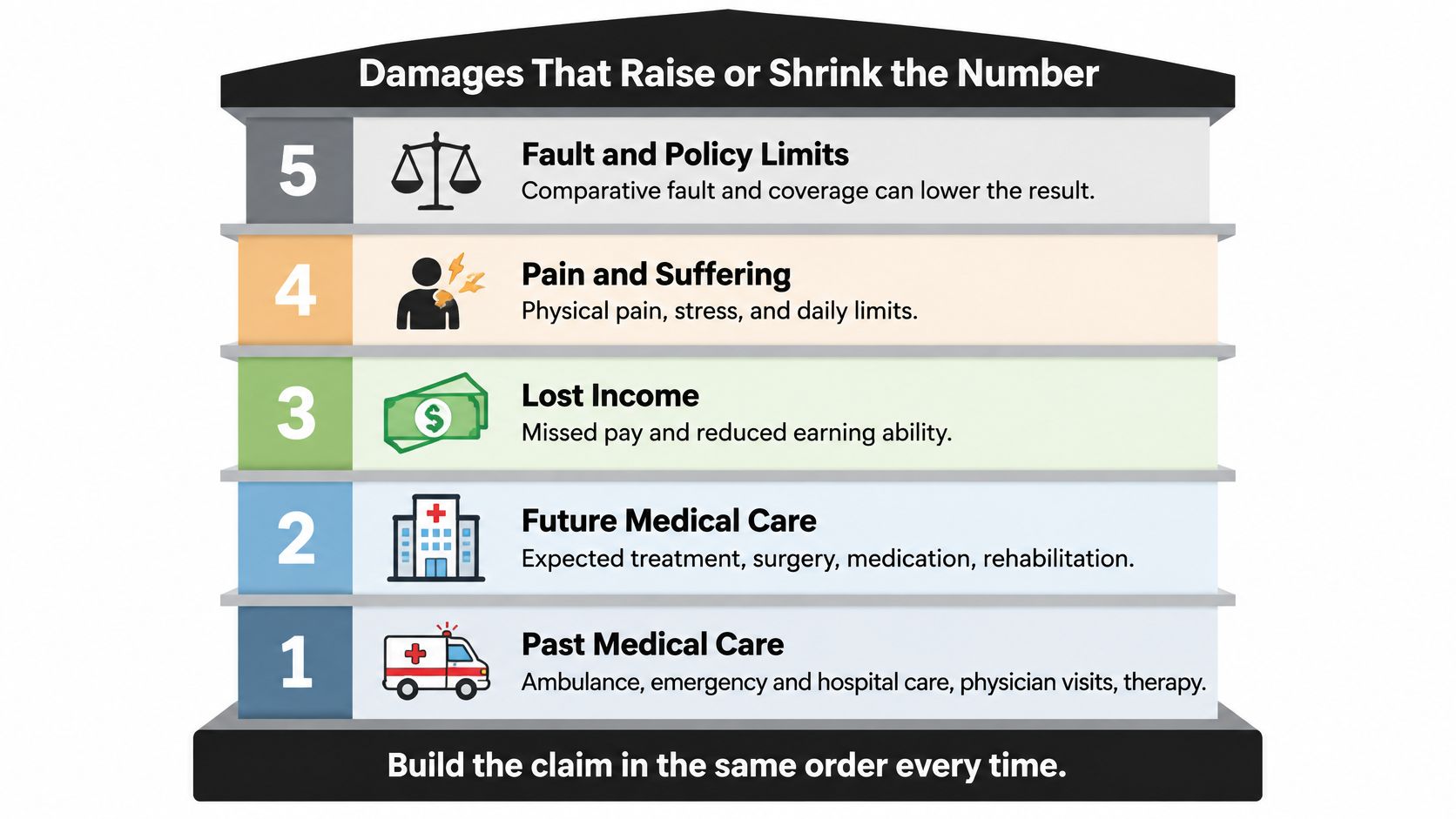
Build your valuation in separate folders rather than applying a secret multiplier to the first bill.
Build the claim from documented losses
- Past medical care. Collect itemized ambulance, emergency, hospital, physician, rehabilitation, prescription, and equipment bills. Match them with explanations of benefits and payment records so you can distinguish charges, adjustments, and outstanding balances.
- Future medical care. Ask the treating clinician to document expected treatment, its purpose, and the likely restrictions involved. A physician projection or life-care plan makes unfinished care more concrete than a general statement that you still hurt.
- Lost earnings. Save pay stubs, tax records, and an employer letter identifying missed shifts or reduced hours. If your ability to earn has changed, preserve the medical restrictions that explain why.
- Lost household productivity. Keep a dated record of childcare, cooking, cleaning, and other tasks you can't perform. Note who took over and whether you paid for help.
- Non-economic harm. Record specific functional changes, such as abandoning a grocery trip because of dizziness or needing breaks during an ordinary drive. Avoid exaggeration and connect those changes to treatment records where possible.
NHTSA's national cost model treats productivity loss as both workplace and household loss; for critically injured survivors at its most severe nonfatal injury level, MAIS 5, average economic cost was approximately $1.0 million, with medical costs and lost productivity comprising 82%. That benchmark underscores the importance of documenting continuing needs, not pricing another person's claim.
This visual summarizes the major valuation categories and coverage constraints.
Keep recovery separate from valuation
For everyday recovery questions, Thermo Recovery Wear's guide to managing neck discomfort after whiplash can help you prepare questions for your clinician. General comfort advice doesn't replace an examination, establish the cause of symptoms, or price a legal claim.
An insurer may challenge responsibility for the crash, argue that treatment relates to another condition, or point to limited coverage. Keep the evidence for each issue separate: collision evidence for fault, medical opinions for causation, and policy documents for coverage.
Don't finalize the demand while important future care remains unexplained. If treatment must continue, get the expected needs written down.
How Long the Claim Usually Takes
You've finished the emergency visit, but you haven't finished recovering. The insurer's request for a final number can arrive before your doctor can give a reliable prognosis.
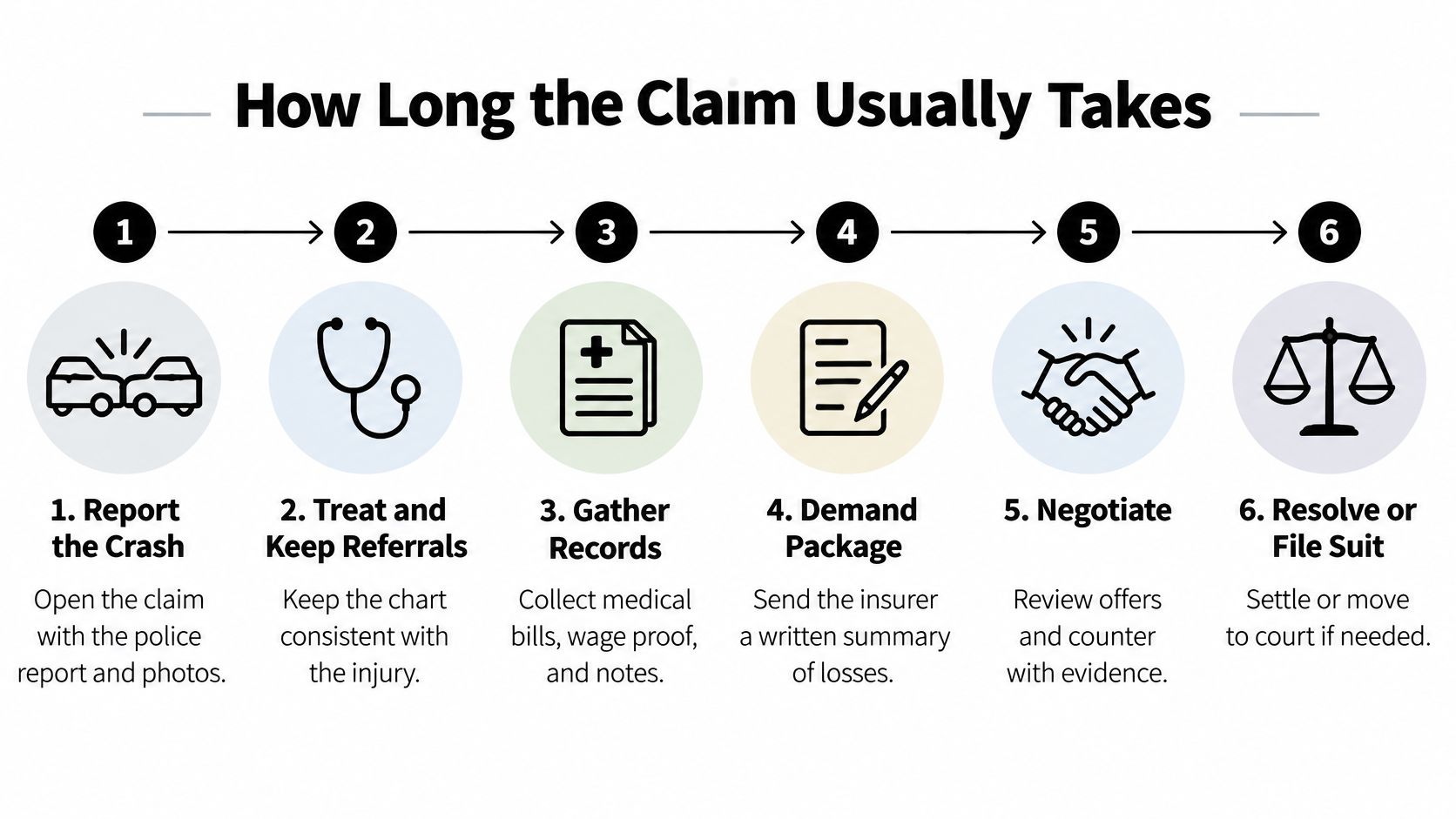
Find your place in the process
- Report the crash and open the claim. Preserve photographs, driver information, and the crash report when available.
- Treat and keep referrals. Tell clinicians about developing symptoms and explain missed appointments clearly. Your chart should reflect what happened, including barriers to care.
- Clarify the medical outlook. Before making a final demand, seek a stable prognosis or a written future-care plan.
- Send a demand package. Organize responsibility evidence, medical records, bills, earnings documentation, and functional losses.
- Exchange offers. Answer disputed items with supporting records rather than repeatedly changing a target number.
- Resolve the claim carefully. Identify reimbursement obligations before signing, then confirm final payoffs and the settlement accounting before spending the proceeds.
The Insurance Research Council analysis examined paid auto-injury claims closed from mid-2017 through mid-2022 and found that represented bodily-injury claims had a median closure time of nearly 440 days, more than twice the duration of unrepresented claims. That comparison doesn't prove that hiring counsel itself caused the delay or predict your completion date.
The process is easier to follow in sequence.
Separate healing time from claim problems
A fast closure may feel attractive when rent is due, but unresolved concussion symptoms or soft-tissue pain can make early valuation unreliable. MEDISTIK's explanation of how long muscle strains take to heal offers general recovery context, not a deadline for settling.
Our car accident settlement timeline guide explains the claim stages in more detail. A coverage denial requires a different response from waiting for treatment records, and neither should distract you from applicable filing deadlines.
Speed alone isn't a sound reason to price undocumented care.
Why a Larger Offer Can Still Fall Short
The offer increases, and you feel relief. Then you learn that the provider balance, reimbursement demand, and legal deductions still have to come out.
Gross recovery is the starting point. Net proceeds are what remain after actual deductions. Financial adequacy is a further question: can that remainder cover income you lost and treatment you still need?
Net proceeds worksheet before you accept
| Line | What to enter | Why it changes the check |
|---|---|---|
| Gross offer | The insurer's proposed payment within available coverage | Starting point only |
| Unpaid medical bills | Confirmed balances still owed to providers | Reduces spendable proceeds |
| Health-plan or government reimbursement | Confirmed private-plan, Medicare, or Medicaid repayment claims | Requires resolution under applicable rules |
| Difference between billed and accepted charges | Contractual adjustments or confirmed negotiated reductions | Prevents deducting charges you no longer owe |
| Attorney fee | The fee calculated under your agreement | Reduces the client remainder |
| Case costs | Records, filings, experts, and other documented expenses | Separate from the attorney fee |
| Unpaid wage loss | Documented income not already replaced | A need the remaining proceeds may have to cover |
| Future care still ahead | Supported treatment projections | Requires a reserve from the remainder |
| Money left | Gross less actual obligations, fees, and costs, then account for income and care needs | Shows both net proceeds and the remaining financial gap |
Don't deduct the same medical expense twice because it appears on both a bill and a reimbursement statement. Likewise, lost wages aren't ordinarily a payment to someone else at disbursement, but they matter when judging whether your remaining money is enough.
Say the offer rises while your health plan's repayment demand arrives and your doctor recommends continued care. Without final balances, you can't tell whether that larger offer improves your position.
Correct what the early file missed
A 2026 report in Auto Body News citing insurer filings reported that 45% of liability and medical claims resolved in 2025 closed without payment, compared with roughly 35% a decade earlier. Those figures don't establish why an individual claim went unpaid.
Early reviews, including automated reviews, may miss delayed symptoms, intermittent pain, caregiving demands, or work restrictions absent from the emergency note. Send a dated symptom timeline, referrals, wage proof, and functional restrictions with a written request to reconsider overlooked information.
A coverage denial concerns whether the policy responds. A dispute over injury severity concerns the medical proof and resulting losses. Obtain the written reason before choosing your response.
Our insurance policy limits explanation can help you assess coverage constraints. Our results include a car wreck brain injury settlement of $500,000 under policy limits, a truck wreck settlement of $1.5 million under policy limits, and a listed $7,250,000 brain injury settlement. These are individual outcomes, not predictions for your claim.
Judge the offer by the documented remainder and unmet needs, not by whether the headline number sounds impressive.
Negotiation Moves Before You Accept
The adjuster sends an offer without explaining how it was calculated. You don't have to answer with an immediate yes or an unsupported demand for more.
A useful counter identifies the missing evidence and explains how it changes the evaluation. Our guide to negotiating with an insurance adjuster provides additional context for those conversations.
Make the counter easy to evaluate
- Request the evaluation in writing. Ask for available policy-limit information and the factual basis for the offer. Disclosure obligations depend on the circumstances and governing law.
- Wait until the medical outlook supports a final demand. If a clinician recommends further evaluation, explain what remains unresolved rather than guessing at its cost.
- Counter by category. Identify omitted treatment, earnings loss, household limitations, or daily-life effects. Attach the record that supports each correction.
- Ask the adjuster to explain deductions individually. A fault reduction and a disputed treatment bill require different answers.
- Clarify recorded-statement requests. Before agreeing, establish who is asking, what subjects they want covered, and whether your own policy requires cooperation. Get advice if you're unsure; don't ignore contractual duties or guess about medical facts.
- Set a reasonable written response date and keep a dated communication log. Your requested date doesn't replace a legal filing deadline.
- Check other coverage before releasing anyone. Determine whether settlement requires notice to, or consent from, an uninsured or underinsured motorist carrier.
Keep the file ready for review
Save the demand, attachments, offer letters, medical timeline, and repayment information together. After a telephone discussion, send a brief confirmation of what was discussed and what each person agreed to provide.
A low initial offer may be a negotiating position, but don't assume every claim will improve through bargaining. The strongest response shows why a particular assumption is wrong.
Before you sign: Silence isn't acceptance, and an adjuster's open file doesn't protect you from a filing deadline.
If negotiations stall, identify the reason. Missing records call for follow-up; a genuine dispute over fault or medical causation may require legal analysis, expert evidence, or litigation rather than another unsupported counteroffer.
When to Hire a Lawyer Instead
Say a delivery driver with a concussion sits at her kitchen table with three envelopes: a reimbursement letter from her health plan, a statement request from another insurer, and an offer that looks decent until she subtracts what the plan wants back. She can make the phone calls herself. The question is whether she can spot every issue that changes what she keeps.
A consultation can help separate paperwork you can handle from decisions that need legal review.

Signs that professional help may be worthwhile
- Lasting or brain-related symptoms. Continuing headaches, cognitive changes, or uncertain work capacity can make valuation difficult.
- Multiple insurance interests. Commercial vehicles, rideshare activity, and uninsured or underinsured motorist coverage can create overlapping obligations.
- Disputed responsibility. Conflicting accounts may require witness development or reconstruction.
- Complicated repayment demands. Government-program or health-plan claims can shrink the net recovery and shape settlement strategy.
- An offer that doesn't meet future needs. A coverage-limited offer deserves review for other potentially responsible parties or insurance sources.
Each of these affects the net number, not just the headline. A larger offer can still leave someone exposed when liens, fees, lost wages, and future care haven't been worked out line by line before anyone talks about averages.
Compare the work with the cost
Handling a claim yourself may be reasonable when you've fully recovered, responsibility is clear, medical balances are manageable, and no earnings were lost. Even then, an independent review of the release can catch consequences that aren't obvious from the offer letter.
Attorney fees and case costs reduce the amount a client keeps, so the fee terms should be weighed against what the legal work could add. That trade can make sense when the work uncovers missing coverage, develops disputed damages, or resolves obstacles you can't handle alone. It isn't automatically worthwhile just because a lawyer participates.
At Nares Law Group, an investigation includes collecting medical records, accident reports, witness statements, and expert opinions to establish liability and damages. The firm has access to medical and accident reconstruction experts who can testify about an injury's cause and impact.
That preparation matters when a truck crash requires reconstruction or a brain injury needs more explanation than an emergency room record provides. The firm's attorneys negotiate with insurance carriers to secure settlements, and the firm never accepts lowball offers.
This video offers another way to consider the decision.
The practical test is simple: if you can't explain every deduction and every party being released, get advice before signing. Ask what work the lawyer proposes, how fees and expenses are calculated, and what could still limit your net recovery.
Confirm the Release Before You Spend It
You've reached an agreement, and the temptation is to treat the money as available. Pause long enough to make sure the paperwork matches the agreement and the deductions are supported.
Signing usually ends the released claim even if symptoms later worsen. This is the last opportunity to catch an omitted future-care need before making that commitment.
Follow the disbursement sequence
- Read who is being released. Identify every person and entity covered, and check the effect on any uninsured or underinsured motorist claim.
- Treat the gross payment as unavailable for spending until you have a settlement statement showing the proposed distribution.
- Obtain final repayment information. Collect applicable lien or reimbursement letters from health plans, government programs, and providers, and confirm how each will be resolved.
- Confirm the attorney fee calculation and itemized case costs in writing. Reconcile them with the signed agreement.
- Consider payment structure if appropriate. Discuss whether an available structured arrangement or lump sum better fits continuing needs, including flexibility and access to funds.
- Save the final settlement statement, payoff confirmations, release, and payment records together.
- Use only the confirmed remainder. Before committing to the release, our free consultation for Colorado auto accident cases gives you an opportunity to ask an attorney questions, discuss the case, and assess the compensation your file may support, without a promise of outcome.
Resolve discrepancies before signing
If a repayment amount is estimated, ask who will finalize it and how any difference will be handled. If the release names an unfamiliar party, find out why that party is included.
Bring the offer, medical bills, and lien letters to the conversation before you sign. You should leave understanding both what you'll receive and what rights you'll surrender.
Nares Law Group LLC offers free consultations for Colorado auto accident cases to help injured people understand their claims and compensation options. Visit Nares Law Group LLC to discuss your offer, outstanding bills, and release before deciding whether the settlement meets your needs.