Only about 3% of personal injury cases reach a judge or jury trial, using historical tort-case studies as the benchmark. That's a starting point for understanding the litigation process, not a forecast for your individual claim.
The important distinction is which cases the statistic counts. Department of Justice and Bureau of Justice Statistics studies measure court cases, not every injury claim submitted to an insurer. Federal jury-verdict figures measure something narrower still. To understand how many personal injury cases go to trial, you need to separate the court system, the claim category, and what counts as a trial outcome.
Share of Personal Injury Cases That Reach a Verdict
Trial is the exception, not the usual endpoint of a personal injury lawsuit. But there isn't a single current percentage that accurately describes every state-court crash case, federal product-liability action, or wrongful death lawsuit.
The foundational Department of Justice study examined approximately 378,000 completed tort cases in the nation's 75 most populous counties from 1991 to 1992, finding that 3% went to trial and more than 75% settled out of court, as summarized in Duke Law's Judicature. Its tort caseload was particularly relevant to injury litigation because automobile accidents and property-liability disputes predominated.
Personal injury and civil trial rates by source
| Source | Period | Trial rate |
|---|---|---|
| DOJ study, 75 largest U.S. counties, tort cases | 1991–1992 | About 3%; more than 75% settled |
| Bureau of Justice Statistics, state courts survey | 2005 | About 3% of tort cases |
| Federal civil cases | 1962 | About 12% |
| Federal civil cases | About 40 years after 1962 | Below 2% |
| Federal civil cases, contemporary data | Recent federal reporting | About 1% |
| Federal personal injury filings | 2019–2023 | Under 1% reached a jury verdict |
| Colorado federal district court | 2024 | 1.29% overall civil-trial rate |
These rows describe different populations and endpoints. The federal historical comparison concerns all civil dispositions, while the narrower personal injury figure concerns jury verdicts, excluding cases decided solely by a judge.
Federal tort litigation also illustrates the long-term decline: the Bureau of Justice Statistics' civil-trial reporting describes a nearly 80% reduction in federal tort trials, from approximately 3,600 in 1985 to fewer than 800 in the later comparison period. That's a change in the number of trials, not the probability that a particular injured person will need one.
Reading rule: Treat these figures as separate benchmarks, not interchangeable estimates of your odds.
The table's strongest conclusion isn't that your case has a precisely measurable chance of trial. It's that filing a lawsuit and obtaining a verdict are very different events. The appropriate comparison starts with the court and claim type your case involves.
What Trial Statistics Measure and Why 4% Misleads
The widely repeated 4% figure isn't a universal personal injury trial rate. It's often detached from the older federal context behind it, then applied to state-court claims with different procedures, defendants, and evidence.
A narrower comparison appears in the Center for Justice & Democracy's civil-caseload analysis: fewer than 1% of personal injury cases filed in federal court from 2019–2023 reached a jury verdict. That finding doesn't establish the trial rate for a Colorado state-court trucking claim. It identifies a particular court system, filing population, period, and outcome.
A lawsuit isn't a completed trial
A trial-disposition rate measures cases resolved through a completed bench or jury trial. It doesn't count every case that enters discovery, receives a trial date, or involves extensive attorney preparation.
Say an injured driver files a lawsuit, exchanges medical records, gives deposition testimony, and then settles at mediation. That case was litigated, but it didn't produce a trial verdict. A settlement after testimony begins also needs to be distinguished from a completed trial when reading court reports.
The denominator matters just as much. Cases filed during a reporting period aren't necessarily the same cases disposed of during that period. Comparing verdicts with filings can therefore answer a different question from comparing trial dispositions with all completed cases.
Claim type changes the comparison
The Bureau of Justice Statistics' state-court study found that about 3% of tort cases reached trial in 2005, while roughly 90% of tort trials were decided by juries. Those percentages answer different questions: how frequently tort cases reached trial, and who decided the cases that did.
A motor-vehicle claim also shouldn't automatically inherit the experience of medical malpractice or product-liability litigation. The evidence needed to prove fault and causation can differ substantially.
Before relying on a percentage, ask:
- Which court? State trial court, federal district court, or a combined dataset?
- Which claim type? Personal injury specifically, all torts, or all civil cases?
- Which procedural stage? Insurance claims, filed lawsuits, or completed cases?
- Which outcome? Jury verdict, bench decision, settlement, or another disposition?
For a practical explanation of denominators and population definitions, you can read survey results with Statlyst. Those same reading habits help prevent a court statistic from becoming a misleading personal prediction.
Why Most Cases Settle Before Trial
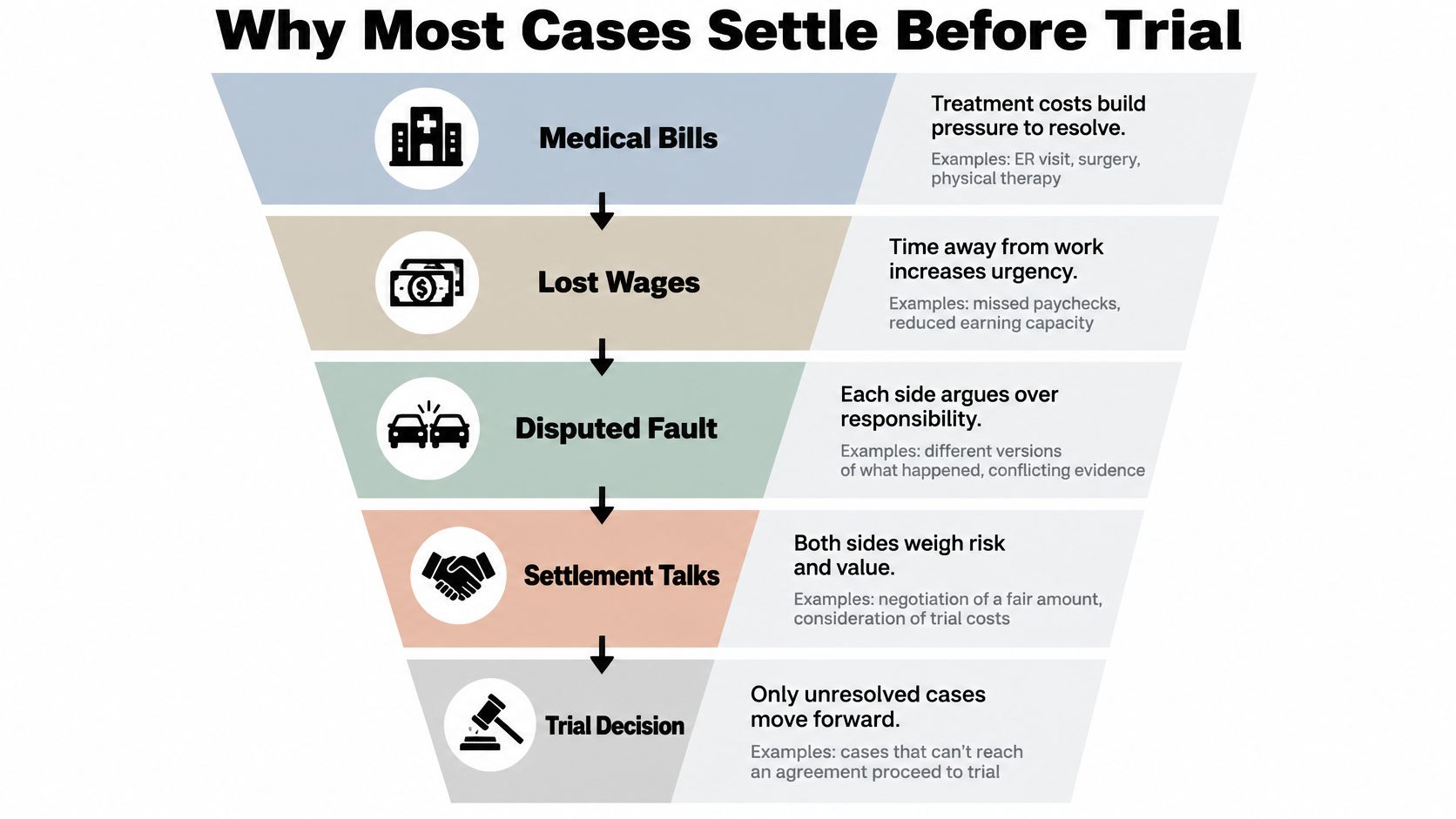
Say a driver needs ongoing treatment after a collision, misses work, and faces an insurer arguing that they share responsibility. The driver wants payment for documented losses. The insurer wants to know what it may have to pay and whether the evidence supports the demand.
Neither side can evaluate the claim well from the medical bills alone. They need the crash evidence, treatment history, wage documentation, and an explanation of any continuing limitations.
How the dispute narrows
Before filing, the claimant's attorney can submit a demand supported by records and supporting evidence. If the parties remain far apart and litigation proceeds, discovery allows them to examine testimony, request documents, and test the assumptions behind their positions.
Mediation gives the parties another opportunity to negotiate without asking a jury to decide the dispute. Our explanation of the mediation process describes that structured negotiation setting.
The historical pattern is clear: the Bureau of Justice Statistics' study of tort cases in large counties found that approximately three-quarters settled out of court, compared with about 3% that went to trial. It's an older benchmark, not a current nationwide settlement forecast.
What both sides exchange through settlement
Settlement trades the possibility of a better trial result for greater control over the outcome. The parties weigh several practical considerations:
- Litigation expense: Expert work, deposition preparation, and courtroom presentation require resources.
- Delay: A disputed case can remain unresolved while the parties complete discovery and await a trial setting.
- Evidentiary uncertainty: A judge may exclude evidence, or jurors may interpret testimony differently than either side expects.
- Post-trial proceedings: A verdict may lead to further motions or an appeal rather than immediate closure.
The claimant must also consider whether an offer accounts for future care and lost earning capacity. Financial pressure alone doesn't establish that an offer is adequate.
Settlement is a negotiated decision about evidence, money, and risk. It isn't proof that the injury was minor or that filing suit was unnecessary.
The records and testimony assembled for courtroom use can help both parties evaluate those risks during negotiations, before they incur the full burden of a trial.
Case Factors That Push a Claim Toward Trial
The features below help explain why otherwise similar injury claims can follow different paths. They're decision factors, not a validated scoring system, and no single factor guarantees a trial or settlement.
Case factors and their effect on trial risk
| Factor | Pushes toward trial when | Usually settles when |
|---|---|---|
| Liability | Fault remains disputed and each driver blames the other | Police reports, video, and witnesses support a consistent account |
| Medical causation | The defense disputes that the crash caused the injury | Treatment records consistently connect the injury to the crash |
| Size of damages | The parties disagree over substantial future care or lost earning capacity | Documented losses are limited and their value is largely agreed |
| Insurance limits | The demand exceeds available limits or coverage is disputed | Available coverage can fund an otherwise acceptable agreement |
| Comparative negligence | The parties contest how responsibility should be allocated | The evidence supports a largely agreed allocation of fault |
| Venue | Local procedures, scheduling, or expected jury reactions complicate agreement | The court's process helps the parties reach a timely resolution |
Court congestion deserves special care. A crowded docket can lengthen the path to trial, but it doesn't necessarily make a verdict more likely. Either side may instead become more willing to settle because of the delay.

Similar injuries, different disputes
Consider rear-end collisions involving drivers with similar neck symptoms. In one hypothetical claim, dashcam footage clearly establishes the impact, and the treatment records document symptoms beginning afterward. The parties may still disagree about value, but they have fewer factual questions to resolve.
In another, the drivers dispute the sequence of impacts, the claimant has a relevant prior condition, and a defense medical examiner challenges the need for continued treatment. The disagreement now concerns both responsibility and the portion of the claimed harm attributable to the collision.
Sworn testimony can clarify these issues. Understanding what a deposition involves helps a claimant prepare to explain the collision, prior health, treatment, and daily limitations accurately.
Permanent impairment doesn't automatically mean trial. It does require the parties to evaluate questions that may be harder to price, including future assistance, employment restrictions, and long-term medical needs.
Likewise, a policy-limit problem isn't solved merely by proving fault. Counsel must examine available coverage and potential recovery sources rather than assume a favorable verdict will translate into collectible compensation.
The useful early assessment identifies what remains disputed, what evidence could resolve it, and what barriers remain even if liability is clear.
Check Your Own Court's Trial Data First
National figures become more useful when you compare them with the right local records. Start with the court named on your complaint, or the court where counsel expects the action could be filed. Don't choose a dataset because it contains the words personal injury.
Follow the reporting trail
Identify the court system. A state trial court and a federal district court serve different caseloads. If you haven't filed, discuss the potential forum with counsel rather than assuming the nearest federal courthouse is the relevant one.
Match the case category. Look for motor-vehicle, premises-liability, or other relevant tort classifications. A broad civil category may include contract disputes and other matters unrelated to bodily injury.
Locate the judiciary's statistical report. State court administrative offices publish caseload information in annual reports or statistical tables. Look for separate entries for filings, dispositions, jury trials, and nonjury trials.
Use district-specific reporting for federal cases. A district's own report is more geographically relevant than a national federal average. Still, an overall civil figure may not isolate injury lawsuits.
Read the timing measure carefully. Time to trial, time to disposition, and age of pending cases aren't interchangeable. Check which events start and stop the reported interval before using it for financial planning.
Inspect the outcome definitions. Determine whether the report counts completed verdicts, trials begun, or another event. Check whether settlements and dismissals appear as separate disposition categories.
Compare like with like
A useful comparison keeps the court system, claim category, reporting period, and outcome definition aligned. If your local report provides only an overall civil jury-trial rate, label it that way. Don't relabel it as your personal injury case's chance of trial.
Be cautious with a reported zero as well. A rounded percentage may conceal a small number of trials, and an empty category may mean the court didn't report that measure.
Practical check: Before using a trial percentage, write down its numerator and denominator in ordinary words.
For example, completed jury trials divided by civil dispositions tells you something different from injury verdicts divided by new injury filings. Bring the relevant table to your case discussion and ask what it reveals about the forum, not what it supposedly guarantees about your outcome.
Trial Readiness and Your Next Step
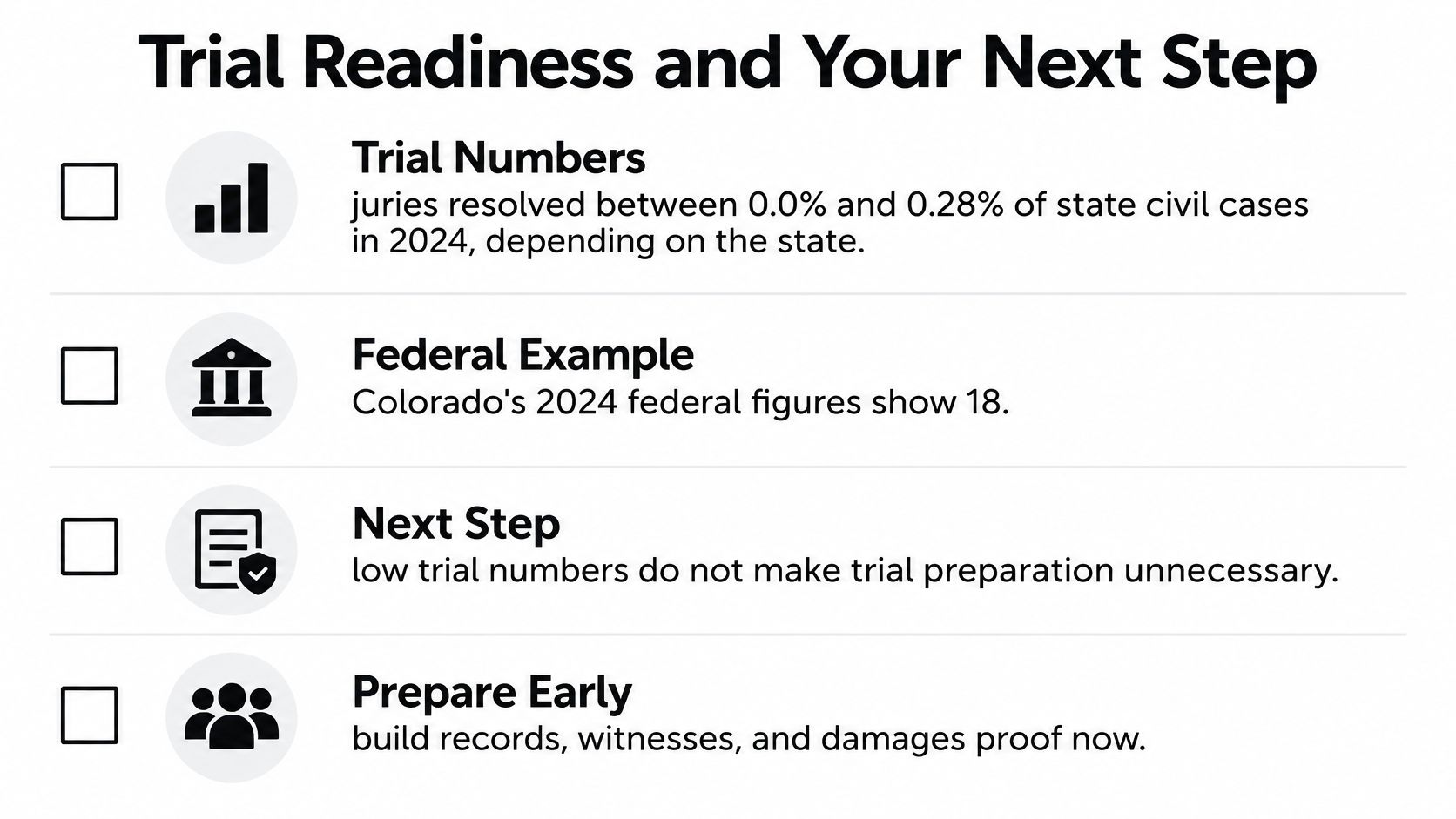
Low trial frequency doesn't remove the need to prepare evidence for courtroom scrutiny. Preparation gives counsel a way to test whether the claim can withstand challenges to fault, medical causation, and damages.
Colorado's 2024 federal district court report recorded an overall civil-trial rate of 1.29%, an average 39-month time to civil trial, and 18 plaintiff-favorable verdicts versus 12 defense-favorable verdicts, plus one settlement during trial. Those outcomes describe the selected cases that reached that stage, not an injured person's probability of winning.
Turn uncertainty into a preparation plan
Start with a fact-specific review. During our free consultation, a personal injury attorney answers questions and evaluates the facts needed to put together a case and pursue compensation. Bring the insurance correspondence, available medical records, and a concise account of what happened.
Organize the investigation. We collect medical records, accident reports, witness statements, and expert opinions to establish liability and damages. Preserve original photographs and messages, and identify witnesses while their contact information remains available.
Understand the possible stages. Our case process identifies Investigation, Treatment, Negotiation, Trial, and Settlement. These aren't a promise that every claim will reach a courtroom, and a settlement opportunity can arise before trial.
Connect expert proof to the disputed issue. We have access to medical and accident reconstruction experts who can testify about an injury's cause and impact. In a brain injury claim, preparation may require careful coordination of medical findings, functional limitations, and future-loss documentation.
Plan for financial uncertainty. Review household expenses, treatment obligations, insurance benefits, and work restrictions without assuming a particular payment date. A court's reported average isn't a deadline for your case, and settlement discussions don't guarantee immediate resolution.
Look for a system, not just a trial date
For families, our guide on how to prepare for trial provides an additional preparation resource. Referring attorneys and co-counsel can also review Attorney Assistant's trial preparation workflows for small law firms when evaluating task ownership, witness coordination, and exhibit management.
The relevant question isn't whether counsel expects every case to reach a verdict. It's whether the team can identify missing proof early, explain unresolved risks clearly, and maintain a defensible damages presentation if negotiations fail.
Assume settlement is possible, not inevitable. An early legal review lets you understand the options without committing to a lawsuit or accepting an insurer's valuation.
Nares Law Group LLC offers free consultations for people facing injury claims, including motor vehicle crashes, truck wrecks, brain injuries, and wrongful death. Visit Nares Law Group LLC to discuss the evidence, insurance issues, and disputed facts that could influence whether your claim settles or needs to proceed toward trial.