The phone is still on the kitchen table from the night it happened. A claims adjuster has already called, asked for a recorded statement, and floated a number that sounds decisive. You have funeral invoices, a police report, and a hole in the household budget, and none of those things, by themselves, win a case.
How to win a wrongful death lawsuit is less about a dramatic courtroom moment and more about two jobs done early: building a chain of proof that a stranger could follow, and putting a number on losses that never showed up on a paycheck. Grief is real. It is not a substitute for duty, breach, causation, standing, or a deadline.
What a Winning Wrongful Death Claim Must Prove
A judge or jury tests the same structure that any negligence case uses, plus a filing that the right person makes in time. The tragedy is the reason you are here. It is not the proof.
| Element | What You Must Show | Evidence That Proves It | Gap That Sinks Cases |
|---|---|---|---|
| Legal duty | The defendant owed the decedent a duty of care | Traffic rules, employment or premises relationship, contracts, licensing | Assuming a duty exists without proving the relationship |
| Breach | The defendant's conduct fell below the expected standard | Crash data, maintenance logs, training records, citations | Treating the police report as the final word |
| Causation | The breach caused the fatal injury | Medical examiner findings, treatment timeline, expert causation opinion | A gap between injury and death with no medical link |
| Survivor or estate losses | Eligible claimants suffered legally recognized losses | Tax returns, pay records, funeral invoices, household records | One undifferentiated damages number |
| Timely, proper filing | The right claimant files in the right court before the deadline | Death certificate, letters of administration, filing records | Missing the limitation period |
Duty is the relationship that created an obligation. A driver owes other road users reasonable care. An employer owes workers a safe job. A property owner owes lawful visitors a maintained premises. Naming the defendant without that relationship leaves the rest of the case floating.
Breach is the specific act or omission that fell below that standard: speed, a skipped inspection, a driver kept on the road after a failed drug test. A police narrative can help, and it can also miss comparative fault, a vehicle defect, or a medical complication after impact.
Causation is the medical link from that breach to the death. If treatment notes, imaging, and the medical examiner do not connect the injury to the fatal outcome, the defense will say something else caused the death.
Losses have to be legally recognized for the people who can claim them: funeral costs, medical bills, lost financial support, and, where the statute allows, companionship or household services. One round number invites the defense to attack every category at once.
Filing is its own element. The authorized claimant has to be in the right court before the clock runs.
Most of this work happens long before anyone talks about a verdict. The Bureau of Justice Statistics reported that in 2005 state courts disposed of an estimated 140,929 tort cases, and only about 4%, approximately 5,600 cases, ended in a bench or jury trial. Plaintiffs won about half of those tort trials, and half of plaintiff winners received $24,000 or less. In a broader national sample of general civil trials, plaintiffs won 56% of cases, the median final award was $28,000, and only about 4% of plaintiff winners received at least $1 million. Those figures do not forecast your result. They show that credible proof, not the fact of a death, is what moves a claim.
Tonight, write four lines: the defendant's duty, the act that broke it, the medical link to the death, and every person who can claim a loss. Whatever is blank is the first gap to close.
Who Can File and the Deadline That Ends Your Claim
A strong set of facts does not buy you time. Every U.S. jurisdiction cuts off the claim, and the rules differ on limitation periods, who may sue, whether the estate or named survivors own the claim, and how damages are measured. A comparative law review of wrongful death statutes maps those differences. Miss the period and a meritorious claim ends before a court looks at negligence, causation, or damages.
Statutes usually name a surviving spouse, children, or parents. Some states require the estate's personal representative to file. Children from an earlier relationship count even when they were not in the household. Colorado, Texas, and New York use different frameworks, so check the controlling deadline and eligible claimant against four facts: where the death occurred, where the conduct occurred, who the defendant is, and whether a government body is involved. Our guide to the Colorado wrongful death statute is the place to start when the death or the conduct is in Colorado.
Two clocks, not one
The wrongful death claim and any survival claim the decedent could have brought are often separate, and each can have its own clock. Probate administration can add another. Florida shows why the path matters: awards that belong to the decedent's estate stay subject to creditor claims that meet probate-law requirements. A verdict that looks large on paper can shrink once those claims are paid.
A city, county, transit agency, or other public body often requires a notice of claim on a much shorter window than the ordinary limitation period. Count from the funeral date when the statute runs from the injury or the death, and you can lose a case you would otherwise have proved.
Cause of death belongs in the same early file. When official findings are thin or disputed, families sometimes seek independent autopsies supporting families' legal claims to document the medical link between the injury and the death. That record can clarify causation. It does not replace the statute's filing rules or the need for a qualified medical review.
Work this list before you talk to an insurer or accept any payment:
- Write both dates. Record the date of the injury and the date of death, and note which one each statute uses.
- List every beneficiary. Include a spouse, minor and adult children, parents, and children from earlier relationships. Add the losses that ran through their hands: childcare, eldercare, household repairs, unpaid bookkeeping. Those services are damages, not favors.
- Flag government defendants. A city bus, a county road crew, or a public hospital can trigger a notice deadline measured in days or months.
- Calendar the earliest date. The first deadline controls, not the most generous one you find online.
- Confirm filing authority. Letters of administration, or the statute's named claimant, decide who signs the complaint.
A deadline counted from the wrong date is a deadline already missed.
How to Build the Evidence Chain Step by Step
Treat the file as a chain. Each link has to connect the defendant's conduct to the death and then to the losses. A story that skips a link is a story the other side will break.
The chain starts at the scene, while marks are still on the pavement.
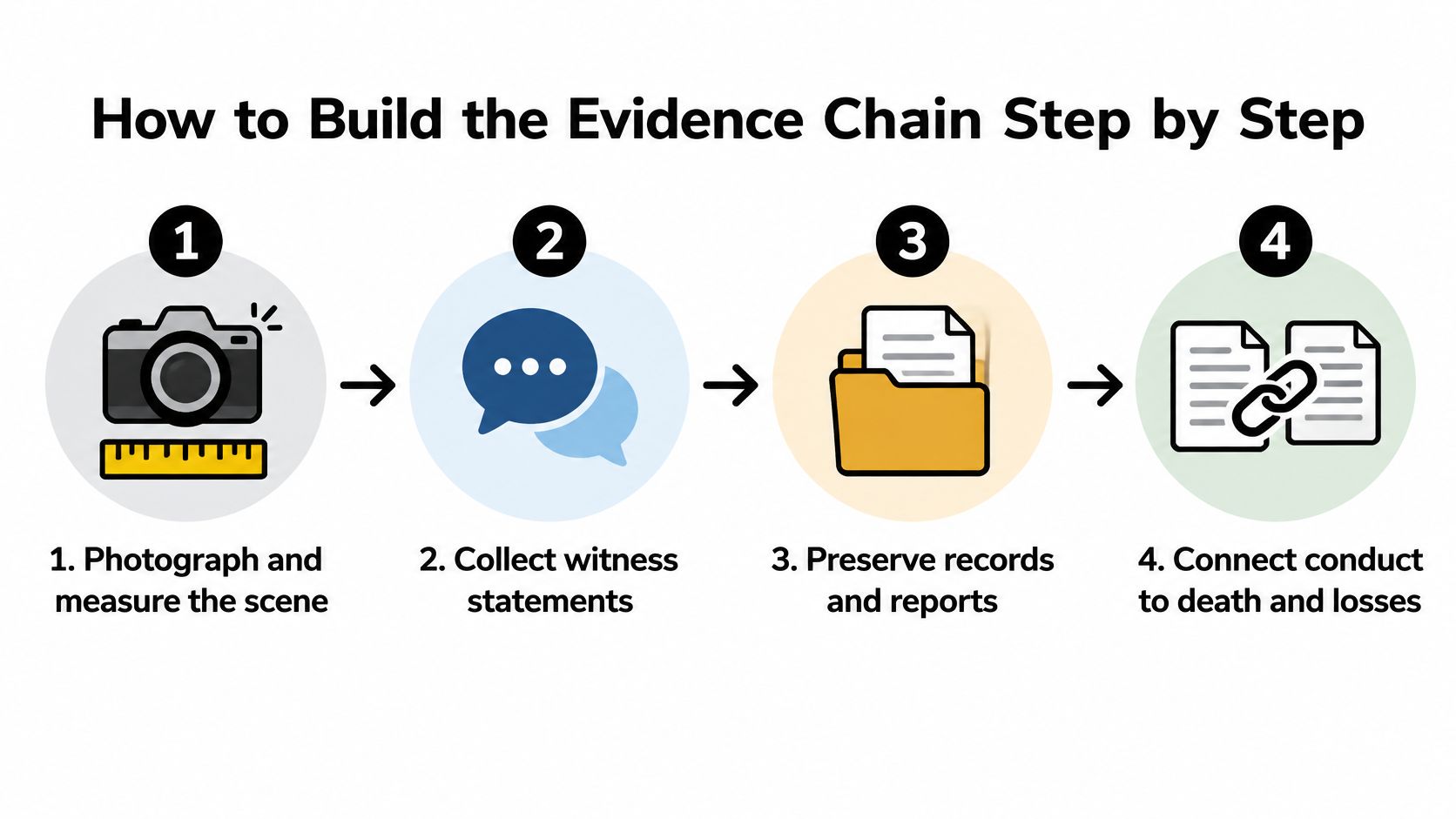
NHTSA's crash-investigation methods rely on physical indicators such as skid marks, fluid spills, broken glass, and bent guardrails, then add interviews and medical-record review. There is no reliable universal win rate for these lawsuits. Outcomes turn on jurisdiction, liability rules, insurance limits, evidence quality, and whether the case settles. During our investigation, we collect medical records, accident reports, witness statements, and expert opinions to establish liability and damages.
- Photograph and measure the scene. Shoot tire marks, debris fields, sightlines, and lighting the same day if you can, and send preservation letters to nearby businesses with cameras within days. Tire marks fade, and many systems overwrite video on a short loop.
- Download vehicle and event data before repair or salvage. Ask for a forensic image of phones and recorders, not a screenshot, and keep the original metadata. A repaired truck often means overwritten module data.
- Pull 911 audio, phone records, and maintenance files. Dispatch timing, a text sent at the moment of impact, and a skipped inspection are documents. A witness who "thinks" the driver was on the phone is not.
- Hire an accredited crash-reconstruction expert. That person ties skid marks, debris, and fluid spills to speed, lane position, and fault. An opinion with no disclosed measurements is easy to dismiss as advocacy.
- Connect injury to death in the medical file. Complete emergency, hospital, and death records, plus a medical examiner opinion, close the gap the defense will look for. A death certificate alone rarely explains mechanism.
- Document the losses with employment, tax, household, and life-expectancy records. Economists need assumptions they can show, not a family estimate.
- Build a dated chronology. Put each document on its own line and keep witness recollection in a separate column. Memory shifts. A log does not.
The slip that undoes good work
Delay is the usual failure. Vehicles are crushed, electronic data is overwritten, and witnesses rewrite what they saw. Assign one evidence custodian on day one, record chain of custody, and send litigation holds to anyone who controls cameras, modules, or maintenance software.
A police report is not conclusive proof. It often omits comparative fault, visibility, a vehicle defect, employer supervision, or medical problems after impact. Experts should state their data, assumptions, error sources, and the alternative explanations they considered.
A short walkthrough of how investigators read scene evidence is worth watching before you decide what to photograph.
For every item in the file, ask one question: could someone outside the family verify this without relying on memory? If the answer is no, it is not yet a link in the chain.
Proving Fault When the Other Side Denies It
Denial is the default. Insurers and defense lawyers do not have to disprove your grief. They only have to raise doubt about one element, or shift a share of fault onto the person who died.
Comparative fault
Many states reduce the recovery by the decedent's share of fault, and some bar it entirely past a set percentage. Expect arguments about speed, a missing seatbelt, poor visibility, or a crossing outside a crosswalk.
Say a driver strikes a pedestrian at night and claims dark clothing made the person impossible to see. Opinion does not answer that. A reconstruction expert measures sight distance, headlight throw, and the feet of travel available in a normal reaction time. Those measurements either support the driver's claim or they don't. We work with medical and accident reconstruction experts who can testify about the cause and impact of an injury, and that testimony is only useful when the measurements are in the report.

What the crash report leaves out
Vehicle defects and recalls. The defense may blame the driver of your family's car. A recall on brakes, a failed tire, or an event-data download that shows a system fault can move liability to a manufacturer or a maintenance shop. Pull the VIN history before you accept the officer's "driver error" box.
Employer supervision. In a truck case, the company often says the driver acted alone. Training files, hours-of-service audits, and prior citations can show the company put that driver on the road anyway. That is a separate duty from the driving itself.
Post-impact medicine. The defense may argue that a complication in the hospital, not the crash, caused the death. Treating-physician notes and the medical examiner's mechanism have to meet that argument directly. If the records show the crash injury started the cascade, say so with those records, not with a family timeline.
Practical rule: Prove each liability point with at least two independent sources, such as module data plus a neutral witness, or a maintenance log plus a citation.
Each expert should write down the evidence used, the assumptions, and what new fact would change the conclusion. If the other side can call the opinion unsupported advocacy, the jury will hear that label more clearly than the opinion itself. I would not take a liability theory to mediation on a single witness and a police diagram.
Valuing Losses Beyond the Paycheck
The larger hole in the household budget is often unpaid work. Childcare, meals, rides, repairs, and the daily management nobody invoiced disappear the week survivors start covering those hours themselves. Funeral invoices and hospital bills get saved. The calendar that showed who did the school run usually does not.
Wrongful death statutes and damages analyses often treat lost financial support, household and childcare services, companionship, parental guidance, and moral support as distinct categories. Net income is only one component, next to tangible and intangible losses. A stay-at-home parent, a retiree, an informal caregiver, or someone paid partly in cash can leave a larger replacement burden than a high salary suggests. For a closer look at how categories and caps interact, see our page on how much you can sue for in a wrongful death case.
| Damage Category | What to Document | Example Evidence |
|---|---|---|
| Funeral and burial costs | Itemized invoices and proof of payment | Funeral home contract and paid receipts |
| Medical bills before death | Itemized bills and insurance explanations of benefits | Ambulance, emergency, and treatment invoices |
| Lost earnings and benefits | Pay records, W-2s, tax returns, employer benefit statements | Several years of returns plus documented raises |
| Household and childcare services | Calendars, school pickup logs, replacement-cost quotes | Quotes for a nanny or housekeeper covering the same hours |
| Lost support to survivors | Budgets, bank records, tax filings showing contributions | Monthly transfers to a dependent parent or child |
| Companionship and guidance | Family statements, photos, school and activity records | Testimony about coaching and daily routines, where state law allows |
How to build the number
- Split economic losses from noneconomic losses. Caps, comparative-fault math, and insurance limits often treat them differently. Mixing them hides which dollars are exposed.
- Calculate earnings and benefits from records. Use W-2s, tax returns, and employer benefit statements. Do not estimate from memory of "about what they made."
- Price household services at replacement cost. Count the hours for school runs, meals, and home repairs, then get quotes for a nanny or housekeeper covering those same hours. Write the hours down before the new routine overwrites them.
- Add companionship and guidance only where that state's law allows it. Family statements, photos, and activity records support the claim. They do not create a category the statute omitted.
- Subtract personal consumption when the economist's method requires it, and write the assumption down. A net figure that hides the deduction is easy to impeach.
A lower-earning decedent may have supplied extensive unpaid labor that survivors now have to buy or perform themselves.
I would not fold those hours into one damages total. A single figure lets the defense attack funeral costs, wages, and companionship with the same objection. Preserve calendars, school records, appointment logs, and household budgets while the old routine is still visible. Statutes differ on eligible beneficiaries and recoverable categories, so the table above is a documentation plan, not a promise that every row is recoverable where you file.
Preparing the Case for Trial
Settlement talks stall when the file is thin or the number is unexplained. Filing is not a threat. It is how you force records, lock testimony, and make the other side price the risk of a verdict.
- File and serve. Put the complaint in the proper court under the claimant authority you already confirmed, and serve every defendant on time. A late serve can undo a timely filing.
- Write for the records they will not volunteer. Maintenance logs, training files, written policies, and insurance declarations usually arrive through interrogatories and requests for production, not through a polite letter.
- Depose the people whose stories will move. The driver, the supervisor, and the treating physicians should be on the record before memories soften and before counsel coaches a cleaner version.
- Exchange expert reports on the court's schedule. Prepare each expert for questions about data, assumptions, and alternative causes. A surprise in cross-examination is how a clean opinion unravels.
- Use motions to narrow what the jury hears. Move to exclude speculative testimony, and tee up comparative-fault arguments before opening statements so the jury is not the first audience for a half-formed theory.
- Separate the damages slides. Economic loss, household services, and survivor support each need their own replacement-cost figure. A single total invites a single discount.
- Pick a few themes tied to the chronology. Warning signs the defendant ignored, a skipped inspection, a prior complaint, beat a speech about negligence in the abstract.
Trial readiness is also what moves a number. A defense lawyer who expects a credible presentation has a reason to pay more than the opening offer. Our notes on how to prepare for trial walk through that sequence in more detail.
What stays off the record
Depositions, expert drafts, and family financial records spread fast if nobody owns confidentiality. Practical confidentiality tips for legal teams are a useful checklist for labeling drafts, limiting who sees medical files, and keeping settlement numbers out of casual email. I would rather lose a week organizing that protocol than explain a leaked tax return at mediation.
Settlement Offers, Trial, and Your First Week
The first offer often arrives before the medical file, the expert reports, and the lien amounts exist. That is when the number is most likely to be low, because the insurer is pricing uncertainty, not your losses.
Match the case to the path using the same factors, not a feeling about "going to court."
| Factor | Settlement Tends to Fit | Trial Tends to Fit |
|---|---|---|
| Liability evidence | Fault is disputed but damages are well documented | Independent proof of fault, such as crash data and neutral witnesses |
| Offer versus documented losses | Offer covers documented losses and liens | Offer falls far below documented losses |
| Insurance coverage | Coverage is clear and the offer approaches available limits | Coverage is disputed or the defendant has personal exposure |
| Family timeline | Family needs funds soon and accepts the risk of a lower amount | Family can wait and values a public finding of fault |
| Expert readiness | Expert reports are incomplete and trial costs are high | Experts are prepared to testify and the defense rebuttal is weak |
Why income-only math underpays
Winning liability does not produce a fair number by itself. A jury-simulation study in Law & Society Review found substantially higher awards for male decedents than for similarly situated female decedents, with the gap tied mainly to estimated lost income. The reported overall median award in that study was $410,000. Pay stubs alone can reproduce bias against women, caregivers, part-time workers, young people, disabled people, and retirees.
The package that answers an early offer should combine vocational and economic evidence with household services, childcare, caregiving, parental guidance, companionship, and the actual cost of replacing that work. Generic online calculators cannot do that across states. We do offer four free settlement calculators, for wrongful death, brain injury, truck accidents, and motor vehicle cases, and they are a starting sketch, not a demand.
Two rules I would not bend. Do not sign a release until liens, probate issues, and beneficiary allocations are written down. Do not reject an offer without a documented valuation that explains the gap in dollars, category by category. A family's need for funds, or for a public finding of fault, is a legitimate factor. It is not a weakness.
One of our wrongful death matters resolved for $1.1 million under the policy limits. That result belonged to that file, that coverage, and that proof. It is not a forecast.
The first seven days
- Confirm the earliest deadline from the filing check, and put it on a calendar more than one person can see.
- Send the insurer a written request that all contact go through counsel, so a recorded statement does not become the defense exhibit.
- Schedule a case review before you answer any offer. In a free consultation, a personal injury attorney at our firm answers questions, puts the case together, and pursues the compensation the client deserves. Bring the damages list and the preservation log, not just the police report.
The best time to protect the claim is before that first offer arrives.
Nares Law Group LLC investigates wrongful death claims, preserves the records that prove fault and household loss, and prepares cases for negotiation or trial in Colorado, Texas, and New York. If you are staring at an early offer or a deadline you are not sure how to count, bring the police report, the medical file, and your list of who depended on your loved one. Visit Nares Law Group LLC to request a free consultation and get a clear read on standing, proof, and value before you sign anything.