You're probably reading this with a rental car in the driveway, an ER bill on the counter, and an adjuster already asking for a recorded statement. Most personal injury cases settle rather than go to trial, and most resolve well before a verdict ever happens.
What carries you through that wait is the file itself: the records, the bills, the proof of what this injury cost you. Medical bills and liens come out of any settlement, and an injury still healing can shrink what you keep. The paperwork you build in the next few weeks will do more for your family than any courtroom could.
The Path From Crash to a Check
The tow truck is gone by morning. The other driver's insurer has called twice. Your neck hurts, your head feels foggy, and you don't know if you'll miss two shifts or two months. Before anyone talks about negligence, you need two things: a calendar and a ledger.
An injury claim runs on proof and cash flow at the same time. One side of the file shows who caused the crash and what the injury changed. The other tracks ER bills, follow-up care, missed paychecks, health-insurance or hospital liens, and every settlement offer. If money pressure arrives before the proof is complete, a fast offer can look bigger than it is. A gross settlement is also only the top line. Medical bills and liens may be paid from it before anything reaches your account.
For those asking “how do personal injury cases work,” the answer is a sequence of handoffs that starts long before any courtroom date. Waiting can protect the value of the case. Waiting without records only creates debt and gaps. Good days and bad offers both happen.
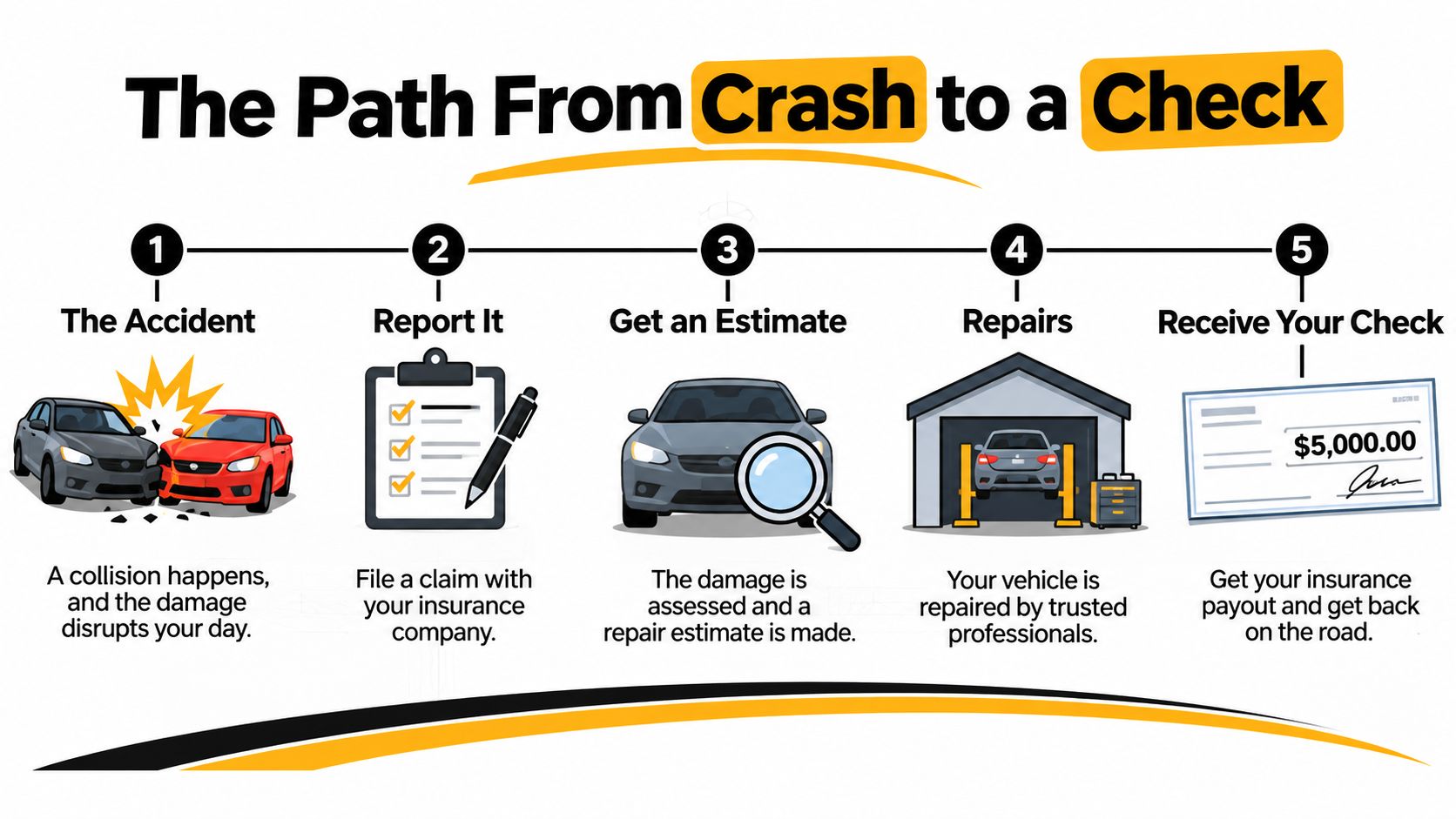
The phases in order
| Phase | What happens | Usual window | What slows it |
|---|---|---|---|
| Evidence hold | Photos, police or incident report, witnesses, vehicle or scene data, insurer notice | First days to a few weeks | Missing video, totaled vehicle released, no witness names |
| Treatment and records | Diagnoses, restrictions, bills, prognosis, no unexplained gaps | Weeks to many months until the course is known | Brain injury, surgery, or symptoms that keep changing |
| Demand | Indexed file of liability, medical proof, wage loss, and future care | After treatment stabilizes and the damages file is complete | Incomplete records or an offer sent before the injury has a prognosis |
| Negotiation | Offers, counters, lien review, mediation before suit | Weeks to a few months | Disputed fault or policy limits too low for the harm |
| Lawsuit and discovery | Complaint, written discovery, depositions, motions, experts | Often adds 12 months or more | Multiple defendants, trucking logs, expert fights |
| Trial, settlement, or appeal | Verdict, agreed number, or a limited appeal | Months if the case resolves, longer if trial or appeal follows | Permanent disability, comparative fault, coverage fights |
Our case process follows that same spine in five stages: Investigation, Treatment, Negotiation, Trial, and Settlement. Investigation locks down proof while it is fresh. Treatment runs until doctors can say what has healed, what has not, and what care comes next. Negotiation then tests whether the insurer will pay a fair number without a lawsuit. Our attorneys negotiate with insurance carriers for settlements and never accept lowball offers.
Filing suit is a way forward when fault is denied or the offer ignores future care. Discovery and depositions force both sides to show their evidence, and mediation can bring the numbers closer. Trial is the last branch. Appeal is narrower still.
A premium notice can land in the same month as the first hospital bill. Your own auto rates may rise even while fault is disputed, so it helps to read about lowering insurance premiums after a collision while coverage is sorted out. Keep that cost separate from the injury claim, and do not let it pressure you into a cheap release.
How the File Gets Built
A strong case isn't an argument you invent at the end. It's a file you build week by week, so an adjuster, mediator, or jury can follow it without guessing.
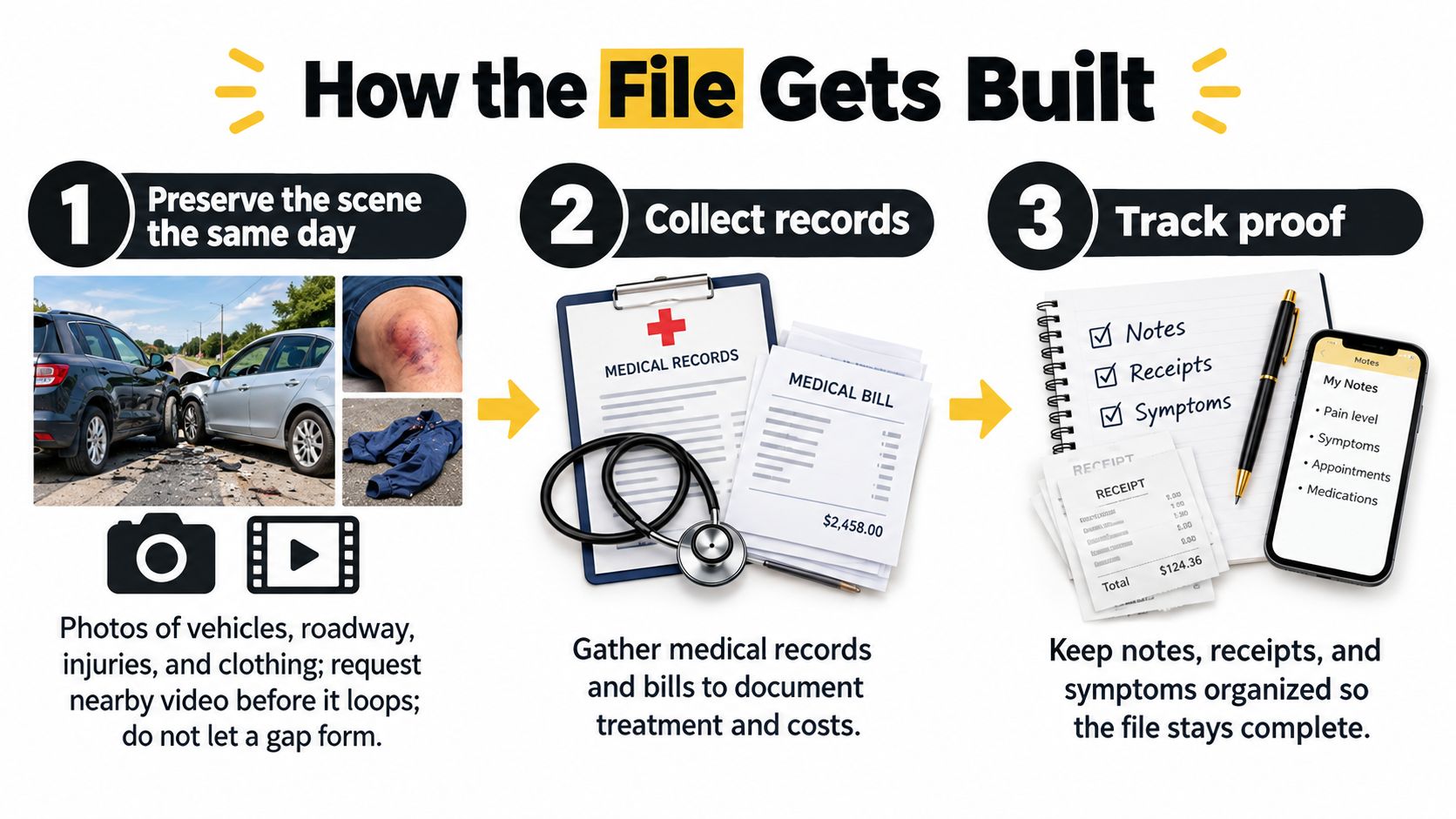
Six moves that create proof
Preserve the scene the same day. Photograph vehicles, license plates, skid marks, debris, injuries, and torn clothing. Ask nearby businesses to save video before it loops. Don't let a car or truck be repaired or scrapped until photos and vehicle data are kept. The slip that ruins this step is waiting a week and finding the video gone.
Get care and name every symptom. Tell the ER and your doctor about headache, dizziness, memory trouble, sleep change, and pain, even if it feels minor. That first chart has to match later treatment. If headaches start on day three and no one writes them down until month three, the insurer will call them unrelated.
Prove liability in plain language. You need four pieces. A duty to drive or maintain property with care, a breach such as running a light or leaving a floor unsafe, causation linking that breach to your injury, and harm the law pays for. During our investigation, we collect medical records, accident reports, witness statements, and expert opinions to establish liability and damages.
Pull the full insurance picture. Find the at-fault driver's liability limits, your own medical payments coverage, and any employer or commercial policy. On a truck wreck, that commercial policy and the company's records can change everything. Don't value the claim until you know what is available to pay it.
Collect records continuously and calendar the deadline. Request bills, therapy notes, work restrictions, wage proof, and prognosis as you go, not in a scramble later. Under Colorado's statute at section 13-80-101, an auto-injury limitation period can depend on when the injury and its cause were known or reasonably should have been known, and the statute also addresses when medical expenses are reasonably expected to exceed $2,500. Because claim type, public defendants, and tolling can move the date, we calendar the earliest plausible deadline instead of trusting that friendly talks with an insurer will pause the clock.
Add experts when cause or impact is contested. We have access to medical and accident reconstruction experts who can testify about the cause and impact of an injury. In a truck case, that can also mean hours-of-service logs and preservation duties. In a brain injury case, it can mean a neurologist explaining why a normal early scan doesn't end the story.
This short walkthrough shows how those pieces fit together before a demand goes out.
A usable file ends up indexed and consistent. Reports, photos, records, bills, wage proof, and expert opinions sit in order, with no symptom story that changes from one page to the next. That's what makes a demand credible.
Who Pays the Bills While You Wait
The ER copay hits before any settlement talk does. Families ask the same question in week one. Who pays while we're waiting?
Usually, the at-fault insurer doesn't pay your medical bills as they arrive. It pays once, at the end, in exchange for a release. Treatment in between has to be bridged some other way, and each bridge has a string attached.
Common bridges before settlement
| Payment source | What it usually covers | What it takes back | Watch-out |
|---|---|---|---|
| Health insurance | Covered treatment, subject to deductible and network | Plan reimbursement or lien from the settlement | Balance billing and subrogation letters |
| Auto medical payments | Early crash-related care up to the policy limit | Often repaid from a later liability settlement | Small limits that run out fast |
| Workers' compensation | Care and some wage loss if the injury was on the job | A statutory lien on the injury recovery | Two claims with different deadlines |
| Provider lien or payment plan | Continued care when insurance will not | The agreed balance at settlement | A lien larger than the case can support |
| Public benefits | A limited safety net for some families | Possible reimbursement rights | Coverage gaps for long-term rehab |
Health insurance keeps care moving, but the plan may send subrogation letters and claim repayment from your recovery. Medical payments coverage can fund early visits, though small limits run out fast. If the crash happened on the job, workers' compensation runs on a separate track with its own deadlines and often a lien on the injury case.
Some providers will treat on a payment plan or a lien and collect at settlement. Ask before you sign. A lien that's larger than a plausible recovery can swallow the check. Our guide to getting medical expenses reimbursed after an injury walks through how those repayment claims get sorted out.
Brain injuries make the timing trap clearest. In a recent economic review of mild traumatic brain injury costs, mean cumulative medical costs were $48,561 during the first two years, while only 24% of reviewed studies reported costs beyond the first year. A three-month snapshot understates post-acute care, and families struggle to plan when clinicians can't give a reliable long-term prognosis.
Gross is not net. Judge any offer by what remains after fees, costs, health plan claims, and provider balances, not by the headline number.
Keep every bill, explanation of benefits, and wage stub in one folder. Note deductibles you've paid out of pocket. That paper trail proves losses and helps negotiate liens down at the end.
Don't trade a release for a fast check before the injury's course is known. Once you sign, you can't reopen the claim because month eight brought a surgery recommendation or therapy you didn't expect in month two. Bad weeks and slow months are part of this. A rushed release turns a temporary cash problem into a permanent one.
Moves That Protect the Recovery
Small habits decide more cases than dramatic courtroom moments. These seven moves prevent the failures insurers use most.
- Follow the treatment plan. Go to appointments and report setbacks the same week. A gap in care becomes the adjuster's favorite argument that you healed and came back for money.
- Keep one symptom history. Say the same things to the ER, your primary doctor, specialists, and anyone else who asks. Inconsistent stories look like exaggeration even when they're just sloppy memory.
- Save proof of daily limits. Keep wage records, missed-shift notes, and a simple daily log of headaches, lifting limits, or tasks you couldn't finish. Photograph visible injuries as they change.
- Stay quiet online. Don't post the hike, the party, or an all better caption while symptoms are flaring. Adjusters read one smiling photo as the whole story.
- Pause before statements and releases. Don't give a recorded statement or sign a broad medical release until counsel has seen the file. One loose answer can lock in a version of the crash that hurts you.
- Preserve the vehicle. Don't repair, scrap, or return a commercial vehicle before data and photos are kept. Once it's gone, reconstruction gets harder.
- Ask for the lien list early. Know what health plans and providers claim before you accept any number.
The case is won in the records long before anyone picks a jury.

Say two people have the same rear-end crash and the same concussion symptoms. One keeps steady neurology visits, follows work restrictions, and gets a future care estimate. The other has a normal ER scan, skips care for six months, and posts video from a loud concert. The second file settles as a minor claim even if that person still can't work a full day. The injury may be real in both lives. Only one file proves it.
Good days will happen. You'll feel clearer, sleep better, and wonder if you're turning a corner. Write those down too. An honest log with good and bad days is more believable than a log that claims every day was the worst day.
How a Demand Becomes a Number
A demand isn't a guess with a big number attached. It's a documented argument that says, here is the proof, here is the loss, and here is what fairness costs.
Economic losses come first. Past medical bills, projected future care, missed wages, and reduced earning capacity each need a record or a qualified opinion behind them. A future care figure without a doctor's support is just a wish. A wage claim without employer records invites a discount.
Non-economic harm comes next, shown through function. Headaches that end the workday at 2 p.m. Missed shifts. Cognitive slips that make a parent reread the same page three times. Family routines that no longer happen. That evidence carries the most weight after a concussion or a more serious brain injury, where the scan may look quiet while daily life doesn't.
The comparison that actually matters
An opening demand and a first offer are bargaining positions. Neither one is the case's value. What matters is expected net recovery: the number left after you discount for the chance of losing on liability, any fault share assigned to you, gaps in the medical proof, litigation costs, liens, and delay. A strong injury alone doesn't prove causation. A strong liability story doesn't fix missing records.
A demand works like an appraisal on a house. The asking price means little on its own. The condition report and the comparable sales set the number, and in an injury case the records are the condition report.
Build a simple liability matrix for each disputed element and ask which document or witness proves it. That is how you negotiate from the file instead of from hope. Our breakdown of a settlement demand letter and what goes in it shows that structure. Our attorneys negotiate with insurance carriers to secure settlements, and we never accept lowball offers.
Historical trial outcomes help with humility, not forecasting. Win rates and median awards blend smaller injuries, different jurisdictions, and cases that look nothing like yours. They remind both sides that a courtroom carries real risk for everyone. They cannot price your file. Only your file can.
The mistakes that shrink a demand are quiet ones. Taking money before the medical course is known, so future care gets valued at zero. Letting symptom stories drift between providers, so the insurer argues the headaches came from somewhere else. Skipping truck driver logs, so fatigue never enters the file. Each one cuts net recovery before anyone argues about pain.
When the Case Has to Be Filed
The deadline usually does the deciding. When the limitation period is closing in, fault is denied, or the offer ignores losses the file proves, the choice narrows to filing suit or letting the claim expire.
Suit starts with a complaint filed before the period runs. Then discovery begins, and it works like an audit: each side gets to open the other's books. Written questions and document demands come first. Depositions follow, putting drivers, witnesses, doctors, and you under oath. Motions and expert disclosures test the same facts the demand claimed, only now under court rules with deadlines attached.
Mediation often sits in the middle of that stretch, once both sides have seen enough records to price risk fairly. Many filed cases still settle there. Filing raises the pressure, and a courtroom remains the exception.
How rare trial really is
Even among cases that do get filed, a verdict is the unusual ending. Federal court data shows the large majority of tort suits close through settlement, dismissal, or another nontrial disposition, and only a small slice reach a judge or jury. When trials do happen, they mostly involve personal injury claims, and juries decide most of them.
That shape tells you something useful. The outcome of your case is mostly written in the file long before a jury could ever see it. Medical records, wage proof, and lien balances decide what a fair number looks like, and they decide it during negotiation and mediation rather than in a courtroom.
If trial does come, you must prove responsibility and damages, and comparative fault can cut the award by whatever share gets assigned to you. That risk is real even when injuries are serious. Choosing trial means accepting uncertainty in exchange for a shot at full damages when an offer won't cover them.
Appeal is narrow. It reviews legal error, adds time, and gives no second chance to prove facts you skipped the first time. Plan to get the record right at trial.
Deadline discipline matters most here. Our overview of the statute of limitations for personal injury claims explains why waiting on an adjuster doesn't protect your filing date. Miss the period and even a strong file can become worthless.
Get Advice Before You Sign a Release
Waiting for the adjuster's next call is the risky move when treatment is still changing. It's also risky when fault is disputed, a truck or commercial policy may be involved, or an insurer wants a recorded statement and a signed release.
A first consultation should answer three questions. What's your earliest filing deadline? Which file items are still missing? Which losses belong in the claim, including future care and reduced earning capacity?
Ask how the lawyer gets paid before you sign anything. Many personal injury firms work on a contingency fee taken from the recovery, with case costs handled under a written agreement. Ask which costs come off before the fee is calculated, how liens and health plan claims will be negotiated, and what happens to the fee if the case settles early.
We offer a free consultation for auto accident cases in Colorado. During a free consultation, a personal injury attorney at our firm answers questions, puts together a case, and pursues the compensation the client deserves. We can also say whether co-counsel outside Colorado is needed for a complex truck or brain injury matter. We offer four free settlement calculators too, for Wrongful Death, Brain Injury, Truck Accident, and the Motor Vehicle Accident Case Estimator, though a calculator can't replace a file review.
Bring three items to that meeting. The crash or incident report, every insurance letter you've received, and a current list of providers. With those, counsel can spot missing records, coverage gaps, and lien risks in one sitting.
Then do the concrete thing. Calendar the earliest deadline, keep treating, and don't sign a release until someone who represents you has priced the full claim. A release ends the case on the insurer's terms. Advice first costs you a conversation. Advice after may cost you the claim.
If you're facing mounting bills, a changing injury, or an insurer pushing for a quick release, Nares Law Group LLC can review your file, identify your earliest deadline, and map the losses your claim should include. Visit Nares Law Group LLC to request a free consultation for your Colorado motor vehicle crash claim before you sign anything.