A driver is hit at an intersection, taken to the emergency room, and sent home with instructions for follow-up care. Weeks later, the bills arrive alongside insurance letters and perhaps a collection notice. The driver has health insurance, but it's still unclear who has paid what, which balances remain, and whether the bills will affect a future settlement.
Medical expenses reimbursement after a crash isn't simply a matter of submitting a bill and waiting for payment. It can involve the treating provider, a health insurer, an auto policy, and the driver believed to be responsible for the collision. Each party may have different rules about what it will pay, when it will pay, and whether it can seek repayment later.
What Medical Expenses Reimbursement Means After a Crash
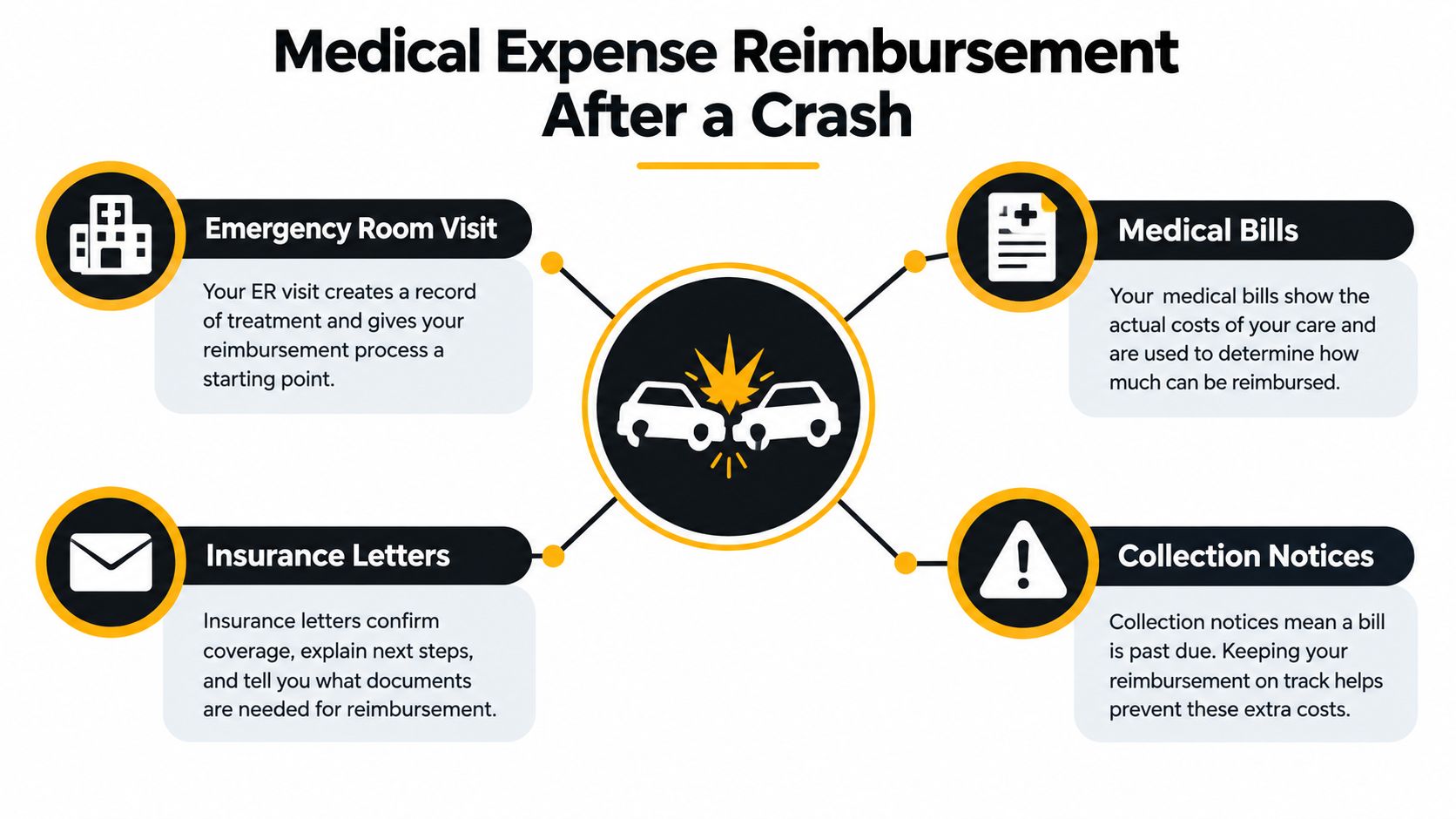
A payer is the person or organization that pays a medical charge, such as a health insurer or auto insurer. The injured person making an injury claim is the claimant. A lien is a claim against money recovered in a case, while subrogation generally refers to an insurer's effort to recover money it paid for care related to the injury.
Think of the process as a three-way tug-of-war. The provider wants payment for treatment, the health insurer may pay under the terms of the plan and later seek repayment, and the claimant may seek compensation from the at-fault party's insurer. The liability claim can take time to resolve, while bills and treatment needs may arrive immediately.
The total printed on a provider's invoices isn't automatically the amount the claimant paid, the amount still owed, or the amount recoverable in a claim. Some charges may have been adjusted under an insurance contract. Other costs may remain as deductibles, coinsurance, copayments, or uncovered services. And an insurer's payment can raise a separate question: does the plan have a right to recover some of that payment from settlement proceeds?
The distinction matters even for people with coverage. In 2023, out-of-pocket spending represented approximately 3% of total hospital spending, while government programs and private insurers paid most hospital expenses. Yet among people who had a hospital stay in 2022, 50% incurred at least $1,000 in out-of-pocket health-care spending, compared with 19% of people who weren't hospitalized, according to KFF's review of hospital costs and out-of-pocket spending.
Keep separate records: what providers billed, what insurers paid, and what you paid or still owe are different figures. A reliable reimbursement picture depends on tracking each one.
The Main Sources of Reimbursement
The first task is to identify which coverage may apply to each bill. A person injured in a crash might have more than one potential payer, but overlapping coverage doesn't mean the same expense can be collected twice. Policy terms, state law, and coordination rules determine how payments fit together.
| Source | What It Covers | When It Applies | Repayment Required? |
|---|---|---|---|
| Health insurance | Covered treatment, subject to plan terms and cost-sharing | When the plan accepts the care and processes the claim | The plan may claim reimbursement from a later recovery |
| Personal Injury Protection (PIP) | Benefits defined by the applicable auto policy and law | Where PIP coverage applies | Depends on the governing policy and rules |
| Medical Payments coverage (MedPay) | Eligible medical expenses as defined by the auto policy | If the policy includes MedPay and the expense qualifies | Depends on policy terms and applicable rules |
| At-fault party's liability coverage | Injury damages for which the insured is legally responsible | As part of a liability claim or settlement | Usually not a medical-benefit advance, but other repayment claims may affect settlement funds |
Health insurance can help keep providers paid while a liability claim is under investigation. But the insurer may apply the plan's deductible, coinsurance, network rules, and coverage limits. If the plan later seeks reimbursement, the payment may reduce immediate pressure without ending the financial dispute.
PIP and MedPay are auto-policy benefits, not names for the other driver's liability coverage. Their availability, scope, and interaction with health insurance depend on the policy and applicable law. Don't assume that having one means all accident-related treatment is covered, or that a payment can never be subject to repayment.
A third-party liability claim asks the responsible party, usually through an insurer, to compensate the injured person for legally recoverable losses. It can take longer than processing a health-insurance claim, and the amount may be disputed. That timing difference is why a person may use available coverage for treatment while preserving a separate claim for damages.
For a plain-language overview of one auto coverage type, see what medical payments insurance coverage can do. Ask each insurer which bills it has processed, what it expects you to pay, and whether it asserts a right to repayment. Get the answers in writing where possible.
How Health Insurance and ERISA Plans Affect Your Claim
A health plan can process an accident-related claim under its usual terms, even while another driver's responsibility remains unsettled. That may help a provider receive payment sooner, but it doesn't automatically resolve the claimant's remaining balance or the insurer's potential reimbursement demand.
Employer-sponsored health plans governed by ERISA may include subrogation or reimbursement provisions. When the plan's language supports it, a plan fiduciary may seek equitable relief against specifically identifiable settlement or judgment funds. The Supreme Court has recognized that such enforcement can include an equitable lien or constructive-trust theory, as described in this overview of ERISA medical-plan reimbursement rights.

Read the governing plan, not just the demand
A generic letter from an insurer may state an amount it wants repaid. The controlling terms, however, may be in the governing plan document and its summary plan description. Review them for the definition of covered expenses, notice obligations, the scope of the reimbursement right, and any language about attorney fees or costs incurred to obtain the recovery.
Ask for an itemized accounting of payments the plan says relate to the crash. Check whether each service is connected to the injury and whether the requested amount reflects the plan's actual payments. A demand should be examined, not treated as automatically correct.
Separate the amounts on each bill
A provider's billed charge is not necessarily the amount the insurer allowed or paid. Medicare Part B illustrates why the distinction matters: after any unmet annual deductible, Medicare generally pays 80% of the Medicare-approved amount, leaving the beneficiary responsible for the remaining 20% coinsurance. CMS also explains that certain nonparticipating physicians with unassigned claims may not charge more than 115% of the applicable Medicare fee-schedule amount for covered physician services. See the CMS Medicare summary reports glossary.
For every service, record the billed charge, allowed amount, insurer payment, and patient responsibility. That breakdown helps avoid overstating amounts paid while still identifying legitimate out-of-pocket costs.
Documenting Your Medical Expenses Correctly
A stack of invoices doesn't tell the full story. To show what happened financially, connect each treatment to the accident and each charge to its payment status. Keep records as they arrive instead of trying to reconstruct the account when settlement discussions are already underway.
Build a file that answers the likely questions
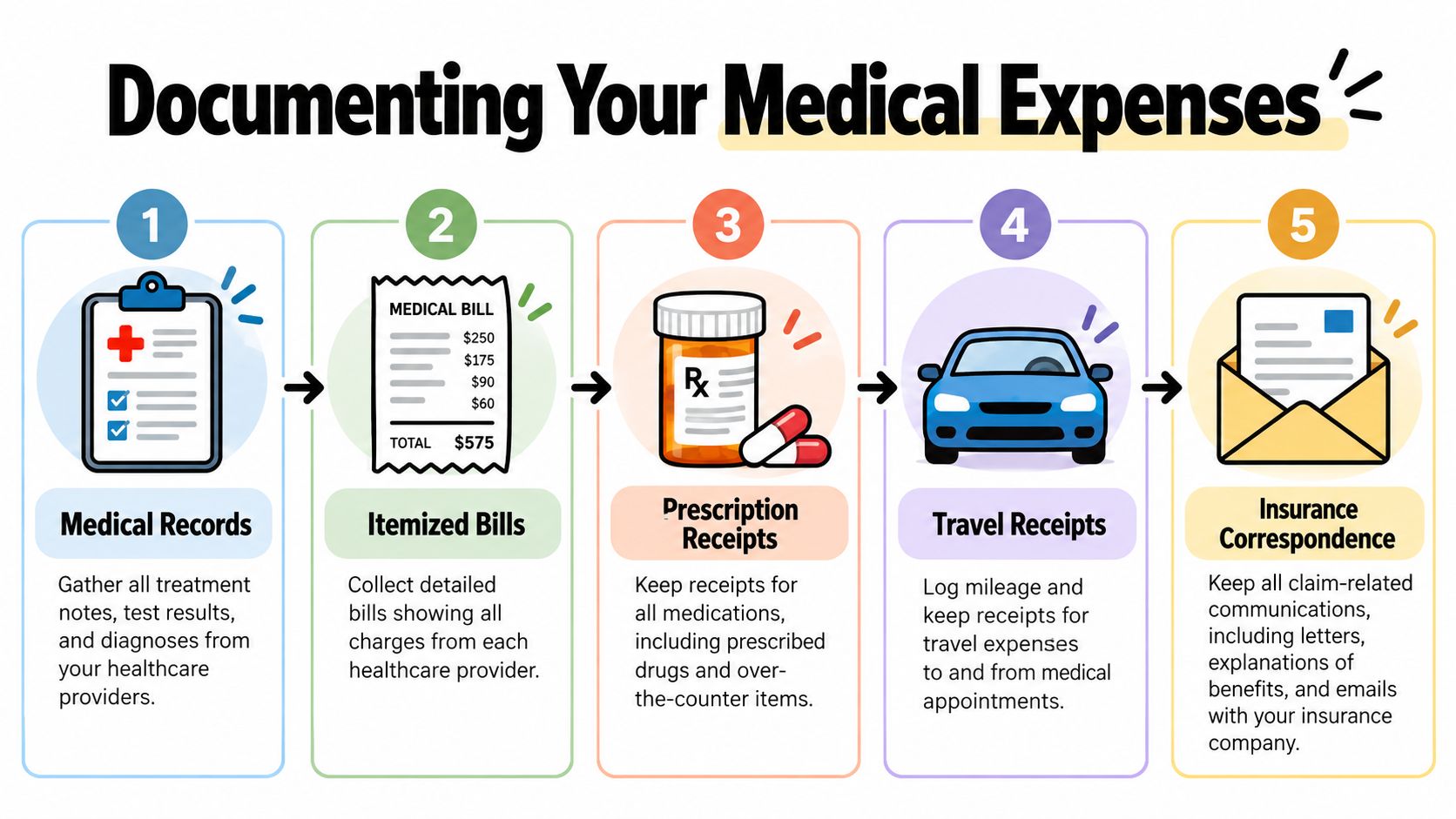
Collect these records and update them when new information arrives:
- Medical records: Keep treatment notes, diagnoses, referrals, and discharge instructions that connect care to the crash.
- Itemized bills: Request a detailed statement from each provider rather than relying on one summary balance.
- Insurance explanations: Save explanations of benefits, payment notices, denials, and records showing adjustments or patient responsibility.
- Payment proof: Retain receipts, bank or card records, and confirmations for amounts you paid yourself.
- Other costs: Organize prescription receipts and a log of travel for treatment, including the date, destination, and reason for each trip.
- Claim correspondence: Keep letters and messages from providers, insurers, lienholders, and collection agencies.
Then reconcile the records. For each service, note the provider's charge, the amount allowed by the insurer if shown, the payment received, any adjustment, and the balance still claimed. Mark disputed entries and ask the provider or insurer to explain them. For Medicare claims, obtain Medicare payment records and identify deductible and coinsurance balances rather than totaling gross invoices.
A settlement ledger can be a spreadsheet with columns for service date, provider, treatment, charge, payer, amount paid, patient balance, and any reimbursement or lien demand. Update it when a bill changes, a payment posts, or a demand is negotiated. Keep the supporting documents with the ledger so each entry can be checked.
For organizing treatment records into a usable file, see this guide to medical record organization. When you need to share sensitive records, check SendItFax's secure sharing advice and use a method appropriate for confidential health information.
If you're gathering records for an attorney, this video may help you think through the documentation process:
Medical Liens and Subrogation Explained
Having health insurance doesn't necessarily mean your settlement is free of repayment claims. A provider balance and an insurer's reimbursement demand are different obligations, even when both relate to the same treatment.
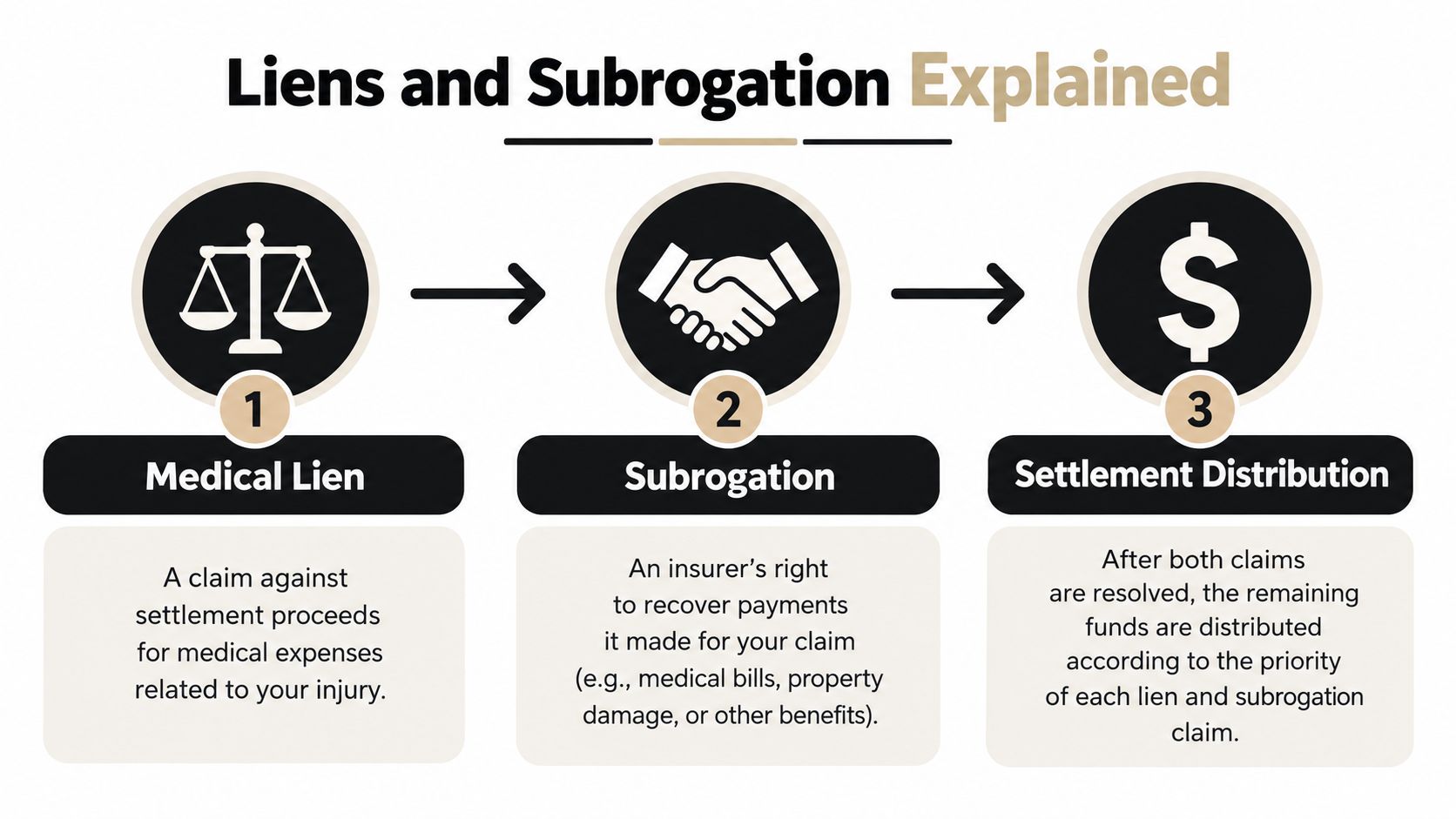
A provider balance is an amount the provider says remains unpaid. A lien is a legal claim against settlement proceeds. Subrogation is an insurer's asserted right to recover payments it made for care connected to the injury. The terms can overlap in a real claim, but they don't describe the same thing.
For example, suppose a health plan paid for surgery after a crash and later identifies those payments in a reimbursement demand. The settlement may be subject to review of that demand before funds are distributed. The amount requested shouldn't be accepted without checking the plan language, payment records, connection between treatment and the crash, and any applicable reduction provisions.
Check the claim before settlement funds are distributed
Request the plan document or other governing agreement, an itemized payment history, and the calculation supporting the demand. Compare each listed service with the treatment records. If a charge appears unrelated, duplicated, reversed, or incorrectly attributed, raise the issue and ask for correction in writing.
A settlement ledger should show each asserted lien, disputed amount, negotiation, and final release. That record helps prevent confusion about which claims have been resolved and whether any funds must be held while a dispute remains open. A lien or reimbursement demand should be addressed before distributing money that may be subject to it.
This concern has consequences beyond the paperwork. A Health Affairs study found that, 18 months after hospitalization for a traumatic injury, the share of patients with medical debt in collections increased by 5.2 percentage points, a 24% relative increase compared with before the emergency, as summarized in this report on medical debt after traumatic injury. For an overview of the legal concept, see how a subrogation claim works.
How Reimbursement Affects Your Settlement
A settlement's headline amount isn't necessarily the amount the injured person keeps. The final calculation may involve attorney fees and case costs, unpaid provider balances, insurer reimbursement demands, and medical care that is still reasonably expected. Each item should be identified before deciding whether an offer is enough.
Consider a hypothetical settlement offer. Rather than judging it by the gross figure alone, list every proposed deduction beside the document that supports it. Check which medical charges have already been paid, what the patient still owes, whether a plan claims repayment, and whether treatment is ongoing. If a demand is disputed, account for that uncertainty before agreeing to distribute proceeds.
Don't settle before understanding the medical picture
A claim resolved before the claimant understands ongoing treatment needs can leave future costs unaddressed. Ask treating providers what care remains recommended and whether the current records describe the likely course of treatment. The appropriate timing depends on the facts of the injury and the claim; don't assume a quick offer reflects the full financial impact.
Medical debt can persist after treatment and after an insurer has paid some bills. A KFF analysis based on the 2021 Survey of Income and Program Participation estimated that Americans owed at least $220 billion in medical debt; roughly 14 million adults owed more than $1,000, and about 3 million owed more than $10,000, according to KFF's analysis of medical debt in the United States. Those figures make it especially important to address billing pressure while a liability claim is pending.
If a bill is overdue, contact the provider's billing office and ask about the account status, available payment arrangements, and whether collection activity can be paused while insurance processes the claim. Keep notes and copies of agreements. Clear communication with the legal team also helps prevent missed notices or surprise deductions; this resource on client communication for injury cases offers context on staying informed during a claim.
Negotiation Strategies With Insurers and Providers
A reimbursement demand is a starting point for review, not a substitute for checking the records. Negotiations work better when you can point to a specific charge, payment, plan term, or account balance rather than asking for a general reduction.
Start with the provider. Request an itemized bill and compare it with the insurer's explanation of benefits. If a service appears duplicated or unrelated to the crash, identify the exact entry and provide relevant records. Ask the billing office to confirm the current balance and whether it has sent the account to collections.
For an insurer's reimbursement claim, request a written accounting showing the payments included and the terms relied upon. Check whether attorney fees or costs of obtaining the recovery affect the amount under the governing plan or applicable rules. If the claim is supported but the requested amount seems disputed or incomplete, make a written proposal and ask for a response before settlement proceeds are distributed.
The No Surprises Act generally protects patients from many unexpected out-of-network emergency bills and certain out-of-network services at in-network facilities. It doesn't automatically resolve every provider dispute, liability claim, ambulance issue, balance-billing exception, or reimbursement lien. CMS-related reporting indicates that nearly 40,000 complaints about possible violations were submitted from 2022 through 2025; Georgetown's analysis found that less than 1% of estimated covered claims generated complaints and that 77% of closed complaints were filed against providers, facilities, or air ambulances. The Department of Labor's guidance on avoiding surprise healthcare expenses explains the protections and where questions may arise.
Keep the emergency bill, explanation of benefits, and any collection notice together. Ask the insurer or provider which protection it believes applies and why. If the issue involves a reimbursement claim against a settlement, treat that as a separate question from whether the original bill was properly charged.
Colorado Rules and Timelines You Should Know
Colorado claims require attention to the applicable auto policy, the type of coverage involved, and the facts of the crash. Don't assume that a rule described for another state applies to a Colorado claim, or that the other driver's insurer will pay medical bills as they arrive. Liability investigations and coverage reviews can take time, while providers may expect payment sooner.
Confirm coverage and deadlines early
Read the declarations page and policy documents for any medical-payment coverage and the process for submitting bills. Ask the insurer which records it needs, where to send them, and whether it has issued a payment or denial. If health insurance has paid accident-related treatment, keep the plan's reimbursement terms and any demand with the auto-insurance records.
A personal injury claim also has legal deadlines that depend on the claim and circumstances. Don't rely on a general online timeline or wait for settlement talks to finish before checking the deadline that applies to your case. Prompt advice can help preserve records, witness information, vehicle evidence, and documentation of treatment.
For each bill, identify the provider, the insurer that processed it, the amount still claimed, and any lien or reimbursement notice. If the responsible party's insurer disputes fault or the connection between treatment and the crash, preserve records that explain when symptoms began and how care followed the collision. Ask for local legal guidance when the policy, a government benefit, or a lien raises questions you can't resolve from the paperwork.
A practical next move is to gather the insurance cards, policy documents, itemized bills, explanations of benefits, payment receipts, and every letter about a lien or collection. Keep a copy of what you send and record the date. Those steps help you understand the outstanding exposure before considering a settlement or authorizing distribution of funds.
Nares Law Group LLC helps injured people in Colorado address accident claims, medical bills, insurance liens, and settlement obligations. If you're facing confusing reimbursement demands after a crash, visit Nares Law Group LLC to learn about the firm's approach and request a consultation.