You're on the grocery-store floor, your wrist hurts, and an employee is asking whether you're all right. You noticed water near the freezer, but you don't know where it came from or whether anyone reported it. Later, with medical paperwork on the kitchen table, you're left wondering whether the store is responsible or whether falling there was bad luck.
Colorado premises liability law doesn't make a property owner responsible just because someone gets hurt. The questions are more specific: Why were you there? Who controlled the dangerous condition? What did that person know, and did their failure to act cause your injury? Those details matter after a fall, an assault, or another injury on someone else's property.
Visitor Status and Mixed Visits
A customer slips in a grocery aisle. A friend trips on a loose step at a backyard party. Both suffered an injury on another person's property, but the legal duties aren't necessarily the same.
Colorado's starting question is what duty this landowner owed this visitor. Under Colorado's premises liability statute, the answer turns on whether the injured person was an invitee, licensee, or trespasser, with different protections and knowledge requirements for each category.
Colorado Visitor Status and Landowner Duty
| Status | Typical visitor | Duty owed | Knowledge required |
|---|---|---|---|
| Trespasser | Enters without consent | Avoid willful or deliberate harm | Deliberate conduct, not ordinary carelessness |
| Licensee | Social guest or permitted visitor there mainly for their own purpose | Reasonable care concerning specified dangers actually known; often a warning of non-ordinary dangers the landowner didn't create | Actual knowledge |
| Invitee | Customer or person invited for mutual benefit, or where the public is expected to enter | Reasonable care to protect against dangers the landowner knew or should have known about | Actual knowledge or what the landowner should have discovered |
The distinction between knew and should have known can change the investigation. For a business customer, the question may include whether reasonable inspections would have revealed the danger. For a social guest, evidence that the host already knew about the danger can be especially important.
Permission alone doesn't make someone an invitee. A host can warmly welcome a friend without creating the same duty a store owes its customers.
Practical rule: Preserve the reason for your visit as carefully as you preserve photographs of the hazard.
Questions That Clarify a Mixed-Purpose Visit
Before settling on a label, write down the facts behind it:
- Purpose: Were you shopping, working, visiting socially, delivering something, or accompanying another person?
- Benefit: Was your presence connected to a business transaction or another mutual benefit?
- Invitation: Who invited you, and was the area open to the public?
- Knowledge: What suggests the person responsible for the property knew about the danger?
Don't answer these questions with conclusions such as “I was definitely a customer.” Save the receipt, invitation, reservation, delivery instructions, or messages that explain what you were doing.
Legal labels can also conceal important differences between a dangerous property condition and someone's active conduct. William & Mary Law Review commentary on social guests describes the traditional treatment of social guests as licensees while examining broader duties associated with a host's active negligence. In Colorado, an attorney should examine the actual conduct and statutory framework rather than assuming every injury at a social gathering follows an identical rule.
How Common Mixed Visits Can Become Difficult
A friend at a house party. A social invitation ordinarily points toward licensee status. If the friend falls through a damaged porch board, messages showing the host discussed that board before the party may matter more than whether the house looked generally well maintained.
A guest at a short-term rental. Don't assume the word “guest” settles the classification. Preserve the booking confirmation, payment records, listing, house rules, and messages identifying who handled repairs. A paying occupant's relationship to the property warrants a different inquiry from a friend stopping by a private home.
A delivery worker at a business entrance. Save the delivery assignment and instructions directing the worker to that entrance. Whether the business expected deliveries there, and whether the worker followed the authorized route, helps explain the purpose and scope of the visit.
Someone accompanying a customer. A person doesn't necessarily become a trespasser merely because someone else made the purchase. Record whether the business welcomed companions, where the injury occurred, and what the accompanying person was doing.
These examples aren't automatic classifications. They show why the evidence behind the visit matters.
Identify Who Controlled the Danger
The name on a building isn't always the only relevant name. A tenant may operate the store, a manager may arrange maintenance, and a contractor may perform the work that created the hazard.
Record who accepted the incident report, who placed warning signs, and who employees identified as responsible for repairs. Keep lease-related communications or management contact details you already have, but don't enter restricted areas to investigate.
Visitor status helps define the duty; control helps identify the potentially responsible parties. Neither question can be answered reliably from the severity of the injury alone.
Filing Deadlines and Colorado Fault Rules
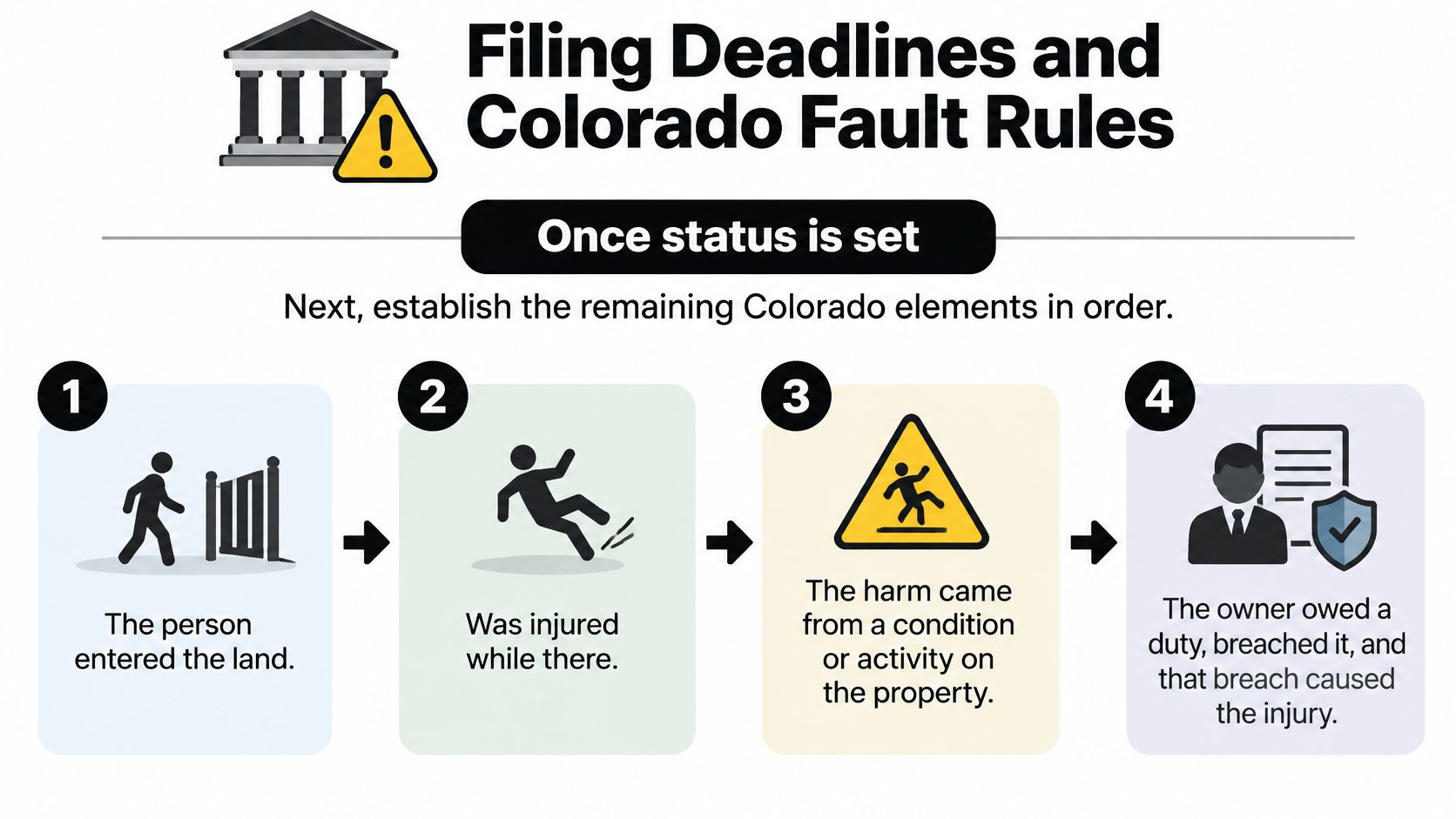
A viable claim needs more than a dangerous-looking floor. The injured person must connect entry onto the property, an injury there, a condition or activity that caused the harm, and a failure to meet the duty assigned to that visitor.
Think of those as separate factual questions rather than a single accusation that the property was unsafe. The claim process graphic provides a way to organize them.
A Puddle Doesn't Answer Every Question
Say a freezer repeatedly leaks, staff receive a repair request, and a customer slips in water beside it. Those facts suggest a path for investigating both notice and causation: the repair request addresses knowledge, while photographs and testimony may connect the water to the fall.
Now change the facts. The customer remembers falling near the freezer but doesn't know whether the floor was wet, and no photograph or witness identifies a condition. The injury may be genuine, but there's still a missing explanation of what caused it.
A warning sign also needs context. Where was it placed? Could the customer see it before reaching the danger? Did it address the condition involved? Neither the presence nor absence of a sign should replace a careful account of the event.
Colorado Deadlines and Fault Shares
Procedural deadlines and allegations of visitor fault deserve attention early. The firm's guide to Colorado comparative negligence addresses how an injured person's conduct can affect a claim.
| Issue | Effect |
|---|---|
| Personal injury filing | A late lawsuit can be barred; confirm the applicable filing deadline promptly |
| Public entity notice | Missing a required notice can defeat the claim before suit |
| Visitor fault below the recovery bar | Recovery may be reduced by the assigned share of fault |
| Visitor fault at or above the recovery bar | Recovery can be barred |
Don't treat an insurance claim as confirmation that every legal deadline has been protected. Ask an attorney to identify the applicable filing date, any separate notice requirement, and the party that must receive notice. Government-owned property deserves particular attention because notice and immunity questions can arise before the merits of the injury claim.
The defense may also argue that a condition was obvious or that the visitor was distracted. Preserve the surrounding facts instead of accepting those characterizations: sight lines, lighting, displays, pedestrian traffic, and the route available to you.
A photograph taken from standing height along your actual approach can explain visibility better than a close-up taken after the area has been cleared.
Falls Security Failures and Other Hazards
A shopper's shoe slides on water near a refrigerated display. In an apartment parking area, a resident encounters an attacker beside a door with a damaged lock. Both incidents raise property-safety questions, but they require different evidence.
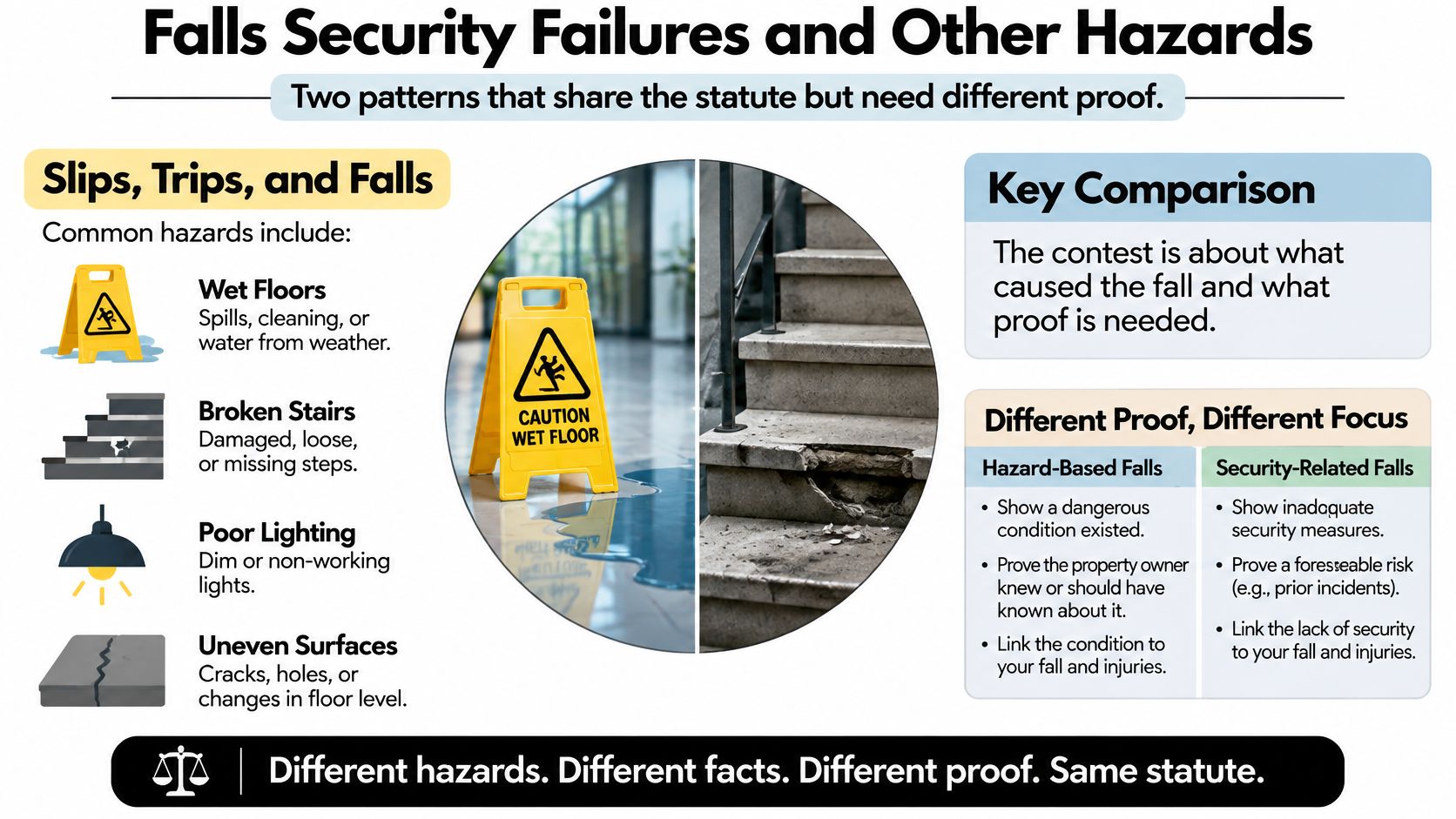
The common hazards below help organize the initial account. They don't establish who is legally responsible.
Falls Require a Specific Explanation
Wet floors, broken stairs, poor lighting, and uneven walking surfaces can create very different mechanisms of injury. Describe whether your foot slipped, caught an edge, missed a step, or landed where you couldn't see the surface.
For the shopper near the refrigerated display, useful questions include whether water came from equipment, cleaning, or a recent spill. A photograph of the puddle helps, but a photograph showing its location relative to the freezer, aisle, and walking route can be more informative.
The human stakes are substantial: the CDC's guidance on common injuries as people age reports approximately 37 million falls annually among U.S. adults aged 65 and older, with roughly 4.5 million emergency-department visits annually from older-adult falls. These national figures illustrate the scale of fall-related harm, not proof of liability in any individual case.
Security Claims Need More Than the Fact of an Assault
After an assault, the immediate priority is safety and medical care. A property investigation then asks what conditions the responsible parties controlled and what information they had before the incident.
Relevant issues may include:
- Lighting: Was the route illuminated, and had anyone reported failed fixtures?
- Locks and access: Was a door or gate malfunctioning, and who received repair requests?
- Earlier warnings: Were threats, unauthorized entries, or similar incidents reported?
- Response: What did management do after receiving a complaint?
An attacker's conduct and a property manager's conduct are separate questions. An assault doesn't automatically establish a negligent-security claim, and a general statement that an area was unsafe doesn't identify a preventable failure.
The video below offers another format for considering premises-safety issues.
For a Colorado incident, focus on the applicable Colorado duty and the facts available to the responsible party. Rules adopted in another state shouldn't be substituted for that analysis.
A broken lock complaint tied to the entrance involved is more useful than speculation about neighborhood crime. Likewise, the investigation must connect the alleged security failure to how the assault happened, not merely show that some part of the property needed improvement.
Records That Prove Notice and Causation
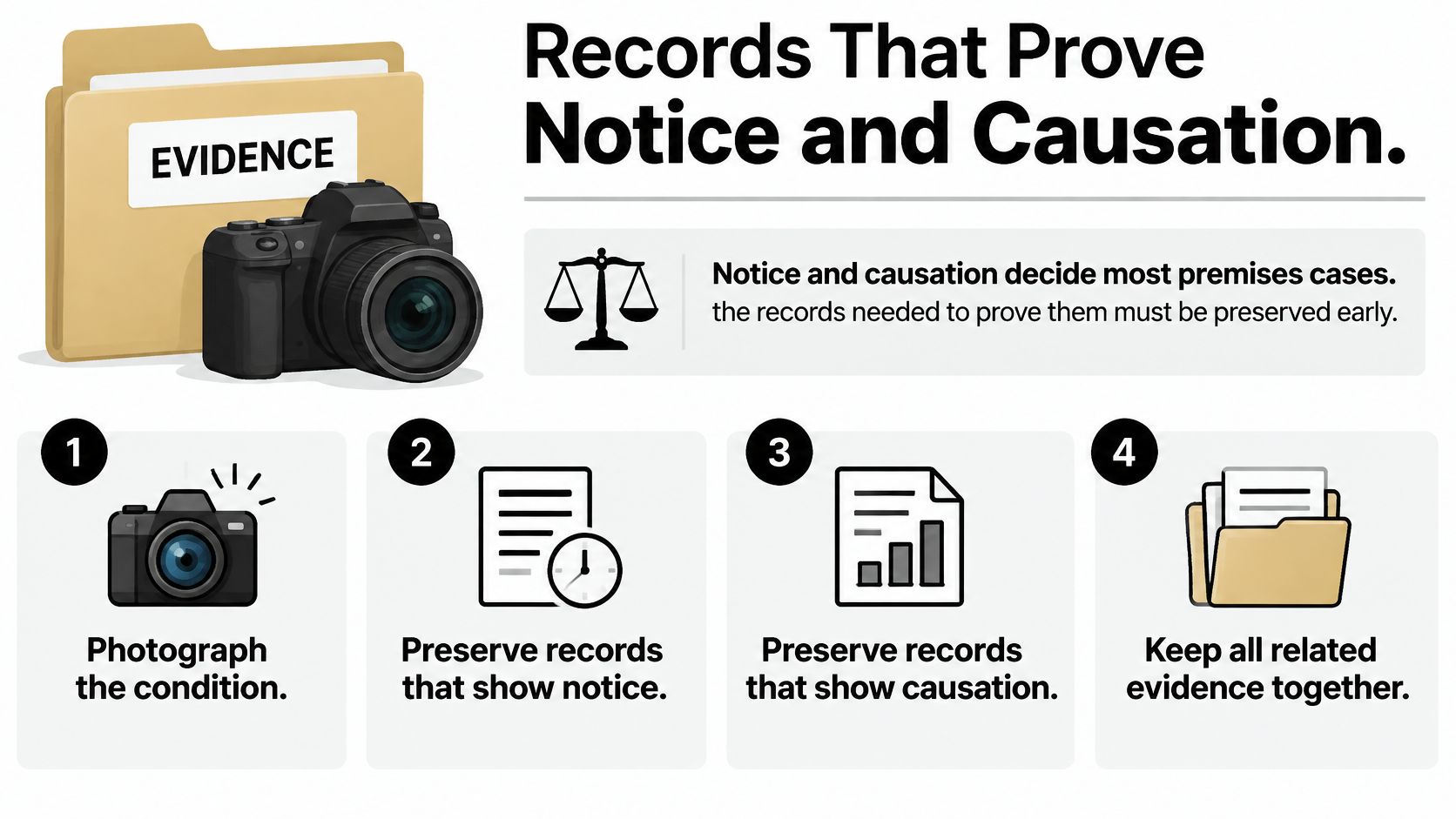
Notice concerns knowledge of the danger. Causation concerns whether that danger produced the injury. A record can help establish one without establishing the other.
Colorado appellate materials addressing premises liability connect the claim to entry, injury on the land, a property condition or activity causing the injury, and breach of the duty associated with visitor status. That's why ordinary business records can become important evidence rather than background paperwork.
Preserve What Can Disappear
Take these steps when you can do so safely. Don't delay urgent medical care to collect evidence.
- Photograph the condition. Include footwear, lighting, nearby objects, and wide views showing the approach before cleaning or repairs change the scene.
- Write down the setting. Record the time, weather, exact route, and what you noticed before and after the injury. Separate observations from guesses.
- Identify people. Get employee and witness names and contact information. Ask witnesses to describe what they personally saw.
- Request preservation in writing. Identify the location and approximate incident time, and ask that relevant surveillance be saved. Keep your request and any response.
- Keep physical items. Preserve shoes and clothing without washing, repairing, or discarding them.
- Save communications and treatment details. Keep incident reports, texts, appointment records, and medical visit times together.
- Organize before a recorded statement. Don't guess to fill gaps. Seek legal advice before giving a recorded insurance account you don't fully understand.
The checklist below offers a compact reminder of the preservation priorities.
Records and the Question Each One Answers
| Record | Question it answers |
|---|---|
| Surveillance footage | When the hazard appeared and how long it lasted |
| Inspection and maintenance logs | Whether a reasonable inspection would have found the condition |
| Prior complaints and incident reports | Whether there was actual or constructive knowledge of the danger |
| Employee messages | What staff knew and when |
| Weather records | Whether rain or ice explains the condition |
| Access-control logs and time stamps | Presence on the property and timing of the injury |
A blank inspection form doesn't necessarily prove an inspection happened. A maintenance entry doesn't necessarily prove the repair fixed the problem. Compare records with photographs, witness accounts, and the incident timeline.
Our guide to investigating a premises liability case provides additional context for assembling that evidence. During our investigation, we collect medical records, accident reports, witness statements, and expert opinions to establish liability and damages.
We also have access to medical and accident reconstruction experts who can testify about an injury's cause and impact. Their role is to explain supported conclusions, not to replace missing facts with certainty.
Medical Bills Wages and Lasting Harm
Say a fall leads to an emergency visit for a wrist fracture. The person expects a brief interruption, but treatment and difficulty using the hand keep them away from physical work for months. The financial loss extends beyond the first hospital bill.
Damages should describe what the injury changed. A diagnosis matters, but it doesn't by itself explain missed income, help needed at home, or limitations that persist after treatment.
Financial Losses Need a Paper Trail
Keep an organized file for costs and income changes:
- Treatment expenses: Emergency care, follow-up visits, prescriptions, medical equipment, and travel to appointments.
- Lost earnings: Pay records, employer confirmation, missed shifts, or self-employment records connecting lost work to recovery.
- Future needs: Medical recommendations addressing continuing treatment, assistance, or restrictions.
- Reduced earning capacity: Evidence that lasting limitations affect the work you can perform, not just the days already missed.
For a self-employed person, gross business revenue isn't necessarily the same as lost personal income. Save invoices, calendars, contracts, expenses, and records of replacement help so the calculation can be examined.
Future losses also need support. A fracture, concussion, or spinal injury may warrant further evaluation, but don't assume a permanent limitation before the medical evidence supports it.
Human Losses and the Amount You Keep
Pain and loss of enjoyment become clearer through specific tasks. Explain whether you stopped driving, needed help bathing, couldn't lift your child, or abandoned a regular activity. Describe changes clearly, including improvement.
Keep a factual recovery journal, not a performance for the claim. A note about an interrupted night or a task you couldn't complete is more useful than repeating that every day was terrible.
A fatal injury raises a different analysis involving surviving family members and a potential wrongful-death claim. It shouldn't be treated as merely an extension of the injured person's medical expenses.
Outstanding bills, liens, health-plan reimbursement claims, and subrogation interests can affect what someone ultimately keeps. Our team monitors medical bills, liens, subrogation interests, and other obligations that can affect a client's final recovery.
When considering premises liability settlement amounts, distinguish a proposed total from the amount available after applicable deductions. A defensible damages claim comes from records, documented limitations, and credible future needs, not a generic settlement average.
What to Do After a Premises Injury
You don't need a complete legal theory before taking useful action. Start with your health and a factual account, then get help with questions you can't answer yourself.
Actions You Can Start Today
- Get medical care. Tell the clinician how and where the injury happened, what body parts were affected, and whether symptoms changed afterward. Don't minimize symptoms because you feel embarrassed.
- Finish urgent preservation requests. Arrange help with outstanding photographs, witness contacts, or footage requests if you can't handle them safely yourself.
- Report the incident. Notify the owner or manager and request a copy of the report. Describe observations without guessing about responsibility or adopting someone else's explanation.
- Confirm legal dates. Have an attorney identify and calendar the filing deadline and any public-entity notice requirements. Don't assume ongoing conversations with an adjuster protect your claim.
- Gather loss records. Put bills, wage documentation, and a short symptom timeline in a folder. Keep original documents and save readable copies.
- Speak with a Colorado attorney. Bring the invitation or transaction records along with the injury evidence so the discussion addresses visitor status, property control, notice, and damages.
Bring Questions, Not Just Paperwork
Ask who may be legally responsible, which facts remain uncertain, and what evidence needs immediate attention. Be candid about distractions, prior injuries, or details you don't remember. An attorney can evaluate difficult facts more effectively when they're identified early.
We handle Colorado premises liability cases, and you can call 720-637-7786 with status and deadline questions. During a free consultation, a personal injury attorney answers questions and helps put together the case the facts can support. No outcome is promised for a new case.
Nares Law Group LLC offers free consultations for people dealing with Colorado premises injuries, including questions about visitor status, unsafe conditions, and resulting losses. Visit Nares Law Group LLC to request a consultation and discuss what evidence and deadlines need attention in your situation.