You're stopped at a Denver intersection when another car hits you from behind. Two weeks later, a letter arrives: the insurer will pay for the car, but it disputes that the crash caused your neck injury. Your vehicle needs repairs, medical appointments are piling up, and you're still trying to work out what the letter means.
That's the moment a claim can start to feel like a negotiation over a loss you haven't finished measuring. The adjuster has put a number or position on the table; you're still gathering bills, treatment notes, and information about how the injury may affect your work. Before you answer, identify what the insurer is really disputing.
Why Motor Insurance Disputes Start After a Crash
Most motor insurance disputes fall into three categories: fault, value, or coverage. They can overlap, but separating them gives you a clearer response.
- Fault: The insurer says its driver wasn't responsible, or assigns you some or all of the blame. The dispute turns on evidence of what happened, such as photos, witness accounts, or video.
- Value: The insurer accepts some responsibility but disagrees with the amount. That might mean a lower vehicle valuation, a disagreement about treatment or lost income, or a dispute about whether an injury is connected to the crash.
- Coverage: The insurer says a policy limit, exclusion, or coverage condition restricts payment. The at-fault driver may have too little insurance to cover a serious injury, or you may need to look at uninsured or underinsured motorist protection.
These disagreements reflect how automobile insurance developed. In the United States, Connecticut enacted the first financial-responsibility law in 1925, and Massachusetts' first compulsory insurance law took effect in 1927. By 2025, 49 states and the District of Columbia required motorists to carry some form of auto-liability insurance, though the minimum limits and coverage structures differed, according to this history of auto insurance. A legal requirement to carry insurance doesn't guarantee that the available coverage will be enough for every injury.
In the Denver example, the insurer's agreement to pay for the car doesn't resolve the neck-injury question. That part is a value or causation dispute: the insurer may accept that an injury exists while questioning its connection to the crash or the amount claimed. If the driver's coverage is also too small to address the losses, there may be a separate coverage issue.
Start with the letter's actual reason. A fault dispute needs evidence about the crash. A value dispute needs a defensible calculation. A coverage dispute needs the policy and limits examined.
Write down whether your own dispute is about fault, value, or coverage before contacting the insurer again. Each calls for a different kind of proof.
Common Motor Insurance Disputes and How Each Is Handled
Use the table to find the row that matches your insurer's letter. Gather the evidence in that row before choosing the next step.
| Dispute type | Typical insurer position | First evidence to gather | Usual next step |
|---|---|---|---|
| Liability denial | Insured driver wasn't at fault | Police report, photos, witness contacts, dashcam or telematics | Send a written rebuttal and request the insurer's liability basis in writing |
| Lowball settlement offer | Offer is below documented medical bills and lost wages | Itemized bills, wage records, treatment chronology | Send a written counteroffer with a line-item calculation |
| Total-loss valuation | Vehicle value is below local replacement cost | Comparable local listings, service records, option list, pre-loss photos | Seek an independent appraisal and challenge the valuation in writing |
| Delayed payment | No decision or payment within a reasonable time | Dated correspondence log, proof of submission | Make a written demand citing policy duties, then consider a state-regulator complaint |
| UM claim | Insurer disputes that the other driver was uninsured or the injury amount | Proof the other driver lacked coverage, police report, medical records | Give formal notice of the UM claim and follow up with each adjuster |
| UIM claim | Insurer disputes damages or whether the at-fault driver's limit is exhausted | At-fault driver's policy limits, medical records, UIM claim notice | Send a formal UIM demand, then consider arbitration or mediation if the policy allows |
| Bad-faith conduct | Denial or delay lacks a reasonable basis | Full claim timeline and every stated reason for delay or denial | Consider a demand letter, regulator complaint, and possible action under state law |
A total-loss dispute isn't settled by what you paid for the vehicle. The question is whether the insurer's valuation reflects the vehicle's condition and what comparable vehicles cost locally. For example, if the insurer's report values your car below similar local listings, keep those listings with their dates, include service records and pre-loss photos, and ask the insurer to explain each adjustment. If repairs are disputed instead, understanding how OEM and aftermarket collision parts compare can help you discuss parts and repair estimates with the shop and insurer.
A UIM claim raises a different question: whether the at-fault driver's available coverage has been exhausted and how the remaining injuries and losses should be valued. Keep the other driver's policy-limit information, your own UIM notice, and updated medical records together. A disagreement about a total-loss valuation and a disagreement over injury coverage may arise from the same crash, but they need separate evidence.
For a delayed payment, compare the insurer's communications with the policy's claim requirements and applicable state rules. The table is a starting point, not a ruling on your rights: policy wording and local law can change the next step. Find your row, then write down the evidence gap before contacting the insurer again.
How a Claim Moves Through the Insurer and Where It Stalls
A motor claim passes through several hands. Each handoff can move the file forward, or leave the next person waiting for a document, decision, or explanation.
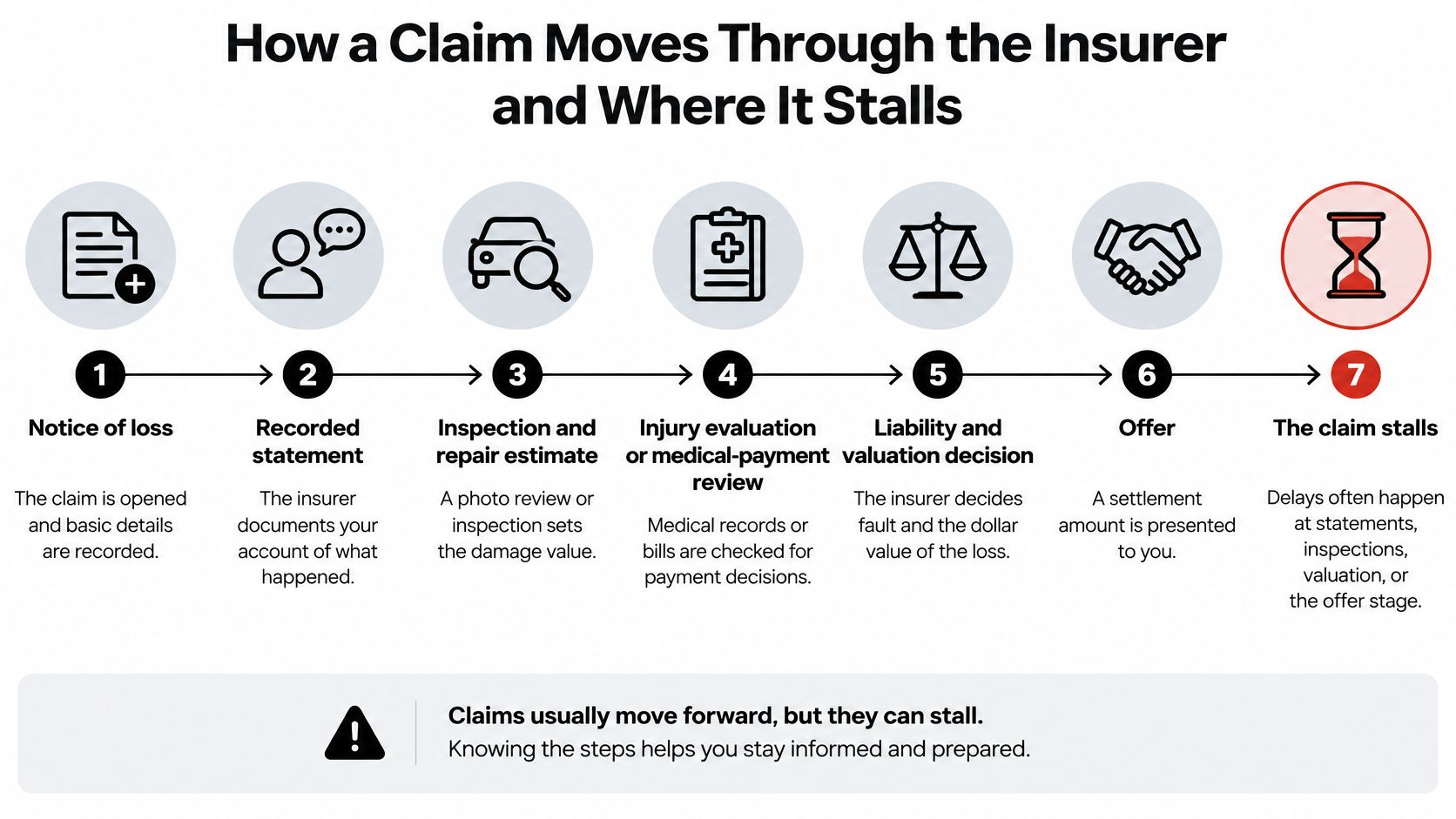
Follow the claim from notice to payment
The sequence usually begins when you report the crash and the insurer opens a claim. An adjuster may take a recorded statement, arrange a vehicle inspection or request photos, and review repair estimates. If someone was injured, the insurer may also request medical records or bills before making liability and valuation decisions, presenting an offer, and issuing payment.
Think of each stage as a relay handoff. If the insurer hasn't received an estimate, the person evaluating the vehicle may have nothing to work from. If you've sent records but can't show when, the file may appear incomplete even when you've done what was requested.
Michigan's Department of Insurance and Financial Services identifies delayed investigation, failure to pay undisputed amounts promptly, unreasonable proof-of-loss demands, and low offers when liability is reasonably clear as potential improper claims practices in its claims-administration bulletin. Those are specific warning signs to compare against your own file, not proof that every slow or low decision is improper.
Mark the stalled handoff
Say you give a recorded statement on day three, then hear nothing for two months. When you follow up, the insurer says the file is incomplete. A dated record of the statement, later calls, emails, and requests lets you ask a specific question: what exactly is missing, when was it requested, and what decision remains open?
Delay can put financial pressure on you while you're trying to manage repairs, care, and missed work. That pressure can make an early offer feel harder to refuse. Keep a dated contact log and separate disputed amounts from amounts the insurer has no reasonable basis to withhold. Compare the dates with the policy's conditions and applicable deadlines, since the rules depend on the policy and the state governing the claim.
If the carrier's investigation raises questions about evidence or its handling of the file, understanding how an insurance company investigation works can help you prepare for requests and preserve your own records. Mark the stage where your claim has stalled, then identify the next document or decision needed to move it forward.
Building the Evidence File That Wins Disputes
A useful claim file isn't a pile of paperwork. It's a set of records that answers the insurer's questions about what happened, what it caused, and what it cost.
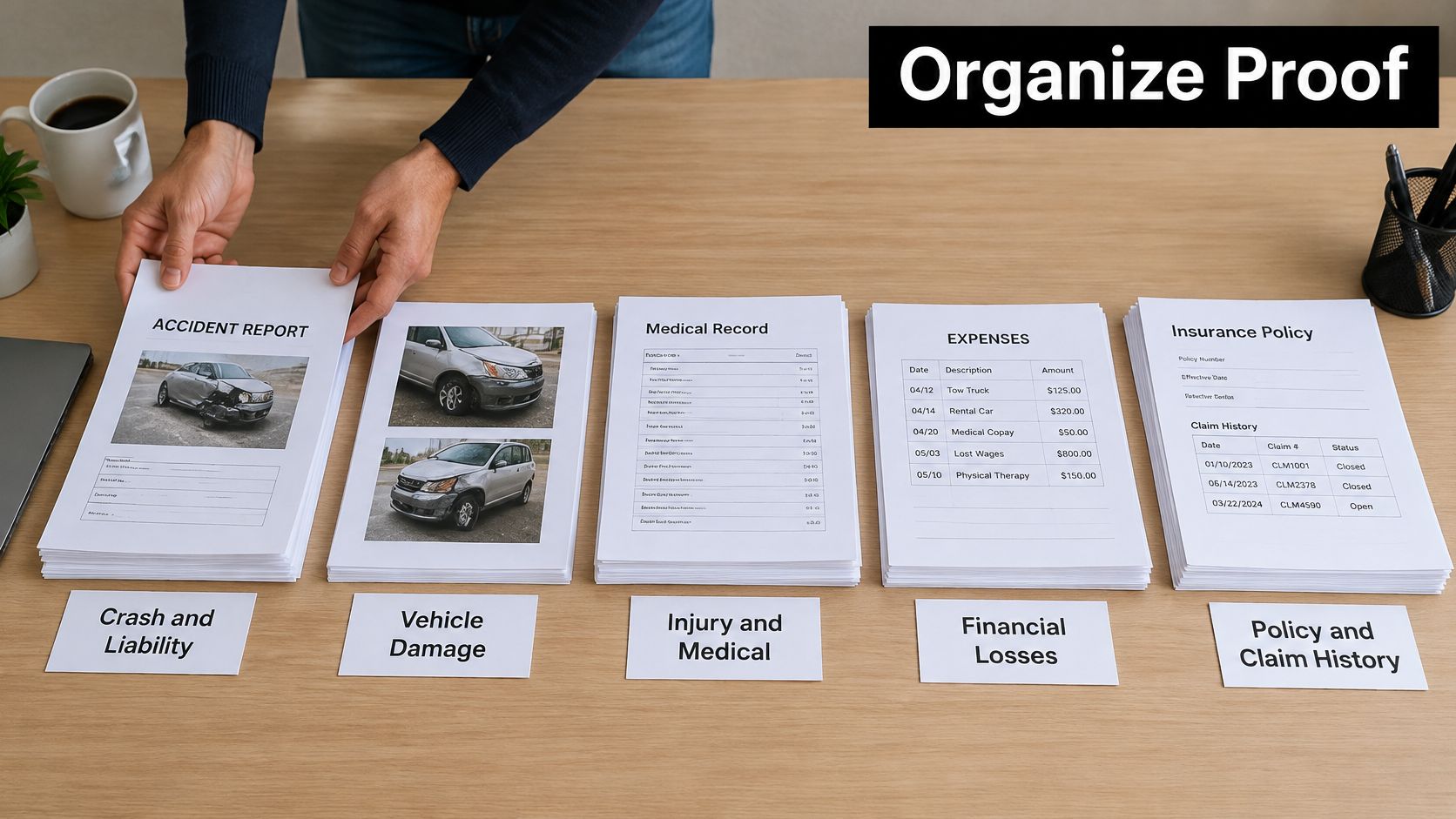
Build five evidence folders
Crash and liability. Keep the police report, original scene and vehicle photos, dashcam footage, witness contacts, and any app or telematics records. Fault is decided from what can be established about the collision, so preserve the original files and their metadata where possible.
Injuries. Assemble a medical chronology, itemized bills, imaging reports, provider notes connecting the injury to the crash, and lien notices. These records help show what treatment you received, when you received it, and how the injury affected you.
Income loss. Save pay stubs, an employer letter identifying missed days and the reason, and tax records that help support your earnings history. A bare estimate of missed income is easier to dispute than a figure supported by employment documents.
Vehicle. Keep repair estimates, service records, option details, pre-loss photos, and comparable local listings with dates. These materials help test whether the insurer accounted for your vehicle's condition and what similar vehicles cost nearby. Before repairs alter the evidence, review practical guidance on assessing collision damage before repairs.
Communications. Save every email and letter, along with a call log showing the date, time, representative's name, and what was discussed. If the insurer relies on telematics, request the specific driving data it used and compare it with records in your own apps.
Records do two jobs: they support the amount you claim, and they show what the insurer knew when it made a decision.
During an investigation, our firm collects medical records, accident reports, witness statements, and expert opinions to establish liability and damages. That process can help organize the evidence around the questions that matter in a particular claim.
The video below offers another way to think about organizing claim information before responding to the insurer.
Preserve original files before they're overwritten, deleted, or changed by repairs. That includes the phone holding your original photos.
How to Challenge a Lowball Offer or Denial
A strong response addresses the insurer's stated reason, not just the amount you want. Work through these steps in order so your rebuttal is specific and easy to verify.
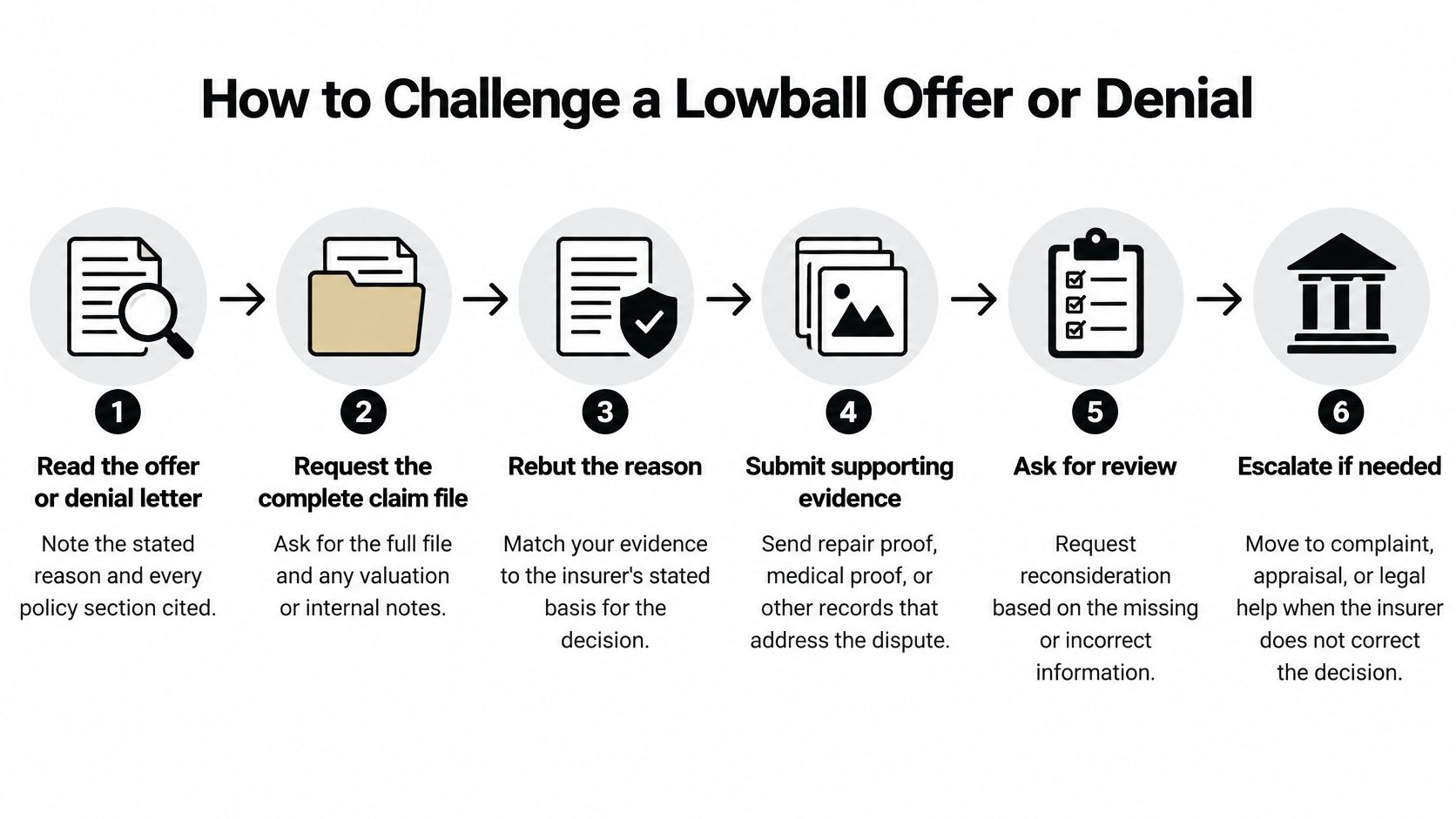
Read the letter closely. Note the insurer's stated reason and every policy section it cites. If you respond before understanding the reason, you may spend time proving a point the insurer didn't dispute.
Request the complete claim file in writing. Ask for the valuation or liability report and any other records used to make the decision. Calling may be quicker, but a phone-only request leaves you without a clear record of what you asked for.
Test the valuation line by line. For a vehicle, check whether comparisons are local and recent, how pre-loss condition was graded, and whether taxes, title, or registration fees are included where required. Ask for support for any salvage deduction; don't assume an unexplained adjustment is correct.
Compare the offer with documented losses. Put the insurer's figure beside the medical bills, supported wage loss, repair estimate, or replacement-cost evidence relevant to your dispute. A useful comparison shows what is missing and why, rather than calling the offer unfair.
Send a written rebuttal and a calculated counteroffer. Cite the records that answer the insurer's reason, then state how you calculated your proposed amount and request a response by a specific date. For a property-damage dispute, this guide to negotiating a fair property damage settlement can help frame the comparison. Avoid sending a vague demand for “more.”
Track the response and escalate if needed. Log each reply and note delays against the policy's timing conditions. If the insurer hasn't addressed the evidence by your stated date, consider a complaint, a dispute process allowed by the policy, or legal advice; a clear insurance dispute letter can put the reasons and requested action on record.
Don't accept a settlement just because it's the first offer, particularly if your treatment is ongoing and the full effect of the injury isn't clear. Your records and policy terms matter more than pressure to finish quickly. A signed release usually ends the claim, so understand what rights you're giving up before you sign.
Complaints, Mediation and Arbitration Compared
The right escalation route depends on what you need someone to decide. An internal appeal can correct a file mistake without leaving the insurer; a regulator complaint can bring attention to handling conduct; mediation and arbitration address disputes between parties in different ways.
| Option | Who decides | Typical cost to you | Binding? | Best for |
|---|---|---|---|---|
| Internal appeal to claims supervisor | Insurer reviewer | Free | No | First written challenge with new evidence |
| State insurance regulator complaint | Regulator reviews handling conduct | Free | No | Delay, misrepresentation, or unfair handling |
| Mediation | Neutral mediator helps parties agree | Mediator fees may apply | Only if both parties sign an agreement | Valuation gaps where both sides want to settle |
| Arbitration | Arbitrator issues an award | Filing and hearing costs may apply | Often yes when the policy requires it | UM or UIM disputes with an arbitration clause |
| Lawsuit | Judge or jury | Attorney fees and court costs may apply | Yes, after judgment | Denials, bad-faith conduct, or unresolved valuation |
An internal appeal is a practical first move when you have new evidence or a clear factual correction. A supervisor still works for the insurer, so this isn't independent review. A state insurance regulator complaint is better suited to concerns about handling, such as delay or misrepresentation; it doesn't substitute for a process that awards damages. Colorado consumers can submit complaints to the state's Division of Insurance.
Mediation brings in a neutral person to help the parties reach an agreement. It can suit a valuation gap when both sides are willing to negotiate, but an agreement becomes binding only if the parties sign it. You can learn more about what the mediation process involves.
An arbitration clause may set a different path, especially in a UM or UIM dispute. The arbitrator issues an award, and the policy may make that award binding. Read the policy wording before agreeing to a process.
Match the route to the problem: delay points toward a regulator; a valuation gap may suit mediation; a UIM dispute with an arbitration clause may go to arbitration; and a clear bad-faith denial may call for court review.
Costs and procedures vary. Check the policy and applicable rules before deciding, especially when a deadline or binding outcome is involved.
When to Talk to a Colorado Injury Attorney Before You Settle
Say a driver is still receiving treatment when the insurer offers a settlement and asks for a signed release. A consultation before accepting can help clarify what the offer covers and whether unresolved issues remain. Consider getting advice if the insurer disputes fault, the available coverage may not meet your losses, a UM or UIM claim is denied, or the insurer delays without a clear explanation.
Legal deadlines depend on the claim type and facts. If a deadline may be approaching, ask an attorney to confirm which one applies rather than relying on a general estimate.
Nares Law Group attorneys negotiate with insurance carriers and are prepared to take a case to court if negotiations fail. Karla Prado monitors medical bills, liens, subrogation interests, and other obligations that may affect a client's final recovery.
Before signing a release, sort the dispute by its cause: fault, value, coverage, or delay. Then review the insurer's valuation line by line, including how it accounts for medical costs, lost income, and future care. A consultation can help identify questions to resolve before a settlement closes the claim.
If your motor insurance dispute involves a denied, delayed, or undervalued injury claim, Nares Law Group LLC can review the decision, organize evidence, and pursue a documented response. Visit Nares Law Group LLC to learn how the firm can help you evaluate your next step before you settle.