You've likely already had the call.
Your phone rings. The adjuster sounds calm, professional, maybe even kind. They say they just need “your side of the story” so they can move things along. If you're dealing with a Colorado car crash, a trucking wreck, or a brain injury claim, that moment can feel like progress and danger at the same time.
That reaction is normal.
An insurance company investigation often starts when you're still in pain, still sorting out medical care, and still trying to understand what happened. The investigation is often assumed to be just paperwork. In serious injury cases, it usually isn't. It's a process built to test your claim, your credibility, and sometimes your patience.
If you feel unsure about what to say, what to sign, or whether the call is being recorded, it helps to understand the rules before you respond. A practical overview of 2026 call recording laws can help you think through that issue before you speak with an adjuster again.
The Phone Call That Starts It All
The first call usually comes fast. In a straightforward vehicle claim, the adjuster may ask where the crash happened, who was involved, whether you were hurt, and whether you've seen a doctor. In a trucking case, the questions may sound simple but carry more weight because the insurer is already looking at vehicle damage, driver statements, electronic records, and potential liability defenses.
If you have a brain injury, the call can be even more difficult. You may be dealing with headaches, memory problems, confusion, irritability, light sensitivity, or trouble finding words. That's exactly why many injured people later regret trying to “just handle it” on the phone. What feels like a harmless answer in the moment can get treated like a fixed statement later.
Practical rule: The first call is not a test of whether you're cooperative. It's the start of a record.
Adjusters often sound reassuring because they want information while your guard is down. That doesn't make every adjuster dishonest. It does mean you should assume the conversation matters.
A common example looks like this:
- You say you're “fine” because you haven't processed the pain yet.
- You estimate your speed or distance because silence feels awkward.
- You try to be helpful by filling in details you don't know.
- You agree to a recorded statement because it sounds routine.
Later, those same comments can be used to question injury severity, fault, or consistency.
If you're new to this process, the goal is simple. Slow it down. Listen carefully. Don't guess. Don't volunteer extra detail. Don't mistake friendliness for neutrality.
You do not need to win the conversation. You need to avoid hurting your claim.
What an Insurance Investigation Really Is
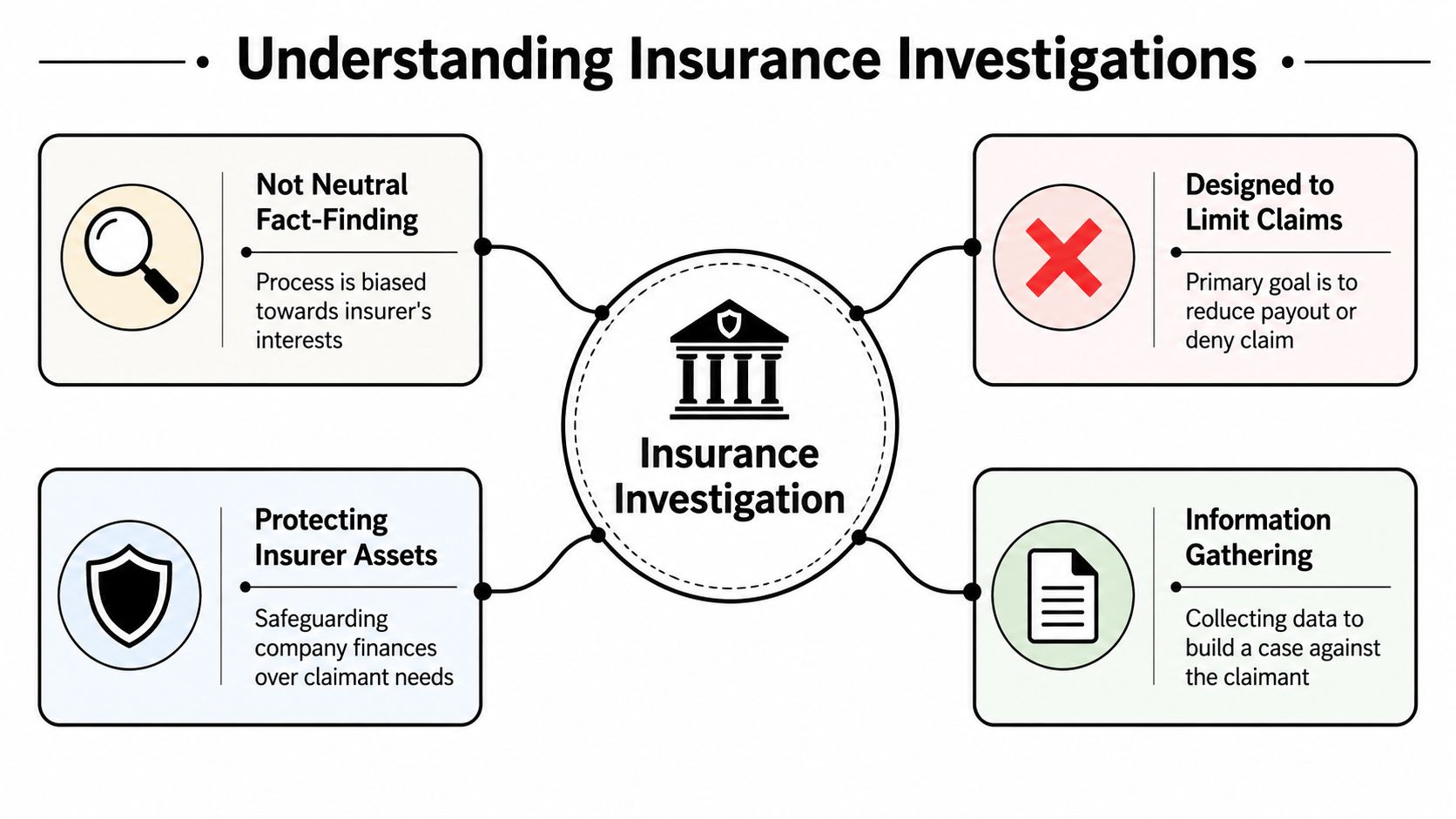
An insurance company investigation is not a neutral search for truth in the way most claimants imagine it. It is a business process designed to verify facts, evaluate exposure, and limit improper or inflated payouts. Sometimes that means a legitimate claim gets paid fairly. Sometimes it means the insurer looks for reasons to delay, narrow, or deny parts of the case.
Consider it the other side's game film. They are not reviewing the facts to help you present your case better. They are gathering information to decide how to defend their money.
Why insurers investigate so aggressively
The insurance industry has a real fraud problem. The Coalition Against Insurance Fraud estimates that fraud steals at least $308.6 billion annually from American consumers, and it says that cost is ultimately passed down through higher premiums to families, according to the Coalition Against Insurance Fraud's fraud statistics.
That context matters because it explains why insurers build serious anti-fraud systems, use specialized investigators, and scrutinize claims that involve large medical bills, unclear mechanisms of injury, or inconsistent records.
It also explains why your legitimate claim may still be treated with skepticism.
Standard claims review versus SIU
Most claims begin with an adjuster handling ordinary fact collection. That usually includes:
- Basic liability review such as police reports, photos, and witness statements
- Damage review including vehicle inspections and repair estimates
- Medical review focused on treatment records and billing
- Background checks that look for prior claims, prior injuries, or inconsistent reporting
A more serious track is an SIU investigation, meaning a Special Investigations Unit review. When SIU gets involved, the insurer usually suspects misrepresentation, fraud indicators, staged loss concerns, document issues, or unexplained inconsistencies.
That doesn't automatically mean you did anything wrong. It does mean the insurer has shifted from routine processing to defensive investigation.
An insurance investigation becomes much more dangerous when the company stops asking, “What happened?” and starts asking, “What can we prove against this claim?”
Your digital life is part of the file
Many claimants still underestimate how much insurers look beyond the crash itself. Photos, public posts, location clues, and old profile content can all become part of the insurer's picture of you. If you're worried about how your public profiles may look out of context, it's worth reviewing practical steps to protect your online reputation before the insurer builds its own narrative.
The bottom line is simple. The insurance company investigation is about risk control for the insurer. If you understand that early, your decisions get better immediately.
The Investigation Timeline and Process
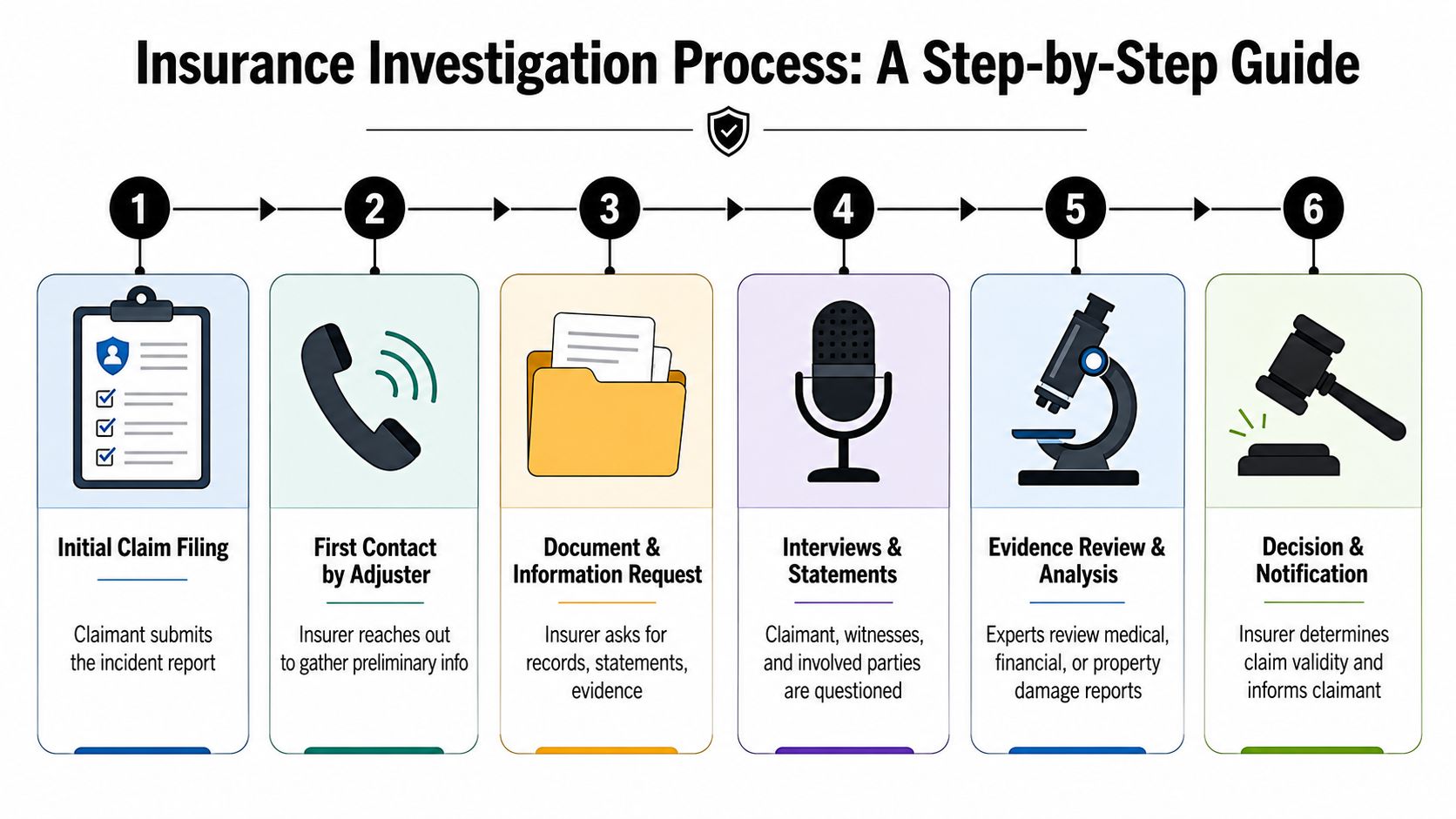
Knowing the sequence often reduces anxiety. The process doesn't always move in a straight line, but serious Colorado injury claims usually follow a recognizable pattern.
The early stage
The first phase often starts within days of the crash. The adjuster opens the file, confirms basic facts, identifies vehicles and drivers, and asks for immediate documents. If your car is damaged, the insurer may arrange an inspection quickly because vehicle evidence can disappear once repairs begin.
You may also be asked for:
- A recorded statement
- Medical authorizations
- Photos or video
- Names of witnesses
- Employment information if wage loss is claimed
At this point, many claimants make two mistakes. They give broad authorizations, and they assume speed helps them. In reality, broad releases can hand the insurer irrelevant history, and rushed statements often create contradictions.
The middle stage
Once the insurer has your basic information, the file gets more layered. The adjuster compares your account to the police report, witness accounts, medical records, property damage, and any digital evidence.
In more complex claims, investigators may review:
- Social media and public online material for posts or images they think undercut your injury claim.
- Medical chronology to separate crash-related injuries from prior complaints.
- Vehicle damage patterns to argue about force of impact.
- Commercial records in truck cases, such as driver logs, maintenance records, or company safety documents.
- Special examinations if the insurer wants a formal statement or medical review.
If you're facing an Examination Under Oath, the process becomes more formal and higher risk. A practical explanation of For The Public Adjusters EUO help can help you understand why these sessions require care.
The later stage
As treatment continues, the insurer keeps updating its valuation of the claim. It may ask whether you've returned to work, whether specialists have diagnosed a permanent condition, and whether future care is expected. In disputed injury cases, especially those involving pain complaints, neurological symptoms, or recovery delays, the insurer may request an independent medical exam. If that issue comes up, it helps to understand what an independent medical examination really is before you attend.
The timeline feels administrative on the outside. Inside the file, every new document is being used to measure leverage.
A claim may resolve after this review, or it may stall if the insurer believes the injuries are overstated, the liability picture is disputed, or the documentation is incomplete. In truck and brain injury cases, this stage can become document-heavy fast because each side is trying to shape the story before settlement talks get serious.
Red Flags and Common Insurer Tactics
Many claimants get into trouble because they think a thorough investigation is the same thing as a fair one. It isn't. Some insurance company investigation tactics are routine and defensible. Others are strategic pressure.
Friendly language can be a collection tool
An adjuster may sound unusually warm, casual, or sympathetic. That can be genuine. It can also be effective information gathering. The more relaxed you feel, the more likely you are to estimate, speculate, minimize symptoms, or speak in absolutes.
Watch for phrases like:
- “Just help me understand” when the question calls for a technical answer
- “We can close this quickly” before your treatment picture is clear
- “It's routine” when they want a recorded statement immediately
- “If there's nothing to hide, this shouldn't be a problem” when they want broad access
Those aren't always improper. They are often designed to lower resistance.
Quick money is often cheap money
A fast offer can feel like relief when medical bills are arriving. But a quick settlement in a truck crash or brain injury claim often means the insurer wants closure before the full scope of harm is documented.
That's especially dangerous with neurological injuries. Symptoms can evolve. Concentration problems, mood changes, sleep disruption, and cognitive fatigue often become more obvious after the chaos of the first week has passed.
If the insurer wants finality before your doctors understand your condition, the offer probably protects them more than you.
Insurers use technical verification
Claims teams don't just read your paperwork. They increasingly analyze digital evidence. Forensic review of images can involve EXIF metadata, compression artifact analysis, error-level detection, reverse image searches, and review of lighting inconsistencies to determine whether a photo is original, altered, or out of sequence, as explained in this overview of forensic verification in claims investigations.
That matters for claimants because honest mistakes can still create suspicion. If you send screenshots instead of original files, strip metadata, crop photos, or lose the date trail, you may give the insurer an opening it didn't have before.
Bias can distort who gets flagged
A serious issue most guides ignore is systemic bias. Consumer advocates have called for investigations into whether insurers' anti-fraud algorithms may disproportionately flag and deny claims from minority communities, according to the Consumer Federation of America's statement on racial bias in claims handling and antifraud efforts.
That matters in practice. A claimant may be treated as suspicious not because the evidence is weak, but because the system assigned risk in a biased way. That doesn't mean every delay is discrimination. It does mean you should take unusual scrutiny seriously, document every interaction, and push back when requests seem disconnected from the actual claim.
Evidence can disappear on both sides
Truck cases raise another problem. Vehicle data, driver records, onboard systems, and company documents can be lost, overwritten, or discarded if no one acts quickly. If you suspect critical evidence is at risk, learn how spoliation of evidence can affect a serious injury case.
Red flags rarely arrive with a warning label. They usually show up as pressure, overreach, selective skepticism, and a sudden change in tone.
Your Action Plan for Dealing with Investigators
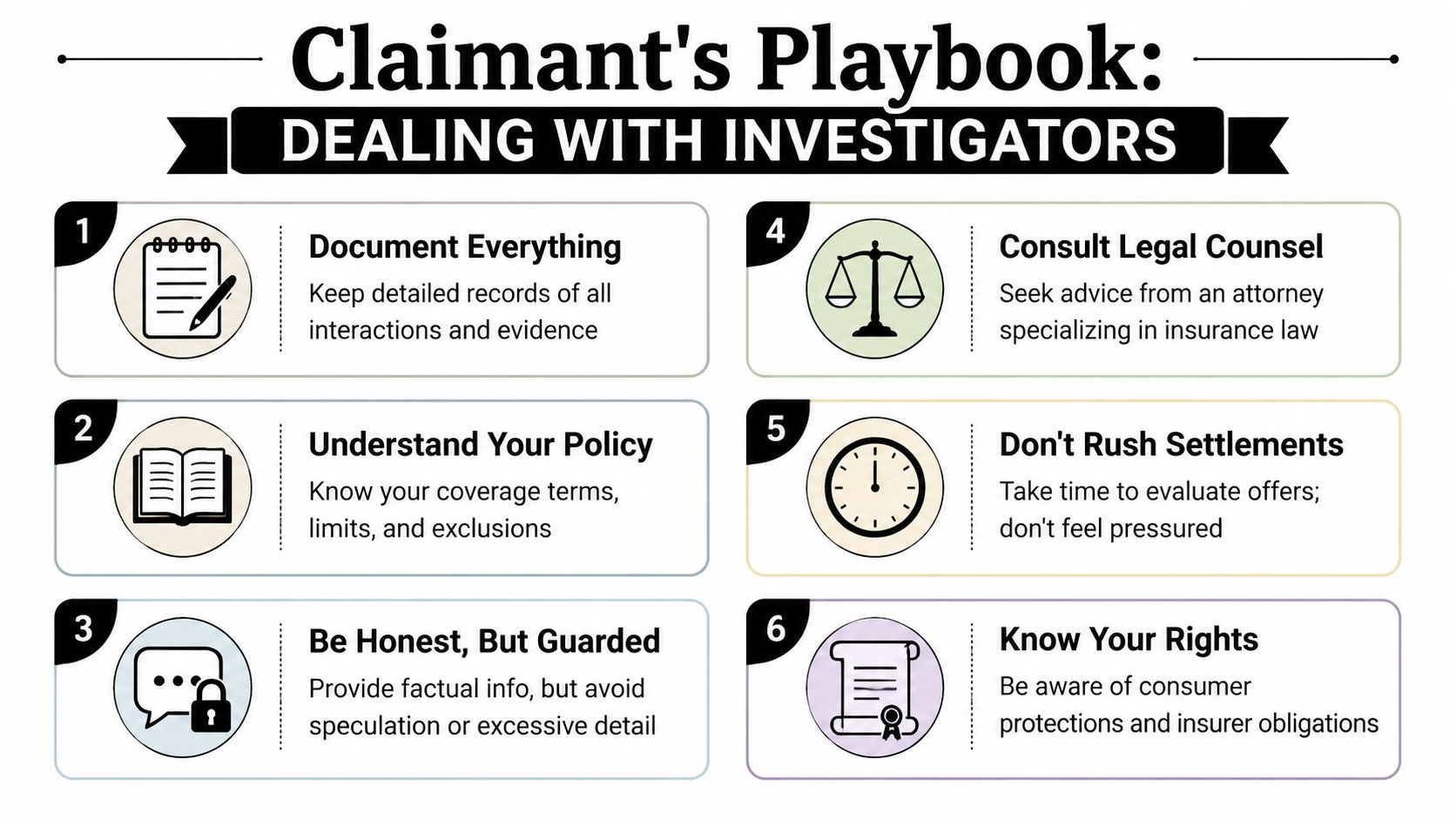
When the insurer starts asking questions, your job is not to out-argue them. Your job is to protect the factual record. Good claims are often damaged by loose communication, missing documents, and rushed decisions.
What to do right away
Start building your own file before the insurer defines the case for you.
- Save original photos and videos. Keep the original files, not just screenshots. Metadata can matter.
- Write down symptoms daily. A short pain and function journal helps track headaches, dizziness, sleep problems, missed work, and daily limitations.
- Keep every document. Save letters, emails, claim numbers, appointment summaries, bills, and prescriptions.
- List every call. Note who called, when, what they asked for, and what you said.
- Preserve witness information. Names, phone numbers, and brief notes can become important later.
A concise guide on how to deal with insurance after a car accident can also help you avoid the most common early mistakes.
What to say and what not to say
The safest communication style is factual, short, and controlled. You don't need to be combative. You do need boundaries.
“I'm receiving treatment and I'm not able to give a recorded statement at this time.”
That sentence is often enough.
“I don't want to guess. I'll answer that once I have accurate information.”
That is better than trying to sound helpful.
Later in the process, visual explanations can help. This short video gives a useful overview of how claimants can approach insurer communications without compromising their position.
Communicating with the Insurance Adjuster
| Do ✅ | Don't ❌ |
|---|---|
| Stick to confirmed facts | Guess about speed, distance, timing, or medical prognosis |
| Ask for requests in writing | Rely on memory alone |
| Keep copies of everything you send | Send original evidence without preserving your own copy |
| Use narrow, accurate answers | Volunteer extra detail to fill silence |
| Review documents before signing | Sign broad medical or employment releases without understanding scope |
| Stay polite and calm | Argue emotionally on the phone |
| Correct mistakes promptly | Assume a casual comment won't matter later |
A simple checklist for difficult claims
Truck wrecks and brain injury cases need extra discipline because the records are more technical and the damages are often more contested.
- For truck cases, keep every towing, repair, cargo, and employer-related document you receive.
- For brain injury cases, note cognitive symptoms the same day they happen. Memory gaps are part of the injury, so written logs matter.
- For any serious crash, don't post about your activities, recovery, travel, workouts, or “good days” online without assuming the insurer may use it out of context.
- If a request feels too broad, pause before responding. Delay is frustrating, but careless cooperation is usually worse.
The strongest claimants aren't the most talkative. They're the most consistent.
Special Considerations for Colorado Accident Claims
Colorado vehicle cases can get complicated quickly, especially when the crash involves a commercial truck, disputed roadway conditions, or a traumatic brain injury that doesn't show up neatly on an X-ray. The insurance company investigation in these cases is usually broader and more aggressive because the financial exposure is higher and the facts are harder to package into a simple story.
Trucking claims bring multiple investigations
A regular car crash may involve two drivers and two insurers. A trucking case can involve the driver, the motor carrier, a trailer owner, a maintenance contractor, a cargo entity, or a manufacturer. Each one may have separate counsel, separate insurers, and separate theories of blame.
That creates a strange dynamic for injured people. Several companies may investigate the same crash at once, but not for your benefit. One party may try to push fault onto another. Another may admit a narrow issue while disputing the scope of injury. Documents that matter early, such as inspection records, dispatch communications, onboard data, and driver qualification materials, can shape the entire case.
Brain injury claims are often treated with skepticism
Brain injuries are hard because they're often real, serious, and not obvious to an outside observer. A person may look normal while struggling with memory, processing speed, balance, emotional regulation, light sensitivity, or fatigue.
Insurers already focus heavily on auto fraud. Auto insurance scams, including staged crashes and fraudulent injury claims, cost auto insurers at least $29 billion a year, according to this summary of insurance fraud statistics focused on auto scams. That background makes insurers especially skeptical of claims involving subjective symptoms or complex recovery patterns.
That skepticism can fall hardest on people with brain injuries because:
- Symptoms fluctuate from day to day
- Imaging may not tell the whole story
- Family members often notice deficits before records fully reflect them
- Claimants may sound better in brief conversations than they function in daily life
Colorado claimants need discipline early
In Colorado cases, treatment consistency and documentation quality often matter as much as the diagnosis itself. If your symptoms involve headaches, concentration problems, dizziness, mood change, or sleep disruption, tell your doctors plainly and repeatedly. If your truck crash involved confusing liability or multiple corporate actors, preserve every notice, letter, photo, and vehicle-related record you can get.
What works in these claims is precision. What doesn't work is assuming the insurer will connect the dots for you.
When an Investigation Signals You Need a Lawyer
Some investigations stay routine. Others cross a line where continuing to handle it alone creates unnecessary risk.
You should strongly consider legal help if any of these happen:
- The insurer refers your claim to SIU
- You're accused of exaggeration, concealment, or misrepresentation
- You receive a reservation of rights letter
- The crash involves a commercial truck or multiple possible defendants
- You have symptoms consistent with a traumatic brain injury
- The insurer demands a recorded statement after inconsistencies are alleged
- You're being asked for broad records that don't seem tied to the crash
- The company is focusing more on your credibility than on the evidence
- Your injuries are severe, disabling, or likely to affect work long term
In serious injury litigation, lawyers often bring in specialists when the claim requires more than ordinary records review. When claims are complex, personal injury firms engage forensic accountants who reconstruct financial events, quantify true lost income, and provide data-backed analysis that supports the claim, as described in this discussion of forensic accounting in insurance claims.
That's why hiring counsel is not about “escalating” the conflict. It's about leveling the field once the insurance company investigation becomes a case-building exercise against you.
If you're dealing with a Colorado vehicle, trucking, or brain injury claim and the insurance investigation is starting to feel bigger than simple paperwork, Nares Law Group LLC can help you understand your options, protect the evidence that matters, and take over communication so you can focus on treatment and recovery.