A personal injury claim is a civil claim for compensation filed by an injured person against the party whose conduct caused the harm, built on four elements: duty, breach, causation, and damages. In England and Wales, the first year of the Official Injury Claim system recorded 386,000 road-traffic-related personal injury claims, including 255,150 started through the new service and 131,000 through the older Claims Portal. Ministry of Justice data
You may be asking because a crash has left you sore, worried about medical bills, or unsure what to tell an insurer. Perhaps the other driver admitted fault at the scene, yet your neck became stiffer over the weekend and a medical appointment produced a diagnosis you didn't expect. The important question isn't only whether someone caused an accident. It's whether the available evidence can connect that conduct to your injury and show what the injury has cost you.
The Phone Call After the Crash
The traffic light changes, but your car doesn't move. A driver behind you has struck the rear bumper, and for a moment you sit with both hands on the wheel, trying to work out whether you're hurt or just frightened.
On the curb, you notice details that may later matter: the police officer writing the report, the other driver saying they weren't paying attention, the tow truck lifting your vehicle, and the ache beginning at the base of your skull. That evening, an insurance representative calls. The representative asks whether you're feeling all right and requests a recorded account before you've had time to understand your symptoms.
You say you're shaken but fine. Two days later, turning your head becomes difficult. A clinician diagnoses a neck injury and recommends treatment. You now have more than damaged property. You have a possible claim, but its strength will depend on the connection between the collision, the diagnosis, and the consequences in your daily life.
Why early details matter
A claim usually begins with ordinary records rather than courtroom drama. The police report, photographs, medical notes, repair estimates, witness details, and messages arranging medical care can help preserve what happened while memories remain fresh.
You also shouldn't treat delayed soreness as proof that an injury isn't real. For general information about symptoms and managing whiplash at home, use a medically focused resource, but seek professional medical advice for your own condition.
Practical rule: Tell your healthcare provider what happened, describe your symptoms accurately, and follow the recommended care. Don't exaggerate, but don't minimize pain simply because it wasn't obvious at the scene.
What a Personal Injury Claim Actually Is
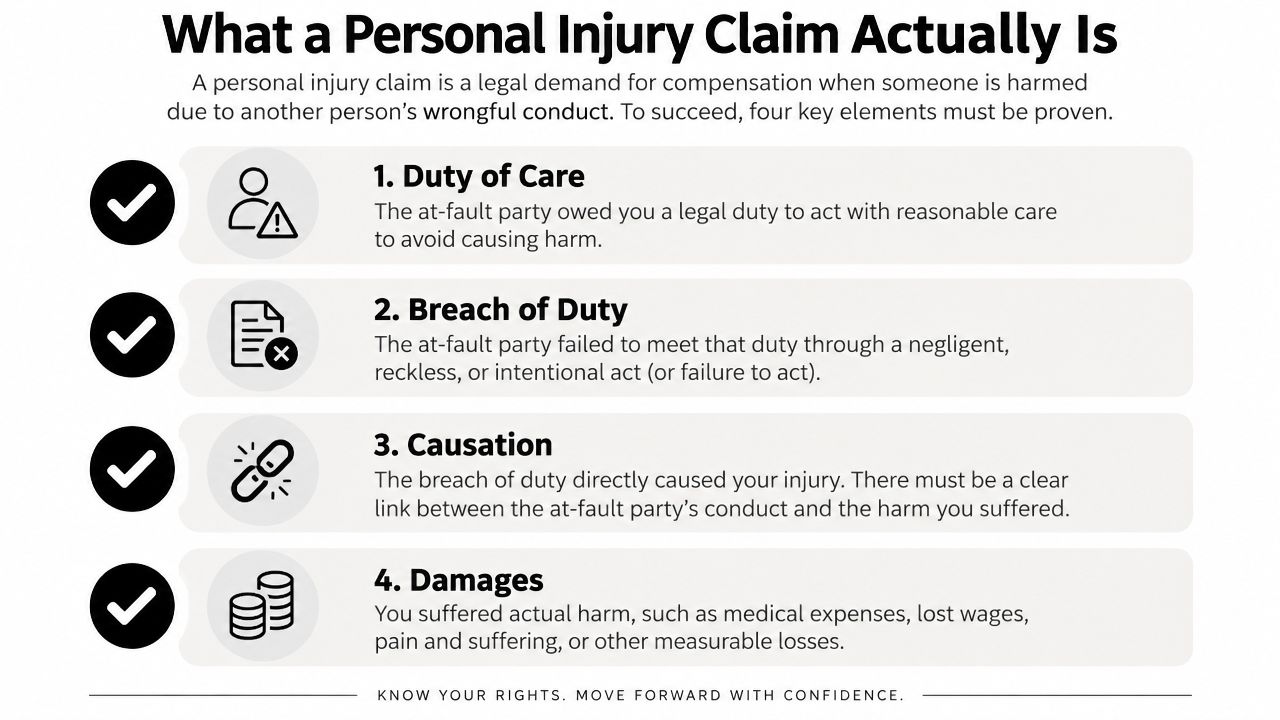
After a crash, a person may have medical records, vehicle damage, and a painful diagnosis. Those facts matter, but they do not automatically create a successful case. A personal injury claim is a civil demand asking the person or organization responsible for an injury, often through an insurer, to provide compensation. The claim explains what happened, why the conduct created legal responsibility, and how the injury affected the claimant.
Many claims are resolved through insurance negotiations. A lawsuit may follow if the parties disagree about responsibility, the connection between the event and the injury, or the amount of compensation. The process often begins with a phone call, but it becomes stronger through consistent records, medical care, witness information, and proof of losses.
The same basic idea applies to a rear-end collision, a fall caused by unsafe premises, a dog bite, or medical negligence. The setting changes, yet the claimant still must connect another party's conduct to a real injury and documented consequences.
A claim requires more than an accident
The legal analysis asks four related questions: duty, breach, causation, and damages. The next section examines what each term means and what evidence can support it.
The American Bar Association's consumer explanation of personal injury claims helps clarify why an accident alone does not establish liability. For example, a person may clearly be hurt, yet still need medical documentation showing that the collision caused the condition rather than merely occurring before it.
That distinction answers what people mean by what is personal injury claim. It is a supported request for compensation, built around responsibility, medical connection, and measurable effects on the injured person's life.
The Four Elements Every Claim Must Prove
A rear-ended driver reports neck pain the same day, visits a doctor, and follows the recommended treatment. Another driver with a similar collision waits weeks, has no consistent medical history, and cannot explain when the pain began. Both may have suffered real injuries, yet the second claim faces a harder fight because the evidence leaves room to question causation.
Evidence connects the event to the injury
A claim can slip through without notice between the accident and the medical diagnosis. The other driver may have violated a traffic rule, or a property owner may have ignored a dangerous condition. Those facts establish a possible breach of duty, but they do not by themselves prove that the conduct caused the injury being claimed.
Causation requires a traceable sequence: the event occurred, the person experienced symptoms, medical evaluation identified a condition, and treatment addressed that condition. A delay in care, inconsistent descriptions, a prior injury, or a gap in treatment can give an insurer an alternative explanation.
The record should therefore preserve more than the fact of an accident. Keep the incident report, photographs, witness details, medical records, imaging results, treatment instructions, and communications about symptoms. Notes describing what the person could no longer do at home or work can also help connect the diagnosis to daily consequences.
Consider a driver who already had back pain before a collision. Afterward, imaging shows a disc herniation, but the driver waits a long time to return for care and gives different accounts to different providers. The insurer may argue that the crash caused only a temporary flare-up, or did not cause the new condition at all. An earlier examination, consistent symptom history, and a physician's explanation of the diagnosis could have addressed those gaps.
Damages show what the injury changed
Even when causation is persuasive, the claim still needs proof of its effects. Medical bills show treatment costs. Pay records or employer documentation can support lost income. Treatment notes, activity restrictions, and a clear account of pain can show how the injury affected ordinary life.
The four elements work like links in one chain:
| Element | Question the evidence must answer |
|---|---|
| Duty | What obligation applied to the other party? |
| Breach | What conduct failed to meet that obligation? |
| Causation | How did that conduct produce this injury? |
| Damages | What measurable losses followed? |
A strong claim does not merely collect documents. It arranges them into a consistent timeline, showing responsibility, medical connection, and resulting loss. That organization can determine whether a valid injury remains an unsupported account or develops into a claim that can be evaluated for recovery.
Who Can File and How Long You Have
The person who suffered the injury usually brings the claim. If that person is a child or can't legally manage the case, a parent, guardian, or authorized representative may act under applicable law. When an injury causes death, a personal representative or eligible surviving family member may bring a wrongful death claim if the relevant statute grants that right.
Timing requires separate attention. In England and Wales, a typical claimant has three years from the date of injury to bring a personal injury claim, as described in this historical overview of personal injury law and limitation rules. Deadlines in the United States depend on the state and claim type. Government defendants may require an earlier notice, and special rules can apply when an injury isn't discovered immediately.
A limitation period is a legal deadline, not a target for starting work. Evidence can become harder to locate, witnesses' memories can fade, and medical gaps can create arguments about causation. Tolling rules may pause or alter the deadline for minors or people who lack legal capacity, but you shouldn't assume a tolling rule protects you without advice.
| Claimant Type | Typical Standing | Usual Time Limit |
|---|---|---|
| Injured adult | Brings a claim for personal losses | Varies by jurisdiction |
| Parent or guardian | May act for an injured minor | Special rules may apply |
| Legal representative | May act for a person unable to manage the claim | Depends on capacity and local law |
| Estate representative or eligible family member | May pursue a wrongful death claim where permitted | Often differs from an injury claim |
| Person claiming against a government body | Must follow applicable notice and filing procedures | May be shorter than the ordinary deadline |
If you're unsure about the deadline, review the statute of limitations for a personal injury claim and speak with a licensed attorney in the jurisdiction where the injury occurred. A missed deadline can permanently prevent recovery, even when the underlying facts appear strong.
How a Personal Injury Claim Moves Through the System
The rear-ended driver calls a lawyer after the first medical visit. During the intake, the lawyer records the collision details, identifies the insurers, and asks for photographs, the police report number, medical records, and witness information. The case file begins with facts, not a settlement figure.
The investigation then develops the liability and injury records. Counsel may obtain the crash report, vehicle photographs, repair information, witness statements, available video, and insurance details. Medical documentation tracks diagnoses, treatment, work restrictions, and whether symptoms are improving or continuing.
Treatment creates a readable record
The claimant attends appointments, follows recommendations, and keeps records of out-of-pocket expenses. A treatment gap doesn't automatically defeat a claim, but it gives the insurer an opportunity to argue that the injury wasn't serious or wasn't caused by the event. Honest explanations for missed care can help clarify the record.
When the medical picture is sufficiently clear, the attorney may prepare a demand package. It typically explains why the insured party is responsible, attaches supporting records, identifies medical expenses and lost income, describes daily limitations, and requests compensation. The insurer can accept, reject, or respond with a counteroffer.
Negotiation may continue through written offers, calls, or mediation. If the parties can't reach a fair resolution, the claimant may file a lawsuit. The defendant responds, and discovery requires both sides to exchange information through document requests, written questions, and depositions.
A lawsuit doesn't guarantee a trial. Parties may settle during discovery or mediation. If the case proceeds, witnesses and experts present evidence, and a judge or jury decides liability and damages under the applicable rules.
What Compensation Really Covers
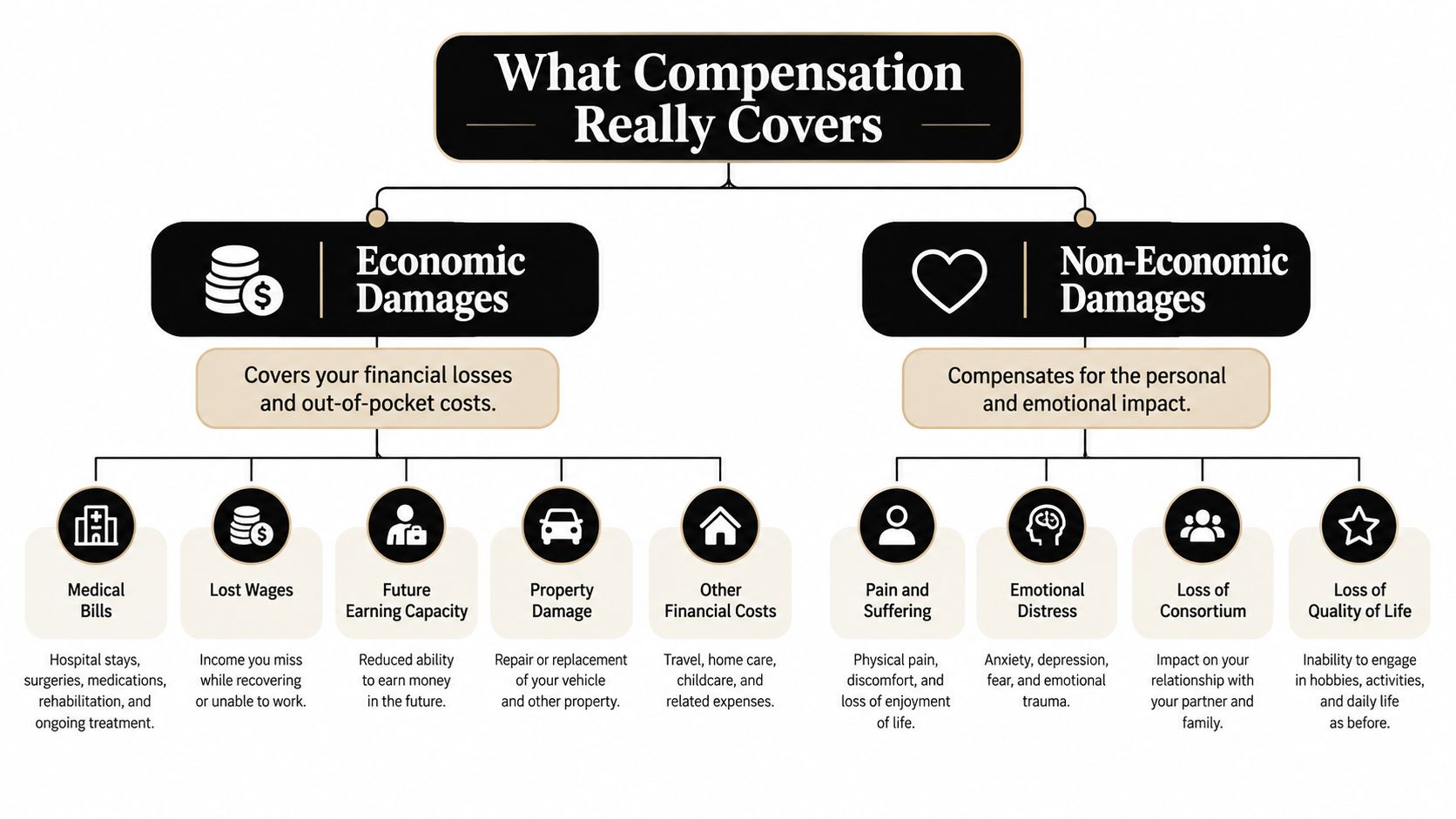
A settlement or judgment should reflect the full effect of an injury, not only the first emergency-room invoice. Compensation commonly divides into economic damages, which can be documented financially, and non-economic damages, which address human consequences that don't arrive with a receipt.
Economic losses have a paper trail
Economic damages may include emergency care, follow-up appointments, imaging, medication, physical therapy, surgery, and anticipated future care. They may also include wages already lost and reduced earning capacity when the injury prevents someone from returning to the same work, schedule, or career path.
Useful records include medical bills, pay statements, employer verification, invoices, tax returns, and professional opinions about future limitations. A person with a back injury, for example, may need evidence showing not only the treatment already received but also why continued therapy or work restrictions are medically reasonable.
Non-economic harm needs different proof
Pain, emotional distress, loss of enjoyment, sleep disruption, cognitive symptoms, and reduced participation in family or social activities may form part of a claim. Therapy records can document mental-health effects, while a symptom journal can show how pain changes ordinary routines. A day-in-the-life video or testimony from people who see the claimant regularly may make those limitations easier to understand.
The pattern of pain also matters. Learning about acute and chronic pain timelines can help a reader understand why a continuing symptom history should be discussed with a healthcare professional rather than dismissed as normal soreness.
Digital evidence can affect both fault and damages. Dashcam footage, vehicle data, phone records, messages, app information, and photographs may help establish what happened or show how an injury affects movement and daily activities. The explanation of personal injury settlements provides further context for why valuation depends on evidence, liability, and the nature of the losses.
Comparative fault can reduce recovery when the claimant shares responsibility, according to the jurisdiction's rules. Punitive damages may be available in limited cases involving especially egregious conduct, but they're not the ordinary measure of compensation in a negligence claim.
Why Valid Claims Still Fail
An injury doesn't automatically create a successful claim. The claimant still needs a responsible party, a legally recognized breach, a causal connection, and evidence of loss. The insurer also isn't required to accept the claimant's first description of events or requested value.
The quiet failure points
Causation often weakens when symptoms appear long after the incident, treatment stops without explanation, or medical records describe a preexisting condition without clearly identifying what changed. In a collision involving a prior back injury, a diagnosis alone may not explain whether the crash caused a new condition, aggravated an old one, or had no material effect.
Evidence can disappear before anyone realizes its value. A vehicle's recording may be overwritten, a witness may become unreachable, or a social media post may appear inconsistent with reported limitations. Insurers may examine medical histories, request independent examinations, compare statements, and investigate whether the claimed restrictions match observed activities.
The practical distinction: Injury severity may attract attention, but consistent records establish the claim.
Other problems include late reporting, incomplete incident details, unexplained treatment interruptions, inaccurate information, and failure to follow a special notice procedure for a government defendant. Comparative fault can also reduce the amount recovered when evidence shows the injured person contributed to the event.
A useful way to think about the file is as a chain. The police report addresses the event, medical records address the injury, employment documents address income, and personal observations address daily life. If a link is missing, the insurer has room to dispute the conclusion even when the claimant is hurt.
What to Do Next After an Injury
Start with your health. Seek a medical evaluation for pain that seems minor, follow the recommended treatment, and explain changes in symptoms. Prompt, accurate records support care and give later reviewers a clearer timeline.
Preserve what may disappear:
- Scene evidence: Save photographs of the vehicles, roadway, property damage, visible injuries, and relevant conditions.
- People and reports: Keep witness contact details, the police report number, and the other driver's insurance information.
- Financial records: Gather bills, receipts, wage information, employer notes, and records of missed work.
- Personal observations: Write a dated account of the event, symptoms, appointments, sleep problems, work limits, and activities you can no longer do comfortably.
Avoid giving a recorded statement to the other insurer before getting legal advice. Don't post about the accident or your recovery, and don't delay follow-up care because symptoms temporarily feel tolerable. You can also review what personal injury lawyers cover so you know what questions to raise during a consultation.
Bring the assembled records to a lawyer who can assess duty, breach, causation, damages, available insurance, and the deadline that applies to your claim. Nares Law Group LLC offers free consultations for people seeking help with injury claims, evidence preservation, insurance communications, negotiation, settlement, or litigation. Visit Nares Law Group LLC to request a consultation and discuss what happened before important evidence or filing time is lost.