A wrongful death attorney free consultation costs nothing and creates no obligation, including before you sign a representation agreement. Its purpose is to determine whether your family may have a viable claim, who has the legal authority to bring it, which deadlines apply, and whether the attorney is the right fit.
You may be reading this after a spouse, parent, or child died suddenly, while the funeral home is asking questions, the police report is incomplete, and an insurance adjuster has already left a voicemail. You don't need to know the legal answer before you call. You need someone to perform procedural triage before evidence disappears, deadlines narrow your options, or the wrong family member makes a filing decision.
A consultation isn't a sales pitch about a projected payout. It should give you a clear answer about standing, venue, liability, evidence, case costs, and the practical path forward. Wrongful death law has statutory roots in Lord Campbell's Act, England's Fatal Accidents Act of 1846, which created a remedy for surviving family members after courts had barred these claims. Many U.S. states later adopted similar statutes, and modern law treats the family's financial loss as distinct from the deceased person's own claim. (Background on the origins of wrongful death claims)
The First Call After a Wrongful Death
The call may come while you're standing in a hospital corridor. Your partner was killed in a commercial truck collision, and you have a funeral director asking for paperwork, a police department promising a report, and an insurer asking for a recorded statement. You may not yet know the final cause of death, who owned the truck, or whether another company controlled the driver.
That uncertainty is exactly why the first legal call should happen early. A good attorney or intake professional will ask who died, what happened, where it happened, when it happened, and whether an insurer or investigator has contacted you. The objective isn't to make you argue the case. It's to identify urgent preservation steps and determine whether the firm can evaluate the claim.
Triage instead of pressure
The consultation should cost nothing and should not require you to commit. You shouldn't be pushed to sign immediately, promise a settlement figure, or give a detailed statement to the opposing insurer before counsel understands the facts. You should leave knowing what the attorney needs next and what you should avoid doing.
A truck collision can involve driver records, vehicle data, company policies, maintenance files, surveillance footage, and electronic evidence. Those materials may be controlled by people or businesses that have no reason to preserve them voluntarily. Early counsel can consider whether a preservation letter, records request, or prompt investigation is appropriate.
Practical rule: If an insurance adjuster calls, get the person's name and company, then tell them your family is seeking legal guidance. Don't guess about fault or provide a recorded statement before you understand your rights.
Some families use a structured intake tool before contacting counsel, especially when grief makes it hard to organize a timeline. A resource on conversational AI for sales calls can help explain how multi-turn conversations capture details without forcing a person to remember everything in one pass. It isn't a substitute for a lawyer's evaluation, but it can help you prepare the basic facts for the first call.
Waiting several weeks to compare websites can create avoidable problems. Witnesses may forget details, vehicles may be repaired or sold, video may be overwritten, and the family may miss a notice requirement. Call early, even if all you can say is, “This happened, we don't know what to do, and an insurer has contacted us.”
What Happens During a Wrongful Death Free Consultation
A free consultation should function as procedural triage, not a general conversation about damages. The attorney must first determine who may act, where the claim belongs, which deadlines apply, and whether evidence or insurance requires immediate attention. Only then does a meaningful case evaluation begin.
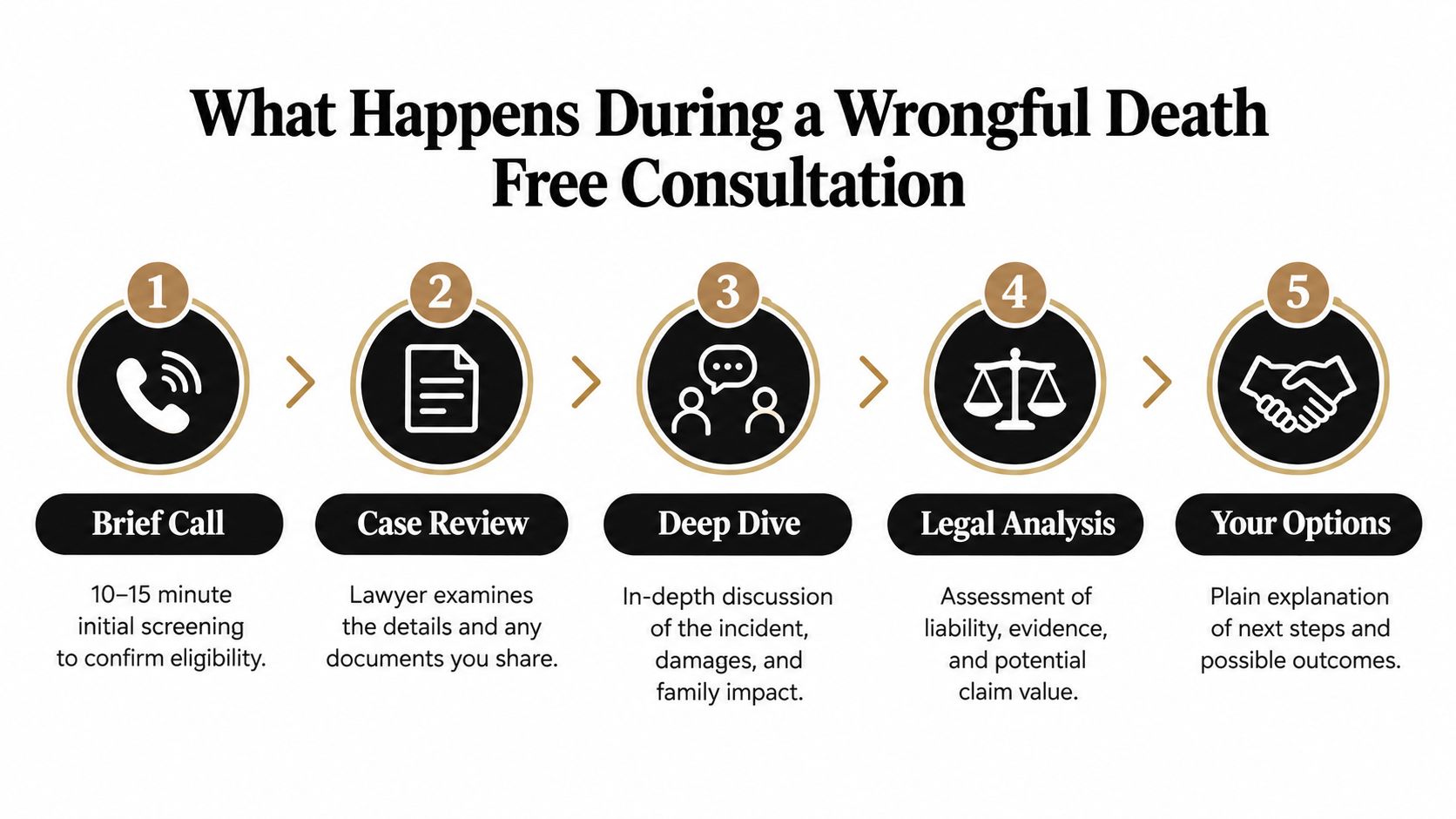
The initial screen
The first call is usually brief. An intake paralegal or attorney confirms the deceased person's identity, the caller's relationship, the general circumstances, the location, and whether an insurer or government entity is involved. The firm is checking for conflicts, jurisdiction, filing deadlines, and immediate risks.
Bring a truthful summary, not a polished chronology. Say what you know, what remains uncertain, and whether anyone has requested records, a recorded statement, or a settlement release. Those details can change what the family should do next.
The deeper evaluation
If the claim warrants further review, the attorney examines available documents and asks about survivors, the estate, medical treatment before death, employment, dependents, and the conduct that may have caused the death. The lawyer is testing three practical questions:
- Liability clarity: Is there a plausible connection between another party's conduct and the death?
- Damages capacity: Did the family or estate suffer losses that the applicable law recognizes?
- Collectible resources: Is there insurance coverage, business liability, or identifiable property from which recovery could realistically be pursued?
There is no official national average wrongful death settlement. Public settlement figures can omit important facts and may involve confidential agreements. Bureau of Justice Statistics civil trial data reports a $961,000 median wrongful death jury award across 452 trials, while plaintiffs won 36% of those trials. (Wrongful death litigation background and BJS benchmark) Use that benchmark as background, not as a forecast for your family's result.
The decision conversation
The attorney should identify the next actions, which may include preserving evidence, requesting records, identifying defendants, investigating insurance, or filing before the applicable deadline. Ask the lawyer to explain the fee agreement and case expenses in plain language, including which costs the firm advances and what happens if the case does not recover money.
“Free consultation” has limits. It generally does not include formal estate administration, tax planning, or a promise that the firm will accept the case. It also does not produce a final valuation before the attorney reviews evidence, insurance, and jurisdictional rules. The consultation should leave you with a clear action list and a candid explanation of what remains unknown.
The video below provides another visual explanation of the consultation process.
Who Can Actually File the Claim
The first question isn't “How much is the case worth?” It's “Who has the legal authority to bring it?” Families often focus on medical bills, lost income, or the police report before confirming whether the person on the phone is the proper claimant.
Wrongful death rules vary by jurisdiction. Some statutes require the personal representative of the estate to file. Others permit particular surviving family members to bring the claim directly, or require an estate representative to act for named beneficiaries. The order can also change when there are multiple survivors, dependents, minors, or a dispute among relatives.
The three threshold questions
Standing asks whether you are legally permitted to bring the claim. Venue asks where it belongs, often based on the place of death, the incident, or the defendant's location. Limitations rules determine how long the family has to file, and special rules may apply to government defendants, minors, or medical providers.
Don't rely on a family tree and a search result. Give the attorney the relationships, marital status, children, dependents, estate information, and any conflict among potential beneficiaries. Neutral legal-aid guidance also emphasizes that the authorized filer and deadline depend on the jurisdiction. A practical overview of what a wrongful death claim involves can help you prepare, but it can't replace state-specific advice.
| State Category | Primary Filer | Secondary Beneficiaries | Estate Required? |
|---|---|---|---|
| Representative-led systems | Personal representative | Statutorily named spouse, children, parents, or dependents | Often |
| Survivor-led systems | Eligible surviving family member | Other qualifying relatives or dependents | Sometimes not |
| Estate and survivor systems | Estate representative and eligible survivors, depending on the claim | Beneficiaries identified by statute | Depends on the claim type |
| Special-defendant claims | Authorized claimant under the applicable statute | Rules may change for public entities or medical defendants | Frequently subject to special procedures |
This is why a consultation should begin with capacity and deadlines. A family can have a strong factual story and still lose the claim if the wrong person files, the wrong court is selected, or the applicable deadline expires.
Documents and Information to Bring
Don't spend the first raw week building a perfect binder. Bring enough information for the attorney to identify the claimant, the incident, the jurisdiction, and the time pressure. The document list should grow as the evaluation becomes more serious.
For the first call
Have these basics available:
- Identity: The deceased person's full legal name and date of death.
- Relationship: Your relationship to the deceased and the names of other close survivors.
- Incident: The date, general location, and one-sentence description of what happened.
- Contacts: Names of insurers, employers, hospitals, police agencies, or other parties that have contacted the family.
- Immediate concern: Whether anyone has asked you to sign a release, give a recorded statement, or accept money.
If you don't know an answer, say so. Guessing can create confusion that a careful attorney could have avoided.
For the case review
Gather what already exists, without delaying the consultation:
- The death certificate.
- The coroner or autopsy report, if available.
- The police, incident, workplace, or crash report.
- Medical records and bills from final treatment.
- Employment, wage, benefit, or business records.
- Information about dependents and household contributions.
- Insurance correspondence, claim numbers, photographs, videos, and witness contacts.
- Any will, probate paperwork, or documentation identifying a personal representative.
Medical records can take time to obtain. Guidance on how to obtain medical records may help you understand the request process, but don't wait for every chart before calling an attorney.
What to preserve
Keep original messages, photographs, letters, bills, and voicemails. Don't edit videos, delete social media posts, or send angry messages to the driver, employer, hospital, or insurer. Write down what you remember while the details are fresh, label guesses as guesses, and keep a simple log of every contact.
The attorney needs facts that establish standing and timing before attempting a detailed damages calculation. That order prevents you from spending energy on paperwork that won't answer the first legal questions.
Questions Worth Asking the Attorney
You are evaluating the lawyer as carefully as the lawyer is evaluating the case. Ask direct questions and listen for direct answers. A refusal to explain fees, responsibility, conflicts, or realistic obstacles should concern you.
“How many wrongful death cases have you handled in recent years?” This reveals whether the attorney regularly handles the legal and emotional complexity of these claims or mainly accepts general injury matters.
“Have you taken a wrongful death case to a jury verdict?” Trial experience matters even when the expected path is settlement, because negotiation often depends on whether the firm can prepare for trial.
“Will you personally handle my file?” Ask who will investigate, communicate with the family, take depositions, and appear in court. A senior lawyer may remain involved, or the file may move to another attorney.
“What facts support liability, and what facts worry you?” You need a candid assessment, not a sales presentation. The answer should identify causation problems, comparative fault issues, missing evidence, or possible defendants.
“Who has authority to file, and which deadline controls?” This question tests whether the attorney is addressing standing and procedure before discussing a payout.
“Where would the claim be filed?” Venue can affect convenience, procedure, witnesses, and strategy. Ask the attorney to explain why that forum fits the facts.
“What is a realistic path to resolution?” Ask how investigation, negotiation, mediation, discovery, and trial might fit together. No ethical attorney can promise a result.
“How will you communicate with us?” Establish whether updates arrive by phone, email, or portal, who answers routine questions, and how the firm handles urgent developments.
“What percentage is the fee, and when does it change?” Ask whether the fee increases after suit is filed or if the matter reaches trial or appeal. Get the answer in writing.
“Are costs taken before or after the fee, and do you have any conflict?” Case expenses can be separate from attorney compensation. Also ask whether the firm has represented the potential defendant, insurer, employer, or related company.
Ask for the uncomfortable answer: “If this were your family, what would you want to understand before signing?”
A strong attorney won't be offended by these questions. The consultation should leave you better informed, even if the firm doesn't accept the case.
Understanding Contingency Fees and Case Costs
A contingency agreement usually means the firm collects an attorney fee only if it obtains a recovery. The consultation must clarify the economics before you authorize an investigation. A case can still generate expenses even when no fee is owed.
Ask for the exact fee percentage at each stage. Rates and contract terms vary by jurisdiction, filing status, and whether the matter reaches trial or appeal. Do not accept a general promise that the firm works “on contingency.” Request the proposed contingency fee agreement and read its definitions carefully.
Two separate deductions
Attorney fees pay for legal work. Case costs fund the work needed to build the claim, including filing fees, deposition transcripts, expert witnesses, medical-record retrieval, investigators, accident reconstruction, and trial exhibits. The firm may advance some expenses and seek reimbursement from the recovery. The contract should state which costs apply, when they are deducted, and who bears them if the case loses.
Ask for a written net-recovery example using the actual proposed percentage and cost terms. Confirm whether expenses come out before or after the attorney fee. Ask whether liens, medical bills, probate expenses, co-counsel fees, expert funding, or settlement authority can reduce the amount distributed to the family.
| Case Stage | Fee Terms to Confirm |
|---|---|
| Before filing | Confirm the written percentage and conditions |
| After filing | Ask whether the percentage changes once litigation begins |
| Trial or appeal | Confirm any separate percentage and added costs |
A settlement may resolve the claim, but preparation still requires records, expert review, negotiation, and sometimes litigation. Ask who pays for each step, whether the firm can stop work if funding is unavailable, and how you will receive an accounting of the final distribution.
The consultation is procedural triage as well as a fee discussion. Before signing, make sure the agreement matches the attorney's explanation of standing, deadlines, venue, investigation, and expected case costs. A clear written contract gives your family a basis for deciding whether representation is financially workable. (Access-to-justice context and free legal intake)
Next Steps After the Consultation
The consultation should end with a decision path, not confusion. You generally have three options: retain the attorney, pause while gathering information or seeking another opinion, or decline representation.
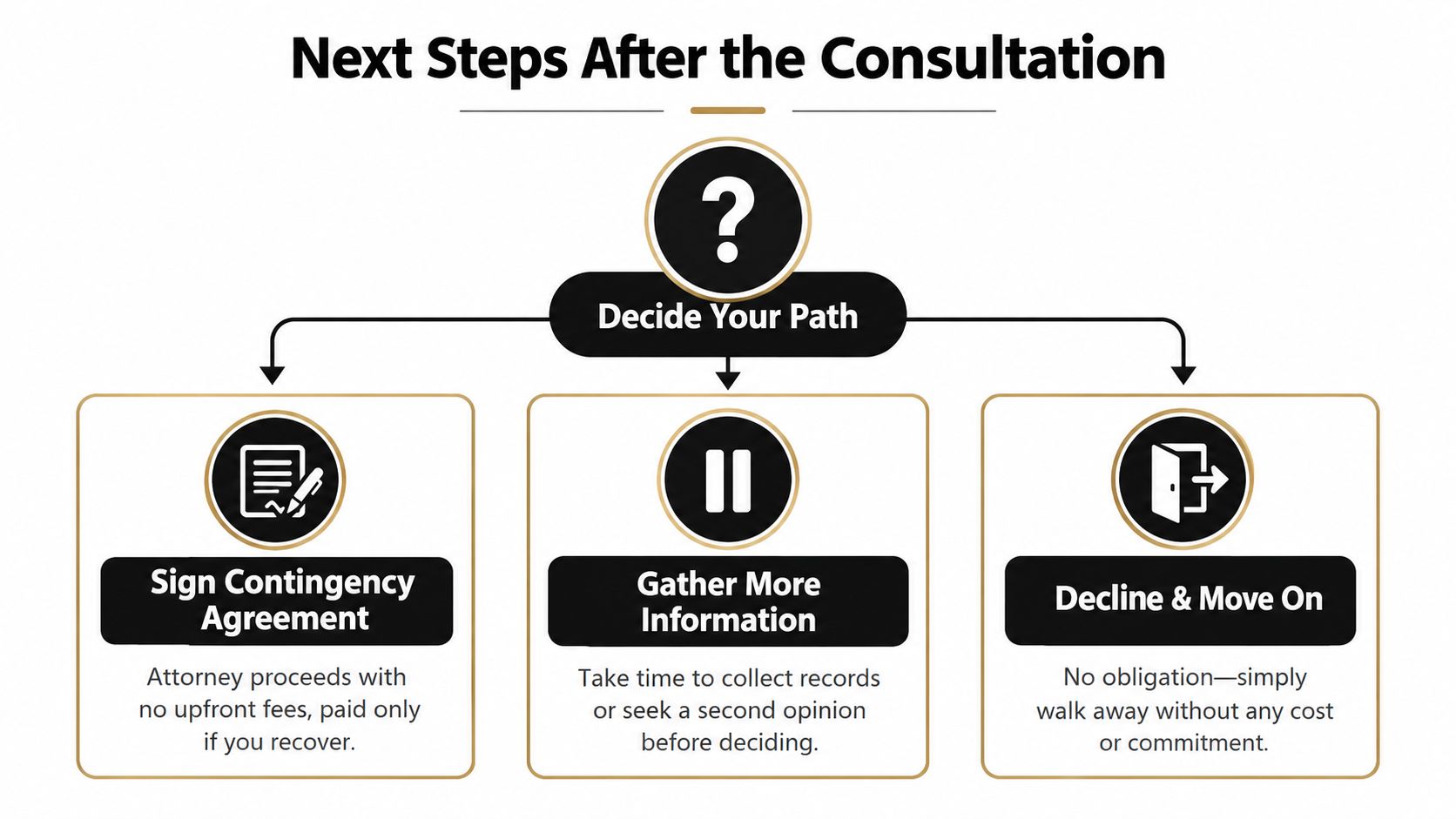
Sign the agreement
If the attorney has explained standing, venue, deadlines, liability concerns, fees, costs, and communication expectations, the firm may send a contingency agreement. It should identify the client, the scope of representation, the fee arrangement, responsibility for costs, settlement authority, termination rules, and how liens or expenses are handled.
Don't sign a blank document or rely on a verbal promise. Read the agreement when you're calm enough to understand it, and ask for changes or explanations in writing.
Pause with a purpose
A pause can be sensible if the attorney needs records, the family must determine who represents the estate, or you want a second opinion. Set a concrete task list, preserve evidence, and keep the filing deadline in view. Indecision doesn't stop the limitations period.
National litigation data shows why families should reject a simple, fast-payout narrative. Roughly 73% of tort cases settle, only about 3% go to trial, and outcomes in wrongful death and medical malpractice matters vary widely. (Civil litigation reporting and case developments) The attorney should explain how that general pattern applies, or doesn't apply, to your facts.
Decline and move on
Walk away if the firm promises a guaranteed result, won't explain the fee contract, pressures you to sign, ignores standing, or cannot identify who will handle the file. A poor fit can create stress at a time when you need clear communication.
Can I speak with more than one attorney? Yes. Comparing lawyers is reasonable, but tell each firm whether another attorney has been retained.
How long do I have to decide? Ask the attorney to state the controlling deadline and any earlier preservation or notice deadline. Don't assume the consultation creates extra time.
Is the consultation confidential? Ask the firm to explain its confidentiality policy and conflict-check process before sharing sensitive details.
When should I walk away? Leave when the lawyer avoids direct answers, guarantees money, or treats your family like a file number.
How quickly does the case move after signing? Ask what happens first, who contacts insurers, what evidence the firm will preserve, and what information the family must provide.
Nares Law Group LLC offers free consultations for families considering wrongful death claims, with services that can include investigation, insurance communications, negotiation, settlement, and trial preparation. Visit Nares Law Group LLC to request a consultation and discuss standing, deadlines, venue, evidence preservation, and the contingency agreement before making a commitment.