A wrongful death claim is a civil lawsuit filed by surviving family members when another party's negligence, recklessness, or intentional act caused a death. It's different from a survival action, which preserves the deceased person's own legal claims for harm suffered before death.
You may be searching this question after a phone call from an insurance adjuster, a funeral, or a sudden quiet at home that still doesn't feel real. Along with grief, your family may be facing medical bills, funeral expenses, lost income, and difficult questions about what happened. Was someone careless? Could the death have been prevented? Who has the legal right to act, and how much time is available?
Colorado law gives families a way to pursue civil accountability, but the details depend on the people involved, the cause of death, the evidence, and the type of defendant. A fatal crash, a commercial trucking collision, a dangerous property, a medical error, and a workplace-related incident can all require different investigations.
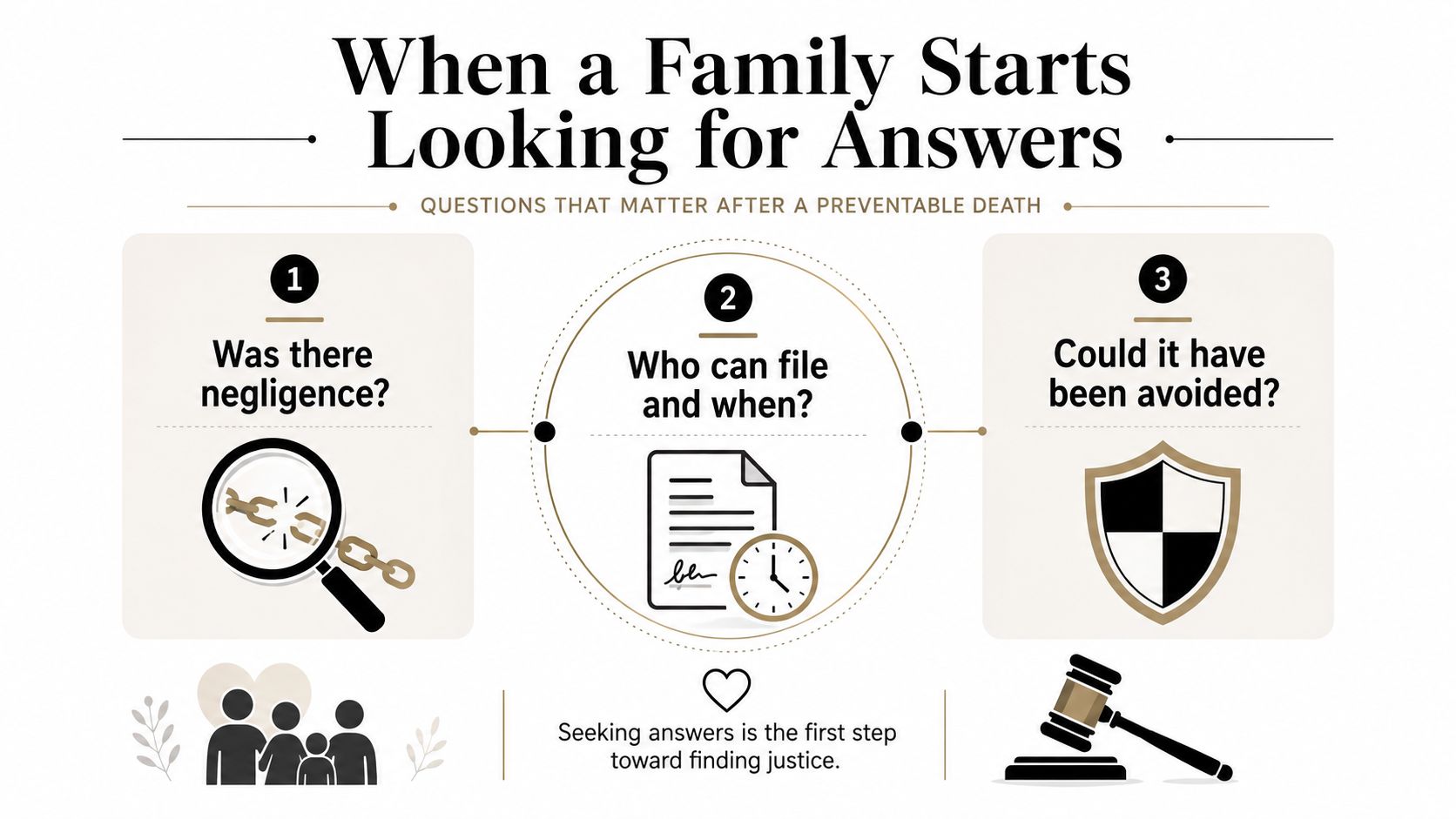
When a Family Starts Looking for Answers
A wrongful death claim is a civil lawsuit brought by qualifying survivors when another person or organization's negligence, recklessness, or intentional wrongdoing causes a death. The claim seeks compensation for losses suffered by the family. It isn't a criminal prosecution, even if prosecutors also bring criminal charges against the person responsible. Criminal court can impose punishment, while a civil wrongful death case seeks to shift the financial consequences of the death to the responsible party.
Colorado families also need to understand a distinction that many introductory explanations overlook. A wrongful death claim generally addresses what surviving family members lost because of the death. A survival action preserves claims the deceased person could have pursued had they lived, such as medical expenses and the deceased person's pain and suffering before death. One event can support both claims, but they address different losses and may involve different beneficiaries.
One event can create two claims
Suppose a distracted driver crosses the center line and kills another motorist. The surviving spouse or children may pursue a wrongful death claim for losses such as lost financial support, companionship, guidance, and funeral expenses, depending on Colorado law. If the injured motorist remained alive for a period before dying, the estate may also pursue a survival action for medical treatment and the person's pre-death suffering.
The answer to what a wrongful death claim can involve therefore requires more than identifying the person who caused the incident. An attorney must examine who may file, which claim belongs to the family, which claim belongs to the estate, and what damages Colorado permits.
Practical rule: Don't assume that one lawsuit automatically includes every loss. Ask specifically whether both a wrongful death action and a survival action should be evaluated.
Wrongful death statutes are civil remedies that didn't exist at common law. England's Parliament created the modern model through Lord Campbell's Act in 1846, and American states began adopting similar statutes in the 1850s. Today, all 50 states recognize some form of wrongful death action, although eligibility and damages remain state-specific. Cornell Law School's overview of wrongful death actions explains this historical foundation and the general role of negligence, recklessness, and intentional wrongdoing.
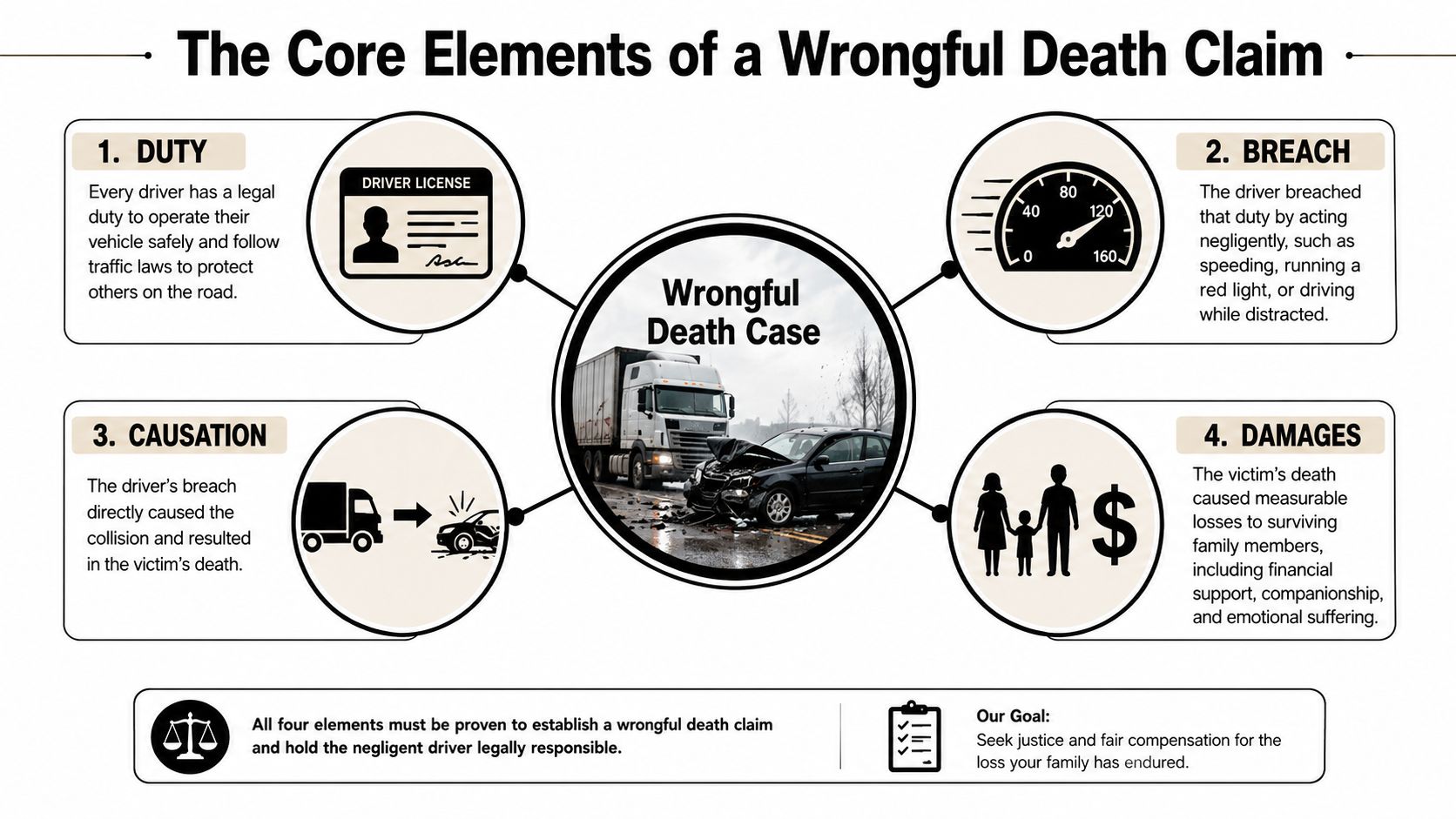
The Core Elements of a Wrongful Death Claim
Most negligence-based wrongful death cases turn on four connected questions: duty, breach, causation, and damages. Those words sound technical, but the basic logic is straightforward.
Duty and breach
A driver owes other people on the road a duty to operate the vehicle with reasonable care and follow applicable traffic rules. That duty exists because other motorists, passengers, cyclists, and pedestrians depend on drivers to make ordinary safety decisions.
A driver may breach that duty by texting, running a red light, driving while impaired, or otherwise operating the vehicle unreasonably. A breach can also involve conduct that appears less obvious, such as failing to maintain control, ignoring dangerous weather conditions, or driving while too fatigued.
The responsible party isn't always an individual driver. A trucking company may face questions about maintenance, hiring, supervision, dispatch practices, or employee conduct. A property owner may have duties involving unsafe conditions. A healthcare provider may be judged under a professional standard of care. A manufacturer may face a product-defect theory. A government entity may involve special statutory procedures and defenses.
Causation and damages
Proving careless conduct isn't enough by itself. The family must connect the breach to the death. If a driver was texting but the evidence shows another independent event caused the fatal collision, causation becomes disputed. Lawyers, accident reconstruction professionals, medical experts, and other specialists may help explain that connection.
The final element is damages. Depending on the applicable Colorado claim, the family or estate may need to document:
- Medical and funeral expenses: Costs connected to treatment before death and burial or cremation arrangements.
- Financial losses: Income, support, benefits, or services the deceased would have provided.
- Family losses: Companionship, guidance, care, and other legally recognized noneconomic harm.
- Pre-death harm: Pain, suffering, and medical costs pursued through a survival action.
Recklessness and intentional wrongdoing can change the legal theory. The evidence must match the claim, and the available damages depend on the statute and facts. That's why a fatal collision involving a private driver can follow a different path from a trucking, medical, premises, product, or public-entity case.
Colorado Rules on Who Can File and How Long You Have
Colorado's wrongful death statute, C.R.S. 13-21-201, controls important questions about who may bring the action and how recovered damages are handled. The deceased person's spouse generally has the right to file. If there's no surviving spouse, the deceased person's children may bring the action. A personal representative may also file on behalf of statutory beneficiaries, but the representative doesn't automatically own the recovery as personal property.
When a spouse and children survive, the statute provides a framework for distributing damages, with the surviving spouse receiving at least one-third of the total recovery in that circumstance. The jury determines the proportions that are just under the statutory framework. A spouse's remarriage doesn't necessarily eliminate eligibility, while other relatives usually don't have the same standing merely because they're related to the deceased.
Colorado families also need to identify the filing deadline quickly. A wrongful death action is generally subject to a two-year period from the death, although exceptions can apply in particular circumstances. Public-entity claims may involve additional notice requirements and procedures. The date a family learns more about the event isn't automatically the date the legal clock begins.
| Issue | Colorado rule |
|---|---|
| Spouse | The surviving spouse generally has statutory eligibility to bring the action. |
| Children | If there's no surviving spouse, the deceased person's children may bring the claim. |
| Personal representative | A representative may file for statutory beneficiaries, but doesn't automatically keep the damages personally. |
| Spouse and children | The surviving spouse receives at least one-third of the total recovery when both spouse and children survive, subject to the statutory framework. |
| Filing deadline | The general period is two years from death, with possible exceptions. |
| Public entities | Additional notice and procedural requirements may apply. |
Because timing rules can be complicated, families shouldn't rely on a general internet summary. Review the facts and potential deadlines with counsel and consult the Colorado wrongful death statute as part of that process.
Damages Families Can Recover in Colorado
A family may face hospital bills, funeral expenses, and the sudden loss of a paycheck after a fatal injury. Colorado wrongful death damages are usually grouped into economic, noneconomic, and punitive damages. The available recovery depends on the claim, the beneficiaries, and the evidence.
Economic damages cover losses that can be measured in dollars. They may include medical expenses from the final injury, funeral and burial costs, lost income, lost financial support, and the value of household services. Employment records, tax documents, benefit information, business records, and testimony about the deceased person's responsibilities at home can help establish these losses.
Noneconomic damages address harms without an ordinary invoice. Depending on the applicable Colorado law, they may include grief, loss of companionship, and loss of guidance. A separate survival action may also seek the deceased person's qualifying pain and suffering before death. That claim is distinct from the wrongful death claim, which addresses losses suffered by surviving beneficiaries. Colorado's noneconomic damages rules include statutory limits that can adjust over time. See this breakdown of Colorado wrongful death lawsuit payouts for how statutory caps can affect a family's recovery.
Punitive damages serve a different purpose. Under C.R.S. 13-21-102, they may be available when the defendant's conduct was willful and wanton, meaning a conscious disregard for the safety of others. A fatal drunk-driving case may raise that issue. Death alone, or ordinary negligence, does not automatically support punitive damages.
| Damage Category | What It Covers | Colorado Rule or Cap |
|---|---|---|
| Economic | Income, support, household services, medical expenses, and funeral costs | Must be supported by evidence and the applicable claim. |
| Noneconomic | Grief, companionship, guidance, and qualifying pre-death suffering | Subject to Colorado's statutory noneconomic-damages rules and any applicable cap. |
| Punitive | Conduct showing willful and wanton disregard for safety | Governed by C.R.S. 13-21-102 and case-specific proof. |
National civil-trial data can provide context, but it cannot calculate a Colorado case. A broad benchmark reports a median jury award of about $961,000, based on 452 trials, with plaintiffs prevailing in 36% of those trials. The wrongful death settlement and award data describes a national litigation benchmark, not a promised settlement or verdict. The family's evidence, the specific losses, and Colorado law carry greater weight than a national figure.
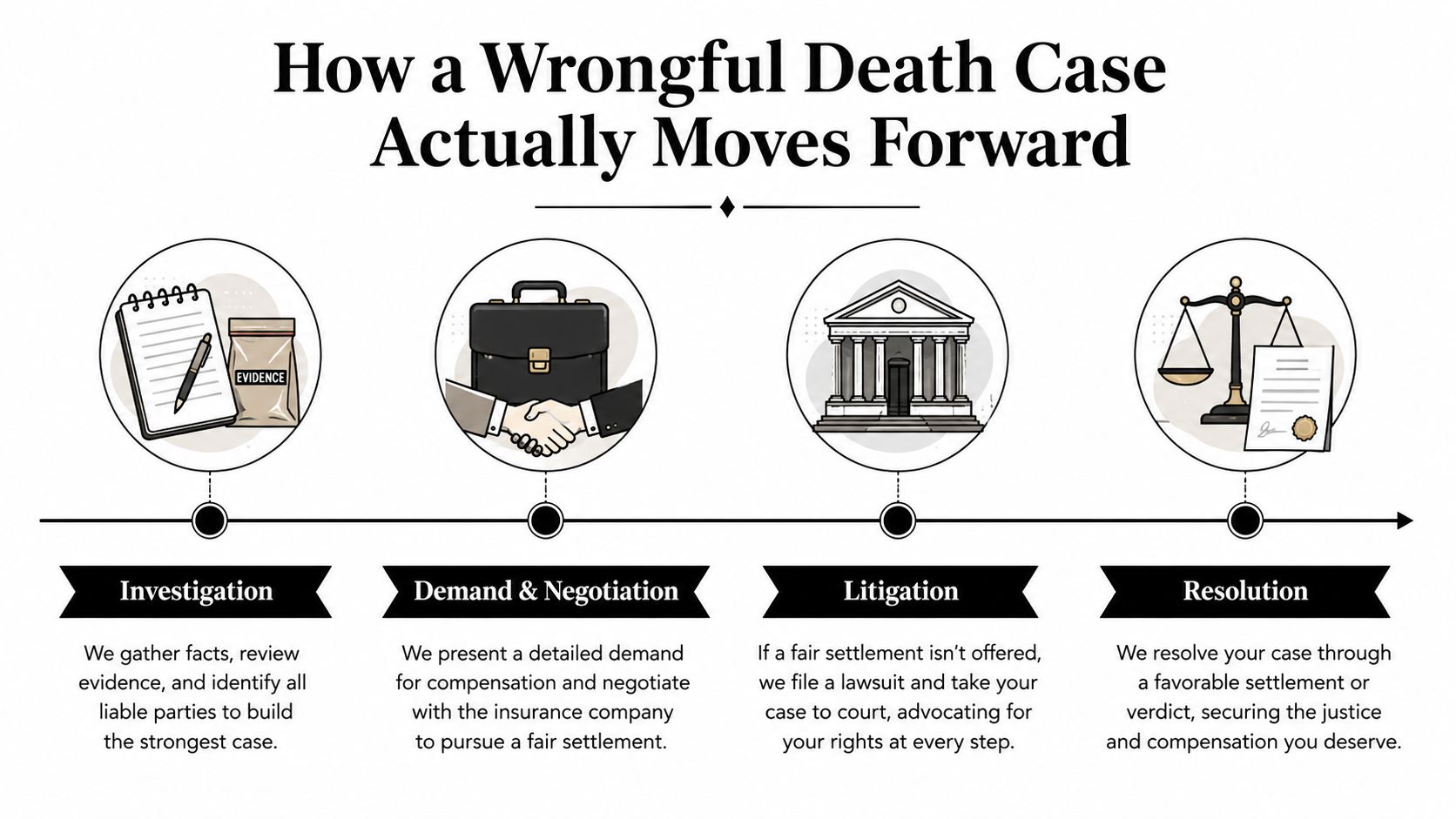
How a Wrongful Death Case Actually Moves Forward
The first work usually happens before anyone files a lawsuit. Counsel gathers police and incident reports, identifies witnesses, preserves photographs and video, obtains medical and employment records, and examines physical evidence. In a trucking case, preservation may include electronic logs, vehicle data, maintenance files, dispatch records, and company safety records. Early letters can matter because evidence may be overwritten, discarded, or altered through ordinary business practices.
Investigation and negotiation
After the evidence starts taking shape, the legal team may prepare a demand package for the insurer. That package typically explains liability, causation, the family and estate claims, medical and funeral costs, financial losses, and the human effect of the death. Negotiation can resolve a case without a complaint, but families shouldn't accept an offer before understanding whether it releases every claim, including a possible survival action.
Contingency representation can allow a family to hire counsel without paying an hourly fee at the outset. The written representation agreement should explain the fee, litigation expenses, case costs, and how any recovery will be distributed.
Litigation and resolution
If negotiations don't produce a fair result, counsel may file a complaint. The litigation phase can involve written discovery, document requests, depositions, expert opinions, motions, and disputes over evidence. Defendants may deny fault, challenge causation, argue that other factors contributed to the death, or dispute the value of family losses.
Mediation often occurs before trial. If the case doesn't settle, the legal team prepares witnesses and exhibits for trial, where a jury evaluates liability and damages. A settlement may be paid in a lump sum or structured arrangement, depending on the agreement and the family's needs.
Colorado wrongful death matters often take 12 to 36 months, but the duration varies with the number of defendants, expert issues, public-entity involvement, disputed causation, and court scheduling. A simple insurance resolution may move faster, while a contested case can last longer. Families should expect emotional decisions throughout the process and should receive clear updates about evidence, offers, risks, and upcoming deadlines.
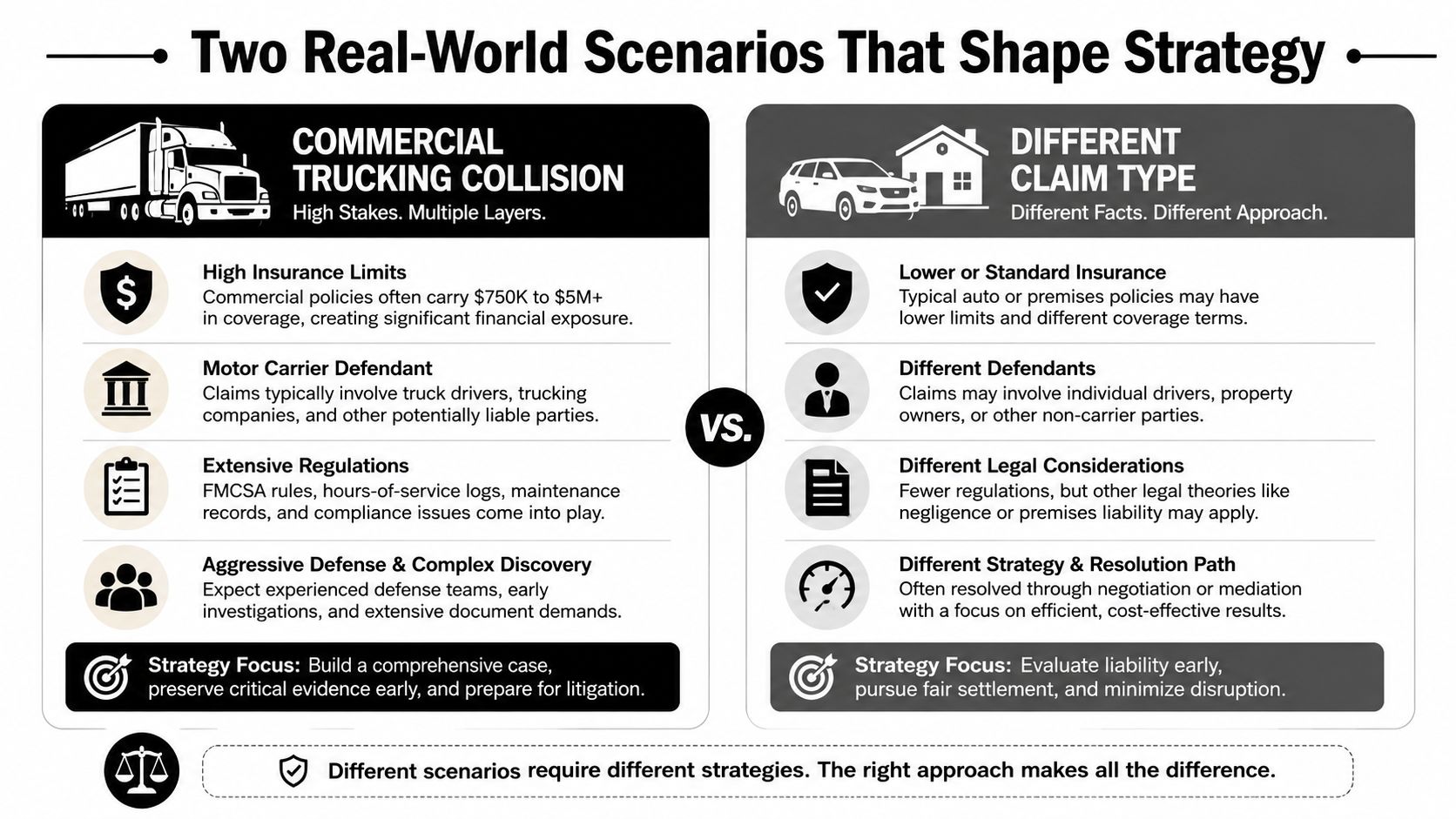
Two Real-World Scenarios That Shape Strategy
A commercial trucking collision on I-70 can look very different from a fatal fall at a ski resort, even though both may fit the broad wrongful death framework.
In the trucking scenario, assume a motor carrier's tractor-trailer collides with a passenger vehicle and the occupant dies at the scene. The investigation may examine the driver's conduct, the carrier's hiring and supervision, maintenance records, inspection history, dispatch instructions, electronic logging data, vehicle-control-module information, cargo loading, and applicable federal safety rules. Lawyers may send immediate preservation demands to the carrier and its insurers before relevant electronic or paper records disappear.
The defense may argue that the driver acted outside company policy, that another motorist caused the crash, or that the available vehicle data doesn't establish fault. A corporate defendant also creates a broader insurance and responsibility analysis than a claim involving only a private driver. The family's strategy may therefore focus on preserving technical evidence early and identifying every entity whose conduct contributed to the collision.
A premises case may follow another path
Now consider a skier who falls because of an allegedly dangerous condition at a resort and dies after a delayed medical decline. The investigation may involve resort inspection records, warning signs, terrain conditions, employee testimony, incident reports, medical records, and the actions of more than one party. The defense may argue that the skier knowingly encountered a risk, that the condition wasn't dangerous, or that medical complications rather than the original fall caused the death.
That dispute can bring comparative negligence, multiple defendants, and causation into the same case. The survival action may also become important if the person experienced pain, received treatment, and incurred medical expenses before death. Unlike the trucking example, the central evidence may be property records and medical causation rather than vehicle data.
These scenarios show why a definition alone isn't enough. The same four elements can require different experts, different preservation demands, and different responses to defense arguments.
Practical Questions Colorado Families Ask First
How quickly should we act? Start sooner than the deadline requires. Colorado's general filing period is two years, but evidence can become harder to locate while a family is waiting for an investigation or trying to understand what happened. Early legal review can identify potential defendants, preserve records, and separate the wrongful death claim from the survival action.
Can we afford a lawyer? Many wrongful death firms evaluate cases through a contingency arrangement, so the family doesn't pay an hourly fee for every conversation or investigation task. Ask for the written agreement and confirm how fees, expert expenses, records, and litigation costs are handled. Nares Law Group LLC describes free consultations and representation that can include investigation, medical-treatment coordination, negotiation, trial, and settlement.
How long will the case take? There's no reliable universal schedule. An insurer may resolve a claim relatively quickly, while a case involving disputed fault, multiple defendants, expert testimony, or a trial can continue for years. A careful lawyer should explain the current stage, the next decision, and the factors affecting timing rather than promise a result.
What should we do before the consultation? Keep photographs, videos, letters, bills, employment records, insurance documents, medical records, police paperwork, and notes about conversations. Don't give a recorded statement to an insurer or sign a release before you understand what rights it may waive. You don't need a complete case file before seeking advice.
The firm's role should be concrete. Counsel investigates the event, protects evidence, coordinates relevant records, calculates family and estate losses, handles insurer communications, files suit when appropriate, conducts discovery, and prepares for mediation or trial.
Turning Information Into a Next Step
The question “what is a wrongful death claim” has a direct answer, but applying it requires careful Colorado-specific analysis. The family generally must connect duty, breach, causation, and damages. The claim may arise from negligence, recklessness, or intentional wrongdoing, and the same event may also support a separate survival action for the deceased person's pre-death losses.
Colorado's C.R.S. 13-21-201 controls who may bring the wrongful death action and how recovery is allocated among statutory beneficiaries. The general filing period is two years from the death, although exceptions and special procedures can matter. Potential recovery may include economic damages, noneconomic damages, and punitive damages when the evidence meets the required standard.
A case typically moves through investigation, demand and negotiation, litigation, and resolution through settlement or trial. Each phase asks something different of the family. Early on, you may need to preserve records and answer factual questions. Later, you may need to evaluate settlement terms, participate in discovery, or decide whether continued litigation serves the family's goals.
The first legal task isn't deciding whether to sue. It's protecting the information needed to make an informed decision.
This week, gather the documents you already have, avoid recorded insurer statements and releases, and schedule a consultation with a Colorado wrongful death attorney. Bring the death certificate if available, incident information, insurance correspondence, medical and funeral records, and a list of surviving spouse, children, or other potentially relevant beneficiaries.
Nares Law Group LLC helps Colorado families investigate fatal crashes and other preventable deaths, evaluate wrongful death and survival claims, preserve evidence, and pursue compensation through negotiation or trial. Visit Nares Law Group LLC to request a consultation and discuss your family's circumstances.