A phone call comes in. A police officer asks whether you're a family member. Or a hospital tells you to come right away. In a few minutes, life splits into “before” and “after.”
The next days rarely feel real. People bring food. Someone asks about funeral plans. An insurance adjuster may call sooner than seems possible. At the same time, your family may already be facing rent, mortgage payments, medical bills, and the sudden loss of the person who held daily life together.
When a death happened because another person or company acted carelessly or wrongfully, Colorado law may allow a wrongful death claim. That claim isn't just about a lawsuit. For many families, it's a way to seek accountability, protect financial stability, and make sure the legal burden isn't left to fall on grieving relatives who are already overwhelmed.
The hard part is that the Colorado wrongful death statute is not simple. It doesn't just ask what happened. It also asks who in the family has the legal right to file, and when. Those timing rules can trip people up, especially when multiple relatives want to help or when no spouse or children survive.
Navigating Sudden Loss and the Law
A common situation looks like this. A husband dies after a crash on I-25. His wife is trying to plan a memorial and answer calls from work, school, and extended family. Their adult daughter wants to “get the case started.” A parent of the person who died believes they should be included immediately. Everyone is acting out of love, but the law may not give everyone the same rights at the same time.
That's where confusion starts. Families often assume that if several close relatives suffered the loss, any of them can file right away. Colorado doesn't work that way. The law creates an order, and that order matters.
A wrongful death case also unfolds in stages, from investigation and evidence gathering through insurance negotiations and, if needed, litigation. If you want a plain-language overview of how civil claims usually move forward, this guide to the stages of a personal injury case can help put the process in context.
Why early clarity matters
In grief, people often focus on the obvious question: who caused this? The law adds another question that's just as important: who is allowed to bring the claim today?
If the wrong person files, the problem may not be about proof. It may be about legal standing. That can create delays at the exact time when families need evidence preserved and decisions made carefully.
Practical rule: In a Colorado wrongful death case, timing affects both the deadline and the identity of the person who can act.
Families also need more than legal information. They need support. If you're trying to care for children, manage shock, and make basic decisions, these grief support resources after wrongful death in Colorado may help with the human side of what you're carrying.
What this process should feel like
The legal system can feel cold, but good guidance shouldn't. You deserve clear answers, honest expectations, and a calm explanation of what has to happen next. Think of the statute like a set of railroad switches. The train may still be moving toward accountability, but if the switch is set wrong at the start, the route changes fast.
That's why families often need to slow down before they rush. The first calls, the first statements, and the first filing decision can shape the whole case.
Understanding a Wrongful Death Claim in Colorado
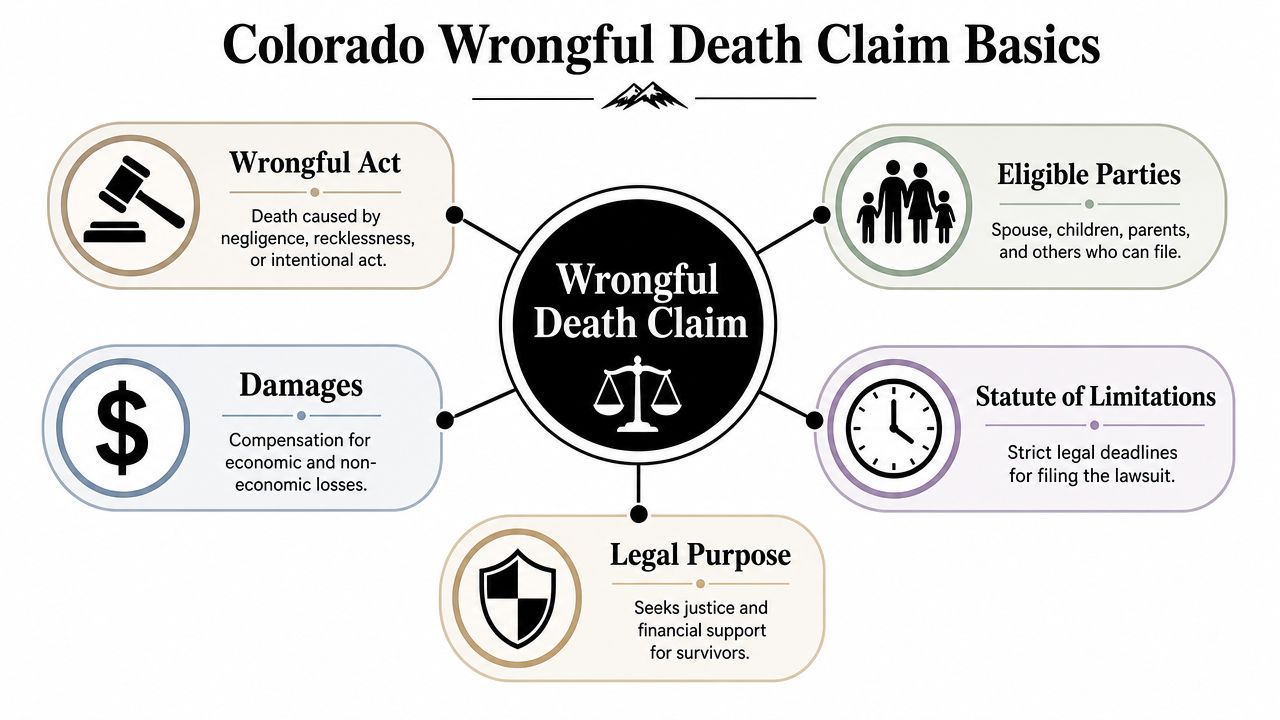
A wrongful death claim is a civil case a family may bring when someone dies because another person or business acted carelessly, recklessly, or wrongfully. In practical terms, the claim asks a court to measure the harm the death caused to the surviving family and to require the responsible party to pay for that harm.
That is different from a criminal case. A criminal case is brought by the government and focuses on punishment. A wrongful death case is brought in civil court and focuses on the losses left with the family.
Wrongful death claim versus survival action
These two claims are often confused, especially in the first weeks after a death. The easiest way to separate them is to ask a simple question: whose loss is the law trying to address?
A wrongful death claim addresses the losses suffered by the surviving family because the person died. A survival action addresses the claim the deceased person could have brought if they had lived, and that claim is pursued through the estate or personal representative.
The two claims differ in their focus and who benefits:
| Claim type | Main focus | Who the loss belongs to |
|---|---|---|
| Wrongful death claim | The family's losses after death | Surviving relatives who qualify under the statute |
| Survival action | The deceased person's claim that survives death | The estate or legal representative |
A simple example helps. If a parent is injured in a crash and dies later, the family may have a wrongful death claim for the loss of that parent's support, companionship, and presence. The estate may have a survival action for harms tied to what the parent experienced before death. They are related, but they are not the same claim and do not always belong to the same person.
What families usually need to prove
Most wrongful death cases come down to a few basic questions.
- Cause of death. Did another person, company, or entity cause the fatal event?
- Wrongful conduct. Was that conduct negligent, reckless, or otherwise wrongful?
- Losses to the family. Did the death leave financial and personal losses that the law recognizes?
This is why evidence matters early. Medical records, crash reports, witness accounts, photographs, employment information, and insurance details can all affect whether the claim is clear or disputed.
A wrongful death claim is a civil claim for the losses a death leaves behind for legally recognized family members.
Why the statute matters
In Colorado, wrongful death exists because the statute allows it and sets the rules for it. That point sounds technical, but the effect is very practical. The law does not just ask whether someone caused a death. It also controls who may file, when they may file, and what kind of damages may be available.
For grieving families, that can feel frustrating. A claim may be valid on the facts and still run into problems if the wrong person files too soon, too late, or without the right legal authority. That timing issue becomes especially important in Colorado because filing rights can change between the first year after death and the second year, and recent changes have added limited sibling rights in certain situations starting in 2025.
So before a family decides how to proceed, it helps to understand one hard but important truth. In Colorado wrongful death law, the order of eligible claimants works a lot like a line at a service counter. The claim itself may be real, but the law still asks who is first in line to act at that moment.
Who Is Eligible to File a Wrongful Death Lawsuit
Many families are blindsided on this point. The answer is not merely “next of kin.” Under Colorado law, who can file changes over time, and that timing can be just as important as the underlying facts.
Early in the process, families often act collectively. Legally, though, Colorado may recognize one person's filing right before another's. That can feel unfair when everyone is grieving. But the statute uses a priority system.
The first year and second year problem
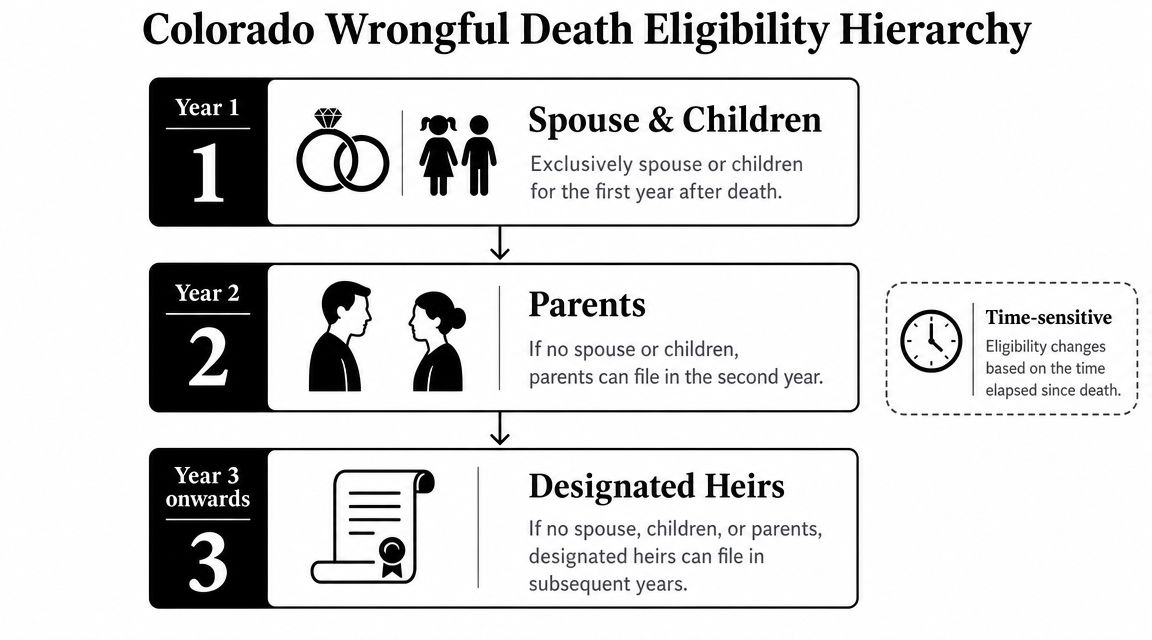
Colorado's wrongful death framework is unusually timing-sensitive because standing changes during the first two years after death. Generally, only the surviving spouse may file in year one, while children may file in year two, and current law also permits limited sibling-based claims in certain post-2025 scenarios under HB24-1472, as described by the Colorado General Assembly bill materials.
That sounds technical, but the practical effect is simple. A strong negligence case can still run into trouble if the wrong family member files at the wrong time.
Here is the practical version:
- During the first year after death. The surviving spouse usually has priority to bring the wrongful death claim.
- During the second year. Children may gain filing rights as the statute allows.
- In certain deaths arising on or after January 1, 2025. Siblings and, in some situations, their heirs may have expanded rights under the newer claimant-order rules.
Filing by the wrong person can create a threshold problem before the court ever reaches questions about fault, evidence, or damages.
This short video gives a helpful visual overview of wrongful death claim basics:
Why families get confused
The confusion usually comes from everyday family language. People say “we're all bringing the claim” or “his parents should file because they're handling everything.” Emotionally, that makes sense. Legally, Colorado may require a different sequence.
Here are a few examples:
- A surviving spouse and adult children disagree. The children may want immediate action, but the spouse may still hold the first filing priority.
- There is no spouse. Children may become central much sooner.
- There is no spouse or child. The standing question gets more complicated, especially after the claimant-order changes for deaths arising on or after January 1, 2025.
The 2025 sibling change
This is one of the least explained parts of the Colorado wrongful death statute. Many online guides still stop at “spouse first, then children.” That's no longer enough for every case.
For certain deaths arising on or after January 1, 2025, current law includes a more detailed hierarchy and allows expanded rights for siblings and their heirs in some cases. That change matters most when there is no spouse, child, or designated beneficiary.
If your family structure is blended, estranged, or not traditional, this issue deserves close attention. The law may recognize a claimant you didn't expect, or it may require coordination among relatives before anyone files.
The Critical Deadlines Colorado's Statute of Limitations
A family can lose the right to bring a wrongful death case while they are still arranging a funeral, waiting on records, or trying to sort out which relative is allowed to file first. That is what makes the deadline rules so hard. The legal clock keeps running even when the family is still in shock.
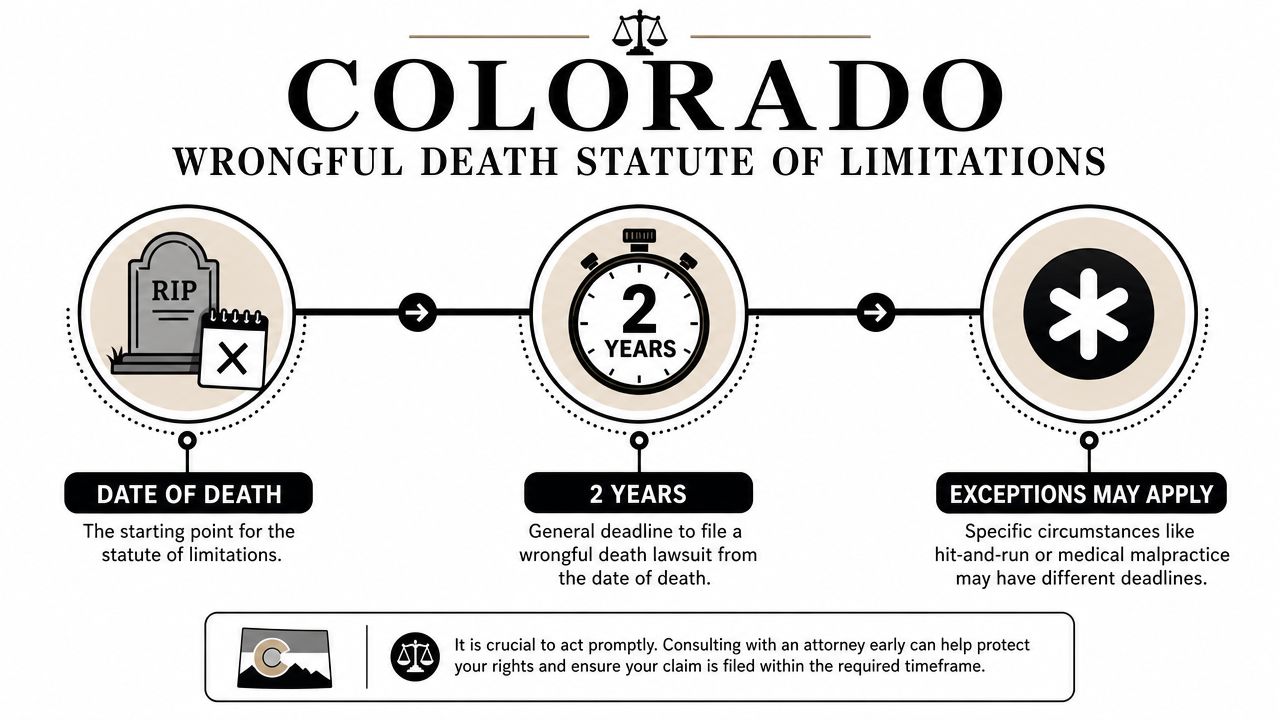
In Colorado, the statute of limitations is the filing deadline for the lawsuit. In many cases, the clock starts on the date of death. It usually does not wait until the family understands the full financial loss, receives every medical record, or resolves disagreements about who should act.
The basic deadline, and why the type of case matters
Colorado wrongful death claims generally have a 2-year filing period. Some cases tied to motor vehicle accidents may have a 3-year deadline, and certain vehicular homicide matters may allow more time.
That difference matters more than many families expect. A hospital case, a dangerous property case, and a fatal crash may not all follow the same calendar, even though all three involve a wrongful death.
| Type of wrongful death claim | Typical filing window |
|---|---|
| Most wrongful death claims | 2 years from date of death |
| Motor vehicle accident wrongful death claims | 3 years |
| Certain vehicular homicide cases | Longer periods may apply |
Why waiting can create two different problems
The first problem is obvious. Missing the statute of limitations can end the claim.
The second problem is easier to miss. Colorado's filing hierarchy changes over time. During the first year after the death, one group of relatives may hold the right to file first. In the second year, that circle can widen. So a family may be dealing with two clocks at once: the deadline to sue, and the timeline that controls who can sue during different parts of the case.
A simple way to picture it is a train leaving on a set schedule while family members are still figuring out who has the ticket. Even if everyone agrees later, lost time can make the process much harder.
This is especially important after the 2025 sibling-related changes for some deaths. In cases with no spouse, child, or other higher-priority claimant, siblings or their heirs may now matter in ways older online articles do not explain well. That can affect strategy early, because families may need to identify the right claimant group before filing instead of assuming they can sort it out later.
Time disappears faster than people expect
Two years sounds long. In practice, it often is not.
Police files can take time to obtain. Medical records may come from several providers. Video footage can be erased. Vehicles get repaired. Phones are replaced. People move. Memories blur around dates, conversations, and warning signs. Early legal work often focuses on preserving evidence and confirming the right plaintiff, even before a lawsuit is filed.
Families who are also handling probate issues may run into another layer of confusion about settlement funds and distribution. This guide on managing wrongful death settlements can help explain that separate process.
If you want a closer explanation of filing windows and how they apply in practice, this guide on the Colorado wrongful death statute of limitations gives more detail.
What Compensation Can Families Recover
After a death, money can feel like the wrong subject. But bills keep arriving, and the law recognizes that a death can cause both financial and personal losses.
In broad terms, compensation in a wrongful death case usually falls into economic and non-economic categories. Those labels sound abstract, but they're easier to understand when translated into daily life.

Economic losses
Economic damages are the measurable financial effects of the death. These can include the income your loved one would likely have provided, funeral and burial expenses, medical bills tied to the final injury or illness, and the loss of work-related benefits that supported the household.
A simple way to think about economic damages is this: if the death removed money, services, or practical support from the family's life, those losses may be part of the claim.
Examples often include:
- Lost earnings and support. What the person likely would have contributed to the household.
- Final medical costs. Bills connected to treatment before death.
- Funeral-related expenses. Costs families had to pay because of the death.
- Lost benefits. Health insurance, retirement contributions, or other employment-related support.
Non-economic losses
Non-economic damages address what can't be measured with receipts. Grief. Loss of companionship. Loss of care, guidance, presence, and the ordinary relationship that made a family feel like itself.
These damages matter because the law recognizes that a death is not only a financial event. It is also a human rupture.
Colorado law places statutory limits on certain non-economic wrongful death damages, and those rules can be affected by filing date and case circumstances. The exact application can become technical quickly, so families usually benefit from a case-specific review rather than relying on a headline figure pulled from a general article.
Some losses are visible on paper. Others show up in an empty chair, a missed school pickup, or the silence that settles into a home after a preventable death.
Why settlement structure matters
Recovery is one issue. Distribution is another. Families sometimes assume that once a case resolves, the money passes through a will or gets split automatically. That may not be how it works.
If your family is trying to understand the practical side of receiving and distributing proceeds, this resource on managing wrongful death settlements gives a useful overview of the issues that can come up after a case resolves. For a Colorado-specific discussion of possible recovery categories, this page on a wrongful death lawsuit payout can also help frame the conversation.
Practical Next Steps for Your Family
A common problem starts like this. One relative is answering insurance calls, another is collecting bills, and someone else is trying to guess who has the legal right to act for the family. In Colorado, that confusion can create real risk because the order of who may file, and when, matters.
The first goal is simple. Create order before deadlines and family misunderstandings create bigger problems.
What to do in the early days
Start by choosing one person to gather information, even if that person is not the one who will ultimately file the claim. That person is acting more like a record keeper than a decision maker. It helps the family avoid mixed messages while you sort out who has legal standing under Colorado's timing rules.
Then focus on the items that are hardest to replace later:
- Collect core documents. Keep the death certificate, incident reports, insurance information, medical records, funeral invoices, and any letters, emails, or claim numbers in one place.
- Preserve evidence. Save photos, videos, text messages, voicemail messages, call logs, and witness names. If a vehicle or other property is involved, do not approve repairs, disposal, or data deletion until you understand whether that evidence may matter.
- Build a simple timeline. Write down what happened, who contacted the family, and what deadlines or appointments have already come up. A timeline works like a map during a stressful week.
- Track the household impact. Note lost income, childcare changes, travel costs, and other new expenses. Those details are easy to forget later.
- Use care with insurance adjusters. Early calls can sound routine, but they often shape the case. Before anyone gives a recorded statement or signs an authorization, confirm who should be speaking for the family.
Why family coordination matters so much in Colorado
Colorado wrongful death law is not just about whether a case exists. It is also about which family member has the right to bring it at a given point in time. That is why this section matters on a practical level.
Families often assume everyone can act at once. The process is usually narrower than that. The first year and second year rules can change who is allowed to file, and recent 2025 changes affecting siblings make the family tree even more important in some cases. A lawyer can help sort that out, but your family can help itself early by identifying the spouse, children, parents, and siblings, and by keeping basic contact information for each person.
That step may feel administrative. It can prevent delay later.
A simple system for paperwork
Grief makes ordinary tasks harder. Papers end up in purses, glove boxes, kitchen drawers, and email threads. A binder or shared digital folder can save a great deal of stress.
If your family wants help setting that up, this guide on managing important family records offers practical ways to organize end-of-life documents without making the process feel like another full-time job.
When to speak with a lawyer
Many families wait because they do not want to turn a loss into a legal matter too quickly. That hesitation is understandable. But early legal advice is often less about filing a lawsuit right away and more about preventing avoidable mistakes.
A lawyer can identify the proper claimant, explain the first-year versus second-year filing rules, preserve evidence, handle insurer contact, and flag issues tied to the 2025 sibling-related changes if they apply to your family. That guidance is especially helpful when relatives are grieving and trying to act respectfully, but are unsure who has authority to move the case forward.
Nares Law Group LLC is one firm families may consider for wrongful death matters in Denver. Whether you speak with that firm or another attorney, the useful question is the same. Who can legally file now, what needs to be preserved today, and what should the family avoid saying or signing until that is clear?
Frequently Asked Questions About Wrongful Death Claims
Some of the hardest questions arise after families understand the basics. These are often the issues that don't fit neatly into a general summary.
What if the at-fault person also died
A wrongful death claim doesn't automatically disappear because the person who caused the fatal event also died. In some cases, related claims may proceed against an estate, an insurance policy, a company, or another responsible party. The answer depends on who may be legally liable and what assets or coverage exist.
That question needs a case-by-case review because the target of the claim may not be only the individual person involved in the event.
What if my loved one was partly at fault
Partial fault can affect a civil recovery. If the defense argues that the person who died contributed to the event, that can reduce or complicate damages. These disputes often matter in traffic deaths, workplace incidents, and cases with limited eyewitness evidence.
Families should be cautious here because insurers often raise fault arguments early. They know the person who died cannot explain what happened.
Can siblings file a wrongful death claim in Colorado
For many families, this is the most important unresolved question. One underserved angle is the 2025 claimant-order change. Most online coverage still centers on the older “spouse first, then children” framework, but Colorado law now has a more detailed hierarchy for who may sue, including expanded rights for siblings and their heirs in some cases for deaths arising on or after January 1, 2025, as noted in this discussion of who qualifies as a wrongful death claimant in Colorado.
That matters most when there is no spouse, child, or designated beneficiary. In those situations, siblings may need a careful standing analysis before anyone files. The statute doesn't treat every family tree the same way, and blended families can raise especially sensitive questions.
If no spouse or child survives, don't assume there is no claim. But don't assume the right person is obvious either.
If your family is facing that issue, it's worth getting legal advice tied to the exact date of death and the exact family relationships involved.
If your family is facing questions about the Colorado wrongful death statute, the most useful next step is usually a case-specific conversation with Nares Law Group LLC. A lawyer can help identify who has standing to file, protect evidence, and explain the deadlines that apply to your family's situation in plain language.