A lot of families land here the same way. A phone call changed everything. The funeral hasn't happened yet, or maybe it just did. Bills are arriving, work has become impossible to focus on, and someone keeps asking a question that feels almost offensive right now: what is this case worth?
That question doesn't mean you loved the person any less. It usually means your household is under strain, and you need to understand what comes next. Mortgage payments still come due. Children still need care. A missing paycheck, lost health coverage, and final medical bills can turn grief into fear very quickly.
Families also tell me they feel torn between two needs that seem to conflict. They want accountability, and they want peace. If you're trying to process both, support outside the legal system can help too. Some people find it useful to read a gentle practical guide to moving on while they sort through the emotional side of loss.
Understanding Wrongful Death Payouts in a Time of Grief
A family sits at the kitchen table after the funeral, and someone finally asks the question everyone has been avoiding. What might a wrongful death lawsuit payout look like, and how long will it take?
That question is practical, not heartless. Rent is still due. Childcare still costs money. A lost income can turn grief into financial pressure almost overnight. Some families also need space to handle the emotional side of loss, and a gentle practical guide to moving on can help alongside legal advice.
Many articles try to answer this with a single number. That approach usually creates more confusion than clarity.
The problem is simple. Large verdicts can pull an average upward and make ordinary cases look more valuable than they are. A median often gives a more honest picture because it reflects the midpoint, not the outliers. Even then, neither number predicts what one family will recover. In practice, the better question is not, “What is the average payout?” It is, “What facts, limits, and state-law rules will control this case?”
That distinction matters early. Families often assume the size of the loss and the size of the recovery will match. Sometimes they do. Sometimes they do not. Insurance limits, proof problems, disputed fault, and state damage rules can narrow a case long before anyone talks about settlement.
A wrongful death claim is really two evaluations happening at once. One asks what the death has cost the family in real, provable terms. The other asks what can be recovered from the people or companies responsible. Those are not always the same number.
I tell families to be careful with quick estimates. An attorney who gives a confident payout figure before reviewing records, insurance coverage, and the governing state law is usually guessing. A careful review takes more time, but it gives you something more useful than a headline number. It gives you a range tied to facts.
The cases that resolve well usually start the same way. Identify who has the right to bring the claim. Gather the records that show the financial loss. Preserve the evidence that proves fault. Confirm how much insurance or other recovery may be available. Then test all of that against the law of the state where the claim will be filed.
That last point is often missed. Colorado, Texas, and New York do not handle wrongful death damages the same way, and those differences can change both case value and how money is divided among surviving relatives. Later sections break that down in plain terms, including the part many families do not hear enough about: not just how a case is valued, but how settlement funds are distributed once the case ends.
What a Wrongful Death Payout Actually Covers
A wrongful death case uses the word damages to describe what the law may compensate. That word sounds cold. It helps to think of it another way.
If a family loses a home in a fire, there are different kinds of loss. There are the receipts for rebuilding. There's also the loss of safety, routine, and the feeling of home. And if someone intentionally caused the fire, there may be a separate penalty. Wrongful death damages work in a similar way.
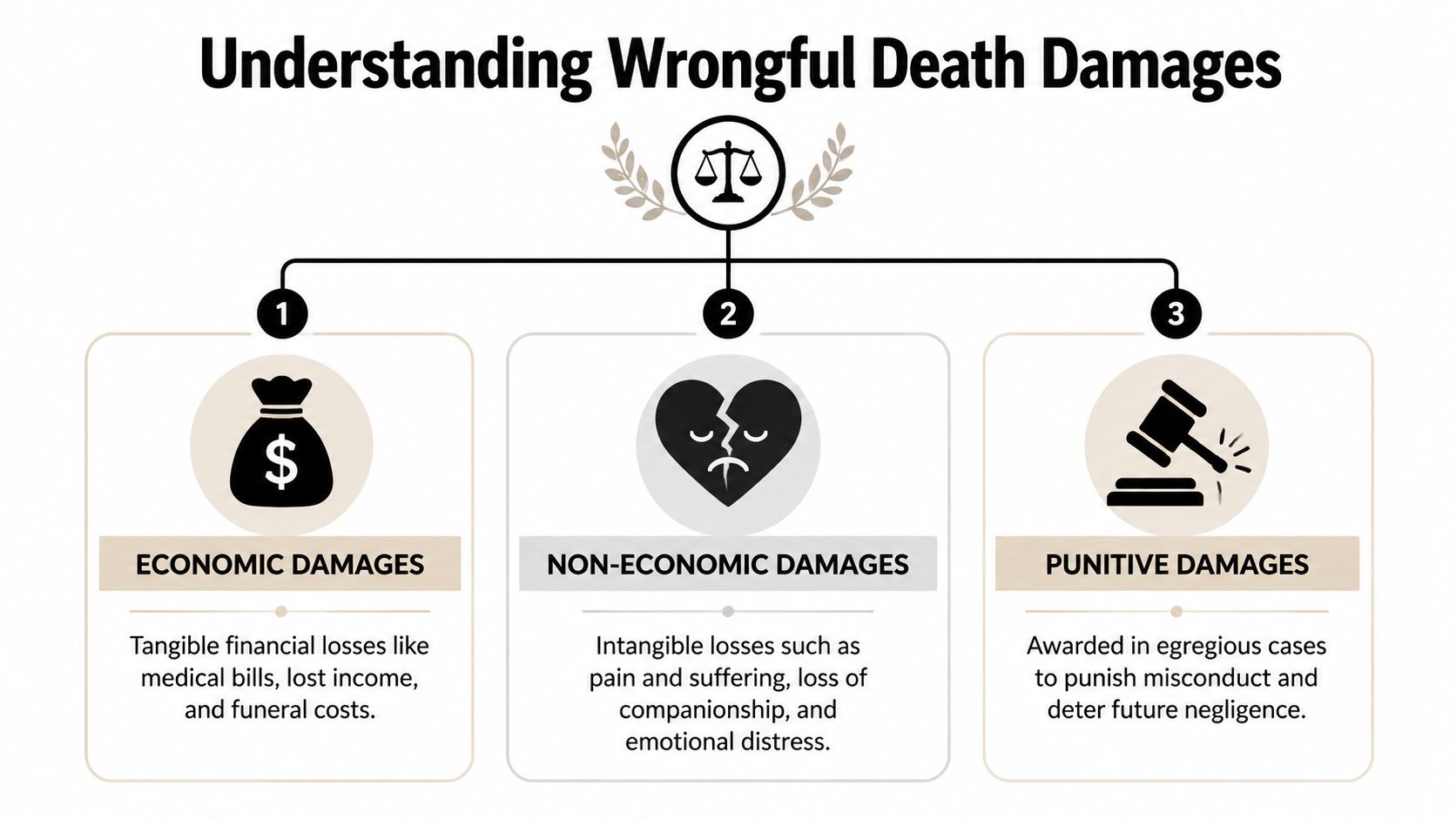
Economic damages
These are the losses that usually come with records, invoices, or income history.
They can include medical bills tied to the final injury, funeral and burial costs, lost wages, lost future earning capacity, and the value of household services the person would likely have provided. In practice, these damages often require more work than families expect. A paycheck stub alone usually isn't enough. Lawyers often need employment records, tax documents, benefit information, and a reliable picture of the person's likely work life.
A separate issue families should keep in mind is that wrongful death compensation is different from life insurance. If you're trying to understand how a policy payout works alongside a legal claim, Coveredly's death benefit guide gives a useful plain-language explanation of death benefits.
Non-economic damages
These damages address the human part of the loss. They try to account for the absence no invoice can capture.
That can include loss of companionship, loss of care, loss of guidance, emotional suffering, and other intangible harm recognized under state law. Legal valuation often feels uncomfortable to families in these situations. They don't want a relationship reduced to a line item. That discomfort is normal. The law isn't saying love has a market price. It's trying, imperfectly, to recognize that a death can destroy far more than a stream of income.
Practical rule: The strongest non-economic claim is still built with evidence. Photos, family testimony, caregiving history, calendars, messages, and daily routines all help show what was actually lost.
Punitive damages
Punitive damages are different. They don't exist in every case.
They're generally tied to especially serious misconduct. The point is punishment and deterrence, not compensation alone. In ordinary negligence cases, punitive damages may never become part of the discussion. But when the evidence shows gross negligence or similarly severe conduct, they can transform the risk facing a defendant.
That's one reason wrongful death cases can vary so sharply. One file may be about proving support and income loss. Another may turn on whether the conduct was so dangerous that punishment becomes part of the verdict.
How Legal Teams Calculate a Claim's Value
There isn't a calculator that can tell a family what their case is worth after answering a few online questions. A serious valuation is built from evidence, law, and judgment.
One reason the public gets confused is that “average payout” numbers hide the spread between ordinary cases and headline verdicts. There is no reliable nationwide average for a wrongful death lawsuit payout because value turns on liability, causation, documented losses, non-economic harm, insurance limits, and collectability, and the practical ceiling is often set by policy limits and the defendant's ability to pay, as explained in this wrongful death payout analysis.
Why average often misleads
One recent case analysis highlighted the problem clearly. It reported a Maryland wrongful death average of about $973,054 and a median of $294,728 across 956 cases from 2019-2024, showing how a smaller number of large results can pull the average far above the middle of the pack, as discussed in Scheuerman Law's settlement calculator discussion.
That's why families should be careful with round numbers pulled from search results. Average answers often describe a market. They do not predict your case.
A legal team usually looks at valuation in layers:
| Part of the claim | What the team studies |
|---|---|
| Economic loss | Earnings history, benefits, taxes, work life, medical bills, funeral costs |
| Human loss | Relationship evidence, caregiving, family structure, testimony |
| Liability strength | Police reports, company records, crash data, witness statements |
| Real-world limits | Insurance coverage, assets, liens, fees, and likely collectability |
What the work looks like behind the scenes
Lawyers don't just total bills and send a demand. They build a model. That may include projecting likely future earnings, identifying employment benefits, documenting services the person provided at home, and gathering proof about the family's dependency and daily relationship.
If you want a clearer sense of how economic loss gets built in practice, this explanation of economic damages calculation is a useful starting point.
The number that matters isn't the one that sounds impressive online. It's the number you can support with evidence and realistically collect.
Families also need to separate gross value from net recovery. Even a strong result can be reduced by attorney fees, litigation costs, liens, and post-verdict adjustments. That doesn't make the claim less important. It just means honest advice has to cover what reaches the family, not only the headline figure.
Key Factors That Influence Payout Amounts
Two families can lose someone in crashes that look similar on the evening news and still see very different case values. That gap usually comes from proof, timing, insurance limits, and state law. Grief may be equal. Legal value is not.
General payout ranges can be useful for orientation, but they often hide more than they explain. Averages get pulled upward by rare verdicts and outlier settlements. In actual case work, lawyers focus on the facts that change bargaining power and collectability.
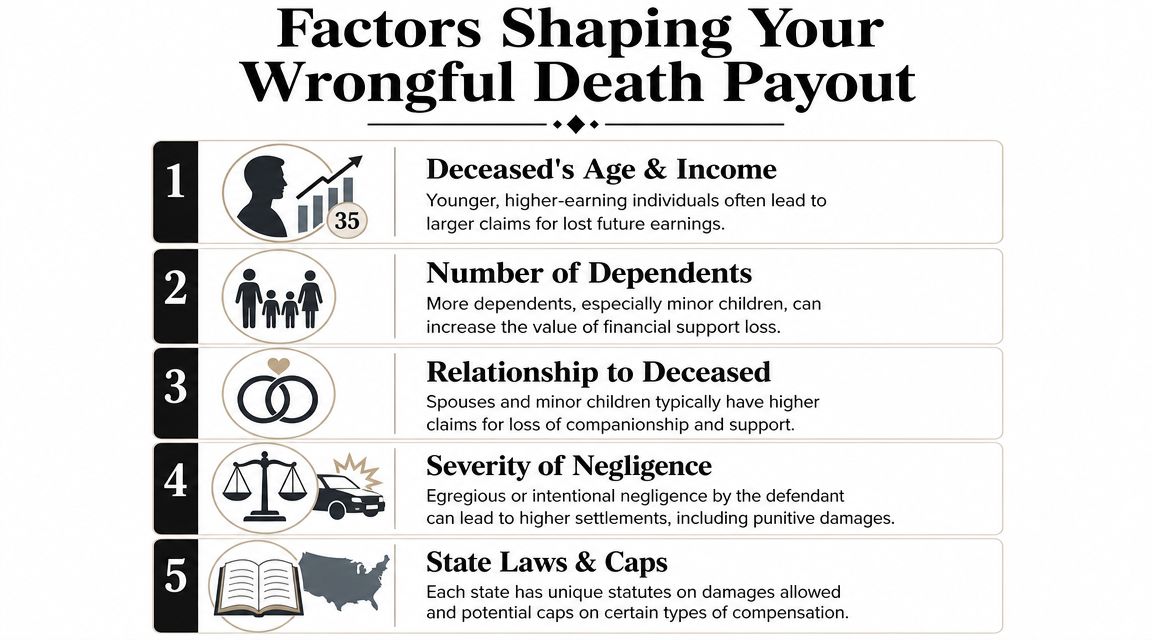
The factors that usually change the number
- Who depended on the person who died: A case often carries more financial weight if a spouse, children, or another dependent relied on that person for income, daily care, transportation, or household management. Juries and insurers respond to documented dependence, not assumptions.
- The decedent's stage of life and work history: A younger worker with steady raises, benefits, and a clear career path may create a larger lost-support claim than a person who was retired or had irregular earnings. This is an economic measurement, not a statement about a family's emotional loss.
- How strong the liability proof is: Clear evidence of negligence raises settlement pressure. Conflicting witness accounts, missing records, or shared fault usually lower offers because the defense has more room to argue.
- Insurance and other practical limits: Some cases are worth more on paper than they are in recovery. If coverage is low and the defendant has few reachable assets, that reality can cap the result.
- State-specific rules: Filing deadlines, damages caps, who may bring the claim, and how proceeds are divided can all change value. Missing a deadline can end the claim entirely, which is why families should review the wrongful death lawsuit statute of limitations early.
This short video gives a practical overview of issues families often face during the claim process.
What usually strengthens a claim
Insurers rarely increase an offer because a loss is heartbreaking. They increase it when the file is organized, documented, and trial-ready.
- Income proof: Tax returns, W-2s, pay stubs, pension records, and benefit summaries usually carry more weight than broad estimates about what the person "would have earned."
- Relationship proof: Calendars, school records, caregiving logs, text messages, shared bills, and testimony from people who saw the family's routine help show what was lost at home.
- Negligence proof: Incident reports, black box downloads, maintenance records, photos, surveillance footage, and internal company documents often decide whether the defense can credibly deny fault.
- Measured future-loss analysis: Credibility matters. A careful projection usually helps more than an inflated demand that gives the defense an easy target.
One more point matters here because families are often not warned about it early enough. The case value and the amount each family member receives are not always the same thing. Liens, fees, costs, and state distribution rules can all affect the final split. That issue becomes especially important in states like Colorado, Texas, and New York, where the rules on who can recover and how damages are treated can differ in ways that materially affect the payout.
Payout Examples and Crucial State Law Differences
A family can read about a nine figure verdict one day and then hear a far lower settlement estimate for their own case the next. That gap is confusing, and it often feels unfair. The reason is simple. Public stories tend to highlight outliers, while actual case value is shaped by state law, available insurance, the quality of the proof, and the way damages are divided among survivors.
That is why average payout figures can mislead. A few unusually large verdicts can pull the average up and make ordinary cases look smaller than they are. Median figures often give families a better sense of the middle of the market, but even that number has limits because wrongful death claims are heavily fact specific. In practice, I tell families to treat national averages as background noise, not a pricing sheet.
Colorado
Colorado law can limit recovery in ways that matter early, not just after a case settles. For civil actions filed on or after January 1, 2025, Colorado set a wrongful death damages cap at $2.125 million, with inflation adjustments scheduled to begin in January 2028, as discussed in Nares Law Group's discussion of wrongful death settlement amounts.
That cap changes the settlement conversation. If the financial loss appears very high, the defense may still negotiate with the cap in mind. Families deserve to know that at the start, because legal value and recoverable value are sometimes two different numbers.
Timing also matters. A strong case can still be lost if it is filed too late, so families should review the wrongful death lawsuit statute of limitations as early as possible.
Texas and New York
Texas often produces wider payout swings than Colorado because the law may allow exemplary damages in the right case. If the evidence supports gross negligence, the defendant is weighing more than compensation for the family's loss. The defendant is also weighing the risk of punishment. That can increase trial exposure and, in some cases, settlement value. It can also create a harder fight, because defendants usually contest punitive allegations aggressively.
New York presents a different issue. Distribution. Even a substantial settlement does not answer the family's most immediate question, which is who receives the money and in what share. New York wrongful death recoveries generally focus on pecuniary loss, and the Surrogate's Court often plays a role in approving and allocating proceeds among eligible family members. In households with a surviving spouse, children from different relationships, or dependent parents, that process can become as important as the gross settlement figure itself.
This is one reason state by state comparisons can mislead grieving families. Two cases with similar facts may produce very different net results because one state caps damages, another permits punitive exposure, and another applies different rules on who can recover and how funds are split after fees, costs, and liens.
Families who want a plain language overview of how negotiated cases are typically resolved can also review this personal injury settlement guide. It helps explain the settlement mechanics, but wrongful death claims add another layer because family status and probate rules may affect distribution.
Jurisdiction affects more than the top line number. It affects bargaining power, timing, and the final amount each person may take home.
The Path to Recovery Deciding Between Settlement and Trial
Most families eventually face a practical decision. Resolve the case through settlement, or take it to trial.
Neither path is automatically better. The right choice depends on the evidence, the offer on the table, the family's tolerance for uncertainty, and the goals behind the claim.
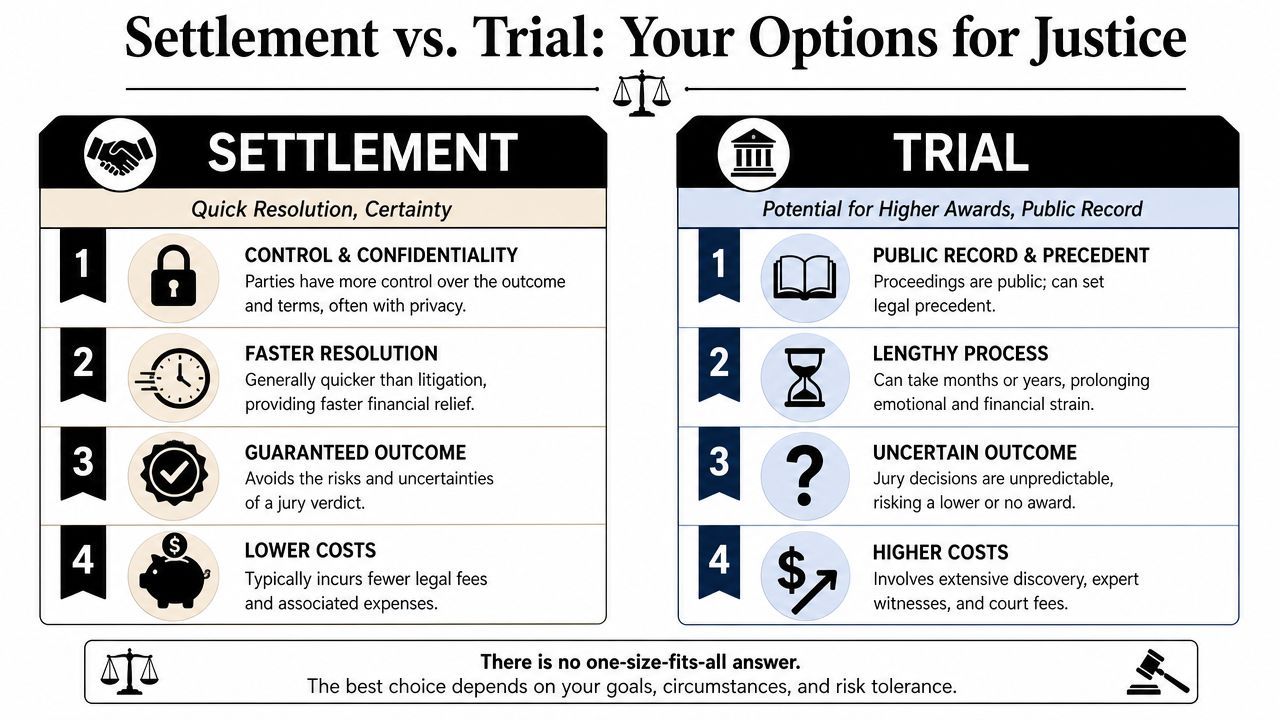
Settlement
Settlement gives the parties a negotiated resolution. It usually offers more control and less public exposure. It can also deliver funds sooner, which matters when a family is already carrying medical debt, funeral bills, or a sudden income gap.
The trade-off is that settlement may require compromise. A defendant pays to close risk, not to admit every moral point the family wants recognized. If the offer reflects the strengths and limits of the case, settlement can be the wise choice. If it ignores clear evidence, trial may become necessary.
If you want a broader look at how negotiated resolutions typically work, this personal injury settlement guide provides a useful overview of the settlement process.
Trial
Trial creates the possibility of a larger verdict, especially where liability is strong and the conduct was serious. It also creates uncertainty. Juries are human. Judges make legal rulings. Appeals can delay payment. Costs rise as the case becomes more complex.
Written terms are paramount. Families should understand exactly what's being released, paid, and resolved before they sign anything. A clear explanation of what a settlement agreement is can help you know what to look for.
Here's the practical comparison:
| Path | Often helps with | Main downside |
|---|---|---|
| Settlement | Speed, privacy, certainty, lower case expense | May produce less than a top-end verdict |
| Trial | Full public presentation, possible larger award | Risk, delay, emotional strain, higher expense |
A thoughtful lawyer shouldn't push trial for drama or push settlement for convenience. The strategy should fit the family.
Frequently Asked Questions About Wrongful Death Claims
How is a wrongful death payout divided among family members
A settlement check rarely answers the hardest family question. Who receives what is often a separate legal issue, and it can become sensitive very quickly.
The answer depends on state law, the wording of the settlement, and the family structure. Some payments go through the estate. Others go directly to legally designated beneficiaries. If there is a surviving spouse, adult children from a prior relationship, minor children, or a dispute about financial dependence, the allocation process can be as important as the total amount.
Written terms become critical at this stage. In some cases, the family agrees on division. In others, the court must approve or decide the allocation, especially if minors are involved. As noted earlier, New York handles distribution under its own rules, which is one reason families should not rely on national averages or generic online answers.
Is the headline settlement the amount the family actually receives
Usually, no.
The public number, or the number discussed during settlement, is often the gross recovery. The net amount can be lower after attorney fees, case expenses, medical or insurance liens, probate or estate costs, and any court-approved division among beneficiaries. A strong lawyer should explain those deductions before papers are signed, not after the funds arrive.
How long does a wrongful death case take
The timeline turns on what has to be proved and who is fighting about it. A case with clear liability, one insurance policy, and cooperative parties may resolve much sooner than a case involving disputed fault, multiple defendants, or expert battles over medical causation and future earnings.
Families should also expect timing issues that have nothing to do with merit. Court calendars move slowly. Probate issues can delay authority to act. If a minor's share needs approval, payment may take longer even after settlement terms are reached.
Are wrongful death cases only about lost income
Lost earnings are often one part of the claim, but they are rarely the whole case.
Depending on the state, the claim may also include funeral and burial costs, final medical bills, loss of services the deceased provided at home, loss of care and guidance, and other family losses recognized by statute. Some states limit certain categories. Others allow broader recovery. That is why median and average payout figures can mislead families. Two cases with the same death can produce very different results based on state law and the relationships involved.
Your First Step Toward Clarity and Justice
A common first call starts the same way. A spouse or adult child says they are being asked to sign papers, answer an insurer's questions, or open an estate before they even understand what the claim may be worth. Grief makes every deadline feel heavier, and uncertainty makes simple decisions feel risky.
That confusion is normal.
Wrongful death claims are rarely just about one number. Families need to know who has the legal right to recover, what losses the law recognizes in their state, and how any settlement may be divided after fees, liens, estate issues, and beneficiary rules are addressed. That last part often surprises people. The headline figure and the amount a family receives are not always the same, especially in states like Colorado, Texas, and New York, where the rules can differ in important ways.
One practical starting point some families use is the wrongful death settlement estimator offered by Nares Law Group LLC. It does not replace a legal review, but it can help organize the first conversation around the facts that usually drive value.

Large verdicts can distort expectations. As noted earlier, some cases produce extraordinary awards when the evidence shows extreme misconduct and punitive damages are available. Those results make headlines because they are unusual. Families are usually better served by a careful review of liability, insurance limits, state law, and the practical question of how funds would be distributed among the people entitled to recover.
If your family is facing questions about a wrongful death lawsuit payout, Nares Law Group LLC offers confidential consultations to help you understand your rights, the value drivers in your claim, and the legal path available in Colorado, Texas, or New York. You do not need every answer today. You need clear advice you can trust.