The tow yard is still open, the hospital discharge papers are on the kitchen counter, and your phone keeps lighting up with numbers you don't recognize. One voice says it's the trucking insurer. Another says it's “just a routine statement.” Meanwhile, the bills are starting and your body hurts in places you didn't expect.
That's where truck accident compensation starts in real life, not in a brochure. The first mistake most families make is thinking this is one number. It isn't. It's a stack of claims, built from medical losses, income losses, pain and suffering, and sometimes punitive damages when the trucking company's conduct crosses the line. And the value of that stack gets decided fast, because evidence disappears, memories drift, and insurers move early to cut fault against you.
A serious truck crash is almost never valued like an ordinary fender-bender. The reason is simple. The FMCSA's 2024 cost estimates put a truck crash causing any injury at about $200,000 and a fatal crash at more than $3.6 million (Wexford Insurance summary of truck settlement values). That's the backdrop for every claim, even though a settlement average near $103,654 can make the numbers look deceptively small when you first search online (Wexford Insurance summary of more than 400 settlements).
The First 72 Hours After a Truck Crash
The first three days after a semi hits you are not about “strategy.” They're about survival, sleep, and keeping the phone from running your life. One family may be at a hospital bedside while an adjuster keeps calling the spouse. Another may be at home with a totaled vehicle, a bruised ribcage, and no idea whether to answer the voicemail from the trucking insurer.
What matters right now
Your first job is to stop the damage from spreading. Get checked medically, even if you think you can tough it out. Truck crashes create injuries that don't always show up cleanly on day one, and the settlement value rises or falls on documented injury, not just how bad it felt at the scene.
Then identify the layers of recovery. Economic damages cover the bills and losses you can count, like treatment, missed work, and future care. Non-economic damages cover the human cost, pain, anxiety, sleep problems, and the way the crash changes daily life. Punitive damages are different. They're about punishment, and they come into play when conduct is egregious, like falsified logs or knowingly dangerous driving.
Practical rule: if the trucking company or its insurer gets your first statement before you have records and counsel, they'll use your own words against you later.
The cast of defendants can be wider than many might expect. It may include the driver, the motor carrier, the broker, or the shipper, depending on who hired whom and what went wrong. That matters because compensation usually comes from a policy tower, not one small auto policy. The more parties involved, the more likely the defense will argue about fault, blame, and who should pay.
Your early choices set the ceiling on the claim. Save every paper, every photo, every text, every billing statement, and every voicemail. Don't treat the crash like a simple insurance claim. Treat it like a value dispute that starts the moment the wreck is over.
The Three Categories of Truck Accident Compensation
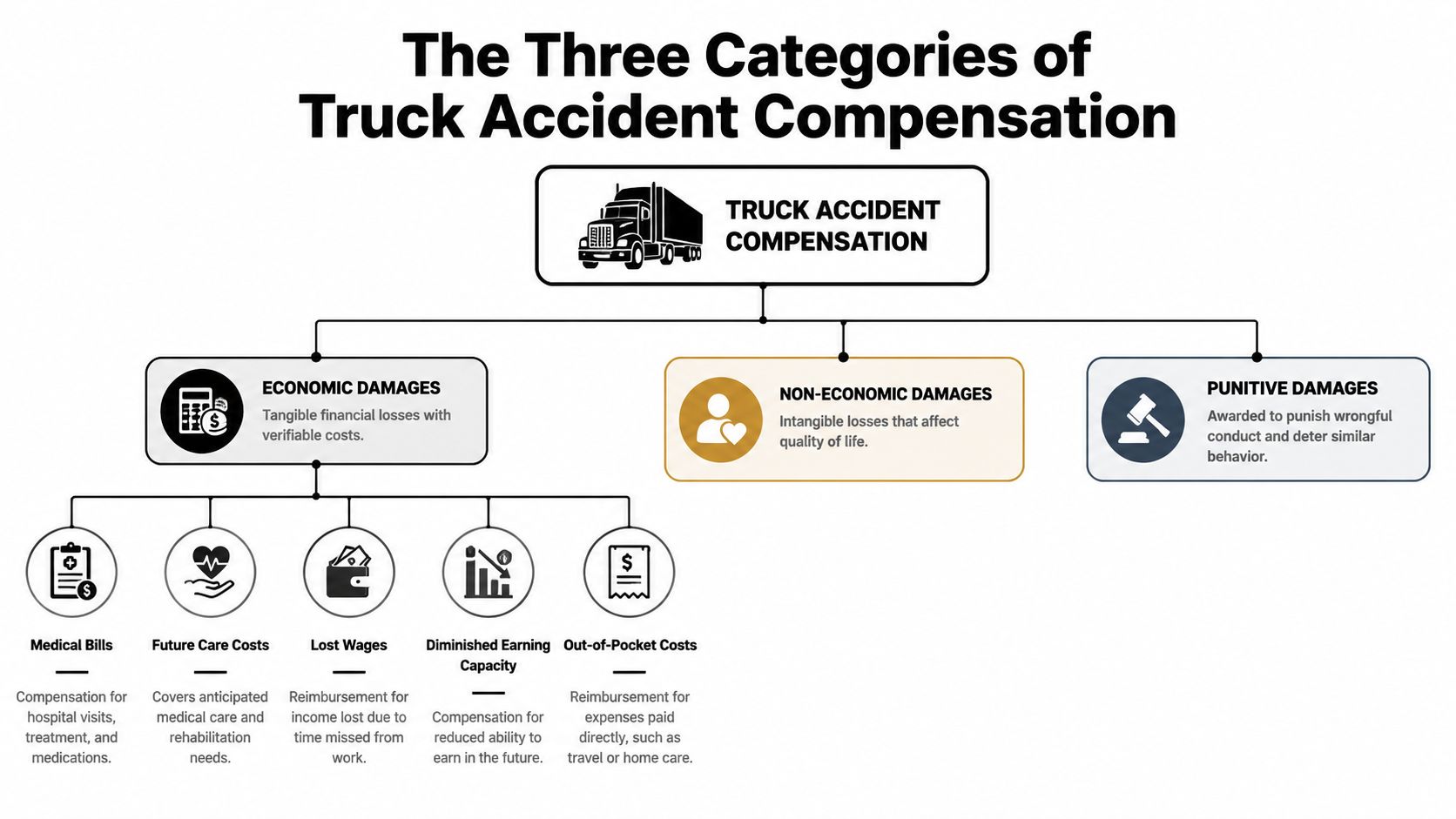
After a semi hits you, the first question is simple, what losses can you prove, and what evidence is going to survive long enough to support them. truck accident compensation is built from three buckets. If the records are thin, the value drops fast. If the records are strong, the claim has room.
Economic damages are the paper trail
These are the bills and financial losses you can document. Emergency care, follow-up treatment, imaging, surgery, rehab, prescriptions, missed paychecks, and the loss of future earning ability all belong here if the crash caused them. Out-of-pocket costs matter too, even the smaller ones, because they show how the wreck keeps pulling money out of a household.
A solid file also includes treatment that does not look dramatic on an invoice but still belongs in the claim. For some people, that includes post-accident pelvic floor therapy, especially when the crash caused pelvic pain, pressure, or related symptoms. A practical overview is available through post-accident pelvic floor therapy, and that care belongs in the damages file when a doctor says it fits the injury.
Non-economic damages are where insurers fight hardest
Pain and suffering, emotional distress, loss of enjoyment of life, and loss of consortium are harder to price because there is no neat formula. That is exactly why the defense attacks treatment gaps, skipped appointments, and any break between the injury and the records. In Colorado, fault can also cut these damages if the defense persuades a jury that you share blame.
Do not let anyone tell you these losses are soft or secondary. A person who cannot sleep, cannot drive comfortably, or cannot pick up a child without pain is dealing with real harm, even when the bills do not capture it well.
Punitive damages target bad conduct
Punitive damages are reserved for conduct that deserves punishment. Falsified logs, ignored hours-of-service limits, or driving under the influence are the kinds of facts that can put them on the table. They are not automatic, and they are not in every case, but when the evidence supports them, they change the pressure in settlement talks.
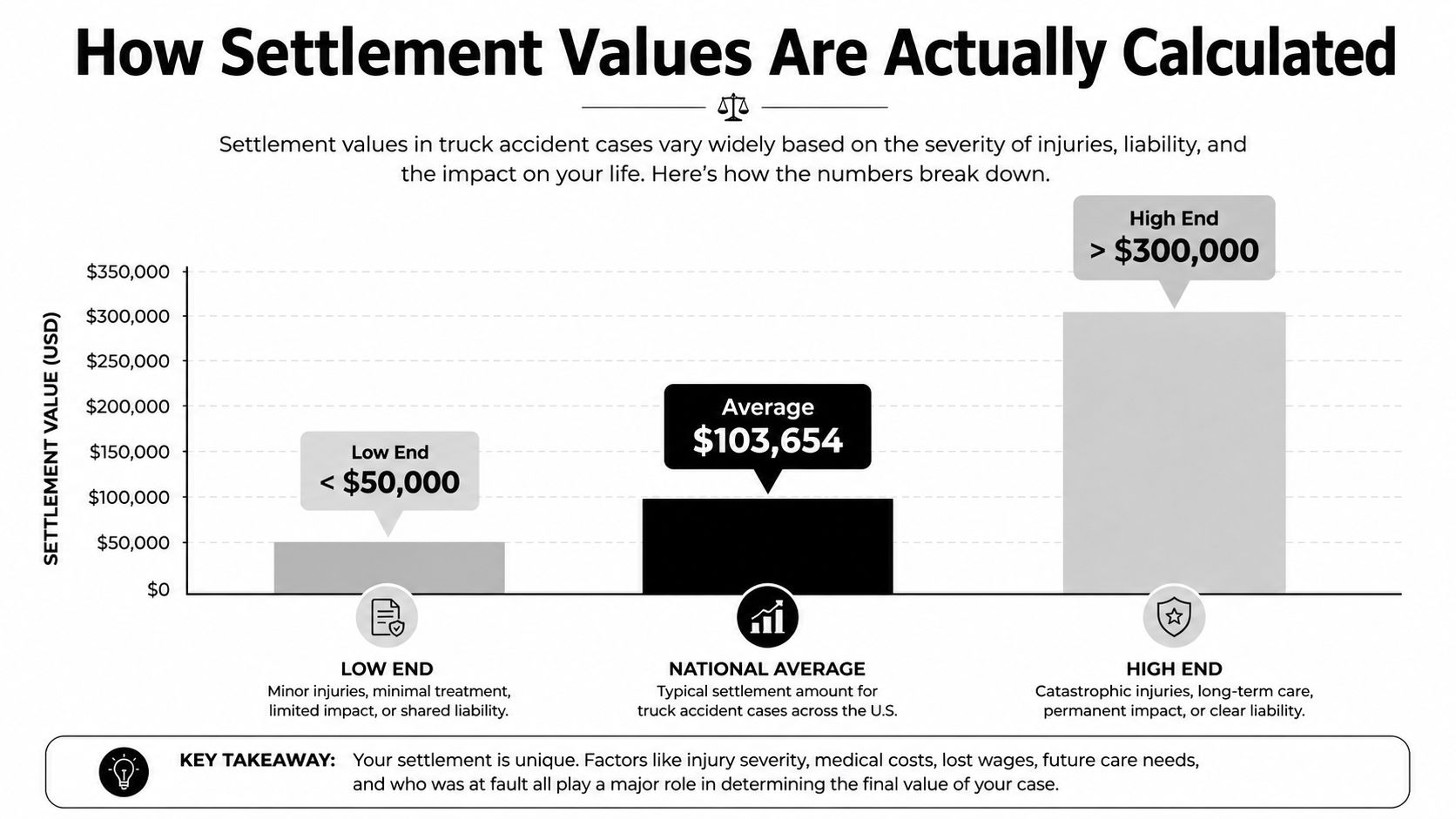
If you want a quick reality check on value, use structure instead of hope. A review of truck-accident settlements discussed in the Wexford Insurance summary found an average near $103,654, but that number only matters as a rough reference because the spread is wide. Minor injuries often sit in the lower range, moderate injuries move higher, and catastrophic injuries can reach the top tier.
A truck accident settlement calculator can help organize that thinking, but it does not set case value. The number depends on injury proof, fault, and whether the trucking evidence survives long enough to use. A case with strong medical records, clean liability facts, and preserved truck data will usually do better than a case built on guesses and missing files.
Trucking-Specific Liability and Evidence
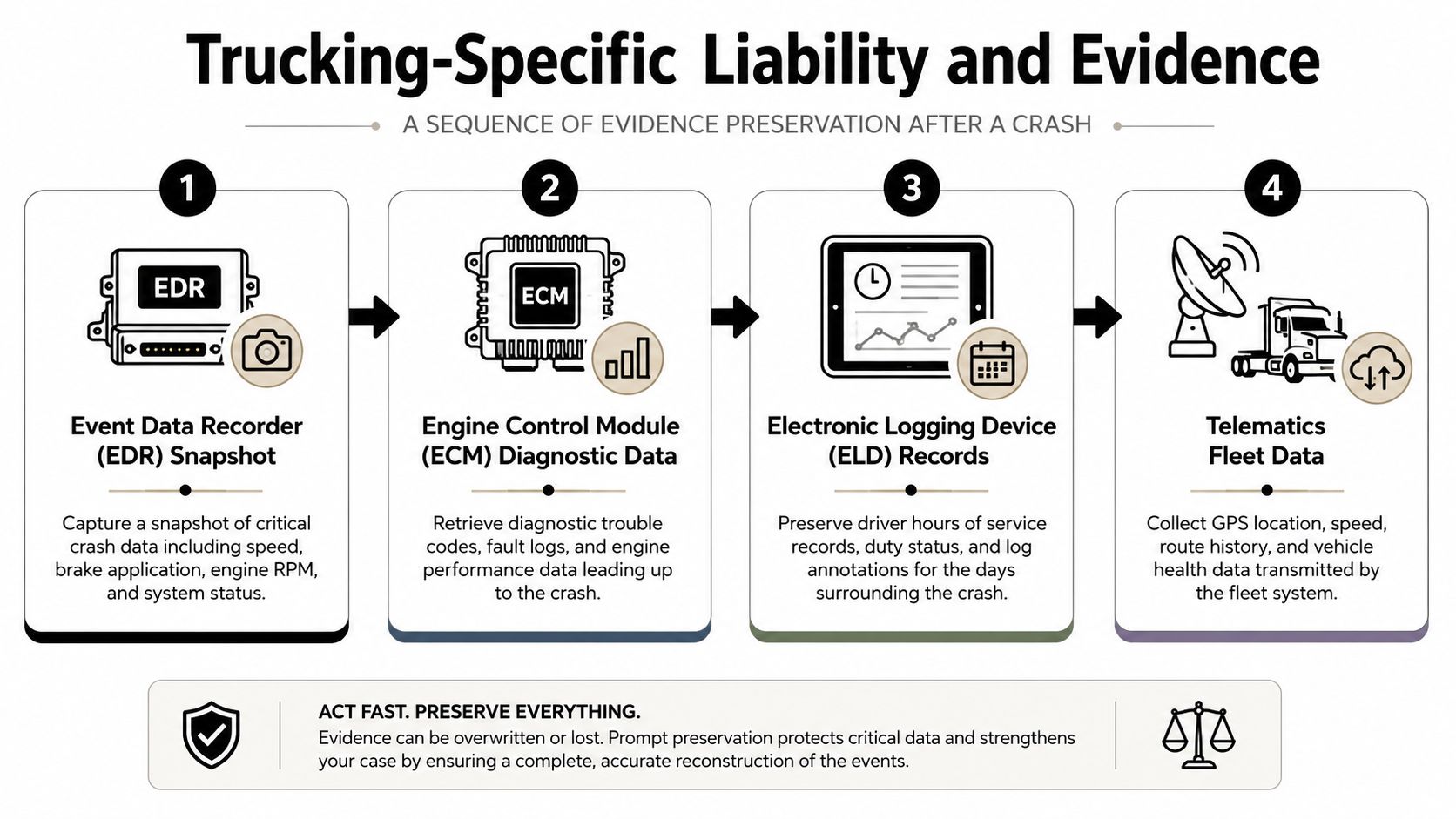
Truck cases turn on machines as much as people. A driver may swear they were slowing down, but the EDR, ECM, ELD, and telematics can show the speed, braking, throttle position, RPM, route, and hours-of-service compliance before the crash. That machine data is usually more persuasive than a witness who saw only part of the collision.
What the data can prove
If the truck was speeding, braking late, or running past legal hours, the digital record can expose it. If the driver gave one story at the scene and the logs tell a different one, the defense has a problem. That's why preservation matters immediately, not after the insurance company has had time to “review” the file.
If the black box and logging data are gone, the case gets harder. The defense knows it.
The practical evidence list should be broad. Keep the truck's DOT number, trailer number, photos of the vehicle positions, witness names, medical records, and every communication with the insurer. If the crash involved a company truck, you also want the maintenance history, driver qualification file, and safety-history records before they disappear into a storage system nobody outside the company can see.
Who else may share fault
The driver is often only one piece of the case. The motor carrier may be on the hook for bad training, poor supervision, or ignored maintenance. A broker or shipper may matter if the load was handled badly or routed unsafely. Even a maintenance contractor can enter the picture if the truck should have been fixed long before the wreck.
A quick VIN check can help identify the vehicle correctly when paperwork is messy. If you need that starting point, the tool to run a VIN on a commercial truck can help match the truck to the records before details get lost.
One more point on defense tactics. If you've been told that the trucking company “doesn't have the file yet,” assume the opposite. Push for preservation now. The earlier the evidence is locked down, the stronger the compensation case gets.
If hours-of-service violations are part of the case, document them early and in writing. A clean starting point is the firm's overview of hours-of-service violation, because fatigue cases usually live or die on logs, timing, and preservation.
Why Compensation Gets Reduced or Lost
The biggest threat to a truck payout usually isn't the size of the policy. It's claim attrition. That means the defense chips away at value through comparative fault, weak records, and missed deadlines until a strong case suddenly looks ordinary.
Colorado makes this especially important because modified comparative fault can bar recovery if you're found 50% or more at fault. That's not theory, that's the kind of rule defense lawyers build their whole playbook around. They'll look for anything they can use, dashcam clips, post-crash drug and alcohol tests, black-box downloads, and cellphone forensics, then argue that you caused enough of the wreck to cut the claim down.
The little mistakes that cost real money
A treatment gap can become an argument that you weren't that hurt. A social-media post can become a line of attack against your pain complaints. A recorded statement can turn into a script the insurer replays when it wants to deny future care.
Hard truth: if the file looks sloppy, the insurer will price it like a sloppy claim.
Documentation is not busywork. It is a tool. If the medical records, photos, wage proof, and scene evidence are clean, the defense has less room to say the injuries are exaggerated or unrelated. If those records are thin, even a severe injury gets discounted.
The other hidden threat is timing. The case can be worth more on paper than in reality if the proof isn't preserved before the legal and evidentiary windows close. That's why claims with solid injuries still lose value. They don't fail on the bruise. They fail on the paperwork.
If a lien issue is already involved, get in front of it before settlement talks stall. A useful reference is the explanation of medical lien on settlement, because lien pressure can eat into a recovery that looked healthy at first glance.
Colorado Deadlines, Fault Rules, and Insurance Limits
Colorado is not the place to guess on timing. For most personal injury and wrongful death claims, the statute of limitations is three years. Claims against certain public entities can carry a two-year deadline. If you miss the calendar, the case can die before compensation is ever negotiated.
The fault rule also matters. Colorado's modified comparative fault system can wipe out recovery if the claimant is 50% or more at fault. That makes early evidence preservation and clean reporting essential. It also means you should not speculate in a recorded statement about speed, distraction, or lane position if you aren't sure.
Insurance coverage is usually bigger than in a passenger-car case
Truck policies are often written at higher limits than ordinary auto policies, sometimes ranging from $750,000 to $5 million depending on the cargo. That doesn't mean the money is easy to get. It means the defense fights harder because the exposure is bigger. Excess and umbrella coverage can extend recovery when the damages outrun the primary policy.
Colorado's no-fault PIP rules can also intersect with a truck case in ways that confuse families, especially when there's more than one insurer involved. Don't let the adjuster tell you the truck carrier is “taking care of it” while your own medical bills sit unpaid. The policies work differently, and one insurer's talking point is not a legal answer.
The bottom line is simple. Know the deadline. Know the fault rule. Know which policy is responsible. If the carrier is offering early money before the injury picture is clear, treat that as a value control move, not a favor.
What Smart Victims Do Right Away
The families who protect compensation do the same boring things fast. They get medical care, they save proof, and they stop talking casually to the trucking insurer. That discipline matters more than people think.
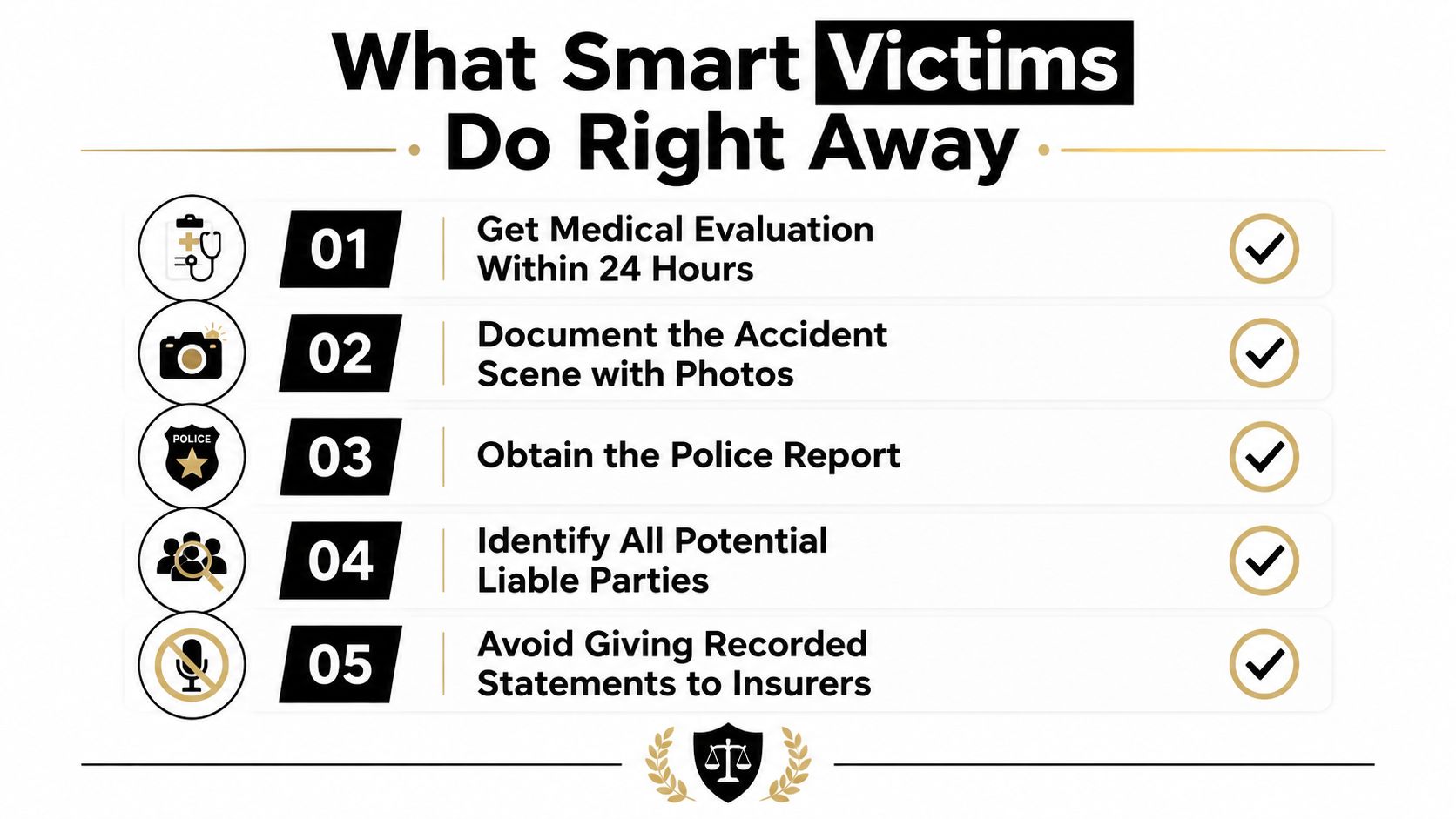
A clean first-week checklist
- Get evaluated within 24 hours. A prompt exam ties the symptoms to the wreck and starts the medical record.
- Document the scene. Save photos, vehicle positions, license plates, DOT numbers, and trailer numbers.
- Get the police report. That report anchors the facts the insurer will try to twist later.
- Identify every potentially liable party. Driver, motor carrier, broker, shipper, and maintenance contractor may all matter.
- Skip recorded statements. The insurer wants words it can use against you, not the full story.
Write down witness names and contact information before they disappear. Forward every photo and video to a safe location so a damaged phone doesn't take your proof with it. Then send preservation demands so the company keeps the ELD, ECM, EDR, maintenance files, and driver-qualification records.
If the crash is hitting you emotionally, don't try to muscle through it alone. Families often need outside support for the trauma side of the wreck as much as the paperwork side. A practical option is trauma counselling in Grande Prairie, especially when sleep, anxiety, or driving fear starts interfering with recovery.
Questions Victims Ask Before They Call a Lawyer
How do truck accident lawyers get paid? Usually on contingency, which means the fee comes out of the recovery if there is one. You shouldn't be paying a big hourly bill while the case is still being built.
How long will this take? A contested truck case can run a long time because evidence, medical treatment, and fault disputes all slow it down. If the insurer is fighting hard, expect the process to take patience, not days.
What if the trucking insurer offers money fast? Be careful. A fast offer is usually a cheap offer, especially before future care and wage loss are understood.
How does a firm decide whether to take the case? The first questions are always the same, who is at fault, what evidence exists, what deadlines apply, and whether the injuries justify the fight.
If you need a team that handles the investigation, evidence preservation, damages analysis, negotiation, and trial work that truck cases demand, talk to Nares Law Group LLC. They handle serious crash claims, including truck wrecks, and they know how much value gets lost when evidence is not locked down early.