Comparative fault reduces your recovery by your percentage of fault, while contributory negligence can bar recovery entirely even at 1% fault. That makes the state where you file potentially more important than the underlying facts, because identical conduct can produce a reduced recovery in one forum and zero recovery in another.
You may be holding a police report, facing medical bills, and getting calls from an insurance adjuster who wants your version of events before you understand what your own conduct could cost. The central question isn't who caused the crash. It's which negligence rule applies, what percentage of fault a jury could assign to you, and whether that percentage crosses a legal cutoff.
A Denver Crash That Changes Depending on Where You File
The collision happens at Colorado Boulevard and 6th Avenue. A driver runs a red light and t-bones your southbound car. Your brake lights had stopped working the previous week, but the other driver never saw them because the light was red and the impact came from the side.
You leave in an ambulance. Later, you receive the police report and begin treatment for your injuries. Then two calls come in.
The first adjuster is handling a Colorado claim. The carrier argues that your defective brake lights contributed to the crash and places 10% of the responsibility on you. Colorado uses a modified comparative-fault framework, so the adjuster values the claim after reducing it by that percentage, assuming the other legal requirements are satisfied. A claim built around a total damage figure of $200,000 would be evaluated at $180,000 before other disputes.
The second call comes from an adjuster applying Virginia law. The same brake-light evidence is used to argue that you bear 1% responsibility. In a contributory-negligence jurisdiction, that small finding can eliminate the claim rather than reduce it.
The practical point: Fault law isn't a footnote after liability. It can determine whether an injury claim produces a recovery check at all.
Whether Colorado is the proper forum depends on the facts, the parties, and jurisdictional rules. Colorado's insurance system and accident rules require careful analysis, as discussed in this overview of whether Colorado is a no-fault state. You shouldn't assume that the location of an adjuster's office decides the governing law.
The lesson is uncomfortable but important. Jurisdiction is a case variable. Before negotiating damages, identify the governing state's negligence rule and preserve evidence that keeps the plaintiff's percentage as low as the facts support.
What Each Negligence Doctrine Actually Means
Contributory negligence is the older all-or-nothing rule. If the injured plaintiff contributed to the harm by any amount, the plaintiff may be barred from recovering damages. Cornell's legal reference identifies Alabama, Maryland, North Carolina, Virginia, and the District of Columbia as jurisdictions that still apply this rule. See the Cornell explanation of comparative negligence.
That rule creates a sharp defense strategy. The defendant doesn't need to prove that the plaintiff caused most of the crash. The defendant needs to persuade the decision-maker that the plaintiff's conduct contributed at all. A disputed lane position, delayed braking, distraction, or failure to use available safety equipment can become a claim-ending issue.
Comparative fault, by contrast, assigns responsibility proportionally. The plaintiff's recovery is reduced by the plaintiff's percentage of fault instead of being eliminated automatically. This approach recognizes that many crashes involve multiple contributing acts and gives the fact finder a method for dividing responsibility.
Pure comparative fault
Under pure comparative fault, the plaintiff can recover a reduced amount even when the plaintiff bears nearly all responsibility. A plaintiff assigned 99% fault may still recover the remaining 1% of damages, with the reduction tied to the assigned percentage. The Maryland legislative reference on negligence systems describes comparative fault as a proportional-damages model.
Modified comparative fault
Modified systems add a threshold. Recovery is available below the applicable bar, but it can disappear once the plaintiff reaches or crosses that threshold. The exact rule is state-specific, so counsel must confirm both the percentage cutoff and how the state treats an exact tie.
California's Supreme Court marked a major historical shift in 1969 in Li v. Yellow Cab Co., rejecting traditional contributory negligence and adopting comparative negligence. The decision also observed that 25 states had already abandoned contributory negligence in favor of allocating fault. The California Supreme Court decision in Li v. Yellow Cab Co. captures that transition.
The result today is a divided national framework. The label alone isn't enough. A lawyer must determine whether the forum uses pure comparative fault, modified comparative fault, or contributory negligence, then identify the precise effect of the plaintiff's assigned percentage.
How Recovery and Damages Differ Under Each Rule
The doctrines change the value of the same injury claim by changing what happens after the jury assigns fault. Economic damages, such as treatment costs and lost income, and non-economic damages, such as pain and loss of enjoyment, are generally subjected to the governing allocation rule in a negligence action. The percentage doesn't merely affect the argument. It affects the amount the plaintiff can collect.
Under contributory negligence, a finding of 1% plaintiff fault can reduce a claim to zero. Defense counsel therefore has a strong reason to contest every detail of the plaintiff's conduct, even when the defendant clearly caused the primary impact. Once the defense develops evidence of any contributing act, the plaintiff's settlement position can deteriorate quickly.
Pure comparative fault produces a different negotiation. A plaintiff assigned 90% fault retains 10% of the damages, assuming the claim otherwise succeeds. That rule removes the automatic claim-ending effect of a small plaintiff mistake, but it can make trials more complicated because jurors must evaluate both liability and the precise allocation of responsibility.
Modified comparative fault creates a cutoff. A plaintiff below the bar receives a reduced award, while a plaintiff at or beyond the bar may receive nothing. The exact treatment of the threshold depends on the jurisdiction, and a single percentage point can become the central issue at mediation or trial.
Recovery outcomes by doctrine
The table uses the verified proportional rule for pure comparative fault and the all-or-nothing rule for contributory negligence. It doesn't assign a specific modified rule to every state, because the threshold and exact-tie treatment must be confirmed under the governing law.
| Doctrine | Plaintiff 10% at Fault | Plaintiff 40% at Fault | Plaintiff 50% at Fault | Plaintiff 60% at Fault |
|---|---|---|---|---|
| Pure comparative fault | Recovers 90% of damages | Recovers 60% | Recovers 50% | Recovers 40% |
| Contributory negligence | Recovers $0 | Recovers $0 | Recovers $0 | Recovers $0 |
| Modified comparative fault | Usually recovers after reduction | Usually recovers after reduction | Depends on the state's threshold and tie rule | May be barred, depending on the state |
Settlement consequence: Under pure comparative fault, the parties negotiate over a percentage reduction. Under contributory negligence, they often negotiate over whether the plaintiff gets anything.
A mediator may therefore press for a global settlement in one case and focus intensely on the likely percentage finding in another. Defense counsel may offer more when the evidence makes a complete bar unlikely, but may hold firm when the plaintiff's conduct could cross a modified threshold. The governing doctrine sets the bargaining range before anyone discusses the final number.
State-by-State Variations and the Colorado Rule
The United States uses three broad approaches. Pure comparative negligence reduces damages by the plaintiff's percentage without an automatic percentage bar. Modified comparative negligence reduces damages until a state-defined threshold is reached. Contributory negligence can eliminate recovery when the plaintiff bears any responsibility.
| Doctrine Type | Recovery Rule | Example States | Key Statute |
|---|---|---|---|
| Pure comparative fault | Recovery is reduced by the plaintiff's percentage of fault, with no complete bar based solely on that percentage | California, New York, Alaska | State-specific comparative-fault law |
| Modified comparative fault with a 50% bar | Recovery is reduced below the threshold and barred at the threshold or under the state's precise rule | Colorado and other jurisdictions | Colorado Revised Statutes § 13-21-111 |
| Modified comparative fault with a 51% bar | Recovery is reduced while the plaintiff remains below the bar, then may be eliminated at the applicable threshold | Wisconsin, Maine, and other jurisdictions | State-specific comparative-fault law |
| Contributory negligence | Any plaintiff fault can bar recovery | Alabama, Maryland, North Carolina, Virginia, District of Columbia | State common law and statutes |
Colorado's framework is codified in C.R.S. § 13-21-111. The jury allocates fault among the relevant parties, and the plaintiff's recovery depends on the assigned percentage and the statute's threshold. The treatment of an exact 50% finding must be addressed directly rather than assumed, because that line can determine whether the judgment is collectible or disappears.
Colorado's middle-ground approach differs sharply from contributory-negligence jurisdictions. In Virginia, Maryland, North Carolina, Alabama, and the District of Columbia, the defense may argue that any plaintiff contribution defeats the claim. In Colorado, the dispute usually centers on proportional responsibility and whether the plaintiff crosses the statutory bar.
Other doctrines can alter the analysis. Assumption of risk, last-clear-chance arguments, and joint-and-several-liability rules may affect how the court evaluates conduct, identifies responsible parties, or collects an award. They aren't interchangeable with comparative fault, and counsel should research each doctrine under the governing state's law.
For Colorado accident victims, a Colorado personal injury law overview can provide useful background, but online information can't resolve a forum dispute. A case filed or litigated under the wrong state's rule may move from a substantial recovery to zero on identical evidence. That possibility makes venue, choice of law, and early fault analysis urgent case issues.
Three Crash Scenarios Side by Side
The following examples show how a fault allocation can produce different outcomes under different systems. They use percentages only to demonstrate the legal mechanics, not to predict what a jury would decide.
Rear-end collision on I-25
The lead driver brakes abruptly without an apparent reason. The following driver looks down to check a GPS and strikes the lead vehicle. Assume the injured following driver is assigned 40% fault.
Under Colorado's 50% bar framework, the claim remains available after a proportional reduction. In a pure comparative state such as California, the plaintiff also recovers the damages attributable to the remaining responsibility. Under a 51% bar system such as Wisconsin's, the plaintiff remains below the bar and can recover after reduction. In Virginia's contributory system, the same 40% finding bars recovery.
Left turn from Colorado Boulevard
A driver turns left across oncoming traffic. The oncoming vehicle is traveling 10 miles per hour over the speed limit. Assume the turning driver is assigned 60% fault, while the speeding driver is assigned 40%.
Colorado's 50% bar can eliminate the turning driver's recovery at that allocation. California's pure comparative system preserves the portion attributable to the other driver's responsibility. Wisconsin's 51% bar also bars the claim if the plaintiff's assigned percentage reaches the state's threshold. Virginia's contributory rule produces the same zero-recovery result, but it would do so with any plaintiff contribution.
Multi-vehicle truck wreck on I-70
A truck changes lanes, a second vehicle follows too closely, and a third vehicle fails to stop after the first impact. Assume the injured plaintiff is assigned 20% fault, with the remaining responsibility divided among the other drivers.
Colorado, California, and Wisconsin each permit recovery under these assumed percentages, subject to their respective allocation rules. Virginia's contributory rule bars recovery because the plaintiff bears some responsibility.
| Scenario and Fault Split | Colorado, 50% Bar | Pure Comparative State | Pure Contributory State |
|---|---|---|---|
| I-25 rear-end, plaintiff 40% at fault | Reduced recovery, assuming the claim remains below the bar | Recovers 60% of damages | $0 |
| Left turn, plaintiff 60% at fault | May be barred under the 50% rule | Recovers 40% of damages | $0 |
| I-70 truck wreck, plaintiff 20% at fault | Recovers after a 20% reduction | Recovers 80% of damages | $0 |
The same photographs, witness accounts, vehicle data, and medical records can therefore lead to four different financial outcomes. Small shifts near a modified threshold carry major negotiation value, especially when the damages are substantial. A lawyer who waits until trial to address the percentage has waited too long.
Settlement Leverage and Trial Strategy by Doctrine
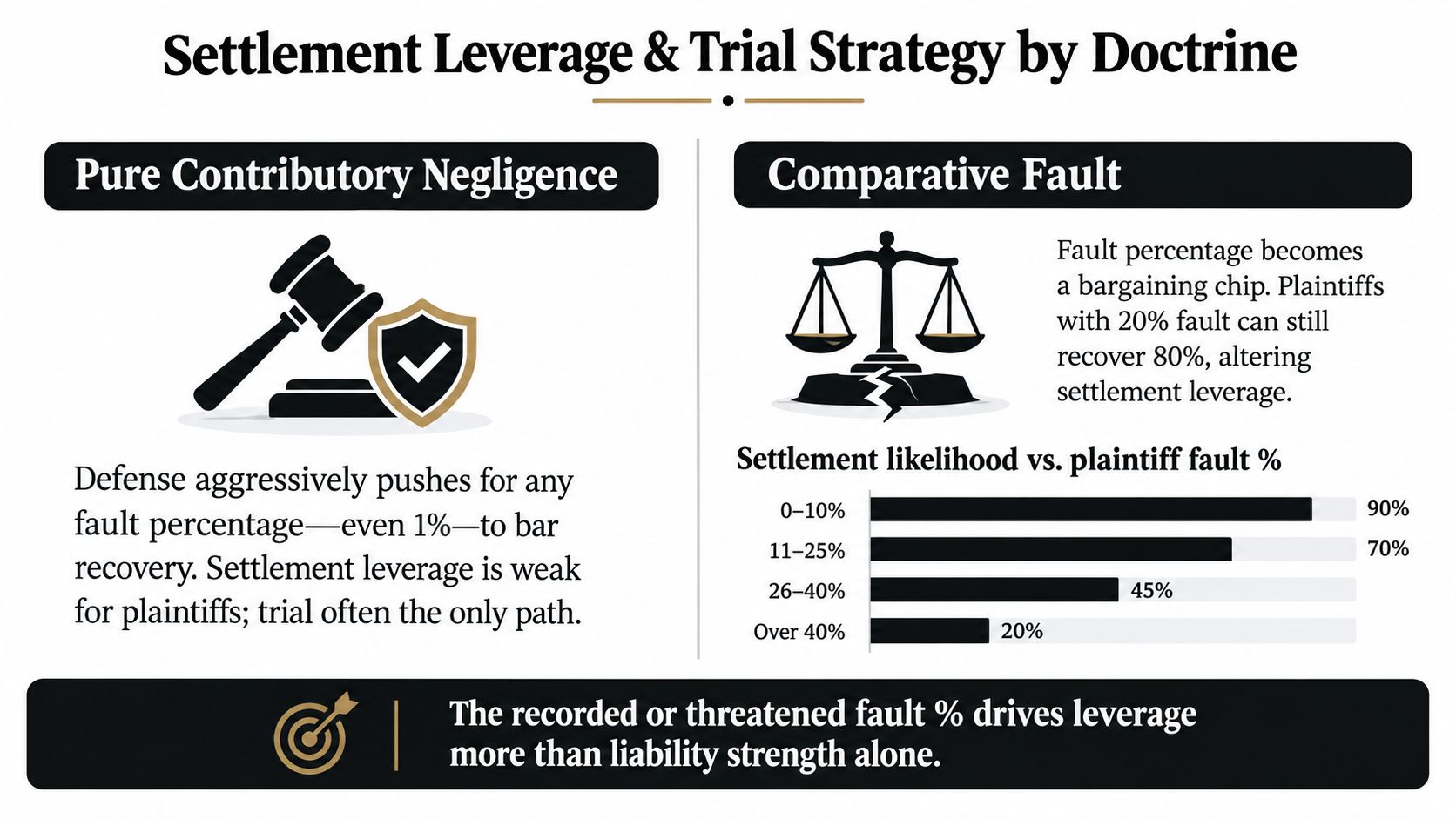
Settlement dynamics follow the threatened fault percentage more closely than many injured people expect. A strong liability case may still attract a poor offer if the insurer believes it can persuade a jury that the plaintiff contributed to the harm.
In a contributory-negligence jurisdiction, defense counsel may invest heavily in proving even slight plaintiff fault. The defense doesn't need to win the entire causation story. It needs a factual path to a complete bar. That posture can make early offers weak and can force plaintiff's counsel to prepare for trial when a percentage dispute would otherwise support compromise.
In a modified comparative jurisdiction, the defense has a different target. Counsel may try to move the plaintiff above the applicable threshold, while plaintiff's counsel builds the record to stay below it. Witness impeachment, vehicle inspections, phone evidence, scene measurements, and accident-reconstruction testimony can all matter because the case may turn on a narrow percentage range.
Pure comparative fault creates a more graduated bargaining process. Both sides can accept that a jury might assign some responsibility to the plaintiff and still calculate a settlement around the remaining damages. That doesn't make litigation simple. It makes percentage allocation, rather than claim survival, the dominant bargaining issue.
Jury instructions and special interrogatories should require clear findings on each party's conduct and percentage. In Colorado, a mediator may test whether the plaintiff will accept a settlement that reflects a borderline allocation, while defense counsel may insist that uncertainty justifies a discount.
For readers evaluating mediation resources outside Colorado, information about Los Angeles for injury lawsuits can help explain how mediation fits into a broader injury strategy. The right settlement demand should also present the facts, damages, and fault analysis in a disciplined format. A properly prepared settlement demand letter gives the insurer a clear reason to value the claim above a bare medical-bill submission.
Practical Steps for Injured Parties and Referring Attorneys
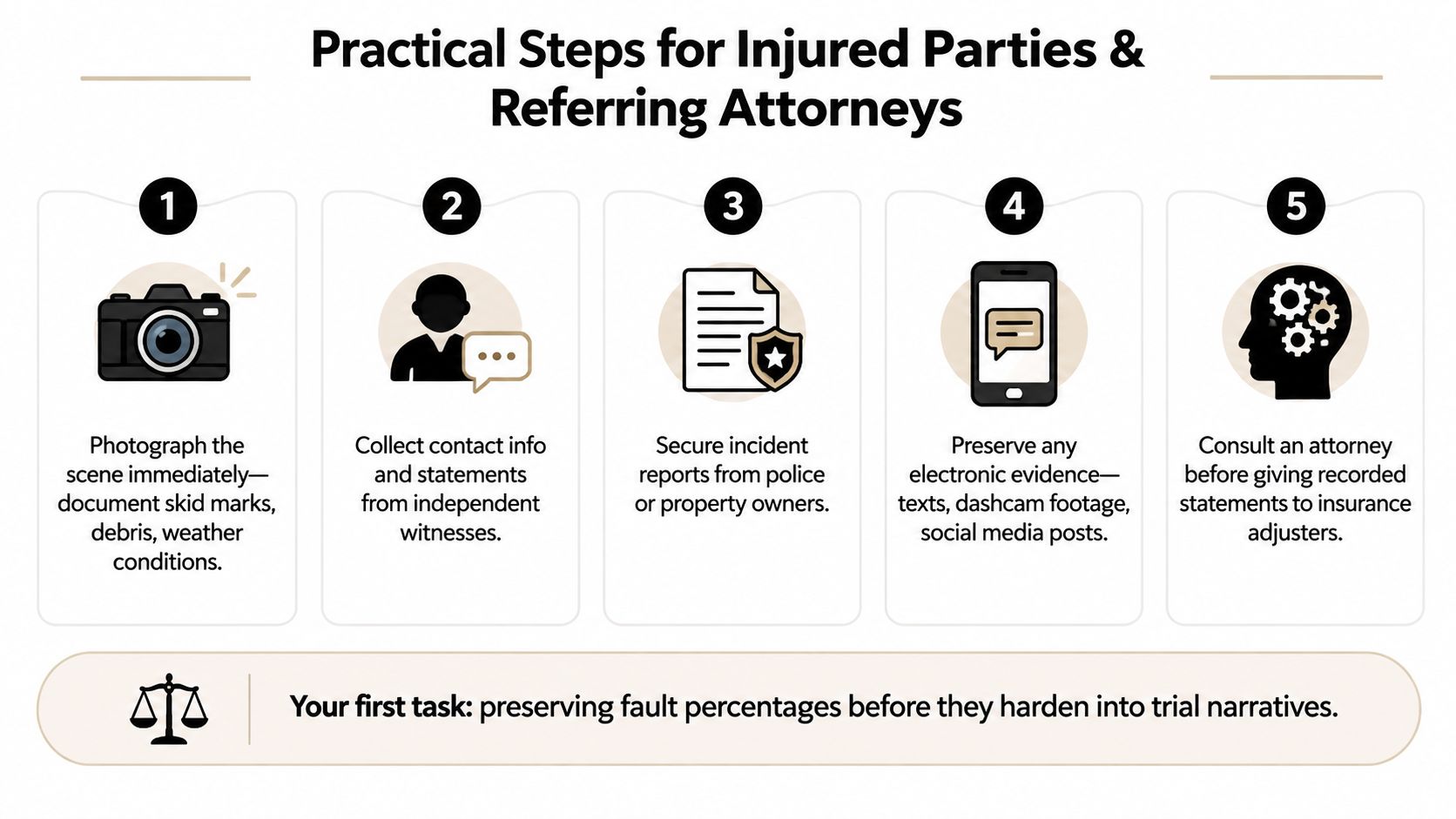
Fault percentages harden early. The first police narrative, the first recorded statement, and the first photographs can shape the case long before anyone selects a jury.
If you're injured, preserve the scene and your treatment history. Photograph vehicle positions, visible damage, roadway conditions, signals, debris, and any nearby businesses that may have video. Request the police report, identify witnesses, and keep medical appointments consistent with your providers' instructions.
Don't give the other insurer a recorded statement before getting legal advice. Adjusters may ask questions that appear routine but later become arguments about attention, speed, braking, protective equipment, or the timing of your symptoms. Write down your own account while events remain fresh, but don't speculate about facts you don't know.
For referring attorneys, make venue and choice-of-law analysis an opening task. Retain an accident-reconstruction expert when speed, visibility, braking, vehicle systems, or multi-party sequencing matters. Preserve dashcam footage, phone records, surveillance, event-data information, and maintenance records before ordinary retention practices erase them.
First-week checklist
- Photograph the evidence: Capture the roadway, vehicles, lighting, weather, traffic controls, skid marks, and debris.
- Identify witnesses: Save names, phone numbers, and the exact location of anyone who saw the impact or its lead-up.
- Request reports promptly: Obtain police, incident, property-owner, and employer records that may contain an early fault narrative.
- Preserve electronic material: Secure dashcam files, texts, relevant posts, surveillance leads, and vehicle data.
- Protect your statements: Speak with counsel before recorded insurer interviews or detailed written submissions.
A referring lawyer should also identify every potentially responsible party and examine whether the governing law permits claims against multiple defendants under the particular facts. Evidence quality matters more than slogans about who had the right of way. The objective is concrete: prevent the defense from turning an uncertain fact into an inflated plaintiff-fault percentage.
Choosing the Right Path and Common Questions Answered
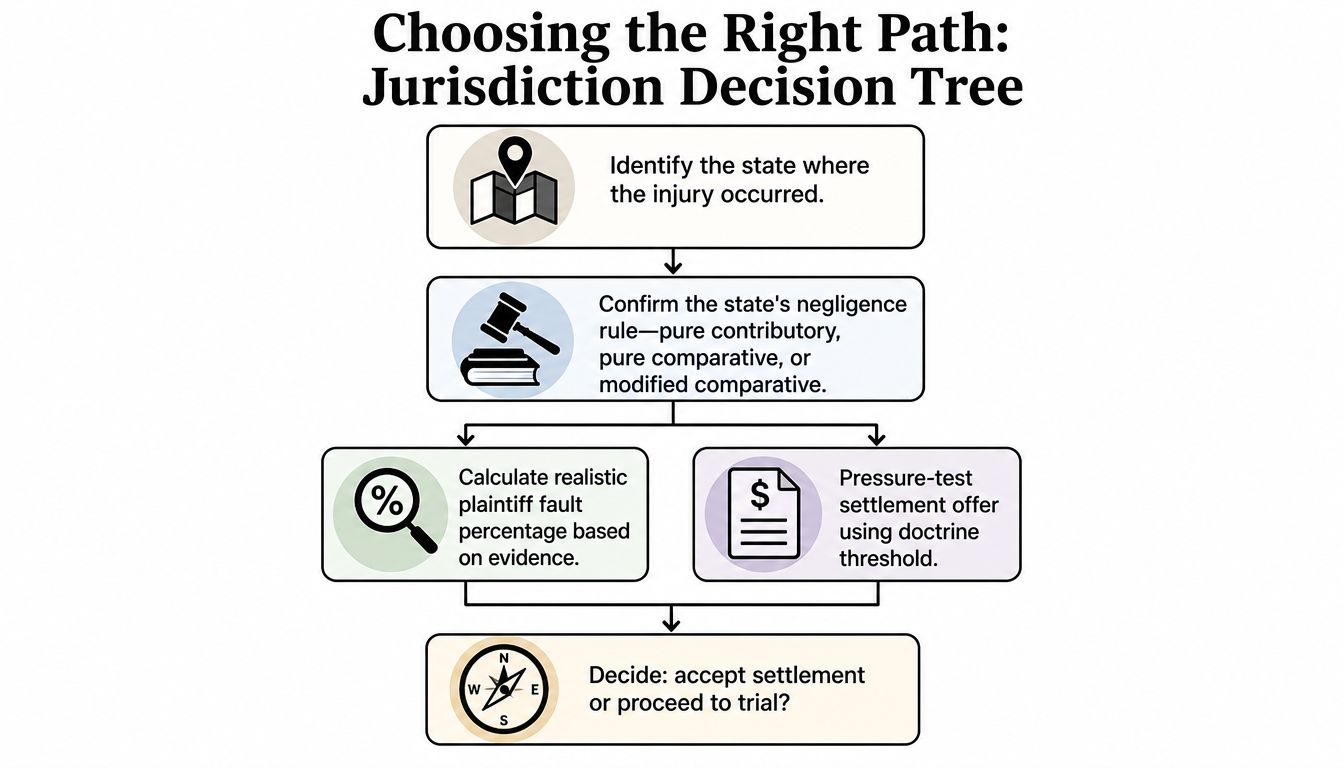
Use a jurisdiction-first decision process:
- Identify where the injury occurred and which court has authority.
- Confirm the applicable negligence rule and threshold.
- Estimate the plaintiff's realistic fault percentage from available evidence.
- Test the settlement offer against the reduction or bar.
- Decide whether the evidence supports mediation, continued negotiation, or trial.
Does insurance follow the forum or the policy? Neither answer is automatic. The policy, accident location, parties, and choice-of-law rules can all matter. Have counsel analyze the governing law before accepting the insurer's position.
How does joint and several liability interact with comparative fault? It can affect collection among multiple defendants, but it doesn't replace the jurisdiction's fault-allocation rule. The court must apply the relevant statute and case law to the specific claim.
What happens if a case moves to federal court? A federal court may apply state substantive negligence law in a diversity case, but removal doesn't let a party choose a more favorable negligence rule by preference.
Are minors or workplace incidents treated differently? They may be. Capacity, tolling, workers' compensation exclusivity, third-party claims, and special statutory rules require separate analysis.
Don't give a recorded statement until a local personal injury lawyer reviews the forum, the likely percentage, and the evidence gaps. Those three issues often set the ceiling on recovery before the damages presentation begins.
Nares Law Group LLC evaluates comparative-fault disputes, investigates motor vehicle and truck crashes, coordinates case development, and handles negotiation or trial strategy for injured families. Visit Nares Law Group LLC to discuss how the governing jurisdiction and your potential fault percentage may affect your claim.