You're standing beside a damaged vehicle, trying to keep your hands from shaking while an insurance representative asks whether you're filing under collision coverage or liability coverage. You may know the other driver caused the crash, but that doesn't automatically tell you which insurer pays first, whether you must pay a deductible, or how quickly you'll get your money back.
That confusion is common, especially when medical bills, missed work, towing charges, and repair estimates arrive at the same time. This collision vs liability insurance guide explains the difference in practical terms for Colorado drivers, including what happens when the other motorist has little insurance, no insurance, or can't reimburse your deductible.
| Criteria | Collision Insurance | Liability Insurance |
|---|---|---|
| Protects | Your insured vehicle | Other people and their property |
| Coverage type | First-party property coverage | Third-party coverage |
| Typical trigger | Damage to your vehicle after impact or rollover | Injuries or property damage you cause |
| Fault requirement | Generally applies regardless of fault, subject to policy terms | Applies when you're legally responsible |
| Deductible | Usually applies | No deductible for repairing your own vehicle |
| Payment limit | Generally your vehicle's actual cash value, minus deductible | Selected bodily injury and property damage limits |
| Common gap | You pay first and may need to recover the deductible later | Limits may be insufficient for serious injuries or multiple claimants |
Why This Distinction Matters Right After a Crash
The tow truck driver has taken your car, but the repair shop won't start work until someone approves the estimate. Meanwhile, the other driver's insurer says its investigation is still open. You call your own carrier expecting liability coverage to fix your vehicle, only to learn that your liability policy protects the people you hurt, not your car.
That moment can feel like a denial, even when the policy is working exactly as written. If you caused the crash, your liability coverage may respond to the other driver's injuries and property damage, while your own vehicle may be repaired only through collision coverage. If the other driver caused the crash, you may pursue that driver's liability insurer, use your collision coverage first, or examine uninsured or underinsured motorist options under your policy.
The financial problem behind the vocabulary
A crash creates several separate losses. Vehicle damage is one category. Bodily injury, medical treatment, lost income, and harm affecting daily life are different categories, often handled through different coverage and claim pathways.
That separation matters in Colorado because a driver can have a valid claim for vehicle damage while the insurer disputes fault, questions the extent of an injury, or limits payment based on the available policy. A property-damage claim may move on a different track from a bodily-injury claim, and accepting a vehicle payment doesn't necessarily resolve every injury issue.
Practical rule: Ask three questions immediately. Whose vehicle is damaged, who caused the crash, and which coverage can pay without waiting for the fault investigation to finish?
What this guide helps you decide
Before a crash, the issue is whether collision protection is worth the premium and deductible for your vehicle. After a crash, the issue becomes more urgent: should you use your own policy, pursue the other driver, or preserve both options while the facts develop?
This isn't legal advice for a specific collision. It's a framework for understanding the insurance language, documenting what happened, and recognizing when delayed reimbursement or disputed liability may require professional help.
What Each Coverage Actually Protects
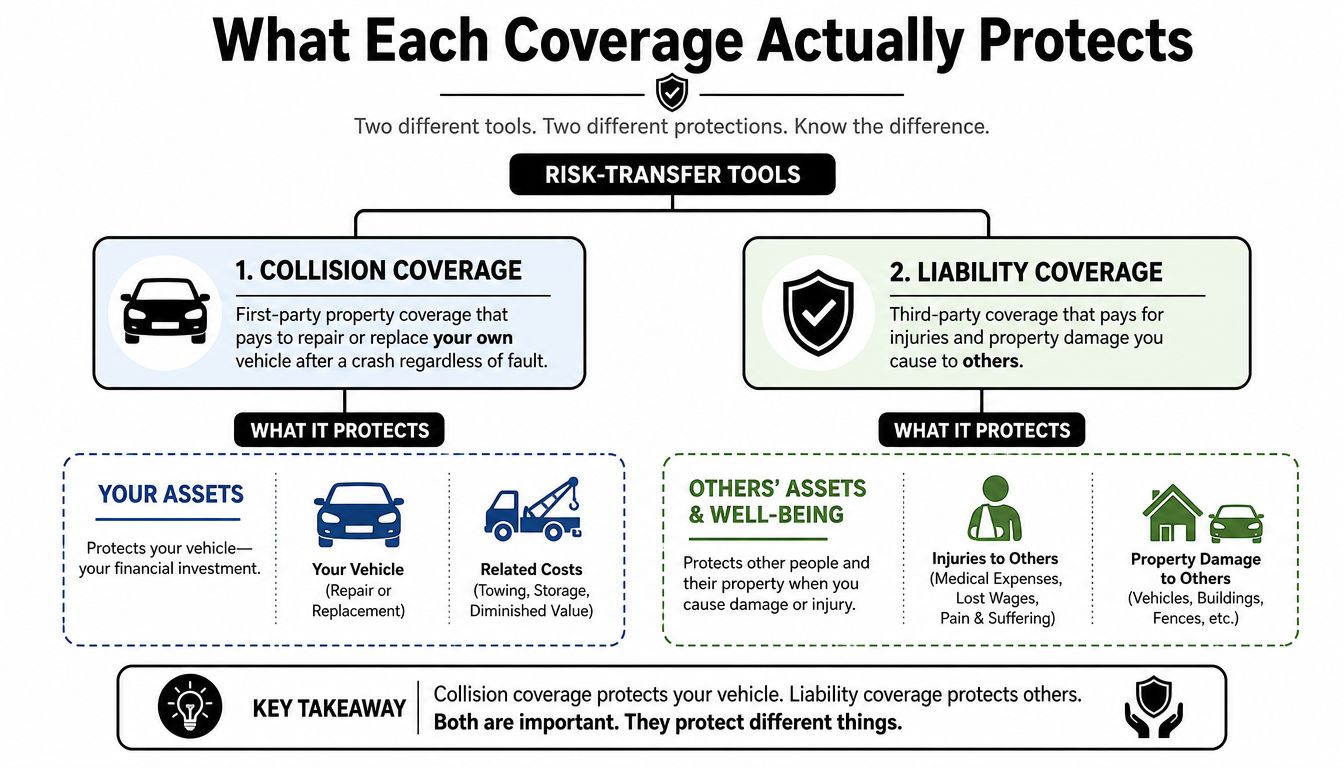
Collision insurance is first-party property coverage. It generally pays to repair or replace your own vehicle after it collides with another vehicle or object, and it can apply to a single-vehicle rollover or overturn. The policy typically limits payment to the vehicle's actual cash value, which reflects depreciation, and then subtracts your chosen deductible. Colorado vehicle coverage guidance from Nares Law Group explains the practical distinction between coverage for your vehicle and property-damage liability for someone else's property.
Collision coverage doesn't depend on the other driver having enough insurance before your insurer can evaluate your vehicle claim. You still must comply with the policy, provide information, and pay the deductible, but your carrier can often move the repair process forward while fault remains under review.
Liability insurance is third-party protection. It pays for bodily injury and property damage you cause to other people, subject to the limits in your policy. It generally doesn't pay to repair your own vehicle, and it isn't a substitute for collision coverage.
Keep the two promises separate
Think of the coverages as two different promises:
Collision coverage protects the vehicle listed on your policy. Liability coverage protects you from covered claims brought by people you injure or whose property you damage.
If you back into another vehicle, liability coverage may address that other vehicle's damage. It won't normally repair your bumper. If another driver strikes you, that driver's liability coverage may address your losses if responsibility and available limits are established, while your collision coverage can provide a separate route for your vehicle.
This distinction also appears in commercial insurance. Businesses comparing personal auto policies with insurance rules for trucking fleets need to separate coverage for a commercial vehicle from liability protection for injuries and property damage affecting others. The labels change with the policy, but the risk-transfer question remains the same: whose loss is being insured?
For a visual explanation, the video below can reinforce the basic coverage boundaries.
Collision vs Liability Insurance Side by Side
The clearest difference is the person or asset the policy protects. Collision follows your vehicle. Liability follows your legal responsibility for harm to someone else.
The coverages also respond to different cost pressures. Collision losses rise when vehicles cost more to repair or replace. Liability losses rise when injuries, medical treatment, wage loss, legal exposure, and third-party property damage become more severe.
Collision vs Liability at a Glance
| Criteria | Collision Insurance | Liability Insurance |
|---|---|---|
| Protected party | The policyholder's vehicle | People and property harmed by the insured driver |
| Loss type | Damage to the insured vehicle | Bodily injury and property damage caused to others |
| Fault | May pay for the insured vehicle regardless of fault, subject to policy terms | Usually depends on the insured driver's responsibility |
| Deductible | Applies to the covered vehicle loss | No deductible for the injured third party's vehicle repair under the liability claim |
| Maximum payment | Usually actual cash value, less depreciation and deductible | Split bodily-injury and property-damage limits |
| If the other driver is uninsured | Collision may provide a path for vehicle damage; UM or UMPD may also matter where available | Your own liability policy doesn't repair your vehicle |
| Main exposure | Repair estimate, total loss, depreciation, and deductible | Medical expenses, lost wages, multiple claimants, and amounts above limits |
The National Association of Insurance Commissioners reported that average incurred loss per collision claim rose from $5,185 in 2020 to more than $6,150 in 2021, an 18.6% increase, and then from $6,113 in 2021 to $7,191 in 2022, a 17.6% increase. The figures appear in the NAIC auto insurance database report. The overlapping year figures reflect the report's separate comparisons, so they shouldn't be treated as one simple sequence without reviewing the source methodology.
Liability exposure operates on a much larger market scale. The same NAIC report recorded $120.5 billion in national liability incurred losses in 2022, up 9.4% from 2021. Collision costs reflect vehicle repair economics, while liability costs reflect what injured people and property owners are owed after a crash.
The Highway Loss Data Institute also reported that collision claim severity rose 22% between 2011 and 2015, and collision overall losses were 36% higher in 2015 than in 2010. Its collision loss trends summary shows why a liability-only strategy can leave a driver exposed to a costly vehicle loss.
For another plain-language comparison of liability and collision coverage, review these expert insurance tips from PTL Insurance. The important decision isn't which coverage sounds broader. It's whether you can absorb the specific loss that the coverage leaves with you.
How Deductibles Limits and Payouts Work in Practice
Policy math becomes easier when you separate deductibles, actual cash value, and liability limits.
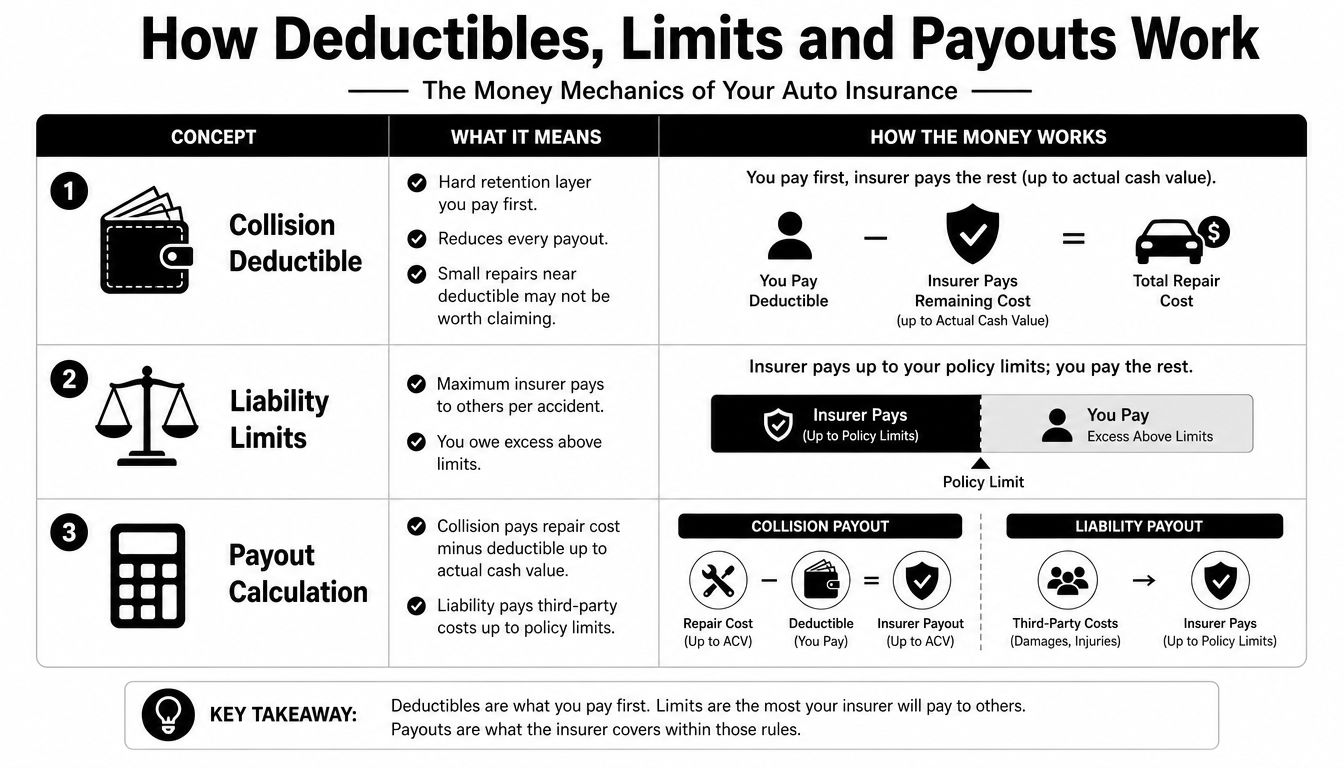
A collision deductible is the portion of your own covered vehicle loss you retain. The deductible is commonly between $100 and $1,000, according to consumer guidance on collision and liability coverage. If covered repairs cost $4,000 and your deductible is $500, the insurer's starting payment calculation is generally the covered loss less that deductible, subject to the policy and approved estimate.
That doesn't mean every repair should be reported under collision. A repair estimate close to the deductible may produce little insurance benefit while still creating claim-handling work. Check the policy and discuss the estimate with the carrier before deciding how to proceed.
Actual cash value changes the result
If the insurer declares the vehicle a total loss, collision coverage generally doesn't pay whatever it would cost to buy a newer replacement. It generally pays the vehicle's actual cash value, reduced for depreciation, and then subtracts the deductible.
A vehicle could therefore be unsafe or uneconomical to repair even though its market value is lower than the repair estimate. The dispute may then concern valuation, comparable vehicles, condition, prior damage, taxes, fees, or policy language. Collision coverage gives you a payment pathway, but it doesn't erase depreciation.
Liability limits work differently
Liability policies commonly use split-limit formats such as 25/50/20 or 30/60/15. The first number generally represents bodily-injury coverage per person, the second represents bodily-injury coverage per accident, and the third represents property-damage coverage per accident. The California Department of Insurance explanation of auto liability limits illustrates this structure and notes California's increase in minimum bodily-injury liability from 15/30 to 30/60.
Consider a 25/50/20 policy. It may cap bodily-injury payment for one person at 25 units of the policy's currency, bodily-injury payment for everyone injured in the accident at 50 units, and property damage at 20 units. Those figures describe limits, not guaranteed payments, and the actual currency amount depends on the policy.
Liability coverage has no deductible for repairing your own vehicle because it isn't a first-party repair benefit. But the insured driver may remain personally exposed when covered damages exceed available limits. For an injured Colorado driver, identifying the policy limits early can influence medical-bill planning and the decision to investigate additional coverage.
More detail on reading these numbers is available in this explanation of insurance policy limits.
Real World Scenarios That Show Which Coverage Applies
Insurance rules make more sense when tied to the moment a driver has to choose a path. The same damaged vehicle can produce different payment timing depending on fault, policy language, and whether the responsible driver can pay.
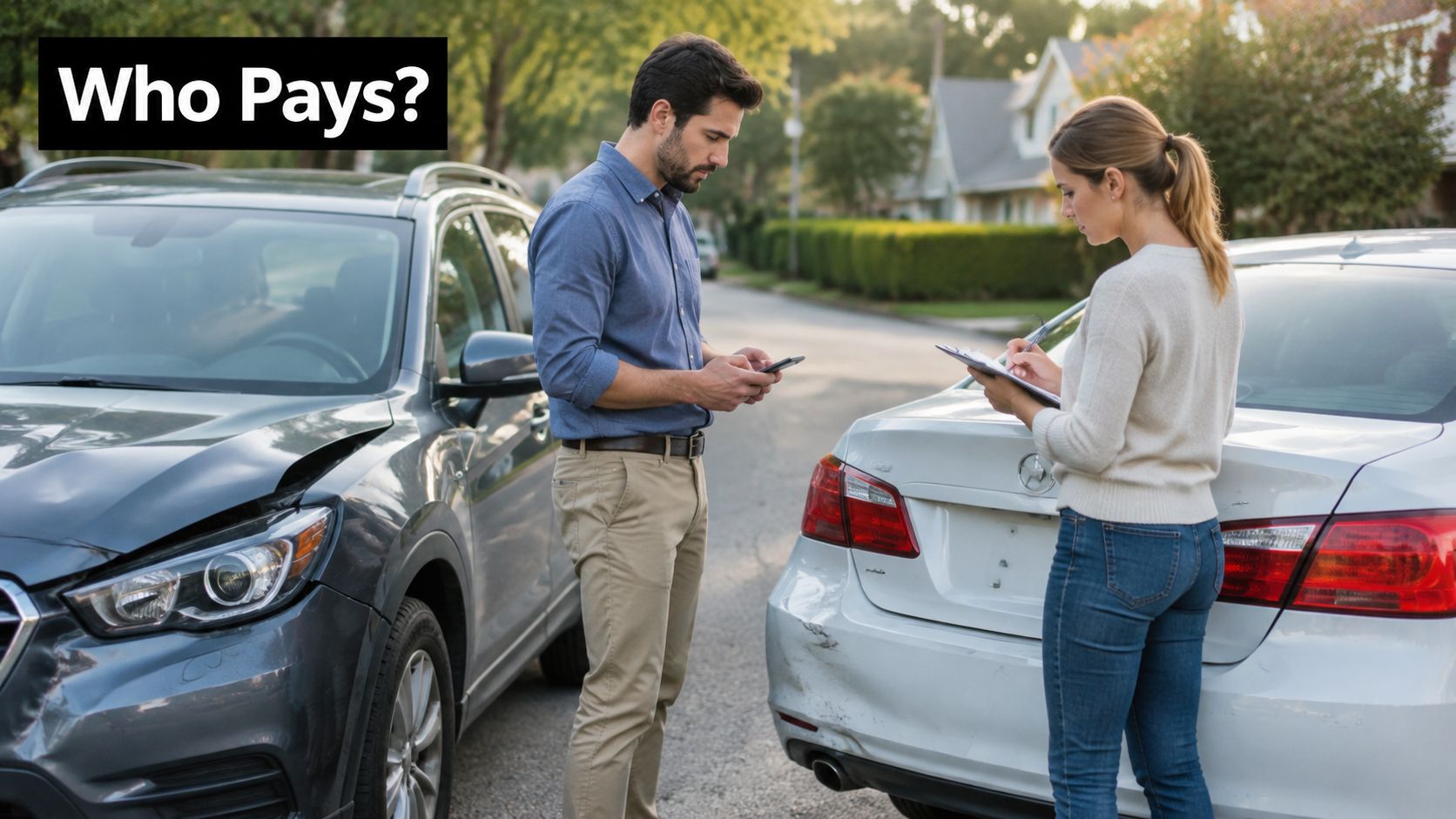
You cause the crash
You misjudge a turn and strike another car. Your liability coverage may address the other driver's bodily injury and property damage, within your limits. Your own vehicle is a separate question. Without collision coverage, you generally bear the repair or replacement cost yourself.
With collision coverage, your carrier can evaluate your vehicle claim, authorize covered repairs, and subtract your deductible from the payment. You still may have to pay that deductible before or during the repair process.
Another driver causes the crash
A driver runs a red light and damages your vehicle. You can pursue the at-fault driver's liability insurer, but that route may depend on an investigation, cooperation, available limits, and agreement about responsibility.
If you use your own collision coverage instead, the insurer may handle the vehicle claim under your policy, subject to the deductible. Your carrier can then pursue reimbursement through subrogation. If it recovers from the at-fault side, it may also seek recovery of your deductible, but that recovery isn't guaranteed or immediate.
A single-vehicle rollover occurs
You leave the road and the vehicle overturns without striking another car. Collision coverage can apply because it generally includes single-vehicle rollovers or overturns, subject to the policy terms and deductible.
Liability coverage doesn't pay for your own rollover damage. It becomes relevant only if your driving caused covered injury or property damage to someone else.
The at-fault driver has no usable coverage
A hit-and-run driver or uninsured motorist damages your vehicle. Your own liability coverage doesn't fix your car. Collision coverage may provide a first-party vehicle-damage route, while uninsured motorist property-damage coverage, where included and applicable, may offer another pathway.
The practical gap is timing. You may need to pay the collision deductible while your insurer investigates recovery. If the responsible driver is uninsured, insolvent, or otherwise uncollectible, subrogation may not return that money. That's why checking collision, uninsured motorist, and underinsured motorist provisions before a crash matters.
How Insurers Handle Claims and What Colorado Drivers Should Expect
A claim usually moves through several decisions, and each decision can affect when money becomes available.
- Report the crash. Notify your insurer promptly, provide the location and contact information, describe the damage, and preserve photographs, video, witness details, and medical records.
- Inspect the vehicle. An adjuster or appraiser reviews the damage and develops a repair estimate. The shop may identify additional damage after disassembly.
- Assess responsibility. Insurers review statements, photographs, police materials, traffic controls, vehicle positions, and other evidence. They may assign fault differently from the drivers' expectations.
- Authorize repairs or evaluate a total loss. If you use collision coverage, the deductible remains your responsibility under the policy. The insurer calculates payment according to covered damage, actual cash value, and policy terms.
- Pursue subrogation. Your insurer may seek reimbursement from the at-fault driver's liability carrier. If recovery succeeds, the carrier may return some or all of the deductible, depending on the recovery and applicable rules.
Why reimbursement can take time
Subrogation is not an instant refund. The other insurer may dispute fault, question the amount of damage, identify shared responsibility, or report insufficient coverage. If the at-fault driver has no insurance or no collectible assets, your insurer may have no practical source from which to recover the deductible.
Recent consumer guidance described collision damage claims as more likely to resolve than liability and medical claims, while also reporting that one in four collision claims closed without payment. It also reported that insurers refused to pay 45% of liability and medical claims last year. Those figures come from the deductible recovery discussion for not-at-fault crashes, and they reinforce why a claim closure or payment decision deserves careful review.
Colorado drivers should keep vehicle damage documentation separate from injury documentation. A repair settlement may address the car while medical treatment continues. Don't sign a release that may affect bodily-injury rights without understanding what it covers.
For a broader overview of the claim journey, consult this guide to securing a fair car accident insurance claim. If an insurer's investigator contacts you about statements, recorded interviews, or medical authorization, review the implications before providing more information, as discussed in this insurance company investigation resource.
Choosing the Right Protection and When to Get Legal Guidance
The right coverage depends on the loss you can withstand, not on a slogan such as “full coverage” or “liability only.” Collision deserves careful consideration when your vehicle is newer, costly to repair, financed or leased, or essential to your work and family responsibilities. Rising repair complexity and total-loss pressure can make a vehicle difficult to replace even after a seemingly moderate crash, as described in CCC's 2026 Crash Course report.
Liability-only coverage may be a deliberate choice for someone who owns a lower-value vehicle outright and can absorb a repair or replacement loss. It isn't a way to protect your own car after an at-fault crash, and it may leave you dependent on the other driver's policy after a not-at-fault collision.
Before changing coverage, check:
- Your vehicle's value: Compare likely actual cash value with the cost of repairs and the deductible.
- Your cash reserve: Ask whether you can pay the deductible and remain mobile while subrogation proceeds.
- Your policy limits: Confirm bodily-injury and property-damage limits, not just the premium.
- Uninsured protection: Review UM and UMPD provisions and their treatment of vehicle damage and injuries.
- Your legal position: Preserve evidence if fault, injury severity, or available insurance is disputed.
Consider speaking with a Colorado personal injury attorney when injuries are serious, fault is contested, the at-fault driver appears underinsured, medical bills are mounting, income is interrupted, or an insurer pressures you to settle quickly. Nares Law Group LLC handles crash investigations, medical-treatment coordination, negotiations, trials, and settlement work for injured people and families.
If you're dealing with disputed fault, unpaid medical bills, a difficult insurer, or uncertainty about collision and liability coverage, Nares Law Group LLC can review the insurance pathways and help protect your financial recovery. Visit the firm to request a consultation and bring your policy, crash report, photographs, repair estimates, and medical records if available.