A mother is driving through Aurora with her two children when another vehicle runs a red light and strikes the family's car. The other driver speeds away. Police investigate, but no license plate is recovered, and there's no liability insurer to call.
That family may still have a path to compensation through its own uninsured motorist, or UM, coverage. If the injuries are serious, however, one vehicle's limit may not cover the medical care, lost income, and long-term effects. The next question becomes: can the family combine UM or underinsured motorist, or UIM, limits from multiple household vehicles or policies?
In Colorado, the answer may be yes, but it never depends on the number of cars alone. State law, policy language, named-insured status, household relationships, endorsements, and signed elections can all change the recovery available. This guide explains how uninsured motorist stacking works, where Colorado fits, and what to look for before an insurer reduces the claim to a single limit.
When the At-Fault Driver Disappears and Your Own Policy Becomes Everything
In an ordinary crash, the injured family starts with the at-fault driver's bodily injury liability insurance. That insurer investigates the collision and pays covered damages up to the driver's policy limits. In a hit-and-run, that recovery source may disappear entirely.
The Aurora mother still has the same injuries, treatment needs, and lost time from work. But the driver who caused the collision cannot be identified, so there may be no liability carrier and no policy limit available from that vehicle. Her own UM coverage becomes the practical substitute for the missing liability insurance.
Colorado's required auto insurance limits are commonly described as 25/50/15, meaning bodily injury and property damage limits are divided by person, accident, and property damage. Those minimum limits can be inadequate after a serious collision, even when the responsible driver is found. A major injury can involve continuing treatment, reduced earning capacity, and pain that extends well beyond the first hospital visit.
The family's policy may hold the missing recovery
UM coverage is designed for injuries caused by a driver who has no insurance or cannot be identified. UIM coverage addresses a related but different problem. It can apply when the at-fault driver has insurance, but that insurance is insufficient for the injured person's covered losses.
The family's declarations page may list UM or UIM coverage for more than one vehicle. That creates the possibility of stacking. If the policy permits it, the available limits may be combined rather than treating one vehicle's limit as the absolute ceiling.
The practical question is not simply whether the other driver had insurance. It's whether the injured person can access every UM or UIM limit purchased by the household.
An insurer may ask for a recorded statement, medical records, wage information, and details about the hit-and-run. Before discussing settlement, families should understand their coverage and preserve evidence. Guidance on how to negotiate effectively with insurers can help explain the larger claim process, but a stacking dispute usually requires the actual policy packet and Colorado-specific analysis.
A Colorado attorney can also review the claim under the framework described in this Colorado uninsured motorist settlement guide. The recovery number may depend on a clause buried in an endorsement, not on what an adjuster says over the phone.
What Uninsured Motorist Stacking Actually Means
Start with the coverage itself.
Uninsured motorist coverage can protect an insured person who is injured by a driver with no liability insurance. It may also address a hit-and-run when the responsible driver can't be identified, subject to the policy's conditions. Underinsured motorist coverage addresses the gap between the injured person's covered damages and the at-fault driver's available liability insurance.
Stacking is the process of adding UM or UIM limits from more than one available source. Those sources may be multiple vehicles listed under one policy, separate policies, or policies connected to eligible household members. Stacking doesn't create coverage from nowhere. It combines limits that were purchased and that the injured person can legally access.
Two ways coverage can be combined
Consider a household with a sedan and a pickup.
Intra-policy stacking concerns multiple vehicles insured under the same policy. If both vehicles carry UM or UIM coverage and the contract permits stacking, the limits may be combined for an eligible injury claim.
Inter-policy stacking concerns separate policies. The sedan may be insured under one policy, while the pickup is insured under another. Whether those limits can be combined may depend on the relationship between the insureds, the policy definitions, the state statute, and any anti-stacking language.
The distinction matters because an insurer may accept one form of stacking while disputing the other. A clause that applies to “vehicles insured under this policy” may not answer what happens with another policy in the household. Conversely, a household-member definition may expand access to a policy, or it may restrict access to a named insured and resident relatives.
Why the policy and the jurisdiction must be read together
State law supplies the legal environment, but the insurance contract supplies the operative language. Courts often examine whether the policy clearly says limits cannot be combined, whether the insured made a valid election, and who qualifies as an insured.
The technical terms become easier to understand this way:
- UM or UIM identifies the protection.
- The declarations page identifies the purchased limits.
- Stacking asks whether multiple limits can be added.
- The policy definitions and endorsements identify who can use them.
- State law determines which provisions are enforceable.
A useful plain-language resource on the difference between these coverages is this guide to underinsured versus uninsured motorist coverage. The key lesson is simple: two cars may create two potential coverage sources, but only the law and contract determine whether both sources belong in the claim valuation.
How Different States Treat Stacking
A family can carry the same UM or UIM limits on two vehicles and still face a different recovery ceiling after moving to another state. Stacking is controlled by a mix of state law, policy language, and the way the insureds and vehicles are listed.
Pennsylvania offers a strong example of a statute that generally permits stacking. When more than one vehicle is insured under one or more policies providing UM or UIM coverage, the stated limit applies separately to each vehicle, and the available limits are added for the injured person. The relevant statutory text appears in Pennsylvania's stacking provision.
California follows a restrictive approach. Its statute provides that, regardless of the number of vehicles, claims, premiums, or policies, the liability limit for two or more motor vehicles or policies may not be added, combined, or stacked to determine available coverage. In that setting, paying premiums for multiple vehicles does not, by itself, create a larger UM or UIM limit.
Florida uses an opt-out structure. Florida's general anti-stacking statute excludes UM coverage, and the Florida Supreme Court has recognized that stacking UM coverage is therefore permissible under Florida law. Florida law also provides that coverage on other vehicles will not be added when the insured validly rejects stacking or elects non-stacked UM coverage. The statutory framework is available through Florida's uninsured motorist statute.
Oklahoma moved toward a more restrictive structure in 2014. For policies issued, renewed, or reinstated after November 1, 2014, its statute generally provides that stacking or aggregation does not apply unless the insurer expressly allows it.
| State | Default rule | Election required | Key citation |
|---|---|---|---|
| Pennsylvania | Statutory language generally permits adding limits for separately insured vehicles | The statutory framework addresses written rejection and selection issues | 75 Pa.C.S. § 1738 |
| California | Limits generally may not be added, combined, or stacked | The statutory anti-stacking rule controls | California Insurance Code § 11580.2(d) |
| Florida | UM stacking is generally permissible unless the insured selects non-stacked coverage or rejects stacking | A valid election can change the result | Fla. Stat. § 627.4132 |
| Oklahoma | No automatic stacking for covered policies unless the insurer expressly allows it | The policy and applicable election language matter | Oklahoma statute amended in 2014 |
Colorado sits closer to the permissive side, but that description does not decide a claim. A Colorado policy may contain a non-stacking election, define insureds narrowly, or treat vehicles under separate policies differently. A move across state lines, a renewal, or a replacement policy can change which contract and rules control the available recovery.
Stacking in Colorado and Why Wording Still Controls
Colorado's permissive environment means an injured person may have a stronger argument for combining UM or UIM limits than someone in a state with an express statutory ban. Colorado's UM/UIM framework under C.R.S. § 10-4-609 still requires attention to the actual insurance contract and any valid selection made by the policyholder.
The public policy behind permissive stacking is practical. A family may pay for UM or UIM coverage on multiple vehicles, and each vehicle can represent a separate purchased protection. If the contract and law allow those limits to be combined, the family may have a larger pool available after an uninsured or underinsured driver causes serious harm.
A simple Colorado example
Suppose a Denver driver has two vehicles, and each carries $50,000 in UM/UIM coverage. If stacking applies, the potential combined limit is $100,000. If the policy is non-stacked, the claim may remain limited to $50,000.
That is not a promise that the injured person automatically receives either amount. Liability, medical proof, damages, policy conditions, and reductions can still affect payment. The example shows only how the coverage ceiling can change.
| Scenario | Non-stacked limits | Stacked limits | Annual premium impact |
|---|---|---|---|
| Two vehicles with $50,000 UM/UIM on each | $50,000 potential limit | $100,000 potential combined limit | The policy must be reviewed for the actual premium difference |
| One eligible vehicle only | The vehicle's listed limit | No additional vehicle limit available | Depends on the policy |
| Non-stacking election signed | The selected single limit | Stacking may be unavailable under the election and policy | Depends on the policy |
The annual premium impact cannot be filled in from a general rule. It depends on the carrier, limits, vehicle use, driver history, and the particular endorsement. A lower premium may reflect a decision to accept non-stacked coverage, while a higher premium may purchase broader protection, but only the declarations and billing documents show what the household selected.
The clauses that can change the result
Even in Colorado, look closely at:
- Anti-stacking language, which may say limits cannot be added together.
- Named-insured definitions, which may determine whose policies are available.
- Household-member provisions, which may include or exclude resident relatives.
- Intra-policy and inter-policy wording, which may treat same-policy and separate-policy coverage differently.
Colorado's permissive posture opens the door. The policy wording determines whether the door is actually unlocked.
Reading Your Policy Like an Attorney Would
An attorney doesn't stop at the declarations page. That page identifies the coverage and limits, but the coverage form and endorsements explain how the insurer calculates payment. A stacking dispute often turns on a few words that a reader might otherwise skim.

Four provisions deserve careful attention
The anti-stacking endorsement may state that the limits for two or more vehicles or policies cannot be added together. Clear wording can defeat an assumption that every listed vehicle automatically contributes another limit.
The definition of “insured” determines whether the claimant qualifies under the policy. A named insured, spouse, resident relative, permissive user, passenger, and household member may not receive identical treatment.
The household exclusion can limit access to coverage connected to another household vehicle or policy. The precise wording matters, especially when spouses own vehicles separately or family members share an address.
The reduction provision may subtract available liability insurance from UIM benefits. That calculation differs from a pure UM claim involving a driver with no insurance, and it can materially change what remains available.
Three snippets, three different readings
Consider a hypothetical claim with a settlement value in the $180,000 range. The number is only an illustration of the damages being asserted, not a guaranteed recovery.
| Policy wording | Plain-English meaning | Potential effect |
|---|---|---|
| “The limits for two or more vehicles may not be added together” | The insurer argues for one applicable limit | A six-figure damages claim may be capped at the single per-person limit |
| No clear stacking language appears | The contract may require interpretation under Colorado law | The claimant may have an argument for combining available limits |
| “Limits for insured vehicles may be combined where permitted by law” | The policy expressly recognizes permissive stacking | Multiple eligible limits may be included, subject to other conditions |
The phrase “limits may not be added together” doesn't answer every issue by itself. An attorney may still examine where the language appears, whether it conflicts with another provision, whether the insured signed a valid election, and whether the clause applies to the specific claim.
Administrative intake can also become difficult after a crash, especially when an insurer requests repeated documents and statements. A service such as SkipCalls for claims intake may help organize intake communications, but it can't replace legal review of the policy or a coverage dispute.
Don't rely on an adjuster's summary. Keep the declarations page, complete policy, endorsements, renewal documents, and any signed selection forms together. If two provisions appear inconsistent, flag them rather than choosing the insurer's preferred interpretation yourself.
How to Find Out Whether You Can Stack
Begin with documents, not assumptions. Ask the insurer or agent for the complete policy packet in effect on the collision date, including the declarations page, UM/UIM endorsement, amendments, renewal documents, and selection or rejection forms.
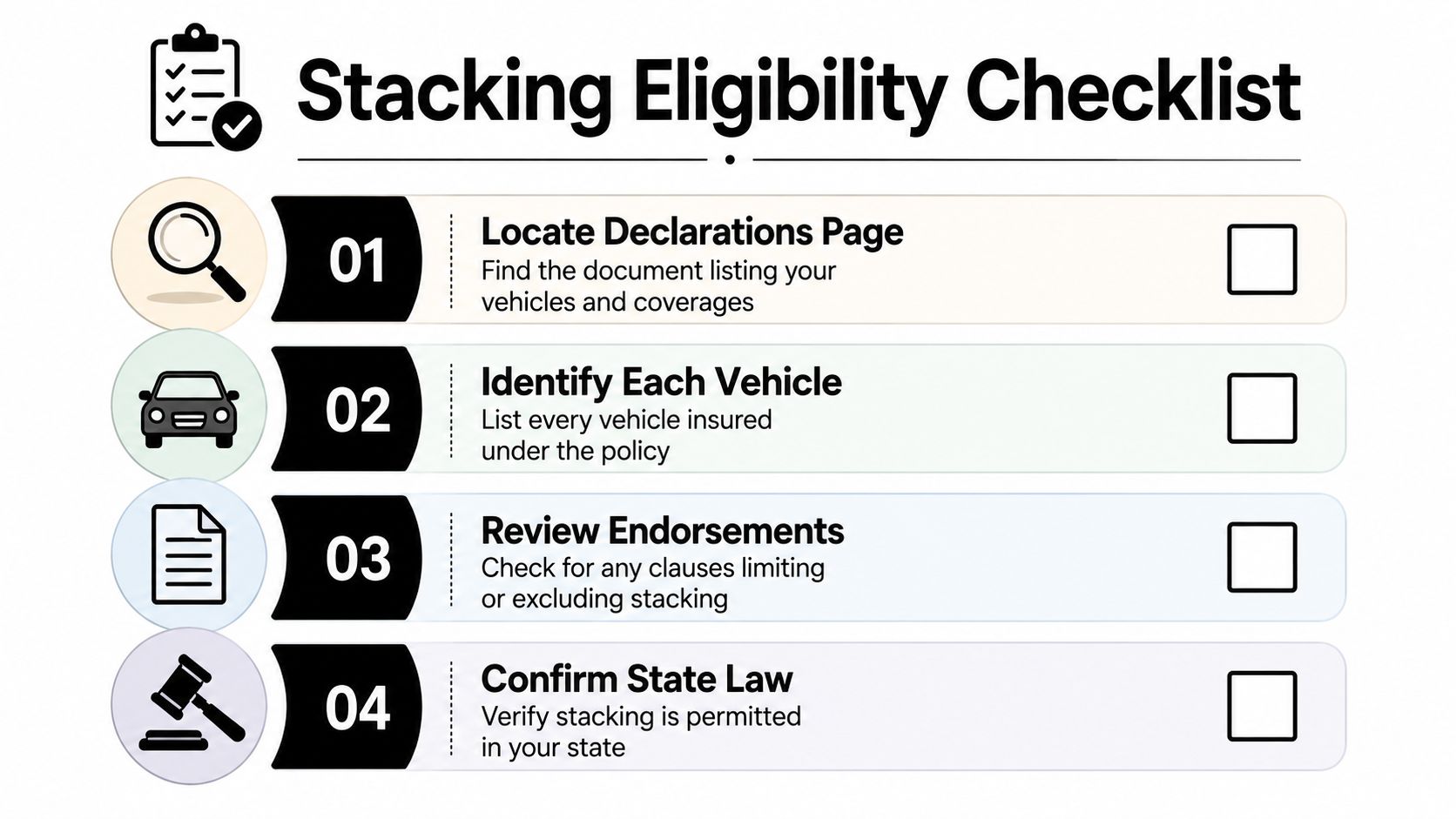
A document-first checklist
Locate the declarations page. Confirm the policy period and identify the UM and UIM limits shown for each vehicle. Don't assume that the limits are identical across the household.
List every insured vehicle. Write down each vehicle listed on the policy, then identify vehicles covered by separate policies. A second household vehicle may be relevant, but only if the claimant and policy language make it available.
Identify every named insured. Note whether the policy names one person, spouses, or other individuals. Then read the definition of an insured and determine whether resident relatives qualify.
Review endorsements and elections. Search for “non-stacked,” “stacking,” “limits of liability,” “other insurance,” “household,” “owned vehicle,” and “reduction.” Find any signed form rejecting stacking or selecting non-stacked coverage.
Confirm the governing state law. The law may depend on the state connected to the policy, the accident, and the contract. A move or policy replacement can create a new coverage question.
Questions to put to the adjuster
Ask for clear answers in writing:
- Is intra-policy stacking permitted for the vehicles on this policy?
- Is inter-policy stacking permitted with another household policy?
- Which people qualify as insureds under the UM/UIM endorsement?
- Does the insurer rely on a signed non-stacking or reduction election?
- Is the company applying a household exclusion or other-vehicle limitation?
- What liability reduction is being applied to any UIM calculation?
The adjuster may not give a complete legal interpretation, and a denial letter may use broad language. Keep the letter and the cited policy provisions. If the claim depends on multiple policies, a Colorado underinsured motorist claim review can help identify whether the insurer evaluated every potentially available coverage source.
A free coverage analysis from a Colorado personal injury attorney is appropriate when the documents conflict, a spouse's policy is involved, a rejection form is disputed, or the insurer says only one vehicle counts.
Mistakes That Quietly Destroy a Stacking Claim
The most dangerous assumption is that stacking happens automatically. It doesn't.
A recent Seventh Circuit decision upheld a no-stacking result where broad policy wording controlled over a more detailed argument involving multiple vehicles. The decision shows why a claimant can't rely on the idea that several insured cars necessarily produce several usable limits.
Four assumptions that need testing
“We own two cars, so the limits double.” Ownership alone isn't enough. The vehicles, insureds, policy forms, and endorsements must connect in a way the law recognizes.
“A waiver on one car affects only that car.” The answer depends on how the election is written and how the policy applies it. A form that appears vehicle-specific may interact with broader policy language.
“The other driver's insurance controls the stacking issue.” The at-fault driver's policy affects a UIM gap, but stacking usually concerns the injured person's own UM or UIM coverage.
“Moving or changing carriers can't change anything.” A new state, renewal, replacement policy, or revised endorsement can alter the governing terms. Recent state developments reinforce that generic national explanations become stale quickly.
The Arizona Supreme Court has also limited stacking where multiple people jointly purchased multiple policies from the same insurer. Those decisions, including the 2021 Fahrner line of cases, demonstrate that named-insured structure and joint ownership can matter as much as the number of vehicles.
A Colorado household should preserve every policy version after a move or carrier change. Don't sign a non-stacking form without understanding what protection it removes, and don't assume a spouse's separately titled vehicle creates an available limit.
The claim can close quietly when paperwork, household structure, and timing don't line up.
Uninsured Motorist Stacking Questions Colorado Clients Ask Most
The Aurora family often asks the same practical questions after a hit-and-run. The answers depend on the contract, but these principles provide a starting point.
| Question | Short answer |
|---|---|
| Can stacking take recovery above the at-fault driver's limits when that driver had no insurance? | Potentially. A UM claim may use eligible household limits because there is no liability policy to collect from, subject to Colorado law and the policy. |
| What happens if one household vehicle has a rejected UM/UIM waiver? | The effect depends on the form's wording, the policy structure, and whether another vehicle or policy provides separately available coverage. |
| Does medical payments coverage get used before stacked UM/UIM? | It may coordinate with the injury claim, but the policy's payment, reduction, and reimbursement provisions must be reviewed. |
| How long is there to demand stacked benefits? | The deadline can depend on policy notice terms, contractual limitations, and applicable law. Prompt review is safer than waiting for a settlement deadline. |
For the Aurora mother, the missing driver doesn't end the analysis. A lawyer must determine whether her policy, her spouse's policy, and any household-member provisions create accessible UM benefits, then account for exclusions, reductions, and damages.
If your recovery depends on combining limits, a free consultation with a Colorado stacking attorney can clarify the documents and deadlines before the insurer closes the claim.
Nares Law Group LLC helps injured Colorado drivers evaluate UM and UIM policies, investigate coverage disputes, and pursue compensation after crashes involving uninsured or underinsured motorists. Visit Nares Law Group LLC to request a consultation focused on your policy language, household coverage, and potential stacking rights.