A truck crash can happen in seconds on a Colorado highway. A passenger vehicle may be struck when a tractor-trailer fails to stop, drifts across a lane, or loses cargo that wasn't secured properly. The people in the smaller vehicle usually see only the final impact. They don't see the decisions, mechanical condition, company policies, or loading records that may have made the collision preventable.
The cause may be documented in electronic logging device records, phone data, maintenance files, dispatch messages, cargo documents, onboard vehicle data, or driver-training records. The most common causes of truck accidents often overlap. Fatigue can lead to lane departure, distraction can cause unsafe following, and poor loading can worsen a loss of control.
This guide explains eight major causes in plain English. It also identifies practical evidence-preservation steps for injured people and families in Colorado. After a crash, seek appropriate medical care, preserve photographs and communications, avoid premature recorded statements, and obtain case-specific legal advice before signing a release. Truck drivers can also review business records and maximize your tax refund with Smart Receipts, but after a collision, safety records and crash evidence should come first.
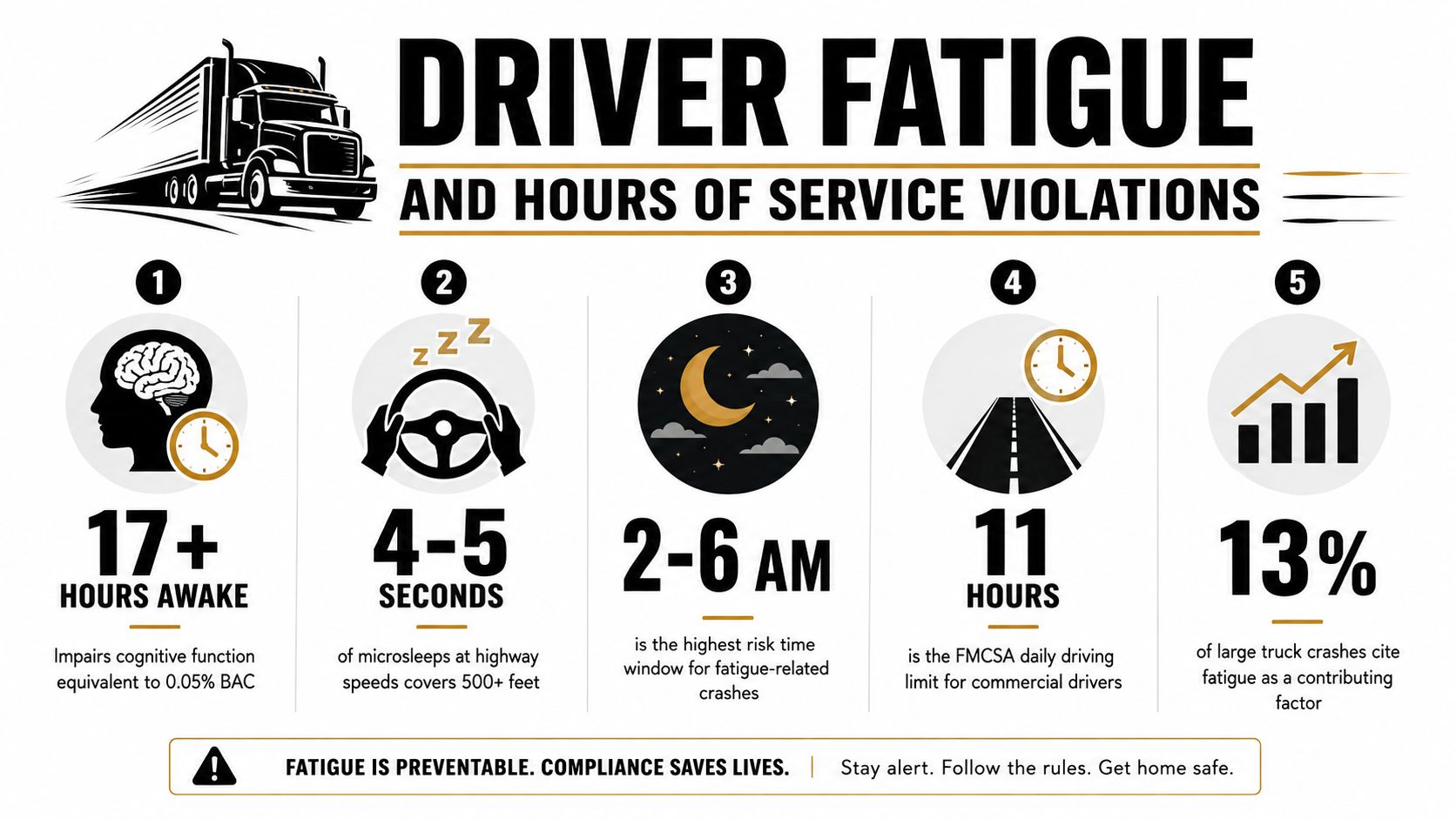
1. Driver Fatigue and Hours of Service Violations
A fatigued truck driver may look awake while still responding too slowly to traffic. Long overnight routes, missed rest, changing schedules, and delivery pressure can reduce judgment and situational awareness. On a Colorado interstate, that can mean failing to recognize stopped traffic, drifting onto a shoulder, or continuing through a curve too quickly.
FMCSA's Large Truck Crash Causation Study recorded driver fatigue in 13% of trucks in the studied crashes and reported a relative risk of 8.0 for fatigue-related involvement. Those figures come from the study's analysis brief, which also explains why fatigue evidence deserves close attention in serious cases. The issue isn't limited to whether a driver admits feeling tired. Records may show how long the driver had been working, whether rest periods were genuine, and whether dispatch decisions encouraged unsafe scheduling.
What investigators should examine
Electronic logging device data may show driving and duty periods that don't match handwritten logs. Dispatch records, GPS history, fuel purchases, toll transactions, and messages can help reconstruct the route and timeline. A company's safety policies may also reveal whether managers monitored fatigue or ignored warning signs.
Preservation point: ELD data and related records can be overwritten or lost. A prompt preservation request should identify the driver's logs, GPS history, dispatch communications, and scheduling records.
For a Colorado injury claim, counsel may also need to examine prior violations, complaints, training, and the carrier's response to known fatigue concerns. An accident reconstruction professional can compare the truck's path, speed, braking, and rest history. A qualified sleep or medical expert may explain how fatigue affected recognition and reaction.
What an injured person can do
After medical treatment, write down what you remember about the truck's movement, the time of day, and anything the driver said at the scene. Preserve photographs, witness details, and messages about the collision. A Colorado attorney can also explain the legal issues involved in an Hours of Service violation and send preservation demands before key data disappears.
2. Inadequate Vehicle Maintenance and Mechanical Failure
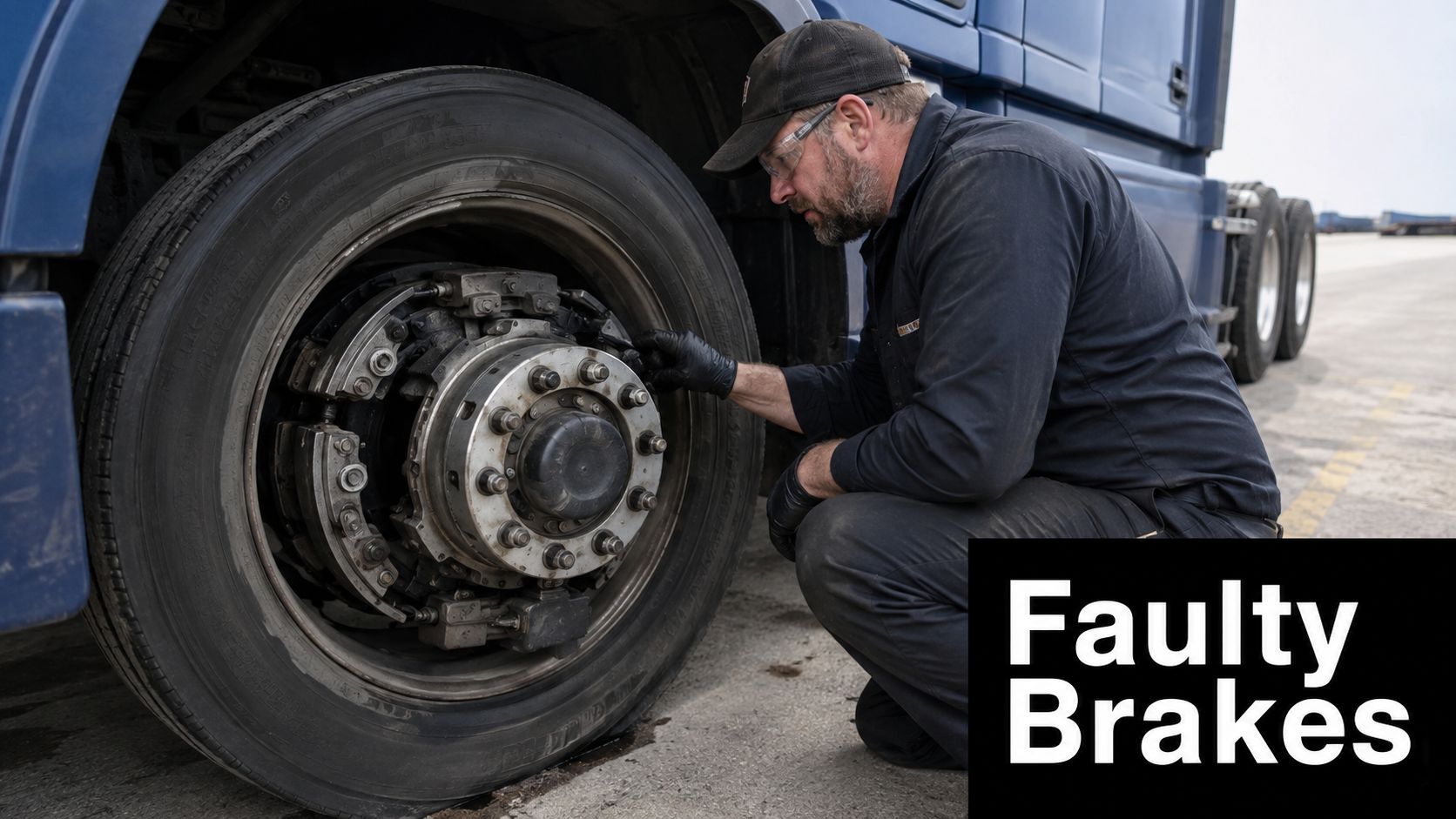
A truck can be operated carefully and still become dangerous when its brakes, tires, steering, suspension, lights, or coupling equipment aren't maintained. A tire failure may send debris into traffic. A steering defect can make a trailer cross a lane. A brake problem can prevent a driver from stopping even when the driver recognizes the danger.
Mechanical evidence often changes the entire direction of an investigation. A crash that first appears to involve speed may also involve worn brake components, a failed tire, a defective steering part, or a maintenance decision that left a known problem unresolved. The vehicle should be preserved before parts are repaired, discarded, or altered.
Physical evidence needs protection
An independent heavy-truck mechanic or engineer should inspect the vehicle, trailer, tires, brakes, coupling system, and onboard systems. Photographs should document component condition, damage, warning lights, and the truck's load configuration. The inspection should happen before the defense or an insurer conducts its own examination whenever possible.
The FMCSA crash-causation study identifies vehicle loss of control in 29% of studied large-truck crashes, associated with factors such as traveling too fast for conditions, cargo shift, vehicle systems failure, and poor roads. That finding supports a broad investigation rather than an assumption that the driver alone caused the crash. The study is available through the FMCSA analysis of large-truck crash causation.
Records that may reveal neglect
- Maintenance files: Request repair invoices, inspection reports, work orders, defect reports, and parts-replacement records.
- Pre-trip materials: Compare inspection documents with the truck's actual condition after the collision.
- Regulatory history: Review safety inspections, out-of-service findings, complaints, and enforcement records.
- Weight and configuration: Document the tractor, trailer, cargo, and axle arrangement because loading can affect braking and handling.
A mechanic's conclusion should be tied to the crash mechanics. For example, an expert may assess whether a brake defect affected stopping, whether a tire failure occurred before impact, or whether the company had notice of the condition.
A short visual reference can help explain why brake and component inspections matter:
Further educational video content may help families understand the inspection process:
3. Distracted Driving and Mobile Device Use
A driver glances down to read a dispatch message. Ahead, traffic stops, a car begins merging, or the signal changes. A heavy truck can travel far enough during that glance to turn a moment of inattention into a serious collision. Distraction may also come from paperwork, food, radio controls, navigation systems, or other equipment inside the cab.
FMCSA crash data for 2021 recorded at least one driver-related factor for 32% of large-truck drivers in fatal crashes. Speeding was the most frequent driver-related factor, while distraction or inattention ranked second in that dataset. The FMCSA Large Truck and Bus Crash Facts 2021 data documents that federal pattern.
The phone may preserve part of the timeline. Call logs, texts, application activity, and timestamps can be compared with vehicle data, witness accounts, video, and the driver's statements. Phone records alone do not establish exactly what the driver was doing, so a digital-forensics or communications expert may help explain their limits.
Video can disappear quickly. In-cab cameras, outward-facing dashcams, traffic cameras, and nearby business systems may overwrite files as vehicles continue operating. A preservation letter should identify those recordings, telematics, phone records, dispatch messages, and company rules about device use.
A focused investigation can ask:
- Who saw the distraction? Record whether witnesses noticed the driver looking down, holding a device, or reacting late.
- What video exists? Request highway, business, vehicle, and in-cab footage before routine deletion.
- Do the timelines match? Compare phone activity with GPS data, braking, lane position, and impact timing.
- What did the carrier do? Review training, monitoring, discipline, and communications concerning mobile-device policies.
The company's role may extend beyond the driver's conduct. Records can show whether supervisors knew of repeated device use, whether dispatch practices encouraged unsafe interaction, or whether enforcement existed only on paper.
Injured people should avoid guessing in a recorded statement. A Colorado truck-accident lawyer can assess whether the available evidence supports a distracted-driving truck wreck claim and pursue relevant records through the proper legal process.
4. Impaired Driving With Alcohol, Drugs, or Medication
A truck can drift across the centerline after its driver takes a sedating medication, uses an illegal drug, or drinks alcohol. The danger may also come from combining substances. Impairment can affect coordination, judgment, alertness, and reaction time, yet appearance at the crash scene does not prove whether impairment occurred. Investigators must connect test results and observed conduct to the time of impact.
The evidence may include roadside observations, field sobriety evidence, blood or urine testing, toxicology reports, medical records, and statements from witnesses or coworkers. Timing matters. Investigators should identify when testing occurred, how samples were collected, and whether the samples were handled correctly. A toxicology expert can explain what a result establishes, and what it cannot establish, about the driver's condition during the collision.
The carrier's records may reveal a preventable risk
The driver's employment file may contain prior substance-related violations, failed tests, complaints, or work restrictions. Hiring records, testing procedures, and return-to-duty documentation can show whether the carrier followed its own policies and applicable requirements. Drug-testing records and company communications may also exist outside the initial police file.
Federal crash-facts material cited earlier places impairment factors, including fatigue, alcohol, or illness, in an ongoing category of driver-related risk. Its 2020 to 2022 overview recorded impairment factors at 5.2% in 2020, with distraction or inattention also at 5.2% and speeding at 7.4%. The figures come from the FMCSA overview already cited, so no new source link is needed here.
Criminal charges and a civil injury claim are separate matters. A criminal case may provide useful records, but an injured person should not wait for it to end before protecting evidence for the civil claim.
What should be preserved first
Begin with the records most likely to disappear or change:
- Testing materials: Preserve toxicology reports, blood-test results, collection records, and laboratory documentation.
- Police investigation: Obtain the report, citations, body-camera footage, and officers' observations.
- Employment records: Request testing history, hiring documents, prior complaints, restrictions, and disciplinary records.
- Driving evidence: Secure video and witness accounts describing erratic movement, delayed braking, or unsafe lane changes.
Medical care comes first. Families should keep treatment records and follow-up instructions, avoid guessing in recorded statements, and tell a Colorado truck-accident lawyer what they remember. Counsel can assess whether impairment, negligent supervision, or both contributed to the crash and protect relevant evidence through the proper legal process.
5. Speeding and Unsafe Following Distance
A heavy truck doesn't need to be traveling at an extreme speed to create a serious stopping problem. Driving too fast for wet pavement, snow, ice, a downhill grade, congestion, a curve, or a work zone can leave the driver without enough control. Following too closely creates a second danger. If traffic stops suddenly, the truck may not have the space needed to avoid a rear-end impact.
FMCSA data identifies speeding of any kind as the top driver-related factor in fatal large-truck crashes. In 2019, speeding was recorded for 7.6% of large-truck drivers in fatal crashes, while the federal data also recorded distraction or inattention at 5.3% and impairment factors, including fatigue, at 4.7%. These figures are provided in the FMCSA driver-related factor table for large-truck fatal crashes.
Reconstructing the seconds before impact
An accident reconstruction expert may examine event data, vehicle damage, tire marks, roadway grade, visibility, traffic movement, and the final rest positions. The analysis can address speed, reaction time, braking, lane position, and whether the driver had a reasonable opportunity to stop. EDR or other onboard data may be important, but it should be interpreted alongside physical evidence rather than in isolation.
A Colorado roadway may present changing conditions within a short distance. Construction zones, mountain curves, weather, and heavy rush-hour traffic can all make a speed that was reasonable earlier unsafe later.
- Preserve vehicle data: Request EDR, telematics, GPS, and dashcam records.
- Document conditions: Photograph pavement, lighting, signage, traffic controls, weather, and work-zone layout.
- Locate video: Seek traffic-camera, business, residential, rideshare, and nearby vehicle footage.
- Investigate scheduling: Review dispatch messages and delivery expectations for possible pressure to maintain an unsafe pace.
The truck's speed is only one part of the analysis. A careful investigation also asks whether the driver left enough space, noticed the hazard, braked promptly, and adjusted to conditions.
6. Improper Lane Changes and Blind Spot Accidents
A truck can begin moving into the next lane while a passenger vehicle remains beside the trailer. Mirrors provide important coverage, yet areas outside their view remain. The risk increases when a driver fails to signal, checks too quickly, misjudges clearance, or starts the maneuver before the other vehicle has cleared the blind area.
The roadway evidence can reconstruct those seconds. Side damage on a passenger vehicle may support a sideswipe or merging theory. Damage near a corner, trailer wheels, or the rear section may help establish the truck's position and direction. Investigators should compare those marks with lane lines, road width, vehicle dimensions, and witness accounts.
Test the first version of events
An insurer may claim that the smaller vehicle was speeding, hidden, or changing lanes improperly. That explanation requires comparison with video, physical evidence, and sight-line analysis. A reconstruction expert familiar with tractor-trailer handling can examine mirror coverage, the truck's turning path, trailer off-tracking, and lane position.
A blind spot describes limited visibility, not permission to make an unsafe maneuver. The investigation should identify whether the driver checked, signaled, yielded, and moved only after the lane was clear.
Preserve evidence before it disappears
- Video recordings: Request dashcam, traffic-camera, toll, business, and nearby vehicle footage before recordings are overwritten.
- Scene photographs: Capture lane markings, signs, sight lines, shoulder width, and vehicle positions.
- Damage documentation: Photograph every vehicle before repairs and preserve repair estimates.
- Driver records: Seek training files, complaints, citations, inspection materials, and communications about the maneuver.
- Visibility systems: Document the truck's mirror configuration and any installed camera or warning technology.
A passenger driver can learn how to eliminate blind spots while driving, but general education does not resolve responsibility for a particular collision. Colorado claimants should preserve the scene and vehicle evidence, avoid giving a recorded statement before obtaining legal guidance, and discuss the crash with a Colorado truck-accident attorney. The records and physical evidence must show who moved, who had the right of way, what each driver could see, and whether the truck driver acted reasonably.
7. Inadequate Training and Negligent Hiring Practices
A commercial driver's license alone doesn't answer whether a driver received enough practical preparation for a specific tractor, trailer, route, load, or weather condition. A carrier may have provided minimal orientation, failed to evaluate driving skills, or placed a driver into demanding traffic before the driver was ready. The company's hiring process may also reveal warning signs that should have prompted closer review.
This cause often requires looking beyond the accident scene. Personnel files may contain applications, road tests, training materials, evaluations, disciplinary documents, complaints, and safety acknowledgments. Prior employers may hold additional records. Driving-history records can show violations, license restrictions, reckless-driving conduct, or other information relevant to the carrier's decision.
Company records can reveal the safety culture
Investigators should compare written policies with actual practice. A carrier may require defensive-driving training but fail to document completion. It may prohibit unsafe conduct but reward unrealistic delivery performance. Former employees may describe whether managers responded to complaints, ignored violations, or pressured drivers to continue operating.
A company's regulatory history can provide leads, but it must be tied to the particular driver and crash. Prior enforcement activity doesn't automatically prove negligence in an individual case. It may, however, identify records, witnesses, or policy failures worth investigating.
- Hiring file: Seek the application, references, background checks, driving history, and qualification documents.
- Training file: Request classroom materials, behind-the-wheel evaluations, coaching notes, and route-specific instruction.
- Supervision evidence: Examine complaints, performance reviews, discipline, dispatch messages, and manager communications.
- Safety history: Review inspections, violations, corrective actions, and internal audits.
The question isn't simply whether the driver held a CDL. It's whether the company reasonably selected, trained, supervised, and retained this driver for this work.
A Colorado truck-accident attorney may use subpoenas, preservation demands, depositions, and expert review to test those issues. An employment or safety expert can assess whether the carrier's process matched accepted commercial-trucking practices and its own written rules.
8. Overloading and Improper Load Securement
Cargo can turn a manageable maneuver into a rollover, jackknife, or loss-of-control event. An uneven load can alter the trailer's balance. A shifting load can move the center of gravity during braking or a turn. Unsecured materials can fall from the trailer and strike vehicles behind it, creating a hazard before the truck itself reaches them.
The investigation should identify who selected, loaded, inspected, and secured the freight. Responsibility may involve the carrier, driver, shipper, warehouse, loading contractor, or another party. The cargo manifest may show what the company intended to transport, while scale tickets and inspection records may show what the truck carried.
Follow the cargo trail
Request bills of lading, loading instructions, photographs, weight tickets, seal records, warehouse records, and communications about the shipment. Compare the cargo description with the physical condition after the crash. Photograph tie-downs, straps, chains, blocking, bracing, damaged packaging, and the trailer floor before evidence is moved.
An expert in materials handling can assess whether the load was distributed and secured appropriately. An accident reconstruction expert can evaluate how cargo movement or weight affected braking, stability, turning, and impact forces. The physical condition of the trailer may be as important as the driver's statements.
- Confirm capacity: Identify the truck and trailer ratings and compare them with available weight records.
- Trace loading decisions: Determine who loaded the cargo and who approved the final arrangement.
- Preserve inspection evidence: Obtain weigh-station records, roadside inspection results, and citations.
- Review company incentives: Examine whether delivery or profit pressure encouraged unsafe loading practices.
If cargo shifted or fell, a Colorado lawyer can investigate an unsecured cargo truck wreck and identify every potentially responsible party. Injured people shouldn't attempt to inspect or move dangerous cargo themselves. Scene photographs and professional preservation are safer and more reliable.
8-Point Comparison of Truck Accident Causes
| Cause | Implementation Complexity 🔄 | Resource Requirements ⚡ | Expected Outcomes ⭐📊 | Ideal Use Cases | Key Advantages 💡 |
|---|---|---|---|---|---|
| Driver Fatigue and Hours of Service Violations | 🔄 High, requires forensic log/ELD and medical analysis | ⚡ ELD/logs, dispatch/comm records, sleep-medicine & reconstruction experts, rapid evidence preservation | ⭐ High, FMCSA HOS breaches often establish clear negligence and strong damages potential | HOS violations, falsified logs, night-time or long-haul crashes causing catastrophic injury/death | 💡 Objective ELD evidence; strong jury sympathy; regulatory per se negligence |
| Inadequate Vehicle Maintenance and Mechanical Failure | 🔄 Medium–High, vehicle preservation and detailed mechanical inspection needed | ⚡ Independent heavy-truck mechanic/engineer, maintenance logs, service history, preserved vehicle | ⭐ High, mechanical causation is often definitive and persuasive to juries | Brake failure, tire blowouts, coupling failures, crashes showing mechanical malfunction | 💡 Maintenance records and expert testimony provide clear documentary causation |
| Distracted Driving and Mobile Device Use | 🔄 Medium, evidence often digital and time-sensitive | ⚡ Cell phone records, dashcam/in-cab footage, communications expert, subpoenas to prevent deletion | ⭐ High, explicit FMCSA prohibitions + objective phone/dashcam data yield strong liability | Texting/phone use moments before impact, in-cab infotainment distraction, captured dashcam video | 💡 Phone logs and dashcam footage create timestamped, objective proof of distraction |
| Impaired Driving (Alcohol, Drugs, Medication) | 🔄 Medium, coordinate toxicology and criminal records; time-critical evidence | ⚡ Blood/toxicology reports, police/DUI reports, FMCSA drug-testing history, toxicology expert | ⭐ Very High, lab results and criminal findings strongly support negligence and punitive damages | Positive BAC/toxicology, erratic driving, fatalities with evidence of substance use | 💡 Toxicology and DUI records are highly persuasive and allow parallel criminal/civil claims |
| Speeding and Unsafe Following Distance | 🔄 Medium, EDR/black box and reconstruction analysis commonly required | ⚡ EDR/black box data, accident reconstruction, skid mark analysis, traffic citations | ⭐ High, EDR/citation + physics produce compelling causation, especially rear-end crashes | Rear-end collisions, pileups, crashes in adverse conditions or construction zones | 💡 EDR and citations provide objective speed/following-distance evidence; physics demonstratives resonate with juries |
| Improper Lane Changes and Blind Spot Accidents | 🔄 Medium, depends on availability of visual evidence and witness accounts | ⚡ Dashcam/traffic camera footage, eyewitness statements, reconstruction, mirror/vehicle inspection | ⭐ High when visual/witness evidence exists; contested if evidence lacking | Blind-spot collisions, lane-change strikes, trailer-sway incidents during maneuvers | 💡 Visual footage often clearly shows sequence; industry lane-change standards support claims |
| Inadequate Training and Negligent Hiring Practices | 🔄 High, requires HR discovery and causal link to accident | ⚡ Personnel files, hiring/background checks, training records, HR/employment expert | ⭐ Medium–High, company-level liability and punitive damages possible with documented failures | Cases involving drivers with prior violations, company safety-culture failures, repeat offenders | 💡 Federal hiring/training standards create objective benchmarks to hold companies liable |
| Overloading and Improper Load Securement | 🔄 Medium, proof relies on weigh/manifest records and reconstruction | ⚡ Weigh-station records, bills of lading/manifests, loading photos, materials-handling & reconstruction experts | ⭐ High, FMCSA weight/securement violations often demonstrate direct causation for braking/rollover issues | Rollover crashes, cargo-shift incidents, braking failures on heavy loads | 💡 Scale tickets and shipping documents provide objective evidence; physics-based causation is persuasive |
Turn the Crash Scene Into a Stronger Case
The visible collision is only the starting point. A truck may have crossed the line, struck the rear of a car, or spilled cargo, but the legal and factual questions often reach back hours, days, or even months. Investigators may need to determine whether the driver was fatigued, whether the carrier ignored a maintenance defect, whether a phone was in use, whether the load was secure, or whether the company hired and trained the driver responsibly.
Medical care comes first. Follow the treatment plan, attend recommended appointments, and tell providers about symptoms that appear later, including headaches, memory problems, sleep changes, pain, anxiety, or difficulty returning to normal activities. Traumatic brain injuries and other serious conditions may not be fully apparent at the scene.
Preserve what you can without putting yourself at risk:
- Photographs: Keep original crash-scene, vehicle, roadway, injury, and property-damage photographs.
- Witness information: Save names, phone numbers, messages, and any photographs or video witnesses offer.
- Communications: Retain calls, texts, emails, insurer letters, employer messages, and social-media communications about the crash.
- Financial records: Track medical expenses, mileage, wage loss, disability information, household help, and other accident-related costs.
- Personal notes: Record symptoms, limitations, missed work, and changes in daily life while the events remain fresh.
Avoid giving a recorded statement or signing a settlement release before you understand the claim. An insurer's early request may come before the full extent of an injury is known and before essential trucking evidence has been preserved. Be truthful, but don't speculate about fault, speed, medical prognosis, or facts you can't remember.
Prompt legal advice can help preserve ELD records, EDR or black-box data, phone records, dashcam footage, maintenance files, personnel documents, dispatch communications, and cargo records. It can also help identify whether the driver, trucking company, maintenance provider, shipper, loader, manufacturer, or another party may have responsibility. Colorado deadlines and legal issues depend on the facts, the parties involved, the nature of the claim, and the circumstances of the injuries or death, so waiting can create unnecessary risk.
Nares Law Group LLC is a Denver-based personal injury firm that represents people harmed in truck wrecks and other motor-vehicle crashes. The firm describes services involving investigation, evidence preservation, medical-treatment coordination, negotiation, trial, and settlement, and offers free consultations. A consultation can help you understand what evidence may matter and what next steps fit your situation, without promising a particular outcome.
If you or someone in your family was hurt, focus on healing while protecting the facts. Keep your records, avoid premature releases, and speak with a Colorado truck-accident attorney promptly so the investigation can begin before electronic, physical, and business evidence disappears.
Nares Law Group LLC offers Colorado truck-accident representation with investigation, evidence preservation, treatment coordination, and claim guidance for injured people and families. To discuss the crash and the records that may support your case, visit Nares Law Group LLC for information about a free consultation.