You're stopped at a red light when a truck slams into your rear bumper. Before you can process the impact, the driver accelerates through the intersection and disappears. Your hands are shaking, traffic is moving around you, and you're suddenly trying to remember a plate number, describe a vehicle, and decide whether your neck or back is seriously hurt.
That confusion is normal. It also makes the first few minutes important. What you do after a hit and run can affect the criminal investigation, your insurance claim, and a future civil case. Police may identify the driver, but you shouldn't assume they'll have the staffing, footage, or physical evidence needed to do it without help. The practical advantage goes to the victim who preserves evidence immediately and protects their legal position from the start.
The First Minutes After a Hit and Run Crash
Your first responsibility is safety. If you can move without worsening an injury, get out of the travel lane. Call 911, explain that the other driver fled, and report any injuries, dangerous traffic conditions, or immediate medical concerns. Don't chase the fleeing vehicle. A pursuit can create another collision and can destroy your ability to document the scene.
While you're waiting for officers, use your phone to record what remains. Photograph your vehicle from multiple angles, the roadway, nearby signs, debris, skid marks, fluid, weather, lighting, and the direction in which the other vehicle left. If you remember only part of a plate, write it down immediately. The same applies to the vehicle's color, body style, damage, stickers, company markings, occupants, and the driver's description.
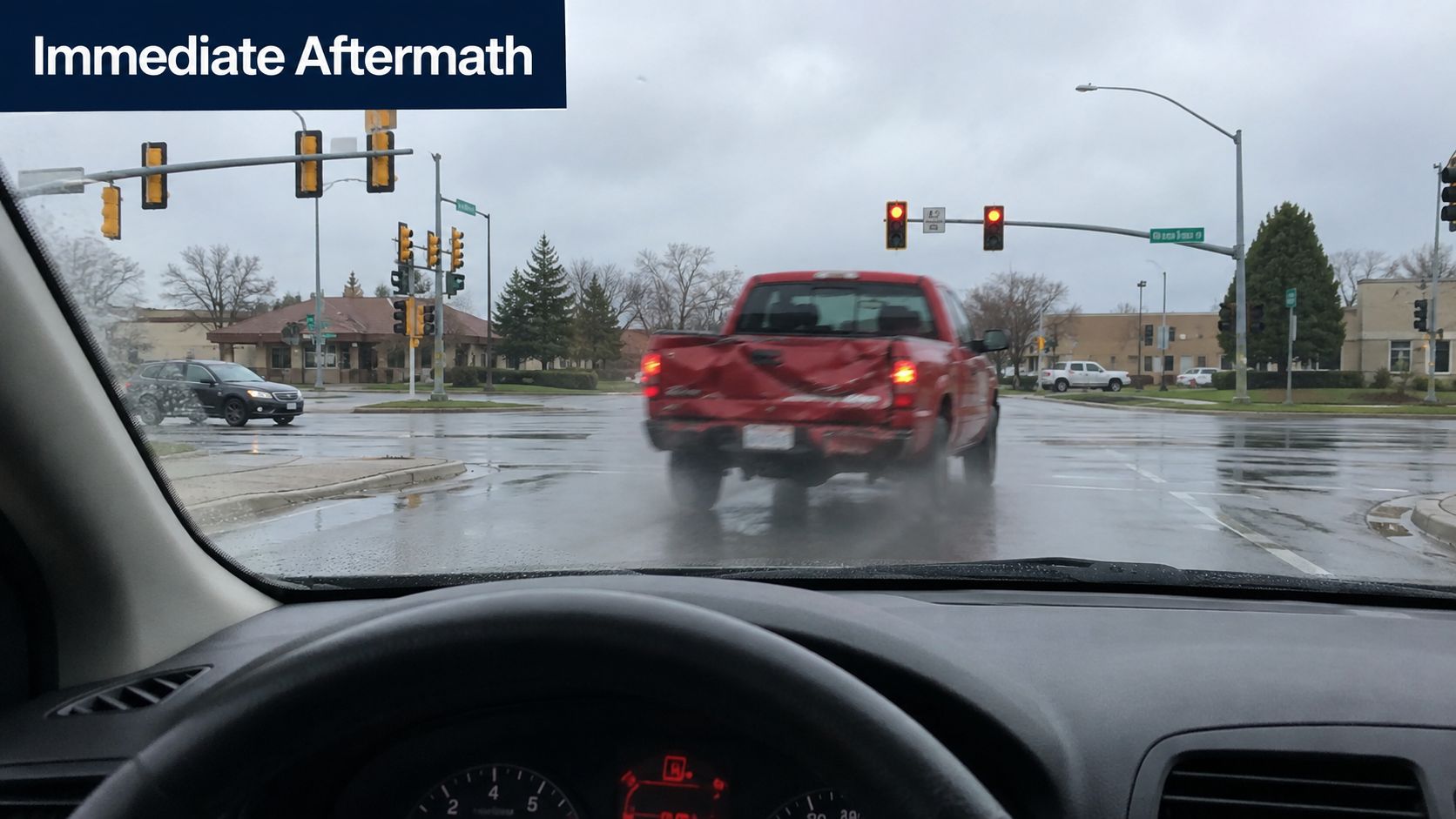
What happens after the 911 call
Dispatchers generally collect the location, direction of travel, vehicle description, injuries, and immediate hazards. Officers may prioritize emergency medical care and scene safety before turning to identification evidence. That priority is appropriate, but it means the first officer may not be able to conduct every forensic task a complex case requires.
Physical evidence is vulnerable from the moment the collision ends. Rain can move paint and debris. Passing vehicles can scatter fragments or erase tire impressions. Road crews and towing operations can remove material before an investigator has photographed it. Don't pick up dangerous debris from an active roadway, but point it out, photograph it from a safe position, and tell the responding officer exactly where it landed.
Protect your account while it's fresh
Give officers a factual account. Separate what you saw from what you inferred. “Dark pickup with a bright object on the rear window” is more useful than a confident but uncertain make and model. If adrenaline affects your memory, say so. You can provide additional information later after reviewing photographs or speaking with witnesses.
For a practical scene checklist, review these steps to take after a car accident. Then notify your insurer promptly, seek medical evaluation for symptoms or possible injuries, and preserve every photograph, video, receipt, message, and report connected to the crash.
Practical rule: A police report starts the record. It doesn't replace your own evidence file.
Why Hit and Run Investigations Are a Growing National Problem
Hit and run cases aren't rare traffic disputes. They form a recurring national fatal-crash problem tracked through the federal Fatality Analysis Reporting System, which has tracked fatal motor vehicle crashes nationwide since 1975 and is updated annually. In 2024, 2,758 people died in traffic crashes involving hit-and-run drivers, compared with 2,911 in 2023, a decline of 5.3% in the federal data. The earlier federal series recorded 2,872 such fatalities in 2023 and 2,972 in 2022, showing why source definitions and reporting series matter when comparing figures.
The broader crash volume is also substantial. The AAA Foundation's analysis of U.S. police-reported crashes found 919,292 hit-and-run crashes in 2023, representing 15% of all police-reported crashes, with more than 240,000 injuries and 2,872 deaths in its published analysis. That analysis compared 785,012 hit-and-run crashes in 2017 with the 2023 total, while fatalities rose from 2,010 to 2,872. The share of all traffic deaths involving hit and run reached 7% in 2023, described in that analysis as the highest percentage recorded.
The people facing the greatest danger
Pedestrians and cyclists lack the protection provided by a vehicle cabin. Federal data show that in 2024, 1,749 of 7,080 pedestrian fatalities, or 25%, involved hit-and-run crashes. Among pedalcyclist fatalities, 230 of 1,103, or 21%, involved hit and run according to the NHTSA fatal-crash data. These figures explain why a fleeing driver can transform a traffic collision into a life-threatening emergency before the victim receives help.
Several pressures can motivate a driver to leave, including fear of criminal consequences, lack of insurance, impairment, or panic. But the victim doesn't need to prove the driver's motive at the roadside. The immediate legal issue is evidence, including what vehicle caused the impact, how the collision occurred, and whether the fleeing driver can be identified.
Why volume changes police response
A department handling a large number of reports must allocate detectives, crash reconstruction personnel, and forensic resources. Serious injuries, fatalities, reliable witnesses, visible vehicle damage, and usable video can push a case toward active follow-up. A property-damage case with no plate, no camera, and no witness may receive a report number but little immediate investigative attention.
| Statistic | Value |
|---|---|
| Fatalities in hit-and-run-driver crashes in 2024 | 2,758 |
| Hit-and-run fatalities in 2023 | 2,872 |
| Police-reported hit-and-run crashes in 2023 | 919,292 |
| Share of police-reported crashes in 2023 | 15% |
| Pedestrian fatalities involving hit and run in 2024 | 25% |
| Pedalcyclist fatalities involving hit and run in 2024 | 21% |
The lesson is direct: report the crash, but don't make the report your entire plan. Preserve evidence, notify your insurer, and get legal advice before the available proof disappears.
How Investigators Identify the Fleeing Driver
Police rarely identify a fleeing driver from one perfect clue. They assemble a chain of partial evidence. A broken lamp can narrow the vehicle type, a witness can establish the travel direction, and a camera can confirm timing even without a readable plate. The case becomes stronger when those details point to the same vehicle and route.
Scene evidence creates the first trail
At the collision site, investigators may collect paint chips, glass, metal fragments, tire impressions, and headlight-filament evidence. The forensic discussion of trace evidence in hit-and-run cases explains comparison methods such as microscopy, solvent testing, pyrolysis gas chromatography, infrared spectroscopy, and elemental analysis.
Those materials can transfer between vehicles and the roadway during impact. Weather, passing traffic, and cleanup can scatter or alter them, so photograph loose material before anyone moves it. Tell police whether each fragment was beneath the vehicle, beside a tire path, or embedded in damaged trim. A vehicle accident reconstruction specialist can then assess how the damage, roadway marks, photographs, and video fit together.
Digital records fill gaps
Traffic cameras, business security systems, residential doorbell cameras, dashcams, automated license plate recognition records, and vehicle-location data can establish a sequence. A time-stamped recording may show the vehicle's lane, direction, impact timing, and departure route even when the plate cannot be read.
Act quickly. Nearby businesses, residences, parking facilities, and transportation agencies may overwrite recordings on their own schedules. Ask each owner to preserve footage from the relevant time, and provide the police report information. Do not pressure anyone to release private material improperly. The owner can retain the recording for investigators or your attorney.
What you should record before memory fades
Write a short timeline while the details are still clear. Record the vehicle's color, body type, likely make, visible damage, lights, decals, racks, business logos, and any partial plate. Describe the driver's clothing, approximate appearance, voice, movements, and whether another person was inside.
Mark the intersection, lanes, turning movement, traffic signal, and direction of departure. Get witness names and contact information, then write down each person's account without embellishment. Identify every camera aimed at the roadway, including storefront, apartment, school, parking, and doorbell cameras.
Your account does not need to solve the case. It needs to preserve leads investigators and your lawyer can verify before physical evidence, video, or memory disappears. Reconstruction can clarify the collision sequence and test whether the available proof supports your version, but it cannot identify a driver without evidence connecting that vehicle or person to the crash.
The Reality of Police Resources and Case Triage
Many victims expect a full-scale search as soon as the fleeing vehicle disappears. Sometimes police develop a strong lead quickly. Often they don't. The outcome depends on injury severity, evidence quality, identifiable leads, staffing, jurisdiction, and whether usable information arrives before it becomes stale.
A 2025 Houston investigation illustrates the gap between public demand and investigative capacity. From January 2022 through April 2025, Houston recorded more than 84,000 hit-and-run reports. Only 39% were assigned to a vehicular crimes officer, and 477 arrests occurred in 33,179 assigned cases, approximately 1.4%, according to the KHOU investigation.
Those figures don't predict the outcome of your Colorado case. They do expose a practical truth: filing a report isn't the same as receiving sustained detective attention.
The three factors that move a case
Police triage commonly turns on three questions:
- How serious is the harm? Fatalities and critical injuries normally demand more investigative attention than a collision involving limited property damage.
- What evidence exists? A clear plate, damaged suspect vehicle, physical trace, or reliable video gives investigators somewhere to start.
- Can someone be identified? A witness, business camera, vehicle description, or connected report may provide a workable lead.
New York agencies publicly track critical-injury cases and whether cases close with or without arrest. That distinction matters because closure without arrest is a routine investigative outcome, not proof that police ignored the victim. Other agencies are also publishing more structured datasets and alert reports, but headline totals still may not tell you whether a case remains unresolved or why.
What to do when follow-up slows
Ask for the report number, investigating agency, assigned unit, and contact method. Provide new evidence in an organized packet instead of sending scattered messages. If you locate a camera, witness, or vehicle lead, identify the exact location and time so an investigator can act quickly.
You can also consult counsel before the case is closed. A police report is valuable, but your civil claim doesn't have to wait for an arrest or criminal charge.
Immediate Steps Every Colorado Victim Should Take
The driver disappears, traffic keeps moving, and the evidence starts disappearing with it. Treat the first day as an evidence-preservation period. Stay safe, summon help, document what you can, report the crash, obtain medical care, notify your insurer, and preserve information that may identify the vehicle.
At the scene
Call 911 and report the flight. Tell dispatch the collision location, the direction of travel, the vehicle and driver description, and whether anyone is injured. Colorado requires reporting an accident involving injury, death, or property damage to law enforcement. The other driver's departure does not remove your reporting duty.
Move only when safety requires it. Follow emergency instructions if your vehicle blocks traffic or creates an immediate hazard. Before moving, photograph the vehicle position, debris, road marks, traffic controls, and surrounding conditions, provided it is safe.
Record your own observations. Use voice notes if writing is difficult. Describe the vehicle, partial plate, damage, driver, passengers, route, time, weather, and lighting. Separate what you saw from what you assume. A precise uncertainty is more useful than a confident guess.
Find witnesses. Get each witness's contact information and ask for a neutral account of what they observed. Do not coach anyone or suggest an interpretation. Give the information to police and preserve it for counsel.
Identify cameras quickly. Photograph nearby storefronts, residences, traffic poles, parking lots, and entrances. Ask owners to preserve relevant footage. Police or your attorney can make formal requests when necessary.
During the next few days
Seek medical care promptly for pain, dizziness, headaches, numbness, limited movement, or any other symptom. Tell the provider that a vehicle collision occurred and describe every symptom accurately. Keep discharge instructions, prescriptions, appointment records, injury photographs, repair estimates, and proof of missed work.
Notify your insurer and ask what your policy requires for an uninsured-motorist or hit-and-run claim. Do not give a recorded statement or sign a release until you understand the request. If you have a Colorado plate or vehicle identifier, you can check Colorado vehicle history to organize publicly available information. That search does not replace police records or formal legal discovery.
Review guidance on a Colorado hit-and-run accident claim and arrange a consultation with a personal injury attorney. Bring the report number, photographs, medical records, insurance policy, witness contacts, vehicle information, and a written timeline. Organized evidence lets counsel pursue your civil claim even if police resources limit follow-up. Your claim does not have to wait for an arrest or criminal charge.
How a Personal Injury Attorney Advances Your Case
A personal injury attorney doesn't control the criminal investigation. Counsel can, however, build the civil evidence record while police decide how much active time they can devote to the case. That parallel work is often the difference between a claim supported by proof and a claim based only on an injured person's recollection.
Counsel preserves evidence before it disappears
An attorney can send preservation demands to businesses, property owners, transportation entities, and other custodians of video. If a camera captured the crash or departure route, the owner may need a formal request, subpoena, or court process to produce the recording. Counsel can also collect vehicle photographs, repair records, medical documentation, witness statements, and roadway information in a defensible format.
Where the collision mechanics are disputed, an accident reconstruction professional can analyze damage patterns, photographs, scene measurements, video, and vehicle data. Trace evidence may also require careful collection and expert comparison. The point isn't to create complexity. It's to prevent an insurer from dismissing the case because the original evidence was never preserved.
A civil case has tools police don't always use
If the responsible vehicle or driver can be identified, a civil lawsuit can compel relevant information through discovery. Counsel may coordinate with a private investigator, review public records, locate witnesses, and compare vehicle damage with the physical evidence. These steps can proceed even when no criminal charge has been filed.
A lawyer also evaluates uninsured and underinsured motorist coverage. When the driver remains unknown, your own policy may provide the primary route toward compensation, subject to its terms and Colorado law. Notify the carrier promptly and avoid treating the insurer as a neutral adviser. The claims adjuster represents the insurance company's financial interests.
Your civil claim and the police case are separate tracks. A stalled criminal investigation doesn't automatically end your right to seek compensation.
Technology can also affect safety planning after a dangerous driving incident. For people who use rideshare services, information about a rideshare silent distress signal may be relevant to emergency-response planning, though it won't substitute for calling 911 after a collision.
Nares Law Group LLC is one Colorado option for victims who need investigation, medical-treatment coordination, insurance negotiation, or litigation support after a hit and run. The firm handles motor vehicle injury and wrongful death matters and can evaluate whether the available evidence and coverage justify a civil claim.
Frequently Asked Questions About Hit and Run Claims
How long will police investigate?
There isn't one reliable timeline. A case with serious injury, a readable plate, strong footage, or a suspect vehicle may move quickly. A report with no usable lead may receive limited follow-up or later be closed without an arrest. Ask for the report number and provide new evidence as soon as you find it.
What if police never identify the driver?
You may still have a claim through uninsured-motorist coverage, depending on your policy, the facts, and Colorado requirements. Your attorney must establish that an unidentified vehicle caused the collision and document your injuries and losses. Keep pursuing the civil and insurance tracks even if the criminal investigation pauses.
What is the civil filing deadline?
The applicable deadline depends on the claim, the parties, the injury, and the facts. Claims involving a government entity may have additional notice requirements. Don't calculate the deadline from a general internet summary. Have a Colorado attorney review it immediately because waiting for police identification can consume the time available for a lawsuit.
Will my insurance rates increase?
No one can promise how an insurer will handle a claim or renewal. Your policy terms, fault assessment, claim history, and state rules can matter. Report the collision, ask for the applicable policy provisions, and consult counsel before accepting a settlement or signing a release.
How is a civil case different from a criminal case?
The government brings a criminal case to pursue punishment for leaving the scene. You bring a civil claim to seek compensation for medical expenses, lost income, property damage, pain, and other legally recognized losses. The cases use different procedures and standards, so a driver's failure to face criminal charges doesn't automatically defeat your civil claim.
What should I do today?
Preserve your photographs and videos in their original form, write the timeline, collect witness information, notify your insurer, obtain medical care, and request the police report. Then speak with a Colorado personal injury attorney before footage, vehicle evidence, and memory become harder to recover.
Nares Law Group LLC helps Colorado hit and run victims investigate the crash, coordinate medical care, address uninsured-motorist coverage, and pursue compensation through negotiation or litigation. Visit Nares Law Group LLC to request a consultation and discuss the evidence and next steps in your case.