The first missed paycheck often arrives before the full financial damage is clear. You may be using sick leave, borrowing money for rent, or trying to work through pain because the bills haven't stopped. Meanwhile, an insurance adjuster may ask for a simple number of missed days, even though your injury has affected overtime, commissions, benefits, household responsibilities, and your ability to earn in the future.
A claim for lost wages due to a car accident should account for the actual economic disruption caused by the crash. The strongest claims connect medical restrictions to specific work consequences and support every part of the calculation with reliable records.
Defining the True Scope of Lost Income
Suppose a warehouse employee misses several shifts after a collision. The immediate calculation seems simple: missed hours multiplied by the regular hourly rate. But the person also loses scheduled overtime, uses paid leave, spends unpaid time attending medical appointments, and can no longer handle certain household tasks while recovering.
That broader picture matters. Lost wages aren't limited to the paycheck that would've arrived last week. Depending on the facts and applicable law, an economic-loss claim may include regular income, commissions, bonuses, overtime, fringe benefits, and reduced future earning ability. The value of unpaid household work can matter too, particularly when an injury prevents someone from caring for children, managing a home, or performing other essential tasks.
Productivity extends beyond the workplace
The National Highway Traffic Safety Administration's 2019 crash-cost analysis estimated $106.3 billion in lost productivity from motor-vehicle crashes in the United States. That total included approximately $75.5 billion in market productivity losses and $30.8 billion in household productivity losses, with market productivity representing 22% of total crash costs and household productivity representing 9%.
Those figures aren't a valuation of your individual claim. They show why a narrow missed-shift calculation can leave out meaningful economic harm. NHTSA also reported that 71% of the combined productivity estimate consisted of wages and fringe benefits, while the remainder reflected lost household production. The analysis included fatalities, nonfatal injuries, property-damage crashes, and both reported and unreported collisions.
A separate CDC analysis of nonfatal crash injuries estimated $32.9 billion in lifetime work-loss costs for injuries occurring in 2012. Hospitalized victims accounted for $23.5 billion, while people treated and released from emergency departments accounted for $9.4 billion. The methodology valued work victims couldn't perform over the remainder of their working lives, not just the first days away from work.
Practical rule: Treat every work-related consequence as evidence to investigate, not as a loss to dismiss because it doesn't appear on one paystub.
Keep a record of missed shifts, reduced hours, lost overtime, canceled assignments, depleted paid leave, and household duties you can no longer perform. A lawyer can then separate recoverable economic components from items that require different proof or may depend on state-specific rules.
Documenting Past Earnings for the Adjuster
An adjuster won't usually accept a wage-loss figure because it feels reasonable. The adjuster will look for a chain of documents showing what you earned before the crash, what work you missed, why you couldn't perform it, and what income you would've received.
Start building that chain immediately.
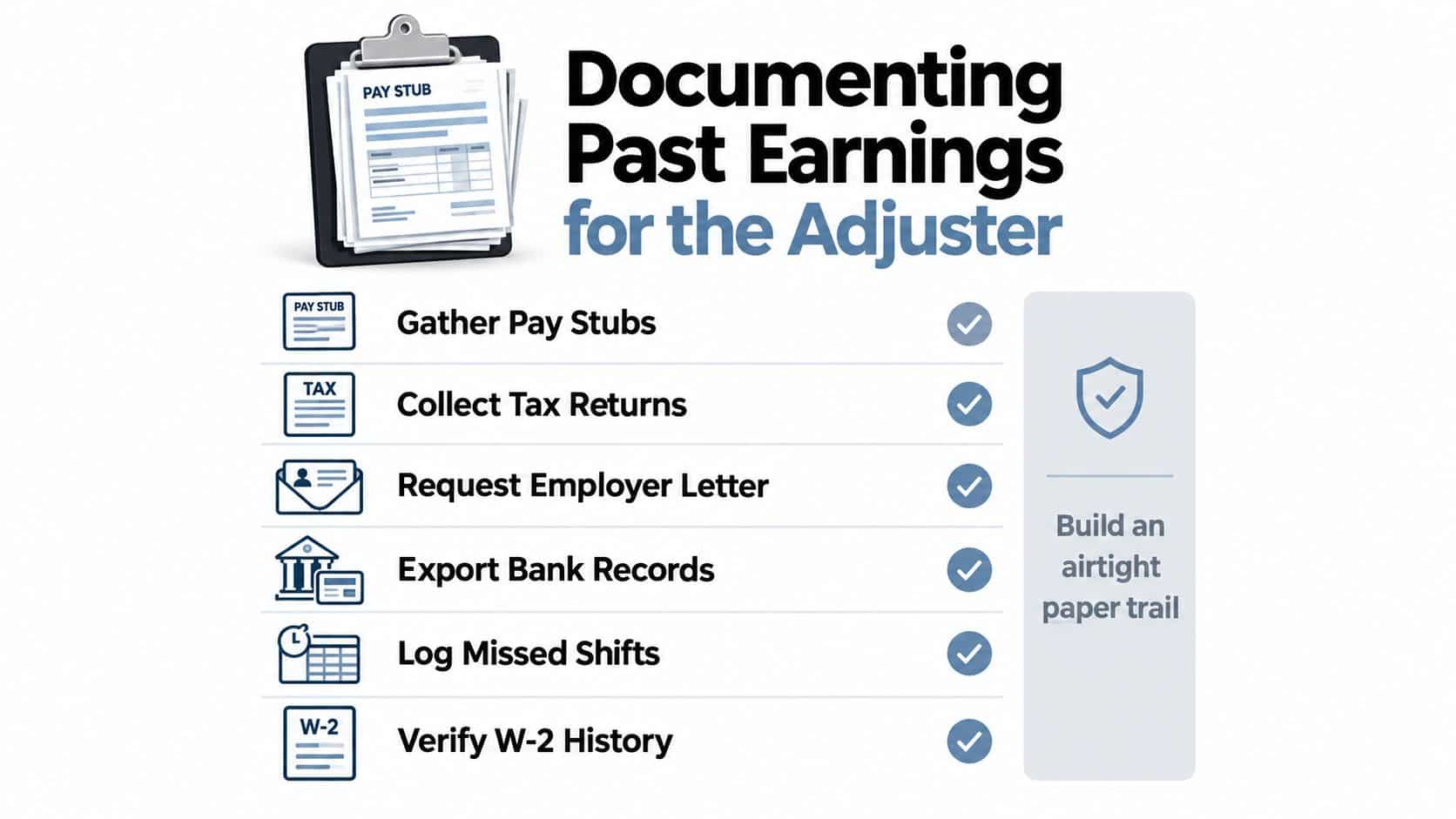
Step one, establish your normal earnings
Collect pay records from before the collision. Don't rely on a single recent check if your income changes with shifts, commissions, tips, or seasonal work.
- Pay stubs: Gather records showing regular pay, overtime, commissions, bonuses, deductions, and the dates covered.
- Tax documents: Preserve W-2s, tax returns, and other filings that establish a longer earnings history.
- Schedules and timesheets: Save the shifts, assignments, or appointments you were scheduled to complete.
- Bank records: Use deposits to corroborate payments when formal payroll records don't show the full picture.
- Employer verification: Request a signed statement identifying your position, rate of pay, missed dates, scheduled hours, and any lost benefits.
Use the records to identify the income you would've earned, not an optimistic figure based on an unusually strong week. If overtime was regular, show that pattern through historical records and schedules. If compensation included tips or commissions, preserve the records that connect completed work to expected payment.
Step two, connect the absence to the injury
An employer letter proves that you missed work. It doesn't necessarily prove that the crash caused the absence. Medical records should identify the injury, restrictions, dates you couldn't work, and the duties you couldn't safely perform.
A general note saying “off work” may be less persuasive than a restriction describing limits on lifting, driving, standing, concentration, or working a full shift. Ask your treating provider to address the actual requirements of your job and to update restrictions as your condition changes.
Step three, address nontraditional income
Self-employed people, freelancers, contractors, gig workers, and business owners need a different record set. Preserve invoices, contracts, appointment calendars, project files, business-account statements, tax returns, profit-and-loss records, and canceled bookings. Show the work that was available, the revenue normally generated, the work you couldn't complete, and whether someone else had to perform it.
Don't inflate the claim with gross business revenue when the relevant loss is reduced net income. At the same time, don't accept an insurer's assumption that a single tax return captures every lost opportunity. The right presentation depends on the business structure and the cause of the reduction.
A strong demand package tells one consistent story. Payroll records establish the baseline, medical restrictions explain the absence, and schedules or business records show the income that disappeared.
Calculating Diminished Future Earning Capacity
Returning to work doesn't automatically end an income claim. A person can be employed and still earn less because the injury limits hours, duties, advancement, or the type of work they can perform.
Consider a construction worker who can return to a job but can't safely lift heavy materials or work at the same pace. Or consider a professional who can perform tasks for part of the day but develops cognitive fatigue that prevents sustained concentration. In both examples, the person may have current earnings while facing a lasting reduction in earning capacity.
The distinction that changes valuation
Past lost wages measure income already missed. Diminished earning capacity addresses the difference between what the person could reasonably have earned without the injury and what they can reasonably earn with the injury. The second calculation requires more than multiplying missed days by an hourly rate.
The analysis may consider:
- Functional restrictions: What movements, hours, cognitive tasks, or environments are medically limited?
- Work history: What duties, promotions, overtime, and career paths were realistic before the crash?
- Transferable skills: Can the injured person move into comparable work, or does the injury force a lower-paying occupation?
- Benefits and compensation structure: Will health coverage, retirement contributions, commissions, or other employment benefits change?
- Work-life expectations: How long would the person likely have remained in the occupation, subject to evidence and applicable law?
NHTSA's analysis of serious nonfatal injuries reported that medical costs and lost productivity represented 84% of average economic cost in its 2000 national analysis. The same source reported $61 billion in lost workplace productivity, equal to 26% of total crash costs. Its methodology also distinguished workplace productivity from household productivity, reinforcing that unpaid work can have economic significance even when the injured person isn't employed.
Building a defensible projection
A vocational expert can evaluate how restrictions affect job duties and alternative employment. An economist can then model expected earnings, benefits, work-life duration, and the probability that a disability will affect future income. Medical testimony supplies the necessary foundation by explaining whether the restrictions are temporary, permanent, or uncertain.
The calculation should remain tied to evidence. A projection based on a person's actual career path, documented restrictions, and realistic alternatives is more useful than a speculative claim for every possible promotion.
For a broader explanation of how personal injury damages are evaluated, review this personal injury settlement calculation resource. The central point is simple: being back at work is a fact to analyze, not proof that the financial loss has ended.
Navigating Disability Benefits and Offsets
Wage-replacement benefits can keep a household afloat after a crash, but accepting them without understanding the consequences can complicate the final recovery. Short-term disability, paid leave, workers' compensation, unemployment insurance, and other benefits may involve different eligibility rules, repayment rights, waiting periods, or reimbursement claims.
The payment source matters. So does the language used in the application and supporting records.
Don't treat every payment as interchangeable
Canada's federal guidance explains that motor-vehicle-accident payments intended to replace employment income may count as earnings for employment-insurance purposes, while payments for pain, suffering, or medical expenses generally don't. That distinction illustrates a broader practical concern: describing a payment as wage replacement can affect benefit eligibility or later calculations.
New York workers' compensation guidance also shows that wage benefits may involve a waiting period and may be calculated from gross average weekly earnings, including overtime and compensation from two jobs. Those rules don't automatically govern an ordinary traffic collision claim, but they demonstrate why the benefit category and jurisdiction must be identified before anyone assumes an offset.
Create a benefits file containing:
- Payment notices: Keep every approval, denial, calculation, and explanation of benefits.
- Application statements: Save what you told the disability carrier, employer, or public agency about your restrictions and income.
- Reimbursement language: Look for subrogation, lien, assignment, or repayment provisions.
- Payment classification: Separate wage replacement from medical payments and noneconomic compensation.
- Multiple income sources: Document side work, commissions, and second jobs instead of relying on one employer's records.
The settlement isn't always the gross recovery
A disability carrier, workers' compensation program, or other payer may assert a right to reimbursement from a settlement. The right may depend on the policy, statute, benefit type, and jurisdiction. An insurer may also argue that amounts already paid reduce the damages it owes, even when the legal treatment is more complicated.
Don't conceal benefits, but don't casually characterize every payment in a recorded statement either. Before signing a release or accepting a settlement, determine who paid you, what the payment covered, whether a lien exists, and whether the payer can demand repayment.
This is especially important for people with fluctuating income, more than one job, or self-employment. The fastest payment isn't necessarily the payment that leaves you in the strongest financial position after medical bills, liens, and unresolved earning losses are addressed.
How Insurers and Courts Value Economic Harm
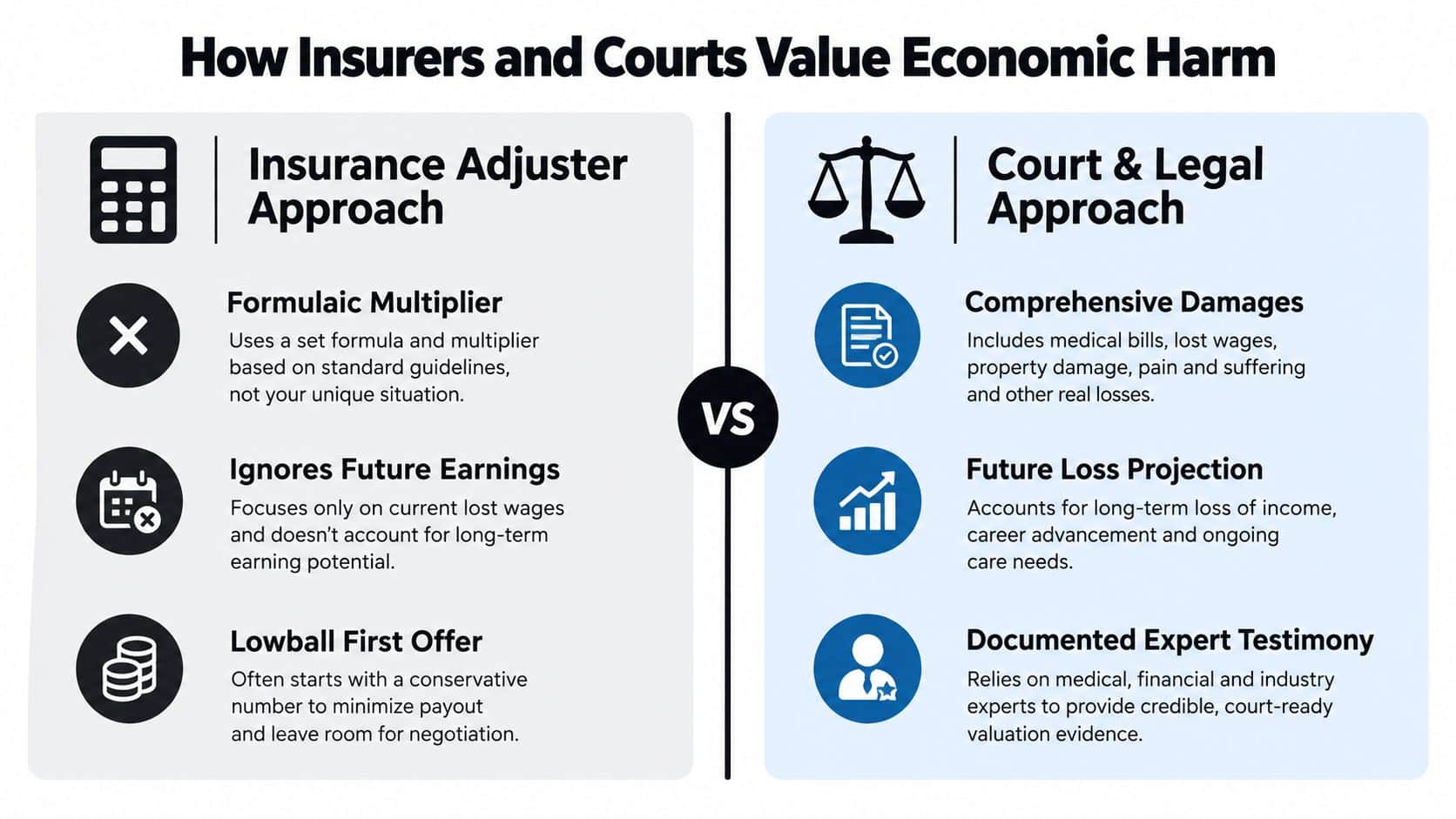
An adjuster often starts with the smallest provable number. A court, preparing for trial, examines the entire causal chain and the evidence supporting each link.
The difference becomes clear when a person misses work after a crash but continues to report pain, reduced stamina, or cognitive difficulty. An adjuster may focus on the first return-to-work date. A fuller analysis asks whether the person returned to the same duties, same hours, same pay, and same prospects.
The proof chain
A persuasive economic-damages claim usually follows this sequence:
- Crash: Evidence identifies the collision and the responsible conduct.
- Medical condition: Treatment records document the injury and its progression.
- Functional limitation: A provider explains what the injured person cannot safely do.
- Work restriction: The limitation is tied to specific job duties, hours, or assignments.
- Financial consequence: Payroll, business, benefit, and career records show the resulting loss.
This structure prevents a common defense argument: that the wage loss reflects a personal choice rather than a medically supported restriction. It also helps distinguish crash-related limitations from unrelated employment changes.
A settlement offer should be tested against the evidence, not accepted because it covers the first visible bills.
NHTSA's research separated workplace and household productivity, while its serious-injury analysis connected injury severity and permanence to economic cost. For fatal crashes, CDC work-loss estimates included expected lifetime salary, benefits, and household work based on age and sex. Those methodologies show why future losses can matter even when no immediate paystub captures them.
When records are complex, forensic accounting experts can help trace business income, compensation patterns, and financial effects. Their work is most useful when paired with medical and vocational evidence, not used as a substitute for proving the injury.
For a focused discussion of the valuation process, see this guide to economic damages calculation.
The embedded resource below provides another way to think about the financial analysis.
Legal Deadlines and the Recovery Process
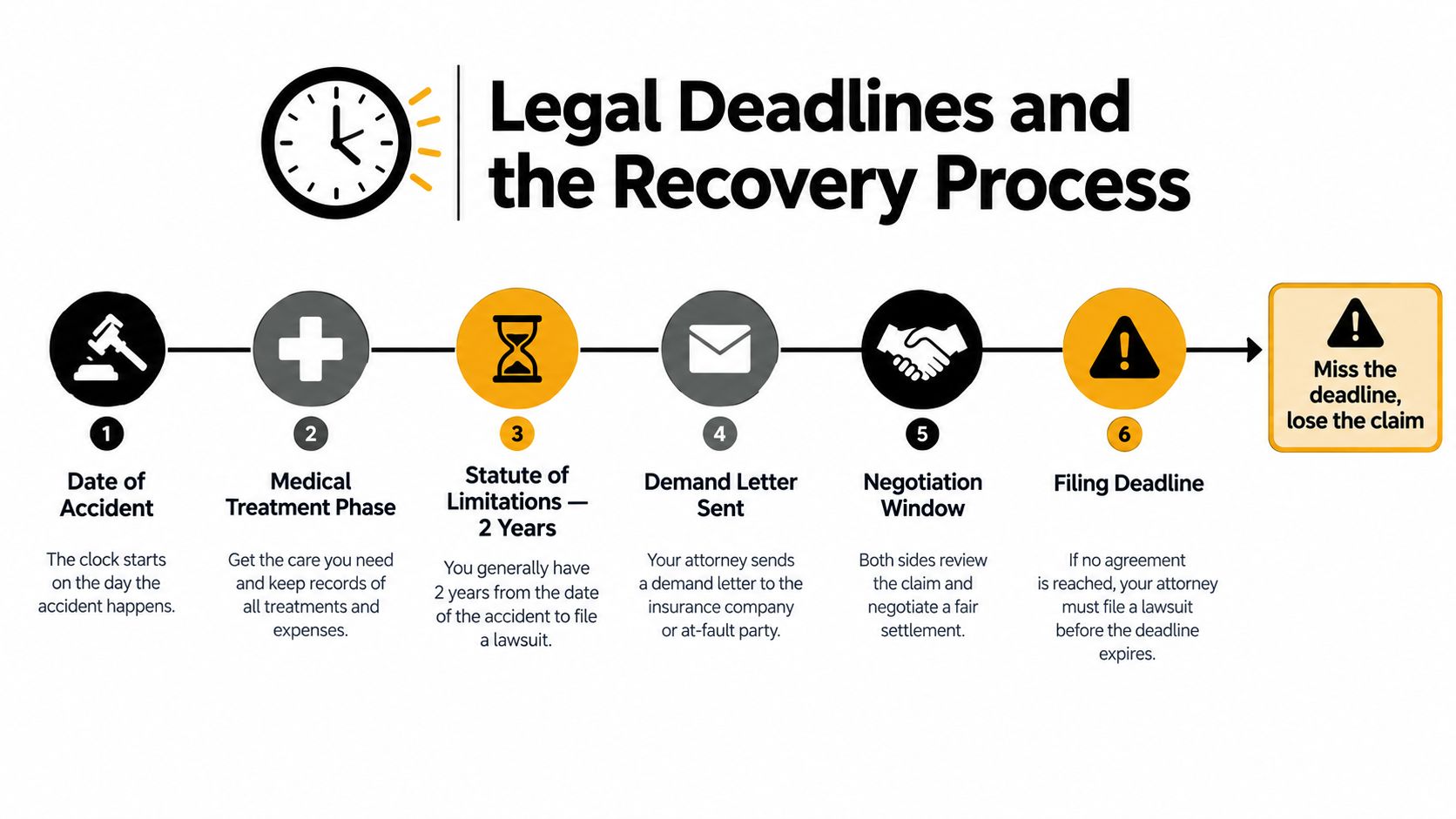
A wage-loss claim depends on the underlying personal injury claim. If the lawsuit is filed after the applicable deadline, strong payroll records won't rescue it. The time limit may differ based on the state, the defendant, the type of claim, and whether a public entity or employment-related benefit is involved.
Colorado, Texas, and New York don't share one universal deadline for every accident claim. Confirm the controlling rule early rather than relying on a general online summary. This statute of limitations resource can help identify the issues that require attention.
Preserve evidence before it disappears
The recovery process generally begins with an investigation, medical treatment, employment documentation, insurance review, demand preparation, negotiation, and litigation when necessary. Each phase affects the next.
- At the outset: Report the crash, preserve photographs and contact information, and identify every potentially relevant insurer.
- During treatment: Follow medical advice and request work restrictions that describe actual job limitations.
- While losses accumulate: Keep pay records, schedules, benefit notices, and a daily log of missed work or reduced capacity.
- Before negotiation: Assemble a demand supported by medical causation, employer verification, and a transparent calculation.
- Before any release: Review liens, offsets, future limitations, and unresolved treatment needs.
Waiting until you feel fully recovered can create problems. Employers may discard older schedules, witnesses may forget details, and an early statement to an insurer may inaccurately suggest that your financial loss ended when you resumed work. A virtual legal assistant can support document organization and deadline tracking, but legal decisions about causation, valuation, and settlement require qualified counsel.
Contacting an attorney early doesn't mean filing immediately. It means preserving the evidence needed to decide whether negotiation or litigation protects your interests.
Protecting Your Financial Future After a Crash
The most important shift is to stop treating income loss as a single calculation. Your claim should reflect the relationship between the crash, the injury, your work restrictions, your actual compensation structure, and your future ability to earn.
Use this immediate checklist:
- Get precise medical restrictions: Ask providers to describe functional limits and how they affect your actual duties.
- Notify the employer carefully: Follow workplace procedures and request written confirmation of missed dates, hours, benefits, and available accommodations.
- Track every financial effect: Record missed shifts, reduced hours, lost overtime, canceled assignments, used leave, and costs associated with arranging household help.
- Preserve the baseline: Save pay records, tax documents, schedules, commission history, contracts, and business records from before the crash.
- Catalog benefit payments: Keep notices and identify any lien, offset, reimbursement, or repayment language.
- Avoid unsupported statements: Don't tell an adjuster you're “fine” or fully recovered when symptoms still affect your work.
- Review before signing: A release can end claims for future earning capacity even when your long-term condition remains uncertain.
The evidence should be updated as treatment continues. A person who returns to work part-time may later require a vocational analysis. Someone who appears to recover may still lose advancement opportunities or be unable to perform the duties that made the former job financially viable.
Nares Law Group LLC handles motor vehicle injury claims involving medical expenses, past and future lost wages, and reduced earnings. The firm investigates the crash, coordinates with medical providers, gathers employment evidence, negotiates with insurers, and prepares cases for trial when a fair resolution isn't available.
If a crash has interrupted your income, contact Nares Law Group LLC for a case evaluation focused on both immediate wage loss and longer-term earning capacity. Bring your medical restrictions, employment records, benefit notices, and any insurer communications so the firm can assess the financial picture before you accept an offer.