The crash report isn't ready, the insurance adjuster has left another message, and your family is trying to arrange a funeral. Someone asks whether you should bring a wrongful death lawsuit. You may not even know who's allowed to make that decision.
You don't have to solve every legal question today. Start with who has the right to file, which deadlines apply, and what evidence and insurance are available. Those questions help determine whether a legally valid claim can lead to compensation your family can collect.
Who Can File a Wrongful Death Lawsuit in Colorado
A family learns that their father died in a crash. His spouse wants answers, his adult child starts collecting documents, and his parents ask whether they should contact the driver's insurer. Everyone has suffered, but that doesn't mean everyone has the same right to bring the claim.
A wrongful death lawsuit seeks compensation for legally recognized survivors when someone's wrongful conduct causes a death that would have supported a personal injury claim had the person lived. The right to file comes from statute, not from being a close relative or handling the funeral.
Why the family relationship matters
Historically, death could extinguish a personal injury claim. England's Fatal Accidents Act 1846 changed that approach by creating a statutory action for specified relatives, principally to replace lost financial support. That statutory foundation helps explain why states have different rules about eligible survivors, filing priority, and recoverable losses.
For Colorado families, eligibility and authority to file are separate questions. A person may help gather records without being an eligible claimant. Likewise, appointment as an estate's personal representative doesn't automatically make that person the plaintiff in the family's wrongful death action.
Colorado wrongful death survivors and their place in the claim
| Survivor | Place in the Claim | What They Can Seek |
|---|---|---|
| Surviving spouse | Has statutory filing priority, subject to timing and election rules | Eligible losses involving companionship, household support, and financial support |
| Children | May claim with or after a spouse under the applicable statutory rules | Eligible losses involving support, guidance, and companionship |
| Parents | May qualify when no spouse or children survive, subject to statutory conditions | Eligible losses involving support and companionship |
| Personal representative | Handles the estate's separate survival claim; appointment alone doesn't confer wrongful death beneficiary status | Pursues recoverable estate losses through the decedent's estate after appointment |
This is a starting framework, not an exhaustive eligibility determination. Colorado's current statute and the family's circumstances must be checked before anyone files, particularly when relatives disagree or the family structure doesn't fit a simple spouse-and-children example.
Start with the family documents
A marriage certificate, birth records, adoption documents, and any estate appointment papers help counsel identify the proper parties. Don't assume the person named in a will controls the wrongful death claim, or that financial dependence alone establishes eligibility.
Ask these questions today:
- Marriage: Was your loved one married when they died?
- Children: Did they have children, including legally adopted children?
- Parents: Were their parents alive?
Also identify other potentially relevant relatives rather than deciding yourself that they're excluded. Stepchildren, adult dependents, and other close relationships don't automatically qualify merely because the emotional or financial connection was strong.
Wrongful Death Versus Survival Claims
The simplest distinction is whose loss the claim addresses. A wrongful death claim addresses the eligible survivors' losses. A survival claim preserves certain claims belonging to the person who died and is pursued through their estate.
Say someone receives emergency treatment after a crash and later dies. The family may have lost ongoing financial support and companionship, while the deceased person incurred treatment expenses and lost earnings before death. Those losses shouldn't be placed into one undifferentiated demand.
| Question | Wrongful Death Claim | Survival Claim |
|---|---|---|
| Whose losses are involved? | Eligible survivors' losses | Recoverable losses belonging to the deceased person |
| Who brings it? | The person or people authorized by the wrongful death statute | The estate's appointed personal representative |
| What needs separate review? | Survivor eligibility and permitted damages | Estate authority and permitted estate damages |
Both claims can arise from the same event, but one doesn't automatically include the other. Nor does opening an estate replace the need to identify the proper wrongful death plaintiff.
Keep the accounting separate
Maintain separate folders for expenses incurred before death, funeral expenses, and the family's continuing financial losses. Counsel can then assign each item to the proper claim and prevent duplicate recovery requests.
Colorado law determines which specific items are recoverable under each action. Have a Colorado attorney confirm that allocation before filing or accepting a release that could affect both claims.
Filing Deadlines Colorado Families Must Track
A fatal crash can start three clocks running at once: the lawsuit filing period, a shorter notice window when a government entity is involved, and the shrinking time before evidence disappears. Each clock runs independently. Completing one task leaves the others untouched, which is why families need all three tracked separately from day one.
Colorado wrongful death deadlines and time-sensitive steps
| Claim or Step | Deadline | Why It Matters |
|---|---|---|
| Wrongful death lawsuit against a private party | A limited filing period set by Colorado statute, measured from the correct start date for that particular claim | Missing the filing deadline can prevent recovery entirely |
| Claim against a Colorado public entity | A much shorter written notice window under the Colorado Governmental Immunity Act, with the exact period confirmed by counsel | Notice and lawsuit filing are different requirements, and both must be satisfied |
| Evidence preservation requests | Immediately after the fatal event | Video, electronic records, and physical evidence may become unavailable |
Get an exact, written deadline calculation from Colorado counsel. A general online summary cannot determine the applicable filing period, when it begins, or whether a special rule changes it.
The date of death is where the analysis starts. Counsel also needs the incident date, the type of conduct involved, the identities of potential defendants, and information about any government involvement before committing to a date.
Notice isn't the same as filing suit
A crash involving a city vehicle or another public entity requires a different review from a claim against a private driver. Governmental immunity, notice requirements, and the proper recipient of notice can all affect whether a lawsuit may proceed.
Sending a crash report to an insurer does not satisfy a public-entity notice requirement. An adjuster's ongoing investigation does not pause the filing deadline, either.
Calendar rule: Keep separate entries for the lawsuit deadline, any government notice deadline, and immediate preservation work. Completing one doesn't complete the others.
Once counsel identifies the governing rules, MatterAlert's court date calculator guide can help you understand date-counting considerations. A calculator supports a verified legal analysis; it doesn't decide which statute applies.
Make the calendar usable
Write down the incident date and date of death, then record every deadline counsel confirms. Each entry should name the required action, the responsible person, and a reminder to verify the step was finished.
Keep copies of submitted notices and delivery records. For a lawsuit, distinguish preparing a complaint from filing it, and filing it from completing any required service on the defendants.
A claim can be strong on fault and damages and still pay nothing if a deadline passes, because the insurance behind the case only matters while the claim stays alive. Counsel can investigate the damages value while taking the procedural steps that protect the right to recover it.
How the Wrongful Death Claim Process Works, Step by Step
A family doesn't need a finished investigation before contacting counsel. The early work is about establishing authority, protecting information, and identifying every potentially responsible party.
This visual provides a broad overview. The detailed sequence below distinguishes the survivors' claim from any estate action.
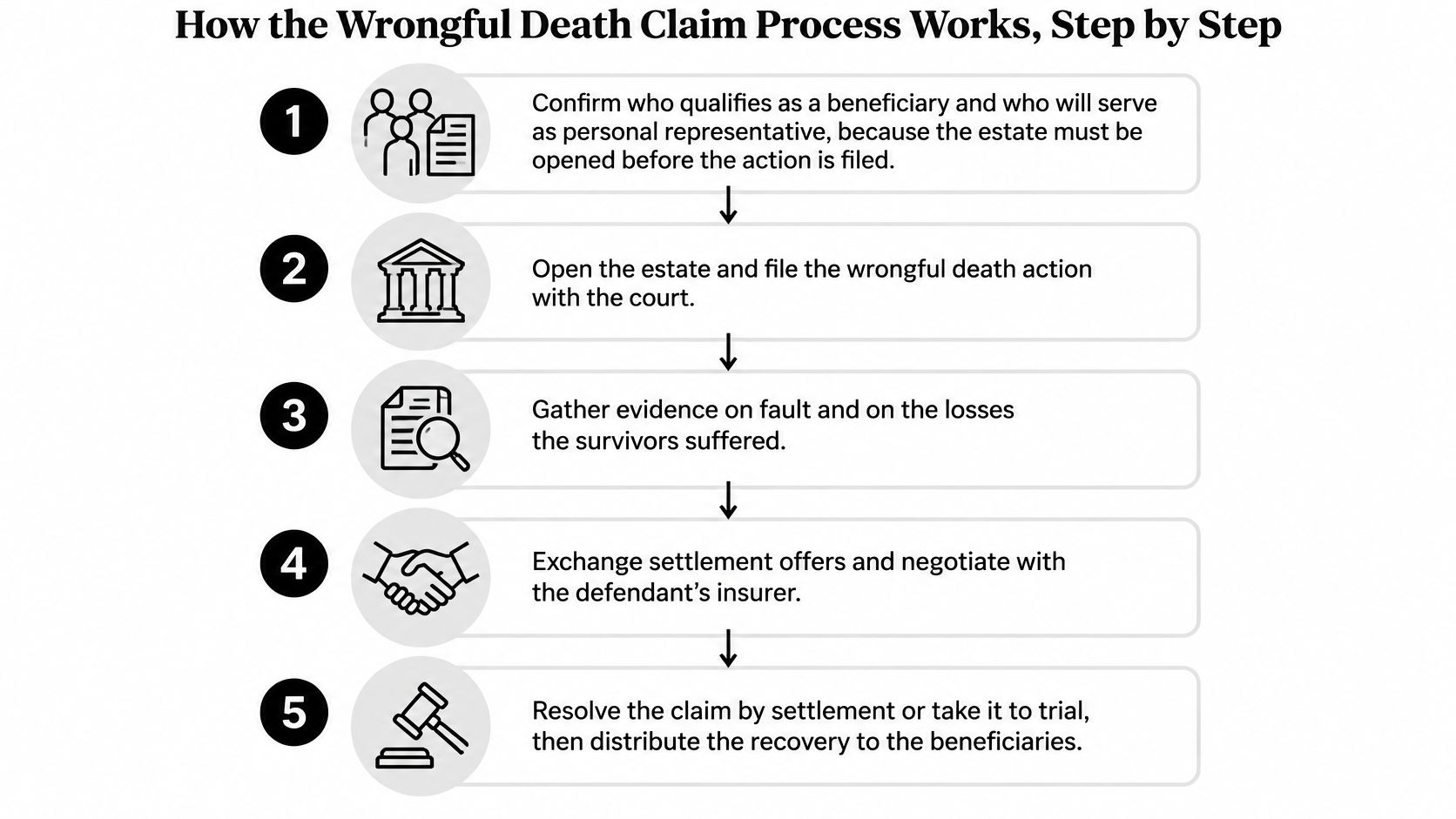
Establish authority and protect the file
Confirm the proper claimants and estate representative. Counsel reviews the family relationships and determines who may bring the wrongful death action. If a survival claim is appropriate, estate appointment must be addressed separately; opening an estate isn't a universal prerequisite to a survivor's wrongful death lawsuit.
Send targeted preservation requests. Identify the driver, employer, vehicle owner, towing company, and anyone holding relevant recordings or electronic records. A useful letter identifies the event and specific material to preserve rather than merely asking the recipient to keep everything.
Handle insurer contact deliberately. Save correspondence, claim numbers, and adjuster contact information. Before giving a recorded statement or signing a release, understand whose insurer is asking, what your obligations are, and which rights the document could affect.
Investigate how the death occurred. Obtain police materials, medical examiner findings, witness accounts, and available vehicle information. Counsel checks whether those sources agree and investigates discrepancies instead of treating an initial crash report as the final answer.
Address any public-entity requirements promptly. Counsel determines whether government involvement triggers a separate notice process and whether immunity affects the claim. Don't postpone that review until settlement negotiations fail.
Build the demand and prepare to litigate
Negotiate from a documented damages model. Present supported losses, the liability analysis, and the available coverage information. A demand should explain why the evidence supports the request, not just announce a settlement number.
File in the proper court when necessary. Counsel shouldn't allow negotiations to consume the time needed to prepare and file a complaint. Filing may be necessary before the insurer has finished evaluating the demand.
Exchange discovery. The parties request documents, take depositions, and obtain expert opinions. Testimony and technical analysis may change earlier assumptions about fault, financial loss, or available coverage.
Evaluate mediation, settlement, and trial. Counsel compares an offer with the provable damages, litigation risks, expenses, and realistic collection options. If the parties don't resolve the dispute, the case may proceed to trial.
A case doesn't necessarily move through these tasks in a rigid order. Investigation, coverage review, and filing preparation often overlap, especially when time is short.
Before substantive settlement negotiations, a well-organized file should contain a dated event timeline, a supported damages model, and a list of identified insurers and coverage questions. Missing information should be marked as an open issue, not treated as zero.
Proving Fault and Measuring Recoverable Damages
Public fatality statistics and advertised settlement averages can't predict what one family will recover. The useful questions are what the evidence proves, which losses the law recognizes, and who can pay.
The National Highway Traffic Safety Administration's traffic-fatality publication addresses population-level crash outcomes, not the value of an individual civil claim. A national trend doesn't establish whether a particular driver caused a death or whether an insurer must cover the resulting losses.
The practical work involves reviewing records like these.
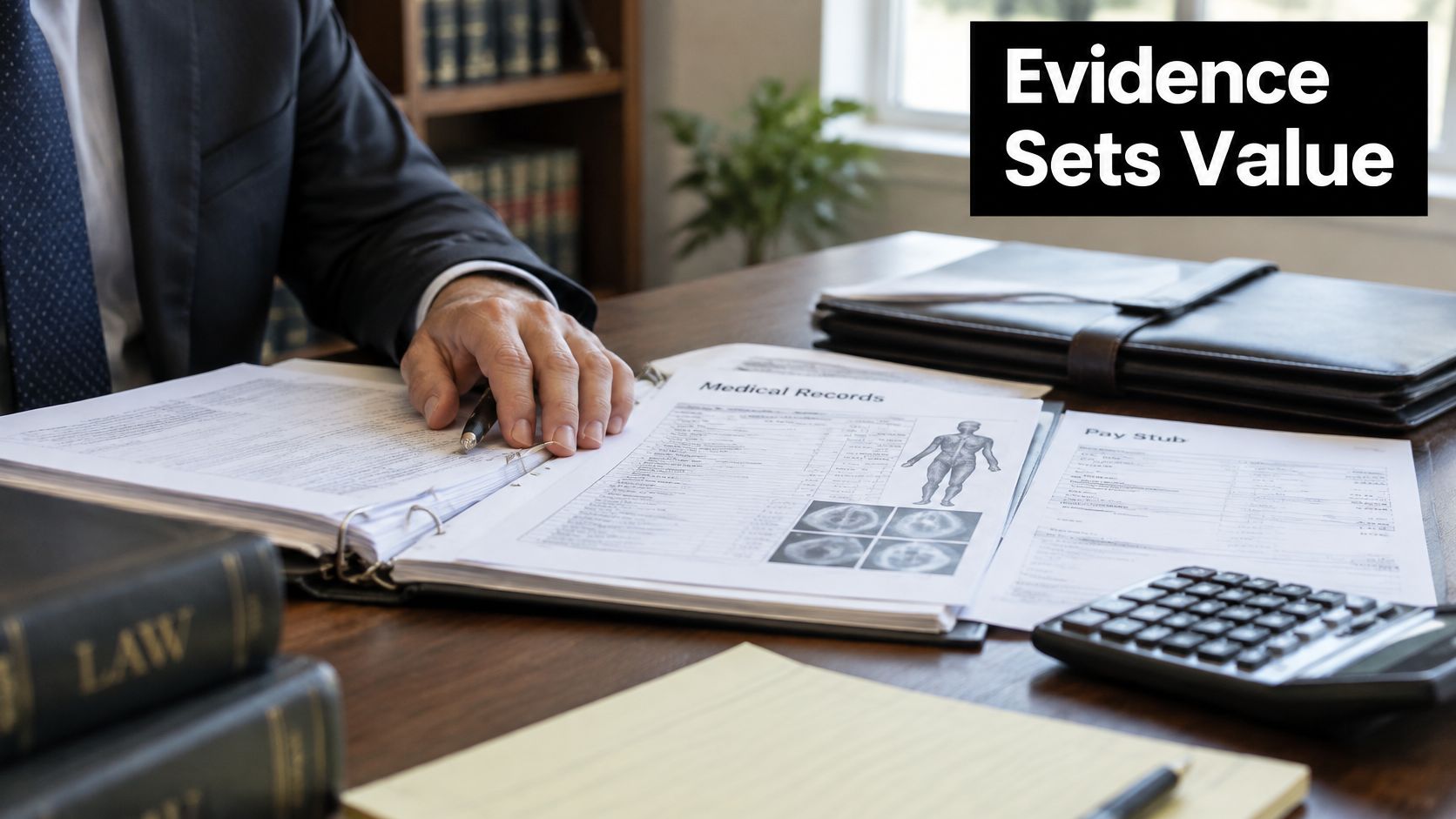
Build the evidence around disputed questions
A negligence claim generally requires a connection between someone's responsibility, their failure to act reasonably, the death, and legally recoverable losses. Our explanation of wrongful death claim elements helps distinguish those questions.
For a fatal vehicle or trucking incident, the working evidence checklist includes:
- Vehicle event data and dashcam footage: Preserve available recordings and arrange qualified retrieval of relevant vehicle information.
- Police and reconstruction materials: Obtain photographs, diagrams, measurements, witness information, and the basis for crash conclusions.
- Truck driver and electronic-logging records: Review driving activity alongside dispatch communications and other relevant commercial records.
- Medical and funeral bills: Keep itemized statements, payment records, and information identifying who incurred each expense.
- Tax returns and employment records: Document earnings, benefits, work history, and the basis for projected financial support.
- Household-service evidence: Record the work your loved one performed, such as childcare, transportation, maintenance, and caregiving.
- Relationship testimony: Describe the person's actual involvement in family life and how their death changed it.
During our investigation, we collect medical records, accident reports, witness statements, and expert opinions to establish liability and damages. Each category should answer a particular question rather than merely increase the size of the file.
Fault and coverage require separate analysis
An insurer may dispute how a collision happened even when the family considers responsibility obvious. A reconstruction expert might compare physical damage, roadway evidence, video, and vehicle information to test the competing explanations.
Colorado's comparative-fault rules can reduce recovery or prevent it when the legally applicable threshold is reached. Counsel must analyze how any conduct attributed to the deceased person affects the survivors' claim, including how fault is allocated among multiple parties.
Don't assume that any share of fault automatically defeats the case. Equally, don't assume that proof of some negligence by the other driver guarantees recovery.
Collectability is a separate question from damages. A family may prove substantial losses but face limited liability coverage and no practical source for collecting the balance.
Counsel should review potentially applicable employer coverage, additional policies, other responsible parties, and available assets. Coverage exclusions, competing claims, and disputes over who qualifies as an insured can also affect payment.
A policy limit may constrain what an insurer pays. It doesn't, by itself, establish the full value of the family's losses or identify every possible source of recovery.
Separate economic and noneconomic losses
The Colorado Judicial Branch's wrongful death model instructions distinguish economic losses, including reasonable funeral-related expenses and survivors' net financial loss, from noneconomic losses such as grief, loss of companionship, emotional stress, inconvenience, and impaired quality of life.
Colorado wrongful death damages and the proof each needs
| Damage Type | Examples | Proof Needed |
|---|---|---|
| Economic | Funeral, burial, or cremation costs | Invoices and receipts |
| Economic | Net lost financial support and household contributions | Tax returns, employment and benefits records |
| Noneconomic | Grief and loss of companionship | Testimony about the relationship and its impact |
| Noneconomic | Emotional stress and impaired quality of life for survivors | Testimony and family records |
Economic damages require more than multiplying a paycheck by an assumed working life. A sound analysis considers the support survivors would likely have received, benefits, household contributions, and appropriate assumptions about the future.
For example, a parent who worked fewer paid hours may still have supplied substantial childcare and caregiving. Documenting those tasks helps prevent an income-only analysis from overlooking the family's practical loss.
Noneconomic proof should be specific without forcing relatives to perform their grief. A spouse might explain the daily responsibilities they shared; a child's caregiver might describe the guidance and routines the parent provided.
The applicable noneconomic limitation needs current legal review, including the rules governing the particular claim. It generally concerns the aggregate claim rather than automatically increasing with every additional defendant.
Build the valuation worksheet with economic losses in one column, the legally limited noneconomic component in another, and supporting evidence beside every entry. Keep insurance and asset information on a separate collection worksheet so nobody mistakes available coverage for the amount of harm proved.
How Wrongful Death Cases Play Out in Practice
These hypothetical situations show why similar losses can lead to different legal and financial questions. They aren't predictions of settlement value.
The ordinary routines a family loses often help explain damages more clearly than a general statement about suffering.

Hypothetical family support claim
A father dies in a crash, leaving a spouse and minor children. Counsel reviews the spouse's filing authority and documents the income, school transportation, childcare, and household work the father supplied, alongside funeral expenses. Lesson: Describe the support the family lost, not just the deceased person's job title.
Hypothetical commercial truck claim
A parent dies in a crash involving a commercial truck, and the available evidence strongly supports liability. The investigation still needs to identify the responsible companies, applicable policies, and whether additional coverage or assets exist. Lesson: Clear fault doesn't eliminate the need for a careful coverage investigation.
Families seeking practical guidance after a vehicle-related death can use our explanation of what happens after a fatal car accident to organize their questions.
This accompanying video offers another format for considering the issues.
Hypothetical disputed-fault claim
An insurer argues that the driver who died contributed to the collision. Counsel compares that allegation with footage, witness statements, and reconstruction evidence before assessing the legal effect of any fault allocation. Lesson: Test an insurer's explanation against the evidence before accepting its conclusion about whether the family can recover.
For real-world context, our firm resolved a wrongful death case for $1.1 million under policy limits. That result illustrates why insurance belongs in the analysis, but it isn't a benchmark or promise for another family's claim.
Which situation sounds closest to your family's circumstances: identifying lost support, locating sufficient coverage, or answering a dispute about fault?
Confirm Your Deadline and Speak With a Colorado Attorney
Your immediate checks are the proper claimant, the applicable deadlines, and the evidence that needs protection. Write down the incident date and date of death, ask counsel to confirm the filing and any government-notice requirements, and request prompt preservation work.
Our free settlement calculators include Wrongful Death, Brain Injury, Truck Accident, and Motor Vehicle Accident Case Estimator. They offer rough orientation, not a prediction of recovery or a substitute for reviewing liability and coverage.
Prepare a useful consultation file
Bring what you have rather than delaying until the folder is complete:
- Identity and incident records: The death certificate and crash report number.
- Coverage information: Insurance details and correspondence for every known party.
- Expense and income records: Medical and funeral bills, recent tax returns, and employment information.
- Family impact: A short written account of lost support, responsibilities, and companionship.
Review our explanation of wrongful death attorney fees and bring any questions about costs to the consultation.
If you're contacting a firm outside office hours, ask how it handles urgent messages and when an attorney will review them. Lighthouse Legal's guide to nighttime intake for solo attorneys provides context about after-hours intake, but sending a message isn't confirmation that a deadline has been protected.
Early review gives counsel more opportunity to secure records, investigate coverage, and address filing requirements while your family focuses on immediate needs.
Nares Law Group LLC offers free case reviews and represents Colorado families pursuing wrongful death claims, from investigation and insurance negotiations through litigation when necessary. Visit Nares Law Group LLC to request a review, discuss the relevant deadlines, and identify the evidence your family should preserve now.