The phone keeps ringing. A hospital social worker left a message. An insurance adjuster wants a statement. A family member is asking whether anyone should “do something.” Meanwhile, you're trying to choose a funeral home, answer texts you can barely read, and make sense of a loss that still feels unreal.
That's where many families are when they start searching for answers about wrongful death claim elements. They aren't looking for legal jargon. They want to know, in plain language, whether the law recognizes what happened, what has to be proven, and what steps matter right now.
A wrongful death claim isn't about putting a price on a person. It's about accountability. It's about asking whether someone's negligence, recklessness, or wrongful act caused a death, and whether the law provides a path to protect the people left behind.
Grief also doesn't move in a straight line. Some families find comfort in legal action. Others need space first. Many do both at once. If you're also trying to hold onto your loved one's memory in more personal ways, these ways to remember loved ones can offer a gentle place to start alongside the practical demands that follow a sudden loss.
Your World Has Been Turned Upside Down
One family may be dealing with a fatal crash that happened in a few seconds. Another may be facing a different kind of shock. Their loved one survived the initial injury, seemed stable, then declined over time until the outcome no one wanted became final. Both families often ask the same question: “Does this count as wrongful death?”
That question makes sense. The law can feel cold when your loss is personal, immediate, and overwhelming. But the legal process does have a structure, and understanding that structure can make the road ahead feel less chaotic.
You don't need to know all the answers right now. You do need a clear way to think about the questions.
Families often worry that pursuing a claim is somehow aggressive or improper. In reality, many claims begin with something much simpler. A driver may have ignored basic safety rules. A company may have failed to fix a known hazard. A medical provider may have made a serious error. When that conduct causes a death, a claim can be one way to seek responsibility and financial stability for the people who depended on the person who died.
You may also be carrying practical fears that sit beside the grief.
- Who pays the final medical bills
- How the mortgage or rent will be covered
- What happens if children depended on that income
- Whether it's too early, or too late, to speak with a lawyer
Those are real concerns. They're not selfish. They're part of what the law tries to address in a wrongful death case.
The Four Core Elements of a Wrongful Death Claim
Think of a wrongful death case like a table with four legs. If one leg is missing, the table won't stand. In legal terms, those four legs are duty, breach, causation, and damages.
A helpful visual makes this easier to follow:
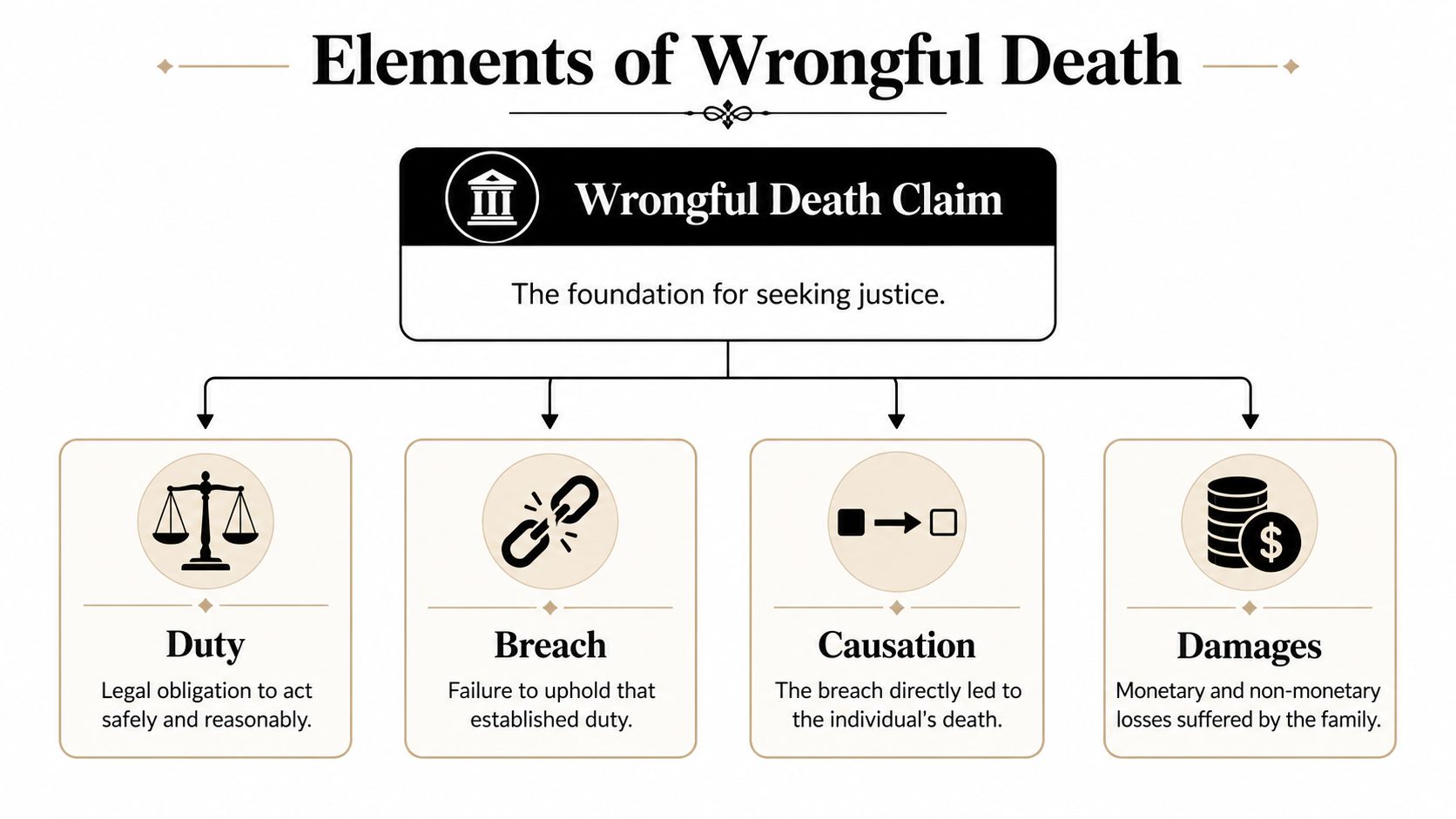
Under one summary of the law, a successful wrongful death claim requires proof of four foundational elements by a “preponderance of the evidence,” meaning a probability greater than 50% that the defendant's wrongful conduct caused the death. Those elements are duty, breach, a direct causal link, and measurable pecuniary damages, as explained in this discussion of the essential elements of a successful wrongful death lawsuit.
Duty means a legal obligation existed
A duty of care is the law's way of saying that people and businesses have basic responsibilities toward others.
A few common examples:
- Drivers must operate vehicles safely.
- Doctors and hospitals must provide care that meets professional standards.
- Property owners must address dangerous conditions they know about or should know about.
- Trucking companies must act reasonably in how they hire, train, and supervise drivers.
Duty usually isn't the hardest part to understand. It is often grasped quickly because it mirrors everyday life. We all live under rules meant to reduce harm.
Breach means someone broke that duty
A breach happens when the person or company failed to act the way the law required.
That breach might be obvious, like drunk driving. It might also be less dramatic, like failing to repair a dangerous stairway, ignoring symptoms that needed medical follow-up, or driving while distracted.
Here's the practical question lawyers ask: What rule was broken, and how do we prove it?
That proof may come from records, eyewitness accounts, photographs, electronic data, expert review, or admissions made after the event.
After you've seen the core framework in writing, it can help to hear it explained another way:
Causation links the breach to the death
Many families encounter difficulty with this aspect. It's not enough to show that someone acted carelessly. The claim must also show that the careless act caused the death in a legally meaningful way.
That usually involves two ideas:
- Cause in fact, often described as a “but-for” question. But for the defendant's conduct, would the death have happened?
- Proximate cause, which asks whether the death was a direct and foreseeable result of that conduct.
If a speeding driver runs a red light and causes a fatal collision, causation may seem straightforward. If a person suffers a traumatic brain injury, survives for months, then dies after complications and multiple medical events, causation becomes much more complex. That issue deserves close attention later because it's often where difficult cases rise or fall.
Damages mean the law must recognize actual loss
The last element is damages. In simple terms, the law asks whether surviving family members and the estate suffered losses the court can recognize.
These losses often include things like funeral expenses, medical bills related to the final injury, lost future earnings, and the loss of support the deceased would have provided. This part of the case doesn't reduce the person to numbers. It gives the legal system a way to measure part of the harm.
Practical rule: In a wrongful death case, it isn't enough to know something terrible happened. You have to be able to prove each legal step that connects the wrongful act to the family's loss.
Who Can File and When in Colorado
After families understand the wrongful death claim elements, the next question is usually more urgent: Who is legally allowed to bring the case, and how much time is there?
Colorado law has its own rules. Those rules matter because even a strong claim can be damaged if the wrong person files too early, too late, or without understanding how the filing rights are structured.
The deadline in Colorado
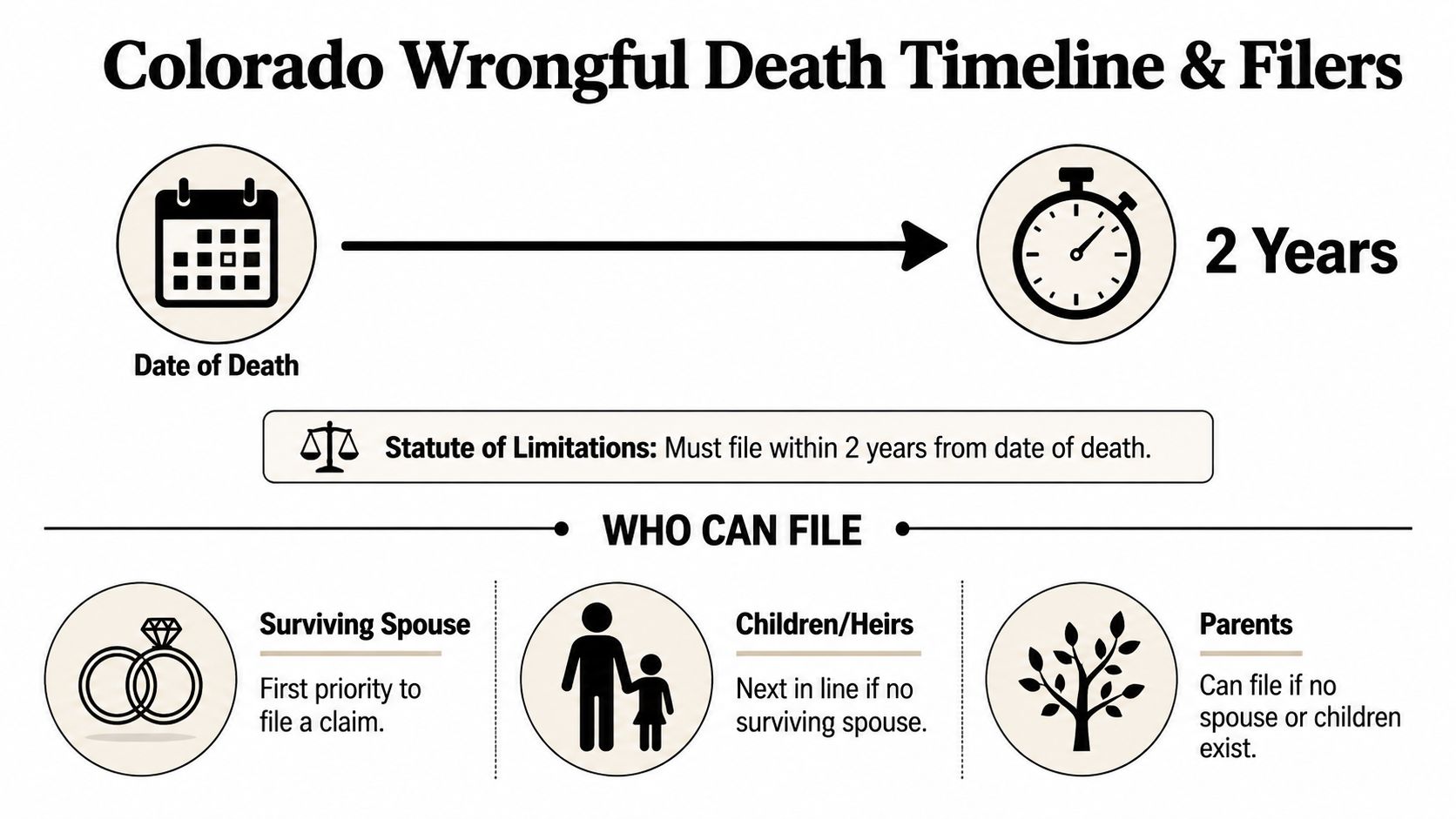
Colorado families should treat the filing deadline as urgent. State-specific time limits matter in every wrongful death case, and civil wrongful death claims are commonly subject to strict statutes of limitations. A general legal overview notes that these deadlines are usually 2 to 3 years from death, depending on the state, in its explanation of wrongful death law basics.
For Colorado-specific guidance, review this explanation of the Colorado wrongful death statute. The most important takeaway is simple: don't assume there's plenty of time.
Who may file in Colorado
Colorado also limits who can bring the claim. Families are often surprised by this. Emotional closeness and legal standing aren't always the same thing.
A simplified way to think about it is that the law gives priority to certain relatives, and that priority can change over time. In many situations, the surviving spouse has the primary right first. In other situations, children or other heirs may have rights to participate or file.
| Family role | General filing priority in Colorado |
|---|---|
| Surviving spouse | Often has first priority |
| Children or heirs | May have rights depending on timing and family structure |
| Parents | May have rights in some circumstances, especially if there is no spouse or child |
Why this becomes a problem
The filing issue gets complicated when families are grieving in different ways or aren't on the same page. One person may want immediate legal action. Another may want to wait. Someone else may assume they automatically control the claim because they paid funeral costs or were closest to the deceased.
That's not how courts analyze it.
- Legal status matters: The court looks at statutory rights, not family assumptions.
- Timing matters: The order of priority can affect who may act during different periods.
- Coordination matters: Multiple relatives may need a clear plan to avoid conflict and delay.
The worst time to discover a filing problem is after evidence has gone stale or a deadline has passed.
If you're in Colorado, it's wise to get answers early, even if you're not ready to decide whether to pursue litigation. A consultation can clarify who has standing and what deadlines control the case.
The Types of Compensation Your Family May Recover
When families hear the word damages, they often recoil. It can sound clinical. But this part of the law is really about recognizing loss in the only language courts can formally use.

One legal summary explains that courts distinguish between economic damages, such as lost income and household services, and non-economic damages, such as grief, mental anguish, and loss of consortium. It also notes that the claim is brought by a personal representative for the estate on behalf of surviving beneficiaries, as discussed in this overview of wrongful death case elements and damages.
Economic losses
Economic damages are the financial harms that can be documented and calculated.
These may include:
- Final medical expenses: Bills for treatment after the injury and before death.
- Funeral and burial costs: Out-of-pocket costs connected to laying your loved one to rest.
- Lost earnings or support: Income the deceased likely would have contributed to the family.
- Household services: The unpaid work people do every day, such as childcare, transportation, cooking, maintenance, or care for an older parent.
Families sometimes overlook household services because there was never a paycheck attached to them. But those contributions were real. If one parent handled school pickups, meals, and daily routines, the family now has to replace that labor somehow.
Non-economic losses
Non-economic damages try to account for the human side of the loss.
That can include:
- Loss of companionship
- Loss of guidance
- Loss of care and support
- Mental anguish and grief, where allowed by law
No amount of money fixes those losses. Courts know that. The legal system isn't pretending otherwise. It's trying, imperfectly, to acknowledge that the death changed the family in ways that aren't listed on a bill.
Why documentation still matters
Even personal losses need proof. That may include testimony about the relationship, photographs, calendars, messages, caregiving patterns, and the routines your loved one held together.
If you want a plain-language overview of how these categories may affect a claim, this wrongful death lawsuit payout guide can help families understand how lawyers and insurers evaluate losses.
A useful question is not “What was my loved one worth?” The better question is: What support, stability, labor, care, and connection did this person provide, and how has the family been harmed by losing it?
Proving Your Case and Overcoming Defenses
Many families assume that if negligence seems obvious, the case will be simple. Often, it isn't. The defense rarely says, “Yes, that's what happened.” Insurance companies and defendants usually test every link in the chain.
The evidence that usually matters
A wrongful death case is built from details. Different cases rely on different records, but common evidence includes:
- Accident reports from police or investigating agencies
- Medical records that show the injury, treatment, and cause of death issues
- Witness statements from people who saw what happened or knew the sequence of events
- Photographs and video from the scene, nearby businesses, or devices
- Expert testimony from doctors, accident reconstruction specialists, or other professionals
- Employment and financial records to show lost support and economic harm
Some evidence disappears quickly. Surveillance footage can be overwritten. Vehicles get repaired or destroyed. Witness memories fade. That's one reason early investigation matters.
The defense may argue your loved one was partly at fault
In many cases, the other side doesn't deny a tragedy happened. They argue the deceased contributed to it.
That can happen in a crash case if the defense says the person was speeding, distracted, or failed to react. It can happen in a premises case if they argue the hazard was open and obvious. It can happen in a medical case if they claim the patient delayed treatment or failed to follow advice.
These arguments don't always defeat a claim, but they do affect value and strategy. Families should be prepared for them.
Proximate cause is where delayed-death cases get hard
This is the part competitors often gloss over, and it matters greatly in traumatic brain injury cases.
A legal discussion of wrongful death elements notes that proximate causation is a critical challenge. It states that 30 to 40 percent of wrongful death dismissals in some states occur when courts view the chain of events as too indirect, and that courts have increasingly rejected claims involving deaths from TBI complications occurring 6 or more months after an accident when there isn't strong expert testimony connecting the initial injury to the final outcome, as described in this FAQ on wrongful death elements and causation.
That doesn't mean delayed-death cases can't succeed. It means time alone doesn't prove causation.
If your loved one died months after the original incident, the key question isn't just what happened first. It's whether qualified experts can persuasively connect the first event to the final death.
Here's a simple way to think about proximate cause:
| Situation | Why causation may be easier or harder |
|---|---|
| Fatal crash at the scene | The link between conduct and death may be more direct |
| Severe injury followed by long hospitalization | The defense may argue later complications broke the chain |
| TBI followed by decline and death months later | Expert medical testimony often becomes central |
Families in these cases sometimes also wonder whether a more detailed post-death examination could clarify what happened. In some situations, a guide to private autopsies for families can help you understand what that process involves and when it may provide useful answers.
Practical Steps to Protect Your Family's Rights
The first days and weeks after a death are not the time for perfect decision-making. They are the time for protective decision-making. Small steps can preserve important options later.
What to do early
- Avoid a recorded statement: The at-fault party's insurer may sound sympathetic, but their job is to evaluate and limit exposure. You don't have to speak off the cuff while you're grieving.
- Gather what you already have: Keep hospital papers, police reports, funeral invoices, photographs, text messages, and contact information for witnesses in one place.
- Write down the timeline: Memories blur quickly after trauma. A simple notebook or phone note with dates, calls, symptoms, and events can become valuable later.
- Track the family impact: Keep a running record of missed work, childcare changes, household help now needed, and major emotional or practical disruptions.
Why these steps matter
These actions aren't about rushing into a lawsuit. They're about protecting the truth.
If a family waits too long, records may become harder to obtain, evidence may vanish, and people may remember less. Early organization also helps a lawyer evaluate whether the wrongful death claim elements can be proven, rather than guessed at.
For families trying to sort through the larger financial aftermath, including policy issues that may arise after a death, this guide to managing life insurance may help with one separate part of the process.
Get legal advice before making big choices
You don't have to commit to filing a claim to ask questions. You can consult a lawyer to learn who may file, what deadlines apply, and what evidence should be preserved. If you want a practical overview of the process, this step-by-step guide to filing a wrongful death claim is a useful starting point.
Some firms also offer case-evaluation tools. For example, Nares Law Group LLC provides a wrongful death settlement estimator that asks users about liability, source of recovery, and damages. Tools like that don't replace legal advice, but they can help families identify the questions that matter most before a full consultation.
Frequently Asked Questions About Wrongful Death Claims
Families usually have a few questions that remain even after they understand the basics. The answers below are meant to be direct and practical.
| Question | Answer |
|---|---|
| What if my loved one was partly at fault? | Partial fault does not always end a wrongful death claim. It may give the defense an argument to reduce or challenge recovery, depending on the facts and the law that applies. This is one reason early investigation matters. |
| Does a wrongful death claim require criminal charges? | No. A wrongful death case is a civil claim. It can exist whether or not prosecutors file criminal charges, and regardless of what happens in a criminal case. |
| Do we need to prove the case beyond a reasonable doubt? | No. Wrongful death claims are civil cases. The standard described in the legal summary cited earlier is a preponderance of the evidence, which means showing it is more likely than not that the defendant's wrongful conduct caused the death. |
| Who actually brings the claim? | That depends on state law. In some cases, a personal representative brings the claim on behalf of the estate and beneficiaries. In Colorado, standing and filing priority require close attention to the statute and family circumstances. |
| What if death happened long after the original injury? | Those cases can be much harder because causation may be disputed. The defense may argue that later medical complications, other health issues, or intervening events broke the chain between the original negligence and the death. Expert testimony often becomes central. |
| Can a case include both financial and personal losses? | Yes. Courts commonly distinguish between economic losses, such as lost income or household services, and non-economic losses, such as loss of companionship or mental anguish, where allowed by law. |
| How do wrongful death lawyers get paid? | Many wrongful death lawyers work on a contingency fee. That usually means the lawyer is paid from a recovery rather than from upfront hourly billing. You should always ask for the fee agreement in writing and make sure you understand costs and expenses. |
| Should we wait until after the funeral to talk to a lawyer? | Not necessarily. You don't have to make final decisions right away, but an early conversation can help preserve evidence and prevent avoidable mistakes. A consultation can be about information, not commitment. |
Grieving families often feel pressure to become investigators overnight. You don't have to do that alone, but you should act soon enough to preserve the facts.
If your family is facing questions about a fatal crash, a truck wreck, a traumatic brain injury, or another preventable loss, Nares Law Group LLC can help you understand your options under Colorado law. A conversation with an attorney can clarify who may file, what deadlines apply, and what evidence should be protected, so your family can make informed decisions during a very difficult time.