A family member is lying in a trauma bay, surrounded by monitors, scans, and urgent conversations. You hear a doctor mention a modified GCS score, but no one has time to explain what those letters mean. You may be wondering whether the number tells you how serious the brain injury is, whether it predicts recovery, and what it could mean if an insurance company later disputes the claim.
Those questions are reasonable. The Glasgow Coma Scale is a clinical communication tool, not a complete forecast of someone's future. A modified version may account for limitations in the original examination or add information that helps clinicians estimate severity more accurately. The score can also become important documentation in a traumatic brain injury claim, particularly when medical records must show how the injury affected consciousness over time.
When You First Hear the Term Modified GCS Score
The first conversation may happen while your family is still trying to understand whether the injured person is stable. A nurse might say the patient's “GCS was recorded,” while a physician asks whether the latest assessment was standard or modified. The language sounds precise, but in the moment it can feel frighteningly incomplete.
The Glasgow Coma Scale, or GCS, measures observable responses. It doesn't directly measure pain, memory, personality changes, balance, or the ability to return to work. It gives clinicians a structured way to describe consciousness and follow changes after a head injury.
A modified GCS score usually means that clinicians have adapted the original approach because the standard examination doesn't fit the patient or because additional information may improve interpretation. An intubated patient may be unable to speak. A child may need age-appropriate communication. A patient's age, pupil responses, or laboratory findings may also affect how clinicians evaluate risk.
What families should hear: A modified score isn't automatically a sign that the injury is worse. It often means the medical team is trying to record the patient's condition more fairly and precisely.
The distinction matters outside the hospital, too. Medical records may later be reviewed by neurologists, rehabilitation professionals, attorneys, insurers, or a jury. A single number rarely answers every question, but a consistent record can help show what clinicians observed, what prevented a complete examination, and how the patient changed.
Families should ask simple questions without hesitation: What type of GCS was used? Which responses were tested? Was the patient sedated, intubated, intoxicated, or otherwise unable to participate? Were later scores recorded under comparable conditions?
Understanding those details can reduce confusion during recovery and prevent an isolated number from being taken out of context in a personal injury case.
Understanding the Standard Glasgow Coma Scale
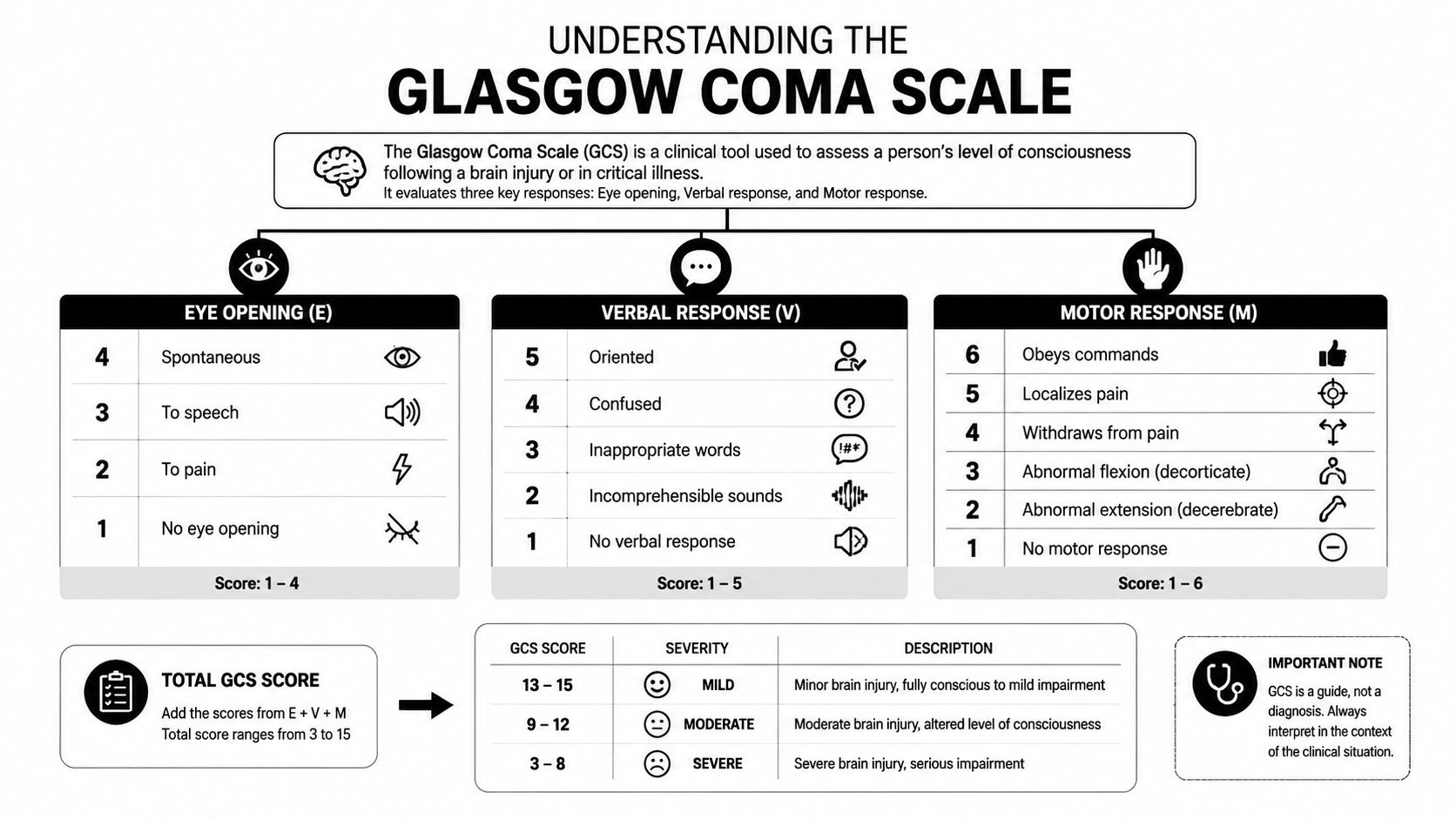
The standard GCS examines three response areas:
- Eye opening, which asks whether the patient opens their eyes spontaneously, in response to speech, in response to physical stimulation, or not at all.
- Verbal response, which considers whether the patient is oriented and speaking appropriately, confused, using inappropriate words or sounds, or making no verbal response.
- Motor response, which looks at whether the patient follows commands, moves toward a stimulus, withdraws, demonstrates abnormal posturing, or shows no movement.
Each component receives its own value, and clinicians add the components to create a total from 3 to 15. A higher total generally reflects more observable responsiveness, while a lower total indicates a more impaired level of consciousness. The total must be read alongside the individual components because two patients can have the same total with very different patterns of eye, verbal, and motor responses.
For example, a patient who opens their eyes spontaneously but cannot speak because of a breathing tube may not be comparable to a patient who is awake but confused. The total may look similar, yet the reason for the verbal finding is completely different. That's why clinicians should document both the total and the component findings.
The GCS was first published in 1974 as a 14-point scale. In 1977, clinicians revised it to a 15-point scale by separating abnormal flexion from normal flexion in the motor response. That version remained accepted in clinical practice for more than 25 years, and later guidance adopted the 15-point structure for repeated mental-status assessments in trauma care because it improved communication and tracking of coma duration. The scale was relaunched in 2014 with the same 15-point structure, reflecting an enduring framework refined through clinical use. These historical details are described in the history and clinical development of the Glasgow Coma Scale.
The standard GCS is useful because it gives different professionals a shared vocabulary. It's also limited because an observed response may reflect airway equipment, medication, injury to the face, language barriers, or a patient's baseline condition rather than consciousness alone. Those limitations are the reason clinicians sometimes document a modified assessment.
For a plain-language overview of how providers use the scale after brain injury, families can review Glasgow Coma Scale information for patients and families.
How Modified GCS Scores Adapt the Original Scale
A modified GCS score keeps the original purpose, but changes the way clinicians record or interpret the assessment. The modification should always be identified in the chart. Otherwise, a later reader may assume that a standard total was calculated under ordinary conditions.
The standard examination and its practical limits
The standard GCS works best when clinicians can assess all three response categories. That isn't always possible. Intubation can prevent verbal communication, facial trauma can interfere with eye assessment, and sedation can suppress responses. Children may also require developmentally appropriate instructions rather than adult language.
In those situations, clinicians may document the untestable component, describe the reason, and rely more heavily on the available observations. The exact notation and scoring practice can vary by institution and clinical protocol, so families shouldn't try to reconstruct a total from incomplete records without medical guidance.
Adding pupil responses with GCS-P
One major modern adaptation is the GCS-P, or Glasgow Coma Scale–Pupils. Introduced in 2018, it combines the GCS with pupillary reactivity to create a single severity index for traumatic brain injury. The approach recognizes that consciousness and pupil response provide related but distinct information about neurological injury.
The GCS-P doesn't replace the underlying examination. It adds a structured pupil component to help clinicians interpret severity, especially when they're assessing traumatic brain injury and mortality risk. A family member should ask whether the record contains the ordinary GCS, the pupil findings, or both.
Adjusting for age and adding serum factors
Age-adjusted approaches use different GCS category boundaries for different age groups. Research using National Trauma Data Bank information from 2010 through 2015 found that revised age-specific categories predicted mortality more effectively than standard cutoffs, with an AUC of 0.800 compared with 0.755, p<0.001. The revised boundaries changed for nearly all age groups except patients in their 50s, where the familiar categories remained similar. The findings are detailed in this age-adjusted GCS study.
Another modification combines neurological assessment with serum factors through multivariable logistic regression. The model incorporated laboratory information rather than treating the bedside examination as the only input, and the authors concluded that it was useful for predicting in-hospital mortality. This type of approach may be particularly relevant when sedation, intubation, facial injury, or fluctuating mental status makes the examination less complete, as described in the serum-enhanced modified GCS research.
A separate clinical reference explains that ATLS-based guidance categorizes a GCS of 13 as mild TBI, creating a mild range of 13 to 15, rather than 14 to 15. That distinction can affect triage and documentation, but it doesn't independently determine a person's recovery.
For broader evaluation after a head injury, families may also find neurological tests for brain damage helpful.
Comparing Standard and Modified GCS in Practice
The same bedside assessment can serve different purposes depending on the patient and the question being asked. The standard GCS records eye, verbal, and motor responses. A modified version identifies limits in that examination or adds information such as pupil reactivity, age-specific interpretation, or serum findings.
| Aspect | Standard GCS | Modified GCS |
|---|---|---|
| Core information | Eye, verbal, and motor responses | Those responses, with an identified adaptation |
| Best use | A patient who can participate in the examination | Intubation, sedation, age-related interpretation, pupil findings, or laboratory-enhanced assessment |
| Calculation | Components are combined into the standard total | The chart should identify the added or changed element |
| Main value | Tracks observable consciousness | Addresses limits in the examination or improves severity interpretation |
| Main caution | May hide why a component is abnormal or unavailable | Different modifications aren't interchangeable |
An intubated trauma patient shows why the chart wording matters. The patient may follow commands while the breathing tube prevents speech. Recording the verbal component as untestable preserves that distinction. A bare total can make inability to speak look like an absent response, which may confuse later clinicians and anyone reviewing the record for a legal claim.
Age can change the meaning assigned to the same observation. An older adult's unadjusted total may not sort mortality risk in the same way as a younger patient's score, so clinicians have studied age-specific categories. The adjustment changes interpretation, not the patient's level of consciousness.
A biomarker-enhanced score addresses a separate clinical question by combining the bedside examination with serum information. It may be worth asking whether that approach was considered when sedation, intubation, facial trauma, or a fluctuating mental state made the initial examination incomplete. A family or lawyer can request clarification of which component was testable, which modification was used, and whether the recorded total is standard or adjusted.
Those details help connect emergency care, repeat assessments, and later rehabilitation records. They also give an attorney a clearer way to compare notes without treating unlike scoring systems as interchangeable. The score remains one part of the record alongside imaging, neurological examinations, and daily functional observations.
Families researching treatment options may encounter specialized interventions. For general information about evidence for hyperbaric TBI therapy, ask the treating neurologist whether a proposed therapy fits the diagnosis, timing, risks, and established care plan.
What Different Score Ranges Mean for Recovery
A family may hear “GCS 8” in the emergency department and wonder what that number says about the months ahead. The usual ranges organize the initial level of responsiveness, but they do not describe every injury, treatment factor, or later ability. Two patients with the same total may show different eye, verbal, and motor responses.
The commonly used categories are:
- Severe TBI, generally associated with scores from 3 to 8.
- Moderate TBI, generally associated with scores from 9 to 12.
- Mild TBI, generally associated with scores from 13 to 15, consistent with the ATLS-based threshold described in clinical guidance available through the National Center for Biotechnology Information.
A severe-range score often leads clinicians to provide intensive monitoring and consider airway support because consciousness is substantially impaired. Moderate-range injuries can produce very different courses. Even a mild-range score may accompany headaches, memory problems, dizziness, emotional changes, disrupted sleep, or difficulty returning to work.
Why the first number can mislead
The first score records what the team could observe at that moment. Medication, low oxygen, seizures, alcohol or other substances, pain, shock, swelling, and emergency procedures may alter the examination. Repeated assessments show whether responses improve, worsen, or fluctuate as those conditions change.
Modified approaches can place the same bedside findings in another interpretive category after adding information about age, pupils, or another clinical factor. The adjustment changes how clinicians organize risk and treatment decisions. It does not rewrite the responses documented at the bedside.
Families may also hear about treatments intended to affect brain pressure or swelling. The FindMyScript mannitol guide explains mannitol's general mechanism in plain language. The treating team must decide whether that treatment fits the patient's findings, risks, and care plan.
Recovery discussions become more useful when they follow function over time. Relevant markers may include waking consistently, following commands, communicating needs, participating in cognitive rehabilitation, tolerating therapy, remembering instructions, managing medications, returning to work duties, or handling daily activities safely. These observations belong beside the score in medical records and can help families and attorneys understand how the injury affected ordinary life.
For practical warning signs and symptoms that may follow a traumatic brain injury, review signs of TBI. New or worsening symptoms require urgent medical attention, regardless of an earlier score.
The video below provides additional educational context about brain injury assessment:
Limitations and Common Misinterpretations
The most dangerous misunderstanding is believing that one GCS number tells the whole story. It doesn't explain the cause of the injury, the location of bleeding, the effect of swelling, the patient's baseline abilities, or the functional problems that may appear after consciousness improves.
Several factors can distort the apparent result:
- Sedation or paralysis: Medication may reduce responses even when the underlying neurological function is different.
- Intubation: A breathing tube prevents ordinary speech and can make the verbal component untestable.
- Facial trauma: Swelling, fractures, or dressings may interfere with eye opening.
- Baseline conditions: Dementia, developmental disabilities, hearing loss, language differences, or prior neurological disease can affect responses.
- Intoxication or medical instability: Substances and systemic illness can complicate the earliest examination.
The trend often carries more meaning than an isolated entry. Clinicians want to know whether responses are improving, worsening, or fluctuating, and under what conditions each assessment occurred. A small change may matter when it is consistent and clinically supported, but it may mean something different if medication was changed or the patient was moved from an airway device.
Practical rule: Always ask for the component scores and the circumstances surrounding the assessment, not just the total.
Families should also resist the opposite error. A higher score can be encouraging, but it doesn't guarantee a complete recovery. Someone can be awake, speaking, and still have serious executive-function problems, impaired judgment, fatigue, sensory sensitivity, or an inability to resume prior work.
For legal purposes, these limitations make accurate documentation more valuable, not less. A record that explains why the verbal component was unavailable may prevent an insurer from treating that missing response as proof of greater impairment. A record that tracks sedation and serial examinations may help a medical expert distinguish temporary treatment effects from neurological changes.
If you're preserving records, request the emergency department notes, trauma flowsheets, nursing assessments, medication administration record, airway documentation, imaging reports, neurology consultations, rehabilitation evaluations, and discharge instructions. Keep a separate timeline of symptoms and functional changes at home.
Why Documentation Matters for Legal Cases
In a motor vehicle collision or truck wreck, the GCS may be one of the earliest objective entries showing how the injured person presented after the event. It can help connect the accident to an acute change in consciousness, but its value depends on context. A score without the component findings, timing, medication information, and explanation of any modification can be misunderstood.
A complete record should make it possible to answer four questions:
- When was the assessment performed?
- Which eye, verbal, and motor responses were observed?
- Was the standard scale used, or was an adaptation applied?
- What conditions could have affected the result?
Hospitals may record these details in different parts of the chart. Families should request the complete medical record rather than relying only on a discharge summary. The full file may include repeated nursing observations, emergency medical services documentation, physician notes, imaging, medication records, and rehabilitation findings.
How insurers may use isolated numbers
An insurer may focus on a later, higher score and argue that the injury was minor. That argument can ignore the initial loss of consciousness, sedation, intubation, evolving neurological findings, or persistent cognitive symptoms. It may also overlook the difference between being awake and being able to function safely and independently.
A careful review compares the score with the rest of the evidence. CT or MRI findings, neurological examinations, therapy notes, work restrictions, family observations, and neuropsychological testing may show problems that a brief consciousness score cannot capture.
A legal record should tell the patient's timeline, not just display the most favorable number.
Medical experts can explain the modification used and its limitations to attorneys, insurers, judges, and juries. They can also connect the acute findings to later consequences, such as assistance with daily tasks, reduced earning capacity, treatment needs, and changes in quality of life. The score doesn't establish every element of damages by itself, but it can become an important part of the medical chronology.
Families can take practical steps immediately:
- Request complete records: Ask for emergency, trauma, inpatient, imaging, medication, and rehabilitation documentation.
- Preserve the timeline: Write down symptoms, appointments, restrictions, missed work, and changes in household responsibilities.
- Identify inconsistencies: Note differences between EMS notes, emergency records, nursing assessments, and discharge summaries.
- Avoid speculation: Don't alter medical records or guess at a score. Ask the treating team to clarify what was documented.
- Get advice early: A personal injury attorney can help preserve evidence, coordinate record review, and identify appropriate medical experts.
Nares Law Group LLC handles motor vehicle crashes, truck wrecks, traumatic brain injury claims, and wrongful death matters, including medical-treatment coordination, investigation, negotiation, and trial preparation. If a modified GCS score appears in your loved one's records, visit Nares Law Group LLC to learn how the firm can help preserve the medical timeline and evaluate the injury claim. Contact the firm for a consultation about the records, evidence, and next steps that may protect your family's legal rights.