You're on the floor, your shoulder hurts, and the manager is asking if you can fill out a short report before you leave. Your phone is in your hand, but you're still trying to understand what just happened. That split second of confusion is exactly where a premises liability law firm becomes useful, because the first choices you make can shape whether the evidence survives long enough to prove what happened.
These cases are a significant part of the civil justice system. U.S. Department of Justice data shows they make up 11% of all civil cases that go to trial, and victims receive approximately $4 billion per year in compensation, which is why these claims are never just minor paperwork disputes, even when the injury started with a simple fall or a bad step on someone else's property. premises liability case statistics and trends
A lot of people assume the next step is just “call a lawyer.” In reality, the next step is usually to preserve the scene, the witnesses, and the records before they disappear. If you're trying to figure out what to do after an injury, a practical starting point is this victim of accident resource, because it helps organize the immediate aftermath while you're still dealing with shock, pain, and uncertainty.
After an Injury Navigating the First Steps
A woman slips near a store entrance after rain has been tracked inside. She's embarrassed, then angry, then worried, because the pain in her wrist is getting worse and the floor is already being mopped as if nothing happened. That mix of discomfort and confusion is common, and it's exactly why the first hour matters so much.
The law doesn't reward the person who panics fastest. It rewards the person who can later prove what the hazard was, how long it existed, and who had the chance to deal with it. A good premises liability law firm starts by making the situation more orderly, not more dramatic.
The first priorities after the fall
The safest move is usually to get medical attention, report the incident, and preserve whatever you can from the scene. Photos, names, clothing, footwear, and the words employees use right after the incident can all matter later, even if they seem small at the time. A wet floor, a broken handrail, or poor lighting often looks obvious in the moment, but those conditions can vanish fast once cleaning starts or a repair crew arrives.
Practical rule: If there's a hazard, treat the scene like temporary evidence. Temporary evidence is easy to lose.
That's why these claims are not just about pain, they're about documentation. When a client is hurting, paperwork and proof can feel secondary, but they're often the only way to show the property owner had a fair chance to fix the problem and didn't. For a plain-language overview of what people often overlook after a serious incident, the Nares Law Group accident guidance page can help orient you before memories start to blur.
Why the situation feels so overwhelming
The confusion usually comes from not knowing which facts matter most. You may remember the fall, but not the exact location of the camera, the employee who responded, or whether anyone else saw the hazard. That's normal, and it's one reason legal help early on can make the difference between a clean record and a messy dispute.
Property owners and insurers often move quickly after an incident because they know scenes change. A skilled firm is thinking about what can be lost, what needs to be preserved, and what can be confirmed later through records, not guesswork. That shift in focus is what turns a chaotic event into a case.
What a Premises Liability Claim Really Means
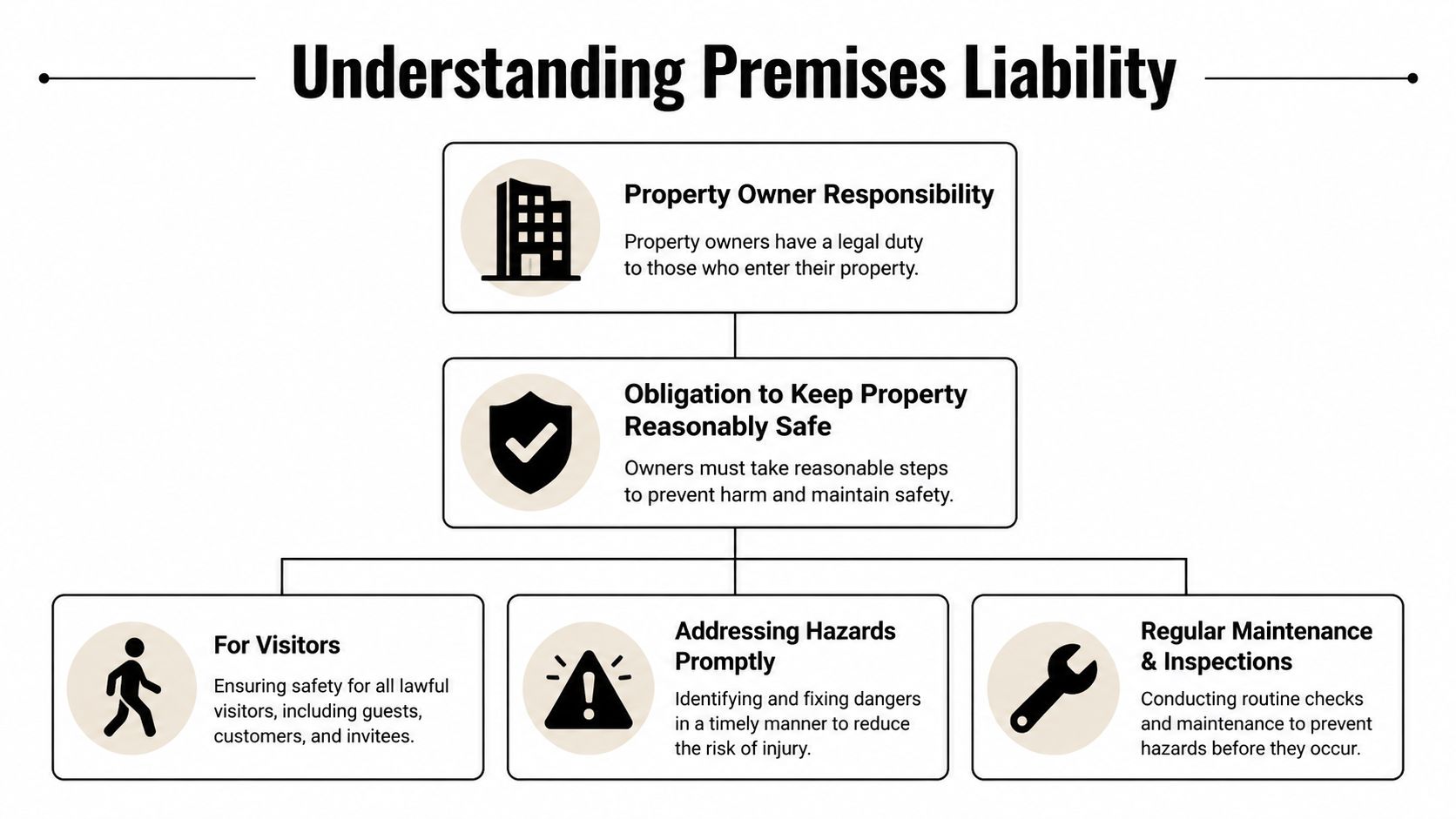
At its core, premises liability is about reasonable safety. If someone invites you onto property, they're expected to take ordinary steps to keep that space safe enough for visitors, just as a host would warn a guest about a loose floorboard before anyone trips over it. The duty isn't perfection. It's a responsibility to act with care when a hazard is known or should have been known.
The kinds of incidents that usually qualify
A claim can begin with a slip on a wet floor, but it doesn't end there. It can also involve broken stairs, poor lighting in a parking area, a missing handrail, unsafe security conditions, or exposure to a dangerous substance. The question isn't just whether something went wrong, it's whether the property condition created an unreasonable risk and the owner failed to handle it properly.
One useful way to think about these cases is to ask who controlled the risk. A store aisle with a spill, an apartment stairwell with a broken light, and a parking lot with weak security all raise different factual questions, but they share the same basic legal problem, someone had the chance to correct a danger and didn't do it in time. A resource like slip and fall prevention program can be helpful if you want to see how prevention systems are supposed to work before an injury happens.
Why the legal label matters
People often use “slip and fall” as a catch-all term, but attorneys sort these cases more carefully. The distinction matters because the evidence changes depending on whether the problem was a spill, a structural defect, a security lapse, or another dangerous condition. The firm looking at your case is trying to match the facts to the right theory of liability, not just file a complaint and hope the labels fit.
That's also why context matters. A parking garage with dim lighting raises different proof issues than a grocery store spill, and an apartment common area creates different questions than a private home. The stronger the factual match, the easier it is to show that the property owner's conduct fell below what a reasonable person would have done.
The Four Elements of a Successful Claim
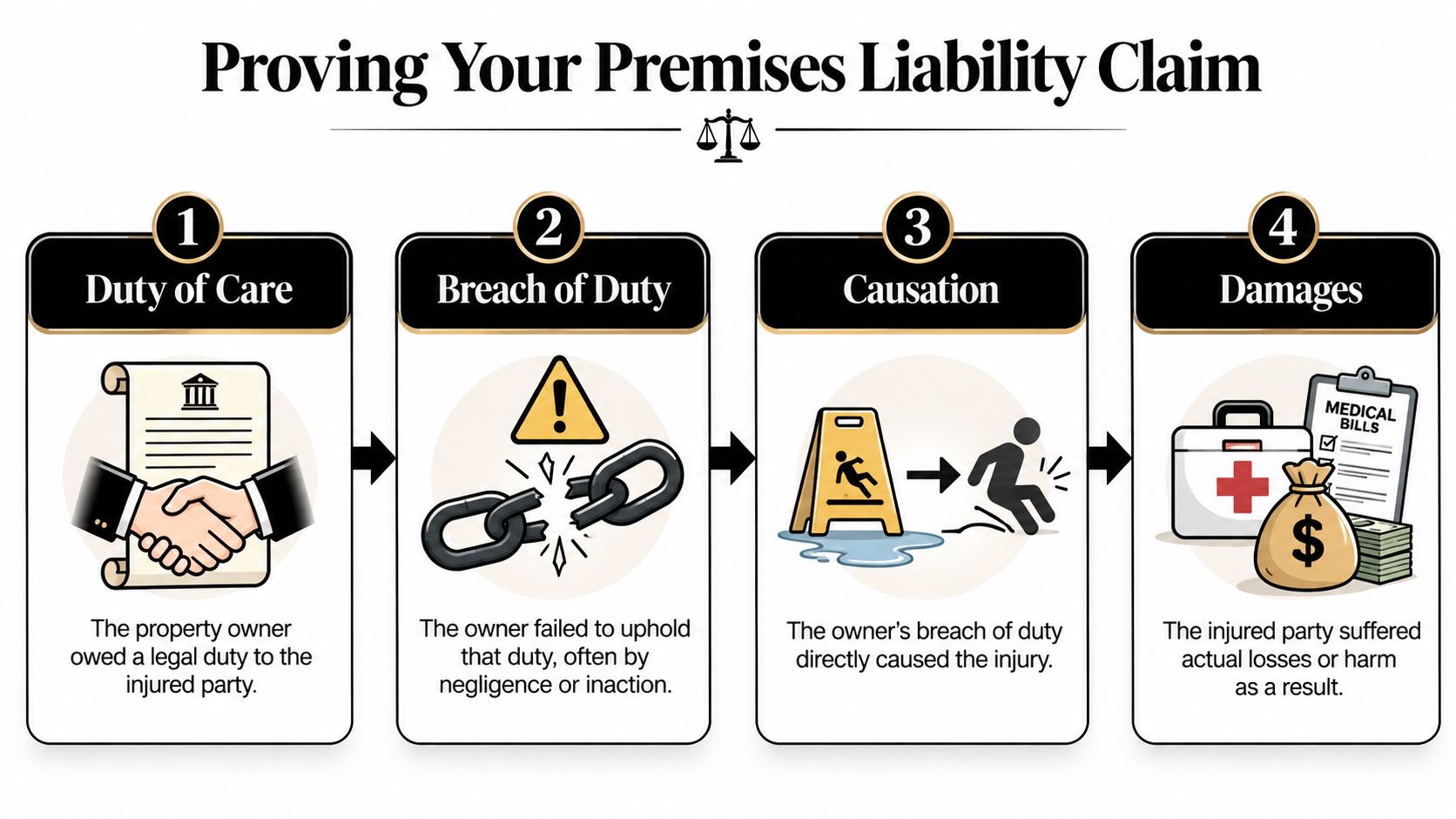
A premises liability claim usually rises or falls on four building blocks. If one of them is weak, the defense will try to pull the whole case apart. If all four are supported, the case becomes much more difficult to dismiss, because the facts start to line up in a way a jury can understand.
Duty and breach
Duty means the property owner had a legal responsibility to keep the premises reasonably safe for the injured person. Breach means that responsibility wasn't met. In real life, breach is often the fight over whether the owner knew about the problem or should have discovered it through ordinary inspection and maintenance.
That idea is often described as notice engineering, which is a practical way of showing the owner knew or should have known about the hazard. Inspection logs, maintenance records, and video can matter because they help show how long a dangerous condition existed and whether anyone had a reasonable chance to fix it. Advocate Magazine's discussion of notice engineering explains why that documentation becomes central when the defense claims the hazard appeared too quickly to detect.
Causation and damages
Causation asks whether the dangerous condition caused the injury. If a person slips because of a spill, or trips because a stair is broken, the case needs a clear factual bridge between the hazard and the harm. Damages are the losses that followed, including medical treatment, missed work, and the impact of pain, mobility limits, and stress.
The strongest cases don't start with argument, they start with proof that connects the hazard to the injury.
A video explanation can also help make the four-part structure easier to visualize.
The key point is simple. A property owner's failure matters only if it can be tied to a specific injury and a measurable loss, and that's where a careful legal file starts to matter more than a quick conversation at the scene.
Building Your Case The Investigation and Evidence Process
The first days after an injury are a race against cleanup, memory loss, and overwritten footage. A premises liability law firm doesn't wait for evidence to arrive politely. It starts collecting, preserving, and organizing it while the trail is still fresh.
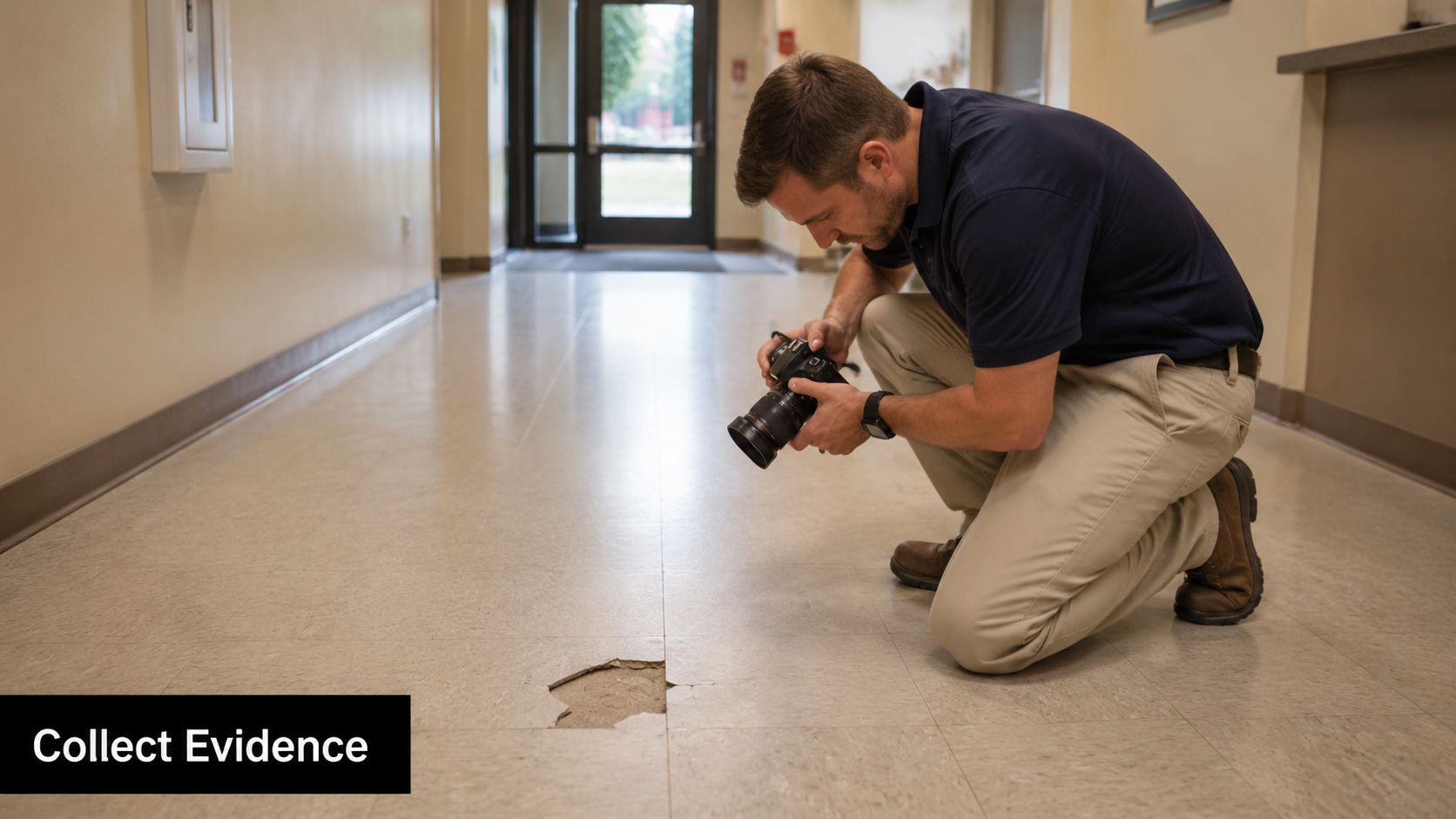
What gets collected first
Photos of the scene usually come first, because conditions can change in minutes. Then comes surveillance footage, witness information, incident reports, maintenance records, and any policies that show how the property was supposed to be inspected or cleaned. The point isn't to collect everything. It's to collect the right things before they're gone.
Defense-oriented guidance is blunt about this, quick investigation is critical because evidence like photos of the scene, witness statements, and surveillance footage can be lost. MGM Law's premises liability guidance makes the practical point that early preservation often decides whether a case is negotiated from a position of strength or fought hard from the beginning. That's not legal theater, it's how records disappear in real life.
A file also has to show who controlled the area. It's not always the owner who had the actual duty to inspect or repair. A lease, a management agreement, or another control document may tell the story better than the name on the deed.
Why medical records and scene records need to match
This is also where organized treatment records matter. If you're still seeing doctors, it helps when the injury history lines up with what happened at the scene, because gaps give the defense room to argue that the condition wasn't serious or wasn't caused by the fall. For practical help keeping treatment paperwork in order, the Patient Talker tips for medical paperwork are useful because they focus on keeping records readable, complete, and easy to retrieve.
Useful habit: Keep a single folder for medical visits, prescriptions, imaging, and work notes. A clean paper trail is easier to trust.
What a lawyer is looking for behind the scenes
The investigation isn't just about proving there was a hazard. It's about showing when it appeared, how long it remained, who had access to the area, and whether the property's own practices were enough to catch it. That's why preservation letters, witness interviews, and document requests come early. If evidence is altered or destroyed after that, the issue becomes more serious, which is why some readers also look up what spoliation of evidence means when they're trying to understand why timing matters so much.
Understanding Compensation and Colorado Law
Colorado injury cases are driven by deadlines and proof. If you wait too long, the claim can be barred before a court ever looks at the facts, so the calendar matters as much as the condition of the property. That's one reason a premises liability law firm starts by checking dates first, then building the evidence around them.
The damage categories that usually matter
Compensation typically falls into two broad groups, economic damages and non-economic damages. Economic damages cover the measurable losses tied to the injury, things like medical care, rehabilitation, and time away from work. Non-economic damages deal with the human impact, such as pain, disruption, and loss of enjoyment of daily life.
That split matters because two people can fall in the same place and walk away with very different cases. One may heal quickly, while another may face lasting limitations that affect work, sleep, driving, or simple movement around the house. The claim value has to reflect the actual harm, not just the moment of impact.
Colorado cases also have to contend with verdict reality. Jury verdicts in premises liability cases can vary widely, with a median award of $98,160 and an average of $643,099 according to summarized verdict research, and severe injuries like spinal nerve damage can result in median verdicts over $162,000. Maryland Injury Law Center's verdict summary shows why serious injuries deserve careful documentation, especially when long-term medical care and lost earning capacity are part of the picture.
Why Colorado clients should move early
A late-starting case is harder to prove because the scene changes, witnesses disappear, and records get harder to obtain. The safest strategy is to assume every important fact needs support, then gather that support before anyone repairs the hazard or overwrites the video. That urgency matters in Colorado as much as anywhere else.
It also matters because insurers often evaluate injuries skeptically when the records are thin. If the file shows consistent treatment, a clear timeline, and a specific hazard, the claim has a better chance of being taken seriously. When those pieces are missing, the defense has room to minimize the injury and argue for a lower value.
How to Choose the Right Premises Liability Firm
The right lawyer for a car wreck isn't automatically the right lawyer for a dangerous-property case. Premises claims have their own proof problems, especially around notice, control, and the defense argument that the hazard was visible. That means you need a firm that knows how these cases get built, not just how they sound in a brochure.
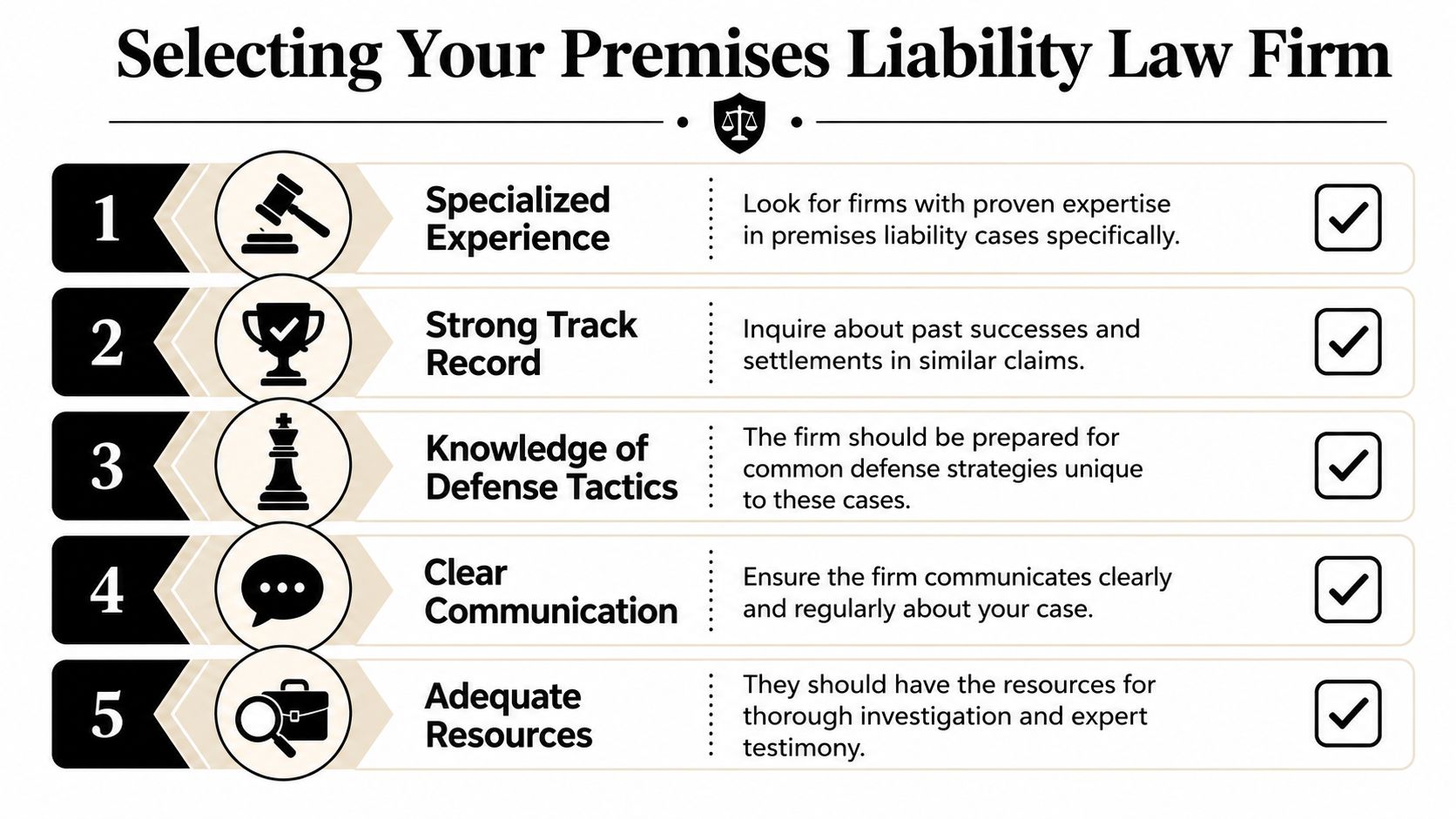
Questions worth asking before you hire
Ask whether the lawyer has handled cases involving slip and fall conditions, security failures, or other dangerous-property claims. Ask who will gather the evidence, who will talk to witnesses, and how the firm handles preservation when footage and records are at risk. Then ask how they prepare for defenses based on visibility and comparative blame.
A strong firm should be able to explain how it approaches the open and obvious defense, because that issue comes up often. Defense practice materials emphasize that visible hazards don't always end the inquiry, since foreseeability, notice, and the chance to cure can still matter. Baker Donelson's premises liability discussion is a useful reminder that the fight is often about whether injury was still preventable, not just whether the hazard could be seen.
What real experience looks like
Experience shows up in details. A lawyer who knows premises cases should talk comfortably about inspection records, scene photographs, prior incident reports, and control documents. They should also explain how they'll communicate with you, because a frightened client shouldn't have to guess what's happening with a serious injury claim.
If you want a practical example of how a firm can organize a premises file, one option is Nares Law Group's contingency fee explanation, which shows how representation can be structured while a case is investigated and developed. The important part is not the marketing language, it's whether the firm has the patience and resources to build proof before the defense narrative hardens.
A quick filter for your first call
- Specialized cases: Ask whether premises liability is a real focus, not just a line on a website.
- Evidence handling: Ask how fast they send preservation letters and request footage.
- Defense readiness: Ask how they respond when the property owner says the danger was obvious.
- Communication: Ask how often you'll hear from the team and who handles updates.
- Trial readiness: Ask whether they prepare every file as if a jury may need to hear it.
A firm that answers those questions clearly is showing you more than confidence. It's showing you a plan.
Your Path Forward with Nares Law Group
After an injury on someone else's property, the legal process can feel like a second shock. Records need to be gathered, deadlines need to be tracked, and the defense often starts building its own story before you've even finished medical treatment. The right team takes that burden off your shoulders and turns a confusing event into an organized claim.
Nares Law Group LLC handles premises liability matters as part of its Colorado personal injury practice, and the firm's role is to manage the investigation, preserve key evidence, and pursue compensation for the losses the injury caused. If you're trying to decide whether you have a case, a free consultation can give you a clearer path without pressure.
If you've been injured on someone else's property in Colorado, Nares Law Group LLC can help you sort out the evidence, the deadlines, and the next legal step. Visit Nares Law Group LLC to request a free consultation and get answers from a team that handles premises liability claims with careful investigation and client-focused guidance.