You're in the middle of a stressful, confusing moment. Maybe the person who hit their head seems “okay” at first, then starts asking the same question twice, or complaining that the room feels off, or sleeping far more than usual. Those changes can be easy to dismiss, especially after a car crash or fall that didn't look dramatic, but signs of TBI often start that way.
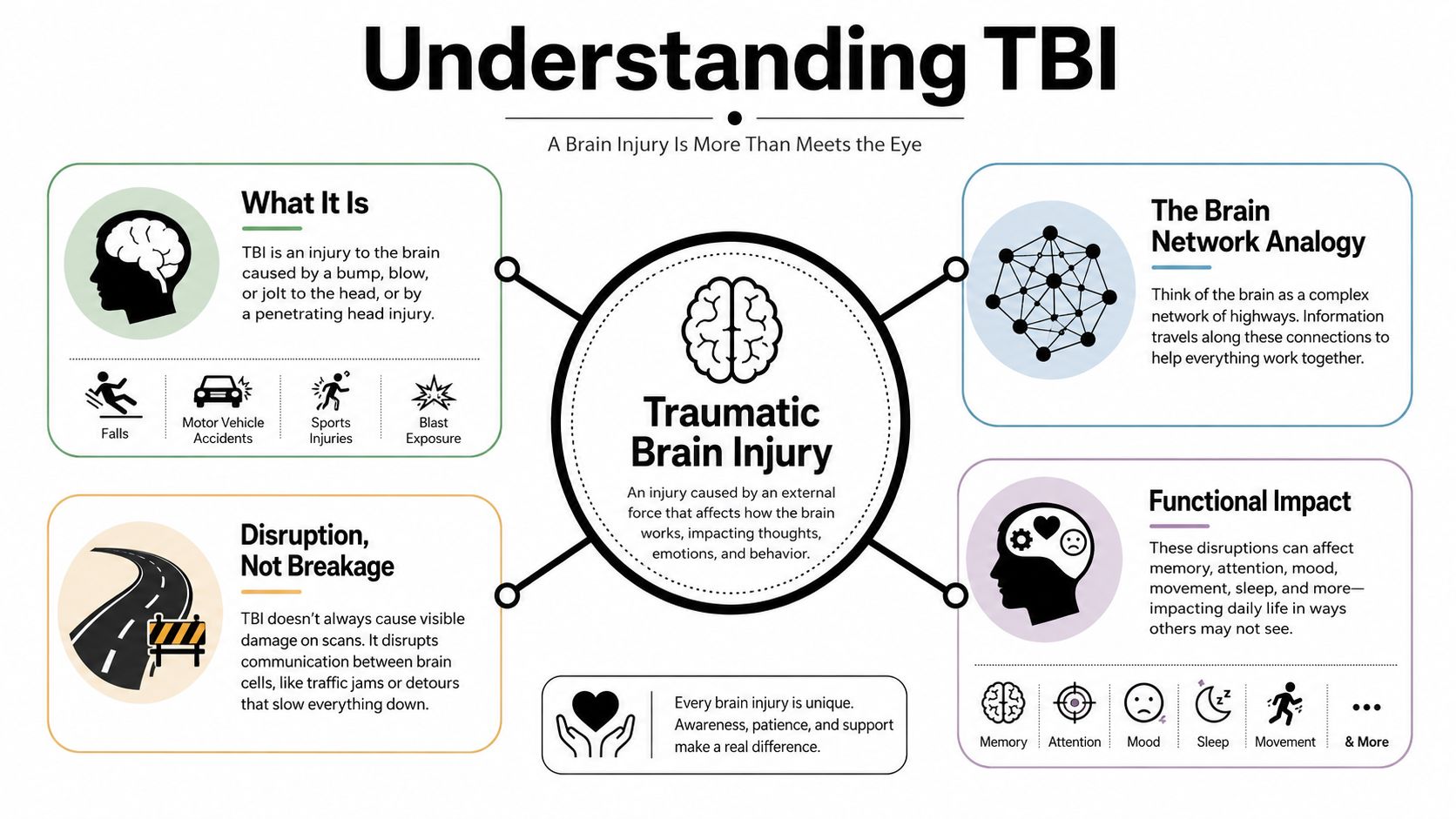
A traumatic brain injury, or TBI, is not just a visible wound. It happens when a blow, jolt, or sudden force disrupts the brain's normal function, and that disruption can affect how someone thinks, feels, moves, sleeps, and remembers. The challenge is that the symptoms are often subtle at first, and they can be delayed, which is why families and accident victims get caught second-guessing themselves.
If you're trying to separate a mild headache from something more serious, clear guidance matters. The same uncertainty can show up after trauma in other forms too, which is why some families also look for a guide to PTSD treatment for veterans when symptoms overlap with anxiety, sleep disruption, or mood changes after an injury.
Understanding What TBI Actually Is
A head injury can leave people looking normal while their brain is still struggling to coordinate basic tasks. That's what makes TBI so hard to recognize, especially in the first few hours after an accident. The injury isn't always a broken bone or a cut that can be seen from across the room, it's often a disruption inside the brain's communication system.
A brain injury can look quiet from the outside
Think of the brain less like a cracked object and more like a phone network that's losing signal. The wires may still be intact, but the messages don't move cleanly, so speech, balance, memory, and mood can all start to glitch. That's why someone with a TBI might seem only a little “off” at first, then struggle later with concentration, irritability, or confusing fatigue.
Mild TBI, often called concussion, is especially easy to miss because it may involve headache, dizziness, blurred vision, sleep changes, mood changes, or memory and concentration problems, and there may be only a brief loss of consciousness or none at all. Medical guidance has increasingly treated mild TBI as a serious condition, not a trivial bump on the head, because symptoms can linger long after the injury itself.
Practical rule: if the brain is behaving differently, treat that as real even when the skin doesn't show much damage.
The scale of this issue is not small. A recent Global Burden of Disease analysis estimated 20,837,465 new TBI cases worldwide in 2021 and 37,928,494 prevalent cases globally that same year, which shows how often TBI becomes a long-term disability issue, not just an acute event (Frontiers in Public Health).
Why the first impression can be misleading
In the emergency setting, most mild injuries account for the overwhelming share of cases. StatPearls notes that mild TBI makes up over 90% of cases presenting acutely to the hospital, and other clinical summaries estimate concussions account for 75%–90% of all reported brain injuries (StatPearls). That's part of why people often underestimate the injury, because the word “mild” sounds reassuring even when the symptoms are not.
For accident victims, the confusion often starts with timing. Symptoms may be obvious right away, or they may surface later as the brain's stress response settles down. Documentation becomes important here, because if the injury is missed early, later symptoms can look disconnected from the crash or fall that caused them.
The Four Categories of TBI Signs
The easiest way to make sense of signs of TBI is to sort them into four groups. Each group points to a different kind of disruption, and someone can have symptoms in more than one category at the same time.
Physical symptoms show up first for some people
These are the signs many individuals anticipate. Headache, dizziness, nausea, blurred vision, balance trouble, and ringing in the ears all fit here, and they can appear quickly after the injury or build over the next day. The body is often the first place individuals notice that something is wrong, especially if walking, turning, or reading suddenly feels harder than usual.
A car crash victim might say the light feels too bright, or that turning their head makes them nauseated. A parent might notice a child is moving more slowly or bumping into door frames. Those details matter because they help separate a normal bruise from a brain injury that's affecting coordination.
Cognitive symptoms can feel like being mentally stuck
Cognitive changes often sound vague to the person experiencing them, but they're very specific in real life. People may forget what they were just saying, lose focus in the middle of a conversation, struggle to follow directions, or feel mentally foggy. It can seem like the brain is rebooting slowly, not because the person isn't trying, but because processing is disrupted.
Emotional symptoms are easy to misread
Irritability, mood swings, anxiety, unusual frustration, and feeling unlike yourself can all be signs of TBI. Families sometimes assume these changes are just stress from the accident, which is understandable, but emotional shifts can be part of the injury itself. That's why a person may seem more short-tempered, tearful, or withdrawn even when they were calm before the accident.
Sleep symptoms can be subtle but important
Sleep changes often get brushed aside because everyone expects someone to be tired after trauma. The problem is that sleep changes can mean insomnia, sleeping much more than usual, or feeling unrefreshed no matter how long the person rests. When sleep is off, every other symptom can feel worse, and recovery can feel slower.
A useful way to think about this is that the brain is trying to recover while also managing daily demands. That combination can make someone seem lazy, confused, or emotionally fragile when they're dealing with a neurological injury.
| Category | What it can look like | Why it matters |
|---|---|---|
| Physical | Headache, dizziness, blurred vision | Signals that the injury may be affecting balance or sensory processing |
| Cognitive | Fog, memory problems, trouble concentrating | Can interfere with work, driving, and decision-making |
| Emotional | Irritability, mood swings, anxiety | Often mistaken for stress, but may be injury-related |
| Sleep | Sleeping too much, insomnia, restless sleep | Can slow recovery and worsen other symptoms |
Red Flag Signs That Require Emergency Care
Some signs of TBI call for immediate emergency evaluation, not observation at home. The key pattern is loss of consciousness, repeated vomiting, worsening headache, seizure, unequal pupils, or focal neurologic deficits like slurred speech, one-sided weakness, or loss of balance (Mayo Clinic).
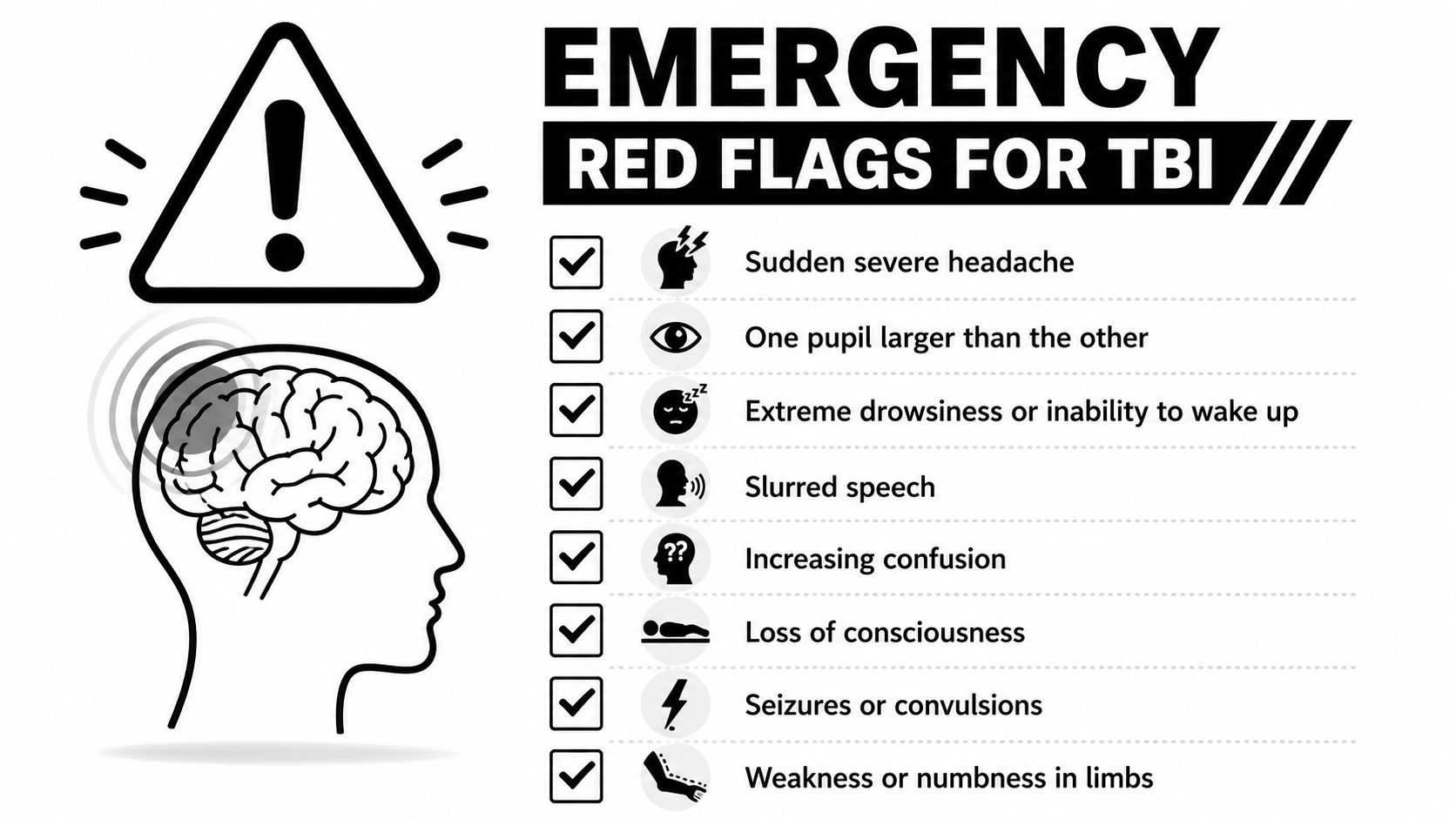
A serious mistake people make is assuming danger only exists if symptoms are immediate. Moderate and severe TBI symptoms can appear within hours to days after the injury, so a person who seemed stable at first can still deteriorate later (Mayo Clinic).
Physical signs can point to internal bleeding
Certain visible findings are especially concerning. Basilar skull fracture signs such as Battle sign, raccoon eyes, hemotympanum, and CSF rhinorrhea or otorrhea are strongly associated with intracranial hemorrhage (Mayo Clinic). If those signs appear after a fall, crash, or assault, the safest move is urgent medical care.
If you're debating whether to “wait and see,” that's usually a reason to go in. It's better to have a serious condition ruled out than to miss the window for treatment.
The emergency room isn't overreacting when it evaluates these symptoms. It's responding to the possibility that brain swelling, bleeding, or pressure changes are evolving in a way that won't be visible from the outside.
How TBI Is Diagnosed and What Recovery Looks Like
After a suspected brain injury, doctors usually start with a neurological exam and a careful symptom history. They're looking at alertness, speech, movement, balance, memory, and whether symptoms are changing over time. Imaging can help when the situation calls for it, especially if there are red flags or concerns about bleeding.
A useful reference on the role of imaging in brain-injury evaluation is this CT scan guide for TBI cases. A CT scan is often used when doctors need a fast look at the head after trauma, while MRI may be used later when symptoms persist or a deeper look is needed.

Recovery rarely moves in a straight line
People often want a clean answer about how long recovery takes. The honest answer is that it depends on the injury and the person, and recovery can move unevenly. Good days can be followed by bad ones, especially when the brain is asked to handle too much too soon.
That unpredictability is one reason follow-up matters. Someone may leave the hospital after a reassuring exam, then notice concentration problems, fatigue, or mood changes later. Those later symptoms are still part of the injury, even if the initial workup was limited.
Observation matters as much as the test
A scan can be important, but it isn't the whole story. Doctors also pay attention to how symptoms evolve during observation, because brain-injury symptoms can change after the first evaluation. That's particularly true when the person has headaches that worsen, confusion that deepens, or new vomiting after the injury.
Recovery can be short for some people and much longer for others, especially when cognitive and emotional symptoms persist. The one-year symptom persistence reported in the trauma-center study, where 50% of patients still reported three or more symptoms at one year after injury, is a reminder that healing can outlast the acute phase (StatPearls).
Recovery rule: improvement doesn't have to be fast to be real, and a normal-looking day doesn't mean the brain is fully healed.
What to Do After a Suspected TBI
The first step is medical care, even when the injury feels minor. A concussion or mild TBI can still affect memory, focus, sleep, and mood, and those changes matter both medically and legally. If the person is showing red flags, go to the emergency room or call for emergency help right away.
Document early and document plainly
Write down the basics while they're still fresh. Include the date, time, what happened, what symptoms appeared, when they started, and what made them worse or better. If the person had headaches after driving, dizziness when standing, trouble reading, or unusual irritability at home, those details belong in the record.
A symptom journal helps in two ways. First, it gives doctors a clearer picture of the pattern. Second, it preserves evidence if the injury becomes part of an insurance claim or legal case later.
Don't minimize symptoms to sound tough
People often say they're fine because they don't want to worry family members or complicate a claim. That instinct can backfire. Brain injuries are frequently disputed because the symptoms are invisible, inconsistent, or delayed, so downplaying them at the beginning can make it harder to prove the full impact later.
That's where legal protection starts with medical honesty. If your daily life has changed, say so. If sleep is off, concentration is weaker, or mood has shifted, make sure those changes are recorded by a clinician, not just remembered in hindsight.
Get help before insurance narratives harden
Accident victims sometimes find that insurance companies focus on the absence of dramatic imaging findings and ignore ongoing cognitive or emotional symptoms. Good documentation from the start helps protect against that. It's also the point where consulting a personal injury lawyer can make sense, especially if the injury happened in a crash and symptoms are interfering with work, driving, or normal routines.
Nares Law Group LLC handles traumatic brain injury and crash-related injury matters, and a focused legal team can help organize records, track symptoms, and coordinate the case alongside treatment. For a practical starting point on screening issues that often get missed, see this traumatic brain injury screening resource.
Keep every appointment, save discharge paperwork, and write down who saw what. Those small details often become the backbone of a strong injury record.
Resources and Support for Victims and Families
No one should have to sort through a brain injury alone. Families usually need two kinds of help at the same time, medical guidance and practical support, because the injury affects the whole household. The right mix of resources can make the next decisions less overwhelming.
Start with medical and educational sources
The Brain Injury Association of America and the CDC's TBI resources are useful places to begin when you want clear, public-facing information rather than scattered internet advice. Specialists also matter. Neurologists, neuropsychologists, and rehabilitation therapists can help evaluate symptoms, measure cognitive changes, and support recovery planning.
If the injury is affecting concentration, memory, or daily functioning, cognitive rehabilitation may be part of the picture. A useful primer on that topic is this cognitive therapy resource for TBI recovery.
Choose support that fits the situation
Some people need a support group to cope with the emotional weight of the injury. Others need a case manager, a therapist, or a lawyer who can coordinate records and keep the process moving. The right choice depends on what's getting in the way, whether that's symptoms, transportation, lost income, or confusion about the claim process.
For families dealing with a crash-related TBI, legal support can help organize the medical side as well as the claim side. The goal isn't to rush recovery, it's to make sure the injury is documented well enough that treatment and compensation aren't undercut later.
The best resource is the one you'll actually use when the next appointment, deadline, or symptom flare-up hits.
Taking the Next Step with Confidence
If the signs of TBI don't fit neatly into a checklist, that doesn't mean they're imaginary. Subtle cognitive and emotional changes often matter just as much as visible injuries, and they deserve attention, not dismissal. Recovery can be uneven, and normal test results don't erase the experience of living with a changed brain.
When a crash or fall has disrupted daily life, early medical care and careful documentation protect more than your health. They protect your ability to explain what happened, prove what changed, and get help that matches the injury.
Nares Law Group LLC helps injured people document brain injury symptoms, understand their options, and pursue claims tied to crashes and other serious accidents. If you're seeing signs of TBI and need guidance on both medical and legal next steps, visit Nares Law Group LLC to learn how the firm supports families facing these cases.