The emergency room after a crash can feel unreal. A nurse asks the same questions twice. Someone shines a light in your eyes. A doctor says they want a tbi ct scan, and suddenly you’re trying to understand a new medical phrase while also wondering whether your loved one is going to be okay.
That moment is frightening because it mixes two kinds of uncertainty. First, you don’t yet know what happened inside the skull. Second, you don’t know what this early testing will mean later, when the insurance company starts asking questions and the family needs answers.
A CT scan is often the first clear window into what the injury looks like right now. It can show bleeding, swelling, fractures, or pressure changes that need fast treatment. It can also become one of the earliest pieces of objective evidence in a Colorado car accident or truck wreck claim.
Families often hear one of two things after the scan. Either the doctor finds something serious and treatment moves quickly, or the report says the scan is “normal,” which sounds reassuring but doesn’t always match what the patient is feeling. Both situations matter medically. Both matter legally.
The First Step Toward Answers After a Head Injury
In the first hour after a crash, families usually want one answer above all others. Is there a dangerous brain injury that doctors need to treat right now?
That urgency is why a tbi ct scan is often one of the first major steps in the emergency room. The scan gives the care team a fast way to check for problems inside the skull that can worsen quickly, such as bleeding, swelling, or a fracture. Before anyone can talk clearly about recovery, the doctors have to rule out the threats that cannot wait.
A helpful way to understand the scan is this. It is less about explaining every symptom on day one and more about spotting the injuries that can change the next few hours. If blood is collecting in the wrong place, or pressure is building, speed matters.
Why the CT scan comes so early
After head trauma, doctors are trying to answer a few immediate questions:
- Is there bleeding inside the skull? Blood can press on the brain and create a medical emergency.
- Is there a skull fracture? A fracture can point to a high-force impact and may affect treatment decisions.
- Is swelling or shifting putting the brain at risk? Pressure changes can require close observation, repeat imaging, or surgery.
- Does the patient need a higher level of care? Some patients need transfer, neurosurgical review, or hospital monitoring even if they seem alert at first.
That early timing also matters outside the hospital.
In a Colorado personal injury or truck accident claim, the first CT scan often becomes the earliest objective record of what the crash did to the body. If the report identifies a hemorrhage, contusion, or fracture, that finding can help connect the injury to the collision before the insurance company has time to argue that something else caused it.
Why families get confused
Confusion often starts when the medical team uses the word mild.
In brain injury medicine, “mild traumatic brain injury” is a clinical category. It does not mean the event felt mild, and it does not guarantee a harmless outcome. A patient may be awake, talking, and still need urgent imaging because doctors know serious problems can hide behind a calm first appearance.
That point matters in both medicine and law. Families may hear that the scan is normal and assume the case is over. Insurers may try the same argument later. Yet a normal CT does not erase the fact that there was a head injury, emergency symptoms, and a need for immediate evaluation. It only means the scan did not show certain structural problems at that moment.
What this first step means for your case
A CT scan can shape two timelines at once. One is medical. The other is legal.
Medically, it helps doctors decide what must happen now. Legally, it fixes an early snapshot in the record. An abnormal scan can provide visible proof of trauma. A normal scan can still support the claim by showing that the symptoms were serious enough to justify emergency assessment after the crash.
That distinction is important in Colorado cases involving delayed symptoms, ongoing headaches, memory problems, dizziness, or concentration changes. The first scan may not answer every question, but it often becomes the starting point for showing what happened, what doctors were concerned about, and why follow-up care was reasonable.
How a TBI CT Scan Works
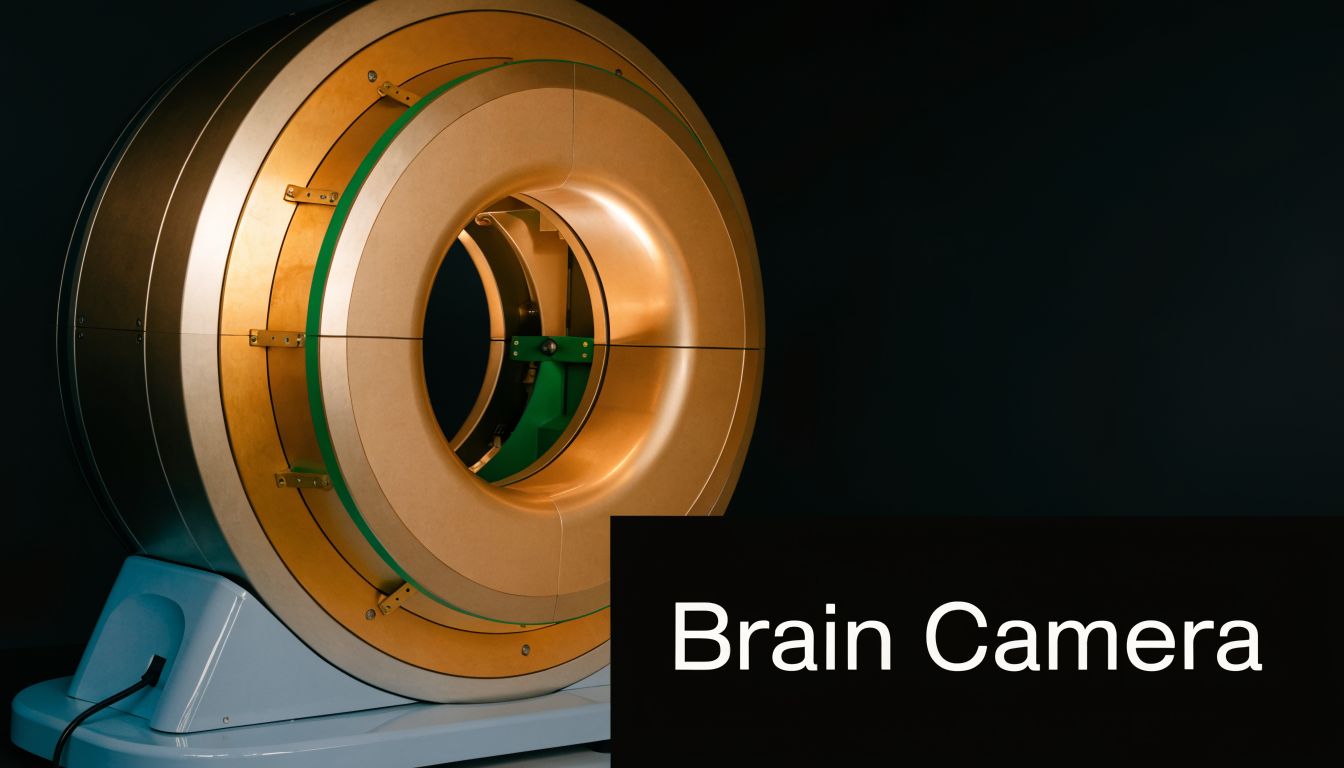
A tbi ct scan uses X-rays and computer processing to create a series of thin images of the head. Instead of showing only one flat picture, it gives doctors layer-by-layer views of the skull, the spaces around the brain, and the brain tissue itself. After a crash, that matters because urgent problems can be hidden beneath a normal-looking scalp injury or a patient who is still awake and talking.
The machine gathers those images in seconds while the patient lies still on a narrow table. A computer then assembles them into views the radiologist can examine from top to bottom. That step-by-step view helps the medical team check for fresh bleeding, swelling, pressure changes, or fractures that could change treatment right away.
What non-contrast means
In emergency head trauma care, doctors usually begin with a non-contrast CT, often shortened to NECT. That means no dye is injected for the first scan.
There is a practical reason for that choice. Fresh blood often stands out clearly on a non-contrast CT, so doctors can look quickly for findings that may require immediate action. The goal is speed and clarity during the first medical decision-making window, when the team is deciding whether the patient can be observed, needs repeat imaging, or may need surgery.
What the patient experiences
Families are often relieved to learn how straightforward the process usually is.
Positioning on the table
The technologist helps the patient lie flat, usually on their back. The head must stay still so the images stay clear.Moving through the scanner
The scanner is short and open, more like passing through a large ring than entering a long tunnel.Image capture
The scan itself is very quick. The room staff may step behind a shield, but they can still see and hear the patient.Rapid review
A radiologist and the emergency team review the images promptly because the results may affect treatment decisions within minutes.
For families, this can feel like a brief pause in a chaotic day. In the medical record, though, it becomes one of the earliest objective snapshots of what doctors were trying to rule out after the impact.
Why CT is often the first imaging study
A CT scan answers a narrow but urgent question. Is there a structural injury that needs immediate attention?
That is why emergency departments rely on it so often after suspected traumatic brain injury. It works quickly, it is widely available, and it can usually be done even when the patient needs close monitoring. MRI often has an important role later, especially when symptoms continue and doctors are looking for injuries CT may miss. If you want to understand that later stage of imaging in more detail, our page on diffusion tensor imaging of the brain explains one of the tools sometimes used to examine more subtle brain changes.
CT also helps doctors evaluate the skull itself. That matters in vehicle and truck accident cases because the force of impact can injure bone and brain at the same time, and those combined findings can shape both treatment decisions and the timeline of recovery.
Why this matters beyond medicine
A CT scan does more than guide emergency care. It creates a time-stamped record close to the accident.
In a Colorado injury claim, timing and documentation often become contested issues. If the scan shows a bleed, contusion, or fracture soon after the crash, that image can help connect the injury to the collision rather than to some later event. If the scan is normal, it still documents that emergency physicians considered the symptoms serious enough to order brain imaging right away. That can matter when an insurer later tries to minimize the injury or argue that follow-up care was unnecessary.
What an Acute TBI CT Scan Reveals
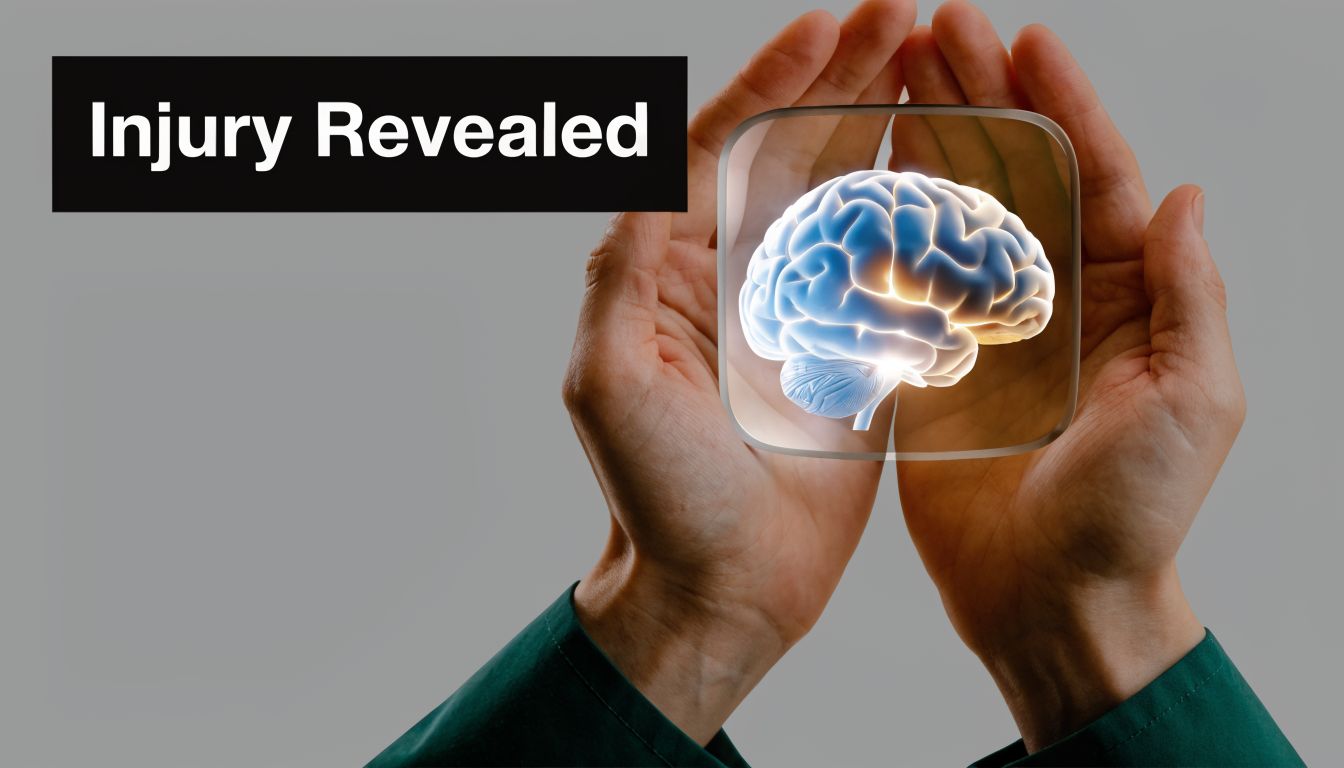
A family may hear, “The CT is positive,” and not know whether that is good news or bad news. In the trauma setting, it means the scan found a physical injury doctors can see right away. That finding can change treatment within minutes, and in a Colorado injury case, it can also become one of the earliest pieces of objective evidence tying the brain injury to the crash.
An acute tbi ct scan is built to answer urgent questions. Is there fresh bleeding. Is the brain bruised. Is a skull fracture present. Is swelling or pressure starting to push the brain out of its normal position. Those are the problems that can worsen quickly, so radiologists read the images with that timeline in mind.
Bleeding around or inside the brain
One of the main jobs of a CT scan is to show where blood has collected after a head injury. Location matters because each pattern raises different concerns about pressure, monitoring, and surgery.
Epidural hematoma
An epidural hematoma is bleeding between the skull and the brain’s outer covering. It often happens with a skull fracture that injures an artery. Because arterial bleeding can expand fast, this is one of the findings doctors treat with real urgency.
On the scan, the blood appears as a defined collection pressing inward. For a family, the practical point is simple. This is the kind of result that can lead to immediate neurosurgical review and very close observation.
Subdural hematoma
A subdural hematoma is bleeding over the surface of the brain, usually from torn veins after sudden movement or impact. This pattern is common in violent collisions because the brain can shift inside the skull even if the outside injuries look limited.
Some subdural bleeds build more slowly than epidural bleeds. They can still become dangerous because the skull is a closed box. Any extra blood takes up space and can compress brain tissue.
Subarachnoid hemorrhage
A subarachnoid hemorrhage means blood has entered the spaces where spinal fluid normally circulates around the brain. A patient may still be awake and talking, yet the scan can show this bleeding clearly.
That matters medically and legally. It shows that the injury is not just a report of pain or confusion. It is visible trauma recorded shortly after the event.
Bruising and direct brain tissue injury
CT scans also pick up contusions, which are bruises in the brain tissue itself. These often occur where the brain struck the inside of the skull during impact, much like fruit bruises where it hits the side of a container.
The location of a contusion can help explain symptoms. A bruise near the frontal lobes may relate to changes in judgment, mood, or concentration. A bruise in other areas may affect speech, balance, vision, or reaction time. That connection can become important months later if an insurer argues that the symptoms are vague or unrelated.
CT does have limits. Some patients continue to have serious symptoms even when the early scan does not show the full extent of injury. In those cases, later testing such as diffusion tensor imaging of the brain may help doctors examine more subtle damage that a CT scan cannot capture well.
Skull fractures and signs of dangerous pressure
A CT scan is also very good at showing bone. Skull fractures can confirm that the force of impact was significant, and certain fracture patterns raise concern about deeper injury underneath.
Radiologists also look for signs that swelling, blood, or a mass is pushing the brain away from its normal alignment. This is often described as midline shift. Families do not need to memorize the term. What matters is the idea behind it. The scan can show whether pressure inside the skull is starting to displace the brain, which is a warning sign that treatment decisions may need to happen quickly.
Here’s a simple way to read the most common acute findings:
| Finding | Plain-language meaning | Why doctors care right away |
|---|---|---|
| Epidural hematoma | Blood trapped between skull and outer brain covering | Pressure can rise quickly |
| Subdural hematoma | Blood collecting over the brain surface | Can compress brain tissue |
| Subarachnoid hemorrhage | Blood in the fluid spaces around the brain | Signals intracranial trauma |
| Contusion | Bruised brain tissue | May affect function and evolve over time |
| Skull fracture | Break in the skull bone | Suggests forceful impact and related injury |
A short visual explanation can make these terms easier to grasp:
What a positive scan means for the family
A positive CT often leads to admission, transfer, repeat imaging, intensive monitoring, or surgical consultation. It gives the medical team something concrete to track from the first hours after the crash.
It also changes the evidence picture. In a Colorado personal injury or truck accident claim, a scan showing hemorrhage, contusion, fracture, or pressure effects can help establish timing, force, and causation. The image becomes a dated record created before litigation strategy enters the scene.
A CT image can turn a disputed symptom into a documented injury.
When Doctors Order an Emergency CT Scan
Doctors order an emergency tbi ct scan because they’re sorting patients into risk categories, not because every bump to the head looks dramatic from the outside. A person can be talking, answering questions, and still have a dangerous bleed developing inside the skull.
In U.S. emergency departments, CT scans are performed in 78% of confirmed TBI cases, reflecting their central role in trauma care and their speed in detecting life-threatening problems such as intracranial hemorrhage, according to ESO’s discussion of CT scans in traumatic brain injuries.
Clues that push doctors toward immediate imaging
Some reasons are obvious. Others are easy for families to overlook in the stress of a crash.
Doctors often move toward emergency imaging when they see:
- Loss of consciousness: Even a brief blackout can signal that the brain was affected.
- Memory gaps: If the person can’t recall the crash or the minutes around it, that raises concern.
- Vomiting or worsening headache: These can point to rising pressure or bleeding.
- Visible trauma to the head or face: Cuts, swelling, or bruising can reflect stronger force than the patient realizes.
- Confusion or unusual behavior: Trouble answering questions, slowed speech, or disorientation matters.
- A Glasgow Coma Scale score below normal: This tool helps measure alertness and responsiveness.
- A high-risk mechanism: Car crashes and truck wrecks can produce violent acceleration, deceleration, and rotation.
The logic behind the decision
Emergency physicians don’t wait for perfect certainty. They act on risk because missing a serious brain injury can have catastrophic consequences.
That’s especially true in vehicle collisions, where the head may strike part of the car, the body may whip forward and back, or the brain may twist inside the skull even without a direct blow. The person may look “not that bad” to family members while the medical team sees warning signs that justify immediate scanning.
Families often ask, “If they’re awake, why do they need a CT?” Because wakefulness doesn’t rule out bleeding.
Why this matters later in a claim
The fact that ER doctors thought emergency imaging was necessary can matter later when an insurance adjuster tries to minimize the injury. It shows that trained medical professionals saw enough concern to order immediate head imaging in the acute phase.
That doesn’t mean every scan will be positive. It means the symptoms and mechanism were serious enough that doctors had to rule out dangerous intracranial injury. In a personal injury case, that early decision can help support the credibility of the patient’s complaints from day one.
Comparing CT Scans and MRI for Brain Injuries
A family may hear two statements that seem to conflict. The emergency doctor says the CT is normal. Weeks later, a specialist recommends an MRI because the headaches, memory problems, dizziness, or personality changes have not gone away.
Both statements can make sense at the same time.
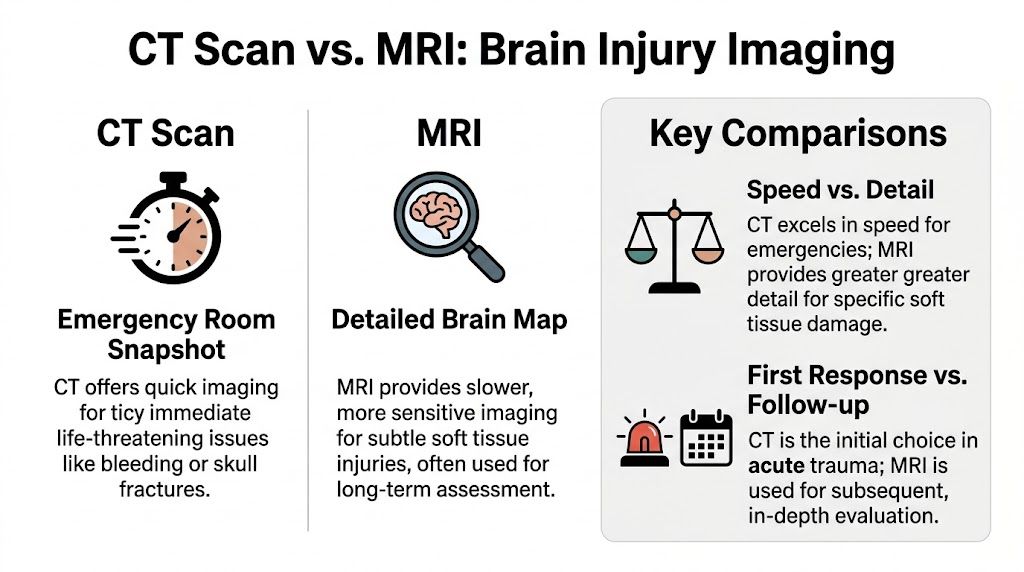
A tbi ct scan and an MRI answer different questions. CT is built for the first urgent question after a crash: Is there bleeding, a fracture, swelling, or another problem that demands immediate action? MRI looks more closely at brain tissue when the story does not end with the emergency room visit.
What CT does well, and why doctors start there
After a violent impact, speed matters. CT is widely used first because it can be performed quickly and can show dangerous changes that affect immediate treatment decisions, such as fresh bleeding, skull fractures, pressure on the brain, or a shift in normal structures.
That makes CT the right tool for the opening phase of care. In practical terms, it helps the trauma team answer, “Is there a problem we must act on now?”
What MRI can show that CT may miss
MRI is slower, but it gives a more detailed look at soft tissue. That matters when a person keeps having symptoms after a wreck even though the first scan did not show a large structural injury.
One common example is diffuse axonal injury, often shortened to DAI. In a crash, the brain can move and twist inside the skull. That motion can injure nerve fibers in ways that do not always appear on an initial CT. A patient may still have real problems with attention, processing speed, sleep, mood, or balance.
This is often the point where families feel confused or even pressured to doubt what they are seeing at home. They should not. A normal CT can rule out some dangerous emergencies. It does not settle every question about whether the brain was injured.
Why the difference matters in a Colorado injury claim
The medical difference between CT and MRI often becomes a legal difference too.
Insurance carriers often place heavy weight on the first emergency scan because it is early, objective, and easy to point to. If the CT does show bleeding or a fracture, that image may strongly support causation. If the CT is normal, the defense may try to argue that the person was never seriously hurt.
That argument is often too simplistic. A lawyer handling a Colorado car or truck accident case has to place the CT in the correct medical context. The better question is not only whether the first scan was normal. The better question is whether the full medical record, including symptoms, follow-up care, specialist opinions, and later testing, shows a brain injury connected to the collision.
Side-by-side comparison
| Feature | CT Scan (Computed Tomography) | MRI (Magnetic Resonance Imaging) |
|---|---|---|
| Main role | Early trauma evaluation | Follow-up imaging and closer tissue assessment |
| Speed | Fast | Slower |
| Best at showing | Acute bleeding, skull fractures, mass effect, major structural changes | More subtle soft tissue and white matter abnormalities |
| Typical setting | ER and trauma care | Later inpatient or outpatient evaluation |
| Legal value | Creates an early objective record after the crash | Helps explain persistent symptoms when CT does not show the full injury |
How families should hear the phrase “normal CT”
A normal CT is still useful. It can reassure doctors that there is no large bleed or other emergency visible at that moment.
But from both a medical and legal standpoint, “normal” does not mean “nothing happened.” It means the scan did not show certain kinds of injury. If the person still struggles with memory, concentration, headaches, sensory overload, or emotional changes, doctors may need a broader workup, including specialist exams and neurological tests used to evaluate brain damage.
A careful claim presents both truths together. The CT may have ruled out the need for emergency brain surgery. The MRI, clinical follow-up, and neurocognitive evidence may explain why life still changed after the crash.
How Your TBI CT Scan Impacts a Personal Injury Claim
A tbi ct scan is a medical tool first, but in a personal injury case it also becomes evidence. Courts, insurers, and defense experts pay close attention to imaging because it creates a record that is harder to dismiss than symptoms alone.
If the scan shows a hemorrhage, fracture, contusion, or shift, that image can directly support causation. In plain terms, it helps prove that the crash caused a physical injury to the brain or skull. That can strengthen claims for medical treatment, lost income, long-term therapy, and future care needs.
When the CT scan is positive
A positive scan gives the legal case objective proof. It anchors the timeline.
That matters because insurers often try to create doubt in brain injury cases. They may suggest the patient is exaggerating, that symptoms are stress-related, or that the problems existed before the wreck. A documented traumatic finding on CT makes those arguments harder to sustain.
A positive scan can help establish:
- Immediate injury after impact: The finding appears close in time to the crash.
- Need for emergency care: The patient didn’t just report symptoms. They needed urgent evaluation.
- Severity: Bleeding, pressure effects, or fracture patterns can show the seriousness of the trauma.
- Future medical reasoning: Follow-up visits, therapy, and specialist care become easier to connect to the original event.
When the CT scan is normal
A normal scan is not the end of a brain injury claim. It means the scan did not show gross structural damage at that moment.
In this situation, many families feel trapped. The patient still can’t think clearly, can’t tolerate noise, can’t drive, or can’t return to work, but the insurer points to the word “normal.” A strong claim addresses that problem directly. It uses symptom records, specialist referrals, neurocognitive testing, follow-up imaging when appropriate, and consistent medical documentation to show the injury that CT could not fully capture.
Why timing and access matter
Early imaging also affects fairness. A retrospective cohort study of 59,540 adult patients with severe TBI found that uninsured patients received fewer guideline-indicated head CT scans within the first 24 hours than insured patients, according to EMRA’s review of under-utilized CT scans.
That disparity has a practical legal consequence. If a patient doesn’t get timely imaging, there may be less early objective evidence in the chart. That can make a later claim harder, especially if the injury evolves or subtle deficits become more obvious only after discharge.
Missing early imaging can create two problems at once. It may delay treatment, and it may leave the family with less proof.
How lawyers use the scan strategically
In a serious truck wreck or car crash case, the legal team doesn’t look only at whether the CT was “good” or “bad.” They study the full context.
That often includes:
- The time the scan was done
- What symptoms were documented before and after
- Whether repeat imaging was recommended
- Whether specialists saw signs that justified more testing
- Whether the scan matched the mechanism of injury
- Whether a lack of early imaging may reflect an access problem, not a lack of injury
A strong brain injury case connects medicine to daily life. The scan helps start that chain of proof, but it’s only one link. The full picture usually includes emergency records, radiology reports, actual imaging files, neurological follow-up, work disruption, and testimony from the people who saw how the person changed after the crash.
Your Next Steps for Recovery and Accountability
After a head injury, families need a plan. The most helpful next steps are usually practical, not complicated.
Keep medical follow-up moving
If symptoms continue, don’t assume the first emergency visit settled everything. Follow up with the doctors your care team recommends, especially if there are ongoing issues with headaches, concentration, speech, memory, vision, sleep, mood, or balance.
A normal CT doesn’t always end the medical investigation. Persistent symptoms may justify specialist care and more detailed testing.
Get the records, not just the discharge papers
Ask for the complete file from the hospital and any later providers. That includes:
- The radiology report: This is the written interpretation.
- The actual imaging files: Ask for the CT images in DICOM format.
- ER notes and nursing notes: These often capture confusion, vomiting, headache, or behavior changes.
- Discharge instructions and referrals: These help show what doctors were worried about.
Those records matter because claims are built on documentation. If you later need a second opinion, the actual images can be as important as the report.
Track what changed after the crash
Keep a simple, consistent log. Write down symptoms, missed work, school problems, medication changes, appointments, and daily struggles that weren’t there before.
This doesn’t need to be polished. It needs to be accurate. Brain injury cases often turn on patterns over time.
Get legal guidance early
If the injury happened in a Colorado car crash or truck wreck, speak with an attorney who understands traumatic brain injury cases. Early legal help can protect evidence, coordinate record collection, and reduce the chance that the insurer defines the injury before the medical picture is complete.
Families dealing with complex recovery issues may also benefit from resources related to a certified brain injury specialist, especially when the case involves long-term symptoms and care planning.
The best next step is usually the one that preserves options. Keep treating, keep documenting, and keep the records together.
Recovery and accountability often move on parallel tracks. One is about health. The other is about proof. Both deserve careful attention from the beginning.
If you or your family is dealing with the confusion that follows a crash-related brain injury, Nares Law Group LLC helps Colorado families understand the medical evidence, preserve critical records, and pursue accountability when someone else caused the harm. Their team handles traumatic brain injury, truck wreck, and wrongful death cases with the kind of clarity and compassion families need when outcomes matter most.