The call came last night. This morning the kitchen table holds a police report number, insurance letters you haven't opened, and a funeral home folder. Someone in the family asks the question everyone else is thinking. If another driver, a trucking company, or a property owner caused this death, can you sue, and what would that pay for?
In New York, the answer is narrower than many expect. A wrongful death lawsuit in New York doesn't put a price on love or sorrow. It pays for the economic support your family reasonably expected to receive and has now lost. Understanding that single idea, plus the two-year filing deadline, will help you avoid the two mistakes that hurt families most: waiting too long and building a file around the wrong kind of loss.
Why New York Pays Economic Loss, Not Grief
A family may be able to show how a death changed their lives, yet New York's wrongful death law does not give grief its own category of damages. Under current law, grief, anguish, and loss of companionship are not standalone recoverable items. Reform proposals sought to add grief and anguish damages, but they have not changed the law families must use today. The 2025 bill S4423 is a proposal, not a basis to count on compensation for grief.
Where the Claim Comes From
New York created a statutory remedy in 1847, after England's Fatal Accidents Act of 1846 changed the common-law rule that generally prevented a family from suing over a death. Today, the main wrongful death statute is Estates, Powers and Trusts Law § 5-4.1. The case is brought by the decedent's personal representative for eligible distributees. Individual relatives do not each file a separate wrongful death claim.
Under EPTL § 5-4.3, the measure is "fair and just compensation" for pecuniary injuries. That means financial losses that can be assessed, rather than the value of a relationship. Recoverable losses can include the support the deceased would have provided, household services with economic value, possible inheritance, and reasonable medical and funeral expenses connected to the death.
The law's focus is compensation, not punishment. A separate question may arise if the defendant's conduct was especially reckless: whether punitive damages may be available under their own rules. They are not automatic in a wrongful death case. Learn what punitive damages mean before treating them as part of a possible recovery.
Two Claims Families Often Mix Up
One death can lead to two related civil claims, with different purposes. The wrongful death claim seeks the distributees' future economic losses. The survival claim belongs to the estate and concerns what the person experienced before death, including conscious pain and suffering if the evidence proves it.
What each New York death claim can pay
| Loss | Wrongful death distributees | Estate survival claim |
|---|---|---|
| Lost financial support | Yes, expected future support | No |
| Household services with economic value | Yes | No |
| Possible inheritance | Yes, as a pecuniary item | No |
| Funeral expenses | Yes | Not the survival theory |
| Medical costs of the fatal event | Often yes; avoid double counting | May overlap and must be allocated |
| Conscious pain and suffering before death | No | Yes, if proved |
| Grief, anguish, or loss of companionship | No under current law | No as a standalone item |
The final row draws a clear boundary. Grief is real, but under current law it does not have its own line in either claim. Families may also face questions about unpaid balances after a death. This resource can help them understand student loans after death and distinguish estate debts from money owed to survivors.
Motor-vehicle crashes are one setting where families confront these rules. The Insurance Institute for Highway Safety state fatality data reports that in 2024, motor-vehicle crashes killed 1,101 people in New York State. In a claim, the financial picture may include rent, wages, childcare, and benefits the deceased would have contributed. Those losses are different from grief, and the law treats them differently.
Deadlines, Notice Rules and Criminal-Case Clocks
The basic rule is short. A New York wrongful death lawsuit must generally be filed within two years of the date of death. The New York Courts official statute-of-limitations chart lists Estates, Powers and Trusts Law § 5-4.1 and states the period as "2 years from death". That clock generally runs from the death itself, not from the crash date if death came later, and not from the day your family learns someone may have been negligent.
That catches people off guard. You might spend months waiting for an investigation, a medical examiner's report, or a criminal charging decision. The civil clock keeps moving anyway.
New York wrongful death filing rules at a glance
| Rule | What New York requires | Timing or limit |
|---|---|---|
| Lawsuit deadline | Personal representative files under EPTL § 5-4.1 | 2 years from the date of death |
| Who files | Duly appointed personal representative, not every relative | Letters testamentary or of administration before filing |
| Who benefits | Statutory distributees under inheritance rules | Spouse, children, and other qualifying heirs |
| Damage measure | Fair and just compensation for pecuniary injuries | Lost support, services, inheritance, medical and funeral costs |
| Grief and companionship | Not a standalone wrongful death category | Excluded under current law |
| Government defendant | Notice of claim in addition to the lawsuit | Generally 90 days after the representative is appointed |
| Related criminal case | Limited extension under EPTL § 5-4.1 | At least 1 year after the criminal case terminates |
| Survival claim | Decedent's own pre-death pain and suffering | Separate claim with its own proof |
Why the Estate Step Eats Time
The lawsuit can't be filed in just any family member's name. It must ordinarily be commenced by the duly appointed personal representative. If no one has been appointed yet, you have a sequencing problem inside a deadline problem.
Someone must go to Surrogate's Court, obtain letters testamentary if there's a will or letters of administration if there isn't, and identify the distributees. The full text of the Estates, Powers and Trusts Law contains EPTL § 5-4.1, which ties the two-year period to the decedent's date of death and provides the criminal-case extension described below. Court processing, locating a will, and resolving a disagreement about who should serve don't automatically stop the two years.
Calendar rule: Write down the date of death first, then add two years to that date. Work backward from there for every estate and notice step.
Don't treat possible tolling arguments as a plan. Appellate courts have recognized that particular circumstances, including estate-administration requirements or other legally recognized tolling rules, may affect a period in some cases. That's a narrow legal question to check early, not a safety net to rely on in month twenty-three. You can read more detail in a guide to the wrongful death lawsuit statute of limitations, but the working date should still be the two-year date.
Government Defendants and the 90-Day Notice
A fatal crash involving a public bus, a city vehicle, a county road crew, or another governmental body adds a second clock. For claims against governmental defendants, a notice of claim generally must be served within 90 days after the appointment of the estate representative, while the wrongful death lawsuit generally must still be commenced within two years of death. The notice and the lawsuit aren't the same document. Serving one doesn't replace the other.
Names matter here. A city, a county, the state, and a public authority are different entities. Serving the wrong agency, or serving the right agency late, can forfeit a claim against that defendant even if fault looks strong.
On day one of any review, ask two questions out loud. Is any possible defendant a governmental entity? Does any related criminal docket exist? Those two answers change your calendar immediately.
When a Criminal Case Extends the Civil Deadline
EPTL § 5-4.1 provides a limited extension when criminal charges arise from the same event. If that happens, the personal representative may have at least one year after the criminal case terminates to bring the wrongful death action, even if the ordinary two-year period has expired or has less than one year remaining. That's why counsel should calendar both the death date and any criminal-case termination date.
Don't stretch that rule further than it goes. A sentencing delay or a family hope that charges might still be filed doesn't automatically extend every claim against every defendant. The extension is tied to the criminal case the statute describes, and government notice rules still need separate analysis.
A conviction also isn't required for a civil claim. The criminal case decides punishment for an offense against the state. The civil claim decides compensation for the distributees' economic losses. A prosecutor may decline to charge, a jury may acquit, and a civil claim may still be viable. The two systems ask different questions and use different proof.
Missing the applicable deadline can bar an otherwise valid claim. Identifying the representative, investigating the incident, preserving evidence, and serving a required notice all take real time. Early estate and legal review isn't paperwork for later. It's the foundation of the case.
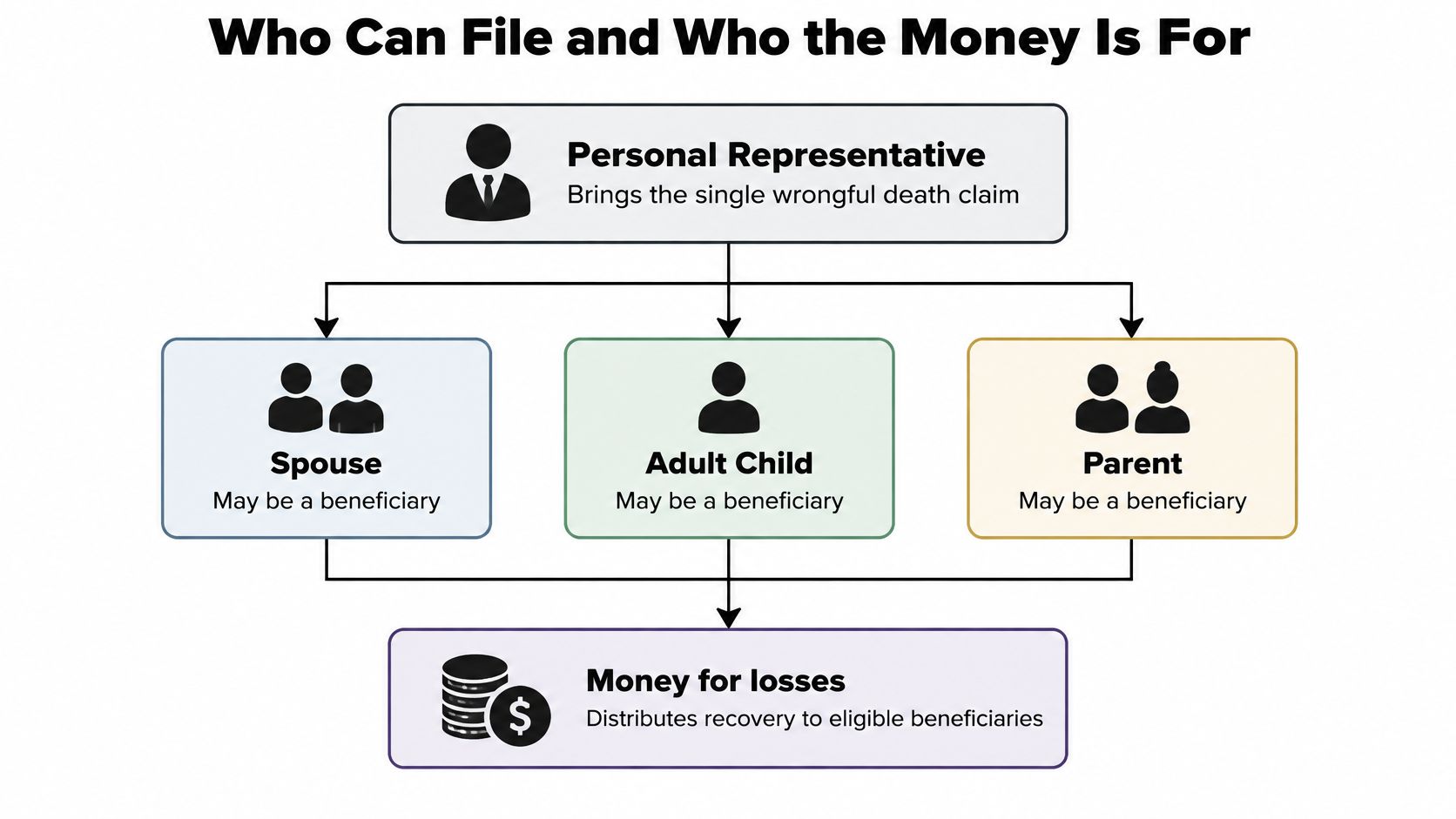
Who Can File and Who the Money Is For
Family disagreements often start with a simple misunderstanding. A spouse wants to file, an adult child wants to file separately, and a parent asks why their name isn't on the complaint. In New York, they don't each file their own wrongful death lawsuit.
Only one duly appointed personal representative brings the single statutory claim. That person files for the benefit of the eligible distributees. The representative is the legal doorway. The distributees are the people standing behind it, waiting for any recovery to be allocated to them under the statute.
How the Representative Gets Authority
If the person who died left a will naming an executor, that person normally seeks letters testamentary from Surrogate's Court. If there's no will, a qualified relative petitions for letters of administration. Until the court issues those letters, the family may have strong facts and no one authorized to file.
This is practical, not ceremonial. Banks, hospitals, employers, and insurers often won't release records to a grieving relative who has no court appointment. The letters establish who can act for the estate, hire counsel, request records, and commence the action.
- Executor with a will: The named person petitions to be recognized and receives letters testamentary if the court approves.
- Administrator without a will: A qualified person, often a spouse or adult child, petitions for letters of administration.
- No ready volunteer: The family still needs a court appointment, and waiting for consensus can consume the filing period.
Who Counts as a Distributee
Distributees follow New York's inheritance priority rules. A surviving spouse and children are the most common beneficiaries. If there are no closer qualifying relatives, parents or more remote heirs may be the distributees instead.
Name every distributee early in the estate petition. Leaving out a child from a prior relationship or failing to identify a parent who may qualify creates notice and distribution problems later. It can also distort the damages proof, because each distributee's expected support and reliance may differ.
The representative doesn't own the recovery. Any settlement or verdict money is held for the distributees, and the representative owes them an accounting.
That duty matters when bills arrive or relatives disagree about a settlement. The representative can't treat the eventual recovery as a personal fund, pay personal debts from it, or promise shares that don't match the statute and court direction.
Edge Cases That Surprise Families
A minor child can't act as the personal representative, even if that child is a distributee who lost financial support. An adult must obtain the appointment and protect the child's interest through the proper court process.
A separated spouse may still have a statutory role, depending on whether the marriage legally ended and on the intestacy facts. Separation in daily life and divorce on paper aren't the same thing. Ask counsel to confirm marital status from records, not from family assumptions.
A live-in partner who isn't a spouse or another qualifying distributee generally has no wrongful death share, even after years of shared rent and expenses. That rule feels harsh because the economic loss can be obvious. The statute, however, distributes recovery through its defined categories, not through a family's own sense of closeness.
The sequence is plain. Open the estate, obtain letters, identify every distributee, confirm who is excluded, and file within the deadline. If you reverse that order and start by arguing about shares, you may lose the right to recover anything to divide.
How Economists and Families Prove the Loss
A pecuniary-loss statute rewards documentation, not adjectives. Say a 42-year-old delivery driver in Queens is killed in a truck crash. He's married, has two children, and earns about $68,000 a year as a hypothetical example, with health insurance and retirement benefits. At night he handled childcare pickup, cooking, and home repairs. His spouse now pays other people for tasks he used to do.
An economist doesn't value his life. The economist values the support and services the distributees reasonably expected to lose. The New York Pattern Jury Instructions wrongful death charge comment reflects EPTL § 5-4.3's limit to fair and just compensation for pecuniary injuries, including lost support, lost services, medical and funeral expenses, and the economic value of future assistance or inheritance, while generally excluding standalone sorrow, anguish, companionship, affection, or society.
Building the Number in Layers
Start with historical earnings. Tax returns, W-2 forms, pay stubs, and union or employer records show base pay, overtime patterns, raises, and job stability. A single good or bad year shouldn't drive the whole model.
Next comes expected work-life. Age, health before the fatal event, occupation, and work history matter. An economist shouldn't assume every person would have worked full time to age 65, and shouldn't assume retirement at 55 without evidence either.
- Fringe benefits: Employer health premiums, retirement contributions, and paid leave have value even though they never appeared as take-home pay.
- Taxes and inflation: The model accounts for taxes and adjusts future dollars rather than treating a dollar twenty years from now as identical to a dollar today.
- Household services: Childcare, cooking, cleaning, transportation, and repairs get hours first, then a local replacement rate for each task.
- Dependents' reliance: Bank records, rent or mortgage payments, tuition, and insurance premiums show who relied on the income.
- Possible inheritance: The question is what savings, benefits, and assets were reasonably likely to remain for distributees, not what the family wishes the estate might have become.
Life expectancy and the probability of continued support keep the estimate honest. A healthy worker with a steady history supports a stronger future-earnings model than someone whose employment was intermittent. A child who would have been supported for many years has a different loss period from an adult child who was already financially independent.
If you want to understand the arithmetic behind this kind of model, a plain guide to economic damages calculation can help you follow how earnings, benefits, and services become one present-value figure.
A Thin File Versus a Strong File
A thin file has a funeral bill, a sympathy letter, and a family member saying support was large. It asks an insurer or jury to guess. Guesses get discounted.
A strong file pairs paper with people. The economist explains earnings and benefits. A vocational or household-services expert explains work capacity and replacement costs. Family members testify about actual routines, who watched the children, who fixed the sink, and who drove an aging parent to appointments.
Cause and timing of death also matter, especially for a survival claim. Medical records, EMS reports, and witness accounts may show whether the person was conscious and aware of pain before death. In disputed cases, learning when to request a private autopsy can be a useful starting point before evidence is lost, because the estate's conscious-suffering proof belongs in the survival claim, not blended into the distributees' economic model.
Documents to gather this week: Recent tax returns and W-2 forms, employer benefit statements, pay stubs, bank records showing household payments, childcare and repair receipts, funeral bills, medical bills from the fatal event, and a written list of weekly tasks the person performed.
Write the task list while routines are still fresh. "He helped around the house" is weak. "He picked up both children at 3 p.m. on weekdays, cooked dinner four nights a week, and handled snow removal and minor plumbing" gives an expert hours that can be valued. In New York, specific hours are worth more than a moving tribute.
How a Wrongful Death Lawsuit Moves Forward
Most cases follow a recognizable path, even when the facts differ. The representative's job is to keep each step from stalling because a record, vehicle, or appointment was missed. The overview below shows the sequence before the fuller steps are explained.
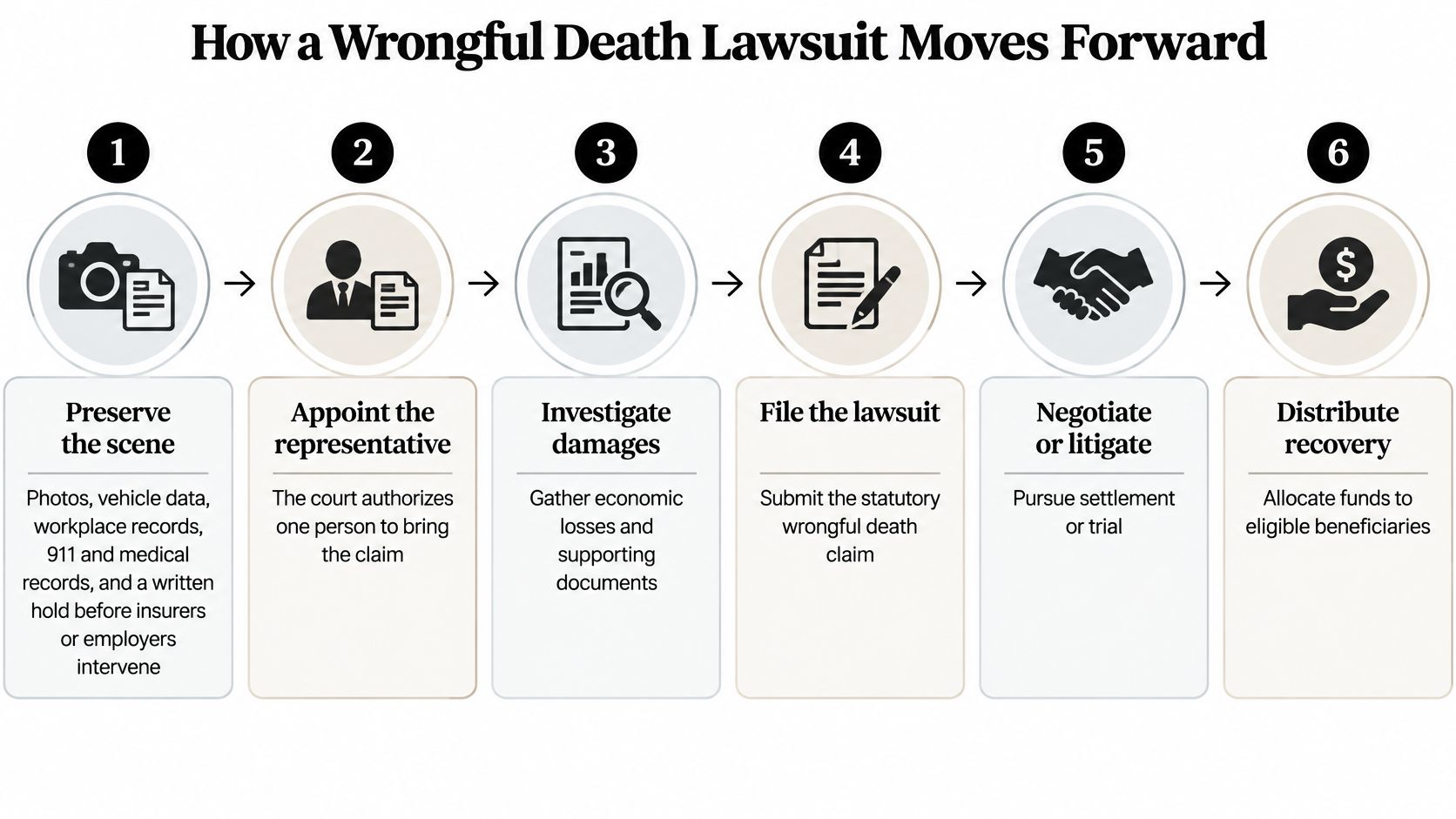
The Eight Steps
Preserve the scene and records. Save photos, dashcam files, vehicle data, workplace records, 911 audio, and medical records. Send a written preservation hold before an insurer, employer, or defendant repairs, scraps, or recycles key evidence. The usual stall is simple. The vehicle is gone before anyone downloads its data.
Open the estate and obtain letters. The representative needs court authority to sue and collect records. Families stall here when they can't find a will or can't agree who should serve. Every month without letters is a month without a plaintiff who can file.
Investigate fault and identify every defendant. Review police reports, witness accounts, maintenance records, employment files, and any video. Check whether a municipality, state agency, or public authority is involved, because that can trigger a notice of claim. Missing one defendant early can mean missing that defendant's separate clock entirely.
File the complaint. The representative files in the proper New York court within the governing deadline, alleging the wrongful conduct, naming the distributees, and pleading any separate survival claim. A complaint that mixes grief into the wrongful death count or leaves out conscious-suffering allegations can create avoidable motions and amendments.
The video below gives a visual walk-through of the process before the later litigation steps.
Exchange discovery. Both sides produce documents, answer questions, and take depositions of witnesses, family members, and experts. The defense will test earnings, work history, household hours, and fault. A family member who gives round numbers with no records behind them creates a credibility problem an economist can't fully repair.
Value the case and negotiate. By this stage, liability evidence, policy limits, and the pecuniary model are clearer, so many claims resolve without a verdict. Negotiation stalls when the defense has a complete economic analysis and the estate has only bills and estimates. Bring the expert work forward early enough to negotiate from documents.
Try the case if the dispute remains. At trial, the jury is instructed on pecuniary loss for the wrongful death claim rather than asked to award money for grief itself. The survival claim, if present, requires its own proof of conscious pain and suffering. Keeping those categories separate in testimony helps the jury apply the charge.
Distribute any recovery. The representative accounts for settlement or verdict funds and distributes them according to the estate's duties and the court's direction. Distribution stalls when distributees weren't identified correctly at the start or when a minor's share needs court-supervised handling.
Each step has a preventable stall. No letters, a lost vehicle, a late notice of claim, and an economist who never meets the family are process failures, not bad luck.
This sequence also explains why early counsel matters even when fault seems obvious. A clear liability case can still fail on authority, notice, or proof of loss. The work is to reach the courthouse with the right plaintiff, the right defendants, and numbers a jury can trace back to records.
What the 2025 Reform Bills Do and Do Not Change
Families ask one question after reading reform headlines. Can we recover for grief, loss of companionship, or emotional suffering in New York right now? Under the law in force, the answer is no for those items as standalone wrongful death damages. A bill announcement is not a legal right.
Three labels matter. A proposed bill has been introduced but may never pass. A vetoed bill passed the legislature but was rejected by the governor and didn't become law. An enacted law has completed the required process and is in effect. Only the third category changes what a family can claim.
The Bills Readers Are Seeing Online
In 2025, bills A6063 and S4423 proposed expanding recoverable damages beyond the traditional pecuniary-loss framework to include grief and anguish, broadening eligible beneficiaries, and extending the filing period by one year. The governor vetoed both measures. Families shouldn't assume any of those proposals apply to a claim filed today.
Senate bill A11340 for 2025-2026 addresses the types of damages available in wrongful death actions. It was referred to the Judiciary Committee in May 2026. A committee referral is a step in the legislative process. It isn't enactment, and it doesn't create a compensable category.
Status of New York wrongful death reform bills
| Bill | Status | Effect on a claim filed today |
|---|---|---|
| A6063 (2025) | Vetoed by the governor | None; grief, wider beneficiaries, and one extra year are not law |
| S4423 (2025) | Vetoed by the governor | None; same proposals are not law |
| A11340 (2025-2026) | Referred to Judiciary Committee, May 2026 | None unless enacted and in effect |
What to Do With a Headline
Don't dismiss reform news. Track it accurately. Legislative status can change during a pending case, and counsel should confirm which law governs the claim before relying on any new category. Ask for the bill number, then ask whether it has been enacted and whether it's effective for your dates.
A lawyer shouldn't promise an emotional-loss number based on pending legislation. If the category isn't in the law in force, it isn't bankable settlement value.
Keep building the economic file. Lost support, services, inheritance, and funeral and medical costs remain the working measure unless enacted law changes it. If reform later becomes effective law, a well-documented pecuniary claim doesn't become weaker for having been prepared properly.
The risk runs the other way. A family that waits for a broader statute, or assumes a vetoed one-year extension already applies, can miss the current filing period. Reform debate is a reason to monitor Albany. It isn't a reason to stop the estate appointment or delay evidence preservation.
Talk With Counsel Before the Two Years Run
Act now if a death may have been caused by a crash, a truck, unsafe property, medical care, or another person's negligence and the two-year date is still ahead. Act now also if the two years may have passed but a related criminal case could affect the deadline. You need a lawyer to calculate the dates from records, not a family guess at the kitchen table.
Bring what you have to a first meeting. You don't need a perfect folder before you call.
- Proof of death and family status: The death certificate, any will, and the names of the spouse, children, and other possible distributees.
- Incident records: Police report numbers, photos, dashcam files, insurance letters, and names of witnesses.
- Economic papers: Tax returns, pay information, benefit statements, funeral bills, and notes on household tasks the person performed.
- Government and criminal clues: Any notice of claim, agency letter, arrest information, or criminal court paperwork you've received.
What a Useful First Review Covers
A careful review should confirm who can serve as personal representative and whether letters are already in place. It should check for a government defendant and calculate any 90-day notice issue separately from the lawsuit deadline. It should separate the distributees' pecuniary loss from the estate's possible survival claim, then say plainly whether the file is early, urgent, or already in danger.
Ask the cost questions readers often skip. How are attorney fees calculated? Are case costs advanced, and do costs come out of any recovery? How will the representative's accounting to beneficiaries be handled? What happens if the firm doesn't accept the claim?
Nares Law Group LLC is one firm families can contact for this kind of review. Verify its New York licensing and wrongful death experience before relying on it, and ask who will handle the economics work. The firm lists results that include a wrongful death case settled for $1.1 million under policy limits, and attorney Julie Hill has decades of civil litigation experience involving personal injury, medical malpractice, wrongful death, and catastrophic injury. Those facts can inform your questions, but they don't predict your case value. No lawyer should promise a result from another family's file.
The firm also offers four free settlement calculators covering Wrongful Death, Brain Injury, Truck Accident, and Motor Vehicle Accident cases. Treat any calculator output as a starting estimate only. It can't test credibility, confirm distributees, or decide whether a criminal-case extension applies.
Before the first call ends, confirm three things. What's the date of death on the certificate? Are letters in place, or does Surrogate's Court still need a petition? Is there any governmental defendant or criminal docket? Book the consultation with those questions ready, even if some records are still missing. Perfect paperwork gathered after a deadline helps no one.
If your family is facing the two-year New York wrongful death deadline, a government notice question, or uncertainty about who must file, contact Nares Law Group LLC for a focused review of your dates, estate appointment, and economic-loss records. Bring the death certificate, any will, and the incident documents you already have, and ask for a clear plan for preserving the claim before more time passes.