Punitive damages are a special money award in a lawsuit that punish especially bad conduct instead of paying you back for your losses, and they are rare. In U.S. state-court civil trials where plaintiffs won, punitive damages were awarded in only 5% of cases in 2005, and in tort cases the rate was about 3%.
If you're reading this after a crash, a truck wreck, or the death of someone you love, you're probably not looking for legal vocabulary. You're trying to understand whether the law sees what happened the way you do. Not just as an accident, but as something far more serious.
That reaction matters. Sometimes a case involves more than carelessness. Sometimes the facts suggest a person or company acted with such disregard for safety that ordinary compensation doesn't feel like enough. That's where punitive damages come in. They exist to punish and to deter, not to cover your medical bills, lost income, or pain.
People often search "what is punitive damages" when they hear the phrase from a lawyer, a police officer, or an insurance adjuster and want a straight answer. The straight answer is this: punitive damages can be powerful, but the legal bar is high, and state law often limits what can be collected.
After a Serious Accident You Deserve More Than Just Answers
A client sits in my office after a violent collision. The car is totaled. The hospital records are stacked in a folder. The police report hints that the other driver may have been doing something far worse than making a simple mistake. Then the client asks the question many people ask in a whisper: “Can the court punish them for this?”
That question usually comes from a deep sense that the harm wasn't random. Maybe a drunk driver got behind the wheel again. Maybe a trucking company ignored obvious safety problems. Maybe someone made a choice that put other people in danger and did it anyway.
Punitive damages are the legal system's way of addressing that kind of conduct. They are not meant to reimburse you for what you lost. They are meant to punish a defendant for especially harmful behavior and discourage similar conduct in the future.
Why this feels confusing
Most injured people first hear about damages in terms of bills and losses. Those are easier to grasp because they connect directly to your life:
- Medical expenses from emergency treatment, surgery, therapy, and follow-up care
- Lost income when injuries keep you from working
- Human losses like pain, disability, and disruption to family life
Punitive damages are different because they focus on the defendant's behavior, not just your injury.
The core question isn't only “How badly were you hurt?” It's also “How bad was the conduct that caused it?”
The instinct many families have is often right
When someone says, “This shouldn't have happened,” they may be talking about ordinary negligence. When they say, “This was outrageously reckless,” they may be describing the kind of conduct that raises a punitive damages issue.
That doesn't mean a punitive claim will succeed. It does mean the facts deserve a careful look, especially in motor vehicle, trucking, and wrongful death cases where the line between mistake and recklessness can change the entire case.
Punitive vs Compensatory Damages What's the Difference
Think of it this way. If a fire destroys your house, compensatory damages are the money meant to help rebuild what you lost. Punitive damages are more like a legal penalty imposed on the person who intentionally set the fire, so that conduct is punished and others are warned off.
That difference is the heart of the issue.
Punitive damages are a non-compensatory remedy awarded on top of compensatory damages. They often require proof by clear and convincing evidence, which is a higher standard than the preponderance of the evidence used for ordinary liability findings, according to Law.com's definition of punitive damages.
Compensatory vs. Punitive Damages at a Glance
| Aspect | Compensatory Damages | Punitive Damages |
|---|---|---|
| Purpose | To repay losses caused by the injury | To punish wrongful conduct and deter repetition |
| Focus | What the plaintiff lost | How bad the defendant's conduct was |
| When sought | In many injury cases | Only in a narrower set of cases involving egregious conduct |
| Proof standard | Usually preponderance of the evidence | Often clear and convincing evidence |
| Paid on top of what | Forms the main damages claim | Added on top of compensatory damages if allowed |
What clear and convincing really means
This phrase sounds technical, but the practical point is simple. The court usually wants stronger proof before it will let a jury punish someone.
For an ordinary negligence claim, the question is often whether the defendant was more likely than not at fault. For punitive damages, the evidence usually has to show much more than a bad judgment call. It must strongly support the idea that the conduct was malicious, intentional, fraudulent, or reckless.
That can include evidence such as:
- Internal records showing a company knew about a danger and ignored it
- Video or electronic data revealing deliberate unsafe conduct
- Admissions in texts, emails, or testimony that show conscious disregard for safety
- Prior warnings that put the defendant on notice before the incident happened
Why people mix these up
Many clients assume that if an injury is severe, punitive damages should follow automatically. That isn't how courts treat them. A catastrophic injury can result from ordinary negligence. A less severe injury can involve conduct so outrageous that punitive damages become a serious issue.
Practical rule: Compensatory damages ask, “What did this cost you?” Punitive damages ask, “What kind of conduct caused it?”
So if you're asking what is punitive damages, the best starting point is this distinction: one category is about making you whole as much as money can. The other is about civil punishment.
How Courts Decide and Award Punitive Damages
Courts don't award punitive damages just because a defendant caused harm. The claim has to be built carefully, and the evidence has to show that the conduct crossed a much higher line than ordinary fault.
Punitive damages are not awarded for simple negligence. Courts generally require conduct described as intentional, malicious, grossly negligent, or in reckless disregard of safety, as explained in this discussion of punitive damages in injury cases.
Early in the case, lawyers usually look for facts that reveal state of mind. Did the defendant know about the risk? Did they ignore repeated warnings? Did they profit from dangerous choices? Those details matter because punitive damages are about blameworthiness, not just causation.
A visual overview helps make the process easier to follow.
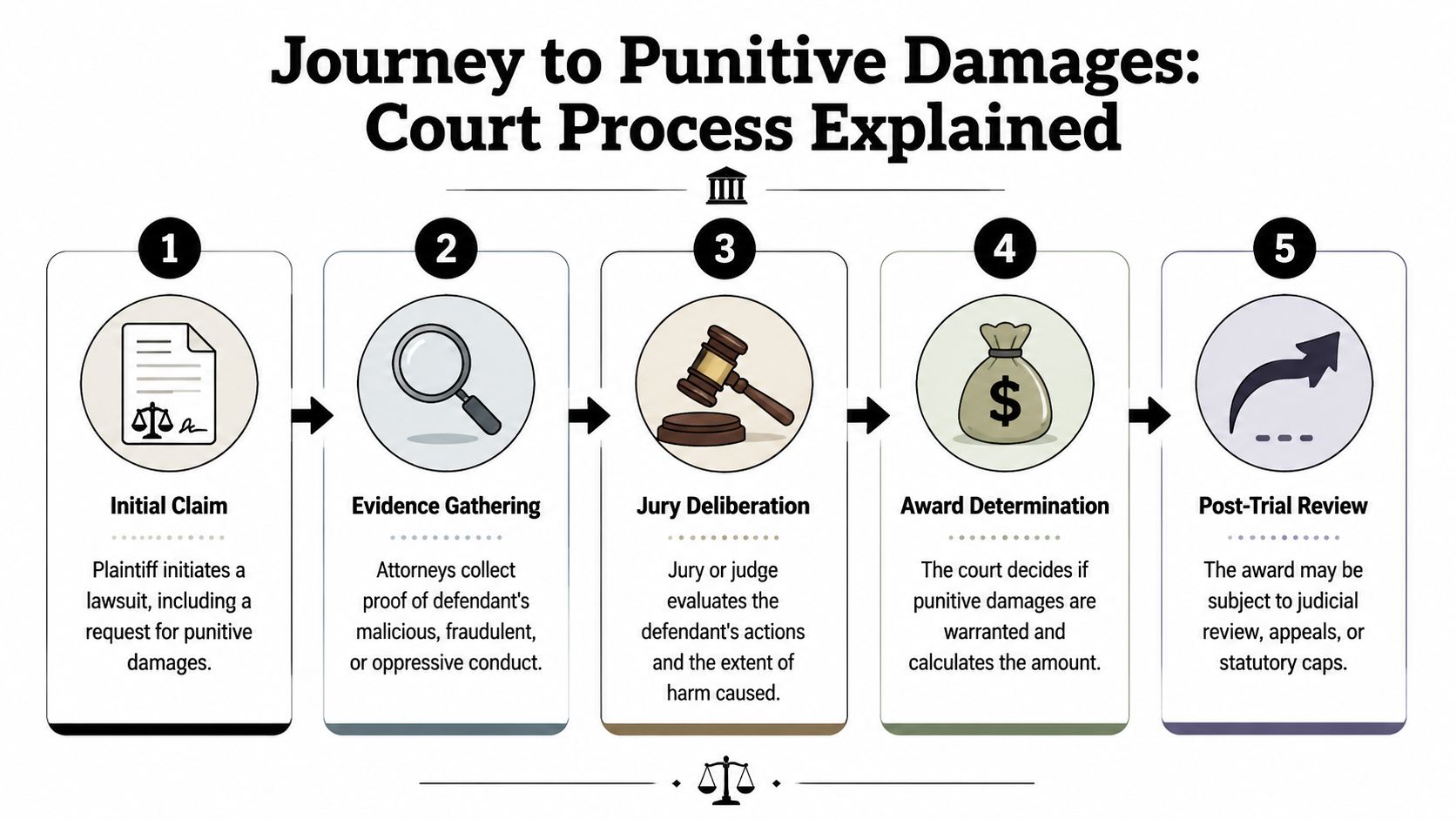
The path from allegation to award
The claim is raised
A plaintiff includes a request for punitive damages if the facts justify it.Evidence is gathered
Lawyers look for proof of intentional, malicious, fraudulent, or reckless conduct.The jury or judge evaluates the conduct
The decision isn't just about whether the defendant caused injury. It also turns on how serious the wrongdoing was.An amount is determined if punishment is warranted
The award must still fit within legal limits.The court reviews the result after trial
Judges may reduce or limit punitive damages under constitutional rules or state statutes.
Later in the process, testimony often becomes critical. If you're trying to understand how sworn testimony works and why wording matters, WhisperAI's deposition guide is a useful plain-English resource.
Why transparency matters here
Lawyers should be candid about how uncommon punitive damages are. In U.S. state-court civil trials where plaintiffs prevailed, punitive damages were awarded in only 5% of cases in 2005, and in tort cases the rate was about 3%, according to the Center for Justice & Democracy fact sheet on punitive damages.
That same source reported a median punitive award of $64,000, while 13% of punitive-award cases reached $1 million or more. That tells you two things at once. Punitive damages are unusual, and when they do appear, the range can be very wide.
Courts reserve punitive damages for a narrower category of civil wrongdoing. That's why strong facts matter more than strong feelings.
State Laws and Caps on Punitive Damages
Even when a case supports punishment, punitive damages are not a blank check. Courts review them for fairness, and many states impose statutory limits. Many online articles, however, fail readers by not addressing these limitations. They define the concept but skip the part people care about most: what can happen in a real case.
At the national level, constitutional limits matter. A modern litigation analysis reported that the median punitive award increased from $35 million in 2017 to more than $87 million in 2022, and the mean punitive award exceeded $690 million in 2022. The same analysis found that annual punitive awards over $25 million ranged from 16 to 33 cases between 2016 and 2022, and it also noted Supreme Court guideposts such as a 4:1 punitive-to-compensatory ratio being near the line in Haslip while extreme ratios like 500:1 were rejected in BMW, as discussed by the Institute for Legal Reform's review of rising punitive awards.
Those big numbers make headlines, but they can mislead injured people if they aren't placed in context. Most cases never look like that. Most cases are shaped by state law, post-trial review, and the facts available to prove reprehensible conduct.
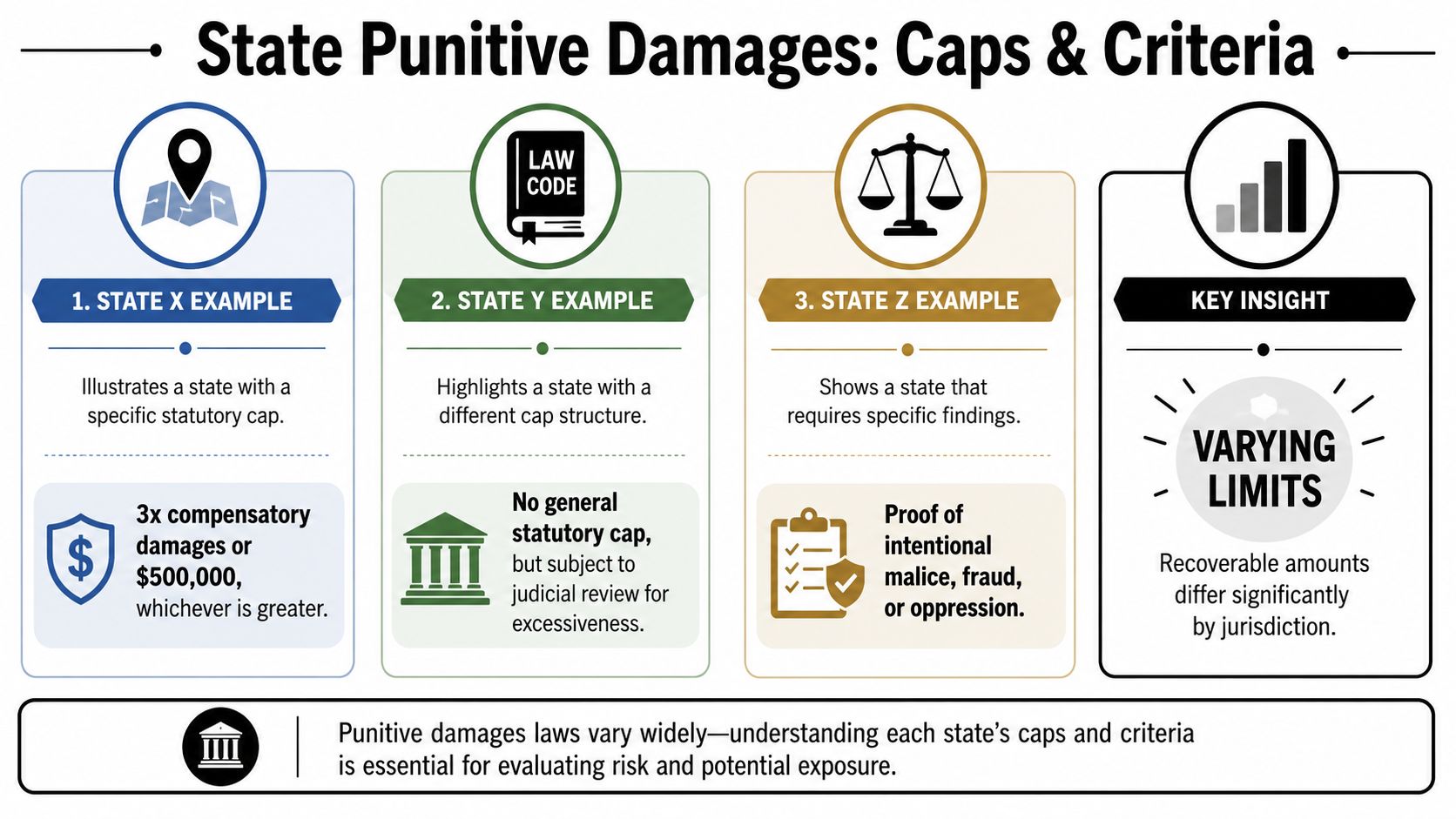
Colorado realities
Colorado is a good example of why the practical answer is often more complicated than the definition. Even when punitive damages are available, state caps can sharply limit recovery. Cornell's Wex notes that one Colorado punitive category is capped at the amount of actual damages, while a higher category for willful and wanton conduct is capped at three times actual damages, as described in Cornell Law School's punitive damages overview.
That means a strong punitive theory still has to pass through a statutory lens. In plain terms, the legal system may agree that punishment is appropriate, but it may still limit how much punishment can be imposed.
If you're trying to understand how Colorado law can affect the overall value of a case, Colorado damage caps and related limits are worth reviewing alongside the facts of your injury.
Texas and New York in practical terms
Texas and New York matter here for a different reason. They show how much punitive damages law can vary by jurisdiction.
Texas uses a cap-based framework. The practical takeaway for injured people is that even a viable punitive claim may be limited by statute, so case value analysis has to account for the formula the law applies.
New York doesn't fit the same simple cap model. In practice, punitive damages tend to be shaped more by common-law standards and judicial review for excessiveness. That doesn't make them easier to win. It means the courtroom fight often centers on whether the conduct was morally blameworthy enough to justify punishment and whether the amount can survive review.
What this means for expectation-setting
Clients often ask a fair question: if punitive damages are capped, are they still worth pursuing?
Sometimes yes. Not always because they produce a massive standalone recovery, but because they can change the posture of a case. A credible punitive claim can affect settlement dynamics, discovery strategy, and how a defendant explains its conduct under oath.
State law doesn't just affect the size of a punitive award. It shapes whether the claim creates real leverage at all.
Punitive Damages in Trucking and Wrongful Death Cases
Truck wreck and fatality cases often bring the issue into sharper focus because the conduct can involve more than a momentary driving error. It can involve systems, policies, and conscious choices made long before the crash.

In a trucking case
A tractor-trailer rear-ends stopped traffic. On the surface, it may look like a basic negligence case. Then the records come in. The company may have ignored repeated driver-hours violations. Supervisors may have looked the other way when logbooks didn't match other records. Maintenance problems may have been flagged and postponed because taking a truck off the road would cost money.
Those facts don't automatically guarantee punitive damages. But they can support the argument that the defendant's conduct was more than a mistake. They knowingly accepted a serious safety risk.
For families trying to understand how these crashes are investigated, Colorado truck accident case resources can help frame the kinds of evidence that often matter.
In a wrongful death case
Wrongful death claims can also involve punitive themes, especially when the conduct reflects repeated or obvious disregard for human life. A fatal crash caused by a repeat-offender drunk driver is a common example people understand immediately. So is a driver who races through traffic after drinking and ignores every warning sign that they shouldn't be on the road.
In that setting, compensation addresses the family's financial and personal losses. A punitive claim, when allowed, serves a different function. It tells the court that the conduct itself deserves civil punishment.
Why these cases are so fact-sensitive
Two truck crashes can look similar in a news headline and be completely different in court. The same is true of two fatal crashes. One may involve distraction or inattention. The other may involve conscious choices, altered records, prior warnings, or deliberate safety violations.
That is why punitive damages litigation often turns on hidden evidence:
- Company communications that reveal what management knew
- Driver qualification and training files that expose ignored red flags
- Electronic logging and safety data that contradict the initial story
- Prior incidents or warnings that show the risk was not new
In serious injury and death cases, the most important punitive evidence is often the evidence a defendant didn't plan to hand over willingly.
Protecting Your Right to a Punitive Damages Claim
A punitive damages claim can rise or fall on what gets preserved in the first days and weeks after a serious crash.
That surprises many injured people. They assume the key question is whether the conduct was bad enough. That question matters, but first you need proof. And in punitive cases, the proof is often the part that disappears fastest. A truck gets repaired. A phone is replaced. Electronic logging data is overwritten. A company keeps only part of an email chain. By the time a lawsuit is filed, the most revealing evidence may already be gone.
That is why early case work matters so much. The goal is to preserve evidence that may show more than ordinary carelessness. In practical terms, that can include intoxication evidence, body-camera footage, scene photos, dispatch communications, maintenance records, onboard data, and posts or messages created close in time to the event.
Some of the best punitive evidence looks ordinary at first.
A short text exchange can show a supervisor knew a driver was unsafe and sent them out anyway. A maintenance note can show the same brake problem was reported before. A casual post-crash statement can later become an important admission. Missing records can matter too, especially if someone had a duty to keep them. If you are worried key material may vanish, it helps to understand spoliation of evidence and why preservation matters.
Depositions also matter here because punitive cases often turn on what a person knew, when they knew it, and what they chose to do anyway. If you want a plain-English overview of how that process works, WhisperAI's deposition guide is a useful starting point.
Defendants usually respond in familiar ways. They try to shrink reckless conduct into a simple mistake. They separate one bad decision from the larger pattern around it. A company may say the problem was only one employee, even where the records point to ignored warnings, weak supervision, or a broader safety problem. They also fight hard over discovery, because prior complaints, internal emails, and preservation failures can turn an ordinary negligence story into a punitive one.
Even with strong facts, expectations need to stay grounded. Punitive damages are rare. Courts set a high bar, and state law can narrow what is available or cap the amount. That is especially important in states like Colorado and Texas, where statutory limits can shape the value of the claim, and in New York, where the fight is often over whether the conduct is extreme enough in the first place. In other words, a punitive claim can be powerful, but it is never automatic.
Nares Law Group LLC handles serious injury, trucking, brain injury, and wrongful death cases, including cases where the evidence may support punitive damages in Colorado, Texas, or New York.
If you suspect the conduct in your case went beyond negligence, act quickly. Waiting usually helps the other side, not you.