The truth is, truck accidents in Colorado are disturbingly common, and their consequences are almost always devastating. We see the aftermath of these collisions on our major routes, from I-25 to I-70. These aren't just traffic incidents; they are life-shattering events that expose the immense danger posed by massive commercial vehicles.
The Devastating Impact of Colorado Truck Accidents
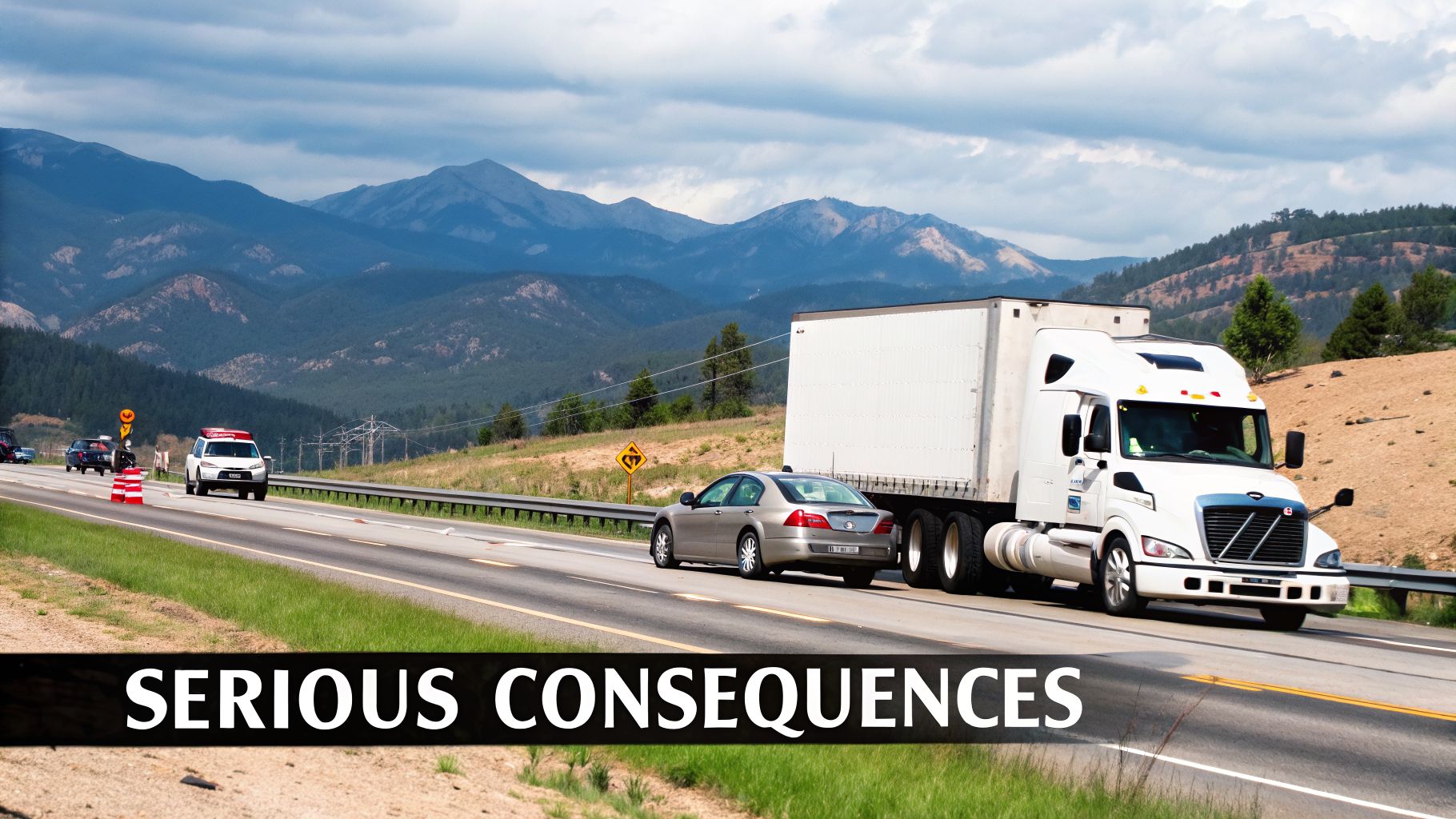
When an 80,000-pound semi-truck hits a passenger car, the laws of physics are brutal and unforgiving. The energy transfer is catastrophic. It’s less like a car crash and more like being struck by a rolling freight train. The result, even at lower speeds, is often life-altering injuries or tragic fatalities for those in the smaller vehicle.
These are not rare events. The numbers paint a grim and consistent picture on our state’s roads.
To put this in perspective, here are some of the realities of large truck crashes in our state.
Colorado Truck Accident Snapshot
| Key Statistic | Finding in Colorado |
|---|---|
| Annual Fatalities | In 2024, Colorado saw 74 fatal crashes involving large trucks. |
| Percentage of Total Fatal Crashes | These crashes made up 8.4% of all fatal collisions in the state. |
| Primary Collision Factor | Driver error remains a leading cause, often tied to fatigue or distraction. |
| Geographic Risk | Mountain corridors like I-70 see a high number of incidents due to steep grades. |
These statistics, detailed further in reports on Colorado truck accident statistics, confirm a hard truth: collisions with commercial trucks are disproportionately deadly. The sheer mass of the truck means the occupants of the car, van, or SUV almost always absorb the worst of the impact.
More Than Just an Accident
It is critical to understand that these events are rarely simple “accidents.” More often, they are the predictable result of negligence. A driver pushed past their legal hours of service. A trucking company that cut corners on critical brake maintenance. A crew that failed to properly secure its cargo.
The aftermath leaves families facing an avalanche of challenges all at once:
- Severe physical injuries demanding long-term medical care, surgeries, and rehabilitation.
- Deep emotional and psychological trauma, including anxiety and post-traumatic stress disorder (PTSD).
- Crushing financial burdens from overwhelming hospital bills and the inability to work.
The human cost behind every number is profound. Each statistic represents a family suddenly thrown into crisis, grappling with loss and uncertainty while trying to navigate a legal system that is complex and intimidating. Understanding your rights is the first step toward regaining some control.
The Unique Dangers of Colorado's Roads
Our state’s geography adds another layer of risk. Colorado’s mountainous terrain, with its steep grades, sharp curves, and unpredictable weather, demands the highest level of driver skill and vehicle maintenance. When a trucker or their company is unprepared, the potential for disaster skyrockets, especially on notorious stretches like I-70 through the Rockies.
This guide is here to bring clarity to the chaos that follows a truck wreck. We will walk through the common causes, explain the state and federal regulations that govern the trucking industry, and outline the steps you must take to protect your family, your health, and your future. Trying to face powerful trucking companies and their insurance carriers alone is an overwhelming battle you should not have to fight.
Why Truck Wrecks Happen on Colorado Roads
When you see the aftermath of a commercial truck accident, it’s easy to assume it was just a simple mistake—one driver’s error. But from our experience handling these complex cases, the reality is almost never that simple. A truck crash is rarely a single event. It’s often the final, devastating outcome of a chain of poor decisions, ignored regulations, and systemic failures that began long before the truck’s tires ever hit the pavement.
These aren't just random acts of bad luck. They are predictable, and often preventable, collisions born from a combination of intense industry pressure and Colorado's uniquely challenging roads. Uncovering the true cause is the only way to hold every responsible party accountable.
Driver Fatigue and Bending the Rules
One of the most common and dangerous factors we see is driver fatigue. There’s a reason federal law has strict Hours-of-Service (HOS) rules that limit driving time and mandate rest. An 80,000-pound semi-truck is a massive responsibility, and a tired driver is a direct threat to every other person on the road.
Think of it this way: you wouldn’t want a surgeon operating on you after being awake for 20 hours straight. The risk of a fatal error is just too high. When a trucker is pushed past their legal limit, their judgment, reaction time, and basic decision-making skills plummet. The results can be just as catastrophic.
This pressure often peaks during the business week. It's no coincidence that a staggering 77% of these crashes happen between 6 a.m. Monday and 5:59 p.m. Friday. This is when tight delivery schedules can tempt or force drivers to violate HOS rules just to keep up. You can see more statistics on the timing of these incidents on whaleninjurylawyers.com.
Improper Cargo Loading
Another culprit that’s often overlooked is how the truck was loaded. The stability of a semi-truck depends entirely on its cargo being perfectly balanced and secured. When a load is uneven or not tied down correctly, it can shift without warning, instantly changing the truck’s center of gravity.
A sudden weight shift on a sharp curve or during a quick stop can make the truck dangerously top-heavy. This is a classic recipe for a jackknife or a rollover accident, putting everyone in the vicinity at risk.
In these situations, the driver might not even be the one at fault. The responsibility could lie with a separate cargo company or the warehouse crew who loaded the trailer hours or days earlier. Getting to the bottom of it requires an investigation that looks far beyond the accident scene.
Inadequate Vehicle Maintenance
Commercial trucks are workhorses that take an incredible amount of punishment. Their brakes, tires, and steering systems require constant, meticulous maintenance to operate safely. Federal regulations are clear on this, mandating regular inspections and prompt repairs.
But some trucking companies put profits ahead of people. They cut corners, delay critical maintenance, or use cheap, substandard parts to save a few dollars. This kind of negligence turns a truck into a ticking time bomb. Some of the most common failures we see include:
- Brake Failure: Poorly maintained or overheated brakes are a primary cause of runaway truck accidents, especially on Colorado's steep mountain descents like I-70 or Wolf Creek Pass.
- Tire Blowouts: Old, worn, or improperly inflated tires can explode at highway speeds, causing a driver to lose all control in an instant.
- Steering or Suspension Failure: When these critical systems break down, the truck can become impossible to steer, leaving the driver helpless.
Colorado’s Unique Geographic Challenges
Finally, we can’t ignore the role our own state’s terrain plays. Colorado’s steep mountain grades, winding two-lane highways, and notoriously unpredictable weather demand a high level of skill and a perfectly maintained rig.
A driver who isn't trained for mountain conditions or who is operating a truck with shoddy brakes is a danger to everyone. When you combine corporate negligence with the natural hazards of our state, the risk of a tragedy skyrockets. You can read more about the specific causes of truck accidents in Colorado and how victims can recover in our in-depth guide.
Who Is Really at Fault? Untangling Liability in a Truck Accident
After a collision with an 80,000-pound truck, it’s natural to assume the driver is to blame. They were behind the wheel, after all. But the truth is almost always more complicated. The person you see in the driver's seat is often just the final link in a chain of failures that started long before the truck ever hit the road.
Figuring out who is legally responsible isn't about pointing a finger at one person. It’s about methodically piecing together a puzzle to reveal every decision, shortcut, and oversight that led to the crash.
More Than Just the Driver
In commercial trucking, a single accident can have many causes. Was the driver exhausted from being pushed to break federal rules? Was the truck's cargo loaded improperly, causing it to become unstable? Or did a critical part fail because maintenance was skipped to save a few dollars?
These questions show why liability is rarely simple. Multiple people and companies can share the blame, and a thorough investigation is the only way to hold every negligent party accountable.
A truck crash is rarely a single person's mistake. It is often the result of systemic failures, where corporate policies, maintenance shortcuts, and inadequate training create the conditions for a disaster to happen on our roads.
These breakdowns in responsibility often fall into a few key categories.
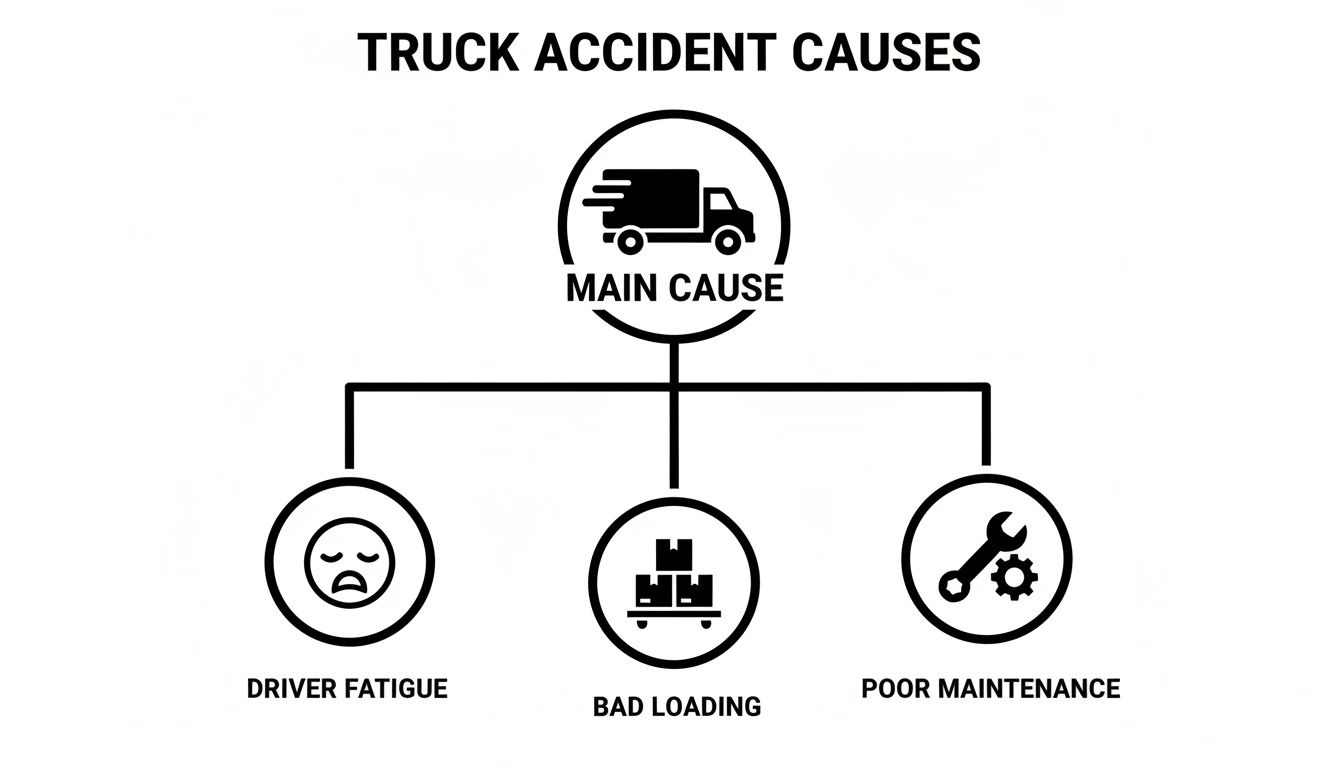
As you can see, the path to a crash often starts far away from the driver, with issues like company pressure, poor loading practices, or mechanical neglect.
Who Can Be Held Liable?
When building a truck accident claim in Colorado, we cast a wide net. The goal is to identify every person or company whose negligence contributed to your injuries. You might be surprised by who can be held responsible.
The table below breaks down the most common parties we investigate.
Who Can Be Held Liable in a Truck Accident?
| Potentially Liable Party | Reason for Liability |
|---|---|
| The Trucking Company | Negligent hiring, poor training, or forcing drivers to violate safety regulations. |
| The Truck Driver | Speeding, distracted driving, driving under the influence, or other direct traffic violations. |
| Cargo Loader/Shipper | Improperly securing or overloading cargo, leading to a dangerous load shift or tipped trailer. |
| Vehicle Manufacturer | A defective part, like faulty brakes or tires, that directly caused the mechanical failure. |
| Maintenance Shop | Shoddy repair work or failing to properly inspect and maintain the truck. |
Each of these parties has a legal duty to ensure safety. When they fail, they can be held financially responsible for the harm that results.
You can learn more about how fault is determined by reading our in-depth guide on who is liable in a truck accident in Colorado.
Why Federal Trucking Rules Are So Important
The trucking industry doesn’t operate on the honor system. It’s governed by a thick book of safety rules from the Federal Motor Carrier Safety Administration (FMCSA). These aren't just suggestions; they are legally mandated standards designed to prevent catastrophic accidents.
Proving that a trucking company or driver broke one of these rules is powerful evidence of negligence. Some of the most critical regulations we look for violations of include:
- Hours of Service (HOS): These rules strictly limit driving time and require mandatory rest breaks to combat driver fatigue. A driver who exceeds these limits is a danger to everyone on the road.
- Drug and Alcohol Testing: Federal law requires trucking companies to implement random, mandatory testing programs. A failure to do so is a massive red flag.
- Vehicle Maintenance and Inspections: Companies must keep meticulous records of every inspection, repair, and maintenance job performed on their trucks. Missing logs or overdue repairs are direct evidence of negligence.
When we investigate your case, we subpoena these records. We dig into driver logs, inspection reports, and company hiring policies. A violation isn't just a technicality—it's proof that a company chose to ignore its safety obligations, putting profits ahead of people's lives.
Critical First Steps After a Truck Accident

The world spins. The noise is deafening. In the chaos right after a collision with a semi-truck, it’s hard to think clearly. Your first instinct is to check on your passengers and make sure everyone is safe.
But what you do in the next few minutes and hours is critical. It sets the stage for both your physical recovery and your ability to get fair compensation. You can be sure the trucking company’s legal team and insurance adjusters are already on their way, and their only goal is to protect their bottom line. Knowing how to protect yourself from the very start is your best defense.
Prioritize Your Health and Seek Medical Attention
Even if you think you feel fine, get checked out. See a doctor, visit an urgent care, or go to the emergency room. The adrenaline that floods your system during a crash is incredibly powerful and can completely mask the pain of a serious injury.
What feels like a little stiffness could be a sign of something much worse. Internal bleeding, organ damage, and traumatic brain injuries (TBIs) often have no immediate, obvious symptoms. If you wait, you not only put your health at risk but also hand the insurance company a ready-made excuse to argue your injuries aren’t related to the crash.
Some common "hidden" injuries to watch for include:
- Abdominal Pain or Swelling: This might signal damage to your liver, spleen, or other internal organs.
- Dizziness or Confusion: These are classic signs of a concussion or a more severe TBI.
- Deep Bruising: A dark bruise on your chest or stomach from the seatbelt can mean there’s serious trauma underneath.
A medical professional can spot these red flags before they become life-threatening.
Document Everything at the Scene
If you are physically able to move around safely, your smartphone is your most important tool. The crash scene will be cleared quickly. This evidence is temporary, and once it's gone, it’s gone for good.
Try to capture these key details:
- Vehicle Positions: Take wide-angle photos showing where all the vehicles ended up before they get moved.
- Property Damage: Get close-up shots of the damage to your car and the truck from every angle.
- Skid Marks and Debris: These details help accident reconstruction experts figure out what really happened.
- Road and Weather Conditions: Was it raining? Icy? Was there a poorly marked construction zone? Snap a picture.
Ask any witnesses for their names and phone numbers. An independent account from someone with nothing to gain can be incredibly powerful. You will need to exchange information with the truck driver, but do not apologize or say anything that could be interpreted as admitting fault. A simple, "I'm sorry this happened," can be twisted and used against you.
Colorado’s Statute of Limitations: In Colorado, you generally have three years from the date of a motor vehicle accident to file a lawsuit. This is a hard deadline. If you miss it, you permanently lose your right to seek compensation.
That three-year clock starts the second the crash occurs. While it might sound like a long time, building a solid case against a major trucking company is a massive undertaking. The investigation has to start immediately. Large trucks were involved in 11% of fatal car accidents in Colorado in 2024, leading to 103 deaths. You can learn more about these sobering numbers in this report on Colorado truck accidents. With stakes this high, you can't afford to wait.
Understanding the Full Value of Your Claim
The first bill that shows up after a catastrophic truck accident—often from the ambulance or the ER—can feel staggering. But it’s just the tip of the iceberg. That bill represents only a tiny sliver of the true cost of the collision.
Trucking company insurers know this. They are notorious for making quick, lowball settlement offers that barely cover those initial expenses. They hope you’ll take the money and sign away your rights before you grasp the full, lifelong impact of what just happened.
True compensation isn’t about paying today's bills. It’s about protecting your future. A fair settlement has to account for every single loss you have endured and will continue to endure, both the tangible and the intangible. To really understand what you’re owed, we need to break down your claim’s value into two distinct parts.
Economic Damages: The Tangible Costs
Economic damages are the most straightforward part of a claim because they come with a receipt or a clear dollar amount attached. Think of these as the calculable, out-of-pocket expenses and financial losses caused directly by the crash. But calculating them correctly means looking far into the future, not just at the stack of bills on your kitchen table.
A complete claim for economic damages after a Colorado truck accident must include:
- All Past and Future Medical Expenses: This goes way beyond the first hospital stay. It covers future surgeries, physical therapy, long-term rehabilitation, prescription drugs, necessary medical equipment like a wheelchair, and even modifications to your home to accommodate a permanent disability.
- Lost Wages and Income: This is the money you’ve already lost from being unable to work while you recover.
- Loss of Future Earning Capacity: This is one of the most critical—and most often overlooked—damages. If your injuries stop you from returning to your old job or limit your ability to work at all, you deserve compensation for the wages you would have earned for the rest of your career.
A severe traumatic brain injury (TBI) from a truck wreck might mean a lifetime of cognitive therapy and an inability to perform complex job functions. A fair settlement must reflect these decades of lost potential income and ongoing care needs, not just the first year of treatment.
Non-Economic Damages: The Human Cost
Non-economic damages are much harder to put a number on because they represent the profound, personal losses you suffer. There’s no price tag for pain or trauma, but these losses are incredibly real and deserve significant compensation. They address the human cost of the accident and the ways your quality of life has been shattered.
These damages are unique to every single person and can include:
- Pain and Suffering: The physical pain, deep discomfort, and agony from your injuries.
- Emotional Distress and Mental Anguish: This covers the fear, anxiety, depression, and PTSD that almost always follow a violent, traumatic event like a truck crash.
- Loss of Enjoyment of Life: This compensates you for being unable to participate in hobbies, activities, and moments you once loved. For example, a severe back injury might prevent an avid hiker from ever returning to the trails or a parent from being able to lift their child.
- Permanent Disfigurement and Scarring: Compensation for the physical reminders of the accident that affect your self-esteem and how you interact with the world.
Insurance adjusters will do everything they can to downplay or dismiss these non-economic damages because they are subjective. But they are a vital component of your claim and often represent the largest portion of a fair settlement.
The factors that influence your settlement for a Colorado truck crash injury are complex. Understanding both the economic and non-economic damages is crucial to fighting for what you truly deserve. Rejecting an insurer's first offer isn’t just a negotiating tactic; it's a necessary step to make sure your lifelong needs are met.
Why You Need a Specialized Truck Accident Attorney

After a crash with a commercial truck, you are not just up against the driver. You are up against a massive corporation, its legal team, and its aggressive insurance carriers. This is not a fair fight. Trying to handle a truck accident in Colorado on your own is like walking into a legal firestorm unprepared.
These companies have teams on standby, sometimes dispatched to the scene within hours. Their job is to control the evidence, shape the story, and protect their company from financial responsibility. Their only goal is to pay you as little as possible. You need someone in your corner whose only goal is protecting you.
The Specialist vs. The Generalist
Not all personal injury attorneys can handle the brutal complexity of a commercial trucking case. A general practice lawyer might do a fine job with a standard car accident, but a collision with an 18-wheeler is an entirely different animal. It demands a deep, working knowledge of federal trucking law, industry operations, and the specific evidence that wins these cases.
Think of it this way: you wouldn't ask your family doctor to perform open-heart surgery. You’d find a cardiac surgeon who has spent years mastering that one specific, high-stakes procedure. The same exact principle applies here.
A true truck accident specialist knows precisely where to look for the truth:
- Electronic Logging Devices (ELDs): We immediately send spoliation letters to force the preservation of the truck’s “black box.” This data is a goldmine, showing speed, braking, and whether the driver violated federal hours-of-service rules designed to prevent fatigue.
- Corporate Negligence: We investigate the trucking company’s history. We pull records on their hiring practices, driver training protocols, and fleet maintenance schedules to find dangerous patterns they don't want exposed.
- Accident Reconstruction: We bring in top-tier engineers and reconstruction experts. They can scientifically prove how a crash really happened, often uncovering that the true cause was brake failure or a dangerously imbalanced load, not just a simple driver mistake.
A dedicated truck accident lawyer doesn't just see a collision. We see the chain of corporate decisions and shortcuts that led directly to your injuries. Our entire focus is on exposing that chain and holding every single negligent party accountable.
Your Partner in a Complex Battle
Trying to fight a legal war while also fighting to recover from serious injuries is an impossible weight for anyone to carry. A specialized firm like Nares Law Group is built to take that entire burden off your shoulders. We manage every single detail, from the moment we are hired.
We handle the evidence preservation, the investigation, the endless calls with insurance adjusters, and all the complex legal work required to prepare your case for trial. This frees you up to focus on the only thing that should matter: your recovery. You can go to your doctor's appointments, commit to your physical therapy, and be there for your family, knowing a dedicated team is fighting for your future.
If you or someone you love was hurt in a commercial truck accident in Colorado, please don’t try to face this alone. Contact Nares Law Group for a free, no-obligation consultation. We'll listen to your story, help you understand your rights, and give you the clarity you need to move forward.
Answering Your Urgent Questions After a Colorado Truck Wreck
After a collision with a commercial truck, your world is turned upside down. The shock and trauma leave you with a storm of questions and a deep sense of uncertainty. The path forward feels foggy and overwhelming.
Getting clear, straightforward answers is the first step toward finding solid ground again. We’ve gathered some of the most pressing questions we hear from families and provided the direct answers you need right now.
How Long Do I Have to File a Lawsuit?
In Colorado, the clock starts ticking immediately. You generally have a three-year statute of limitations for crashes involving motor vehicles. This means you have three years from the date of the accident to file a lawsuit for your injuries.
Three years can feel like a long time, but it vanishes quickly. Evidence disappears. Witnesses' memories fade. Trucking companies are notorious for "losing" crucial logbooks and maintenance records.
If you miss that deadline, your right to seek justice is gone forever. Acting fast isn’t just about meeting a legal requirement; it’s about preserving the evidence needed to build a powerful case.
What Should I Do If the Trucking Company’s Insurance Calls Me?
Be very, very careful. An insurance adjuster from the trucking company will likely call you soon after the crash. They may sound friendly and concerned, but their job is to protect their company’s bottom line—not yours.
They want to get you on a recorded line and ask questions designed to get you to downplay your injuries or accidentally accept some blame. Anything you say can be twisted and used against you later.
Your best response is to be polite but firm. Decline to give a statement, sign any papers, or discuss the accident. Just tell them your attorney will be in touch.
Never accept a settlement offer or sign any paperwork from an insurance company without speaking to an experienced truck accident lawyer first. Their initial offer is almost always a lowball amount that doesn't come close to covering the true cost of your harm.
What If I Feel Fine and Don’t Think I’m Hurt?
You must get checked out by a doctor right away. After a violent crash, your body is flooded with adrenaline, a powerful hormone that can completely mask the pain of serious injuries.
You might feel shaken but "okay," while internally you could be dealing with life-threatening conditions like internal bleeding, organ damage, or a traumatic brain injury (TBI). The symptoms of these hidden injuries can take hours or even days to surface.
Waiting not only puts your health in grave danger but also gives the insurance company an excuse. They will argue that if you didn't see a doctor, your injuries must not have been caused by their driver. A prompt medical exam creates the undeniable link between the crash and the harm you've suffered.
If you or someone you love was hurt in a truck accident, you don’t have to face the legal maze alone. The dedicated team at Nares Law Group is here to bring clarity and fight for the accountability you deserve.
Contact us today for a free, no-obligation consultation to understand your rights and protect your future. Learn more at https://www.nareslawgroup.com.