The first days after an injury rarely feel legal. They feel medical, financial, and exhausting. You're trying to get imaging scheduled, refill prescriptions, figure out missed work, and answer calls from insurance adjusters who sound helpful until they start asking questions that seem designed to narrow your claim.
While that is happening, the law starts keeping time.
That deadline matters whether you were hurt in a car crash, a truck wreck, a fall, or another serious incident. And if you're asking how long after an injury can you sue, the honest answer is: it depends on where the case belongs, what kind of claim it is, and whether anything happened that changed the normal clock.
The hard part is that many people assume they can “wait and see” until treatment is finished or negotiations stall. That approach can ruin a good case. Deadlines can shift for delayed injuries like traumatic brain injuries, for crashes involving multiple states, and for claims against a city, county, or other government body. Those are exactly the situations where waiting often does the most damage.
The Hidden Clock That Starts After an Accident
The legal clock usually starts long before most injured people realize it has started.
A common pattern looks like this. You leave the scene thinking you're lucky to be alive. A day later, your neck stiffens. A week later, headaches and light sensitivity begin. Bills start landing in the mailbox. The other driver's insurer says it's “reviewing” the claim. Meanwhile, nobody tells you that the time to file suit may already be running.

That clock is the statute of limitations. It functions as a filing deadline attached to your rights. If you miss it, the court may never fully examine what happened, how badly you were hurt, or what the injury has cost your family.
Insurance companies know this. They don't need to lie about the deadline to benefit from delay. They only need the claim to drift. A few more medical records to gather. A few more months to “evaluate.” Another adjuster transfer. Another request for a recorded statement. Time slips away.
Why people miss the deadline
Most missed deadlines aren't caused by carelessness. They're caused by confusion.
People often wait because:
- Treatment is ongoing: They think they must finish care before talking to a lawyer.
- Symptoms are still evolving: A concussion or TBI may not be fully diagnosed right away.
- The insurer seems cooperative: Early friendliness gets mistaken for protection.
- The crash involves unusual facts: An out-of-state truck, a government vehicle, or a death in the family can make the timeline feel unclear.
Practical rule: If you were injured and you're still asking whether you have time, treat that as a reason to check the deadline now, not later.
The law doesn't slow down because life got complicated after the wreck. That's why the earliest weeks matter so much. They aren't just about healing. They're also about preserving your right to bring the case at all.
What Is a Statute of Limitations in a Personal Injury Case
A statute of limitations is the legal deadline for filing a lawsuit. In plain English, it's the court's cutoff date.
The easiest way to understand it is this: a claim has a kind of legal “best by” date. Not because your injury becomes less real after that date, but because courts expect claims to be brought while evidence is still usable. Witnesses forget details. Vehicles get repaired or sold. Surveillance footage disappears. Records become harder to collect and harder to interpret.
Why these deadlines exist
These laws are built around a practical trade-off. Injured people deserve a fair chance to seek compensation, but defendants also have a right to defend a case while the facts are still reasonably fresh.
Across the United States, personal injury deadlines typically range from 1 to 6 years, with 28 states using a standard 2-year deadline. Missing the filing window by even one day can end the claim, and courts dismiss over 90% of late-filed personal injury suits that don't qualify for an exception, according to this state-by-state statute of limitations analysis.
That last point is what people underestimate. A strong case filed late is still a late case.
What filing late usually means
If the defense raises the statute of limitations and the court agrees, the result is usually simple and final:
- The case gets dismissed
- You lose your advantage in settlement talks
- You can't recover for medical bills, lost income, or pain and suffering through that lawsuit
Negotiating with an insurer is not the same thing as filing suit. Sending records is not filing suit. Asking for policy information is not filing suit. Only a properly filed lawsuit stops the limitations problem.
The statute of limitations is not a warning light. It's a shutoff valve.
For a closer look at how this issue applies in crash cases, see this guide on the statute of limitation for a car accident.
What doesn't work
People often rely on assumptions that don't protect them:
- “The adjuster knows I'm injured.” That doesn't preserve a claim.
- “We're still talking settlement.” The clock usually keeps running.
- “I want to wait until I know the full value.” Sometimes that's reasonable for negotiation. It's dangerous if it delays suit past the deadline.
The better approach is simple. Learn the deadline early, treat it as immovable unless a lawyer confirms an exception applies, and build the case backward from that date.
Injury Claim Deadlines in Colorado Texas and New York
If your case may belong in Colorado, Texas, or New York, the numbers matter. So do the differences between them.
Colorado is often where the urgency becomes clearest in motor vehicle cases. For personal injury claims arising from motor vehicle accidents in Colorado, the statute of limitations is two years from the date of injury under C.R.S. § 13-80-102(1)(a). Filing after that deadline almost always leads to dismissal and loss of the right to recover damages, as summarized in this discussion of personal injury filing deadlines.
Texas and New York also require close attention, but the practical risk isn't always the same. The key is to identify the claim type correctly from the start. A standard injury case, a wrongful death claim, and a delayed-diagnosis case don't always travel on the same timeline.
Quick comparison by state
| Claim Type | Colorado | Texas | New York |
|---|---|---|---|
| Personal injury from motor vehicle accident | 2 years from date of injury | Qualitatively, Texas is described in the verified data as a 2-year state for motor vehicle injury claims | Qualitatively, New York is identified in the verified data as a key jurisdiction with its own state-specific rules |
| Wrongful death | 2 years from death | 2 years from death | 2 years from death, with a medical context extension described in the verified data |
| Medical malpractice | The verified data discusses discovery-rule concepts and delayed discovery generally, but does not provide a standalone Colorado malpractice deadline for this table | The verified data notes no discovery rule for latent causes in Texas wrongful death, but does not provide a standalone malpractice deadline for this table | The verified data references a pre-death medical discovery extension in wrongful death contexts |
That table is intentionally conservative. If verified data doesn't give a precise number for a category, it's better to say so plainly than to guess.
For a Colorado-specific breakdown, this resource on the statute of limitations for personal injury in Colorado is a useful starting point.
What these differences mean in practice
A deadline is never just a number on a chart. It changes how a case should be handled.
In Colorado, a car crash case often needs fast work on vehicle damage evidence, scene documentation, black box or electronic data questions in truck cases, and early medical record collection. If the injuries involve brain trauma, waiting for a “complete picture” can backfire if nobody is tracking the legal deadline in the meantime.
In Texas, the usual lesson is not to assume flexibility where the law may be strict. If a case involves death, delayed understanding of the cause may not save a filing made too late. Families need the claim analyzed promptly, especially when there may be trucking issues or multiple responsible parties.
In New York, timing questions can become more technical depending on how the injury was discovered and whether the claim arises from death or medical circumstances connected to the death. That doesn't mean the family has more breathing room than they think. It means they need clarity earlier.
Different states don't just give different deadlines. They create different risks if you choose the wrong one or wait too long to decide where the case belongs.
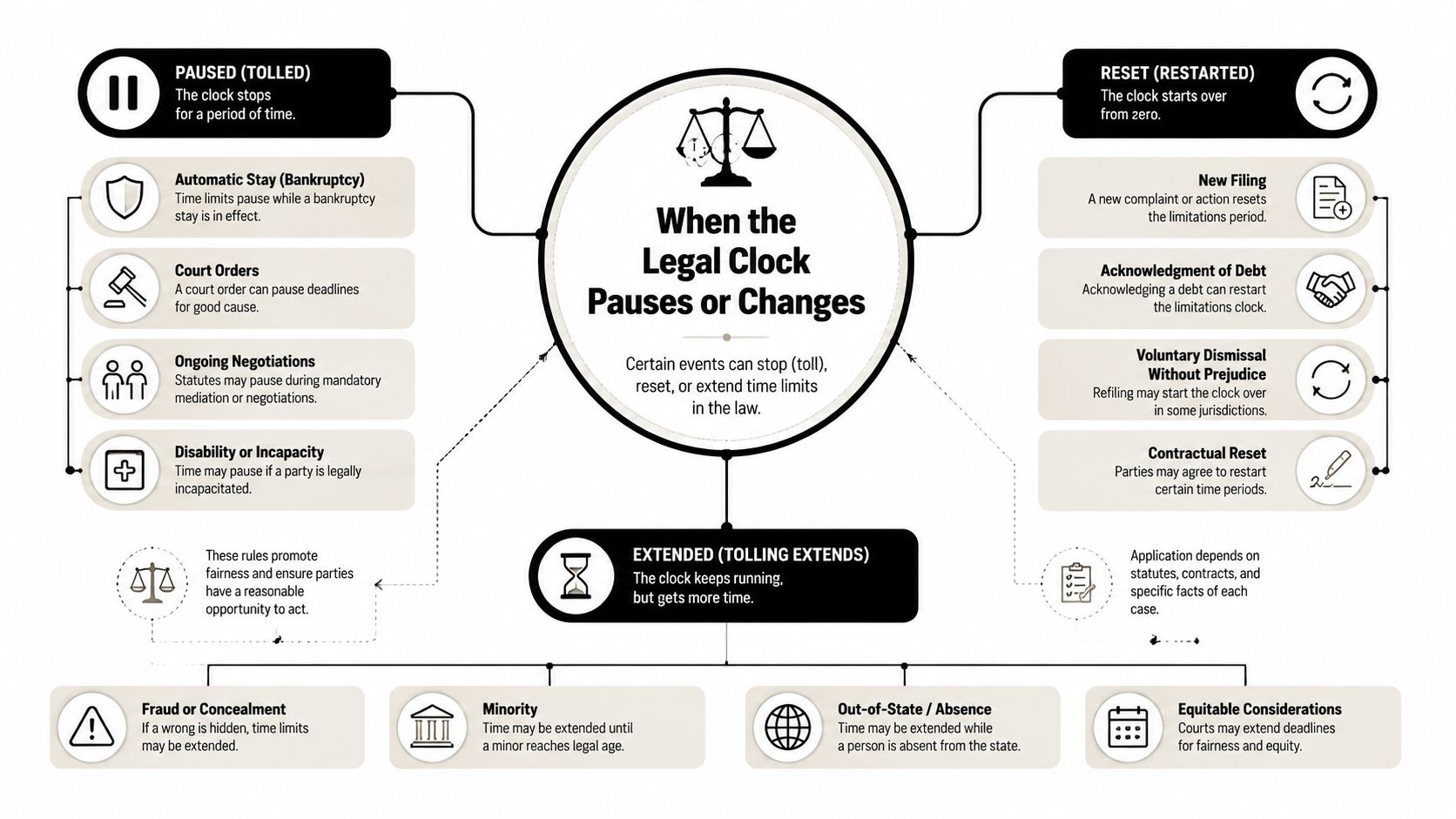
When the Legal Clock Pauses or Changes
The ordinary deadline is only the starting point. Some cases have a clock that starts later, pauses, or gets cut short by a special notice rule. Those cases are where people get hurt by half-remembered legal advice.
Delayed injuries and the discovery rule
Some injuries don't announce themselves cleanly on day one. That is especially true with concussion symptoms, traumatic brain injuries, internal complications, and illnesses whose cause becomes clear only later.
In Colorado, the discovery rule can matter for latent harms like traumatic brain injury. Under C.R.S. § 13-80-108(1), the two-year clock may not begin until the injury is reasonably discoverable. But courts read “reasonable discovery” strictly, which is why prompt medical documentation matters so much, as explained in this discussion of delayed injury discovery.
That exception helps some people. It doesn't rescue everyone.
What reasonable discovery usually means
Courts generally ask a practical question. When should a reasonable person, with the symptoms and information available, have realized something was wrong?
That is why these facts matter:
- Early headache complaints: If they appear in records soon after the crash, the defense may argue the injury was discoverable earlier.
- Missed follow-up care: Gaps in treatment can make a delayed-discovery argument harder.
- Objective testing later on: Imaging, neuropsychological testing, and specialist evaluations may support a later timeline, but they work best when tied to a documented symptom history.
If you think you “might have a TBI but aren't sure yet,” that is exactly when you should protect the legal side of the case.
The same logic appears in occupational and toxic exposure matters. In death cases tied to long-term illness, causation evidence can become highly technical. Families dealing with those issues may benefit from learning about obtaining forensic evidence for mesothelioma suits, because the timing of diagnosis, death, and proof of causation can all affect how a claim is evaluated.
Minors and tolling
“Tolling” means the clock is paused.
For injured children, the law in many states gives extra protection because a minor can't realistically control litigation decisions the way an adult can. The verified data notes that tolling for minors is recognized broadly and that most states extend 1 to 3 years after the child's 18th birthday. That doesn't mean every family should wait. It means the law may preserve a right longer than usual in some cases.
Waiting can still damage the case even if tolling applies. Witness memories fade for children's cases too. School records, pediatric records, and scene evidence still need to be collected while they are available.
Wrongful death claims
Wrongful death claims follow their own timeline, and families often assume the injury date controls. Often, it doesn't. The death date may be the trigger.
For the jurisdictions highlighted here, the verified data states:
- Colorado wrongful death claims must be filed within 2 years of death
- Texas wrongful death claims must be filed within 2 years of death
- New York wrongful death claims must be filed within 2 years of death, with a limited medical-context extension described in the verified data
That distinction matters in real life. A person may survive for a period after a crash, then die from complications. The family then has to sort out whether there is a personal injury claim, a wrongful death claim, a survival-type claim, or several overlapping issues. Treating it as “just a crash case” is a mistake.
Claims against government entities
Many otherwise valid claims collapse at this point.
When the at-fault party is a government body or employee, the normal lawsuit deadline may not be the first deadline that matters. A special notice requirement can arrive much sooner. The verified data states that government claims in Colorado require 180-day notice. If that notice is missed, the later lawsuit may be dead before it begins.
Common examples include:
- A city bus collision
- A crash caused by a government vehicle
- Roadway defect claims involving a public agency
- Fatal crashes involving a public employee on duty
The shortest deadline often controls the strategy. In government cases, that's frequently the notice deadline, not the lawsuit deadline people assume applies.
Immediate Steps to Protect Your Right to Sue
Knowing the rule isn't enough. You need habits that protect the claim while you're still dealing with treatment and disruption.
The goal isn't to “build a lawsuit” on day one. It's to avoid preventable mistakes that weaken timing, causation, or proof.

The steps that help most
Get medical care promptly
Early treatment does two jobs at once. It protects your health, and it creates a timeline. If symptoms change, worsen, or spread, report that clearly and consistently. With head injuries, that detail matters.Keep every record in one place
Use a single folder, notebook, or app to track bills, visit summaries, work absences, mileage, prescriptions, and out-of-pocket costs. Disorder creates delay. Delay creates gaps. Gaps create arguments for the defense.Write down what your days feel like
A short pain journal can help capture details no record keeper will document for you. Trouble sleeping, dizziness in grocery stores, sensitivity to noise, inability to lift a child, panic while driving, all of that can matter later.
What to avoid
Some actions create risk almost immediately:
- Don't give a recorded statement casually: The other insurer may frame questions around inconsistency, prior symptoms, or fault.
- Don't assume claim talks stop the legal clock: They usually don't.
- Don't post casually on social media: Photos and comments get pulled out of context fast.
- Don't wait for “the right time” to get legal advice: Timing questions are easiest to fix early and hardest to fix late.
A practical guide on how to file a personal injury claim can help you think through the process in a more organized way.
What actually works
The best early move is simple. Put dates on a calendar now.
List the date of the incident, the date of first treatment, any follow-up appointments, any communication from insurers, and any fact suggesting a government vehicle, public property issue, or out-of-state trucking company may be involved. Once those facts are on paper, the legal analysis gets sharper and the risk of missing a hidden deadline drops.
Frequently Asked Questions About Injury Claim Timelines
Some timing questions don't fit neatly into a standard rule. These are the ones that often decide whether a case survives.
Which state's deadline applies in a truck accident involving more than one state
It depends on where the crash happened, who the parties are, and which state has the strongest relationship to the dispute. In interstate trucking matters, courts may use a most significant relationship test to decide which state's statute of limitations applies. The verified data also notes that 15% of large truck crashes involve interstate carriers, which is why early jurisdiction analysis matters so much, as discussed in this overview of multi-state injury filing issues.
That issue isn't academic. If two possible states have different rules, the shorter or stricter path can shape strategy immediately.
Does negotiating with the insurance company pause the deadline
Usually, no.
Insurance negotiations and lawsuit deadlines run on separate tracks. An adjuster can request records, make an offer, or keep “evaluating” while the filing deadline keeps getting closer. Unless a lawyer tells you that a legally recognized exception applies, assume the clock is still running.
What if I already missed the deadline
You should still get the case reviewed quickly. Some people assume they are out of time when an exception may apply, especially in delayed-injury, minor, death, or government-related scenarios.
But don't rely on hope. Late cases are hard to save. If there's any argument available, it needs to be identified fast and backed with records.
What if my injury didn't seem serious until later
That's one of the most dangerous situations because it feels reasonable to wait. In practice, delayed symptoms need immediate medical and legal attention once they appear.
If you're also navigating treatment interruptions, work restrictions, or benefit delays, this explanation from MedAmerica Rehab Center may help you think through how timing problems in one system can complicate recovery in another. Workers' compensation and personal injury claims are different, but delay in care can affect both.
Should I wait until I know the full value of my case before taking action
No. You can evaluate damages as the case develops, but you should not wait to protect the claim itself. Filing deadlines and evidence preservation come first.
The best time to investigate a deadline is when you still have options. The worst time is after the defense raises it.
If you're asking how long after an injury can you sue, the safest answer is to get the case reviewed immediately, especially if the injury involves a truck crash, a brain injury, a death, or any public agency.
If you or your family need a clear answer about your filing deadline, contact Nares Law Group LLC for a free, confidential consultation. The firm handles serious injury, truck wreck, traumatic brain injury, and wrongful death cases in Colorado, Texas, and New York, and can help determine what deadline applies, what exceptions may matter, and what steps should happen now to protect your rights.