You're probably here because collision coverage sits on your declarations page, costs real money every renewal, and still feels fuzzy until a crash happens. Then it gets very real. Your car is damaged, the tow truck is on the way, and the question stops being “Do I have collision?” and becomes “What exactly will it pay, what will I owe, and where can I still get stuck with a bill?”
That's the part many drivers never get walked through clearly. Collision insurance coverage isn't just a definition on a policy. It's a financial tool with limits, deductibles, total-loss rules, and sometimes a painful gap between what the insurer pays and what you still owe on a loan. If you understand that math before the next crash, you make better decisions about deductibles, older cars, and whether collision is still worth carrying.
What Collision Coverage Really Means After a Crash
A crash turns an abstract line on your policy into a money question fast. You hit a pole in a parking garage or slide into the car ahead of you at a light. Your car needs body work, maybe a tow, maybe airbags. Collision coverage is the part of your auto policy that helps pay for damage to your own vehicle after that kind of impact.
The simplest way to read it is this: collision usually applies when your car hits another vehicle, hits an object, or rolls over. The Insurance Information Institute's auto insurance overview describes collision coverage as protection for your car when it is damaged in a crash with another car or object, subject to your deductible. That last part matters because a claim does not mean the insurer pays every dollar of the loss.
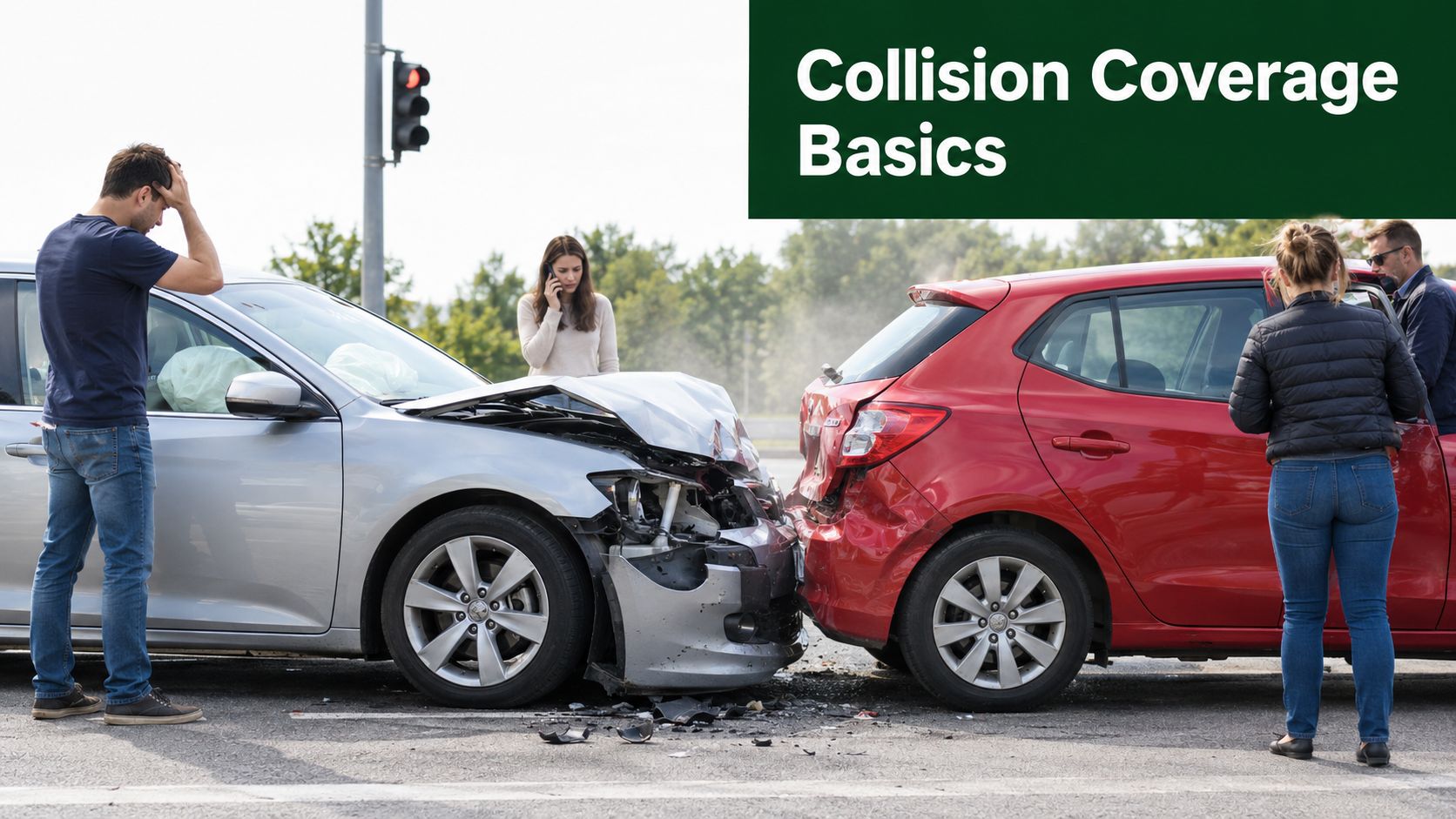
Collision works like the repair bucket for impact damage to your car.
It commonly applies in situations like these:
- You hit another car: Rear-end crashes, intersection collisions, side-swipes, and lane-change impacts.
- You hit an object: A pole, fence, wall, curb, guardrail, or mailbox.
- Your car rolls over: Even if no other driver was involved.
That sounds simple, but the true value of collision coverage shows up in the gap between the repair bill and the cash you can afford to pay today. If your bumper, hood, headlights, and sensors cost $6,500 to fix, collision may keep that from becoming a full out-of-pocket expense. If your deductible is $1,000, your money is still on the line for that first $1,000. If the car is worth less than the repair cost, a different money problem can appear, because the payout may be limited by the car's value rather than the shop estimate.
That is why collision is not just a definition. It is a way to limit how much of a crash lands directly on your bank account.
What collision does not cover
Drivers often assume one claim covers everything that went wrong. Auto insurance does not work that way. Collision is only one piece of the post-crash bill.
It usually does not pay for:
- Damage to the other person's car: That usually falls under property damage liability if you caused the crash.
- Injuries and medical treatment: Those costs usually involve bodily injury liability, MedPay, or PIP, depending on the policy and state.
- Theft, hail, flood, fire, or vandalism: Those losses usually fall under the part of the policy that covers non-collision damage.
- Animal strikes: Hitting a deer is usually handled under non-collision coverage, even though it feels like a crash.
A practical shortcut helps here. If your car was damaged because it physically struck a vehicle or object, collision is usually the first coverage to check. If the loss came from weather, theft, broken glass, or an animal, the answer is often somewhere else in the policy.
That distinction matters because the financial aftermath of a crash rarely arrives in one neat pile. Car repairs, deductibles, loan balances, rate increases, and injury claims can all follow different rules. Collision coverage helps with one major piece of that puzzle: the damage to your own car after impact.
How Collision Coverage Pays for Damage
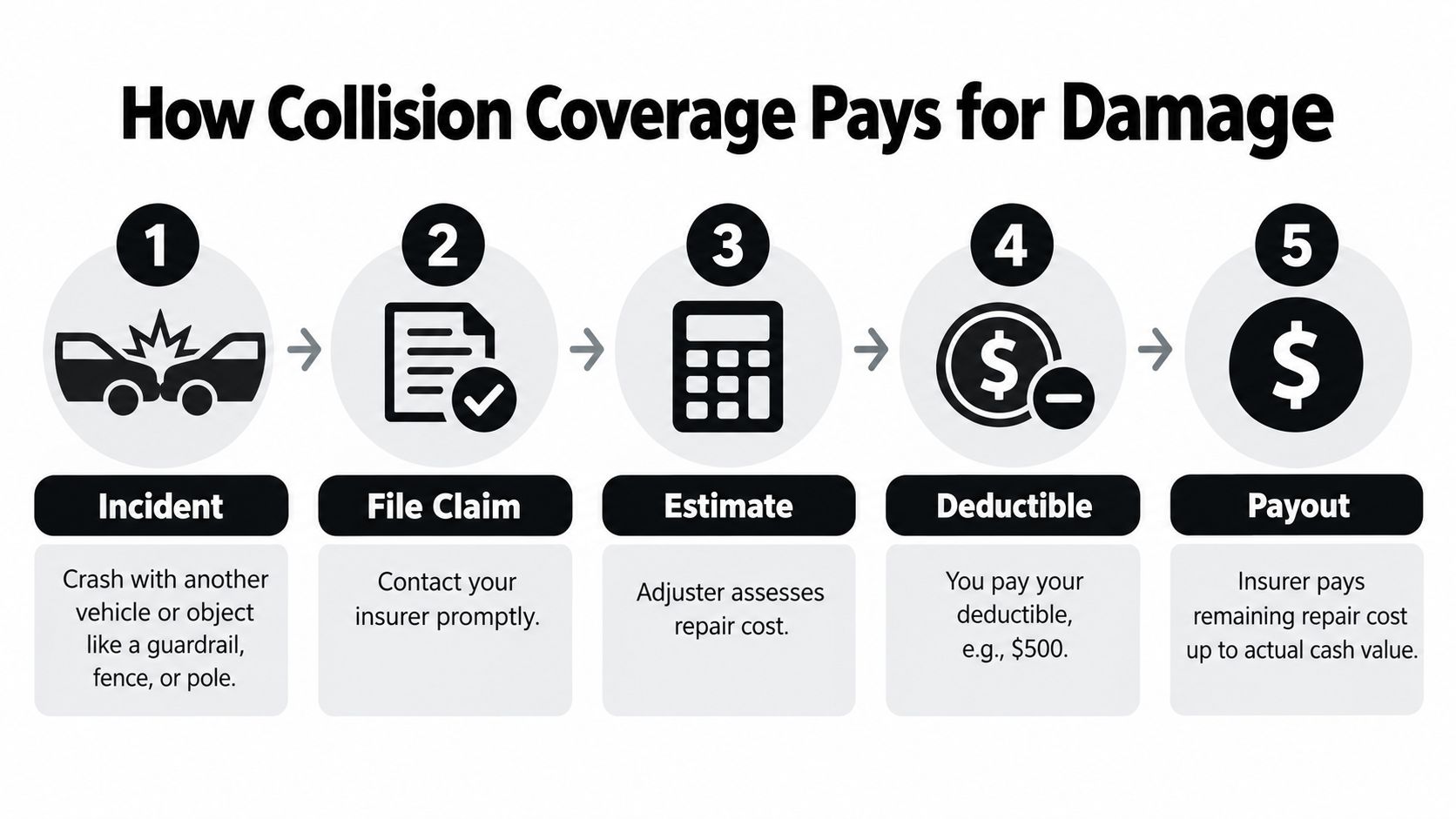
After a crash, collision coverage does not hand you a blank check. It follows a simple money rule: the insurer usually pays up to the cost to repair the car, or up to the car's pre-crash value if it makes more sense to total it, and then subtracts your deductible. If repairs cost more than the car is worth, the claim often turns into a total-loss payment instead of a repair payment, as explained in Progressive's total-loss overview.
The core payout formula
A useful way to picture it is to treat collision coverage like a ceiling with a floor opening beneath it.
The ceiling is your car's actual cash value, which means what the car was worth right before the crash. The insurer will not usually pay more than that amount for damage to your car. The floor opening is your deductible, which is the part you agree to pay yourself before the insurance money starts covering the loss.
In plain terms, the payout is usually:
The lower of
- the repair cost, or
- the vehicle's actual cash value,
minus your deductible
That one formula explains most collision claims.
A repair example
Say your car was worth $12,000 before the crash. The shop estimate is $7,200. Your collision deductible is $1,000.
Because the repair cost is lower than the car's value, the claim usually stays in the repair lane. The insurer would typically pay $6,200, and you would cover the $1,000 deductible.
That is the first place many drivers feel the cash impact of a crash. The policy may cover the big bill, but the deductible is still money that has to come from somewhere.
A total-loss example
Now change the numbers. Your car is worth $10,000, and the repair estimate is $11,500.
At that point, fixing the car costs more than the car was worth before the crash, so the insurer will usually treat it as a total loss. With a $1,000 deductible, the payout would typically be $9,000.
Your deductible still applies even when the car is totaled.
This is also where drivers can run into a second money problem. If you still owe more on the loan than the car's actual cash value, the collision payout may not be enough to pay off the lender. The repair bill is handled, but the loan balance gap can remain.
How the claim usually moves
Behind the scenes, the process is fairly mechanical:
- You report the crash
- The insurer inspects the vehicle or reviews photos
- A repair estimate or value assessment is prepared
- The insurer decides whether the car should be repaired or declared a total loss
- Your deductible is subtracted
- Payment goes to the shop, to you, or to the lender, depending on the situation
Deductibles often fall in a few common tiers, such as $250, $500, or $1,000, according to GEICO's explanation of collision deductibles. That choice can look minor when you buy the policy, but after a crash it becomes a direct out-of-pocket bill. A higher deductible usually lowers the premium. It also means you keep more of the immediate financial hit if your car is damaged.
Collision Coverage Compared to Comprehensive and Liability
A lot of insurance confusion starts after a simple crash. You hit a guardrail, step out, and see three separate money problems at once. Your bumper is crushed. The guardrail is damaged. If another person was hurt, there may be medical bills too.
Those costs do not come out of one bucket.
Collision coverage pays for damage to your own car after an impact with another vehicle, a pole, a fence, a mailbox, or even a rollover. Liability coverage pays for the harm you cause to other people, whether that is damage to their car, damage to their property, or injuries. The third coverage drivers often ask about pays for events that happen to your car without this kind of impact, such as theft, hail, fire, vandalism, flood, or an animal strike.
One event can trigger different parts of the policy
Go back to the guardrail example. Your own repair bill belongs under collision. The guardrail repair belongs under property damage liability. If a passenger in another car is injured, that usually falls under bodily injury liability.
That split matters because each part protects a different part of your wallet.
| Coverage Type | What It Pays For | Example Scenario | Required by Law? |
|---|---|---|---|
| Collision | Damage to your own vehicle after hitting another car or object, or after a rollover | You slide into a pole and damage the front end | Usually optional, though a lender or leasing company may require it |
| Other-than-collision coverage | Losses to your vehicle from theft, hail, vandalism, flood, fire, or hitting a deer | Your car is stolen or dented by hail | Usually optional |
| Liability | Damage or injuries you cause to other people | You damage a mailbox or injure another driver | Generally required in nearly every state |
A simple way to keep them straight is this: collision is about your car after impact, liability is about the other person's losses, and other-than-collision coverage is about bad events that are not crash damage.
Why the distinction affects your own money
Drivers sometimes ask whether carrying only the legal minimum is enough. The legal answer usually points to liability, because states typically require that coverage. The financial answer is more personal. If you drop collision, damage to your own car after a crash may come straight out of your savings, even if the vehicle is still worth a meaningful amount.
That is why this comparison matters beyond definitions. It helps you see which bill lands where, and which bill can still land on you.
If you are pricing policies by state, a local shopping guide can help you find affordable auto insurance California while still checking whether the mix of coverages fits your car and budget. If you want a legal-focused explanation of how fault and payment lines differ after a crash, Nares Law Group's article on collision vs liability insurance is a useful companion.
How Insurers Price Collision Coverage
A driver with a clean record can insure one car for a modest collision premium and pay much more for another, even with the same deductible. The reason is simple. Insurers are pricing the chance of a future repair check, and the likely size of that check.
They usually start with two questions:
- How often does this kind of risk turn into a collision claim?
- If a claim happens, how much does it usually cost to fix or pay out?
The frequency side is easier to picture if you think in batches of 100 insured cars. IIHS and HLDI reported that collision losses for recent model years averaged a little over seven claims per 100 insured vehicle-years, and the same research showed big differences by vehicle class. Four-door microcars had much higher relative claim frequency than very large vans, according to the IIHS HLDI collision summary.
Frequency is only half the bill.
A car that crashes less often can still be expensive to insure if each repair is costly. That is where parts prices, labor rates, and repair complexity matter. A bumper used to be mostly plastic and paint. On many newer vehicles, that same bumper area may also house cameras, radar units, wiring, and calibration points. A low-speed hit can turn into a much larger shop invoice.
That pattern showed up in industry reporting on IIHS and HLDI findings. Vehicles with sensors and driver-assistance hardware had higher collision claim severity, even though overall losses were somewhat lower because claim frequency dropped, as summarized by Autobody News.
Here is the practical takeaway. Your collision premium is not just a price for "coverage." It is a price for your insurer's estimate of how much of your future crash cost they may have to absorb after your deductible.
A simple example makes the pricing logic easier to see:
- Driver A has a sedan with lower repair costs and a $1,000 deductible.
- Driver B has a newer SUV with more expensive parts and the same $1,000 deductible.
- If the insurer expects Driver B's average claim to cost much more, Driver B will usually pay more for collision, even before either driver has an accident.
Your own profile changes the price too. Insurers commonly weigh:
- Driving history. Recent at-fault crashes usually increase perceived risk.
- Vehicle type. Some vehicles generate more frequent or more expensive claims.
- Repair costs. Specialty parts, aluminum panels, cameras, and radar can raise claim size.
- Deductible choice. A higher deductible often lowers the premium because you keep more of the first layer of risk.
That last point connects directly to your own money after a crash. If you raise your deductible from $500 to $1,000, you may save on premium, but you are also agreeing to cover an extra $500 yourself before the insurer pays. Collision pricing is really a cost-sharing formula.
| Factor | Why insurers care | What it can mean for your price |
|---|---|---|
| Claim frequency for your vehicle class | More claims usually mean more expected payouts | Higher or lower base premium |
| Average repair severity | Costlier repairs raise expected claim size | Higher premium on harder-to-fix cars |
| Your driving record | Past at-fault losses can signal higher future risk | Surcharge or reduced discounts |
| Deductible selected | You absorb more or less of each loss | Higher deductible often lowers premium |
Industry sources also show why many drivers feel this cost pressure more sharply now. The Insurance Information Institute noted that average auto insurance expenditures were $1,127.55 in 2022 and that collision premiums vary widely by state and driver profile, in its overview of auto insurance costs and expenditures. That does not tell you your exact collision rate, but it helps explain why shopping for collision coverage can produce very different quotes for drivers who seem similar on paper.
The larger point is financial, not just technical. Collision pricing reflects the insurer's estimate of repair risk, while your deductible reflects the part of that risk you keep. After a crash, that split determines how much comes from the insurer and how much comes from your wallet.
When Collision Coverage Stops Making Financial Sense
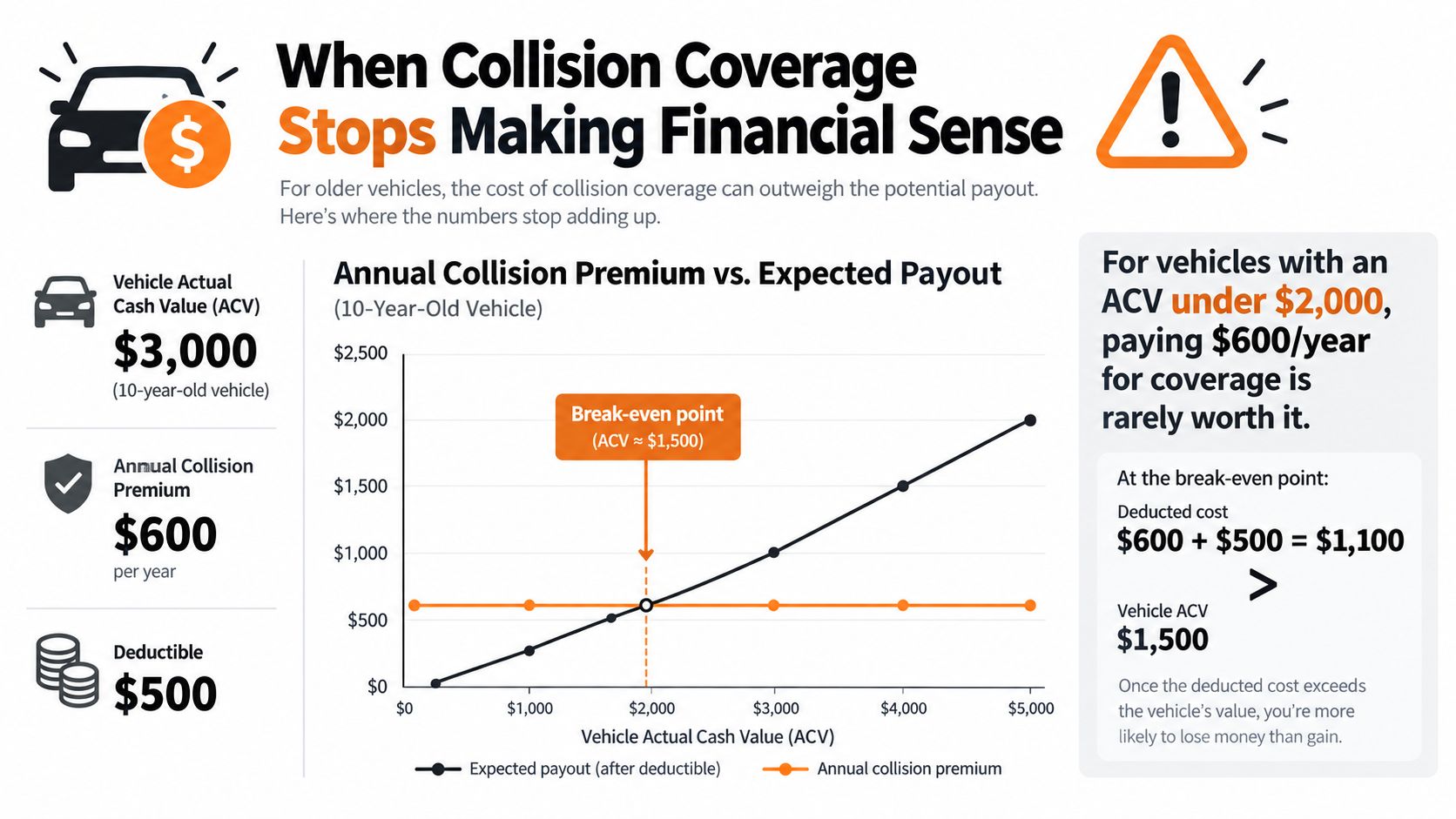
Collision coverage isn't automatically a bad buy on an older car. But there is a point where it starts acting less like practical protection and more like an expensive hedge against a shrinking asset.
CCC's 2025 crash-course data says the average total cost of repair reached $4,768 through Q3 2025 and was over $4,730 in 2024, while more drivers chose higher deductibles, including increased use of $1,000, $2,000, and $2,500 deductibles, according to CCC Crash Course 2025 Q4. That matters because rising repair costs can make collision valuable on one car and pointless on another.
The break-even test
Ask two questions:
- What is my car worth today?
- How much money am I keeping at risk through premiums plus deductible?
Use this simple lens: if your deductible and the premiums you're paying over time start approaching the likely maximum payout, collision may stop making sense.
For a visual walk-through, this short video helps explain the logic in plain language:
Two practical examples
A five-year-old sedan worth $4,000 with a $1,000 deductible still leaves room for a meaningful payout after a serious crash. If the car suffers major damage but isn't totaled, collision could still prevent a large repair bill from landing fully on you.
A ten-year-old vehicle worth $1,500 is different. With a $1,000 deductible, the most the policy may effectively protect is a narrow slice of value. If you've also been paying premiums year after year, the math gets harder to justify.
- Keep collision longer when your car still has meaningful value, you couldn't comfortably replace it, or repair costs in your area are high.
- Raise the deductible carefully when you want lower premiums but can still absorb the larger out-of-pocket hit after a crash.
- Consider dropping collision when the car's actual cash value is so low that a future payout would be modest even in a bad accident.
A good renewal question is not “Do people usually keep collision?” It's “If this car were badly damaged tomorrow, how much would the policy really do for me after the deductible?”
Totaled Cars, Deductibles, and the Gap Coverage Question
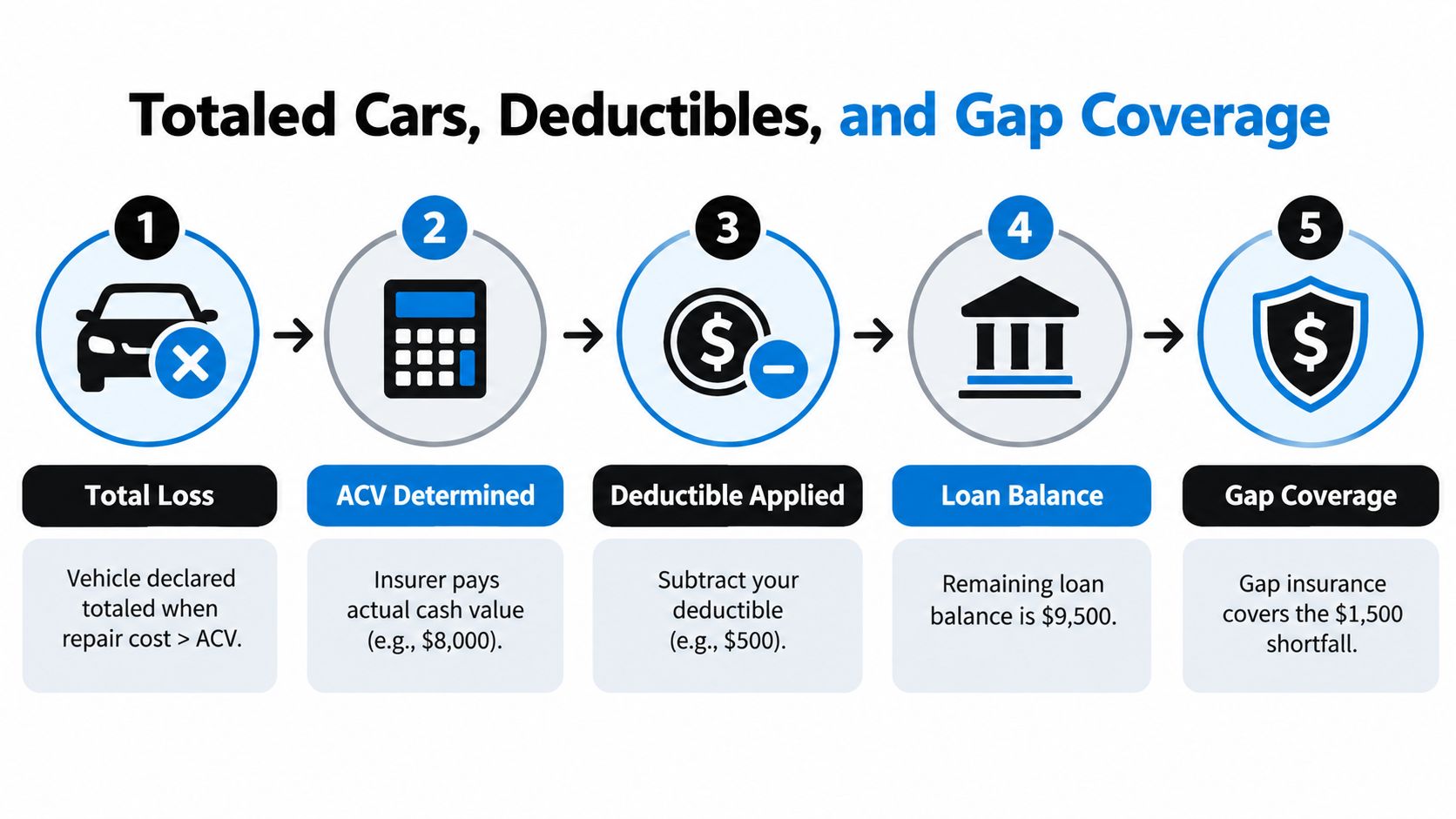
A totaled car claim often surprises drivers for one simple reason. The loan and the insurance payout follow two different math problems.
Say you still owe $28,000 on a newer car. Before the crash, the car's market value has fallen to $22,000. Then a collision totals it.
Where the shortfall comes from
Collision coverage pays based on the car's actual cash value at the time of the crash. It does not pay what you originally paid, and it does not pay whatever amount is still left on the loan.
Using the numbers above, the insurer values the car at $22,000. If your collision deductible is $1,000, the payout would usually be $21,000.
You still owe $28,000.
So the crash leaves you with a $7,000 hole. About $6,000 comes from depreciation, which is the gap between what the car is worth and what you still owe. The other $1,000 is your deductible. A total loss can wipe out the car and still leave part of the bill attached to you.
Where gap coverage fits
Gap coverage is meant for that loan-balance problem. As explained in Allstate's gap insurance overview, it can help pay the difference between the car's actual cash value and the amount you still owe after a total loss or theft. Some policies also address the deductible, but not all do, so the contract details matter.
High deductibles make this risk easier to miss. A deductible lowers your premium while nothing has happened. After a crash, it becomes cash you must absorb yourself. If you chose a large deductible to save money each month, ask whether you could cover that amount next week if the car were declared a total loss.
Why financed drivers should care
Lenders often require collision coverage because they want the car protected as loan collateral. That requirement does not mean your own finances are fully protected.
You are more likely to owe money after a total loss if:
- You made a small down payment
- You rolled old loan debt into the new vehicle
- You picked a high deductible
- Your vehicle lost value faster than the loan balance dropped
That is why collision, deductible choice, and gap coverage should be viewed together, not as separate boxes on a policy.
If you want a clearer breakdown of how a claim against another driver differs from using your own collision coverage, this guide on property damage vs collision explains the difference in plain terms.
How a Collision Claim Affects Your Premiums and Your Injury Case
A collision claim can split into two separate tracks very quickly. One track is about the car. The other is about your body, your treatment, and who is legally responsible.
Premium effects after a claim
If you file a collision claim, especially after an at-fault crash, your insurer may re-rate your policy at renewal. The exact change varies by carrier, state, claim history, and fault determination. Even a not-at-fault crash can create friction if the file lacks clear evidence about what happened.
That's why the paperwork matters. If fault is disputed, the details in the claim file can affect not just whether the insurer pays the vehicle damage correctly, but also how your risk is viewed later.
Collision money is not injury money
Collision coverage pays for vehicle repair or vehicle value, subject to the deductible and value cap. It does not pay your medical bills, lost wages, or pain and suffering.
Those issues usually run through other coverage paths, such as:
- The at-fault driver's bodily injury liability
- Your own MedPay or PIP, if available
- A personal injury claim or lawsuit when necessary
That separation matters because a fast property-damage payment can create a false sense that “the insurance claim is handled.” It isn't, if you're hurt.
Keep the vehicle claim and injury claim mentally separate, even when they come from the same crash.
What to document right away
The best claim files are built early. After a crash, try to gather:
- Photos of all vehicles and the scene
- Contact information for witnesses
- The police report number
- The other driver's insurance details
- A prompt medical evaluation if you feel pain, dizziness, headache, or other symptoms
For drivers dealing with disputed fault or inconsistent insurer questions, materials like Nares Law Group's page on an insurance company investigation can help you understand why carriers ask for certain records and how those requests fit into a broader claim.
If the collision involved injuries, legal guidance can also help keep the property-damage side from overshadowing the injury case. That's one of the practical situations where firms like Nares Law Group LLC may review the insurance pathways and claim handling issues after a crash.
A Short Checklist for Your Next Collision Coverage Decision
Don't focus on a bigger vocabulary about insurance. Focus on a better decision process. Use this checklist before your next renewal or right after buying another car.
Eight questions worth asking
- Start with your car's current value: If the vehicle were totaled tomorrow, what would its cash value likely be, not what you wish it were worth?
- Look hard at your deductible: If your deductible is high, could you pay it without scrambling for rent money or using a credit card?
- Compare premium savings to retained risk: A higher deductible can lower the premium, but the trade only works if the savings matter more than the bigger hit after a crash.
- Check your loan or lease terms: If the car is financed, the lender may require collision coverage whether or not you think it's worth keeping.
- Review the total-loss problem: If you owe more than the car is worth, ask whether gap coverage is missing from the picture.
- Check nearby coverages: Rental reimbursement, towing, uninsured motorist protection, MedPay, and collision can all affect how rough the aftermath feels.
- Build a crash-document habit: Keep your insurance card accessible, make sure your phone can take clear photos, and know where to store witness names and report numbers.
- Re-run the numbers every renewal: Don't keep collision on autopilot. Revisit it as the car ages and its value falls.
A practical way to use the checklist
Take out your declarations page and make notes in the margin. Write down the deductible, whether the car is financed, and your best estimate of what the car is worth today. Then ask a blunt question: if the vehicle were badly damaged this week, would this policy protect your finances in a meaningful way, or just soften a problem you'd still mostly pay for yourself?
That one exercise often tells you whether to keep collision as is, raise the deductible, or remove the coverage on an older vehicle you could replace without major hardship.
The best collision decision is rarely “always keep it” or “always drop it.” It's “match the coverage to the car, the loan, and the amount of loss you can personally absorb.”
If a crash leaves you sorting through collision coverage, deductibles, fault disputes, and injuries at the same time, Nares Law Group LLC helps drivers understand how the insurance pieces fit together and what claims may still be available beyond vehicle damage. If you want legal guidance after a motor vehicle collision, visit Nares Law Group LLC to learn more about their accident and injury representation.