It’s one of the most common points of confusion after a car accident: Who pays to fix which car? The answer lies in two very different types of insurance coverage, and knowing the difference is the first step to getting your vehicle repaired.
The simplest way to think about it is this: Property Damage Liability is coverage you buy to pay for damage you cause to someone else's car or property. Collision Coverage is what you buy to pay for damage to your own car, no matter who was at fault.
Unpacking Property Damage vs. Collision Coverage
After a car wreck in Colorado, figuring out which insurance policy applies can feel overwhelming, but the distinction is critical. Think of it this way—your Property Damage (PD) Liability protects other people from your mistakes, while your Collision coverage protects your own financial investment in your vehicle.
This image breaks it down to its most basic level.
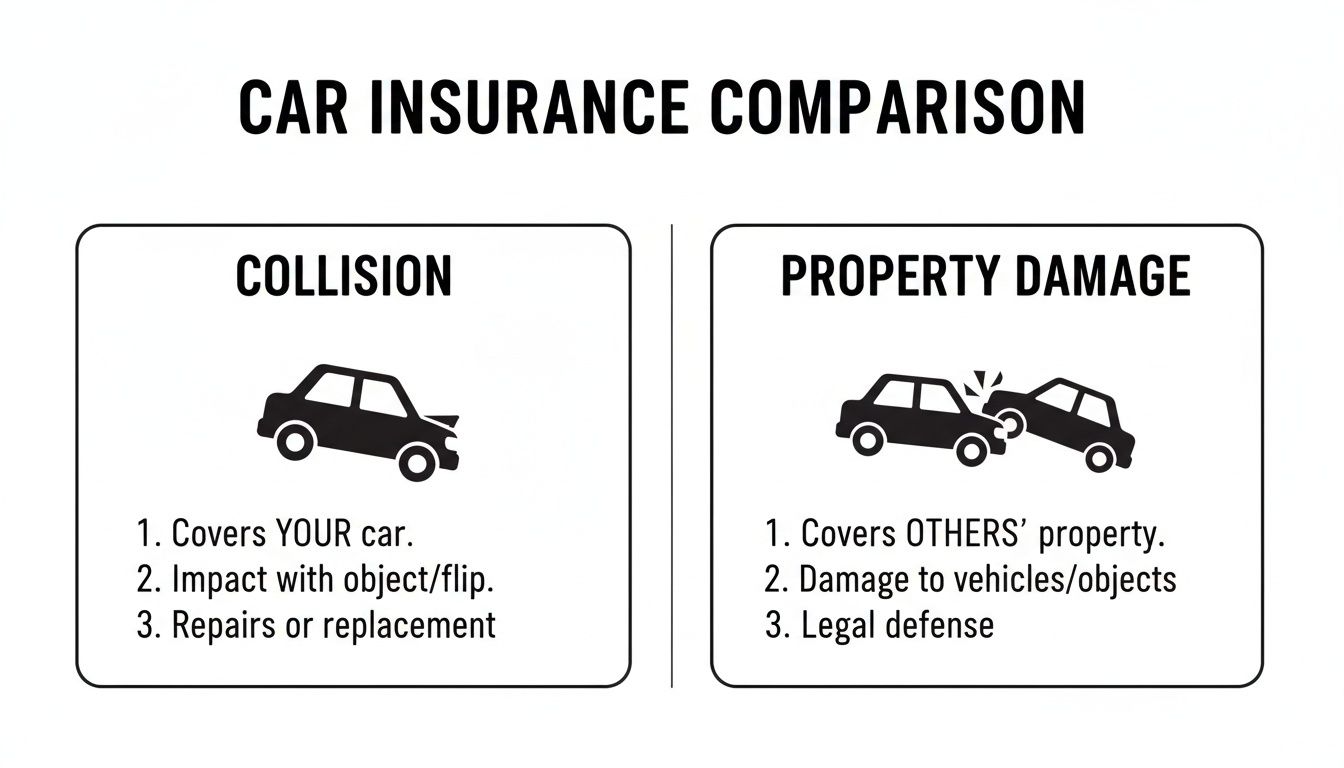
Collision is for your car. Property Damage is for the other person's property. Understanding this split tells you exactly where to file your claim.
Who Pays for What?
In Colorado, Property Damage Liability is mandatory. This is the coverage that kicks in when you are found legally responsible for an accident. It covers the repair bills for the other driver’s car and can also pay for other property you might have damaged, like a fence, a mailbox, or even a building.
Collision coverage, on the other hand, is usually optional unless you’re leasing or still have a loan on your car. It’s designed to cover your own repair costs after you collide with another object—whether that’s another car, a guardrail, or a tree. With this coverage, you’ll almost always have a deductible, which is the amount you have to pay out-of-pocket before your insurance company starts paying.
If another driver hits you and is at fault, you file a claim against their Property Damage Liability policy. If you cause the crash, you use your own Collision policy to fix your car, while your PD Liability covers their damages.
Why You Really Need Both
While Colorado law requires a minimum amount of liability insurance, those limits are often nowhere near enough to cover the damage from a serious crash, especially if a new or high-end vehicle is involved.
If the repair costs exceed the at-fault driver's policy limits, the injured party can be left with huge, unpaid bills. This is exactly why having your own robust Collision policy is so important. It’s also why underinsured motorist coverage can be a financial lifesaver.
To make it even clearer, here's a quick side-by-side look.
Property Damage Liability vs Collision Coverage At a Glance
This table breaks down the core purpose of each coverage type after a Colorado car accident.
| Coverage Type | Whose Property It Covers | What It Pays For | When It Applies |
|---|---|---|---|
| Property Damage Liability | Another person's car or property (third-party) | Repair or replacement costs for their vehicle and property | When you are found at fault for the accident |
| Collision Coverage | Your own vehicle (first-party) | Repair or replacement costs for your car, minus your deductible | Regardless of who is at fault for the collision |
Essentially, one protects others from you, and the other protects you from financial loss, no matter what happens. Having both provides a critical safety net.
How Each Insurance Claim Process Actually Works
After a car wreck, you’re faced with two very different paths to get your car fixed. The route you choose depends on whether you file a claim against the at-fault driver's Property Damage Liability insurance or turn to your own Collision coverage.
One path is a fight, pitting you against an insurance company that has no loyalty to you. The other is based on a contract you already paid for. Knowing the rules of engagement for each is the key to getting your vehicle repaired without getting taken advantage of.
Filing Against Their Insurance: The Adversarial Path
When the other driver caused the crash, your first instinct is probably to file a claim against their Property Damage (PD) Liability insurance. The moment you make that call, you've entered an adversarial relationship. That insurance company’s legal duty is to protect its own customer and its own profits—not to make you whole.
Their adjuster’s job is simple: minimize the company's payout. They will question everything to verify their driver was at fault, pick apart your repair estimates, and lowball the value of your vehicle if it’s a total loss. Expect delays and disputes. Every dollar they pay you comes directly out of their pocket, and they won't part with it easily.
Key Takeaway: The other driver's insurance adjuster is not on your side. Their goal is to protect their company's money, which almost always means delaying, denying, or undervaluing your claim.
To have any chance of success here, you need to show up with undeniable proof:
- The Official Police Report: This is your strongest tool for establishing who was at fault.
- Photos and Videos: Get pictures of everything—the final resting positions of the cars, skid marks, and the damage to both vehicles from multiple angles.
- Witness Statements: An independent witness who can back up your story is incredibly powerful.
Using Your Own Policy: The Contractual Path
Filing a claim under your own Collision coverage is a world apart. Here, the relationship is built on a contract. You’ve been paying your premiums for exactly this service—for your insurer to cover your repairs or pay out your car's value after a collision.
Your insurance company owes you a duty of good faith and fair dealing. In simple terms, they have to treat you fairly and handle your claim promptly based on the policy you bought. The process is almost always faster because proving the other driver’s fault isn't the first hurdle. You just pay your deductible, and your insurer gets the repair process started.
This is where a lot of people hesitate. They worry that using their own coverage, even when they weren’t at fault, will make their rates go up. But honestly, it’s often the quickest and least painful way to get back on the road.
Once they've paid for your damages, your insurer will go after the at-fault driver's insurance company to get their money back. This is a process called subrogation. If they succeed, you get your deductible refunded.
Why Policy Limits and Market Trends Matter
Here’s a hard reality check: Colorado’s minimum PD liability requirement is only $15,000. If you're hit by someone with a basic policy, that's all their insurance is required to pay. With today's repair costs, especially for newer cars, it’s frighteningly easy for damages to blow past that limit, leaving you to cover the rest. This is one of the best reasons to always carry your own Collision coverage.
Recent industry trends are making things even trickier. Insurers are facing rising costs and are changing their tactics. For instance, while the frequency of property damage claims has dropped, the severity of bodily injury claims has shot up, with average payouts hitting $27.6K—a 35% jump since late 2021. For vehicle damage, collision claims are resulting in a total loss a record 22.8% of the time. For Colorado drivers, this means insurers are quicker than ever to declare a vehicle totaled, often using declining used-car values to justify a low settlement offer. You can discover more insights about these insurance trends and what they mean for policyholders.
In the end, understanding the difference between a property damage and a collision claim isn't just about insurance terms. It’s about knowing who you can trust, what battles to expect, and how to make the right moves to protect yourself after a crash.
Why Your Car Might Be Declared a Total Loss
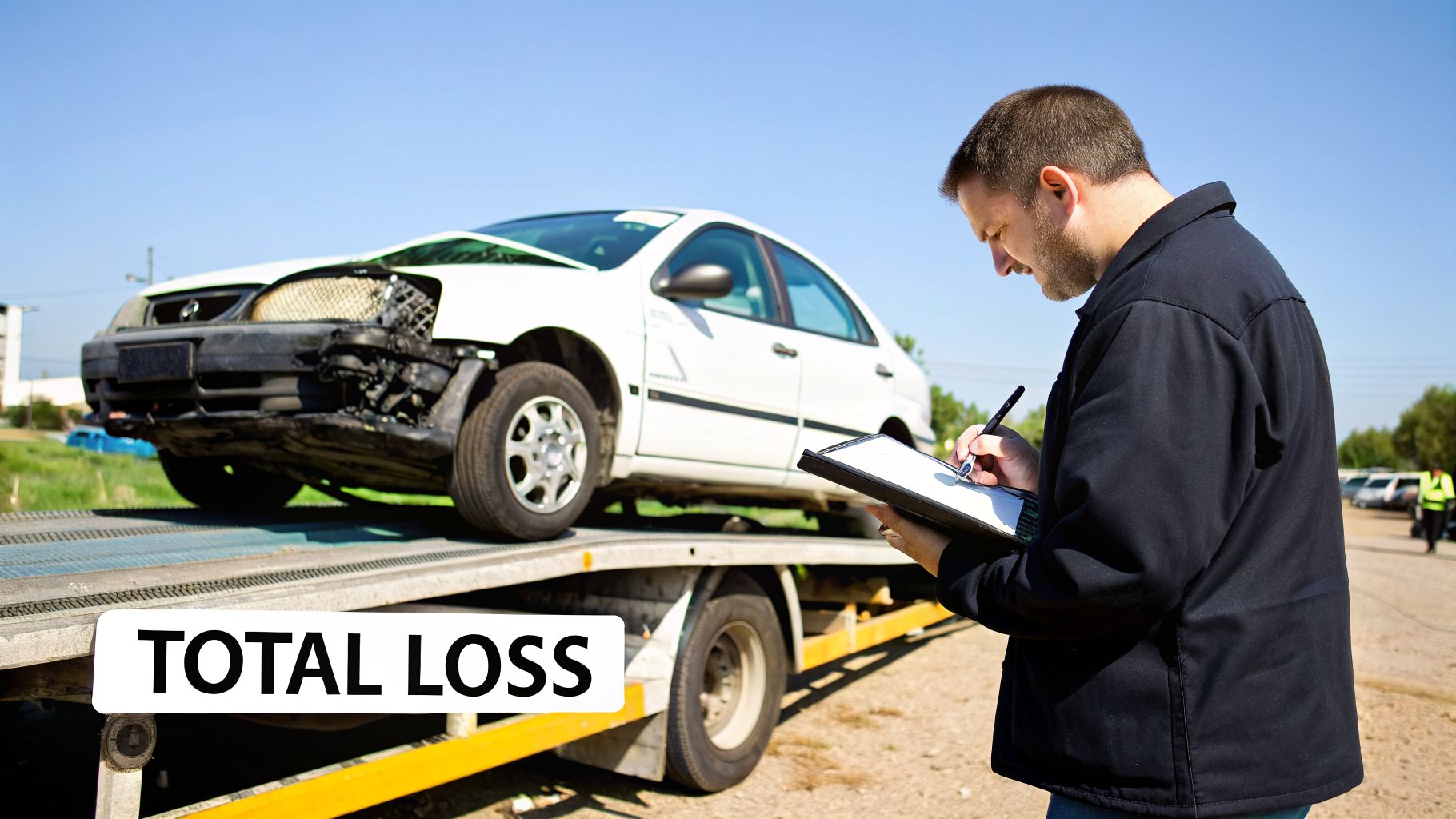
Hearing an insurance adjuster say the words "total loss" is a gut punch. Most people assume it means their car was crushed beyond recognition, but the truth is far more technical—and it’s happening more and more often.
An insurer "totals" a car when the cost to fix it gets too close to what the car was worth right before the crash. This isn't about feelings; it's a cold, hard business calculation. And it’s a calculation that is often the starting point for a major fight over a fair settlement.
The Total Loss Formula Explained
At its core, the formula insurance companies use is pretty simple: Cost of Repairs + Salvage Value > Actual Cash Value (ACV). If the first two numbers added together are more than the car’s value, it’s a goner.
- Cost of Repairs: This is everything—parts, paint, and the mechanic’s labor.
- Salvage Value: This is what the insurer can get for your wrecked car by selling it to a junkyard or parts dealer.
- Actual Cash Value (ACV): This is the key number. It’s what your car was worth one second before the impact, not what it costs to buy a new one.
Here in Colorado, the law says an insurer can total a vehicle once repair costs hit 100% of its ACV. But don't be fooled by that high number. Most insurance companies have their own internal policies that trigger a total loss at a much lower threshold, usually around 70-80%. This gives them a lot of wiggle room, and it’s rarely used in your favor.
Why Are More Cars Being Totaled?
If it feels like you're hearing about more totaled cars, you're not wrong. The trend is real and it's accelerating.
Data from 2026 showed that total loss frequency in collision claims shot up to 22.8%, a massive jump from just 17% in 2021. That means nearly one out of every four cars in a significant crash is now being written off instead of fixed. The reason? The cost to repair modern cars is exploding—the average bill for a 5-year-old car jumped 50% between 2020 and 2025. You can get more details on rising total loss trends at AutoBodyNews.com to see the full picture.
Three big things are driving up repair costs:
- Advanced Driver-Assistance Systems (ADAS): All those sensors for blind-spot monitoring, automatic braking, and lane-keeping assist are embedded in bumpers, mirrors, and windshields. A minor fender-bender can now mean thousands in specialized parts and complex recalibration.
- Supply Chain Headaches: Getting the right parts can take weeks or even months. Those delays drive up costs for labor and rental cars, which the insurer adds to the "repair" side of the total loss equation.
- Space-Age Materials: Cars are safer because they use high-strength steel, aluminum, and even carbon fiber. But those materials are incredibly expensive and difficult to repair properly, requiring specialized training and equipment.
An insurance company's decision to total your car isn't just about the damage; it's a business calculation. When it becomes cheaper for them to write a check for the ACV and sell the salvage than it is to pay a growing repair bill, they will declare it a total loss every time.
How to Fight a Low ACV Offer
The most common fight in a total loss claim isn't about the repairs—it's about the Actual Cash Value. Insurers use third-party companies that often pull data from wholesale auctions, which can seriously undervalue a well-maintained, low-mileage car.
You do not have to take their first offer. Here’s how you push back.
- Demand Their Homework: Ask the adjuster for the complete valuation report they used. Go through it line by line. Are the "comparable" vehicles they found really similar to yours in mileage, condition, and options? Often, they are not.
- Do Your Own Research: Find at least three vehicles just like yours for sale in your local area. Use real-world listings from sites like Autotrader, Kelley Blue Book, NADAguides, and local dealer websites to prove the true market rate.
- Show Your Work: Did you just put on new tires? A new battery? Provide receipts for any recent, significant maintenance or upgrades. These add value, and the insurance company’s report probably missed them.
- Bring in a Pro: For a few hundred dollars, you can hire a certified, independent appraiser. A professional appraisal report gives you powerful leverage and signals to the insurer that you’re not backing down.
Challenging a lowball total loss offer takes work, but it's worth it. By arming yourself with solid evidence, you can fight for the money you actually need to get back on the road.
How Your Wrecked Car Tells the Story of Your Injuries
After a car crash, you’re juggling two different claims that feel worlds apart: one for your vehicle's damage and another for your body's injuries. The property damage claim is about repair costs and car values. The personal injury claim is about getting you the resources to heal.
But these two claims are more connected than you think. The damage to your car—or lack of it—becomes a central piece of evidence. It can either powerfully support your injury case or become the main weapon the insurance company uses to deny it. Understanding how to connect the two is everything.
When Major Damage Makes Your Case Clearer
A mangled car tells a story no one can ignore. Twisted metal, shattered glass, and a crumpled frame are undeniable proof of a violent, high-energy impact.
When we show photos of a severely damaged vehicle to an insurance adjuster or a jury, it creates an immediate, visceral understanding of the forces at play. It answers the question of how someone could have suffered a traumatic brain injury, a herniated disc, or complex fractures.
The logic is simple and powerful: a violent crash that destroys a car will also violently harm the person inside it.
This visual evidence makes it extremely difficult for an insurance company to argue that your serious injuries are somehow exaggerated or didn't come from the crash. For injuries that aren't visible, like concussions or internal damage, the wrecked car serves as the objective proof of the trauma you endured.
The “No Damage, No Injury” Myth
Insurance adjusters love fender benders with little visible damage. Why? It gives them a simple, and frankly lazy, argument: “The car barely has a scratch. How could you possibly be so hurt?”
Don’t fall for it. This is a calculated tactic designed to make you doubt your own pain. Modern cars are built to absorb and hide the force of an impact. Bumpers can compress and pop back into place, masking the violent transfer of energy that just shot through your body.
Your body isn't made of plastic and steel. It’s not designed to handle that jolt. Even in a low-speed collision with minimal property damage, that sudden whipping motion can cause devastating and permanent injuries.
- Whiplash: The rapid back-and-forth snap of your head can tear the muscles and ligaments in your neck.
- Herniated Discs: The compressive force on your spine can be enough to rupture the discs between your vertebrae.
- Concussions: Your brain can slam against the inside of your skull, causing a traumatic brain injury even without a direct blow to the head.
It is a proven medical fact that serious injuries can happen in crashes that leave a car looking almost untouched. Never let an adjuster use the repair estimate to define your physical reality.
Tying the Crash to Your Injuries: Building Your Narrative
To fight back against the "low impact" defense, you need to build a clear, undeniable story that connects the crash to your medical condition. This narrative has to be built on a foundation of solid proof, leaving the insurer no room to poke holes in it.
Your story starts the moment the crash happens.
- Capture the Scene: Before the cars are moved, use your phone. Take photos and videos of everything—the damage to both vehicles from all angles, skid marks, broken glass, and the overall scene. This is your first, best evidence.
- Get Medical Care Immediately: Go to the ER or an urgent care clinic the same day. Adrenaline is a powerful painkiller and can hide serious injuries. A medical record from the day of the crash officially links your injuries to the event.
- Follow Your Doctor’s Plan: Go to every single appointment, physical therapy session, and specialist follow-up. Gaps in treatment are one of the biggest red flags for an adjuster. They will use any missed appointment to argue you weren't really hurt.
- Keep a Simple Journal: Each day, jot down notes about your pain level, what you can't do, and how the injuries are impacting your work and family life. This personal account provides the human context that medical charts can't capture.
By taking these steps, you build a powerful case that draws a straight line from the property damage—major or minor—to the reality of what you're going through. Your compensation should be based on your pain and your recovery, not the size of the dent in your bumper.
Dealing with Messy Claims and Insurance Company Pushback
Real-world car accidents are rarely simple. They don’t fit neatly into the boxes on an insurance form. You’re often left dealing with overlapping claims, confusing rules, and insurance companies that seem determined to argue. Knowing how to handle these disputes requires a clear head and a solid understanding of your own policies.
Whether it’s a multi-car pile-up or a frustrating hit-and-run, knowing which coverage to lean on and what proof you need is everything. These are the situations that test the limits of your policy and often expose gaps you never knew you had.
Untangling Multi-Vehicle Wrecks and Hit-and-Runs
When three or more cars are involved in a wreck, figuring out who is at fault can turn into a complete nightmare. Multiple drivers might share the blame, and you can bet their insurance companies will spend weeks pointing fingers at everyone else. You’re left stuck in the middle.
Trying to file a claim against a single driver’s property damage liability policy in that chaos will get you nowhere fast.
This is exactly why you have collision coverage. The smartest move is often to use your own policy. You’ll pay your deductible upfront, but you get your car into the shop right away. Your insurer then takes on the headache of subrogation—the formal process of fighting with the other insurance companies to get their money back and, most importantly, refund your deductible.
Hit-and-runs are a similar, but even more maddening, problem. With the at-fault driver long gone, there’s no one to hold responsible. There is no third-party property damage policy to file a claim against. Your only path to getting your car fixed is through your own collision coverage. If you don't have it, you're on your own.
Crucial Insight: In messy accidents where fault is unclear or the other driver is gone, your collision coverage is your best friend. Waiting for other insurers to sort out the blame can leave you without a car for weeks or even months.
When a Crash Is More Than Just a Collision
Sometimes, an accident isn't just about two cars hitting each other. A hailstorm or icy roads might have caused the initial crash, or a collision might lead to something else, like a fire. This is where comprehensive coverage—which handles non-collision events like theft, weather, and vandalism—can overlap with your collision policy.
Here’s a common example: you swerve to miss a deer and hit a guardrail instead. That’s a collision claim. But if that deer runs straight into the side of your car, it’s usually handled as a comprehensive claim. The difference really matters because comprehensive deductibles are often much lower than collision deductibles. Knowing how to classify the event correctly can easily save you hundreds of dollars.
With the rise of extreme weather, these situations are becoming more common. In fact, while the number of collision repairs was down 10.4% year-over-year through August 2026, the number of total losses hit 22.6%, partly driven by an increase in weather-related comprehensive claims. If you're curious, you can read more about emerging trends in auto physical damage claims. For people in the Denver area, this means weather damage can often be layered onto a collision claim, which can change how the entire process plays out.
Common Fights Over Repairs and Your Car’s Value
Even after everyone agrees on who is at fault, the disputes are far from over. Two of the biggest fights with insurance companies are about the quality of the repairs and the lost value of your car.
- OEM vs. Aftermarket Parts: Insurance companies are notorious for trying to save a buck by approving cheap, low-quality "aftermarket" parts. You have the right to demand Original Equipment Manufacturer (OEM) parts to bring your car back to its true pre-accident condition. You need to check your policy and review the repair estimate with a fine-toothed comb to make sure you aren’t getting short-changed.
- Diminished Value Claims: A car that’s been in an accident is worth less than one that hasn’t, even if it’s repaired perfectly. This drop in resale value is called "diminished value." In Colorado, you are legally entitled to recover that loss from the at-fault driver's insurance. Insurers will almost never offer this willingly—you have to demand it and prove your loss with reports from professional vehicle appraisers.
Trying to manage these arguments is exhausting, especially when you’re also trying to recover from an injury. To get a better sense of the playbook they use, take a look at our guide on how auto insurance adjusters work. Winning these fights almost always comes down to collecting your own evidence and refusing to back down from lowball offers.
Your Action Plan After a Colorado Car Accident
The moments after a car crash are a blur of confusion and adrenaline. It’s hard to think clearly. But what you do right then and there can have a massive impact on your physical and financial recovery.
Now that you understand the difference between property damage vs collision coverage, it’s time to focus on the practical steps. Every action you take—or don't take—builds the foundation for your insurance claim. Think of it this way: you are gathering the facts before an insurance adjuster has the chance to create their own version of the story.
This is your roadmap.
Immediate Post-Accident Checklist
Your first moves matter most. Concentrate on these essential tasks at the scene and in the hours immediately following.
Focus on Safety and Medical Care First. If you can, move your vehicle out of traffic. Call 911 right away. Go see a doctor, even if you think you’re fine. Adrenaline is a powerful painkiller that can hide serious injuries, and having a medical record from the same day is the single best way to connect your injuries to the crash.
Document Everything. Your phone is your most important tool. Take photos and videos of everything: the damage to all cars, the entire scene from different angles, and any visible injuries you have. Get the other driver’s information, but never apologize or admit fault. If there are witnesses, get their names and phone numbers.
Get an Official Police Report. A police report is an impartial record of the incident. When the officer arrives, calmly and clearly explain your side of what happened. You can find more details on this crucial step in our guide on how to make a car accident report.
Crucial Tip: When you call your insurance company, just state the basic facts of what happened. Don't speculate or guess. Absolutely avoid giving a recorded statement or minimizing your injuries until you've been fully checked out by a doctor.
When to Call a Personal Injury Attorney
For a simple fender bender with no injuries, you might be able to handle the claim yourself. But some situations are immediate red flags, signaling that you need professional legal advice.
You should contact an attorney right away if:
- You or anyone in your car was injured. Insurance companies will work hard to downplay injuries and limit what they pay for medical bills, therapy, and lost income.
- The other driver is denying they were at fault. An attorney knows how to collect the evidence needed to establish liability and shut down the other insurer’s arguments.
- The adjuster is delaying, denying, or making a lowball offer. These are common bad-faith tactics. They hope you’ll get frustrated and just give up.
- The crash involved a truck or other commercial vehicle. These cases are far more complex and always involve corporate lawyers whose only job is to protect their company.
A good attorney takes over the entire process. They handle the investigation, deal with the adjusters, and manage all the paperwork so you can focus on the one thing that truly matters: getting better.
Common Questions After a Colorado Car Wreck
After a crash, the insurance questions start piling up fast. It's a confusing process, and making the wrong move can cost you time and money. Here are answers to some of the most common things we hear from clients.
Should I File a Claim on My Own Insurance If the Other Driver Was At Fault?
This is a great question, and the answer surprises a lot of people: yes, it’s often the smartest thing you can do.
Waiting for the at-fault driver's insurance company to accept liability can turn into a long, drawn-out battle. They might delay, dispute the police report, or try to pin some of the blame on you. While they drag their feet, your car just sits there, undrivable.
Using your own collision coverage gets the ball rolling immediately. You'll have to pay your deductible to get the repairs started, but your insurance company will then go after the other driver's insurer to get that money back for you—a process called subrogation. When they succeed, you get your deductible refunded.
What Happens If the Other Driver Doesn’t Have Enough Insurance to Cover My Car?
This is a dangerous and all-too-common scenario. Colorado's minimum requirement for property damage liability is just $15,000. With the cost of modern vehicle repairs, that amount is wiped out in a hurry.
Imagine your car needs $25,000 in repairs, but the person who hit you only carries the state minimum. Their policy will pay the $15,000, and that's it. You're left on the hook for the remaining $10,000. This is exactly why carrying your own collision coverage is so vital—it protects you when the other driver's policy falls short.
Can I Get a Rental Car While Mine Is in the Shop?
Yes, but who foots the bill depends on which insurance policy you're using.
If you file a claim against the at-fault driver’s property damage policy, you are legally entitled to compensation for a rental car or for your "loss of use."
However, if you file through your own collision coverage to speed things up, you can only get a rental if you have rental reimbursement coverage on your own policy. If you don't have that specific add-on, you'll be paying for the rental out of pocket.
Your insurance policy is a contract. Don't wait for an accident to figure out what it says. Pull out your declarations page now and check your coverages, especially for things like rental reimbursement and your collision deductible.
If you've been injured in an accident and are struggling to get fair treatment from the insurance companies, you don't have to fight them alone. The team at Nares Law Group LLC is here to protect your rights and handle the insurance chaos so you can focus on healing. Contact us for a free, no-obligation consultation to discuss your case.