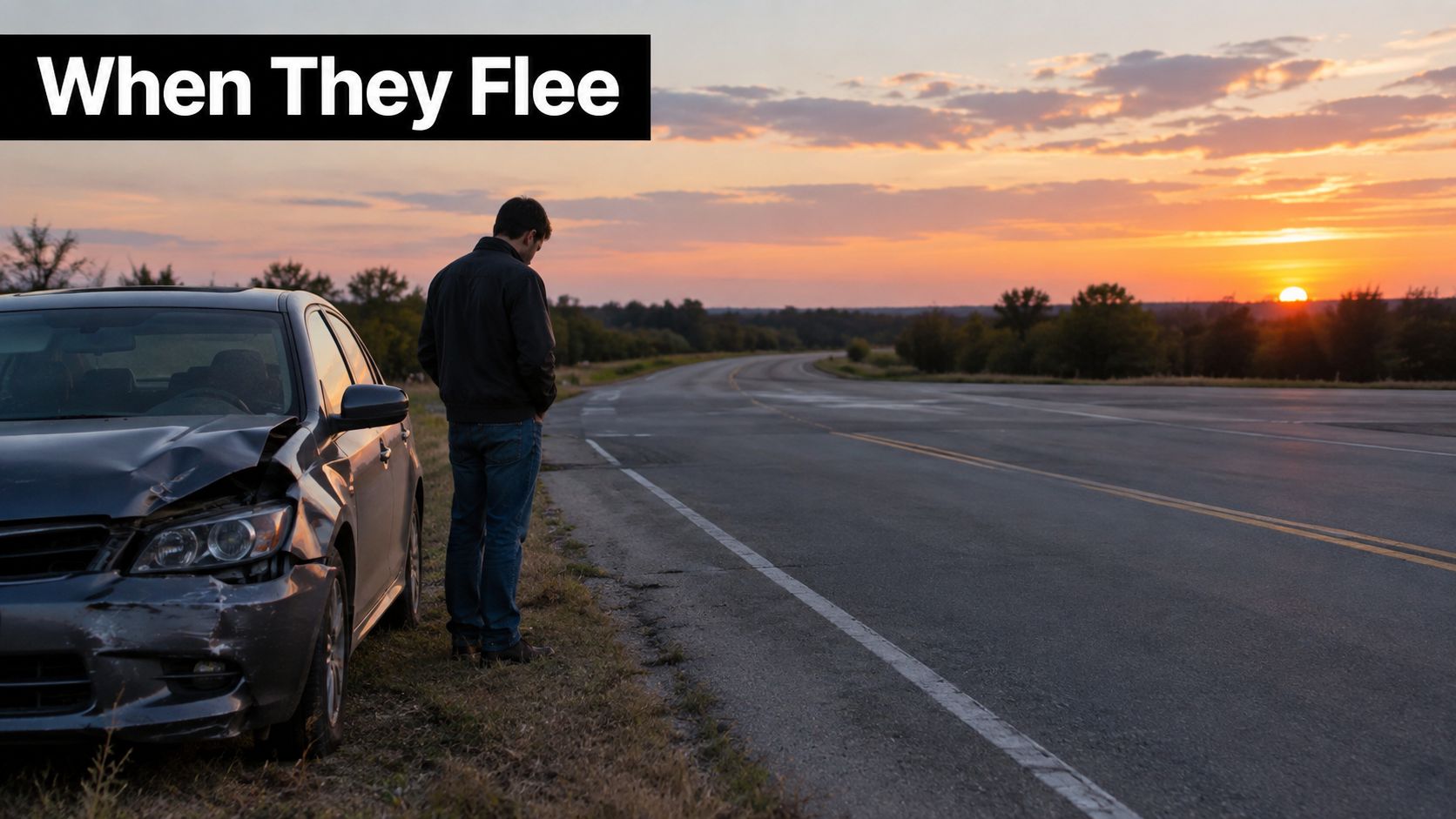
You're standing beside your damaged car, trying to remember the color of the vehicle that hit you. The other driver may have disappeared before you could read a plate, and now you're left with pain, repair questions, medical bills, and a report that says “unknown vehicle.” That combination can make recovery feel impossible.
A hit-and-run changes the process, but it doesn't erase your options. The criminal investigation may continue, yet your financial recovery can also move forward through evidence, insurance coverage, and a civil claim. The immediate priority is protecting your health and preserving the details that may later identify the vehicle or establish what happened.
Introduction When the Other Driver Disappears
A person injured by a fleeing driver often feels trapped between two fears. The first is uncertainty about whether police will find the vehicle. The second is the practical worry that nobody will pay for treatment, lost income, vehicle damage, or the long-term consequences of the crash.
Those fears are understandable. A normal collision usually gives you another driver, an insurance card, and a clear place to send a claim. With hit-and-run drivers, the other side may be absent from the scene and unknown to you. That absence makes the investigation harder, but it doesn't make your injuries less real or your claim less important.
Your first job isn't to solve the entire case at the roadside. It's to get safe, obtain medical care, report what happened, and protect evidence.
Think of the recovery process as two tracks. Law enforcement may investigate whether the driver violated criminal traffic laws. Separately, you and your representatives can examine insurance coverage and pursue compensation for the harm caused by the crash. Those tracks can develop at different speeds.
This guide focuses on the civil recovery roadmap. You'll learn what qualifies as a hit-and-run, what evidence matters, how criminal exposure differs from financial responsibility, and which insurance policies may respond when the driver is never identified. You'll also see why prompt action matters, especially when nearby cameras overwrite footage or witnesses forget details.
You don't need to know every legal term before taking the next step. Start with safety and documentation. Then review your policy, preserve records, and obtain advice before giving a recorded statement or accepting a settlement that may not account for future care.
Understanding What Counts as a Hit and Run Crash
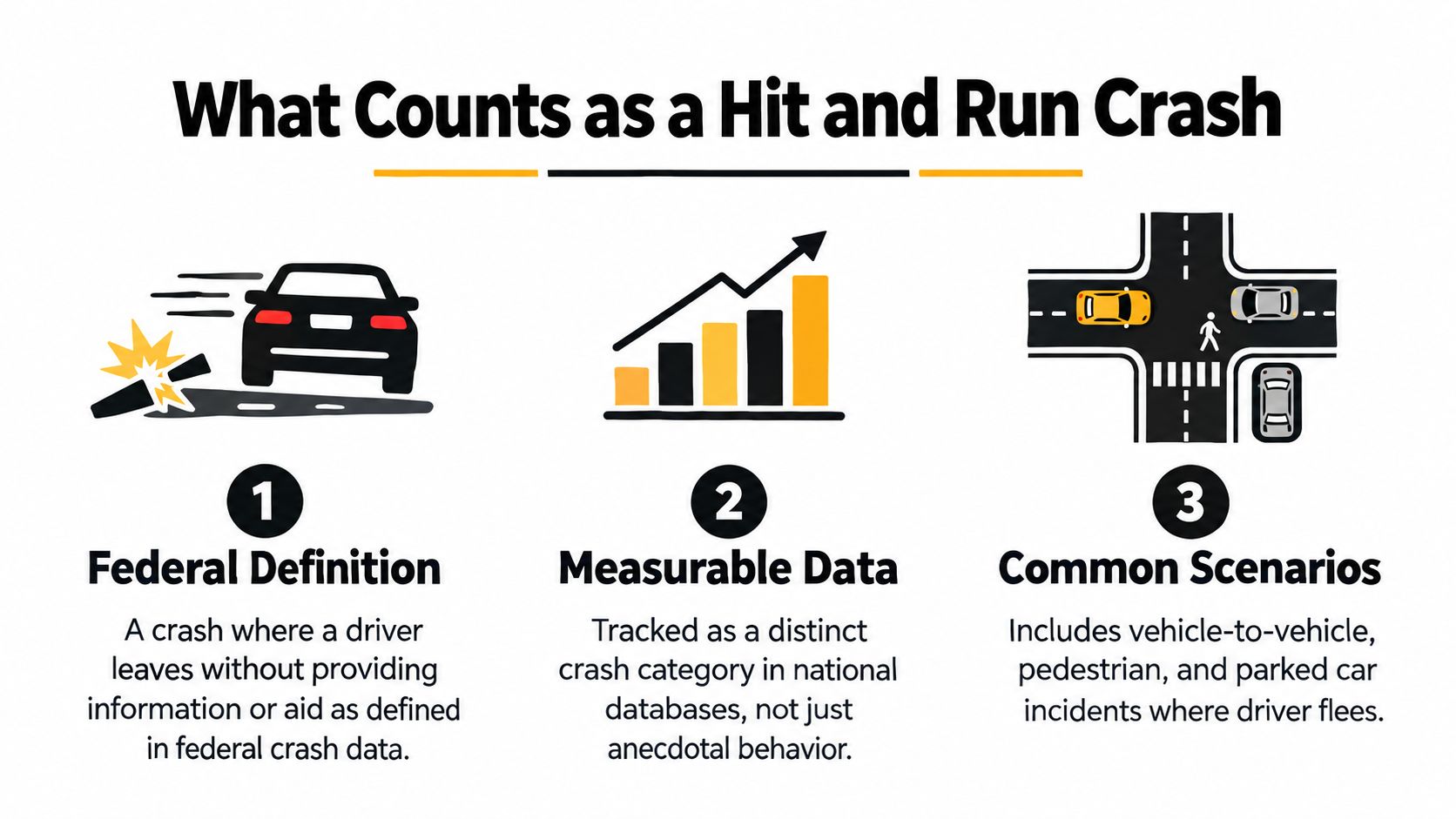
A driver clips your bicycle, a car strikes yours, or a vehicle hits you while you are walking. The other vehicle then leaves before exchanging information or offering help. That disappearance can qualify as a hit-and-run crash, even when the driver is never identified.
Federal crash data uses a specific definition rather than treating every frightening departure the same way. Under the NASS General Estimates System, a crash is coded as hit-and-run when a motor vehicle in transport, or its driver, departs the scene, whether that vehicle struck another road user or was struck. The definition excludes vehicles that were not in transport, as explained in the NHTSA GES coding manual.
The wording matters. A vehicle that clips a bicyclist and leaves, strikes another car and flees, or hits a moving vehicle before disappearing may fall within the same broad category. Property damage under different circumstances may be treated differently, so investigators still need the details of what happened.
Why the national data matters
National data helps place an individual crash in context. NHTSA reported 2,872 fatalities in crashes involving hit-and-run drivers in 2023, compared with 2,972 in 2022. The 2023 deaths included 1,818 pedestrians, representing 25% of all pedestrian deaths, and 274 pedalcyclists, representing 23% of all cyclist deaths, according to NHTSA's 2023 traffic safety data.
AAA also reported about 900,000 police-reported hit-and-run crashes in 2023, equal to 15% of all police-reported crashes, with more than 240,000 injuries. The Federal Highway Administration's FARS resource describes how federal fatal-crash systems record hit-and-run status, injuries, and fatalities.
A missing driver doesn't mean a missing case
A hit-and-run investigation works like a puzzle with one missing piece. The scene may still hold vehicle fragments, paint transfer, witness observations, camera footage, emergency calls, medical records, and damage patterns. Together, those details can support an investigation and help build a civil recovery claim, even without the driver's name.
Pedestrians and cyclists have less physical protection, so their injuries may be severe. The vehicle's disappearance does not reduce the harm or end the available insurance review. Prompt medical documentation and preserved evidence can support claims involving UM/UIM or collision coverage while investigators continue looking for the driver.
Legal Liability and Criminal Exposure for Hit and Run Drivers
A driver disappears after striking you, and the case can feel out of your hands. Two separate legal paths may still exist. One concerns whether the driver committed a crime by leaving. The other concerns how you recover money for your injuries and losses. An arrest may help with the first path, but it is not always required for the second.
Criminal proceedings belong to the state. Prosecutors review the available evidence and decide whether charges are supported and should proceed. Possible consequences depend on the circumstances, including whether the crash caused injuries or death. The criminal case focuses on punishment, deterrence, and accountability.
A civil claim has a different job. It seeks payment for medical care, lost income, property damage, pain, reduced ability to work, and lasting effects on daily life. After a fatal crash, eligible survivors may also have a wrongful-death claim. Police may still be searching while you review your own insurance, including UM/UIM and applicable collision coverage.
How fault can be shown without the driver present
A civil claim does not require the fleeing driver to sit across from you. It requires evidence that connects the collision to a vehicle, person, or insurance policy and shows how the crash caused your losses. The evidence works like pieces of a puzzle. No single piece may identify the driver, but several pieces can establish what happened.
Depending on the circumstances, useful evidence may include:
- Scene evidence: Skid marks, debris, vehicle fragments, road position, and impact damage can help reconstruct the collision.
- People who witnessed the crash: A witness may recall the vehicle's type, direction of travel, unusual damage, or part of a license plate.
- Video and digital records: Traffic cameras, business security systems, doorbell cameras, dashcams, and 911 calls may establish timing and movement.
- Medical documentation: Treatment records can connect symptoms to the crash and show the care your injuries require.
- Insurance records: Your policy may provide a recovery route when the responsible driver is unknown or lacks adequate coverage.
As defined under the federal coding rule described earlier, a hit-and-run involves a departing vehicle or driver in transport. That definition helps identify the event for crash reporting, while your claim still depends on evidence, coverage, and documented losses.
Why an arrest isn't the finish line
An arrest may create a direct path toward a claim against an identified driver and that driver's insurer. It does not guarantee payment. Likewise, no arrest does not automatically end your recovery efforts.
When the driver remains unknown, your uninsured-motorist claim may become central. Collision coverage may also address damage to your vehicle, depending on the policy terms. The practical civil questions are straightforward: what evidence exists, what coverage applies, and what losses can be documented?
That shift in focus can make a stressful situation more manageable. The criminal investigation seeks accountability. Your civil recovery roadmap preserves evidence, identifies available insurance, and documents the harm you are trying to repair.
What to Do Immediately After a Hit and Run
The first minutes should follow a simple order: safety, medical attention, reporting, documentation, and preservation. Don't chase hit and run drivers. Moving away from traffic and getting emergency help is more important than trying to obtain a perfect description.
Start with health and safety
If you're hurt, call 911 or ask someone nearby to call. Move to a safe place only if you can do so without worsening an injury. If you're a pedestrian or cyclist, don't assume that pain is minor because you remained conscious. Head, neck, back, and internal injuries may require prompt evaluation.
Medical documentation protects more than your health. It also records when symptoms began, what providers observed, and what treatment your injuries require.
Tell medical professionals exactly what happened and identify every symptom, even if it seems small. Follow discharge instructions, attend recommended appointments, and keep records of prescriptions, referrals, restrictions, and missed work.
Capture what you can without disturbing the scene
If you're physically able, photograph the vehicle damage, debris, road surface, nearby signs, lighting, lane markings, and the surrounding area. Write down everything you remember as soon as possible, including the vehicle's color, body style, direction of travel, sounds, partial plate characters, and visible damage.
Ask nearby people whether they saw the collision. Get names and contact information, but don't pressure anyone to guess. A witness who says “I don't know” may still remember a useful detail later.
Report and preserve
Call law enforcement and make sure the report clearly identifies the crash as a hit-and-run. Ask how to obtain the report number and how to submit photographs, video, or later-discovered information. If a business, residence, intersection, or vehicle may have captured the crash, request preservation promptly. Many systems overwrite footage on a routine schedule.
Notify your insurer according to the policy's reporting requirements, but keep the conversation factual. Don't speculate about fault, minimize your injuries, or provide a recorded statement before you understand what the insurer is asking and why.
For a broader accident-response checklist, review the steps to take after a car accident. You can also use the video below as a practical reminder of what to document and report.
Keep a dedicated folder for the police report, medical records, bills, wage information, photographs, insurance letters, witness details, and notes about symptoms. A clean record helps you and your lawyer see the full picture instead of relying on memory during a stressful period.
Insurance Options When the Driver Is Unknown or Uninsured
When hit and run drivers aren't identified, your own insurance policy may become the most practical source of recovery. The right path depends on the type of loss, the coverage you purchased, policy conditions, deductibles, and whether investigators later identify the vehicle.
Uninsured motorist coverage, often called UM, may apply when the responsible driver is unknown or has no liability insurance. Policies can require a police report, timely notice, cooperation with the investigation, and proof that the crash occurred. An unknown driver is sometimes called a “phantom vehicle,” but your policy language and state law control how the claim is handled.
Underinsured motorist coverage, or UIM, generally applies when the responsible driver is found but doesn't have enough insurance to cover the full loss. A driver can be identified and still leave you with an unpaid gap. Collision coverage may pay for damage to your vehicle regardless of whether the fleeing driver is found, subject to the policy's deductible and terms.
MedPay, health insurance, disability benefits, or other available coverage may help bridge immediate medical or income needs. These benefits can involve reimbursement rights, liens, or subrogation, so don't assume the first payment you receive represents the final value of the claim.
| Coverage Type | When It Applies | What It Pays | Key Consideration |
|---|---|---|---|
| Uninsured motorist | The responsible driver is unknown or uninsured | Covered bodily injury losses, subject to policy terms | Report promptly and follow proof requirements |
| Underinsured motorist | The identified driver's coverage isn't enough | The remaining covered loss, within policy limits | Settlement may require insurer consent |
| Collision | Your vehicle is damaged in the crash | Covered vehicle repair or replacement costs | A deductible may apply |
| MedPay | Your policy includes medical-payments coverage | Eligible medical expenses under policy terms | It may help before a liability claim resolves |
| Health insurance | Medical treatment is covered under your health plan | Covered care according to plan rules | Reimbursement or lien issues may arise |
Before discussing coverage with an adjuster, read the declarations page and endorsements. The uninsured motorist coverage guide can help clarify common policy terminology, but your actual contract controls.
Readers comparing insurance procedures across countries may also find this AutoProv claim guide for traders useful for general comparison. Its legal framework is different from Colorado's, so use it for context rather than as Colorado-specific advice.
Don't give up because the driver is unknown. A lawyer can review the policy, identify notice requirements, coordinate the claim with medical treatment, and address an insurer that treats your own UM or UIM claim as if it were an ordinary property-damage file.
How Investigation and Evidence Build Your Compensation Claim
A civil recovery plan should begin with evidence, not with the assumption that the driver will be found. Police may investigate, but victims and their legal teams can also preserve information that disappears quickly. The strongest cases often combine small details that become meaningful when placed together.
A prompt investigation may examine the police report, 911 audio, dispatch records, nearby traffic cameras, business security footage, doorbell cameras, dashcam video, and witness accounts. Vehicle fragments and paint transfer can help identify the make, model, or color of a fleeing vehicle. Damage patterns may show the direction and force of impact.
Some vehicles also contain electronic data that may help establish movement or collision conditions. Access depends on the vehicle, the data available, ownership, privacy rules, and legal process. Your lawyer may work with investigators, engineers, or an accident reconstruction specialist when the crash dynamics are disputed or the available evidence needs technical interpretation.
Turning evidence into a claim
The investigation should connect three things:
- What happened: The collision mechanics, location, timing, and departing vehicle.
- Who or what may be responsible: The driver, vehicle owner, another negligent party, or an applicable insurance policy.
- What the crash caused: Medical treatment, lost wages, property damage, pain, disability, and changes to everyday life.
That connection can exist without a criminal charge. A civil claim may rely on a combination of physical evidence, witness testimony, medical records, employment documentation, and policy provisions. If the driver is later identified, the strategy can expand to include that driver's liability insurance or personal assets, subject to the facts and available coverage.
A lawyer can also communicate with insurers, organize records, coordinate medical care, evaluate future needs, and negotiate or litigate when necessary. Nares Law Group LLC handles investigation, medical treatment coordination, insurance disputes, settlement, and trial for injured people and families, including Colorado hit-and-run matters and complex cases involving serious injury or wrongful death.
Be careful with early settlement offers. An insurer may know more about policy limits than you do, while the full medical picture may not yet be clear. Before signing a release, understand which claims it resolves and whether it affects later treatment, UM or UIM benefits, or other available recovery.
Moving Forward Toward Recovery and Accountability
A hit-and-run crash can leave you waiting for answers that may never come. Treat recovery like a roadmap, with separate routes for your health, evidence, insurance, and legal rights.
- Protect your health: Get medical attention, follow the treatment plan, and save medical and wage records.
- Protect the evidence: Report the crash, photograph the scene and damage, identify witnesses, and ask businesses or agencies to preserve camera footage.
- Review insurance: Check UM, UIM, collision, MedPay, and other applicable benefits. The policy may provide a recovery route even when the driver remains unknown.
- Protect your rights: Discuss evidence, deadlines, policy requirements, and possible civil claims with counsel.
Hit-and-run is a recurring source of serious roadway harm, as described in the FARS program overview cited earlier. That context matters because an unidentified driver does not automatically end the civil recovery process.
You do not have to wait for a criminal resolution before asking what your policy may cover. A prompt consultation can help preserve evidence, identify the appropriate claim path, and prevent avoidable mistakes in communications with insurers. Firms such as Nares Law Group LLC may offer free consultations and handle qualifying cases through contingency arrangements. Ask directly about fees and costs.
Nares Law Group LLC helps Colorado hit-and-run victims investigate crashes, preserve evidence, coordinate medical care, and pursue available uninsured or underinsured motorist compensation. Visit Nares Law Group LLC to request a free consultation and discuss next steps before evidence or filing deadlines become harder to manage.