A crash case can start losing strength before anyone files a lawsuit.
You may leave the scene thinking the important proof is obvious. The vehicles are damaged. The police responded. The other driver admitted something at the roadside. Maybe a truck driver even mentioned dashcam footage or electronic logs. Then, weeks later, you hear words that should make any injured person uneasy: the video was overwritten, the truck was repaired, the records can't be located, the phone was replaced, the data is unavailable.
That is often where spoliation of evidence enters the case.
If you're dealing with a Colorado car or truck accident, this issue matters because missing proof can change how fault is argued, how experts evaluate the collision, and how an insurance company values your claim. The law has tools to address destroyed evidence, but those tools work best when someone acts early. Delay is what usually helps the party who controlled the evidence in the first place.
The Vanishing Evidence After a Crash
A serious truck crash creates a trail of proof almost immediately. There may be dashcam footage, driver logs, dispatch messages, maintenance records, cell phone data, GPS history, scene photos, vehicle modules, and the damaged vehicles themselves. In the first days after the collision, all of that may still exist.
Then the routine cleanup starts.
A trucking company puts the vehicle back into service. A tow yard charges storage fees, so someone authorizes disposal. A business keeps video only for a short retention period. A driver gets a new phone. Your own car is moved, repaired, or totaled before anyone with technical training can inspect it. By the time a lawyer asks for those materials, key proof may already be gone.
Why this feels so unfair
Clients usually react the same way. They ask a simple question: if the evidence mattered, how can the other side just let it disappear?
The answer is that they can't always do that without consequences. Courts have long treated destruction or concealment of relevant proof as a serious litigation problem. In Florida practice, courts may impose sanctions ranging from exclusion of expert testimony to an evidentiary presumption, striking pleadings, default on liability, or dismissal when spoliation impairs the opposing party's ability to present its case, as discussed in the Florida Bar Journal on spoliated evidence.
That doesn't mean every missing record proves wrongdoing. Sometimes evidence is lost through carelessness, poor procedures, or automatic deletion. But from the injured person's side, the result can be the same. The proof you needed to show speed, braking, hours of service, distraction, or impact severity may no longer be available.
Missing evidence doesn't just create frustration. It can change what experts can test, what witnesses can confirm, and what a jury is allowed to hear.
What matters right now
If you suspect evidence is disappearing, treat that as an urgent legal issue, not an administrative problem. In crash cases, the first fight is often about preserving proof before the second fight even begins over who was at fault.
What Spoliation of Evidence Actually Means
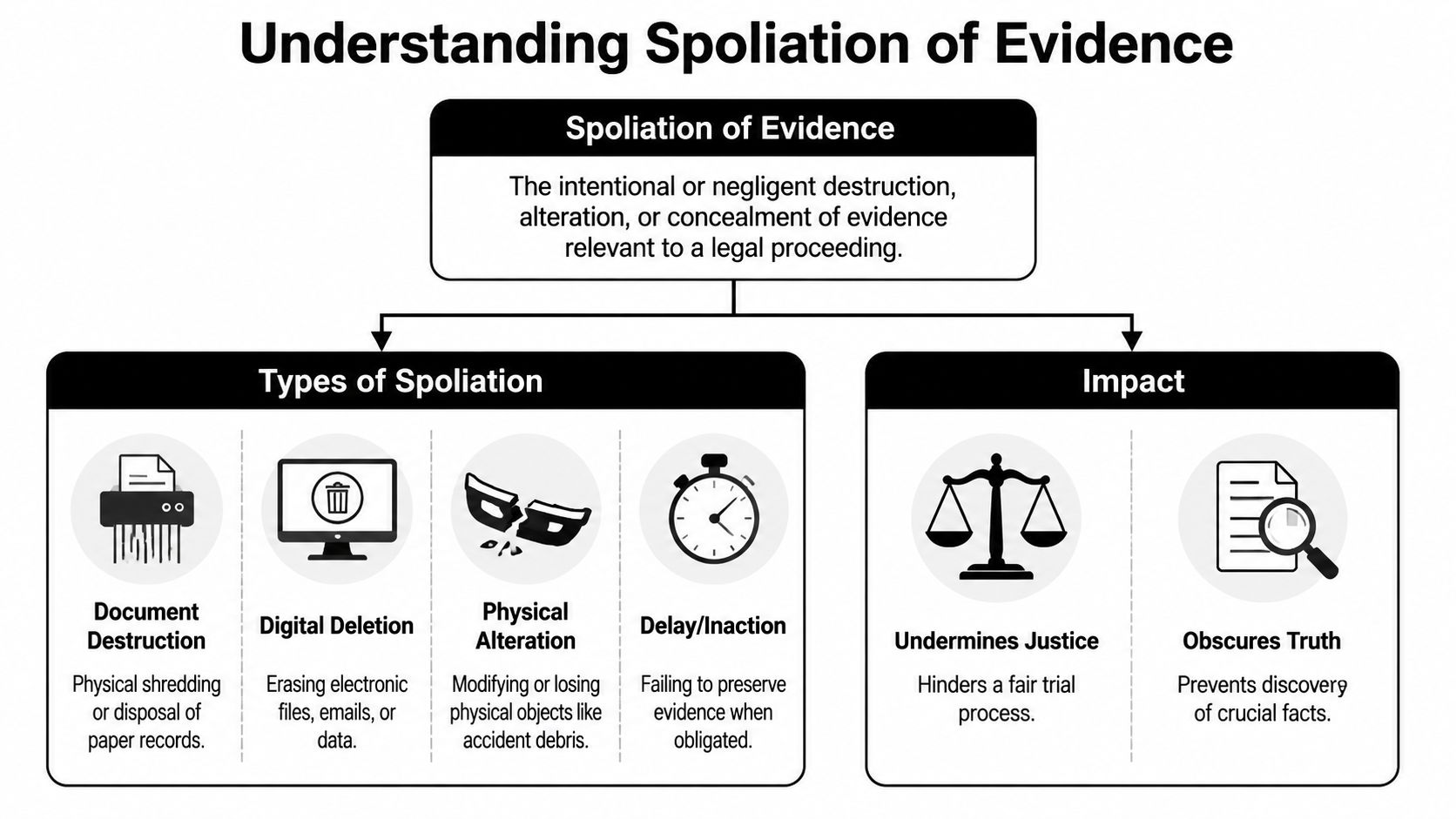
What is spoliation of evidence? In plain English, it means relevant evidence was destroyed, altered, withheld, or lost when it should have been preserved.
That definition is broader than typically expected. It isn't limited to someone feeding papers into a shredder. It can include repairing a vehicle before inspection, deleting a text thread, allowing surveillance footage to auto-delete, discarding a broken part, or failing to stop a normal retention policy after a serious wreck.
Three parts of the concept
It helps to break spoliation into three practical pieces:
| Part | What it means in a crash case |
|---|---|
| The act | Evidence is destroyed, changed, withheld, or lost |
| The mindset | It may be intentional, reckless, or negligent |
| The trigger | A duty to preserve existed when the loss happened |
A useful analogy is a house fire investigation. If the burned wiring, appliances, photos, and debris are all discarded before anyone can inspect them, no one can reliably reconstruct what happened. A vehicle collision works the same way. If the truck is repaired, the event data is wiped, and the video disappears, the truth becomes harder to test.
It covers physical evidence and digital evidence
Spoliation can involve many different categories of proof:
- Physical items like a wrecked car, brake components, tires, debris, or a helmet
- Documents such as maintenance logs, inspection reports, driver files, repair invoices, and company policies
- Electronically stored information like emails, texts, dashcam files, GPS records, photographs, and onboard vehicle data
According to Control Risks on spoliation of evidence, spoliation in civil litigation is not limited to deliberate destruction. It also includes negligent alteration, withholding, or loss of evidence relevant to a trial, and it can happen before or after a preservation notice is issued.
Practical rule: If a serious crash happened and a claim is likely, nobody should assume that "routine deletion" or "ordinary repairs" make evidence loss acceptable.
What people often miss
The legal problem usually isn't just that evidence disappeared. The deeper problem is that the missing material can no longer be tested, authenticated, or used in expert analysis. That is why judges take spoliation seriously. It threatens the fairness of the case itself.
When the Duty to Preserve Evidence Begins
Many people think preservation starts only after a lawsuit is filed. That's a dangerous mistake.
The duty to preserve begins when evidence may be relevant to reasonably foreseeable litigation. Virginia's statute states that the duty arises when a party or potential litigant is on notice that specific, identifiable litigation is likely, as set out in Virginia Code § 8.01-379.2:1. That principle is useful because it reflects the actual-world timing problem in accident cases. Evidence often disappears before a complaint is ever filed.
What reasonably foreseeable looks like after a crash
You don't need a court date on the calendar for litigation to be foreseeable.
In practice, warning signs often include:
- A severe collision with major vehicle damage or emergency transport
- A commercial vehicle wreck involving a trucking company, employer, or corporate insurer
- A fatality or traumatic brain injury where liability and damages will obviously be disputed
- A disputed account of the crash where video, scene evidence, or electronic data could decide fault
If a tractor-trailer rear-ends a stopped car and someone is hospitalized, nobody should act as if a legal claim is merely hypothetical. The same is true when a driver receives notice from an insurer, a police investigation starts, or counsel becomes involved.
This duty applies to you too
Spoliation isn't only the other side's problem. Injured people can also damage their own claims by failing to preserve evidence.
That can happen when someone:
- Repairs or disposes of the vehicle before inspection
- Deletes phone photos or text messages
- Loses a damaged child seat, helmet, or motorcycle gear
- Waits too long to secure records like the police file or scene documentation
If you haven't already, get the basic official record moving by learning how to obtain an incident report. That report won't preserve every piece of evidence, but it helps anchor the timeline and identify witnesses, agencies, and involved parties quickly.
A lawsuit doesn't create the first preservation duty. The crash itself often does.
The practical takeaway
After a serious accident, act as if important evidence is already on the verge of being lost. Because in many cases, it is.
Spoliation Examples in Truck and Car Accident Cases
Spoliation becomes easier to understand when you see how it shows up in ordinary crash litigation.
A trucking case may depend on data that exists for only a limited window unless someone intervenes. A car crash may turn on vehicle damage patterns that disappear after repairs. A wrongful death case may hinge on electronic communications that get replaced when someone upgrades a device. These aren't technical side issues. They often decide whether negligence can be proven clearly or only argued indirectly.
Common examples that damage accident claims
Consider how a few familiar scenarios play out.
A truck driver says there was a dashcam. By the time counsel requests it, the company says the footage was overwritten in the normal course of business. That video may have shown lane position, speed changes, following distance, and traffic conditions in the seconds before impact.
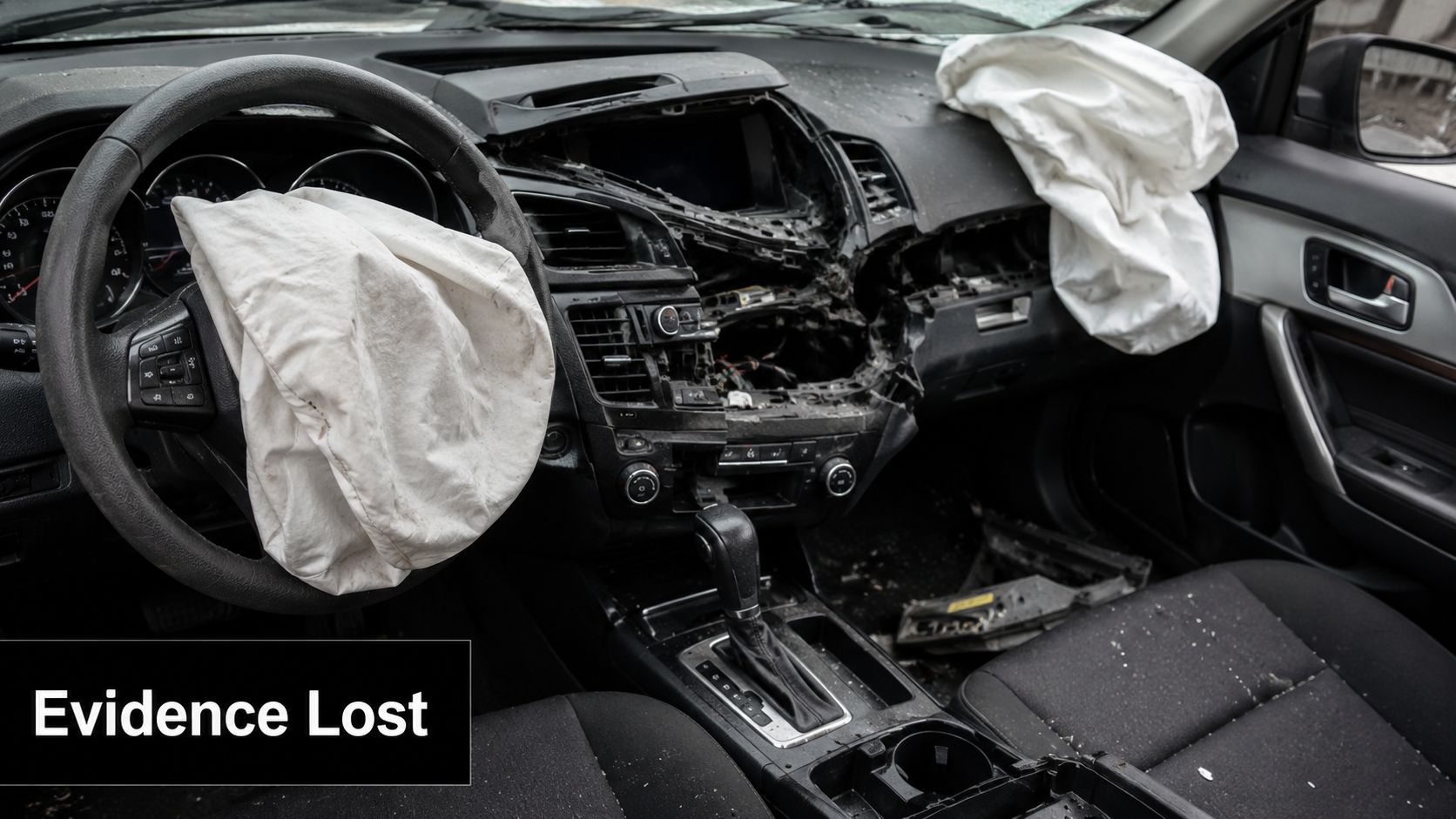
In another case, the tractor and trailer are repaired before an engineer can inspect them. That can erase crush patterns, lighting issues, underride evidence, tire condition, and mechanical clues that help explain why the collision happened.
Sometimes the missing proof is administrative rather than visual. A company may fail to preserve maintenance records, inspection reports, post-crash writeups, dispatch communications, or driver qualification materials. Those records can matter when the case involves negligent hiring, training, supervision, or vehicle upkeep.
Why modern vehicle data matters so much
Digital evidence has changed collision cases. Event data, onboard systems, apps, and route histories can all help reconstruct what happened.
For personal vehicles, some drivers also use tools that monitor your car's movements through route history and trip tracking. In the right case, that kind of user-controlled data may help confirm location, timing, or movement patterns when other sources are disputed.
When technical proof is still available, attorneys often work with engineers and other specialists to interpret impact dynamics, visibility, speed, and avoidance opportunities. If you're trying to understand that side of a case, this overview of an accident reconstruction specialist shows why preserving the vehicles and data early matters.
A short risk checklist
Evidence is often most vulnerable in these categories:
- Video evidence including dashcams, business surveillance, and body-worn recordings
- Vehicle data from passenger cars, trucks, phones, and onboard systems
- Driver records such as logs, dispatches, messages, and qualification files
- Physical inspection targets like the vehicles, tires, brakes, airbags, seatbelts, and debris field
The key question isn't just what existed. It's what disappeared before your side had a fair chance to examine it.
The Legal Consequences for Destroying Evidence
When evidence is destroyed, courts don't shrug and tell everyone to move on. Judges can impose remedies designed to correct unfairness and deter misconduct.
Think of sanctions like penalties in a game. Some are corrective. Some restrict what a party can argue. The harshest ones can effectively end part of the case.
What judges look at
The severity of a spoliation sanction is generally tied to four factors: whether there was a duty to preserve, the degree of culpability, the importance of the missing evidence, and the prejudice to the opposing party, as summarized by Parzfirm's discussion of spoliation sanctions.
That framework matters because not every loss gets the same response. Losing a central piece of crash evidence through intentional conduct is very different from an accidental loss of a minor record that can be replaced another way.
The sanctions that matter most
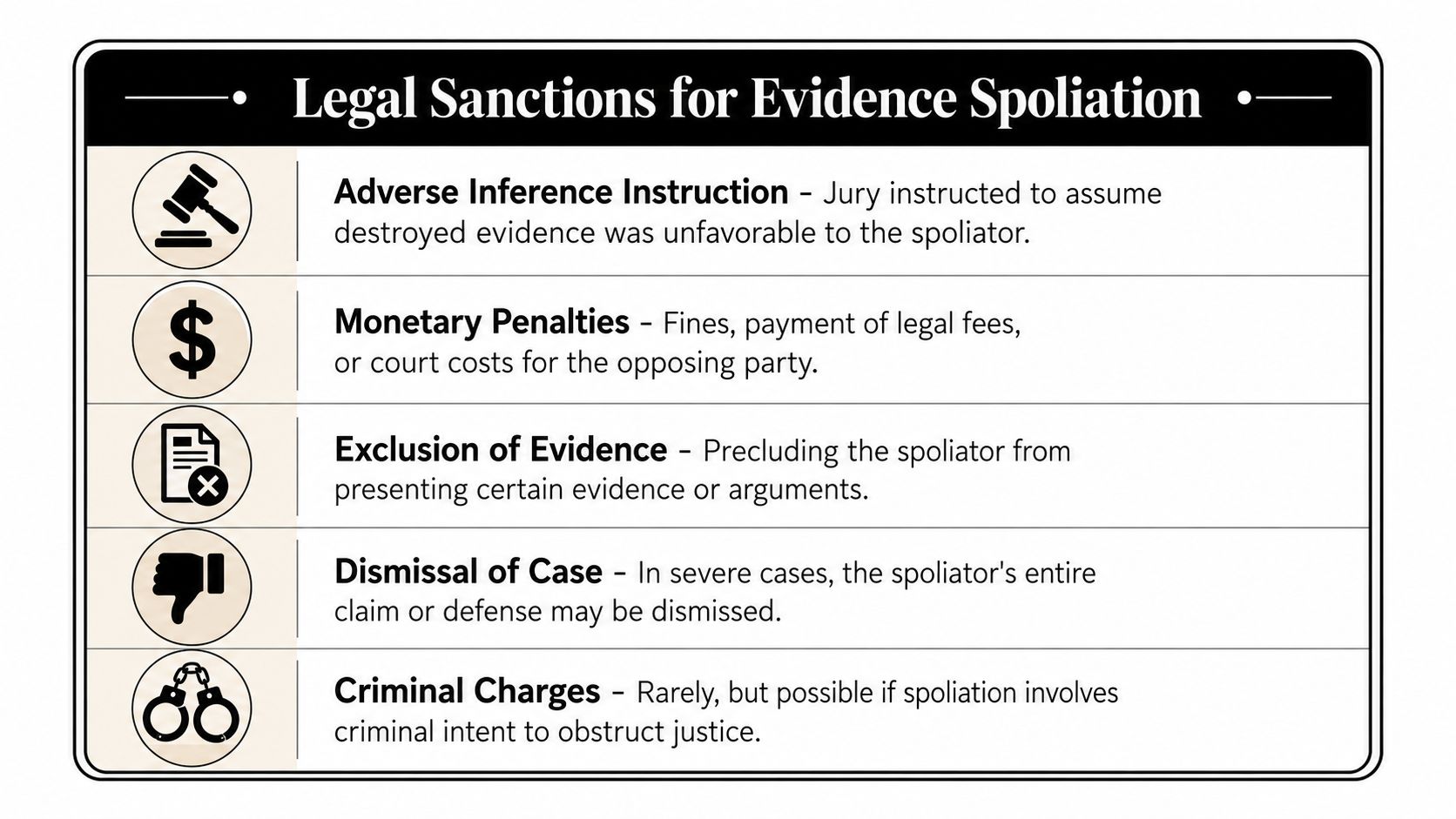
Courts may respond in several ways:
- Adverse inference. The judge may allow the factfinder to presume the missing evidence would have been unfavorable to the party responsible for losing it.
- Exclusion of testimony or evidence. If an expert's opinions depend on material that was destroyed, the court may limit or exclude that proof.
- Striking claims or defenses. In serious cases, a court can remove a party's ability to pursue or defend key positions.
- Default or dismissal. Where the loss is severe and the conduct is reckless or intentional, the sanctions can be case-ending.
Florida courts, for example, may impose sanctions ranging from exclusion of expert testimony to an evidentiary presumption, striking pleadings, default on liability, or dismissal when spoliation impairs the opposing party's ability to present its case, as noted earlier in the Florida Bar Journal source.
Virginia's statute also reflects a calibrated approach. If lost evidence can't be restored through additional discovery, a court may order the minimum remedy needed to cure prejudice, but may go further and presume the evidence was unfavorable, instruct the jury accordingly, or dismiss the case if the party acted recklessly or with intent to deprive the other side of the evidence.
Courts usually aim first to cure prejudice. They escalate when the conduct is more blameworthy or the missing proof is more important.
What doesn't work
People sometimes assume that merely accusing the other side of destroying evidence will transform the case. It won't.
Judges want a clean showing that the evidence existed, mattered, should have been preserved, and is now unavailable in a way that harms your ability to prove the claim. Suspicion alone isn't enough. That is why documentation, preservation letters, inspection requests, and fast factual development matter so much.
How to Protect Your Claim from Evidence Spoliation
The most effective response to spoliation is prevention. Once evidence is gone, you're often asking a court to repair damage that cannot be undone.
That is why the first days and weeks after a crash matter so much.
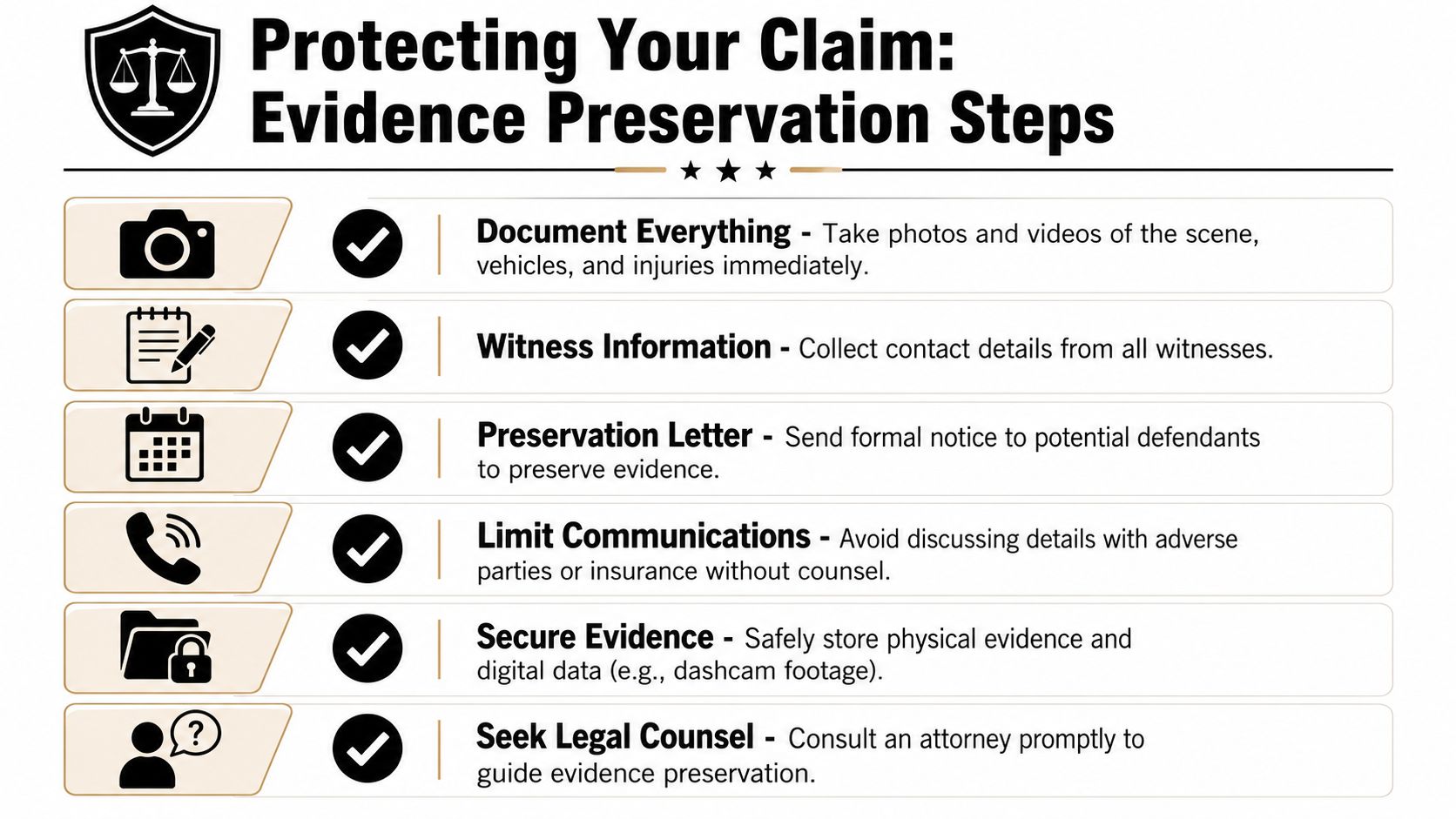
Your first line of defense
Start with what you control.
Photograph everything you can safely document. Take wide shots, close-ups, skid marks, debris, vehicle interiors, deployed airbags, visible injuries, roadway signs, weather, and lighting conditions.
Preserve your own digital material. Save dashcam files, text messages, call logs, app history, emails, and voicemail. Back them up instead of leaving them only on one phone.
Do not repair, discard, or authorize disposal too quickly. Your vehicle, child seat, helmet, torn clothing, or damaged personal property may later become important physical evidence.
A practical roadmap for the immediate aftermath is available in these steps to take after car accident. The central idea is simple. Early organization protects both safety and proof.
Here is a useful primer that explains the role of forensic pathologists in court when an injury or death case turns on medical causation. In the right case, those experts depend on properly preserved records and physical findings just as reconstruction experts depend on preserved vehicle evidence.
Use a preservation letter early
A formal preservation demand, often called a spoliation letter, puts the other side on direct notice to keep specific evidence. In a truck case, that letter may identify the tractor, trailer, event data, dashcam footage, driver logs, dispatch communications, maintenance records, cell phone records, and post-crash inspection materials.
It should be specific. "Preserve all evidence" is weaker than naming the exact categories that matter.
This video gives a practical overview of why timing and documentation matter after a crash:
Get help before the evidence window closes
What works is speed, detail, and follow-through. What doesn't work is assuming the insurer will gather and protect proof for everyone's benefit.
In many cases, counsel needs to contact the tow yard, identify custodians, request inspections, preserve electronic data, and coordinate with experts quickly. A personal injury firm like Nares Law Group LLC handles that kind of early case preservation as part of accident investigation, alongside obtaining records, communicating with insurers, and preparing liability proof.
Frequently Asked Questions About Spoliation
Can I file a separate lawsuit just for spoliation in Colorado
Be careful with that assumption. Content online often overstates spoliation as a standalone claim, but the law is jurisdiction-specific. Massachusetts and Virginia state there is no independent tort cause of action for spoliation, while Florida recognizes one in some circumstances, as noted in the Massachusetts guide to evidence on spoliation. In many cases, spoliation is handled as a sanctions issue inside the underlying case rather than as a separate lawsuit.
For a Colorado accident victim, the practical answer is usually this: focus first on preserving evidence and building the record for court remedies if proof is lost.
What is ESI and does spoliation apply to texts and emails
Yes. ESI means electronically stored information. In a crash case, that can include texts, emails, app messages, photos, cloud files, dashcam video, GPS history, and electronic vehicle data.
People often think of evidence as metal, glass, and paper. Modern litigation doesn't work that way. Some of the most important proof now lives on phones, servers, memory cards, and vehicle systems.
Does the other side have to prove intentional destruction
Not always. Spoliation is not limited to deliberate destruction. Negligent alteration, withholding, or loss can still create serious problems in litigation, especially if the missing evidence was important and the loss prejudiced the other side's ability to prove the case.
That matters for accident victims because many evidence losses are framed as mistakes, routine retention, or ordinary business practice. Those explanations don't automatically end the inquiry.
If you suspect evidence is disappearing, don't wait for certainty before acting. Preservation is time-sensitive, and delay usually helps the party who already controls the proof.
If a crash left you injured and you're worried that video, vehicle data, or records may be disappearing, Nares Law Group LLC can evaluate the situation, help identify what evidence should be preserved, and advise you on the next steps to protect your claim.