After a truck crash, many people start with one question: what did the driver do wrong? That's understandable. The police report may mention speed, distraction, lane position, or a traffic citation. But in serious commercial truck cases, that's often only the surface.
A tractor-trailer doesn't end up in a dangerous condition by accident. Someone hired the driver. Someone decided how much training was enough. Someone approved the maintenance schedule, set the delivery expectations, and created the workplace culture around safety. If you're sitting with medical bills, missed work, pain, and a wrecked vehicle, those company decisions matter just as much as what happened in the seconds before impact.
When a Truck Crash Is More Than Driver Error
The first days after a truck crash are a blur. You may be getting calls from insurers, trying to arrange treatment, and replaying the crash in your head. If the truck driver made a mistake, it can seem like the legal question is simple. In many cases, it isn't.
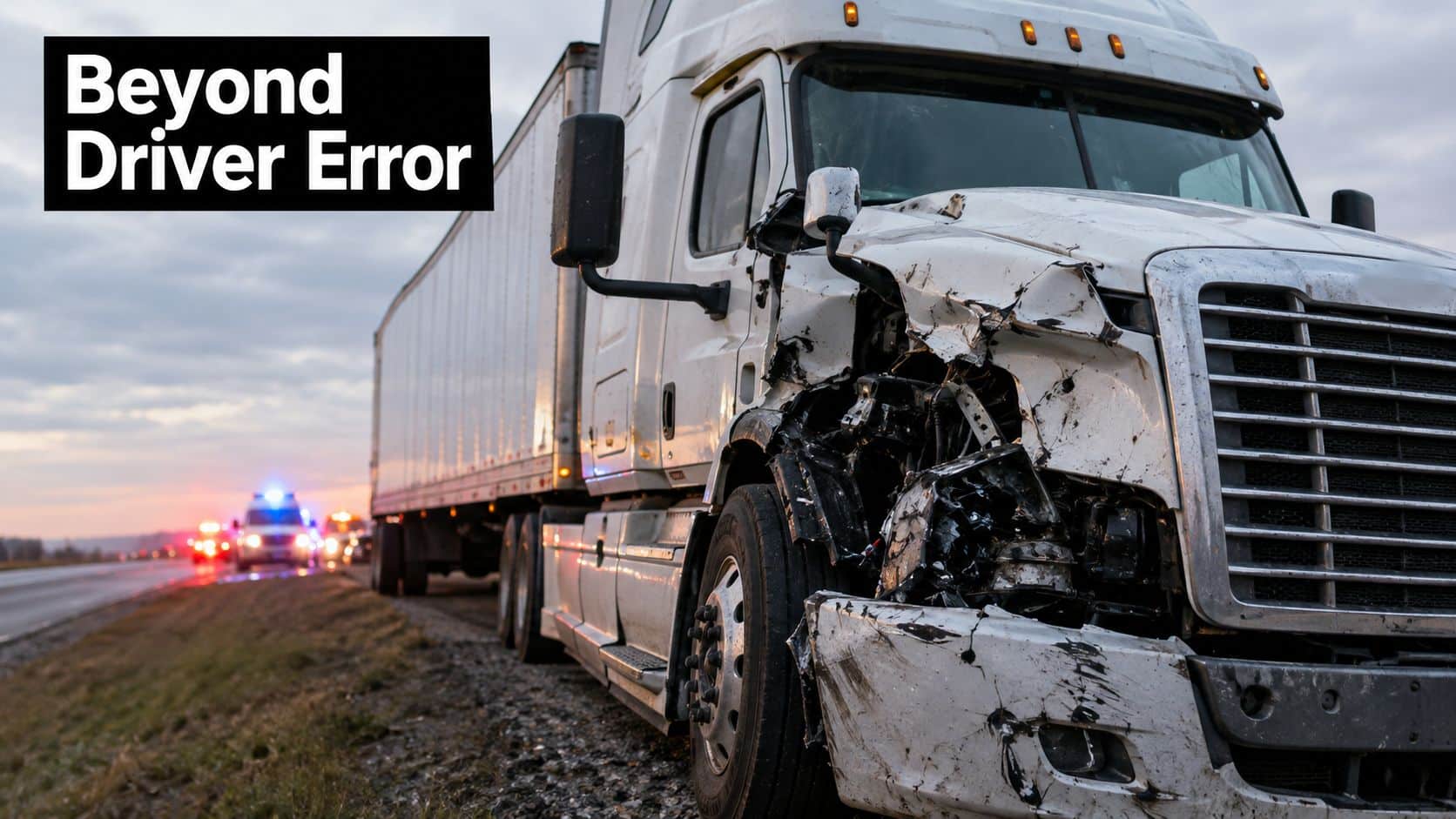
Federal crash research has long pointed to human performance as a central issue in major truck wrecks. The Federal Motor Carrier Safety Administration's Large Truck Crash Causation Study identified about 141,000 large trucks involved in fatal, incapacitating, and non-incapacitating injury crashes over a 33-month study period, and found that driver reasons accounted for 87% of the crash reasons identified in those crashes, according to the FMCSA Large Truck Crash Causation Study. The same study found many driver-related failures involved not correctly recognizing the situation or making poor driving decisions.
That doesn't mean the company gets a pass. It often means the opposite. If a driver missed an obvious hazard, drove while exhausted, or made a rushed decision, the next question is whether the company's systems helped create that mistake. Safety rules for trucking aren't just about blaming a driver after the fact. They exist because carriers control so many of the conditions that shape driver behavior, and those duties are reflected in federal trucking regulations.
Why the police report is only the starting point
A police report usually focuses on the scene. It records what officers could see that day. It may not show whether the company ignored prior maintenance warnings, pushed a driver to keep moving, or failed to remove an unsafe driver from the road.
Practical rule: In a truck case, the crash scene tells you what happened. Company records often tell you why it happened.
That difference matters for compensation too. When trucking company negligence is part of the case, the claim can expand beyond a single driving mistake and include the broader safety failures that allowed the crash to happen.
What Trucking Company Negligence Means Under the Law
Trucking company negligence usually starts with a basic idea: if you put a large commercial vehicle on public roads, you have a duty to do it safely. That sounds simple because it is. The hard part is seeing how many pieces of the system that duty touches.
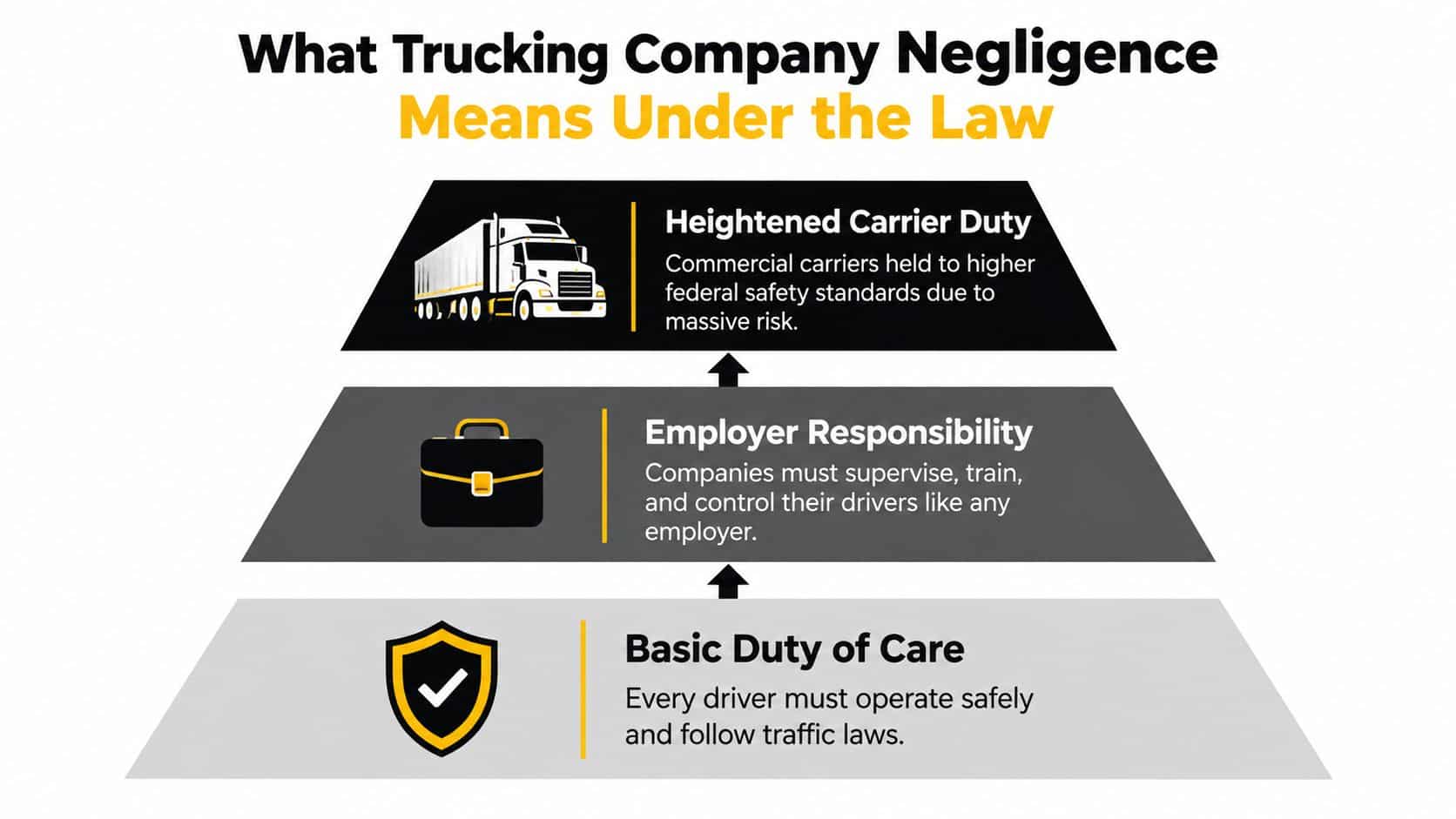
Think of a trucking company like an airline operating planes. If a pilot makes an error, people naturally look at the pilot. But they also want to know whether the airline trained the pilot properly, maintained the aircraft, set realistic schedules, and enforced safety rules. Trucking works the same way. The vehicle is smaller than a plane, but the company still runs a safety system.
Direct negligence and vicarious liability
There are two ideas that often get mixed together.
Vicarious liability means a company can be responsible for harm caused by its employee while doing the job. If a truck driver negligently causes a crash during a delivery route, the carrier may be legally responsible because the driver was acting within the scope of work.
Direct negligence is different. That's when the company itself did something careless. Examples include poor hiring, weak supervision, unsafe dispatch pressure, or skipped maintenance. In that situation, the company isn't liable only because of the driver. It may be liable because of its own conduct.
Why federal safety rules matter
Commercial trucking companies don't operate under the same expectations as an ordinary private driver. They're subject to a detailed safety framework that covers drivers, vehicles, operations, and recordkeeping. FMCSA's crash-causation guidance treats truck safety as a connected system involving the driver, the vehicle, the environment, and the motor carrier, as described in the FMCSA LTCCS analysis series on using crash-causation data.
That systems view matters in real cases. A truck crash may involve:
- Driver issues like fatigue, inattention, or poor judgment
- Vehicle issues like brakes, tires, steering, or load problems
- Carrier issues like scheduling, supervision, training, and safety history
A company doesn't avoid responsibility just because the driver made the final mistake. If company practices helped create the conditions for that mistake, those practices may be part of the case.
The independent contractor confusion
People also get tripped up by labels. A trucking company may say the driver was an independent contractor, not an employee. Sometimes that matters. Often, the issue is control. Who set the route, maintained the truck, enforced safety policies, handled dispatch, and kept the driver working?
A contract label can matter less than the facts on the ground. In truck litigation, lawyers often look past the paperwork and ask who controlled the operation.
Common Types of Trucking Company Negligence
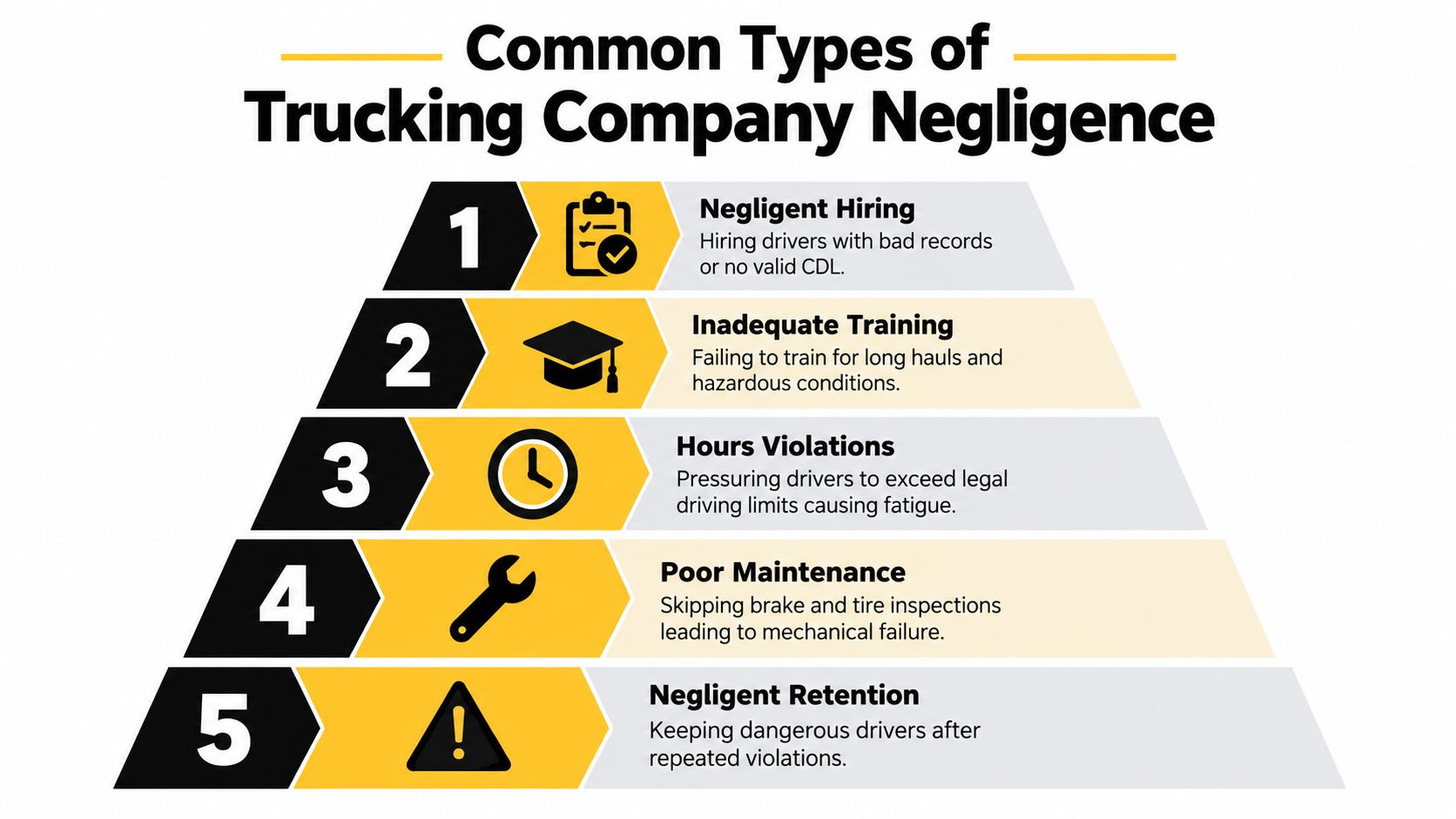
Not every truck wreck involves company fault. Many do. The most common pattern is that several small failures line up at once, then one bad moment on the road turns them into a catastrophe.
National crash data shows why this systems view matters. In 2024, 5,340 people were killed and 161,201 people were injured in traffic crashes involving large trucks, according to NHTSA crash statistics publication 813816. That publication also reports a substantial share of those killed were occupants of other vehicles. In other words, the people most harmed are often the people with the least control over the risk.
Hiring and retention failures
A carrier has to make sound decisions before a driver ever starts a route. If it puts an unsafe driver behind the wheel, the danger doesn't begin at the crash scene. It begins in the hiring process.
Negligent hiring may involve overlooking a poor record, failing to verify qualifications, or ignoring warning signs that a driver shouldn't be operating a commercial rig. Negligent retention happens when the company keeps a driver on the road after repeated problems.
Training and supervision gaps
Some drivers know how to move a truck. That doesn't mean they're prepared for mountain weather, downhill braking, dense traffic, or emergency decision-making.
Weak supervision can look ordinary from the outside. A company may have a manual, a few basic policies, and a dispatcher checking delivery times. But if no one is monitoring compliance, no one is coaching risky conduct, and no one intervenes after near misses, the safety system is mostly paperwork.
Here's a short explainer that helps many people understand how these cases are evaluated in practice:
Fatigue pressure and unrealistic dispatch
Some of the clearest federal data on trucking company negligence involves pressure and fatigue. FMCSA's Large Truck Crash Causation Study analysis brief recorded driver fatigue for 18,000 trucks (13%, relative risk 8.0), traveling too fast for conditions for 32,000 trucks (23%, relative risk 7.7), driver inattention for 12,000 trucks (9%, relative risk 17.1), and “felt under work pressure from carrier” for 16,000 trucks (10%, relative risk 4.7), according to the FMCSA crash causation analysis brief.
That's important because fatigue cases rarely come with a simple confession. A driver may never say, “My company pushed me too hard.” Instead, pressure shows up in dispatch messages, delivery windows, route expectations, and a pattern of choosing speed over rest.
Maintenance, cargo, and safety culture
Maintenance failures are another major area. The same FMCSA analysis brief recorded brake problems for 41,000 trucks (29%). When brakes, tires, or steering components are neglected, the truck becomes a hazard before it even leaves the yard.
Cargo issues can create rollover risk, shifting loads, and stopping problems. Safety culture ties all of this together. A company with a weak safety culture may tolerate shortcuts in several places at once.
| How Common Carrier Failures Create Crash Risk | ||
|---|---|---|
| Type of Negligence | Example | Why It Increases Risk |
| Negligent hiring | Company overlooks serious warning signs in a driver's background | An unsafe driver may be put on public roads in a heavy commercial vehicle |
| Poor training | Driver gets little preparation for mountain routes or emergency braking | The driver may react poorly in high-pressure conditions |
| Hours and dispatch pressure | Dispatcher sets unrealistic timing that discourages rest | Fatigue and rushed decisions can impair recognition and judgment |
| Poor maintenance | Brake issues are ignored until a trip is underway | The truck may be unable to stop or respond safely |
| Cargo and loading failures | Load is improperly balanced or secured | The trailer may shift, sway, or roll during routine driving |
| Weak retention and supervision | Company keeps a driver on the road despite repeated safety concerns | Known risk stays active instead of being corrected |
If you want a plain-English way to compare unsafe conduct across different contexts, this guide on how to spot negligence early CasePulse is a useful companion to truck-specific analysis.
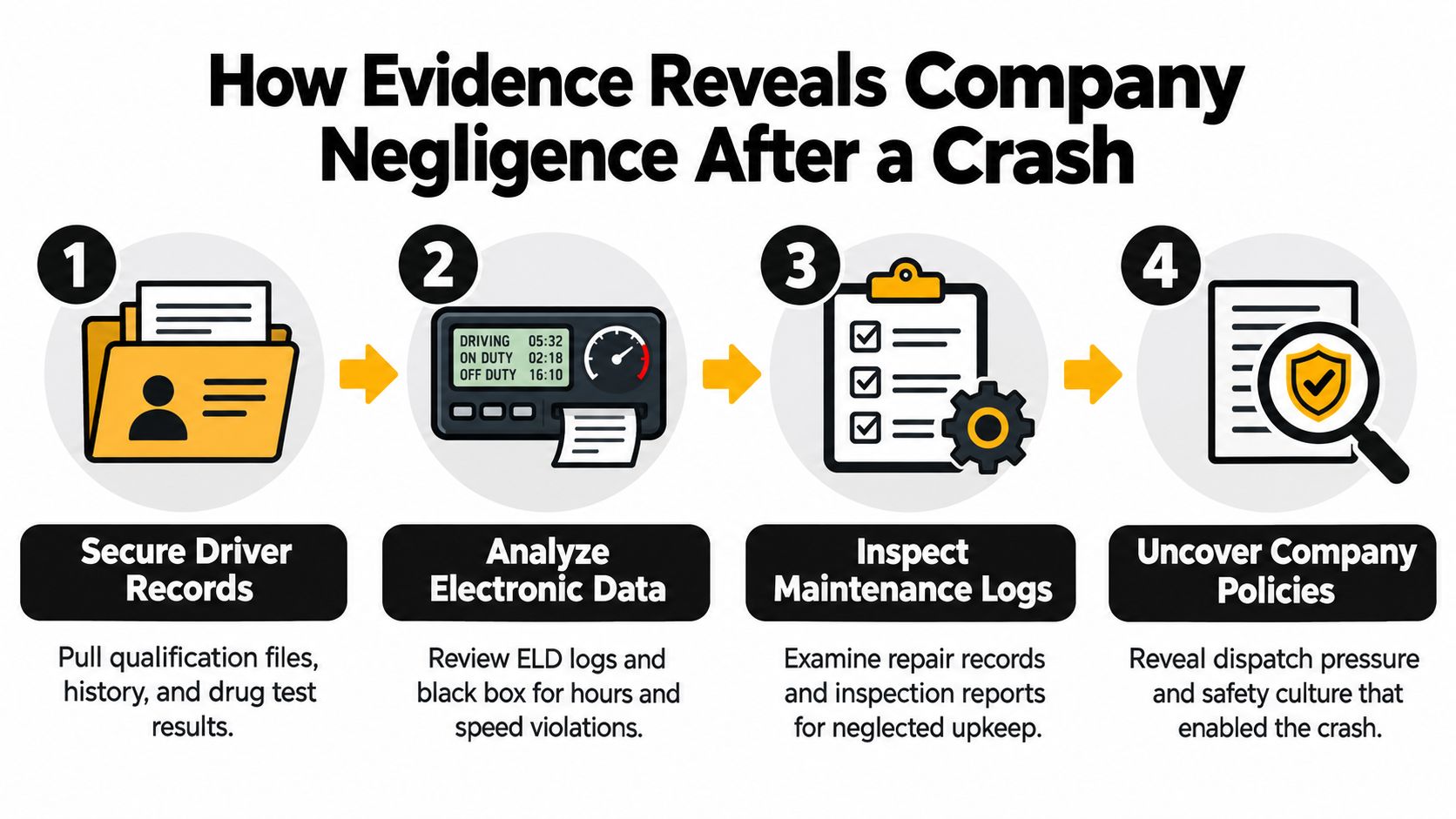
How Evidence Reveals Company Negligence After a Crash
Truck cases are document cases. The scene matters. Photos matter. The vehicles matter. But company negligence is often proven through records that most injured people never see unless someone demands they be preserved and produced.
Start with preservation
A truck crash investigation should move quickly because important evidence can disappear in the ordinary course of business. Electronic driving data may be overwritten. Vehicles may be repaired. Paper and digital records may be scattered across the carrier, insurer, maintenance vendors, and third parties.
That's why early preservation requests matter. They put the company on notice that key materials must be kept.
The police report may describe the impact. It usually won't tell you whether the company had months of warning before the impact ever happened.
What investigators usually look for
The strongest cases usually don't rely on one dramatic document. They rely on patterns across multiple sources.
- Driver qualification materials can show how the driver was screened, reviewed, and monitored over time.
- Hours-of-service and ELD records can reveal whether fatigue or schedule pressure may have been involved.
- Maintenance and inspection files can show whether a known mechanical problem was ignored or repeated.
- Dispatch messages and internal communications may reveal how much pressure the driver was under.
- Event data and truck electronics can help reconstruct speed, braking, and vehicle operation before impact.
In more technical cases, attorneys may also work with an accident reconstruction specialist to compare physical evidence, scene data, and electronic records. That can be especially important when the company blames the victim, weather, or a sudden emergency.
Why patterns matter more than a single bad fact
A single missed inspection might not prove much by itself. Neither will one hurried text from dispatch. But when records line up, the story becomes clearer.
A realistic example might look like this:
- The truck had unresolved brake history.
- The driver's logs suggest little room for rest.
- Dispatch pushed a tight delivery timeline.
- The truck was traveling too fast for conditions when traffic slowed.
Each fact is part of the same safety picture. That's how trucking company negligence is often proven. Not through a slogan, but through the paper trail.
Your Rights and Compensation After Trucking Company Negligence
When company negligence is part of a truck case, the legal claim may extend beyond the driver alone. Depending on the facts, responsibility may include the motor carrier, the driver, and sometimes other companies involved in maintenance, cargo, or logistics. The exact answer depends on who controlled which part of the operation.
One issue that confuses many families is the independent contractor label. A company may argue it isn't responsible because the driver wasn't technically an employee. That's not always the end of the analysis. Control, supervision, maintenance responsibility, dispatch authority, and hiring decisions can all matter more than the label in a contract.
What compensation is meant to cover
A truck injury claim is meant to address the losses the crash caused. In Colorado, that often includes medical care, lost income, reduced earning ability, pain, suffering, physical impairment, and the disruption the injuries caused in daily life. In a fatal crash, wrongful death claims may also address the losses suffered by surviving family members.
If you want a fuller overview of categories that may apply in a truck case, this guide to truck accident compensation can help frame the discussion.
Why company liability can change the case
Commercial truck claims are often defended aggressively. Carriers and insurers may argue that the event was unavoidable, that the driver acted alone, or that your injuries were less serious than they appear. Company-level evidence can change that conversation because it moves the focus from one moment to the larger operation.
Recent public-facing safety discussions also point to a practical concern. FMCSA crash resources continue to show large-truck crashes as a persistent problem, and public reporting has raised questions about how much dangerous carrier conduct is identified before a crash occurs, as reflected in FMCSA crash statistics resources. For injured people, that means it's often necessary to build the case from records and investigation, not assumptions that regulators already caught the problem.
A truck claim isn't just about what was broken on the highway. It's also about what was broken inside the company before the truck ever got there.
Colorado Deadlines and Fault Rules That Affect Your Claim
Colorado law adds another layer to truck cases. Even a strong negligence claim can be damaged by delay, missing records, or an avoidable dispute over fault.
Timing matters more than most people realize
Colorado has filing deadlines for personal injury and wrongful death claims, and those deadlines can depend on the kind of case and when the claim accrued. Because truck cases often involve corporate records, electronic data, and third-party evidence, waiting can create practical problems long before a formal deadline arrives.
A simple way to think about it is this: legal deadlines decide whether a claim can proceed, but evidence deadlines are often much earlier in real life. A truck may be repaired. Driver records may become harder to trace. Witness memories fade.
If there's any chance trucking company negligence played a role, early legal review helps protect the proof, not just the calendar.
Colorado comparative fault in plain language
Colorado also follows comparative fault rules. That means the defense may argue you were partly responsible for the crash. In a truck case, that can involve lane changes, speed, following distance, distraction, or reaction time.
A comparative fault argument doesn't automatically defeat a claim. It means the facts of your own conduct may affect recovery. For example:
- Rear-end chain reaction case: the carrier says you stopped too suddenly.
- Highway merge case: the defense says you lingered in a blind spot.
- Weather-related crash: the company says road conditions, not its safety failures, caused the wreck.
Those arguments are common. They also need to be tested against the full evidence. If the truck had maintenance problems, the driver was under pressure, or the company ignored safety issues, Colorado fault analysis should include those facts too.
For many people, the biggest mistake is assuming shared fault means no claim. It doesn't. It means the case has to be evaluated carefully and early.
Practical Next Steps and When to Contact an Attorney
If you think trucking company negligence may be involved, your first job is still your health. Follow medical advice, attend appointments, and tell your doctors about every symptom. Truck crashes often cause injuries that evolve over time, especially head, spine, and soft tissue injuries.
What to gather right away
You don't need to build the whole case yourself, but a few steps can help protect it.
- Keep all records including discharge papers, imaging orders, bills, prescriptions, and work notes.
- Save photos of vehicles, injuries, the roadway, debris, and anything visible on the truck or trailer.
- Write a timeline while your memory is fresh, including weather, traffic, what you saw, and what anyone said.
- Preserve communications from insurers, adjusters, towing companies, and anyone connected to the trucking company.
What to avoid
Truck claims can turn on a few careless statements. Be cautious.
- Don't guess about speed, distance, or fault if you're unsure.
- Don't downplay injuries just to be polite on a recorded call.
- Don't sign releases quickly if they may allow broad access to unrelated records or early settlement closure.
When legal help makes a real difference
A lawyer can help most when the case involves serious injury, disputed fault, a commercial carrier, or signs of company-level wrongdoing such as fatigue pressure, poor maintenance, or missing safety records. In those situations, early investigation often matters as much as negotiation.
One practical option in Colorado is to speak with a firm that handles truck wreck investigation from the beginning through litigation. For example, Nares Law Group LLC handles truck crash cases involving investigation, treatment coordination, negotiation, and trial work for injured people in Colorado.
As you research lawyers, you may even notice how firms present truck cases online. If you're curious about that side of things, this article on personal injury lawyer SEO tips gives a useful look at how legal information gets published and found. It won't tell you whether a lawyer is right for your case, but it can help you read law firm content with a sharper eye.
The most important sign that it's time to call an attorney is simple: you suspect this wasn't just a driver's split-second mistake. If the company's systems may have helped cause the crash, the case deserves a deeper look.
If you were hurt in a commercial truck wreck, Nares Law Group LLC can investigate whether hiring, maintenance, dispatch pressure, or other company failures played a role and help you pursue the evidence needed to prove it. The firm works with injured people and families dealing with serious crashes, insurance pressure, and unclear answers. To learn more or request a consultation, visit Nares Law Group LLC.