After a traumatic brain injury (TBI), simple tasks can suddenly feel monumental. Remembering a phone number, following a conversation, or just planning your day can become exhausting struggles. The familiar landscape of your own mind feels foreign and unreliable.
This is where cognitive therapy comes in. It’s not a magic fix, but a structured, expert-guided process for rebuilding the critical skills your brain needs to function.
Your Roadmap to Brain Injury Recovery
Think of a TBI as a powerful storm that has washed out the roads and downed the communication lines in your brain. The signals that once traveled instantly between different regions now get stuck, rerouted, or lost entirely. This internal chaos is why tasks that used to be automatic now require so much effort.
TBI cognitive therapy provides the blueprint and the work crew to repair this damage. It's a highly targeted process where therapists help you find and clear the blockages, reroute traffic, and strengthen the connections that make up your cognitive abilities.
Creating the Blueprint
A good therapy team doesn’t just start building randomly. Their first job is a thorough assessment, much like surveyors mapping out the storm damage. They need to see precisely which connections are weak, which are broken, and which are still strong.
This detailed map, usually created through neuropsychological testing, becomes the foundation for your recovery plan. It ensures the work is focused exactly where you need it most.
From there, the real rebuilding begins. The goal isn’t always to restore the brain to its exact pre-injury state—that may not be possible. Instead, it’s about smart, adaptive reconstruction.
The entire process is built on neuroplasticity—your brain's incredible capacity to rewire itself by forming new connections. Therapy provides the specific, targeted stimulation needed to guide that natural healing process in the right direction.
Just as a physical therapist has you lift weights to strengthen a muscle, a cognitive therapist uses specific, repetitive exercises to strengthen mental skills.
Rebuilding Key Cognitive Functions
A comprehensive therapy program gives you a practical, step-by-step path toward taking back control of your life. While every plan is unique to the individual, the work centers on a few core areas.
Below is a quick summary of the main focus areas in TBI cognitive therapy.
| Therapy Component | Primary Goal | Example Activity |
|---|---|---|
| Attention & Concentration | Relearn how to filter distractions and sustain focus | Practicing tasks with background noise; using timers to extend focus duration |
| Memory | Develop strategies for recall and information retention | Using memory aids like calendars; practicing word association techniques |
| Executive Functions | Rebuild high-level planning and problem-solving skills | Breaking down complex tasks into small steps; simulated budgeting exercises |
| Information Processing | Improve the speed and accuracy of handling new information | Sorting and categorizing exercises; tasks that require quick responses |
Systematically working through these areas helps turn the chaos of a post-injury life into a manageable journey. It gives survivors a clear, actionable way forward. The timeline for this journey is different for everyone, but as our guide on the TBI recovery timeline explains, consistent, targeted effort is what drives real results. This is your roadmap.
What TBI Cognitive Therapy Actually Involves
After a traumatic brain injury, recovery isn’t about a single magic bullet. It’s about assembling a dedicated team of specialists who bring different tools to the table. Think of TBI cognitive therapy less as one treatment and more as a personalized toolkit, where every tool is chosen to rebuild specific cognitive abilities.
This whole process kicks off with a deep dive into how your brain is currently working. A neuropsychological assessment acts like a high-resolution map, pinpointing exactly which cognitive skills took a hit from the injury and which ones are still strong. This map becomes the essential blueprint for your entire rehabilitation plan.
The Brain's Personal Gym: Cognitive Exercises
Once that assessment shows us where to focus, the active work begins. This usually involves structured cognitive exercises, which are best described as a dedicated gym for your brain. The entire goal is to strengthen weakened cognitive "muscles" through focused, repetitive practice.
These exercises are never one-size-fits-all; they’re tailored to your specific struggles. For example, if attention is a challenge, your therapist might guide you through activities that force you to concentrate on one thing while tuning out background noise. If memory is the problem, you might work on using association techniques to get better at remembering names or lists.
The science behind this is something called neuroplasticity. By consistently tackling these structured tasks, you’re actually encouraging your brain to form new, more efficient neural pathways. You're effectively helping it "rewire" itself around the damaged areas to get the job done.
This structured practice is what lays the foundation for real-world function. It helps sharpen your processing speed, attention, and working memory—all fundamental skills you need for just about everything else.
The graphic below shows some of the key brain functions that cognitive therapy targets.
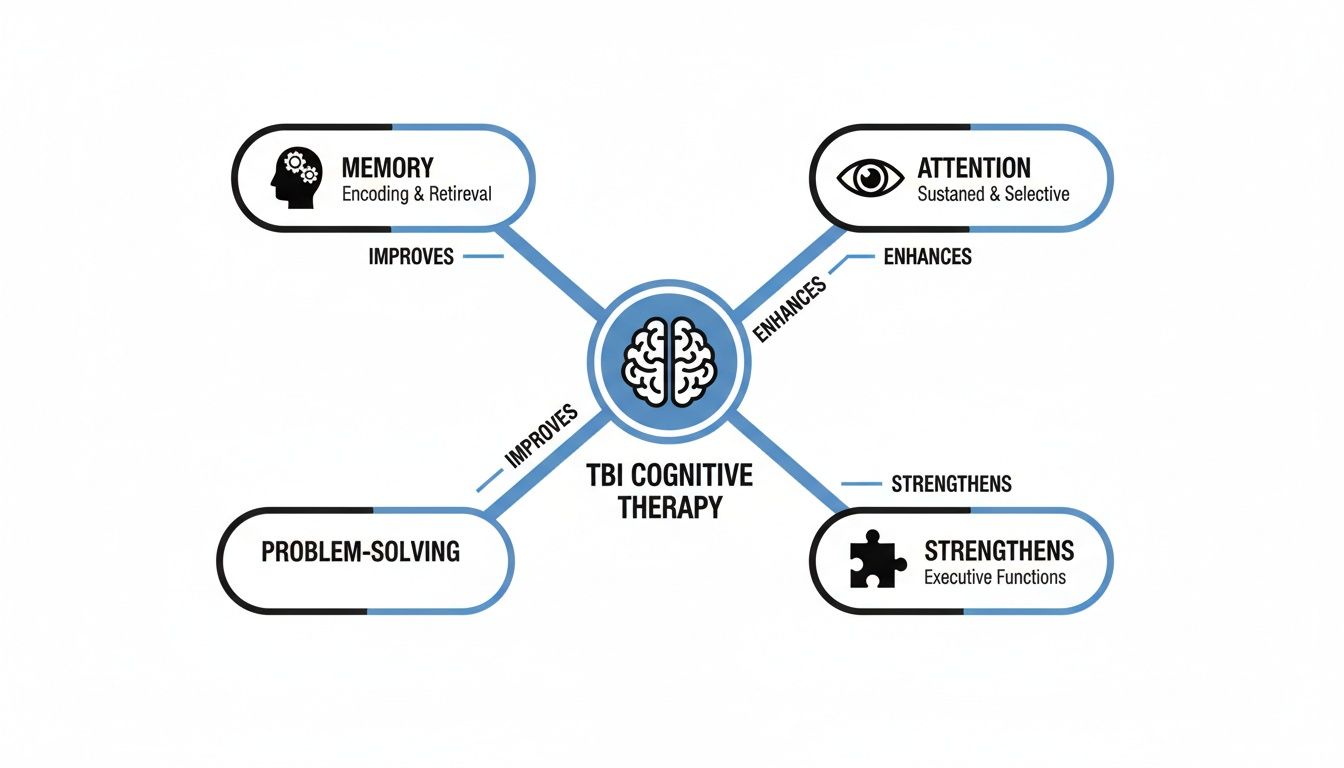
As you can see, therapy acts as a central hub, sending targeted support to improve critical functions like memory, attention, and problem-solving.
Putting It All Together in Daily Life
While exercises in the "brain gym" rebuild foundational abilities, other therapies are crucial for translating those skills back into your everyday routine. This is where the work gets really practical.
Several key specialists make this happen:
- Occupational Therapists (OTs): OTs are experts in the "occupations" of daily life. They help you relearn and adapt crucial activities like managing your money, cooking a meal, or navigating your work responsibilities. An OT might help you break down the steps to pay bills online or create a simple system to manage your schedule without getting overwhelmed.
- Speech-Language Pathologists (SLPs): A TBI often tangles up communication. SLPs tackle challenges with finding the right words (aphasia), organizing thoughts into clear sentences, or picking up on social cues in a conversation. They might use role-playing to help you practice taking turns in a discussion or develop a strategy for when a word is on the tip of your tongue but just won't come out.
- Cognitive Behavioral Therapy (CBT): A brain injury is more than a cognitive event—it's an emotional one. Frustration, anxiety, and depression are incredibly common and can derail recovery. CBT is a type of talk therapy that helps you recognize and reframe the negative thought patterns that hold you back, giving you the tools to cope with the emotional weight of the injury.
Together, this team builds a safety net. They ensure the skills you're building in therapy sessions actually lead to real improvements in your independence and quality of life.
Data from the TRACK-TBI study shows that a large number of people with moderate to severe TBIs see major gains in life functioning and regain independence at home within the first year. This really speaks to the power of an integrated approach, where each therapy supports and amplifies the others.
Does Cognitive Rehabilitation for TBI Really Work?
After a traumatic brain injury, this is the one question that matters most. Is all the grueling work of rehabilitation worth it? Will life ever feel manageable again?
The short answer is yes. But the road back is a marathon, not a sprint. While studies show that targeted therapy leads to measurable gains in attention, memory, and executive function, the statistics don't tell the whole story. The real proof is in the small, hard-won victories that allow survivors to reclaim their lives.
Let’s walk through a real-world example. Imagine a construction worker named Mark who suffers a moderate TBI from a fall on the job. In the weeks that follow, his world feels like it’s shrinking. He can't hold onto a conversation he had an hour ago. He gets lost driving to the grocery store he’s been to a hundred times. Simple decisions, like what to make for dinner, feel completely overwhelming. His frustration is immense.
The Journey from Struggle to Strength
Mark begins a comprehensive cognitive therapy program. His initial neuropsychological assessment pinpoints the core of his struggles: significant deficits in his working memory and executive functioning. This means his therapy isn't a random collection of exercises; it's a program designed specifically to target those weaknesses.
The First Phase: His therapists start with the fundamentals. A speech-language pathologist works with him on memory drills, teaching him association techniques to recall names and lists. His occupational therapist helps him build structured daily routines, using a simple whiteboard and phone alarms to manage his day.
The Middle Phase: As his foundational skills get stronger, the focus shifts to the real world. He starts practicing multi-step tasks that used to be second nature, like following a recipe, planning a full grocery trip, or managing a simple budget. Each small success builds not just his cognitive strength, but just as importantly, his confidence.
This entire process is powered by a principle called neuroplasticity—the brain’s incredible ability to rewire itself and forge new connections. Every time Mark practices a new strategy, he is actively training his brain to work around the injured areas. It's a slow, deliberate process of rebuilding.
Measuring What Truly Matters: Real-World Outcomes
So, how do we know the therapy is actually working? Progress isn't about getting a better score on a test in a quiet office. It's about tangible improvements that show up in daily life.
For Mark, the signs of progress appear gradually, then all at once:
- He remembers his daughter’s soccer schedule without having to check his phone five times.
- He successfully navigates a new route to his therapy appointment just by using a map.
- He can follow along in family conversations again, without losing track of the topic.
- He starts volunteering, a huge step toward rebuilding his social connections and finding a sense of purpose.
After a year of consistent, difficult work, Mark is not the same person he was before the injury. But he now has the tools to manage his cognitive challenges. He has even returned to work in a modified role that plays to his strengths and accommodates his remaining difficulties. He is independent, engaged, and back in control.
This journey highlights a critical truth about TBI recovery. The goal of cognitive therapy isn't always to restore the brain to its exact pre-injury state. It’s to provide the strategies and build the new neural pathways needed to live a full, functional, and meaningful life.
This isn't just wishful thinking. A major research initiative, the TRACK-TBI study, found that a significant number of people with moderate to severe TBIs achieve major improvements and regain independence within the first year. Even those with grave impairments in the early days often achieve favorable outcomes months later.
While every brain injury is unique, Mark’s story shows a common and hopeful path. Consistent, tailored TBI cognitive therapy offers survivors the very best chance to make lasting improvements and reclaim their quality of life.
Building Your TBI Recovery Team
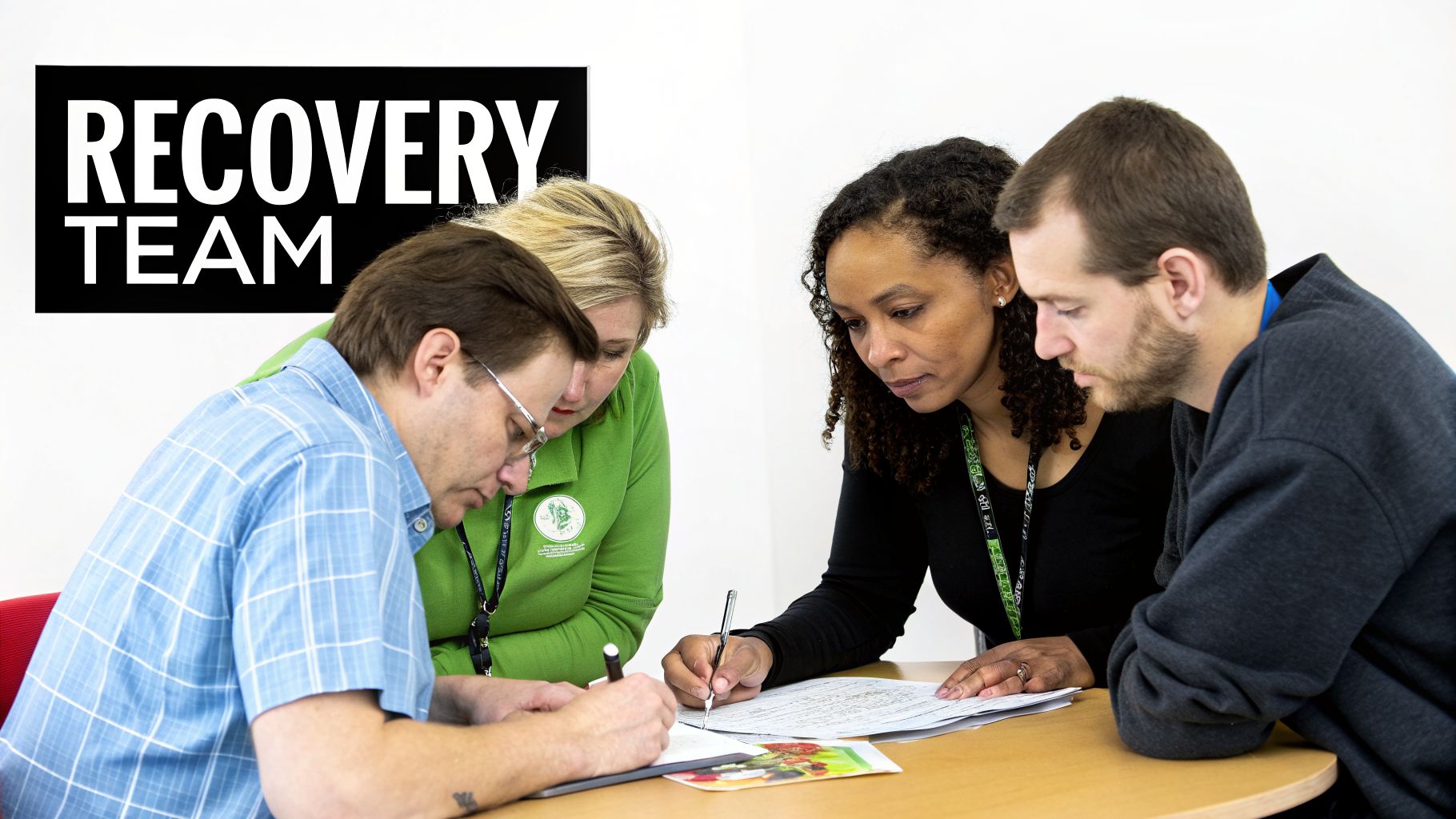
Recovering from a traumatic brain injury isn't something anyone should do alone. The sheer volume of appointments, therapies, and different specialists can quickly become a full-time job. Putting the right team in place is one of the most important things you can do to manage the chaos and fight for the best possible outcome.
Think of it less like a list of doctors and more like assembling a hand-picked crew. Each professional has a specific, crucial role, but their real power comes from working together. They are all focused on one goal: supporting your TBI cognitive therapy and your path back to your life.
Core Medical Specialists in TBI Recovery
Your team will be built around a core group of medical experts who diagnose, treat, and oversee different parts of your recovery. Finding the right fit is critical, as you’ll be working with these individuals for months, if not years. You need people you can trust.
Here are the key players you'll want on your side:
- Physiatrist (Rehabilitation Physician): This doctor is often the team captain. They specialize in physical medicine and rehabilitation, which means they look at the big picture of your recovery, create the overall game plan, and coordinate care between all your other specialists.
- Neuropsychologist: This is the expert who maps out exactly how the TBI affected your brain's cognitive functions. Through detailed assessments, they pinpoint your specific strengths and challenges, which is essential for designing effective therapy exercises and tracking your real progress.
- Occupational Therapist (OT): The OT is your real-world coach. Their job is to help you reclaim independence in the activities of daily living—everything from managing your finances and organizing your day to relearning how to safely prepare a meal.
- Speech-Language Pathologist (SLP): A TBI often disrupts communication. An SLP works on much more than just speech; they help with word-finding, understanding social cues, and organizing your thoughts so you can express them clearly.
When you meet with potential providers, be direct. Ask them about their specific experience with TBI cases. Just as important, ask how they communicate and collaborate with other members of a patient's care team.
The Importance of a Coordinated Approach
A scattered group of specialists isn't a team. A real recovery team talks, shares notes, and makes sure your treatment plan is a single, cohesive strategy. When that coordination is missing, therapy can feel disjointed, frustrating, and far less effective.
Crucial Insight: Your providers must talk to each other. It’s non-negotiable. What your neuropsychologist discovers in an assessment should directly guide the strategies your OT uses. Your physiatrist needs constant updates from everyone to make smart adjustments to the plan.
Insist that your providers share reports and hold regular team meetings—even brief ones—to discuss your case. This unified approach makes sure every piece of your TBI cognitive therapy is working in harmony, giving you the best shot at recovery. You can find more tips on selecting the right experts in our guide on vetting neurologists for traumatic brain injury assessment and treatment.
The Strategic Role of Your Legal Counsel
While your medical team works on your physical and cognitive healing, a specialized personal injury attorney plays a critical parallel role. Their job isn't just about getting a settlement; it's about protecting your recovery every step of the way.
A law firm that focuses on TBI cases will already have relationships with top-tier medical experts. They can help connect you with trusted neuropsychologists, physiatrists, and therapists who understand the nuances of brain injury. More importantly, they make sure your entire treatment journey is documented perfectly, building the powerful evidence needed to hold the at-fault party accountable for the full, lifelong cost of your care.
Navigating Therapy Costs and Insurance Hurdles
The road to recovery after a traumatic brain injury is already demanding. The last thing your family needs is the added weight of financial stress. For so many, the cost of sustained TBI cognitive therapy feels crushing, and dealing with health insurance often just adds another layer of confusion and frustration.
It’s a difficult and exhausting hurdle, but one you don’t have to clear alone. Learning how to work with—and, when necessary, fight—your insurance company is a critical part of this journey. The process can feel like a full-time job, demanding relentless persistence and airtight organization.
Decoding Your Health Insurance Policy
Your first task is to become an expert on your own insurance plan. The policy documents are often dense and written in confusing language, but knowing the specifics is your best tool. You have to get clear answers on your coverage before you get too deep into the treatment process.
Start by calling your insurance provider and asking these essential questions:
- Pre-authorizations: Which specific therapies need approval before an appointment can happen? Missing this step is one of the most common reasons for a denied claim.
- Session Limits: Is there a cap on the number of physical, occupational, or speech therapy sessions you’re allowed each year?
- Provider Networks: Are the TBI specialists you need "in-network"? If they aren't, what are your "out-of-network" benefits, and what will you have to pay out-of-pocket?
Unfortunately, even when you follow every rule, denials can and do happen. One of the most common reasons an insurer will deny coverage is by claiming a therapy is not “medically necessary.” This is incredibly frustrating, especially when your doctor has explicitly prescribed that treatment as essential for your recovery.
A denial from an insurance company is not the end of the road. It is an opening bid in a negotiation. You have the right to appeal their decision, and with the proper documentation and support, you can successfully fight back.
This is where having a personal injury claim can make all the difference. While you pour your energy into healing, an attorney can take on the burden of these financial battles for you.
Holding the At-Fault Party Accountable
If the TBI was caused by someone else’s carelessness—a car crash, a slip and fall on an unsafe property, or any other act of negligence—you should not be the one carrying these costs. A personal injury claim is the legal tool used to hold the at-fault party's insurance company responsible for the full scope of the damage they caused.
This isn’t just about paying for the medical bills you have today. A well-built legal claim demands compensation for all of your damages, including:
- Future Medical Needs: The projected costs of all future TBI cognitive therapy, medications, and any potential long-term care you may require.
- Lost Wages: The income you’ve already lost and the earnings you will miss out on because you’re unable to return to work in the same capacity.
- Pain and Suffering: Compensation for the immense non-financial toll on your life, from emotional distress to the loss of your ability to enjoy daily activities.
A law firm with deep experience in TBI cases knows how to manage the complex process of proving these damages. They work hand-in-hand with your medical team to make sure every single aspect of your recovery is documented, building an undeniable case for why these therapies are essential and must be paid for. This legal shield allows you and your family to focus on the one thing that truly matters: getting better.
Why Medical Documentation Is Crucial for Your Legal Claim

After a traumatic brain injury, your main focus is on one thing: getting better. But when someone else’s actions caused your injury, a second journey begins at the same time—building a legal claim for the resources you need to heal. In that fight, your medical records aren't just paperwork. They're everything.
These files are the objective proof of what you’re going through. They translate your private struggles into a language the legal system can understand and act upon.
Think of it this way: your legal case is a bridge that must support the full weight of your future needs. Every detailed medical report, every therapist's note, and every diagnostic scan is a steel cable strengthening that bridge. Without them, the structure can easily buckle under pressure from insurance companies whose goal is to pay as little as possible.
The Story Your Records Must Tell
When it comes to a TBI, a few generic medical notes just won’t cut it. The records from every single provider involved in your TBI cognitive therapy need to weave together to tell one clear, consistent, and undeniable story of your injury and its aftermath.
This is the narrative your documentation has to build:
- Diagnostic Reports: This is the foundation. It starts with ER records and brain scans but becomes truly powerful with the detailed findings from a neuropsychological assessment, which maps out your specific cognitive challenges.
- Treatment Plans: These are the blueprints for your recovery. Created by your physiatrist and therapists, they show that your therapy is a structured, necessary, and goal-oriented process—not just a series of appointments.
- Progress Notes: These are the daily and weekly entries that tell the real story. Notes from your speech, occupational, and cognitive therapists document your hard-won victories, your frustrating setbacks, and the real-world challenges that don't just disappear.
- Future Care Projections: This is where an expert looks ahead. Reports that detail the need for ongoing therapy, potential future medical needs, or lifelong support are absolutely essential for calculating the true, long-term cost of your injury.
A law firm that specializes in TBI cases knows this level of detail is non-negotiable. They work hand-in-hand with your medical team to make sure every note tells a piece of the story, building a powerful and complete picture of your injury's true impact.
Connecting Documentation to Compensation
Insurance companies will almost always challenge the need for and the cost of long-term cognitive therapy. They’ll suggest your symptoms are overstated or maybe not even related to the accident. This is where your stack of meticulous documentation becomes your best defense.
When an adjuster sees a thick file full of consistent, detailed reports from multiple credible specialists, it becomes much harder for them to argue with the facts. The documentation turns your personal experience into objective evidence.
For example, detailed notes from your speech therapist about your trouble finding the right words directly connect a cognitive deficit to the accident. Reports from an occupational therapist on your difficulty managing your budget provide tangible proof of how your quality of life has been damaged.
This evidence is also critical for justifying the use of advanced diagnostics. For a deeper look, you can learn more about how specialized imaging like Diffusion Tensor Imaging can support a TBI case in our detailed guide on the topic.
Ultimately, securing fair compensation isn’t about winning one argument. It’s about building a mountain of evidence so high the other side can’t climb over it. Your medical records are the bedrock of that mountain, turning a painful medical journey into a clear and compelling legal case.
Common Questions About TBI Cognitive Therapy
After a brain injury, the path forward can feel uncertain. You have questions—about timelines, effectiveness, and how you’ll manage the costs. We've seen hundreds of families grapple with these same concerns. Here are some straightforward answers based on our experience.
How Long Does TBI Cognitive Therapy Take?
There’s no set calendar for brain injury recovery. The timeline is deeply personal, shaped by the severity of the injury, your specific goals, and how your brain responds to the work.
Someone with a mild TBI might find their footing after a few focused months. For those with moderate to severe injuries, therapy can become a source of ongoing support, sometimes for several years. Your therapy team will map out a starting plan after your first neuropsychological assessment, but think of it as a living document. It will change as you hit milestones and uncover new challenges. The real key is consistency, not speed.
Can Cognitive Therapy Still Help Years After An Injury?
Absolutely. It’s a common misconception that there's a small window for recovery. While starting early is always a good idea, the brain’s incredible capacity to adapt and forge new pathways—a process called neuroplasticity—doesn't just switch off. Progress is possible, even years down the road.
A good therapist can help you build new strategies for managing persistent cognitive symptoms, find better ways to cope, and ultimately improve your quality of life. It is never too late to take another step forward in your recovery.
Key Takeaway: Insurance denials are a common and frustrating hurdle, but they are not the final word. A denial can and should be appealed. Do not accept "no" as the final answer.
What if My Insurance Company Denies Coverage for Therapy?
An insurance denial feels like a brick wall, but it’s often just the beginning of a negotiation. It is critical to appeal the decision right away. This is precisely where having a personal injury law firm that specializes in TBI becomes essential.
Your legal team can challenge the denial by arming the insurance company with the medical evidence it needs to understand why this therapy is not optional—it's necessary for your recovery. We work to hold the at-fault party’s insurance accountable for covering these costs so you can focus on healing.
At Nares Law Group LLC, we understand that a TBI affects your entire life. If you're struggling to get the care you need after an accident, our team is here to fight for you. Visit us at https://www.nareslawgroup.com for a free consultation.