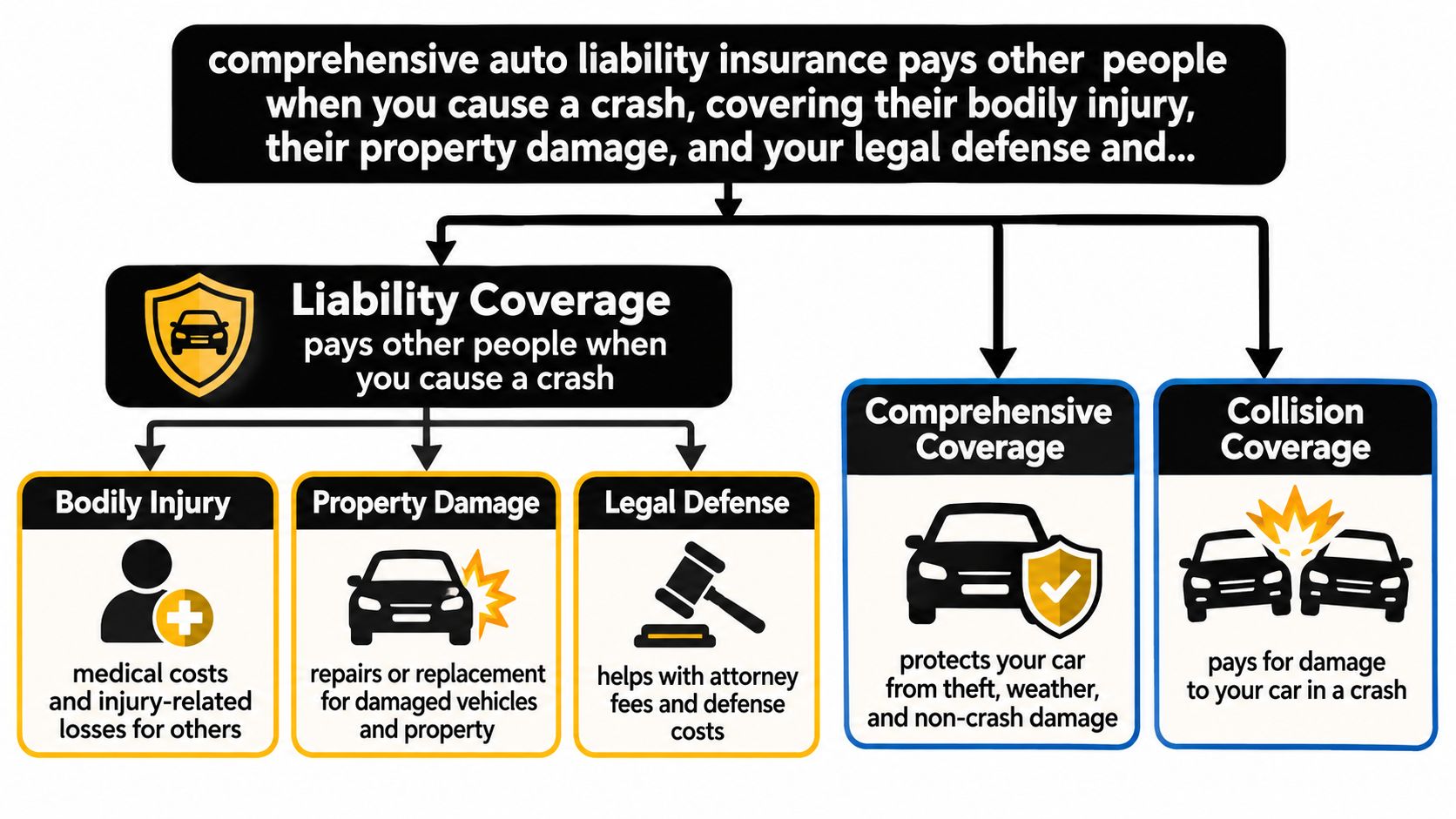
The liability portion of what drivers call auto liability insurance pays for other people's bodily injuries and property damage when you cause a crash, up to your policy limits. It doesn't pay for your own car or your own injuries.
If you've bought “full coverage,” why might you still face unpaid medical bills after a collision? Because that phrase usually bundles separate protections, not a promise to pay every loss. Understanding which coverage responds, and exactly where it stops, helps you make better decisions before a crash and protect your recovery afterward.
How Liability Differs From Comprehensive and Collision
A crash can trigger different parts of an auto policy, depending on what was damaged and who was responsible. Liability addresses harm you cause to others. Collision may pay to repair your car after a crash, while other coverage generally applies to covered damage unrelated to a collision, such as theft or hail.
The term “full coverage” can blur these distinctions. It is not a single policy promise to pay every loss. The National Association of Insurance Commissioners' auto insurance guide describes the coverages as separate protections for harm you cause, crash damage to your car, and certain non-collision damage to your car.
Coverage types compared after a crash
| Coverage | Pays for | Pays when | Does not pay for |
|---|---|---|---|
| Liability | Other people's bodily injury and property damage you cause | You're legally responsible for a covered loss; claims and defense follow policy terms | Your own car and your own injuries |
| Comprehensive | Your car after theft, hail, vandalism, fire, falling objects, or animal strikes | A covered non-collision loss occurs, minus your deductible | Injuries to anyone or damage you cause to others |
| Collision | Your car after a crash with another vehicle or object | A covered collision occurs, regardless of fault, minus your deductible | Injuries or property owned by others |
| Uninsured/underinsured motorist | Covered bodily injuries when the at-fault driver has no insurance or insufficient insurance | Coverage requirements are met, within applicable limits | The other driver's losses; vehicle damage requires applicable state and policy protection |
When the Other Driver Has No Insurance
If an uninsured driver rear-ends you, collision coverage may pay for your car repairs, minus the deductible. It does not pay your injury claim. Uninsured-motorist bodily-injury coverage may address your injuries if the policy and state requirements are met. The NAIC's overview of uninsured-motorist coverage explains how it differs from coverage for vehicle damage.
Use the type of loss to identify which protection may apply:
- Damage to my car? Identify the cause, then check other-than-collision coverage, collision insurance coverage, or the responsible driver's property-damage coverage.
- Injury to me? Examine the responsible driver's bodily-injury coverage and your applicable medical or uninsured/underinsured benefits.
- Damage or injury I caused? Notify your liability insurer.
How Policy Limits Cap Payouts Per Person and Per Crash
Suppose a crash injures three people, each with $40,000 in covered losses. The policy's limits determine how much the insurer can pay, even if the total damages are higher.
Colorado minimum liability limits: 25/50/15
| Limit | Colorado minimum | What it caps |
|---|---|---|
| Bodily injury, per person | $25,000 | The most paid for any one injured person's covered bodily-injury claim |
| Bodily injury, per accident | $50,000 | The total paid for all covered bodily-injury claims from one crash |
| Property damage, per accident | $15,000 | The total paid for covered property damage from one crash |
The Colorado Division of Insurance's auto insurance guidance identifies these minimums: $25,000 per injured person, $50,000 for bodily injury per accident, and $15,000 for property damage per accident. Each figure is a payment ceiling, not an estimate of what an injury or damaged vehicle is worth.
A Worked Example With Multiple Injured People
The three people in this example have $120,000 in combined covered injury damages. The per-person limit caps payment for each individual at $25,000, while the per-accident limit caps total bodily-injury payments at $50,000.
One possible mathematical allocation would pay $25,000 to two people and nothing to the third, leaving $70,000 unpaid. This illustrates how the two ceilings interact; it does not predict how an insurer or court would allocate competing claims.
Property damage has a separate pool. If the same collision damages two vehicles, a fence, and a traffic signal, all covered property claims draw from the $15,000 property-damage limit. Unused bodily-injury coverage does not automatically transfer to repairs.
Payment ceiling, not damage valuation: Reaching a policy limit does not mean an injured person has received full compensation.
The insured may remain personally responsible for covered damages above the purchased limits. For another plain-language explanation of ceilings and categories, see insurance policy limits explained. The guide to understanding insurance policy limits also explains how those limits affect recovery.
Read Your Declarations Page Before You Need It
- Find the liability entries. Note the bodily-injury and property-damage limits listed on the declarations page.
- Identify the structure. Split limits set separate ceilings for different categories. A combined single limit uses one shared ceiling, subject to the policy's terms.
- Test a multi-person crash. Compare potential losses for several injured people and damaged vehicles with the applicable limits. Don't assume the insurer owes the limit multiplied by the number of claimants.
- Consider the shortfall. Compare possible losses above the limits with your assets and income, keeping in mind that collection rules and exemptions differ.
The key question is whether the policy's separate payment ceilings fit the harm you could cause.
What Liability Coverage Excludes and Where Gaps Form
Having a policy on a car doesn't mean every driver, activity, or loss involving that car is covered. Who was driving, whether they had permission, and how they were using the vehicle can change the coverage analysis.
A family member driving with permission may qualify as an insured. A specifically excluded household driver may not. An unlisted driver isn't automatically excluded, either, which is why the definitions and endorsements matter more than assumptions about the driver list.
Common Boundaries to Check
- Intentional harm. Liability coverage generally addresses negligent vehicle use, not deliberately causing injury or property damage.
- Your own injuries. Your liability policy generally isn't your source of personal injury benefits. Medical payments, personal injury protection where applicable, and uninsured/underinsured coverage serve different functions.
- Passenger injuries. Don't assume passengers are excluded. An injured passenger may have a liability claim against a negligent insured driver, subject to applicable exclusions and law.
- Your own vehicle. A liability claim against yourself won't fund its repair.
- Losses above the ceiling. Proving additional damages doesn't expand the insurer's contractual payment obligation.
- Excluded drivers or unauthorized use. Permission, household-driver provisions, and specific exclusions can determine whether the insurer responds.
- Undisclosed commercial activity. Delivery work, rideshare driving, or other business use may require coverage that a personal policy doesn't provide.
Permission and Use Need Separate Answers
Suppose you lend your car to a relative for groceries, but they instead use it for paid deliveries. Permission to drive and coverage for commercial activity are different questions. Likewise, a borrowed vehicle can involve both its owner's policy and the borrower's insurance, with provisions determining which applies first.
For an injured claimant, the investigation must establish ownership, permission, negligence, causation, and damages, along with the relevant coverage facts. A police report alone may not resolve every issue.
Ask about the actual activity, not just whether the car is insured. “Is paid delivery work covered?” is more useful than “Am I fully covered?”
Read the exclusions and endorsements, then ask your agent for a written explanation of any uncertain driver or use. Keep that response with the policy documents.
How Liability Coverage Shapes Personal Injury Claims
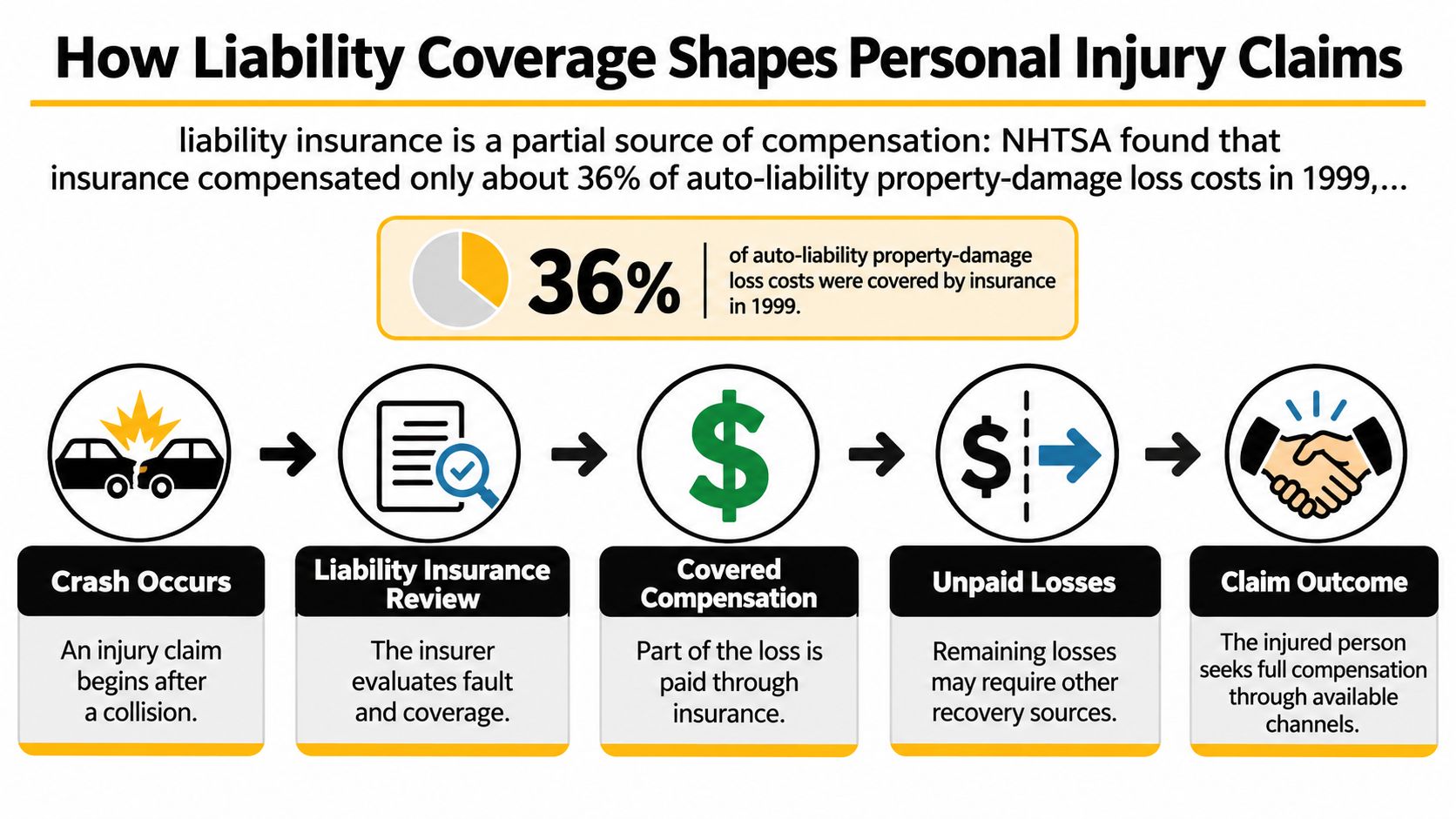
Liability insurance is a partial source of compensation, not a guarantee of complete recovery. A historical National Highway Traffic Safety Administration analysis found that auto liability insurance compensated roughly 36% of auto-liability property-damage loss costs in 1999. That finding concerns historical property losses, not a current payout rate for injury claims.
For an injured person, the practical lesson is to investigate both the value of the claim and the sources available to pay it. Those are related questions, but they aren't interchangeable.
From Collision to a Supported Demand
- Document the crash. Seek necessary care, preserve photographs and witness information, and obtain the accident report when available. Keep records of symptoms and treatment rather than relying on memory.
- Open the appropriate claims. Notify the at-fault driver's liability insurer and your own insurer as appropriate. Don't assume every benefit must wait for the liability investigation to finish; notice and payment requirements differ.
- Establish responsibility and coverage. Investigators examine the report, vehicle ownership, permission, witness accounts, and other evidence. At Nares Law Group LLC, we collect medical records, accident reports, witness statements, and expert opinions to establish liability and damages.
- Document the losses. Medical bills show charges, but they don't tell the whole story. Employment records support lost income, while medical opinions can explain future treatment needs and lasting limitations.
- Evaluate the offer. Compare the proposed settlement with supported damages and confirmed coverage. An offer within policy limits isn't automatically fair merely because insurance is available.
- Investigate additional recovery. Where losses exceed available liability benefits, examine underinsured-motorist coverage, other responsible parties, and applicable excess policies.
Make the Unpaid Balance Visible
Consider a hypothetical injury claim with $80,000 in medical bills and $30,000 in lost wages. Those losses total $110,000. If the applicable per-person liability limit is $50,000, and that amount is paid, $60,000 remains unpaid, before considering any additional damages.
Review the release before signing. A settlement agreement can waive claims against specified people or entities, and settling without required consent may affect another coverage claim. Confirm who is being released, which claims end, and whether another insurer needs notice or consent.
The remaining balance doesn't automatically become an underinsured-motorist payment. Eligibility, offsets, available limits, and settlement requirements still need review. The same is true of another party's insurance: investigators must establish a legal and factual basis for that party's responsibility.
Keep settlement proceeds separate from the question of net recovery, too. Medical bills, liens, and reimbursement obligations can affect what remains for the injured person after a claim resolves.
State and Federal Minimums Versus Adequate Limits
Federal minimum liability for motor carriers
| Carrier or cargo | Federal minimum | Note |
|---|---|---|
| For-hire interstate general freight | $750,000 | FMCSA finds this too low for serious large-truck crashes |
| Certain oil and hazardous material operations | $1 million | Applies to specified regulated operations |
| Specified hazardous materials | $5 million | Higher floor for listed hazardous cargo |
| For-hire passenger carriers | $1.5 million or $5 million | Seating capacity determines the applicable floor |
The Federal Motor Carrier Safety Administration's financial-responsibility assessment identifies minimums of $750,000 for for-hire interstate general freight, $1 million for certain oil and hazardous-material operations, $5 million for specified hazardous materials, and $1.5 million or $5 million for for-hire passenger carriers. It also concludes that the general-freight minimum is too low relative to the costs and damages of serious large-truck crashes.
Match the Requirement to the Operation
The rows aren't interchangeable. A freight carrier's operating status matters; an oil or hazardous-material operation requires cargo-specific review. Passenger-carrier requirements involve seating capacity, not whether passengers were aboard when the crash happened.
For each category, ask the same adequacy question: could the available amount address prolonged hospital treatment, lost earning capacity, future assistance, and competing claims? A traumatic brain injury or wrongful death claim can exceed a statutory floor or primary policy.
Personal-auto requirements operate at the state level. Check the applicable state insurance or motor vehicle department rather than assuming a neighboring state's rules apply. Our explanation of Colorado car insurance requirements provides a starting point for Colorado drivers.
Look Beyond the Primary Policy
Commercial coverage discovery should examine:
- Primary insurance and filings. Confirm the carrier, insured entities, applicable policy period, and operating classification.
- Excess and umbrella layers. Determine attachment requirements, exclusions, and whether underlying coverage must first be exhausted.
- Leased vehicles and business relationships. Review lease provisions, shipper or broker arrangements, and potentially applicable additional-insured coverage.
These relationships don't automatically create liability or coverage. They identify documents and parties that deserve investigation before anyone treats the first disclosed policy as the recovery ceiling.
For your own coverage decision, identify the applicable minimum, estimate a serious injury's costs including income loss and future care, and compare the two. Legal compliance answers whether you meet a requirement. Adequacy asks whether the protection fits your risk.
Choose Liability Limits and Confirm Them Before Renewal
Budget pressure is real. The National Association of Insurance Commissioners' average premium supplement reports that the average U.S. auto-insurance expenditure reached $1,431.63 in 2024, a 36.64% increase from 2020. That's a national expenditure measure, not a quote for your household or the price of liability coverage alone.
Start a limit decision with what you need to protect, then obtain actual quotes. Guessing that higher limits will be unaffordable can lead you to reject protection before knowing its incremental cost.
Work Backward From Your Financial Exposure
- List the resources you depend on. Include home equity, savings, investments, and earnings. This is an exposure inventory, not a conclusion that every asset is collectible; state exemptions and other legal rules matter.
- Describe a serious injury scenario. Include emergency treatment, surgery, rehabilitation, time away from work, and future assistance. Don't use a routine repair bill as your model for bodily-injury risk.
- Test the per-person amount. Ask whether it could address one person's substantial claim. A generous accident total can still leave a single claimant constrained by a lower individual cap.
- Test a multi-claimant event. Consider a vehicle carrying several occupants or a chain-reaction collision. Compare the combined injury exposure with the accident-wide ceiling.
- Evaluate umbrella coverage. Ask what underlying auto limits it requires, which household members qualify, and which activities it excludes. An umbrella isn't a substitute for checking the primary policy.
- Compare the price difference with the protection gained. Request written quotes using the same vehicles, drivers, deductibles, and endorsements. Otherwise, a cheaper quote may reflect removed coverage rather than a better price.
Homeowners and high-income earners have clear reasons to examine liability exposure. Households supporting dependents also need to consider how an uncovered obligation could affect essential expenses. Frequent drivers have more road exposure, while people driving for work need an additional review of permitted use.
Renewal habit: Save the quote, declarations page, and written explanation together. You should be able to explain why you chose the limits, not just recognize the premium.
Confirm the Contract Before It Renews
A quote shows proposed protection. The issued policy and endorsements establish what you bought. Review the renewal documents rather than assuming last year's choices carried forward unchanged.
Use a short written checklist:
- Policy identity and dates. Verify the named insured, covered vehicles, and effective period. Check that a replacement vehicle appears correctly.
- Drivers and permissions. Disclose household drivers as required and review any named-driver exclusion. Ask about a child away at school or a relative who regularly borrows the vehicle.
- Liability structure. Record the selected limits and whether they're split or combined. Confirm the issued amounts match the accepted quote.
- Work-related driving. Describe delivery, rideshare, client visits, or other business activity accurately. Ask which endorsement or separate policy addresses it.
- Uninsured and underinsured benefits. Ask for options matching your liability limits where available, then review who qualifies and any selection or rejection documents.
- Deductibles and vehicle protection. Keep these decisions separate from bodily-injury limits. Confirm you could fund the chosen deductible without disrupting essential expenses.
- A written decision. Keep the alternatives you considered and the agent's answers. If you decline a coverage, record the specific loss you're choosing to fund yourself.
You don't need to predict an exact future crash cost to make a considered choice. You need to identify meaningful shortfalls, understand the exclusions, and select protection you can maintain.
If you've already been injured, focus on the policies that applied on the crash date. During our free consultation for Colorado auto accident cases, a personal injury attorney answers questions and helps put together a case to pursue the compensation you deserve, including evaluating whether liability limits and other available coverage can address your losses.
Nares Law Group LLC investigates auto accident claims, evaluates available insurance, and pursues compensation for medical costs, lost income, and future care. Visit Nares Law Group LLC to request a free consultation for a Colorado auto accident case, and bring your crash report, insurance documents, and any settlement offer so we can discuss the coverage and recovery questions that matter to you.