The emergency-room bill arrives the same week your paycheck comes up short. Your car is still at the shop, physical therapy is taking up afternoons, and the insurance adjuster asks what amount would settle your claim. It's tempting to add the bills you have and send a number just to get something moving.
Don't confuse a quick answer with a complete claim. A car accident demand letter should explain responsibility, document your losses, and identify which insurance policies can pay. The safest starting point isn't a settlement multiplier. It's an organized file and a clear picture of what recovery will require.
What a Car Accident Demand Letter Must Cover
A demand letter is a documented settlement proposal, not an email saying you're unhappy with the insurer. It connects the driver's conduct to your injuries, connects those injuries to specific losses, and explains the compensation you're requesting.
A repair estimate and an emergency-room bill leave important questions unanswered. Will you need more treatment? Have your work restrictions affected your income? Can you lift your child, sleep comfortably, or drive without symptoms?
The distinction between financial expense and human harm matters. For crashes occurring in 2019, the National Highway Traffic Safety Administration estimated $340 billion in economic costs, rising to $1.37 trillion in societal harm when quality-of-life losses were included. Those nationwide totals don't value your claim, but they show why bills alone aren't a complete description of crash losses.
Build a damages schedule before choosing an amount
Keep separate categories instead of putting everything into an unexplained total. Our guide to economic damages calculation can help you distinguish expenses already incurred from income and care needs still ahead.
Damages to quantify in a car accident demand
| Loss category | What to quantify | Proof to attach |
|---|---|---|
| Past medical care | Bills from crash-related treatment to date | Itemized bills, records, diagnostic reports |
| Future medical care | Projected treatment still ahead | Treatment plan, prognosis, physician restrictions |
| Lost wages | Hours or days missed times pay rate | Pay stubs, tax forms, employer letter |
| Reduced earning capacity | Lasting limits on the job the person can do | Work restrictions, job description, vocational opinion if serious |
| Property damage | Repair cost or total-loss value | Estimates, photos, rental receipts |
| Pain and diminished life | Functional limits, not a multiplier | Dated examples of pain, missed activities, and household help |
Lost wages and reduced earning capacity aren't interchangeable. Missing shifts during recovery is a past income loss. Being unable to return to a physically demanding occupation raises a different question about future work.
Non-economic harm needs equally careful description. Say you previously drove your children to school, but neck restrictions now prevent you from checking traffic safely. Record when that started, who took over, and what your physician documented. That tells the adjuster more than saying the crash ruined everything.
Readiness check: Mark each damages row documented, pending, or unknown before proposing a final settlement.
A pending record or unresolved prognosis means the final demand isn't ready. You can still give notice, request coverage information, and supply available records without pricing away an uncertain future.
Which Policy Limits Shape the Demand
The value of an injury and the insurance money available are different amounts. According to the Colorado Division of Insurance, Colorado's required liability minimums are $25,000 for bodily injury per person, $50,000 for bodily injury per accident, and $15,000 for property damage.
The per-person limit restricts what that policy can pay for an individual's bodily injury. The per-accident limit restricts the combined bodily-injury payment when several people are hurt. Property damage has its own coverage category.
Map every possible payment source
Coverage sources that can answer a car accident demand
| Source | What it can pay | Limit or rule to check |
|---|---|---|
| At-fault bodily injury liability | Injury damages if that driver was negligent | Colorado's per-person minimum described above; verify actual purchased limits |
| Per-accident bodily injury cap | Combined injury claims from the crash | Colorado's per-accident minimum described above; identify competing claimants |
| Property damage liability | Vehicle and other property damage | Separate property limit; verify actual coverage |
| Medical payments or PIP | Specified medical or economic losses, often regardless of fault | Check whether coverage exists, what it pays, and whether benefits are exhausted |
| Uninsured or underinsured motorist | Covered losses when the at-fault policy is missing or inadequate | Your policy's limits, notice requirements, and settlement conditions |
| Commercial, truck, or rideshare policy | Covered losses involving business or app-based driving | Vehicle use, driver status, separate insurers, and applicable exclusions |
Say you and a passenger both need substantial treatment after a collision. You can't assume each claim will receive the entire accident limit. The insurer must evaluate the claims within both the individual and shared limits.
Likewise, a delivery driver may have personal auto insurance, but the vehicle's business use creates additional coverage questions. Identify the employer, vehicle owner, and any app involved before assuming the personal carrier is the only recipient.
Separate benefits paid from losses still outstanding
State systems also differ. Under New York Department of Financial Services guidance, basic no-fault coverage pays up to $50,000 per person for specified economic losses regardless of fault, while a third-party bodily-injury claim requires proof of another party's negligence. Don't apply another state's payment structure to a Colorado claim.
Create columns for the original charge, the payer, benefits paid, the outstanding balance, and any asserted reimbursement claim. Show payments transparently, but don't automatically subtract every first-party payment from your liability demand. The treatment of those payments requires policy and state-law analysis.
Our explanation of insurance policy limits helps distinguish a policy ceiling from a damages valuation. The insurer determines its coverage position and proposed payment; Colorado's regulator can review claims handling but doesn't set your settlement amount.
Finish the coverage map by assigning a recipient to each claim. You may need a liability demand to the other driver's carrier and a separate submission to your own insurer, rather than one letter copied indiscriminately to everyone.
How to Draft the Demand Letter Step by Step
Say another driver rear-ends you while you're stopped in traffic. You receive urgent care, begin physical therapy, and remain under lifting restrictions. Build the package while treatment continues, but leave the final settlement amount open until your medical outlook is adequately documented.
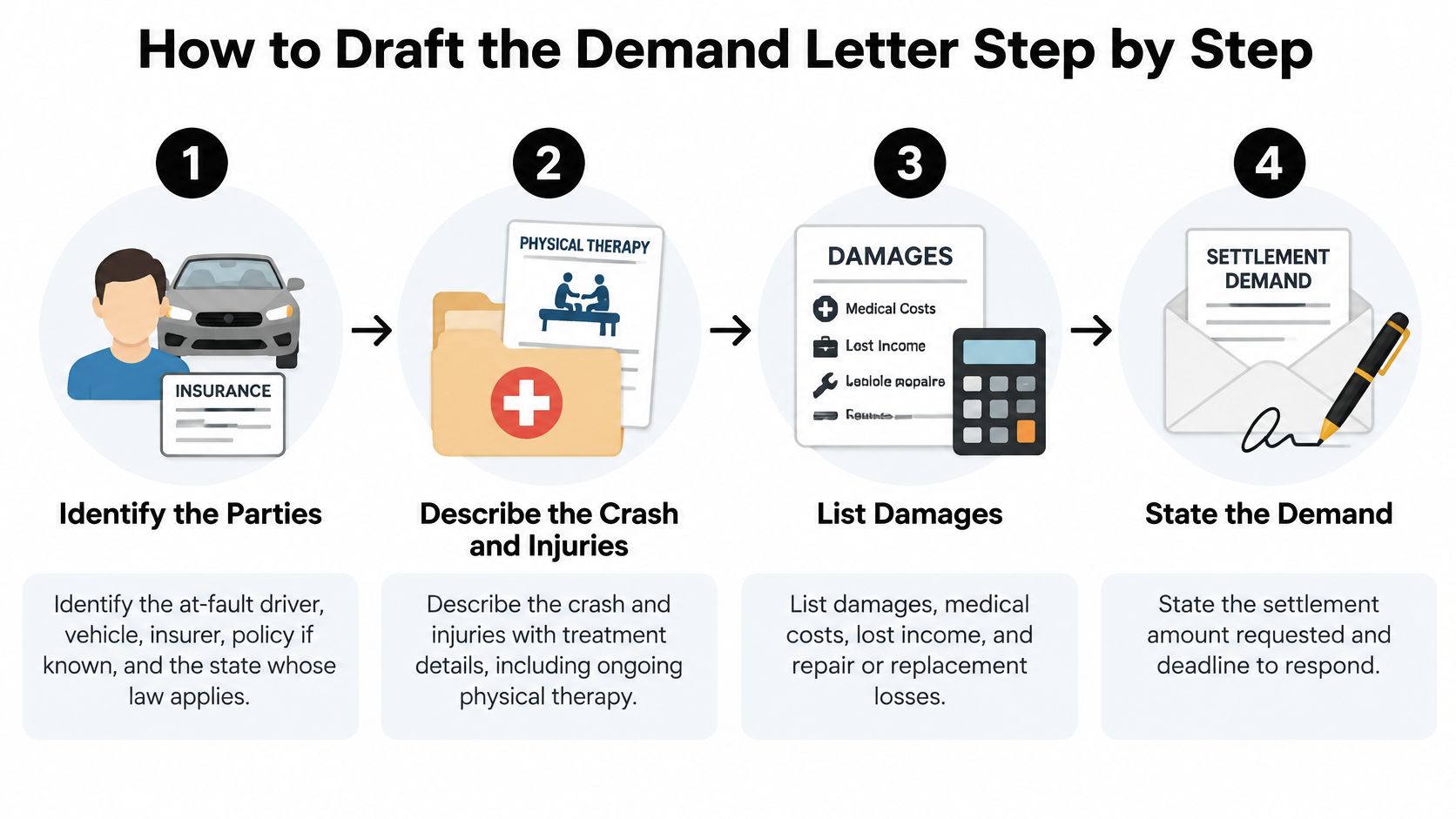
Use this visual as an overview of the drafting sequence.
Assemble the facts in a reviewable order
Identify the claim and the correct insured. Put your contact information, claim number, crash date, driver's name, vehicle, insurer, and policy information at the top. Identify the state whose rules apply. A common slip is treating the vehicle owner and driver as the same person without checking.
Explain how the collision caused the loss. Describe where you were, how traffic was moving, and what the other driver did. Reference the crash report, scene photographs, vehicle damage, and witness information. Don't describe a police report as conclusive proof of every disputed fact; distinguish what the officer observed from what someone reported.
Present treatment chronologically. Start with the initial visit, then diagnostics, referrals, therapy, restrictions, and the current prognosis. Explain when symptoms began and what providers recorded. The California Department of Insurance accident guide identifies injuries, medical expenses, and lost wages as documentation needed for uninsured- or underinsured-motorist claims. Attaching bills alone does not explain why each service relates to this crash.
Calculate economic losses on separate lines. List past medical charges, supported future care, wage loss, necessary household assistance, and property damage. Identify the document supporting each entry. Keep unpaid balances distinct from total charges, and don't add the same expense under multiple categories.
Describe the practical injury impact. Use dated examples that match your records: leaving a shift because sitting increased symptoms, needing help carrying groceries, or being unable to turn your head while driving. Avoid claiming permanent limitations unless the medical support justifies that statement.
Make a defined proposal and request a response. Once valuation is supportable, state the amount requested, the claim it would resolve, and a specific calendar date for a written response. Request written confirmation of applicable liability limits and identify known liens or reimbursement claims. Reserve your rights rather than suggesting you've already agreed to release unrelated parties or claims.
Make every attachment easy to find
During our investigation, we collect medical records, accident reports, witness statements, and expert opinions to establish liability and damages. When fault or injury causation is disputed, a medical or accident-reconstruction opinion can address the specific disagreement rather than leaving it to competing descriptions.
Use a concise cover letter, followed by a tabbed or bookmarked exhibit package:
- Exhibit A: Crash report, photographs, and witness information.
- Exhibit B: Past treatment records and itemized bills.
- Exhibit C: Prognosis, restrictions, and supported future-care plan.
- Exhibit D: Employer verification and wage records.
- Exhibit E: Property estimates, receipts, and functional-impact documentation.
Keep originals and send legible copies. Check that every exhibit referenced in the letter is attached, with readable pages and consistent filenames.
The accompanying video offers another format for reviewing the demand process.
Sample Demand Letter Language
Use this skeleton only after confirming the facts and deciding whether you're ready to propose settlement. Replace every bracketed entry, remove statements that don't apply, and align exhibit references with your actual attachments.
Adapt the facts without overstating them
Re Claim [claim number], collision on [date], insured [name]
On [date] at [intersection or address], [driver name] failed to [documented driving conduct] and struck my vehicle while I was [stopped or traveling]. The enclosed crash report is numbered [report number]. [Photographs or witness evidence] support the account described in Exhibit A.
I was treated at [facility] on [date] for [documented diagnosis]. My subsequent care includes [treatment] with [provider]. My physician has restricted me to [restriction] through [date or documented review point], and the current prognosis is [supported prognosis].
Past medical charges total $[amount], supported by Exhibit B. Projected future care is $[amount] under the attached treatment plan in Exhibit C. Lost wages are $[amount] for [documented time missed], supported by Exhibit D. Additional supported losses are [category and amount].
Since the crash, I've been unable to [specific activity]. On [date], I experienced [specific functional limitation]. [Record, photograph, or other documentation] supports this description.
Based on the enclosed evidence, I request $[amount] to resolve [specifically identified claim against specifically identified party], subject to an agreed written release. Please respond in writing by [calendar date], confirm the applicable bodily-injury limits under policy [number], and identify any liens or reimbursement claims known to you.
This letter itself releases no party or claim. I reserve my rights while settlement discussions continue.
[Name and contact information]
Replace risky phrasing before signing
| Use | Avoid |
|---|---|
| My provider documented [diagnosis or restriction]. | I'm permanently disabled, without supporting medical findings. |
| Exhibit D supports the claimed wage loss. | I missed lots of work. |
| Future care follows the attached treatment plan. | I'll probably need expensive treatment forever. |
| This proposal concerns [identified claim and party]. | I'll sign whatever release you send. |
A reservation sentence isn't a substitute for reviewing the settlement agreement. Your final release must match the intended scope of the deal. If you can't yet complete the future-care or prognosis paragraph accurately, keep this as a working draft rather than sending an unsupported final number.
When to Send and How to Deliver It
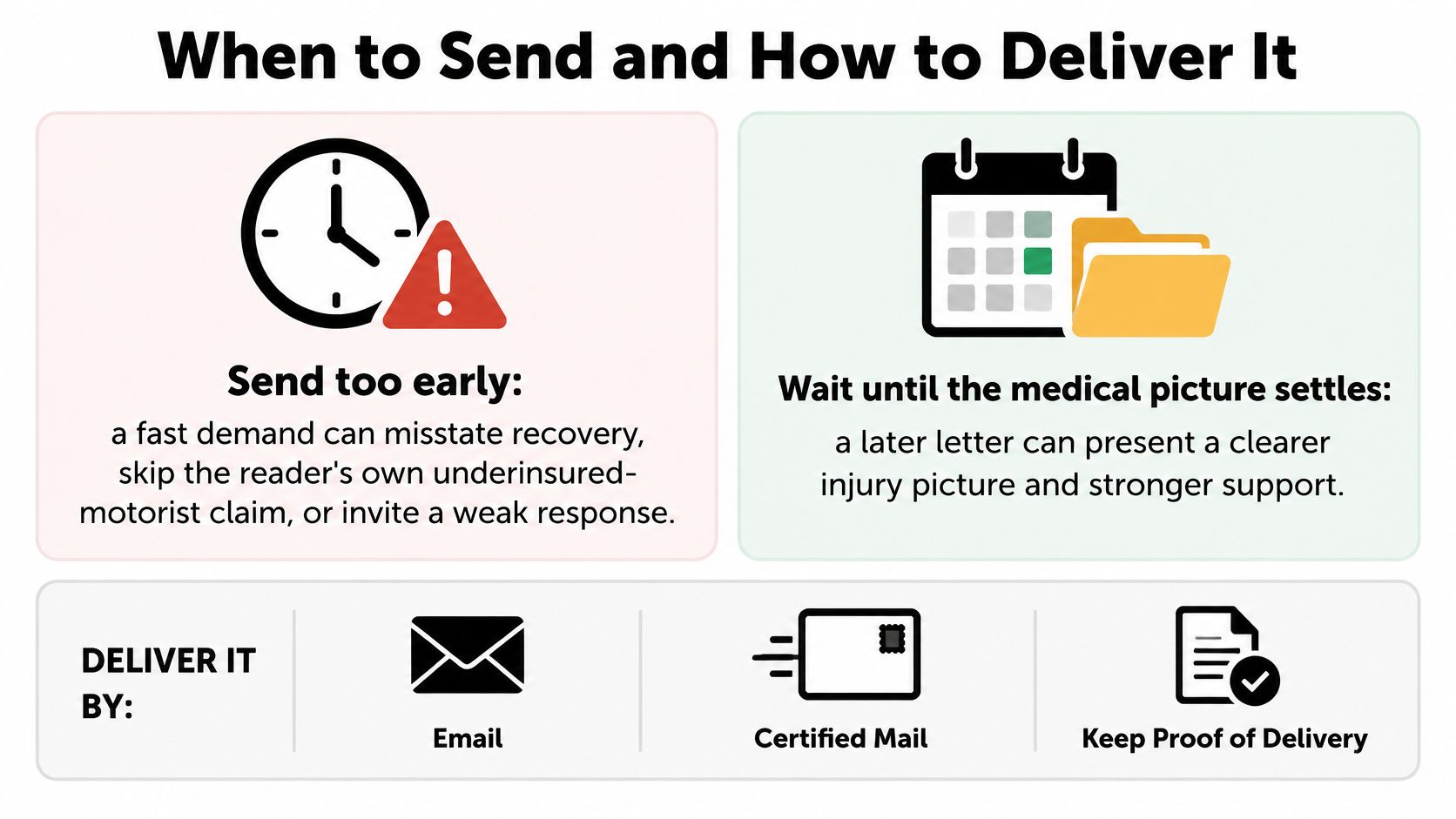
Wait for a sufficiently stable medical picture, not necessarily the end of every appointment. A documented long-term treatment plan may allow evaluation even when care continues. A changing diagnosis, unanswered surgery question, or unclear work prognosis usually means a final settlement demand is premature.
Waiting to value the claim doesn't mean waiting to notify insurers. Policy notice requirements and legal filing deadlines need attention while records are still being gathered.
Send necessary notices promptly. Send a final settlement proposal when you can support what it asks you to give up.
These timing and delivery checks help separate those decisions.
Protect your own coverage before resolving another claim
A Colorado federal underinsured-motorist case illustrates how a separate claim against the injured person's insurer can involve written notice, proof of loss, medical examinations, and medical-record authorizations after settlement with the at-fault carrier. That sequence isn't a universal instruction to settle first. Review your own policy's conditions before accepting another insurer's offer.
Check medical-payments benefits as well as underinsured-motorist coverage. Ask for the applicable policies and written limit confirmation instead of relying on an adjuster's verbal summary.
Preserve the delivery record
- Confirm the destination: Address the package to the assigned adjuster and verify the claim number and approved submission channel.
- Save the exact submission: Keep the signed letter, exhibit index, attachments, and delivery confirmation together.
- Use traceable delivery: Certified mail, a portal receipt, or acknowledged email can document transmission and receipt.
- Calendar follow-up: Record the response date separately from policy and lawsuit deadlines.
For attorney-managed files, LiveDocument's resource on legal document workflows for attorneys provides context for organizing document handling. The practical requirement remains simple: retain a clear record of what was sent, to whom, and when.
Before sending, confirm treatment status known, reimbursement issues identified, correct carriers named. If an insurer requests a recorded statement or examination under oath, clarify your obligations and obtain advice where needed. Don't guess from memory or ignore a policy-based request.
What to Do After the Adjuster Responds
In 2024, the average U.S. auto liability claim for bodily injury was $28,278, according to the Insurance Information Institute. That's an industry average, not a target or a prediction for your injury.
You also shouldn't rely on an advertised demand-letter success rate. Outcomes depend on fault, evidence, coverage, injuries, and the parties' negotiating positions. Evaluate the actual explanation behind the response.
Match your next move to the response
Adjuster response and next move
| Response | What to do | Watch for |
|---|---|---|
| No reply past deadline | Send one short follow-up with the exhibit list and a new date | Silence is not acceptance |
| Low offer | Ask which records or losses were rejected; correct the identified gaps | Unrelated bills treated as the whole file |
| Policy-limits offer on a modest, fully treated injury | Verify limits and liens, then review the release | Releases that drop every claim against every person |
| Policy-limits offer on a brain injury, truck crash, or future surgery | Check underinsured-motorist coverage and liens before signing | An early release that extinguishes future-care recovery |
For silence, first confirm receipt and ask whether the insurer needs a missing attachment. Keep the follow-up short. Repeatedly resending a large file without finding the problem can create more confusion.
For a low offer, request the insurer's reasoning in writing. Does the adjuster dispute fault, treatment necessity, time off work, or the prognosis? Answer the actual objection.
For example, if the offer omits wage loss, identify the employer letter and payroll records, state the omitted category, and restate the corrected schedule. Don't rewrite the entire collision story unless the insurer disputes it. Our resource on motor insurance disputes explains issues that may require closer review when an insurer's position remains unresolved.
Review the net payment and the release together
A policy-limits offer can still leave substantial expenses unpaid. Prepare a net-payment worksheet showing the proposed settlement, outstanding bills, asserted reimbursement claims, and any applicable fees or costs. Resolve uncertainty about those deductions before treating the gross offer as money available to your household.
Read who gets released and which claims disappear. A form may name additional people or businesses, include unknown claims, or foreclose later recovery for care arising from the same injury. Don't assume you can reopen the settlement when symptoms worsen.
Accept only after you understand the net recovery, the rights being surrendered, and any remaining medical uncertainty.
Keep crash and settlement discussions off social media while the claim remains open. Preserve existing evidence rather than deleting posts or messages. If the available money won't cover known losses, get advice about remaining recovery options before signing.
Decide If a Lawyer Should Send the Letter
You may be able to send the demand yourself when fault is clear, treatment is finished, the records are complete, and the losses fit within verified coverage. A lawyer should review the file when injuries are evolving, fault is disputed, or the available insurance may not cover the harm.
The dividing line isn't how polished your writing sounds. It's whether you can reliably identify the responsible parties, support the damages, and understand what settlement would end.
Recognize when a template isn't enough
- Brain injury or continuing symptoms: The claim may require careful medical analysis of cognition, work capacity, and future assistance.
- Truck or business-vehicle collision: Vehicle ownership, employment, and commercial coverage can require investigation beyond the driver's personal policy.
- Competing injury claims: Several injured people may be seeking payment from a shared insurance limit.
- Disputed causation or fault: Medical and reconstruction opinions may be needed to explain how the crash caused the claimed harm.
- Broad release or coverage demands: Advice can help distinguish reasonable cooperation from surrendering rights you still need.
We handle motor vehicle and brain-injury claims, and we have access to medical and accident-reconstruction experts who can testify about an injury's cause and impact. That support matters when an adjuster challenges whether the crash explains your symptoms or whether your restrictions affect future employment.
Don't let negotiation consume the filing deadline
Sending a demand letter doesn't stop the deadline for filing suit. Check the deadline that applies to your claim, including whether a government entity or another special circumstance changes the required steps. Don't assume an open claim or ongoing conversation gives you more time.
Bring the crash report, insurer correspondence, available medical records, wage documents, and any proposed release to a legal review. Missing documents don't prevent you from asking for help; identify what's still outstanding so it can be requested.
If you can't establish a supported prognosis, identify all relevant carriers, or explain the proposed net recovery, pause before mailing a final settlement number.
Nares Law Group LLC offers a free consultation for Colorado auto accident cases to discuss your records, coverage questions, and whether an attorney should prepare your demand. Visit Nares Law Group LLC to arrange a consultation before sending a final number or signing a release.