A contingency fee means you pay no money up front, and the lawyer is typically paid about one-third of the recovery only if the case succeeds. If the case loses, there's no attorney fee at all.
That arrangement matters most when you're staring at a wrecked car, missing work, and opening medical bills you didn't expect. A quick call from the insurance adjuster can make the pressure worse, because the insurer wants a fast answer before you've had time to understand your injuries or your rights. If you're in that spot, you're probably asking the right question, can I even afford to hire help?
The short answer is yes, in many injury cases you can. A contingency setup exists so ordinary people can get legal representation during a painful stretch when cash is tight, wages are interrupted, and expenses keep arriving. For a practical overview of how injury claims are commonly handled, a solid starting point is the personal injury law page, which lays out the basics in plain language. If you've just been in a crash, the steps you take immediately afterward also matter, so it helps to review a clear checklist like this guide on what to do after a car accident.
What Happens After a Serious Accident in Colorado
A rear-end collision on I-25 can look minor at first. Then the neck pain starts, the towing bill shows up, and a week later you're missing shifts because you can't turn your head without wincing. The insurance adjuster calls early, sounding calm, and offers to “wrap things up” before the medical picture is clear.
That's the point where a lot of Colorado families start wondering whether a lawyer is even realistic. Hourly billing sounds like one more bill they can't carry, especially when the household already has lost wages and treatment costs. A contingency arrangement is designed for exactly that moment, because the client doesn't pay upfront attorney fees and the lawyer is paid only if the case results in a recovery. That structure is what makes representation possible for people who can't fund litigation out of pocket, and it's why the model became so important in plaintiff-side cases involving uncertain damages and constrained budgets, as reflected in the Center for Justice and Democracy's explanation of lawyers' income and fees.
Why the first call changes the pressure
The core value of contingency isn't just financial. It changes the timing of your decisions, so you're not forced to accept the first number the insurer puts on the table just because you're worried about legal bills. A lawyer can review liability, insurance coverage, and the medical records before anyone talks numbers.
Practical rule: If you can't afford hourly billing while you're recovering, contingency representation is often the only way to get full legal help without paying legal fees from your own pocket.
That's also why many injured people start with a simple consultation instead of trying to guess their claim's value alone. If you're comparing firms, a useful reference point is whether they explain the fee structure clearly and in writing. Colorado drivers dealing with a crash claim should also keep their records organized, because the facts you collect early shape the whole file, and a step-by-step checklist like the one above can keep that first week from slipping away.
How Contingency Fee Agreements Work
A contingency agreement has two parts that clients often blend together, the attorney fee and the case costs. The fee is the lawyer's payment, usually a percentage of the recovery. The costs are the out-of-pocket litigation expenses, things like filing fees, deposition charges, expert expenses, and investigation costs that the firm may advance during the case. The distinction matters because a “one-third fee” does not mean one-third is the client's final net.
Under the American Bar Association's consumer guidance, one-third is a common benchmark, and typical ranges often run about 33% to 40%, with higher percentages more common when a case goes deeper into litigation or trial, according to the ABA's explanation of contingent lawyer fees. That does not mean every agreement uses the same number, but it does show why the percentage can change depending on how much work the case requires.
A simple settlement example
Take a hypothetical $100,000 settlement with a one-third fee and $8,000 in reimbursable costs. The math sounds simple, but the order of deductions is easy to miss, so it helps to look at each layer. The lawyer's fee comes off the recovery, and the costs come out separately under the agreement.
| Item | Amount | Notes |
|---|---|---|
| Gross settlement | $100,000 | Total recovery before deductions |
| Attorney fee at one-third | $33,333 | Common benchmark fee structure |
| Case costs | $8,000 | Filing, experts, records, or similar expenses |
| Net to client | $58,667 | Remaining amount after fee and costs |
If the case goes all the way to trial, the fee percentage may be higher than it would be for an early settlement, because the law firm takes on more time, risk, and front-loaded expense. Deeper litigation requires that extra commitment, and the higher percentage reflects that added work and risk.
What happens if the case loses
If there is no recovery, there is generally no attorney fee. Many agreements also say the client owes nothing for advanced costs if the case does not succeed, but that part has to be checked carefully in the written contract. The separate treatment of fees and disbursements is one reason clients should read the fine print before signing, and the NYC Bar's consumer guidance on contingency fees and disbursements explains that distinction in plain terms.
A plain-language breakdown of lawyer pricing is also available in this guide to personal injury lawyer fees, which can help you compare one agreement against another before you sign.
Which Case Types Use Contingency Fees
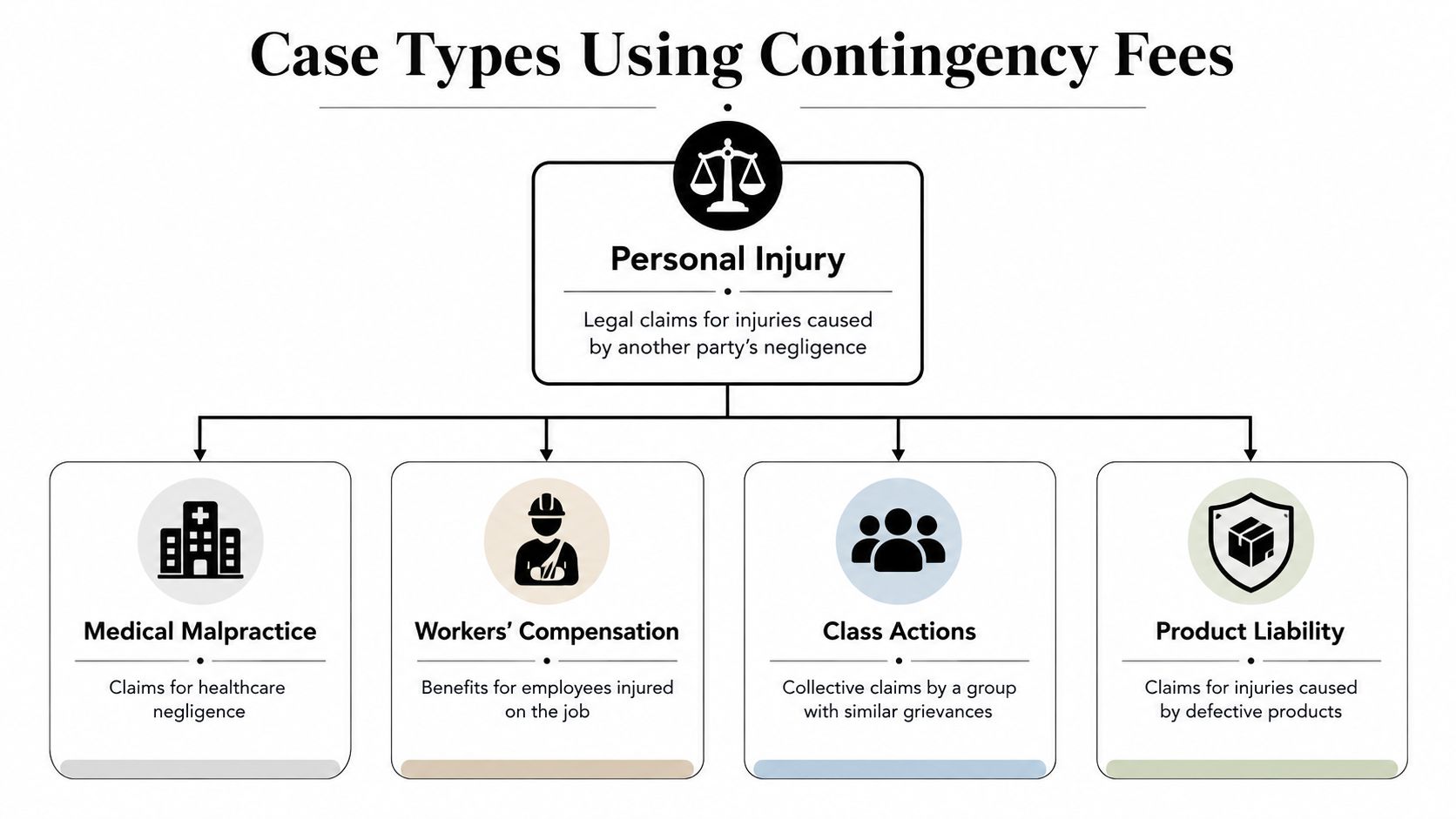
Contingency work is common in cases where the claim is tied to a monetary recovery and the client probably can't bankroll the fight alone. That's why you see it most often in personal injury, wrongful death, trucking crashes, traumatic brain injury claims, and some product-liability or workplace injury matters. Those cases often involve serious damages, contested liability, and expensive proof, which makes fee-shifting risk to the lawyer more practical.
Where contingency is less common
Contingency is not the default in every legal field. It's generally not the norm in criminal defense, family law, or most business disputes, because those matters don't usually revolve around a straightforward money recovery the way an injury claim does. That's why someone searching for an attorney on contingency needs to screen by case type first, not just by city or firm size.
Colorado families dealing with severe head trauma often ask whether their case fits the contingency model, and that's a fair question. A firm that regularly handles those claims should be able to explain why the case belongs in that category and what costs are likely to arise. If you're comparing firms that work on traumatic brain injury matters, this traumatic brain injury law firm page gives a useful sense of how those claims are commonly framed.
Not every lawyer who handles injury work will take every injury case. The claim has to be economically and legally workable for the firm, and that selectivity is part of the model.
Why the fit matters
The fit matters because contingency is built around expected recovery, not just legal merit. A case with strong evidence but little collectible value may still be hard to staff, while a well-documented crash with meaningful damages may be much more attractive. That's one reason clients should ask directly whether the lawyer handles the specific kind of case they have, instead of assuming every personal injury office is a match for every claim.
Benefits and Drawbacks of Contingency Representation
A family hurt in a serious crash often faces a hard choice. The medical bills are already landing, the car may be out of service, and hiring a lawyer can feel out of reach. Contingency representation helps in that moment because the client does not have to pay hourly fees just to get legal help started.
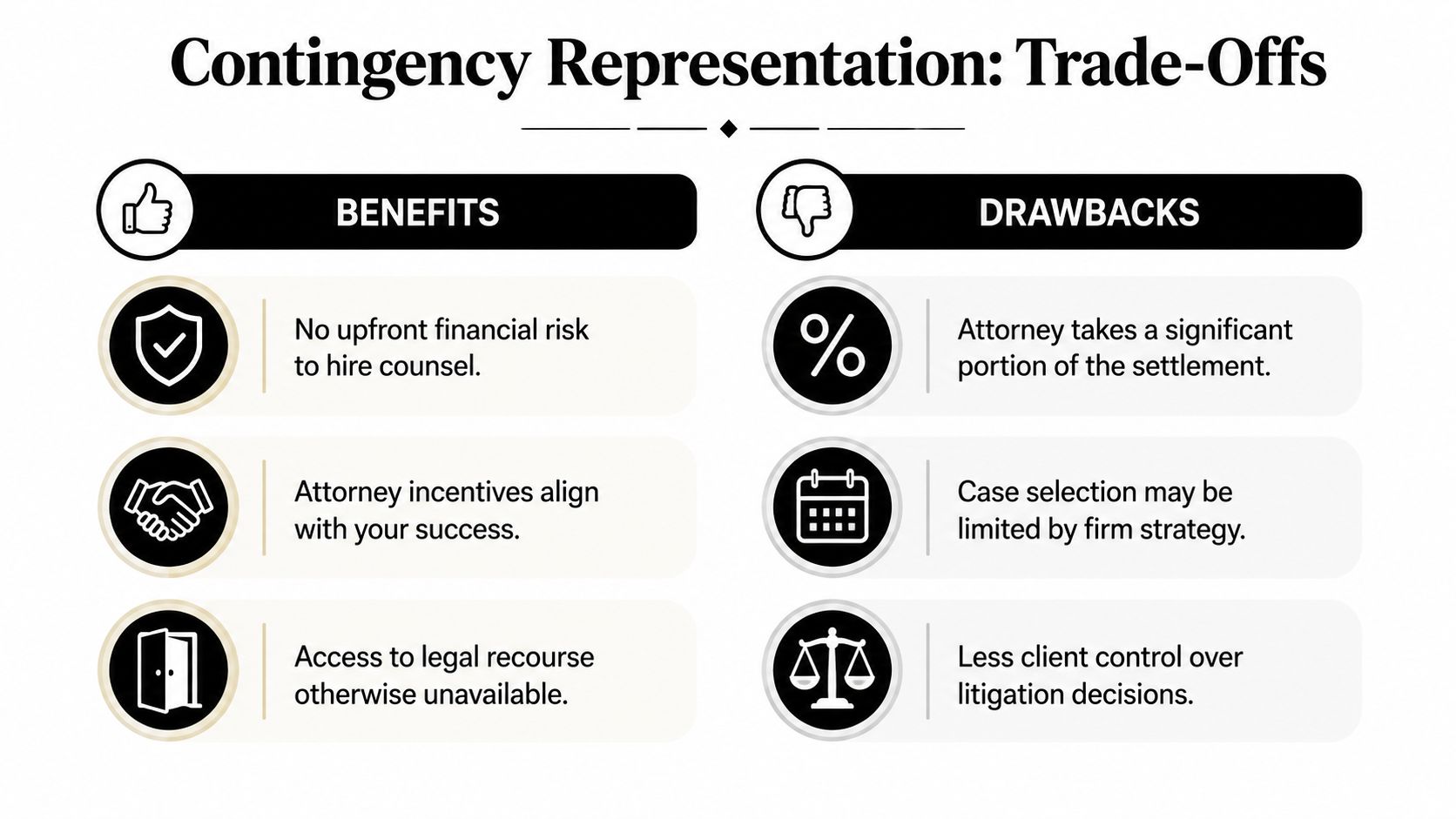
The trade-off is just as important. The lawyer's payment depends on recovery, so the lawyer and client are tied to the same result, but the final settlement is not the same as the amount the client takes home. That structure can help with focus and case selection, yet it also means the agreement should be read with care before anyone signs.
Side-by-side comparison
| Benefits | Drawbacks |
|---|---|
| No upfront financial risk to hire counsel | The attorney takes a significant portion of the settlement |
| Aligned incentives between client and lawyer | The firm may be selective about which cases it accepts |
| Access to legal help when hourly billing isn't realistic | Costs and disbursements can reduce the final net recovery |
| The firm can front investigation and expert expenses | Client control may feel less direct than in a pay-by-the-hour arrangement |
The biggest practical benefit is access. A person who could not realistically pay by the hour can still get a lawyer to investigate the claim, gather records, and build the case without having to write a check at the start. In that sense, contingency works like a shared-risk arrangement, where the lawyer takes on the cost of moving the case forward and gets paid only if there is a recovery.
The drawbacks show up in the math. The fee comes out of the settlement, and case expenses can come out too, so the amount on the release is often higher than the amount the client keeps. A claim that settles for a fair number on paper can still leave a smaller net once the fee, medical liens, filing costs, expert charges, and other deductions are handled. That is why the percentage alone never tells the whole story.
Some clients also feel a loss of control. The lawyer still has professional duties, but a contingency case can feel less like hiring a service by the hour and more like joining a business partnership with shared risk and shared stakes. That is a fair trade for many injury clients, especially when they need help now, yet the agreement should spell out who pays expenses, how those expenses are repaid, and what number is used to calculate the fee.
Common Pitfalls and Red Flags in Contingency Agreements
A serious injury can make the fee section feel like the only number that matters. That is where people get tripped up. The percentage matters, but the answer depends on how expenses are handled, when the case ends, and whether costs are taken before or after the fee is calculated.
One red flag is an agreement that makes the client responsible for costs in broad terms, without saying what those costs are or how they are charged. Another is vague language about a higher fee rate later in the case, especially if the contract ties that increase to filing suit, mediation, or trial without naming the point clearly. The fees and disbursements in contingency cases discussion from the NYC Bar is useful here because it separates the fee from the case expenses that may come out of a recovery.
Clauses that deserve a hard look
- Fee increases without clear triggers: If the agreement says the percentage changes later, ask exactly what event causes that change.
- Cost repayment language: If the firm expects reimbursement even after a loss, the contract should say that plainly.
- Settlement-control provisions: Read carefully if the agreement gives the firm broad power to settle without your real input.
- Cost deductions before fee calculations: Ask whether the fee is taken from the gross recovery or from the amount left after costs are paid.
The part many clients miss is who fronts the case expenses. Some firms pay those costs as the case goes along and recover them only from a settlement. Others may expect reimbursement under certain conditions, even if the result is poor. That difference can matter a great deal in a contested claim where records, experts, and depositions start adding up.
Ask for a sample distribution sheet before you sign. A real breakdown is worth more than a verbal promise, because it shows how the money would be divided if the case settled tomorrow.
A simple example helps. If a settlement looks fair on paper, the client still needs to know how the money will be split after the fee, medical liens, filing charges, expert fees, and similar deductions are taken out. That is why a careful agreement should spell out who pays expenses, how repayment works, and what number is used to calculate the fee. For a broader look at how people choose counsel, this guide to law firm client decisions helps explain why clarity and trust matter before anyone signs.
If a clause feels confusing, ask for it to be rewritten in plain language. Slow the process down until the agreement makes sense. A good lawyer should be able to explain the risk, the cost flow, and the settlement math without making you feel rushed.
Questions to Ask Before Signing a Contingency Agreement
A first meeting should work like a two-way interview. You are checking whether the lawyer explains the deal clearly, whether the fee terms make sense for your situation, and whether the firm will protect your interests when the numbers start to matter. The best time to ask hard questions is before anyone signs, while you still have room to compare one agreement with another.
For a broader look at how people choose counsel, this guide to law firm client decisions is useful because it shows how much trust, communication, and clarity shape the decision before anyone signs.
Ask about the fee structure
- What is your exact percentage? A firm should state the number plainly, so you do not have to guess.
- Does the percentage change if the case settles early or goes to trial? Ask what event changes the fee and what that means in real terms.
- Is the fee calculated before or after costs are deducted? That detail can change the size of your final recovery.
Ask about costs and expenses
- What expenses will the firm advance? Filing fees, experts, depositions, and records should be identified up front.
- Who pays if the case loses? This question matters because some agreements leave the client with repayment responsibility even when the result is poor.
- How will costs be tracked and reported? You should know whether the firm uses a running ledger or sends periodic updates.
A sample distribution sheet can help here. Seeing the numbers on paper is often clearer than hearing a verbal explanation, because it shows how a settlement would be divided if the case resolved tomorrow.
Ask about process and representation
- How do you handle negotiation versus trial? You want to hear the firm's actual approach, not a slogan.
- Who decides whether to settle? The answer should show how much control stays with you.
- Will you handle the case personally? It matters whether the lawyer you meet is the lawyer who will stay involved.
Ask about timeline and capacity
- What is a realistic timeline? No lawyer should promise speed, but they should explain the likely stages.
- How often will I get updates? Communication expectations should be clear before the relationship starts.
If the answers stay vague, that is a warning sign. A contingency agreement should help you understand risk, cost flow, and settlement math, not leave those pieces buried in legal language. The clearer the answers, the easier it is to decide whether the firm is the right fit for your case.
Next Steps How Nares Law Group Can Help
A clear understanding of contingency fees is only useful if the firm you hire explains the rest of the process transparently. That includes the fee percentage, the costs, the likely timeline, and what happens if the case doesn't resolve the way everyone hopes. For Colorado families dealing with a wreck, truck crash, traumatic brain injury, or wrongful death claim, that transparency can make the next decision much less overwhelming.
Nares Law Group is a Denver-based firm that handles motor vehicle crashes, trucking cases, traumatic brain injuries, and wrongful death matters on a contingency basis. The team's approach is built around investigation, medical treatment coordination, negotiation, trial, and settlement, so clients aren't left piecing the case together alone. Licensed in Colorado, Texas, and New York, the firm also serves families who need practical guidance during a very hard season.
For readers who want to understand how legal arguments are built on paper as well as in the courtroom, this guide on how to write a legal brief is a helpful companion. It shows why careful organization and clear facts matter long before a hearing or trial ever starts.
Nares Law Group also offers free consultations and educational resources through blogs, videos, webinars, and the Mother Justice podcast. If you're trying to decide whether contingency representation makes sense for your situation, the cleanest next step is to talk with a firm that will explain the costs before you sign anything.
If you're trying to understand whether an attorney on contingency is the right fit for your Colorado injury claim, Nares Law Group LLC can walk you through the fee agreement, the expected costs, and the next steps in plain English. Reach out for a free consultation if you want a careful review of your situation and a clear answer before you sign anything.