The bills often arrive before the shock wears off. One envelope is from the ambulance company. Another is from the emergency room. Your phone starts buzzing with insurance calls, and somewhere in the middle of all that, you're supposed to decide whether you can afford a lawyer.
That question keeps many injured people from getting help. They assume hiring a personal injury attorney means a large retainer, hourly invoices, and another financial burden they can't carry right now.
In most personal injury cases, that isn't how it works. The core issue usually isn't whether you can hire a lawyer. It's whether you understand how the money flows through a case, from settlement to fees to expenses to any medical claims that must be paid back. If you live in Colorado and you're weighing your options after a crash, that financial map matters.
Why Understanding Legal Fees Is Your First Step
A lot of clients call after the same kind of day. They've missed work, they're in pain, and they've just opened another medical bill. They're worried about their car, their paycheck, and whether the insurance company is already building its defense. Then one more fear shows up: “I probably can't afford a lawyer.”
That fear is understandable. It's also one of the biggest barriers between injured people and the help they need.
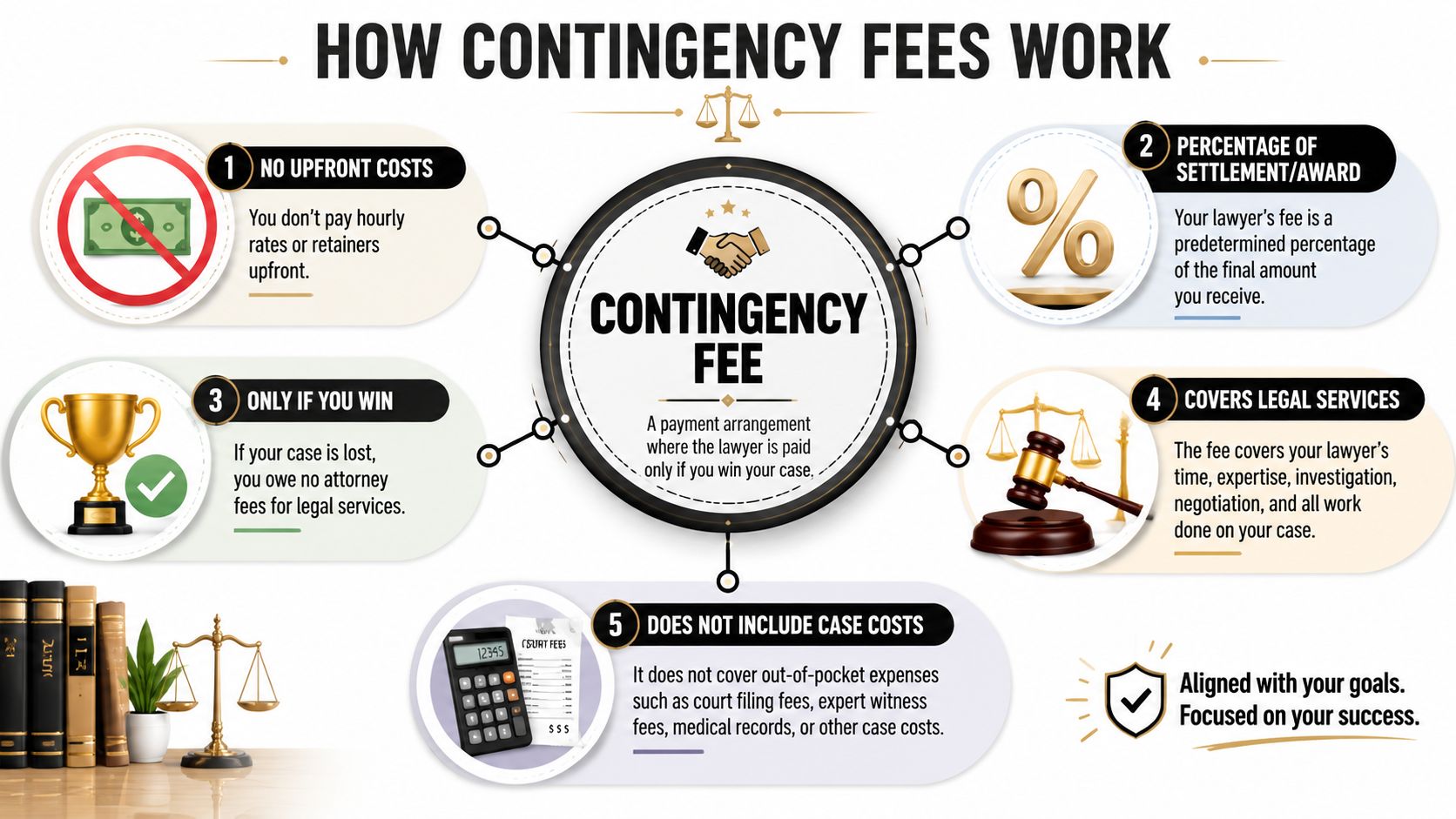
The most important concept to understand is the contingency fee agreement. In personal injury law, that usually means you don't pay an attorney fee upfront. The lawyer takes on the work and only gets paid if money is recovered in the case. That arrangement changes the conversation from “Can I afford legal help today?” to “Does this lawyer believe in my case enough to invest in it?”
Why this matters so early
A fee agreement isn't just paperwork. It shapes every decision that follows.
If your lawyer is working on contingency, the lawyer is taking on risk with you. The firm may spend time gathering records, investigating the crash, speaking with witnesses, dealing with adjusters, and organizing the claim before any payment comes in. That structure can open the door to representation for people who are already under financial pressure.
Practical rule: If you don't understand how the lawyer gets paid, you can't accurately judge any settlement offer.
Communication matters here, too. Clients often feel most lost at the beginning, when calls go unanswered or they can't tell whether a case is moving. For firms trying to respond more clearly and screen urgent calls, tools like SkipCalls for legal professionals show how intake and client communication can be handled more consistently.
The question beneath the question
When people ask, “How much does a lawyer cost?” they usually mean something more personal:
- Will I owe money right away
- What happens if the case doesn't settle
- How much of the final recovery will I keep
- Will medical bills eat up the whole result
Those are the right questions. Personal injury lawyer fees aren't just about a percentage on paper. They're about your final net recovery and whether the numbers make sense for your life.
How Contingency Fees Work in Personal Injury Cases
A contingency fee is easiest to understand if you think of your lawyer as a business partner in one specific project: your case. The lawyer contributes time, legal skill, negotiation effort, and often front-end resources. In return, the lawyer receives an agreed share of the recovery if the case succeeds.
That's why “no fee unless you win” is helpful but incomplete. The arrangement isn't free. It's risk-shifted. The client avoids upfront attorney billing, and the lawyer takes the chance that the case may produce no fee at all.
What the percentage usually looks like
In major U.S. personal injury markets, the dominant fee model is contingency-based: clients typically pay no upfront attorney fee, and the lawyer is paid only if money is recovered. Across multiple legal-market explanations, the standard attorney share is usually 33% to 40% of the settlement or award, with about one-third common for cases that resolve before a lawsuit or trial and up to two-fifths for cases that proceed further into litigation. In practical terms, that means a client who recovers $100,000 may see roughly $33,000 to $40,000 go to attorney fees before expenses are deducted, depending on the agreement and case stage, as explained in this discussion of what percentage personal injury lawyers take and in the market overview from Ask Adam Kutner.
That range often confuses people until they understand the reason behind it.
Why the percentage can change
A case that settles early usually requires less formal legal work. A disputed case can require much more. Once litigation begins, the lawyer may need to handle written discovery, take depositions, work with experts, respond to motions, prepare exhibits, and get ready for trial.
Consider a roof repair scenario. Patching a small leak is one project. Rebuilding structural damage after months of water intrusion is another. The second job costs more because it takes more labor, more materials, and more risk.
A contingency fee pays for the lawyer's work, but it also reflects the chance the lawyer may spend substantial time and recover nothing.
What the fee does and does not cover
The contingency percentage usually covers the lawyer's legal services. It generally does not answer a different question: who pays the out-of-pocket expenses required to move the case forward?
Those expenses are called case costs, and they deserve their own separate look because clients often mix the two together. That's where settlement math can become confusing if the agreement isn't clear from the start.
Attorney Fees vs Case Costs What Is the Difference
Clients often use the words “fees” and “costs” as if they mean the same thing. In a personal injury case, they don't.
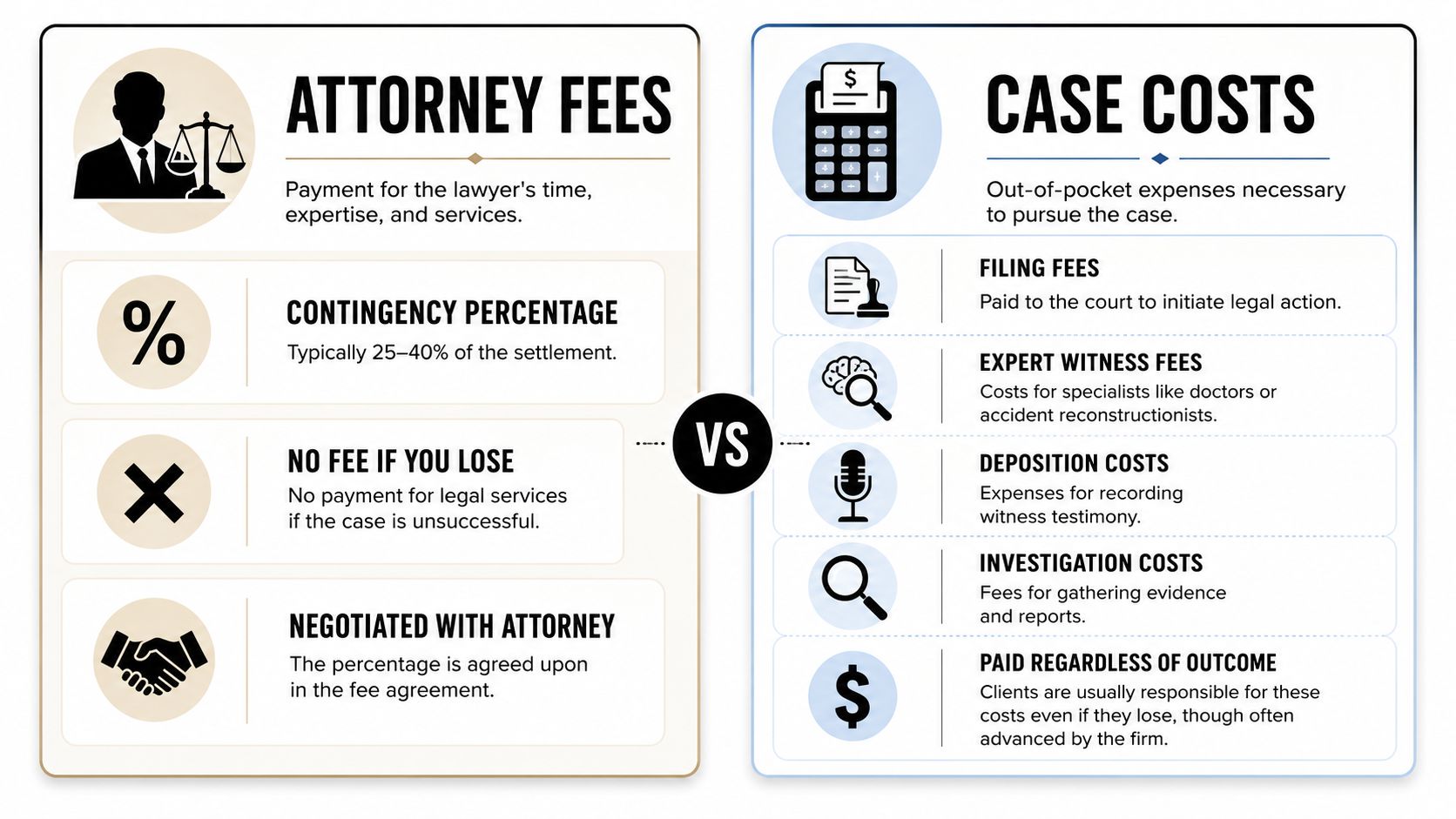
The cleanest way to separate them is this: attorney fees pay for the lawyer's work. Case costs pay for the things needed to build and pursue the case.
If you were building a house, the architect's fee would be one category. Lumber, concrete, permits, and windows would be another. Both matter. They just aren't the same bill.
What belongs in each category
Here's a simple side-by-side view:
| Category | What it means | Common examples |
|---|---|---|
| Attorney fees | Payment for legal services | Case strategy, negotiations, drafting, litigation work, trial preparation |
| Case costs | Out-of-pocket expenses tied to the claim | Filing fees, expert witness charges, medical record charges, deposition expenses, investigation expenses |
That distinction affects your bottom line. A client may hear “one-third fee” and assume that explains everything. It doesn't. The fee is only one piece of the financial picture.
Why costs deserve close attention
Case costs can become significant in a disputed claim. Some matters require only records and routine investigation. Others require outside experts, extensive discovery, and formal court filings.
Ask these questions before you sign anything:
- What counts as a cost. Get examples in writing, not broad labels.
- Who advances the cost. Many firms front these expenses during the case, but the agreement should say so clearly.
- When costs are repaid. The timing of repayment can affect the amount you ultimately receive.
- Will I get an itemized statement. You should be able to see what was spent and why.
Fees compensate the lawyer. Costs fund the case.
The confusion that causes most surprises
The surprise usually isn't that costs exist. It's that clients don't realize how they interact with attorney fees and medical obligations.
A settlement check doesn't automatically become your take-home amount. It first moves through a series of deductions based on the written agreement and any obligations attached to the claim. If that process hasn't been explained in plain English, the final number can feel jarring even when it was predictable all along.
Calculating Your Net Recovery A Practical Example
This is often the primary concern: what lands in your hands at the end.
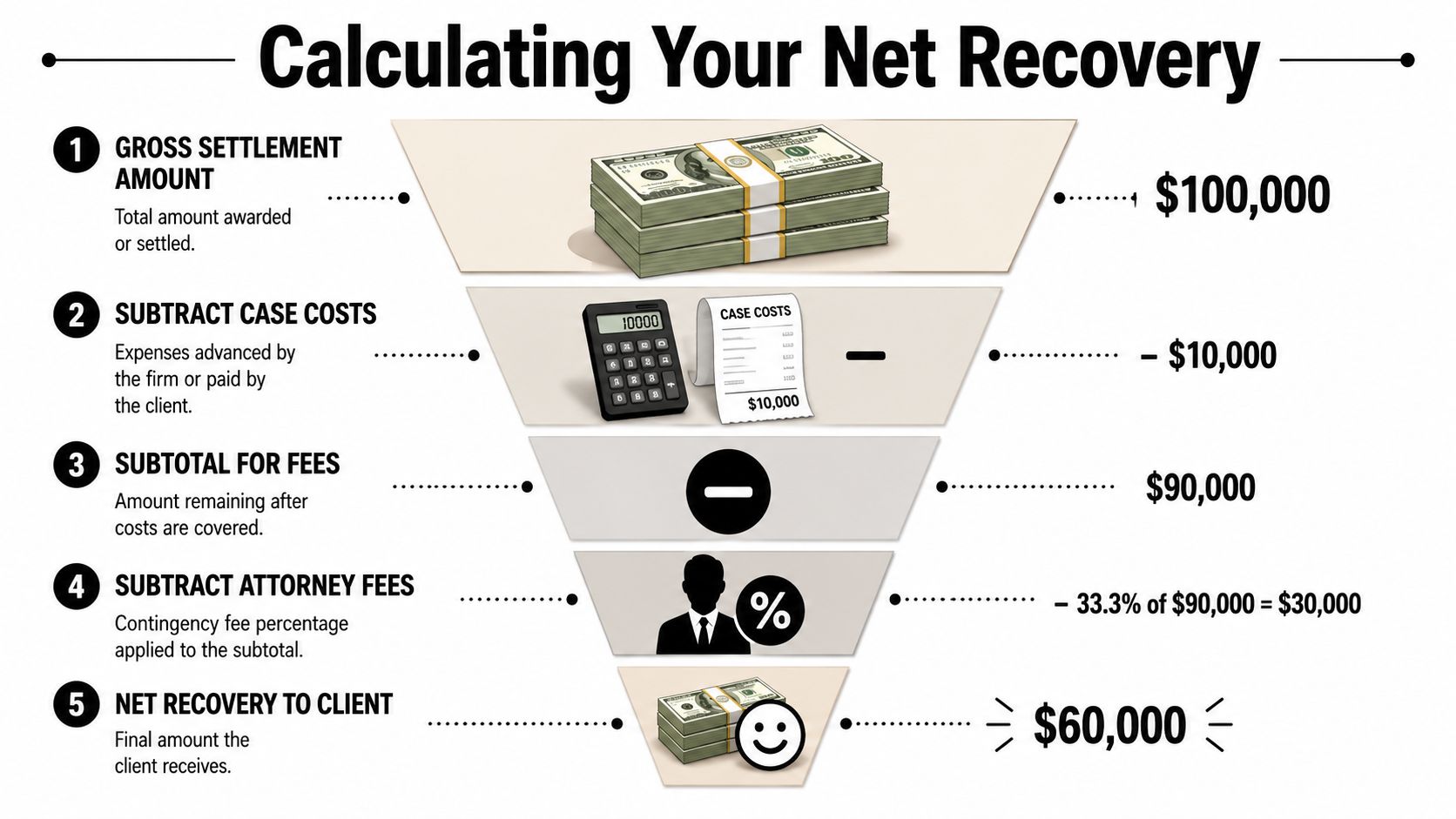
The simplest formula is:
Settlement − attorney fees − case costs − liens = net recovery
That formula matters because a settlement amount is a gross number. Your net recovery is the amount left after the required deductions are made. If you don't separate those two ideas, it's easy to overestimate what a case resolution means for your household.
To make the flow easier to visualize, this graphic shows the basic path from total settlement to client recovery.
A real-world style example
One California example gives a concrete illustration: on a $100,000 pre-litigation settlement with a 33% fee, $8,000 in costs, and a $12,000 lien, the client's net recovery is about $47,000, as described in this explanation of how personal injury lawyer fees affect the client's net recovery.
That single example clears up several common misunderstandings at once. A client can receive a meaningful settlement and still take home substantially less than the gross amount because several parties may need to be paid from the same pool.
Here's how to think about the moving parts:
Gross settlement
This is the total amount paid to resolve the claim.Attorney fee
This is the lawyer's agreed share for legal services.Case costs
These are the expenses spent to pursue the claim.Liens or medical repayment obligations
These can include claims that must be satisfied from the recovery.Net recovery
This is what the client receives.
For a broader look at how losses are valued in the first place, Nares Law Group provides a useful primer on economic damages calculation.
Why liens catch clients off guard
A lien is one of the least understood parts of a case. Many clients focus on the lawyer's fee but forget that medical providers, health-related payors, or other claimants may also have a right to repayment depending on the facts.
That doesn't mean every case has the same repayment issues. It does mean you should ask early whether anyone else may be paid from the settlement funds.
A short video can also help if you prefer hearing the process explained out loud.
The most useful question to ask
Don't stop at “What is your fee percentage?”
Ask this instead: Can you walk me through a sample disbursement sheet so I can understand my likely net recovery?
That question gets past slogans and into the practical financial journey of the case. It helps you see not just what the lawyer charges, but how fees, costs, and liens interact before the final check reaches you.
Fee Agreements and Rules Specific to Colorado
Colorado clients should expect more than a handshake and a verbal promise. A proper contingency arrangement should be documented clearly and signed. If a lawyer can't slow down and explain the agreement in writing, that's a problem before the case even starts.
The general market reality is familiar. In major personal injury markets, the dominant pricing model is a contingency fee: the lawyer's compensation is typically 33% to 40% of the settlement or verdict, with about 33% common for pretrial resolution and about 40% when the case proceeds to litigation or trial. The technical significance is that the fee rate functions like a risk-adjusted price, as discussed in Zabrisk's overview of personal injury lawyer cost and fee percentages.
What a Colorado client should see in writing
A fair fee agreement should answer the practical questions that affect your money and your expectations. You shouldn't have to guess.
Look for clear language on these points:
- The contingency percentage. The agreement should say how the fee is calculated and whether it changes if the case enters litigation.
- Responsibility for case costs. The contract should explain whether the firm advances costs and how those expenses are reimbursed.
- Client obligations at the end of the case. You should understand what gets deducted before funds are disbursed.
- Signatures and consent. A written agreement protects both sides, but it especially protects clients from fuzzy memories and shifting explanations.
Why this matters in Colorado practice
Colorado injury cases often involve the same practical pressures seen anywhere else: treatment decisions, insurance disputes, lost wages, and uncertainty about timing. A written agreement gives structure to all of that. It turns assumptions into terms.
When the fee agreement is clear, settlement conversations become easier because everyone is using the same financial roadmap.
This is also where ethical lawyering shows up in plain view. If multiple firms are involved, or if outside counsel assists on part of the matter, the client should understand who is doing the work and how the fee arrangement operates. Transparency isn't a courtesy. It's part of competent representation.
Red Flags to Watch For in a Fee Agreement
A strong fee agreement should make you feel informed. A weak one leaves you rushed, confused, or oddly embarrassed to ask basic questions. That feeling matters.
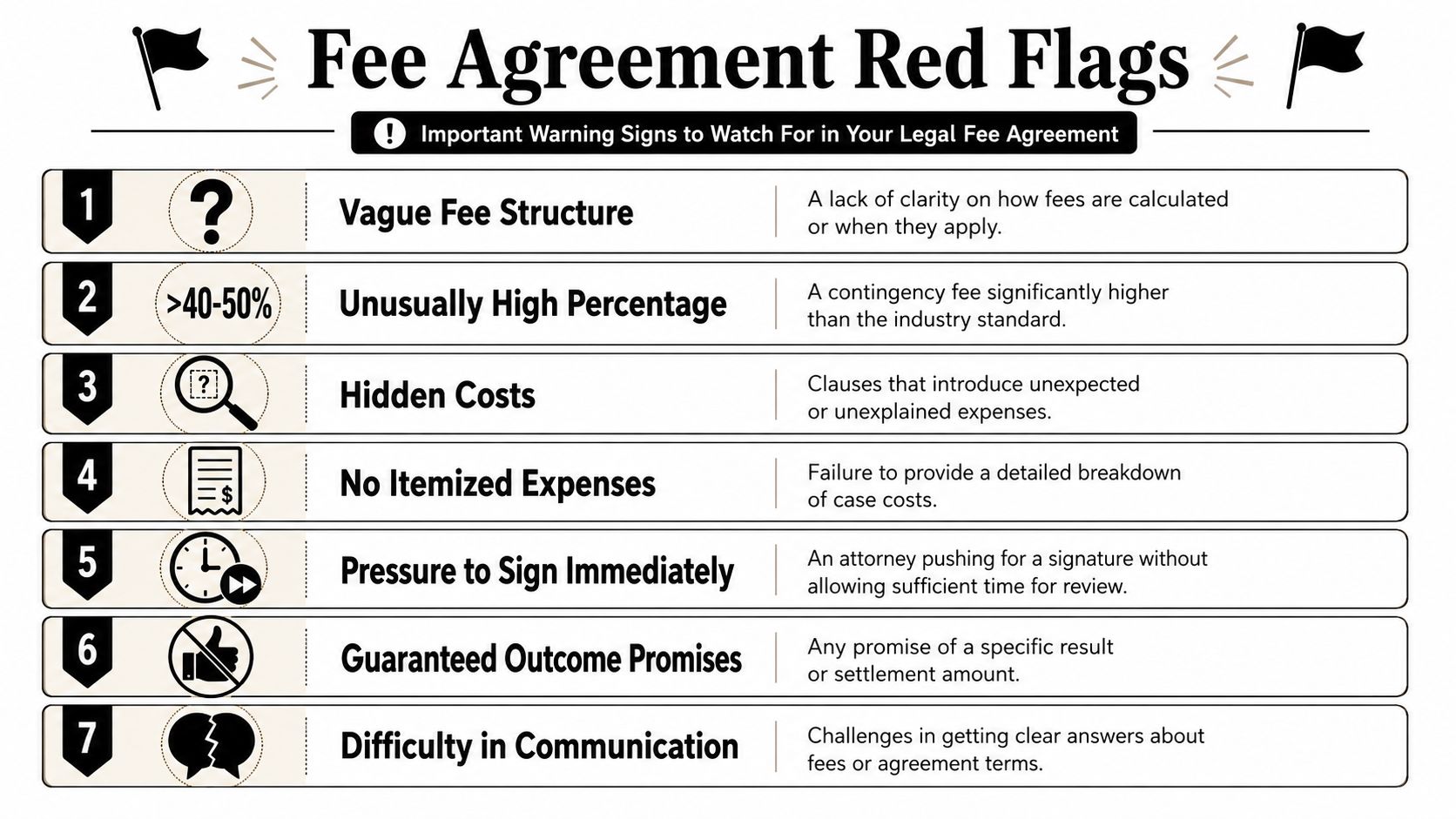
Most bad surprises don't come from one dramatic clause. They come from vagueness. A missing definition here, a casual verbal promise there, and by the time the case resolves, the numbers don't look the way the client expected.
Warning signs worth slowing down for
Watch closely if you run into any of these:
- Vague language about the fee. If the agreement doesn't clearly say how the percentage works, when it changes, or what recovery it applies to, pause.
- Unclear treatment of costs. “Client responsible for costs” is not enough by itself. You need detail.
- Verbal assurances that aren't in the contract. If it matters, it belongs in writing.
- Pressure to sign immediately. A lawyer who values clarity should give you space to review and ask questions.
- No sample settlement breakdown. If the firm can't explain how disbursement works, you may be walking into confusion.
- Guarantees about outcome. No ethical lawyer can promise a specific settlement result.
Better questions to ask before signing
You don't need legal jargon. You need direct questions.
Try these:
- Is the fee calculated on the gross recovery or after certain deductions?
- Can I see an example disbursement sheet from a hypothetical case?
- What kinds of case costs commonly arise in matters like mine?
- If the case becomes more contested, does the fee change?
- Who will explain liens or repayment claims before I accept a settlement?
A transparent lawyer won't treat these questions as distrust. They'll treat them as responsible decision-making.
What transparency looks like
Good communication is specific. The lawyer or legal team should be able to explain the agreement in plain English, not just point to a paragraph and say, “It's standard.”
You should leave that conversation knowing what the lawyer earns, what the case may cost to pursue, and what factors could affect your net recovery. If you leave more confused than when you arrived, keep looking.
What to Do Next After an Injury in Colorado
After an accident, people often feel they need to solve everything at once. You don't. You need to make a few solid decisions in the right order.
Start with your health. Follow through with recommended treatment, keep your appointments, and tell your providers about all symptoms, even the ones that seem minor. Small details early can matter later.
A practical three-step plan
Get and follow medical care
Your body comes first. Consistent treatment also creates a clearer record of what the injury has done to your life.Preserve what you already have
Save photos, discharge paperwork, repair estimates, witness information, insurance letters, and any notes about how the injury affects daily activities. If you need a simple checklist, this guide on steps to take after a car accident is a useful starting point.Schedule a consultation and ask fee questions early
Bring your questions about attorney fees, case costs, and possible liens. Don't worry about sounding uninformed. These are the exact questions that protect your interests.
What to bring to that first meeting
You don't need a perfectly organized file. Bring what you have.
Helpful items may include:
- Accident documents such as the exchange of information or any report you received
- Medical paperwork from urgent care, the hospital, specialists, or physical therapy
- Insurance communications including emails, letters, claim numbers, and recorded statement requests
- Your own notes about pain, missed work, transportation problems, and household limitations
The goal of the first conversation
You're not just asking whether you have a case. You're deciding whether this lawyer explains things in a way you can trust.
That means listening for clarity. Can the lawyer explain the likely path of the claim? Can they describe how fees and costs interact? Can they tell you what questions still can't be answered yet? Honest uncertainty is often a better sign than overconfident promises.
If you understand the financial journey of the case, you're in a stronger position to make every later decision, including whether to accept a settlement, continue treatment documentation, or move forward with litigation.
If you were injured in Colorado and want a plain-English explanation of how fees, costs, and case recovery may work in your situation, Nares Law Group LLC offers free consultations for injury cases. That meeting gives you a chance to ask direct questions, review how a written fee agreement works, and understand the practical financial path of your claim before you decide what to do next.