If you're standing at the side of the road after a crash, watching flashing lights wash over twisted metal, the EMT's first decisions can feel almost invisible. They aren't invisible at all. They determine who gets oxygen first, who gets rushed out, what injuries get documented, and what details may later matter in a police file, an insurance claim, or a lawsuit.
When people ask upon arrival at a motor vehicle crash the EMT should, the answer starts with discipline under pressure. EMTs are trained to follow a structured sequence because traffic crashes can deteriorate fast, and road trauma remains a major global killer, with about 1.19 million road traffic deaths each year reported by the World Health Organization in the clinical guidance cited by New York State EMS materials (New York State BLS protocols). That structure is about more than medical efficiency. It also preserves the early facts that explain what happened, what was visible, and what changed before the hospital ever saw the patient.
What the First Minutes After a Crash Look Like
The first thing people usually notice is noise. Traffic is still moving, radios crackle, glass shifts under boots, and someone nearby may be shouting that the driver will not answer. EMTs step into that scene with a different focus, because those first minutes can decide whether a patient steadies or tips into a crisis.
A trained responder does not rush straight to the closest injured person. They first look for hazards, decide where they can work safely, and keep from becoming another casualty. To bystanders, that can look cautious. In clinical terms, it is controlled movement under pressure.
Practical rule: a calm, organized arrival usually means the EMT is already sorting life threats, scene hazards, and transport priorities at the same time.
That approach comes from protocol, not hesitation. New York State BLS guidance tells responders to assess scene safety, count the patients, identify the mechanism of injury, and look for environmental hazards before deeper care begins. Tennessee EMS guidance says the full patient assessment, vital signs, treatment, and ongoing reassessment should begin as soon as contact is made and continue until transfer of care. The sequence is laid out in state protocol materials, and it gives the crew a shared method instead of a guess at the roadside.
Families often read that early scene behavior before anyone explains it. If the crew moves a patient quickly, calls for higher-level care, or speaks in short, focused phrases, that usually means they have seen signs that are not obvious from the shoulder of the road. A fast decision at the scene can shape what happens later in the emergency department, from trauma activation to imaging and surgical consultation.
It also affects the record. The vehicle's position, the patient's complaints, the visible injuries, and the time the crew arrived all become part of the story that later has to be reconstructed. That matters in injury claims, because scene observations can help show how the crash unfolded and what was present before treatment changed the picture. For a clear look at how crash events progress in stages, this collision stages guide is a useful reference, and the downstream value of vehicle evidence is often easier to understand once you see how frame damage affects value.
Scene Size-Up and the Structured Primary Survey
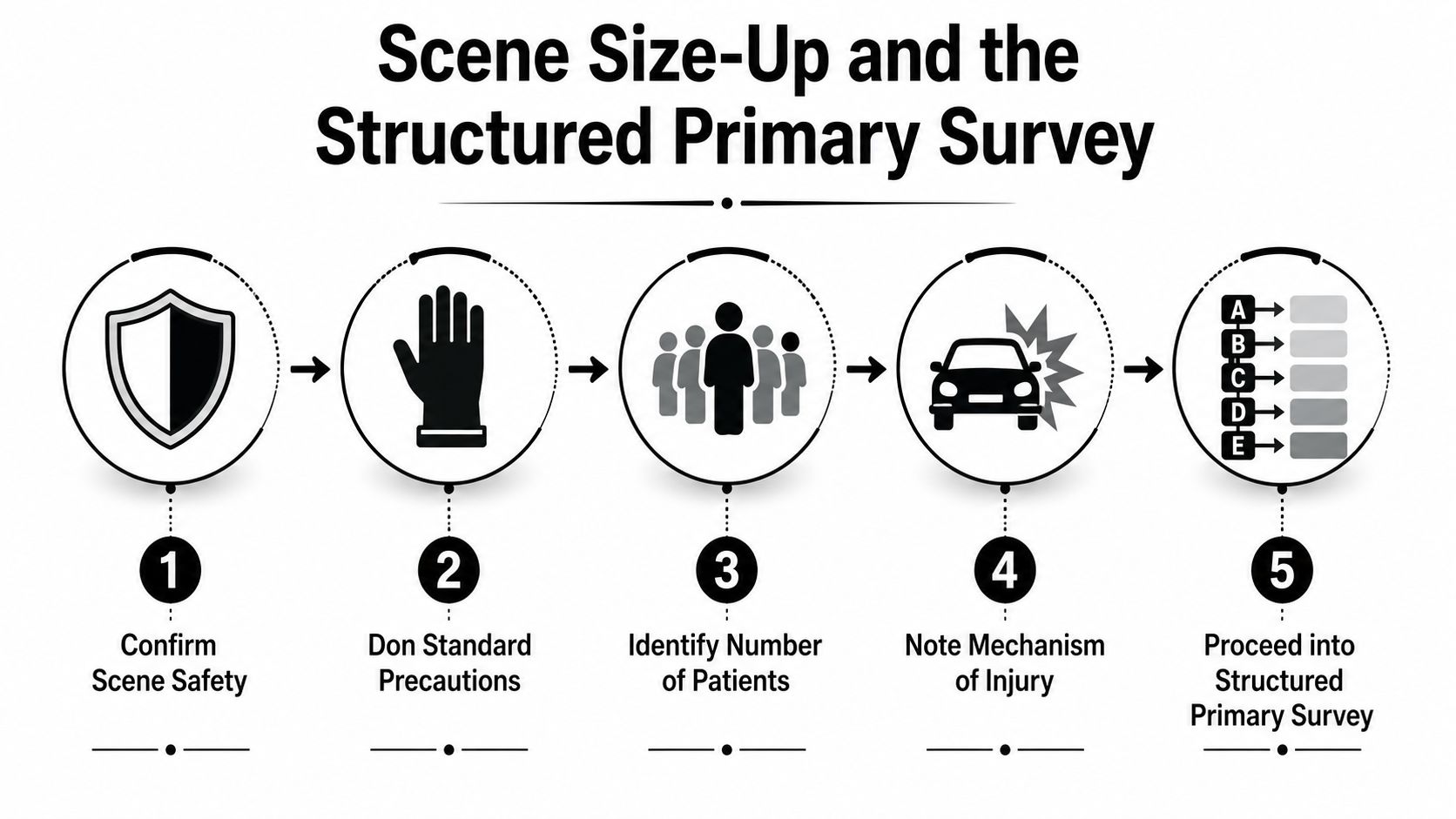
The EMT's first clinical move is a scene size-up, then a fast ABCDE primary survey. That order can look clinical and detached from the outside, but it is how the crew decides whether the patient needs immediate intervention, rapid transport, or both.
What the sequence looks like on scene
The first step is confirming scene safety. Then come standard precautions, a quick count of patients, a review of the crash mechanism, and then the structured primary survey. In plain language, the crew is asking, “Can I work here, how many people need help, what struck what, and which problem could kill this patient first?”
Onlookers often notice the crew checking the patient's head, chest, skin, breathing, and responsiveness in a fixed order. They may see a hand on the jaw, a glance for chest rise, a pulse check, or a shirt cut open to inspect for bleeding. That is the ABCDE approach in real time, Airway, Breathing, Circulation, Disability, Exposure.
Why the pause feels slower than it is
A bystander may think the crew is moving slowly past an injured driver. In reality, they are sorting problems by danger. A patient who looks alert can still be bleeding internally, and a patient with a small-looking external injury can still need urgent transport.
That is why crash crews do not stop at the vehicle. They look at the person. They assess airway patency, breathing adequacy, circulation, mental status, and hidden injury. Trauma education for MVCs emphasizes that patient physiology comes before scene fascination once hazards are controlled.
A collision can also create evidence that matters later. Scene findings, the patient's condition, and the vehicle's condition all help explain what happened before treatment changed the picture. That is one reason how frame damage affects value matters beyond repairs alone. Severe frame damage can support the story of force and transfer in the crash, which families and claimants often need to understand long after the sirens are gone.
What families should remember: the first organized assessment is usually the most important one, because it tells the crew who can wait, who cannot, and who needs immediate transport.
Scene Safety Beyond the Obvious Hazards
A crash scene isn't safe just because the cars have stopped moving. Secondary collisions, downed lines, leaking fuel, bystander crowding, and unstable vehicles can change the scene while EMTs are already working. That's why responders keep reassessing, not just doing one quick look from the shoulder of the road.
The practical difference between an inner-circle and outer-circle survey is simple. The inner circle is the immediate wreckage, the patient, the vehicle, glass, fluids, and anything touching the patient. The outer circle reaches farther out, to approaching traffic, traffic patterns, power poles, slope, debris field, and any person who was ejected or thrown away from the vehicle.
That outer circle matters more than people think. A patient who was ejected may be farther from the wreck than the eye first catches. A struck-away pedestrian or passenger can also be missed if everyone stares only at the crumpled car. Fire and rescue guidance emphasizes parking in a protective angle, avoiding blind approach paths, and treating scene safety as an active process, not a box to check once (Firehouse extrication considerations).
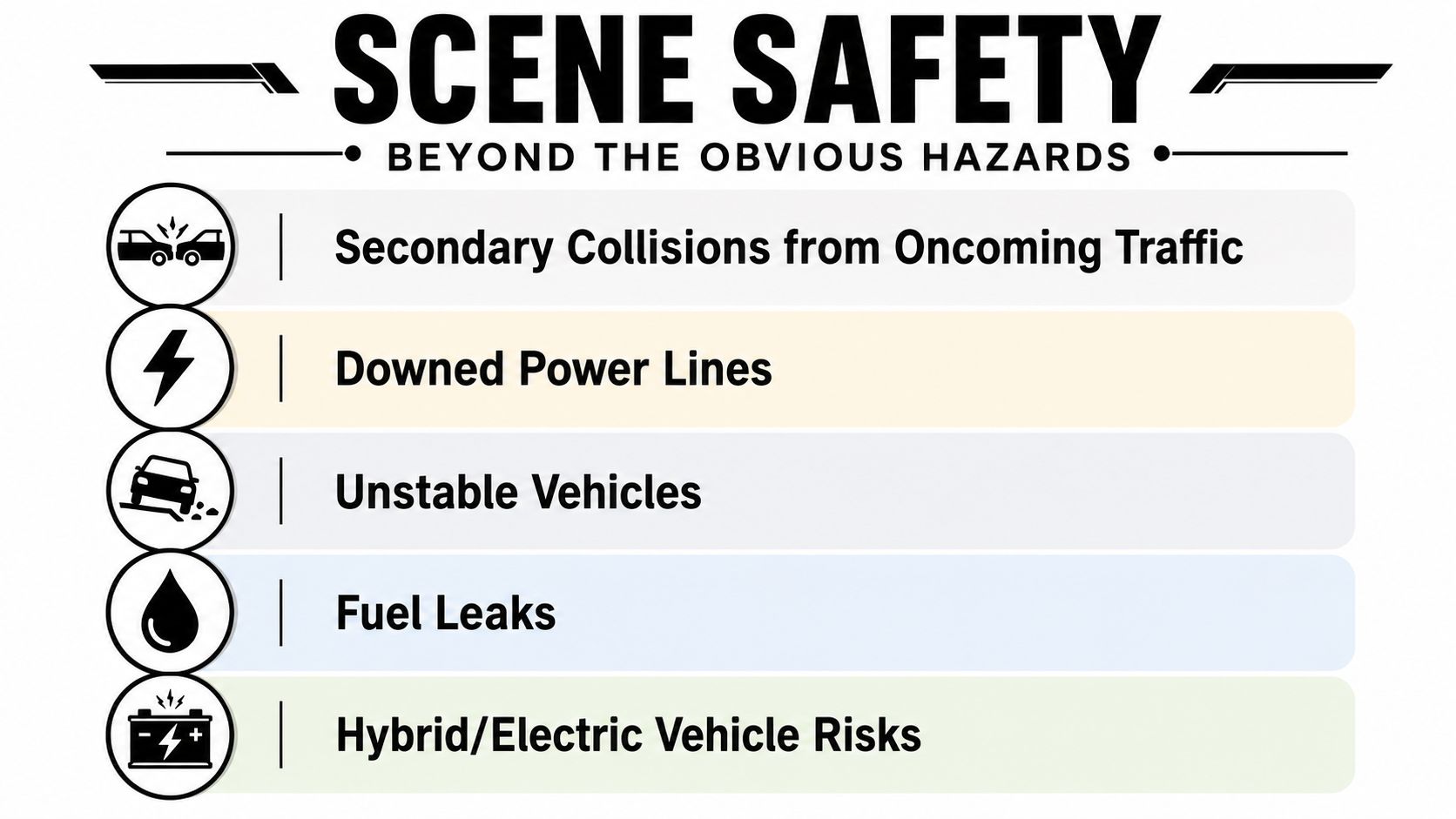
A person inside a damaged SUV may want to stand up, walk over to family, or accept a ride from a friend. EMTs often refuse that, not to be controlling, but because movement can worsen an unseen injury. The same logic applies when a vehicle is unstable, when traffic is too close, or when a hybrid system or other hazard hasn't been secured.
One practical example is a nighttime crash on a curved ramp. The wreck may look isolated, but the danger is the next driver who doesn't see the scene in time. Another is a rainstorm crash where the car slid off the road. The vehicle may look quiet, yet the slope, mud, and traffic conditions can make access dangerous for everyone.
The scene also affects later proof. Photos of tire tracks, vehicle resting position, deployed airbags, and the distance of debris can become vital if fault is disputed. That's one reason families should stay back unless directed otherwise. A crew asking people to move away is usually protecting both the patient and the integrity of the scene.
Airway, Breathing, Circulation, and Bleeding Control
The first minutes after arrival usually center on airway, breathing, circulation, and hemorrhage control. EMTs do not wait for a perfect diagnosis before acting on a blocked airway or major bleeding, because those problems can turn life-threatening fast.
The hands-on work families may see
If the airway looks threatened, EMTs may use a jaw-thrust maneuver, suction, oxygen, or assisted ventilation with a bag-valve mask. If the patient is breathing but poorly, they support breathing right away. If blood is pouring from a wound, they use direct pressure, wound packing, or a tourniquet for life-threatening extremity bleeding.
A bystander may only catch part of that work. A blanket gets cut away. Gloved hands press hard on a leg or arm. A mask appears. The patient may be turned just enough to clear the airway, then positioned again for transport. Each of those choices also shapes the record of what happened at the scene, which can matter later when families and claimants try to understand fault, injury severity, and whether the right care was given.
Trauma guidance for MVCs repeatedly prioritizes cervical spine precautions, oxygen support, assisted ventilation, and bleeding control before definitive transport (New York State trauma guidance). National EMS teaching for MVCs also places airway, breathing, pulse, and major bleeding at the top of the first check, with immediate transport when indicated.
What families should watch for later
If an EMT has already left, do not assume the danger is over just because the patient is awake. Worsening confusion, shortness of breath, expanding bruising, or new weakness can mean the injury is still changing. If you are later reading about head injury concerns, signs of TBI is worth reviewing, because concussion and more serious brain injury can look subtle at first.
A crash patient can look steady and still be unstable. Early airway and bleeding care is meant to keep the scene from becoming a second emergency on the way to the hospital.
Spinal Precautions, Extrication, Packaging, and Transport
A lot of people still picture every crash patient strapped to a rigid backboard. That's not how modern EMS works in every case. Today, crews focus much more on physiology, perfusion, airway, and hemorrhage control than on rigid immobilization alone, while still using spinal precautions when the situation calls for them.
How the transport decision gets made
If the patient is unstable, the answer is often load and go. If the patient needs urgent procedures but can't safely be treated in place, the crew moves quickly while continuing care en route. If the scene is complicated but the patient is not yet at immediate risk, the crew may coordinate with fire rescue for extrication before packaging and transport.
That's why you may hear terms like scene time or trauma activation. They aren't jargon for the crew's benefit. They're shorthand for how quickly the patient is being moved to a place that can handle the injury. Published trauma checklist guidance supports a rapid arrival check, ongoing monitoring, posterior examination, warming, and handoff without lingering on scene (Tennessee EMS protocol guidelines).
Common transport decisions at a motor vehicle crash
| On-Scene Finding | Typical EMT Decision | Why It Matters |
|---|---|---|
| Airway is blocked or breathing is poor | Clear the airway, assist ventilation, transport quickly | Oxygen delivery can fail fast |
| Severe external bleeding | Apply pressure, pack wound, use a tourniquet if needed | Hemorrhage can become fatal before arrival |
| Patient is trapped in the vehicle | Coordinate extrication while maintaining care | Safe removal preserves life and reduces added injury |
| Patient is alert but mechanism is high risk | Continue reassessment and consider rapid transport | Early normal signs can change later |
| Vehicle is unstable or scene is unsafe | Stage, reposition, or delay access until protected | Responder safety protects the patient too |
Families often ask why the patient wasn't just driven to the nearest hospital. The answer is usually that EMTs are balancing trauma needs, distance, and the resources available at the receiving facility. In some cases, they'll bypass a smaller hospital for a trauma center if the injuries suggest the patient needs higher-level care.
A crew may also choose air medical transport if time, distance, or severity makes that the safer route, though that decision depends on local protocols and scene conditions. Either way, the destination is part of the medical plan, not an afterthought.
Documentation and Evidence Preservation Families Rarely Notice
The patient care report can matter almost as much as the treatment itself. EMTs document the mechanism of injury, the patient's mental status, vital trends, what they saw, what they did, and how the patient changed from the street to the ambulance to the hospital door. Those notes often become part of the record that lawyers, insurers, and doctors later read.
A strong report may include the Glasgow Coma Scale, the time a tourniquet was applied, whether suction was needed, what bleeding was controlled, and whether the patient worsened during transport. Those details can either support the seriousness of the injuries or expose gaps if the case is later disputed.
That is why evidence preservation starts at the curb. If you can safely do it, write down the ambulance unit number, keep a note of the time EMS arrived, save witness names and phone numbers, and photograph the cars before anything is moved. The vehicle position, broken parts, airbags, skid marks, and visible injuries can all matter later.
The line between good documentation and bad evidence handling can get blurry fast. A family member who wanders into the scene, moves objects, or starts cleaning up can unintentionally erase facts that would've helped explain fault. For a deeper legal explanation of why preserving that information matters, what spoliation of evidence means is directly relevant.
Useful habit: if you're able to stand aside safely, collect names and unit numbers first, then let the scene stay untouched until authorities and EMS finish.
People also ask how to get the EMS report. In most cases, the report is part of the medical record and access depends on privacy rules and who has authority to request it. If you're handling the claim, ask the hospital, the EMS agency, and later a lawyer how to request the run report, because it can help explain what EMTs observed before the emergency department ever saw the patient.
One more caution matters here. Emergency personnel should never be photographed or recorded in ways that compromise patient dignity or invade privacy. The scene belongs to the patient, the responders, and the investigation, not to the crowd.
What Injured People and Families Should Do Next
The EMT's work doesn't stop at the ambulance door, and neither should your attention. What happens next in the emergency department often depends on what the crew reported, what the hospital hears about the crash, and how clearly the injuries are described in the first hours after arrival.
What to ask and what to save
Ask the hospital what injuries they're evaluating, what imaging they ordered, and whether they're concerned about head injury, spinal injury, internal bleeding, or delayed symptoms. Ask the EMS agency how to request the run report and what identification they need from you. Save discharge papers, medication lists, and follow-up instructions in one folder.
A few practical questions help later:
- What was the mechanism of injury? Make sure the treating team hears how the crash happened, not just the symptoms.
- What records should we request? Ask for the EMS run report, emergency room records, and imaging summaries.
- What symptoms should trigger a return visit? Get that answer in writing if possible.
- Who should we call next? Follow up with rehab, primary care, or specialists as directed.
Why this matters beyond medical care
The first records shape both treatment and compensation. If the emergency note downplays pain, or if the crash mechanics aren't documented accurately, insurance companies may use that against the claim later. Early legal guidance can help families preserve records, request the right documents, and avoid mistakes that make the injury case harder to prove.
Bottom line: good prehospital care protects the body first, but good documentation protects the story of what happened, and that story can affect recovery, accountability, and compensation.
If you're dealing with injuries after a crash, Nares Law Group LLC can help you understand the medical record, preserve key evidence, and organize the next steps after an ambulance transport. Visit Nares Law Group LLC to learn how the firm approaches motor vehicle crash cases, investigates what happened, and helps injured families move forward.