After a motor vehicle crash, you may look fine while feeling profoundly different. You forget conversations, lose track of familiar tasks, struggle to find words, or become overwhelmed by noise and ordinary decisions. Family members may notice irritability or impulsive behavior before you can explain what feels wrong. When a CT scan appears normal, an insurer may treat those problems as unrelated, temporary, or exaggerated.
Cortical brain damage offers a way to understand how an injury can affect thinking, movement, language, memory, vision, and behavior without an obvious wound. It also gives a personal injury claim a more precise medical story. The location and mechanism of the injury can help explain why daily life changed, while careful records can connect those changes to medical expenses, lost income, future care, and loss of independence. If your symptoms seem invisible to others, this resource on brain injuries that hide in plain sight may help you recognize why documentation matters.
An Invisible Injury with Life-Altering Impact
A week after a collision, you might tell a doctor, “I'm just tired.” Later, you may miss appointments, reread simple emails, lose patience with your spouse, or need help managing finances. Cortical injury often appears through a pattern of small disruptions rather than a dramatic physical sign. Over time, those changes can affect employment, relationships, confidence, and independence.
The frustration can be difficult to explain. You may still know how to perform a familiar job, yet the steps no longer stay organized in your mind. You may understand another person's words but need more time to answer. You may remember the crash clearly while struggling to retain new information. A normal-looking scan can add to the confusion, especially when others assume it proves that your brain is functioning normally.
Why “I look fine” proves very little
The cerebral cortex supports interconnected networks, not one isolated ability. An injury can affect planning, language, emotional regulation, sensory processing, or memory while leaving consciousness and basic conversation intact. Recent research describes function-specific cognitive decline, including hidden deficits that clinicians may miss without testing particular cognitive domains (UCL research on cortical lesions and cognitive decline).
Practical rule: Describe what changed in ordinary life, not only what a scan shows.
For a personal injury claim, “brain injury” identifies the problem but does not fully prove its consequences. The evidence must connect the injury to your actual capacity. Can you complete a full shift, supervise children, drive safely, prepare meals, manage medication, or take part in family decisions? Answers may change as symptoms develop or recovery progresses, so timely medical care and consistent records help establish both the health impact and the legal claim.
A claim does not depend on you explaining everything alone. Medical professionals can assess symptoms, attorneys can organize records, and family members can document changes you may not recognize. Keep notes about specific incidents, assistance you need, and tasks that now take longer. If others dismiss an injury because you look well, this guide to recognizing a brain injury that hides in plain sight explains why careful documentation matters. Your daily experience is evidence worthy of investigation, not a personal failure.
What Exactly Is Cortical Brain Damage
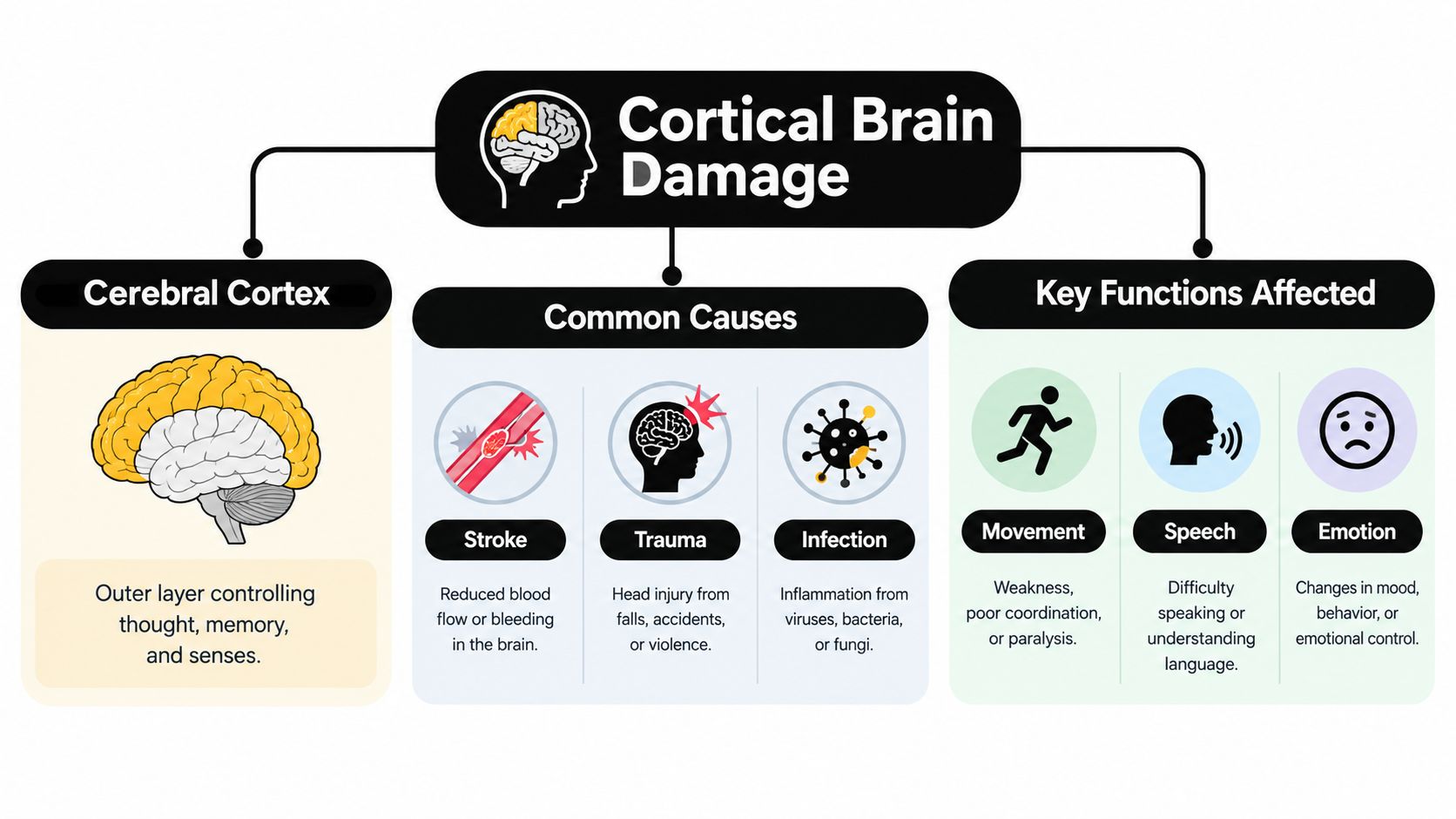
The cerebral cortex is the brain's outer layer and one of its main processing systems. Think of the brain as a command center with interconnected departments. The cortex helps interpret sensory information, support movement, organize language, store and retrieve memories, guide judgment, and shape behavior. Those departments communicate constantly, so damage in one area can affect tasks that seem unrelated.
Cortical brain damage means that injury has affected cortical tissue or the networks connected to it. The damage may involve bruising, bleeding, loss of tissue, or disruption of delicate nerve pathways. It may be focal, affecting a defined region, or diffuse, affecting connections across broader areas. The visible injury and the functional injury don't always match.
A historic lesson from Phineas Gage
Phineas Gage's 1848 injury became a foundational case in neuroscience because frontal-lobe destruction was associated with changes in personality and behavior. A later analysis estimated that the iron rod destroyed approximately 11% of the white matter in Gage's frontal lobe and about 4% of his cerebral cortex (historical analysis of Phineas Gage's injury).
The lesson isn't that every brain injury produces a dramatic personality change. It's that location matters. A frontal injury may interfere with inhibition or planning. A temporal injury may affect memory or language comprehension. A visual-cortex injury may alter what a person can see. Two people can experience different symptoms after accidents that appear similar from the outside.
Why clinical context matters
Medical terminology can be difficult to interpret after an accident. A neurosurgical evaluation may involve imaging, neurological examination, and decisions about whether pressure, bleeding, or structural damage requires intervention. A plain-language overview of how neurosurgery works can help families prepare questions, although it can't replace advice from the treating team.
A diagnosis should connect three pieces: what happened, what changed, and what objective testing shows. That connection becomes important medically and legally because symptoms alone may be dismissed, while a scan alone may not capture the full functional impact.
How Accidents Cause Cortical Injuries
A crash can injure the brain through several different physical mechanisms. The head doesn't have to strike a hard surface for the cortex to suffer harm. Sudden acceleration, deceleration, and rotation can move the brain inside the skull, creating stress that disrupts tissue and neural connections.
A direct impact can produce a focal injury. For example, the head may strike a window, steering wheel, dashboard, or another object. The force can bruise the cortex beneath the impact site. Bleeding or swelling may then interfere with nearby brain functions, depending on the area involved.
The brain can move even when the skull stops
During rapid deceleration, the skull may stop while the brain continues moving briefly within it. The brain can strike the inside of the skull at the initial impact site and then move toward the opposite side, a pattern commonly described as coup-contrecoup injury. This motion can create more than one area of tissue stress.
Rotation creates another risk. In diffuse traumatic brain injury, nerve fibers can shear at the gray matter and white matter junction, even when focal lesions aren't visible. Researchers link this process to reduced cortical thickness and loss of neuronal connectivity (research on diffuse traumatic brain injury and cortical damage).
Medical significance: A normal-looking first scan doesn't automatically rule out a meaningful brain injury.
Why crash details belong in the medical record
The direction of impact, vehicle deformation, airbag deployment, loss of consciousness, amnesia, and immediate symptoms can help clinicians understand the forces involved. So can delayed symptoms. Headache, confusion, slowed processing, nausea, light sensitivity, balance problems, or unusual behavior may emerge after the emergency phase.
Treatment should come from qualified medical professionals who evaluate your individual condition. If you're looking for general information about post-crash evaluation in Utah, you can review car accident treatment in Salt Lake City, but Colorado accident victims should follow the advice of their own treating providers.
For a legal claim, preserve crash evidence alongside medical evidence. Vehicle photographs, event data when available, witness accounts, emergency records, and symptom descriptions can help establish how the collision occurred and why the resulting injury deserves more than a superficial review.
Mapping Symptoms to Damaged Brain Regions
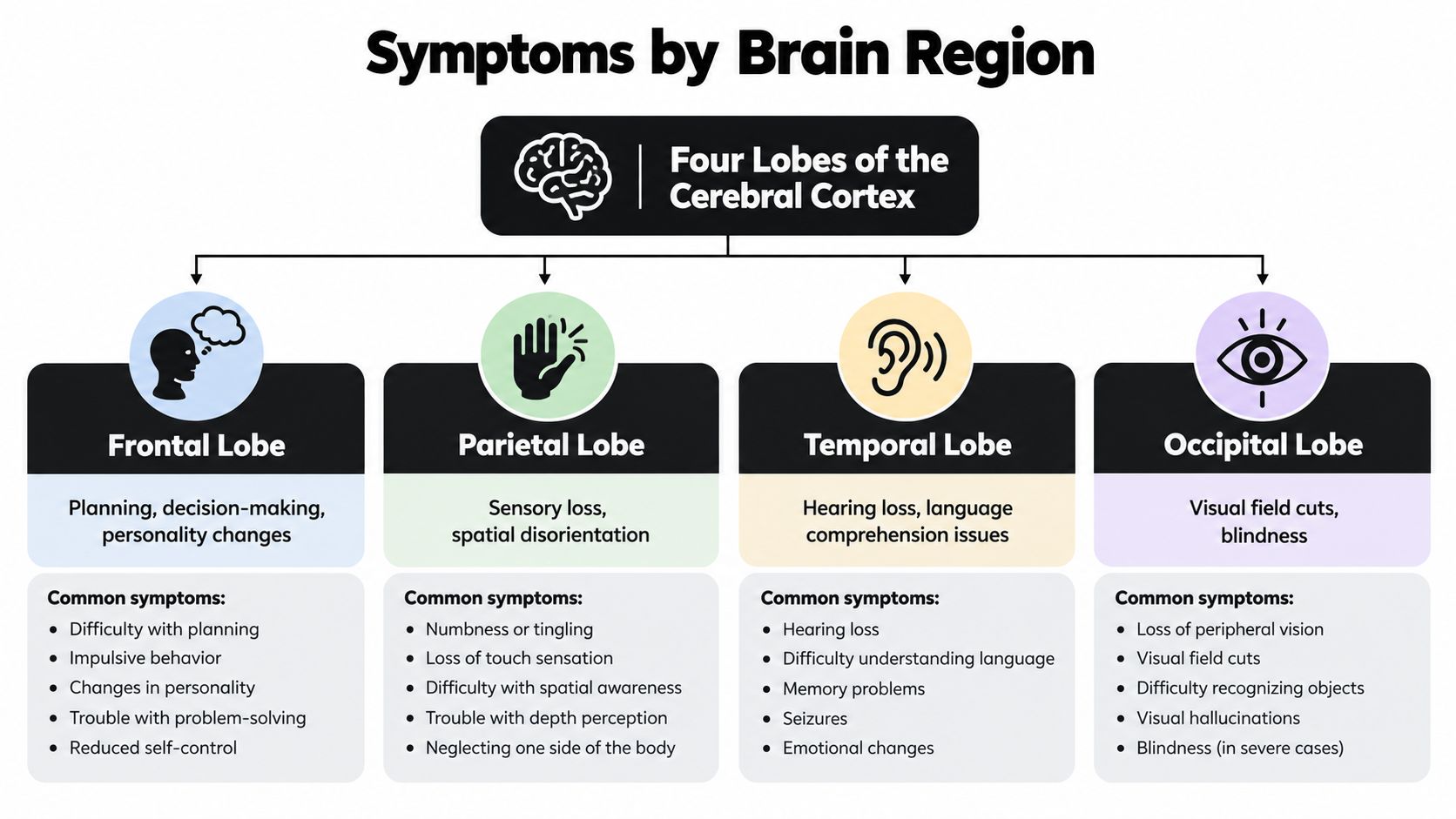
The cortex works as an interconnected system, not as four isolated boxes. Still, the four-lobe model gives families and legal teams a practical map for connecting symptoms to affected functions. One injury can involve several connected networks, so overlapping problems are common.
Frontal lobe
The frontal lobe supports planning, judgment, attention, voluntary movement, inhibition, personality, and behavior. Injury may cause disorganization, impulsive decisions, reduced initiative, emotional outbursts, difficulty changing tasks, or trouble understanding consequences.
These symptoms can be mistaken for unwillingness or poor effort. A person who once managed a household may now need reminders for bills, appointments, or ordinary sequences of tasks. In a personal injury claim, records should connect those changes to specific limits in daily life, work, and decision-making.
Parietal lobe
The parietal lobe processes touch and body position and contributes to spatial awareness. Injury may alter sensation, distance judgment, object recognition by touch, or orientation in familiar places.
A worker may understand a job in theory but misjudge a tool's location or struggle to coordinate movements safely. Observations from supervisors, family members, and rehabilitation providers can show why the person cannot reliably perform the same duties, even when motivation remains strong.
Temporal lobe
The temporal lobe contributes to hearing, memory, and language comprehension. Damage may make it difficult to retain new information, follow conversations, recognize familiar sounds, or understand spoken instructions.
Someone may speak fluently yet miss the meaning of a question. A short office conversation may not expose the problem, while a busy workplace meeting can reveal it quickly. That difference matters when evaluating job performance and future support needs.
Occipital lobe
The occipital lobe processes visual information. Injury can affect visual fields, visual recognition, or interpretation of what the eyes receive. A person may miss objects on one side, struggle to read, or have difficulty moving safely through familiar spaces.
The key legal and medical issue is function over label. Consciousness may remain relatively intact while cognition, language, or executive control becomes substantially harder. A neuropsychological evaluation can examine those abilities directly rather than relying on casual conversation. The results can then be compared with pre-injury responsibilities, present limitations, and the assistance needed over time.
The Process for Diagnosis and Prognosis
Diagnosis usually begins with the accident history, neurological examination, and emergency imaging. CT scans can help clinicians identify urgent bleeding, fractures, swelling, or other structural problems. MRI may reveal details that CT doesn't show, while specialized imaging and neuropsychological testing can examine how the brain performs.
A functional problem may exist even when conventional imaging appears unimpressive. Neuropsychological testing can assess attention, processing speed, memory, language, reasoning, emotional control, and executive function through structured tasks. Those results can show how symptoms interfere with work and daily activities.
Prognosis requires more than one appointment
Recovery depends on the injury, the affected networks, treatment, health, support, and time. Some people improve substantially, while others need continuing assistance or adaptations. The goal isn't to promise a particular outcome. It's to identify the person's current abilities, monitor change, and plan for needs that may persist.
In moderate-to-severe TBI, a major review reported brain tissue loss on the order of 5% per year, with reported loss ranging from 4.0% to 8.5% within one year of injury. The same review reported average chronic-phase gray-matter atrophy of 1.55% (review of brain volume changes after TBI). These findings don't predict one individual's future, but they explain why long-term follow-up can matter.
Families often need practical guidance for supervision, memory support, routines, and safety. Resources about caring for a parent with memory loss may offer general caregiving ideas, even when the cause of memory problems is traumatic injury rather than aging.
Keep copies of evaluations and ask providers to explain what each result means functionally. A guide to neurological tests for brain damage can also help you prepare for conversations with clinicians and attorneys.
Turning Medical Evidence into a Legal Case
A medical diagnosis becomes persuasive legal evidence when it explains the consequences of the injury. An attorney must show more than an abnormal image or a list of symptoms. The case should connect the crash to the injury, the injured network to the functional limitation, and the limitation to a measurable loss in the person's life.

Building the medical narrative
Medical records may include emergency notes, imaging reports, specialist examinations, therapy records, medication changes, and neuropsychological testing. The legal team reviews those materials for timing, consistency, prior functioning, treatment needs, and changes documented by people who know you.
Experts may serve different purposes. A neurologist or neuropsychologist can explain the injury and symptoms. A rehabilitation professional can address treatment and functional limitations. A vocational specialist can evaluate work capacity, retraining needs, and restrictions. A life care planner can organize anticipated medical, therapeutic, equipment, and support needs when the injury requires long-term services.
A useful legal question is: “What can this person no longer do safely, consistently, or independently?”
That question turns abstract deficits into evidence. Difficulty with executive control may explain missed deadlines or unsafe multitasking. Language-processing problems may affect customer conversations. Memory impairment may require supervision, written prompts, or repeated instruction. Fatigue and slowed processing may make a former full-time schedule unrealistic even when strength appears normal.
The legal team also compares life before and after the crash. Employment records, performance history, family observations, school records, calendars, and financial documents can establish the baseline. The objective isn't to exaggerate harm. It's to prevent an insurer from treating invisible limitations as insignificant.
A clear explanation of the legal and medical relationship can help families understand the work involved:
Compensation may involve past and future medical care, lost wages, reduced earning capacity, household assistance, pain, emotional suffering, and diminished quality of life. The available categories depend on the facts and governing law, so early legal advice matters.
How to Document Long-Term Effects for Full Compensation
Your daily records can fill the gap between a short clinical visit and the rest of your life. Start with a symptom journal that records headaches, fatigue, memory lapses, confusion, sensory overload, sleep disruption, mood changes, and the task that triggered each problem. Write what happened, what help you needed, and how long it affected you.
Avoid turning the journal into a medical opinion. Use concrete observations. “I read the same paragraph repeatedly and couldn't summarize it” is more useful than “my brain felt bad.” Include missed work, reduced hours, canceled plans, driving limitations, and tasks that now require assistance.
Build evidence from several viewpoints
Ask trusted family members, friends, coworkers, and supervisors to record changes they personally observed. They should describe specific events rather than diagnose you. A spouse might document forgotten conversations or unsafe household decisions. A supervisor might describe slower work, repeated instructions, or changed interactions with coworkers.
Preserve the records that show both injury and effort:
- Medical records: Keep emergency, primary-care, specialist, imaging, therapy, medication, and neuropsychological documents.
- Employment evidence: Save pay records, schedules, leave notices, performance communications, job restrictions, and documentation of reduced duties.
- Daily-life examples: Record help with transportation, cooking, shopping, childcare, medication, finances, and personal safety.
- Treatment consistency: Attend recommended appointments when possible and explain barriers if you can't. Missed care can be misunderstood unless the reason is documented.
- Communication records: Save messages with providers, employers, insurers, and family members that describe symptoms or limitations.
Longitudinal evidence matters because cortical changes and functional outcomes may evolve. One imaging study found significant cortical thinning over six months in 75% of the left hemisphere and 71% of the right hemisphere after moderate-to-severe TBI, with worse outcomes associated with more initial atrophy and greater thinning over time (longitudinal imaging study of cortical thinning after TBI). That finding doesn't establish what will happen to you, but it supports continued monitoring rather than treating an early snapshot as the final answer.
A life care plan can organize projected services and support needs. Learn more about what life care planning involves and ask your attorney whether this type of analysis fits your case. Nares Law Group LLC can help accident victims organize medical evidence, symptom timelines, work losses, and long-term consequences while communicating with insurers. Visit Nares Law Group LLC to request a case review and discuss the next steps for protecting your claim.